
Chapter 3 The Internal Environment Resources Capabilities and
Chapter 3 The Internal Environment: Resources, Capabilities and Core Competencies Michael A. Hitt R. Duane Ireland Robert E. Hoskisson © 2000 South-Western College Publishing Ch 3 -1
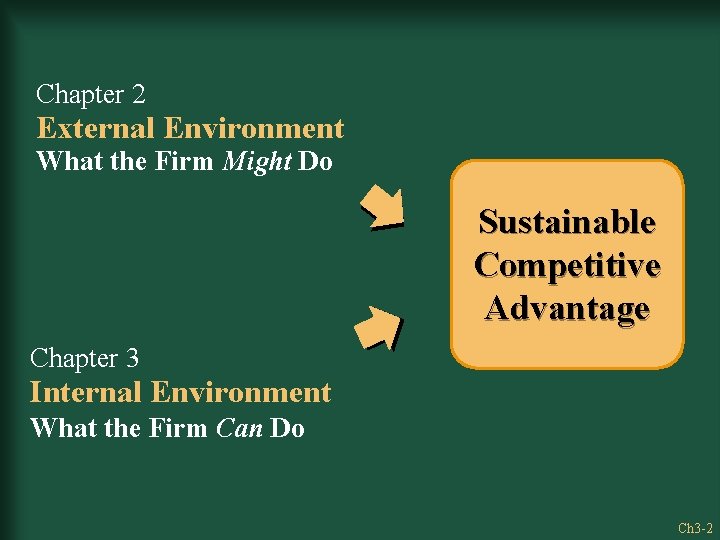
Chapter 2 External Environment What the Firm Might Do Sustainable Competitive Advantage Chapter 3 Internal Environment What the Firm Can Do Ch 3 -2
SWOT Analysis • • Strengths Weaknesses Opportunities Threats Ch 3 -3
The purpose of SWOT Analysis • It is an easy-to-use tool for developing an overview of a company’s strategic situation – It forms a basis for matching your company’s strategy to its situation Ch 3 -4
Strengths • A STRENGTH is something a company is good at doing or a characteristic that gives it an important capability. • Possible Strengths: – Name recognition – Proprietary technology – Cost advantages – Skilled employees – Loyal Customers Ch 3 -5
Weaknesses • A WEAKNESS is something a company lacks or does poorly (in comparison to others) or a condition that places it at a disadvantage • Possible Weaknesses: – Poor market image – Obsolete facilities – Internal operating problems – Poor marketing skills Ch 3 -6
Strengths and Weakness form a basis for INTERNAL analysis • By examining strengths, you can discover untapped potential or identify distinct competencies that helped you succeed in the past. • By examining weaknesses, you can identify gaps in performance, vulnerabilities, and erroneous assumptions about existing strategies. Ch 3 -7
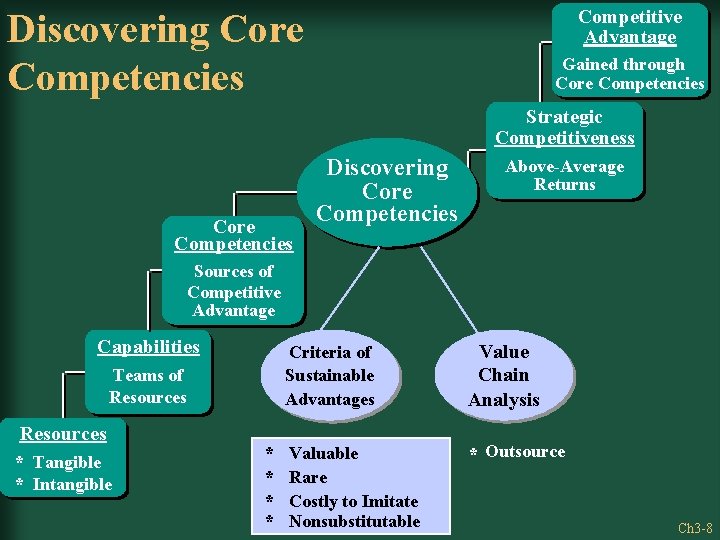
Competitive Advantage Discovering Core Competencies Gained through Core Competencies Strategic Competitiveness Core Competencies Discovering Core Competencies Above-Average Returns Sources of Competitive Advantage Capabilities Teams of Resources * Tangible * Intangible * * Criteria of Sustainable Advantages Value Chain Analysis Valuable Rare Costly to Imitate Nonsubstitutable * Outsource Ch 3 -8
Key Questions for Managers in Internal Analysis How do we assemble bundles of Resources, Capabilities and Core Competencies to create VALUE for customers? And. . . Will environmental changes make our core competencies obsolete? Are substitutes available for our core competencies? Are our core competencies easily imitated? Ch 3 -9
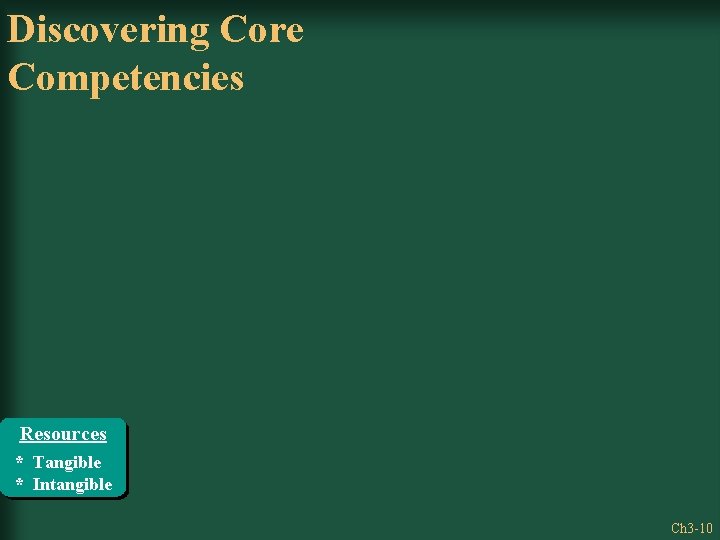
Discovering Core Competencies Resources * Tangible * Intangible Ch 3 -10
Resources What a firm Has. . . What a firm has to work with: its assets, including its people and the value of its brand name Ch 3 -11
Resources What a firm Has. . . What a firm has to work with: its assets, including its people and the value of its brand name Resources represent inputs into a firm’s production process. . . such as capital equipment, skills of employees, brand names, finances and talented managers Ch 3 -12
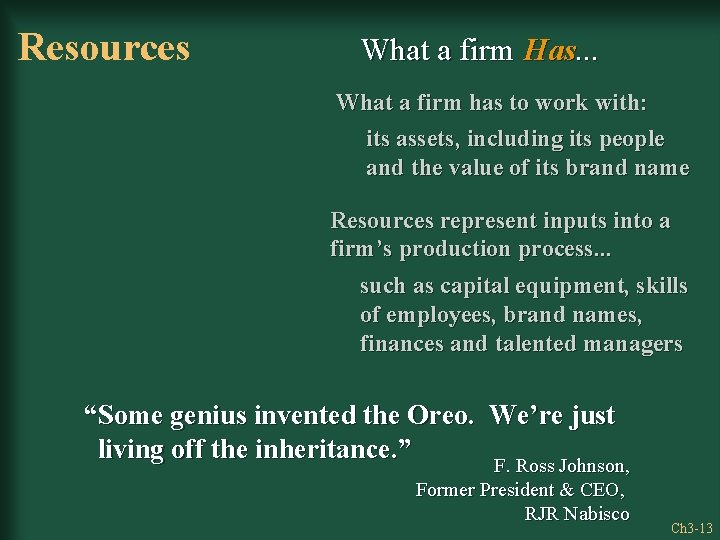
Resources What a firm Has. . . What a firm has to work with: its assets, including its people and the value of its brand name Resources represent inputs into a firm’s production process. . . such as capital equipment, skills of employees, brand names, finances and talented managers “Some genius invented the Oreo. We’re just living off the inheritance. ” F. Ross Johnson, Former President & CEO, RJR Nabisco Ch 3 -13
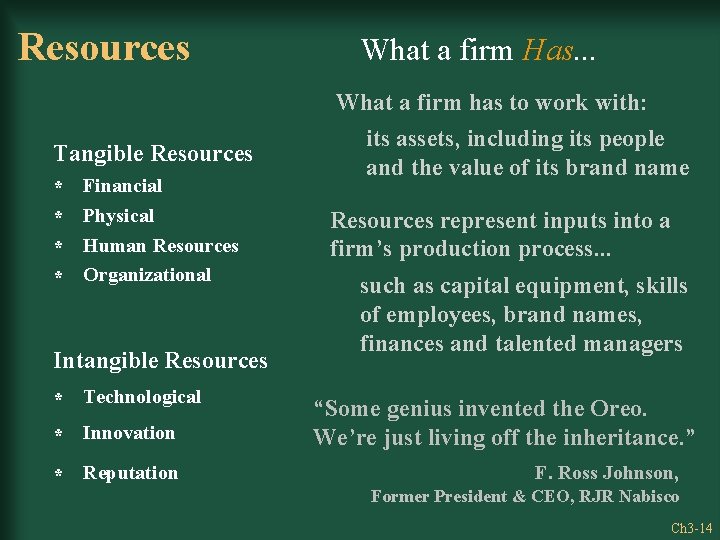
Resources Tangible Resources * * Financial Physical Human Resources Organizational Intangible Resources * Technological * Innovation * Reputation What a firm Has. . . What a firm has to work with: its assets, including its people and the value of its brand name Resources represent inputs into a firm’s production process. . . such as capital equipment, skills of employees, brand names, finances and talented managers “Some genius invented the Oreo. We’re just living off the inheritance. ” F. Ross Johnson, Former President & CEO, RJR Nabisco Ch 3 -14
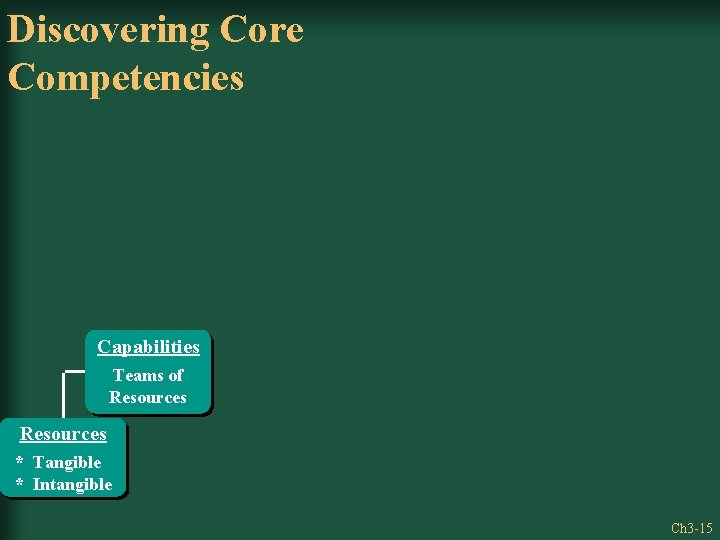
Discovering Core Competencies Capabilities Teams of Resources * Tangible * Intangible Ch 3 -15
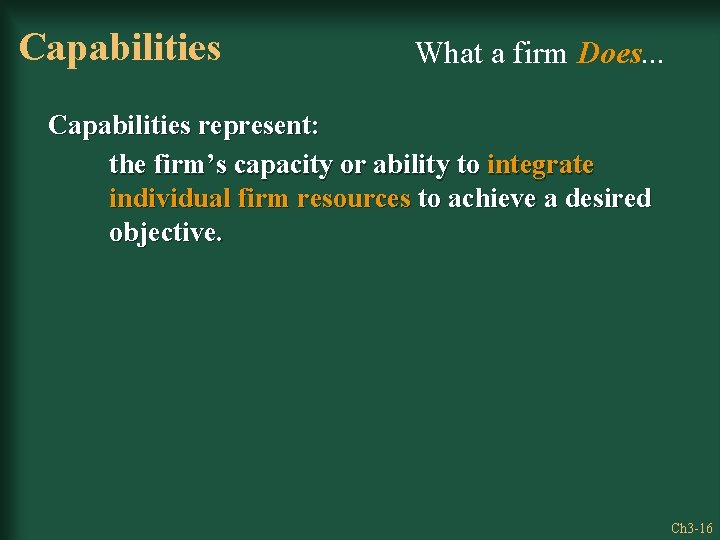
Capabilities What a firm Does. . . Capabilities represent: the firm’s capacity or ability to integrate individual firm resources to achieve a desired objective. Ch 3 -16
Capabilities What a firm Does. . . Capabilities represent: the firm’s capacity or ability to integrate individual firm resources to achieve a desired objective. Capabilities develop over time as a result of complex interactions that take advantage of the interrelationships between a firm’s tangible and intangible resources that are based on the development, transmission and exchange or sharing of information and knowledge as carried out by the firm's employees. Ch 3 -17
Capabilities What a firm Does. . . Capabilities represent: the firm’s capacity or ability to integrate individual firm resources to achieve a desired objective. Capabilities develop over time as a result of complex interactions that take advantage of the interrelationships between a firm’s tangible and intangible resources that are based on the development, transmission and exchange or sharing of information and knowledge as carried out by the firm's employees. Capabilities become important when they are combined in unique combinations which create core competencies which have strategic value and can lead to competitive advantage. Ch 3 -18
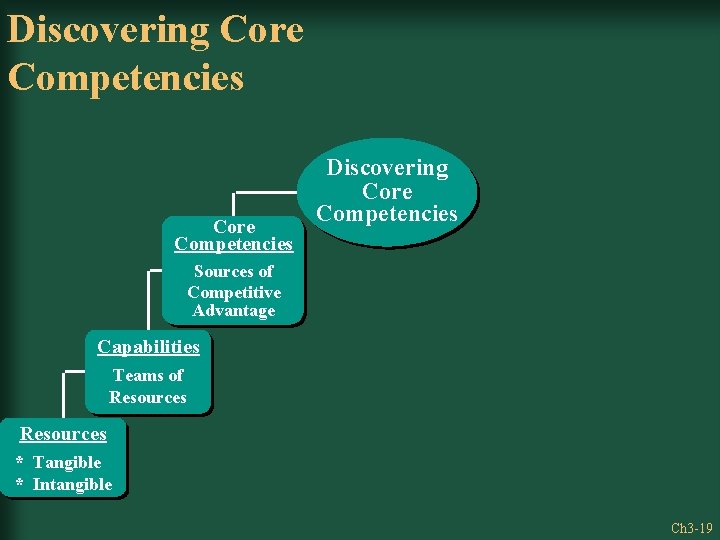
Discovering Core Competencies Sources of Competitive Advantage Capabilities Teams of Resources * Tangible * Intangible Ch 3 -19
Core Competencies What a firm Does. . . that is Strategically Valuable “…are the essence of what makes an organization unique in its ability to provide value to customers. ” Leonard-Barton, Bowen, Clark, Holloway & Wheelwright Mc. Kinsey & Co. recommends identifying three to four competencies to use in framing strategic actions. Ch 3 -20
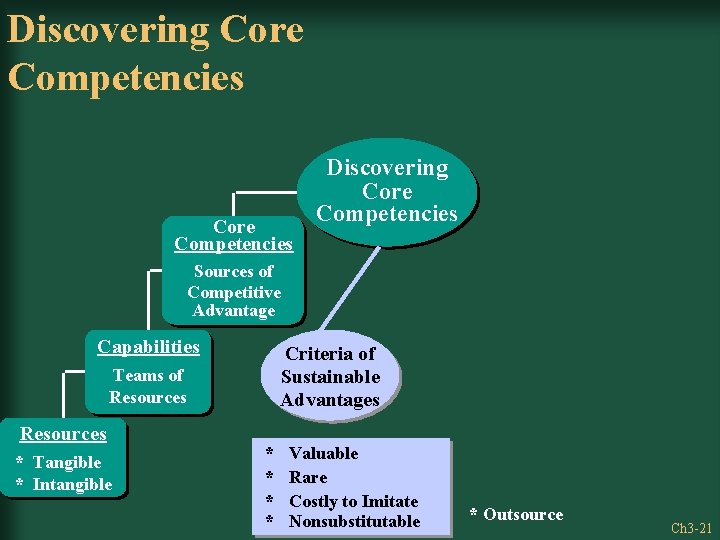
Discovering Core Competencies Sources of Competitive Advantage Capabilities Criteria of Sustainable Advantages Teams of Resources * Tangible * Intangible * * Valuable Rare Costly to Imitate Nonsubstitutable * Outsource Ch 3 -21
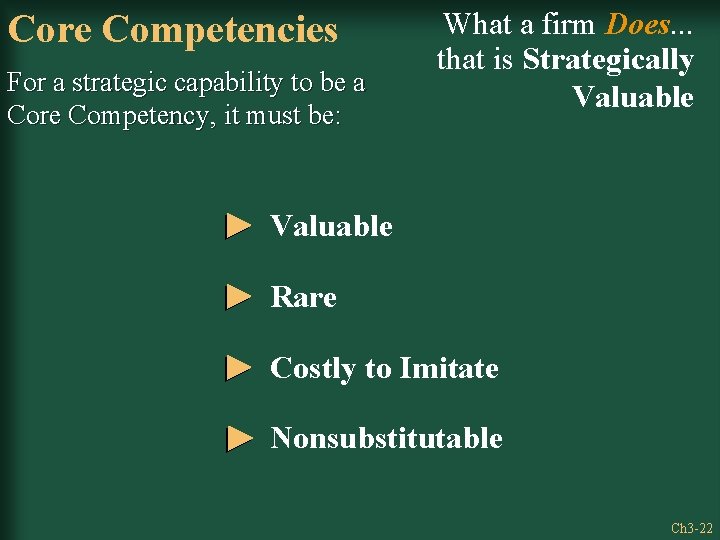
Core Competencies For a strategic capability to be a Core Competency, it must be: What a firm Does. . . that is Strategically Valuable Rare Costly to Imitate Nonsubstitutable Ch 3 -22
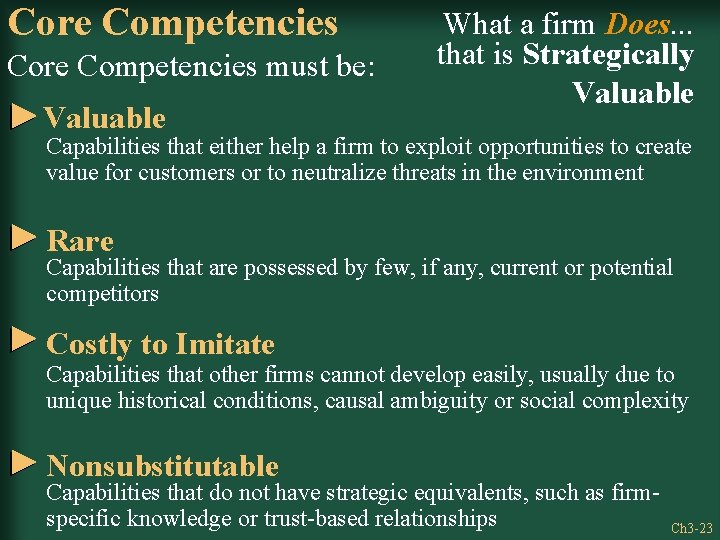
Core Competencies must be: Valuable What a firm Does. . . that is Strategically Valuable Capabilities that either help a firm to exploit opportunities to create value for customers or to neutralize threats in the environment Rare Capabilities that are possessed by few, if any, current or potential competitors Costly to Imitate Capabilities that other firms cannot develop easily, usually due to unique historical conditions, causal ambiguity or social complexity Nonsubstitutable Capabilities that do not have strategic equivalents, such as firmspecific knowledge or trust-based relationships Ch 3 -23
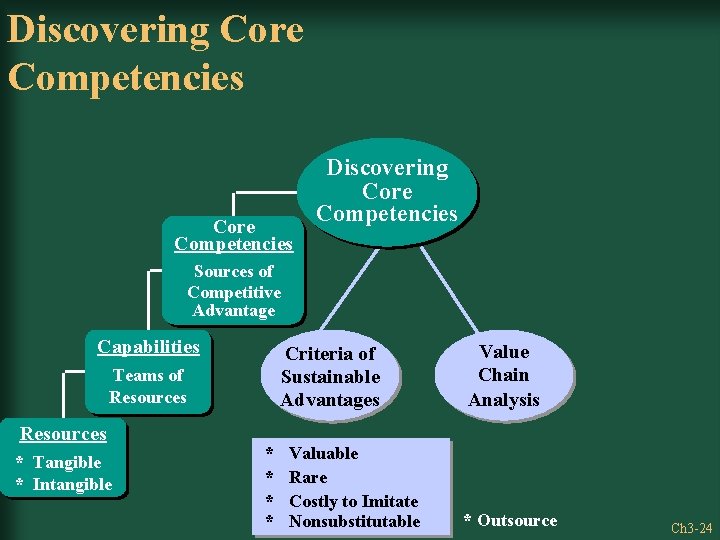
Discovering Core Competencies Sources of Competitive Advantage Capabilities Criteria of Sustainable Advantages Teams of Resources * Tangible * Intangible * * Valuable Rare Costly to Imitate Nonsubstitutable Value Chain Analysis * Outsource Ch 3 -24
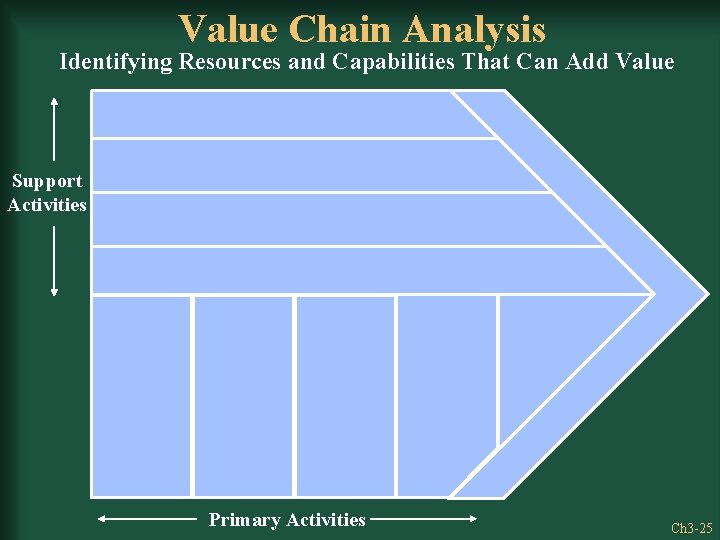
Value Chain Analysis Identifying Resources and Capabilities That Can Add Value Support Activities Primary Activities Ch 3 -25
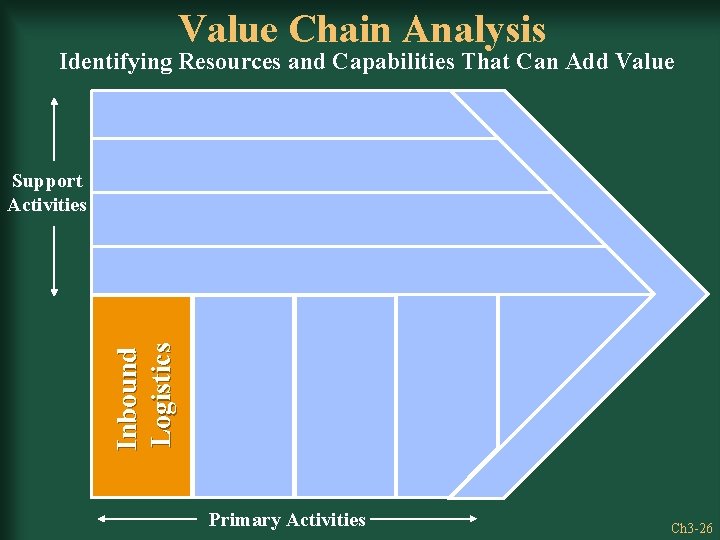
Value Chain Analysis Identifying Resources and Capabilities That Can Add Value Inbound Logistics Support Activities Primary Activities Ch 3 -26
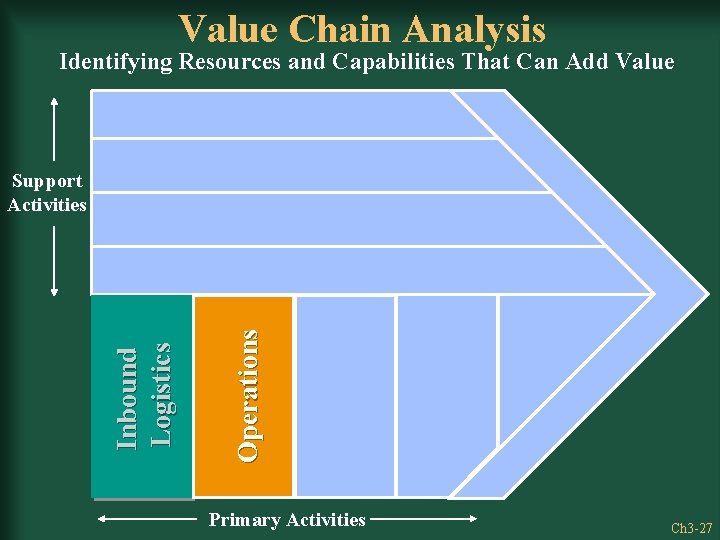
Value Chain Analysis Identifying Resources and Capabilities That Can Add Value Operations Inbound Logistics Support Activities Primary Activities Ch 3 -27
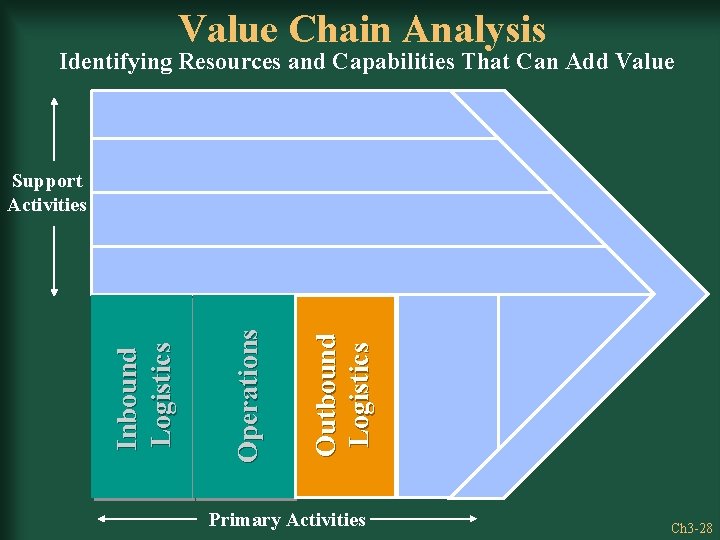
Value Chain Analysis Identifying Resources and Capabilities That Can Add Value Outbound Logistics Operations Inbound Logistics Support Activities Primary Activities Ch 3 -28
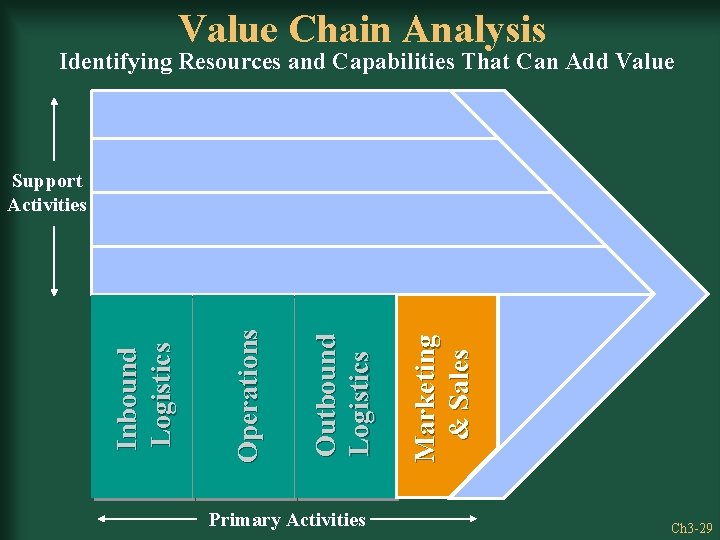
Value Chain Analysis Identifying Resources and Capabilities That Can Add Value Primary Activities Marketing & Sales Outbound Logistics Operations Inbound Logistics Support Activities Ch 3 -29
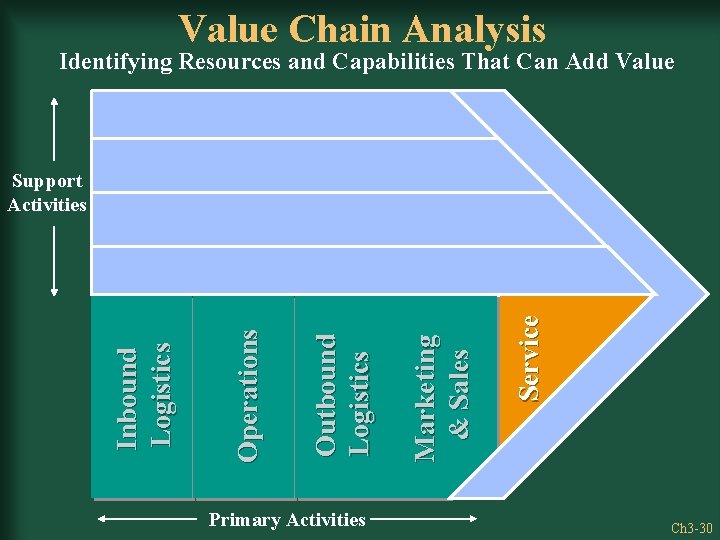
Value Chain Analysis Identifying Resources and Capabilities That Can Add Value Primary Activities Service Marketing & Sales Outbound Logistics Operations Inbound Logistics Support Activities Ch 3 -30
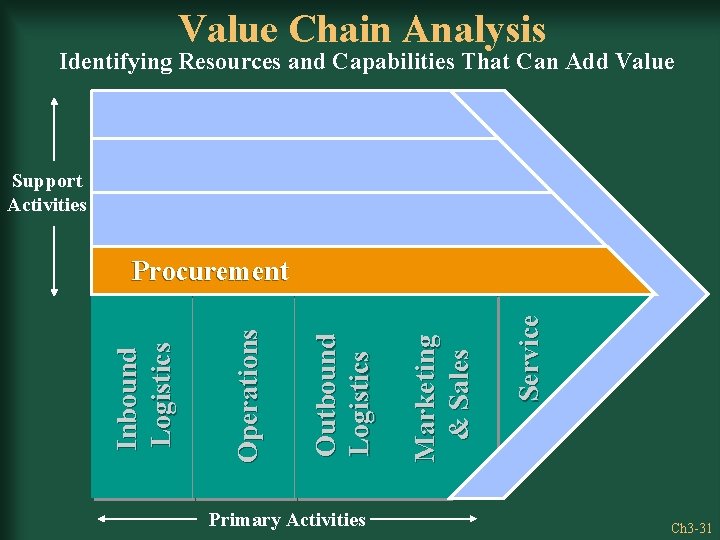
Value Chain Analysis Identifying Resources and Capabilities That Can Add Value Support Activities Primary Activities Service Marketing & Sales Outbound Logistics Operations Inbound Logistics Procurement Ch 3 -31
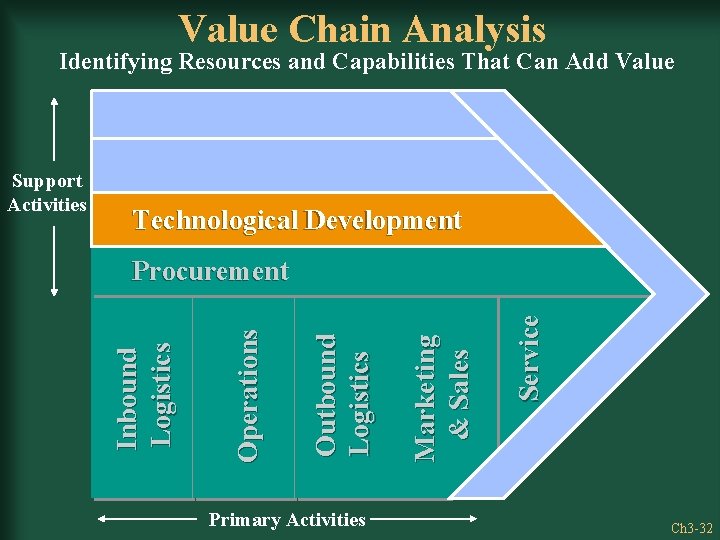
Value Chain Analysis Identifying Resources and Capabilities That Can Add Value Technological Development Primary Activities Service Marketing & Sales Outbound Logistics Operations Procurement Inbound Logistics Support Activities Ch 3 -32
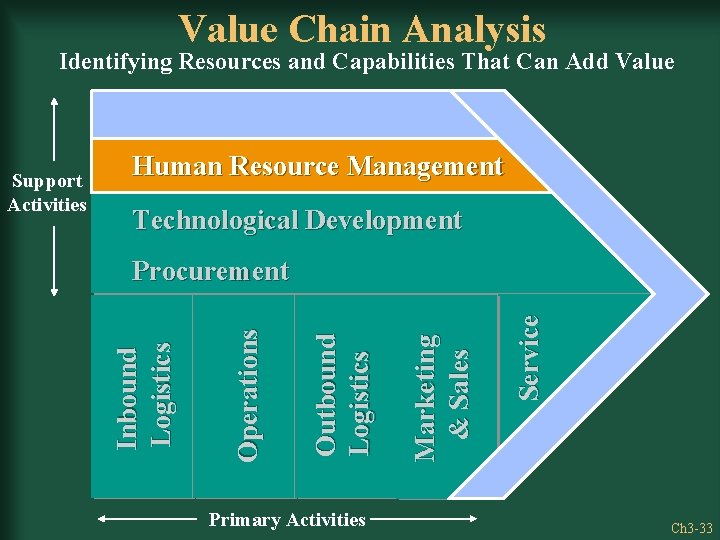
Value Chain Analysis Identifying Resources and Capabilities That Can Add Value Human Resource Management Technological Development Primary Activities Service Marketing & Sales Outbound Logistics Operations Procurement Inbound Logistics Support Activities Ch 3 -33
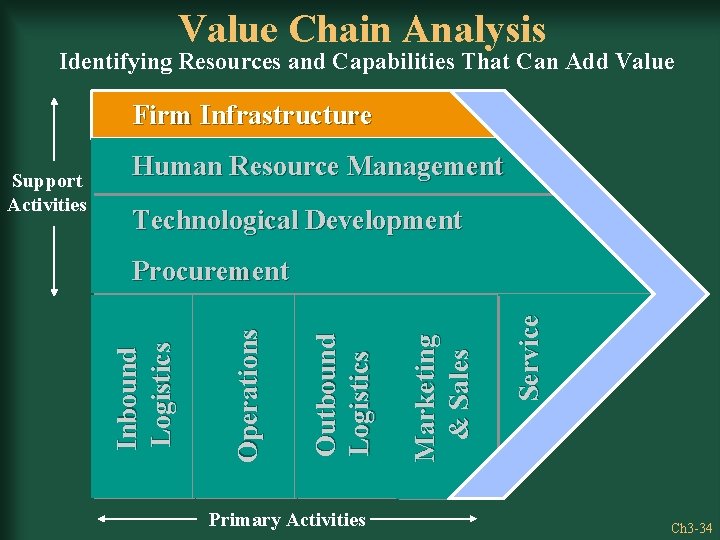
Value Chain Analysis Identifying Resources and Capabilities That Can Add Value Firm Infrastructure Human Resource Management Technological Development Primary Activities Service Marketing & Sales Outbound Logistics Operations Procurement Inbound Logistics Support Activities Ch 3 -34
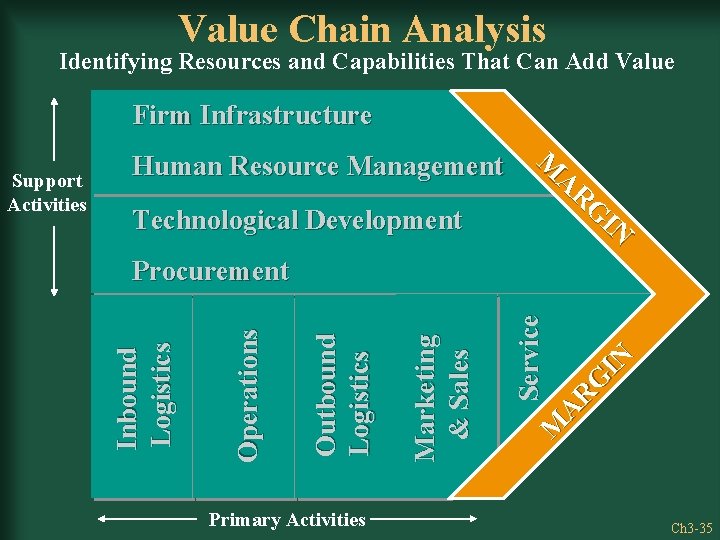
Value Chain Analysis Identifying Resources and Capabilities That Can Add Value Firm Infrastructure Technological Development M A R G IN Primary Activities M Service A R G IN Marketing & Sales Outbound Logistics Operations Procurement Inbound Logistics Support Activities Human Resource Management Ch 3 -35
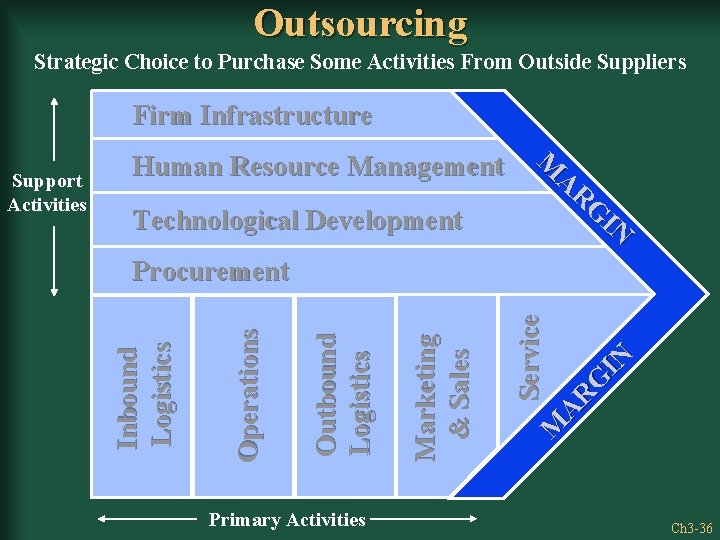
Outsourcing Strategic Choice to Purchase Some Activities From Outside Suppliers Firm Infrastructure Technological Development M A R G IN Primary Activities M Service A R G IN Marketing & Sales Outbound Logistics Operations Procurement Inbound Logistics Support Activities Human Resource Management Ch 3 -36
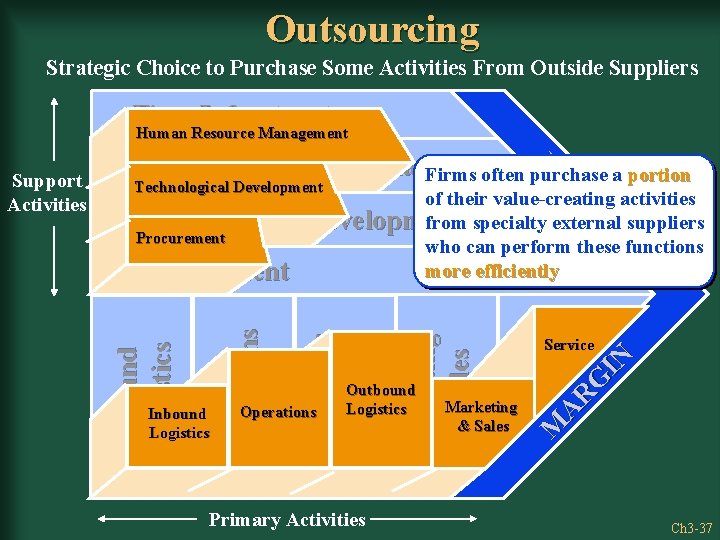
Outsourcing Strategic Choice to Purchase Some Activities From Outside Suppliers Firm Infrastructure Human Resource Management Operations Marketing & Sales Outbound Logistics Operations Inbound Logistics Outbound Logistics Primary Activities M Service A R G IN who can perform these functions more efficiently Procurement Inbound Logistics Support Activities M Human Resource Management Firms often purchase a portion A Technological Development R activities of their value-creating G IN suppliers from specialty external Technological Development Procurement Service Marketing & Sales Ch 3 -37
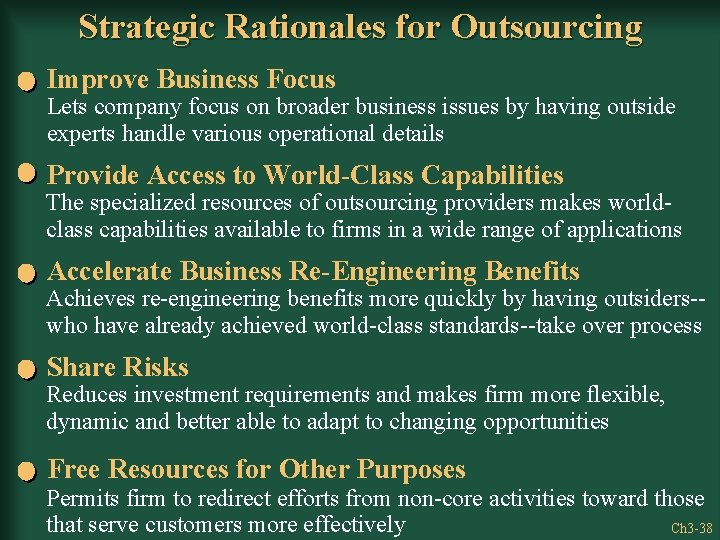
Strategic Rationales for Outsourcing Improve Business Focus Lets company focus on broader business issues by having outside experts handle various operational details Provide Access to World-Class Capabilities The specialized resources of outsourcing providers makes worldclass capabilities available to firms in a wide range of applications Accelerate Business Re-Engineering Benefits Achieves re-engineering benefits more quickly by having outsiders-who have already achieved world-class standards--take over process Share Risks Reduces investment requirements and makes firm more flexible, dynamic and better able to adapt to changing opportunities Free Resources for Other Purposes Permits firm to redirect efforts from non-core activities toward those that serve customers more effectively Ch 3 -38
Core Competencies--Cautions and Reminders Never take for granted that core competencies will continue to provide a source of competitive advantage All core competencies have the potential to become Core Rigidities are former core competencies that sow the seeds of organizational inertia and prevent the firm from responding appropriately to changes in the external environment Strategic myopia and inflexibility can strangle the firm’s ability to grow and adapt to environmental change or competitive threats Ch 3 -39
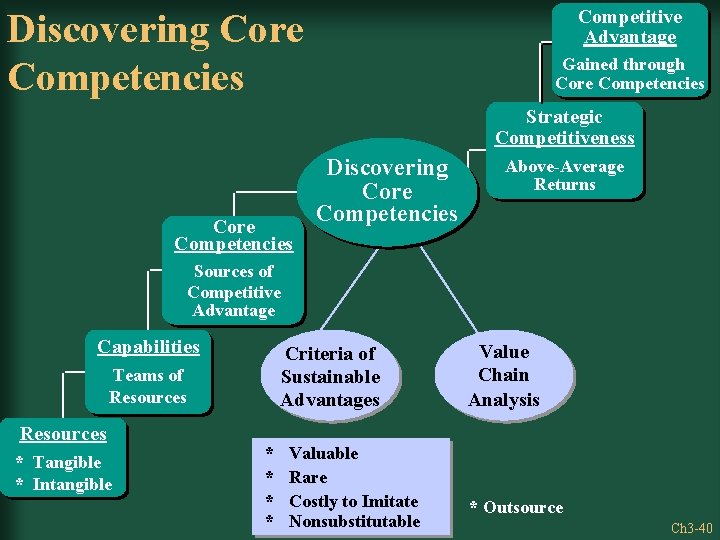
Competitive Advantage Discovering Core Competencies Gained through Core Competencies Strategic Competitiveness Core Competencies Discovering Core Competencies Above-Average Returns Sources of Competitive Advantage Capabilities Criteria of Sustainable Advantages Teams of Resources * Tangible * Intangible * * Valuable Rare Costly to Imitate Nonsubstitutable Value Chain Analysis * Outsource Ch 3 -40
- Slides: 40