
Chapter 3 The Internal Environment Resources Capabilities and
Chapter 3 The Internal Environment: Resources, Capabilities and Core Competence Michael A. Hitt R. Duane Ireland Robert E. Hoskisson © 2003 Southwestern Publishing Company 1
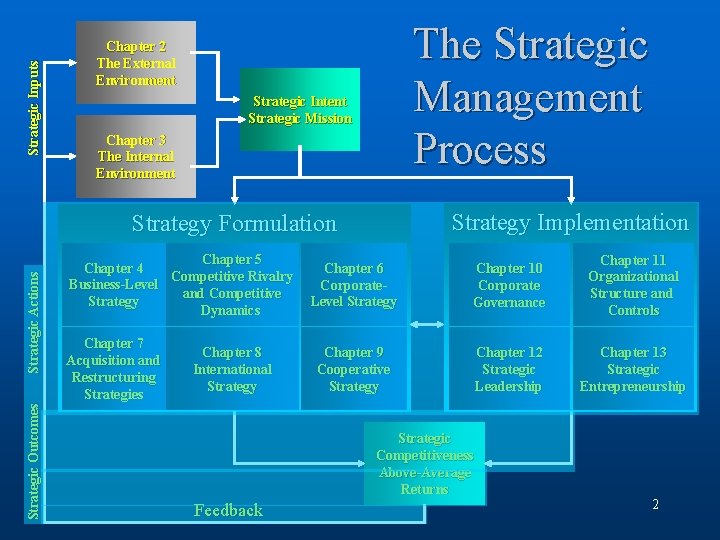
Strategic Inputs The Strategic Management Process Chapter 2 The External Environment Strategic Intent Strategic Mission Chapter 3 The Internal Environment Strategy Implementation Strategic Outcomes Strategic Actions Strategy Formulation Chapter 5 Chapter 4 Competitive Rivalry Business-Level and Competitive Strategy Dynamics Chapter 7 Acquisition and Restructuring Strategies Chapter 8 International Strategy Chapter 6 Corporate. Level Strategy Chapter 10 Corporate Governance Chapter 11 Organizational Structure and Controls Chapter 9 Cooperative Strategy Chapter 12 Strategic Leadership Chapter 13 Strategic Entrepreneurship Strategic Competitiveness Above-Average Returns Feedback 2
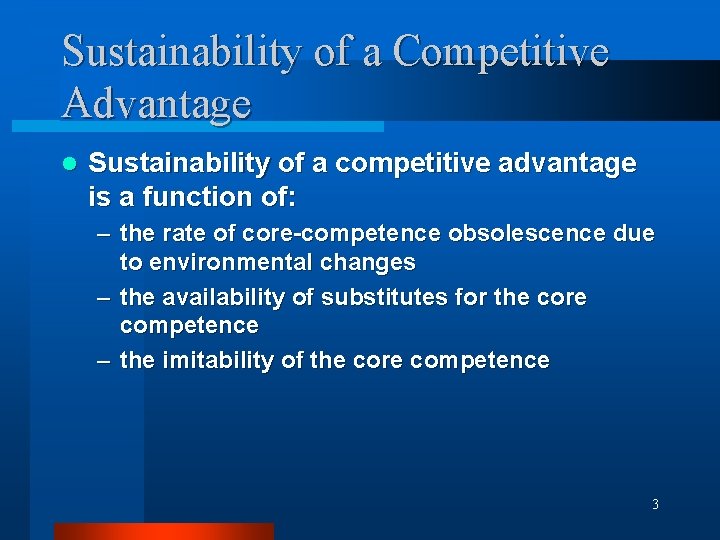
Sustainability of a Competitive Advantage l Sustainability of a competitive advantage is a function of: – the rate of core-competence obsolescence due to environmental changes – the availability of substitutes for the core competence – the imitability of the core competence 3
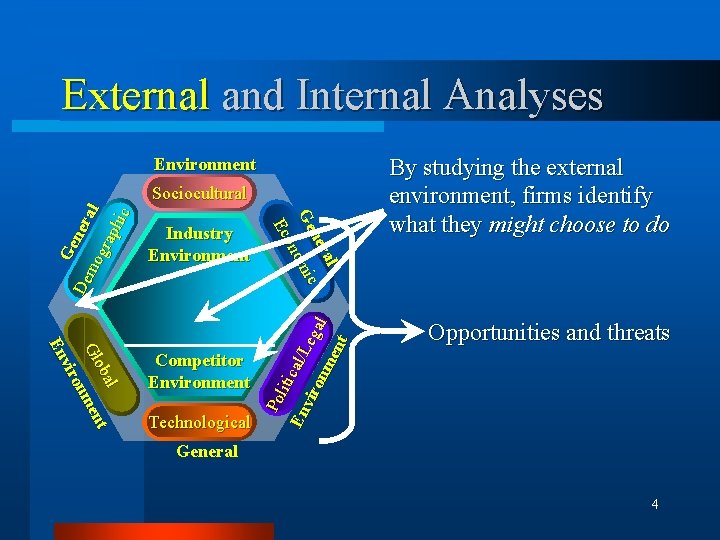
External and Internal Analyses Environment al t ob Gl n men o v ir En Competitor Environment Technological Po liti cal En /Le vir onm gal ent Industry Environment al ner Ge o mic on Ec Ge ner De a mo gra l phi c Sociocultural By studying the external environment, firms identify what they might choose to do Opportunities and threats General 4
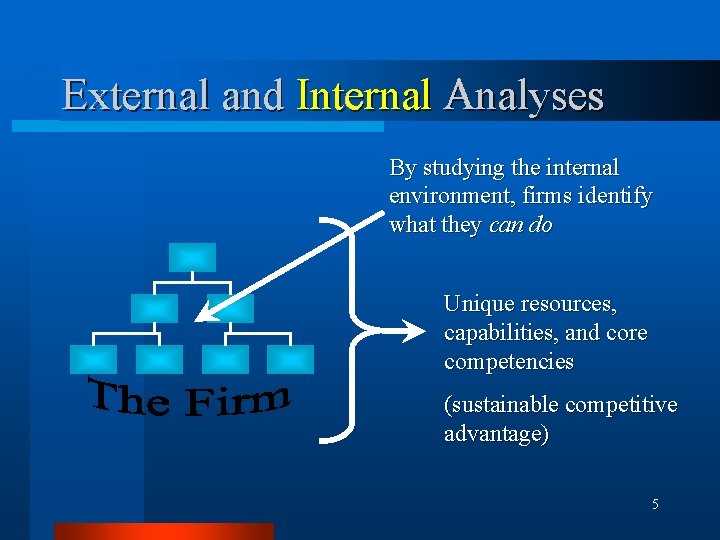
External and Internal Analyses By studying the internal environment, firms identify what they can do Unique resources, capabilities, and core competencies (sustainable competitive advantage) 5
Challenge of Internal Analysis l l l How do we effectively manage current core competencies while simultaneously developing new ones? How do we assemble bundles of resources, capabilities and core competencies to create value for customers? How do we learn to change rapidly? 6
Three Conditions Affecting Managerial Decisions About Resources, Capabilities, and Core Competencies l Uncertainty regarding characteristics of the general and the industry environments, competitors’ actions, and customers’ preferences l Complexity regarding the interrelated causes shaping a firm’s environments and perceptions of the environments l Intraorganizational Conflicts among people making managerial decisions and those affected by them 7
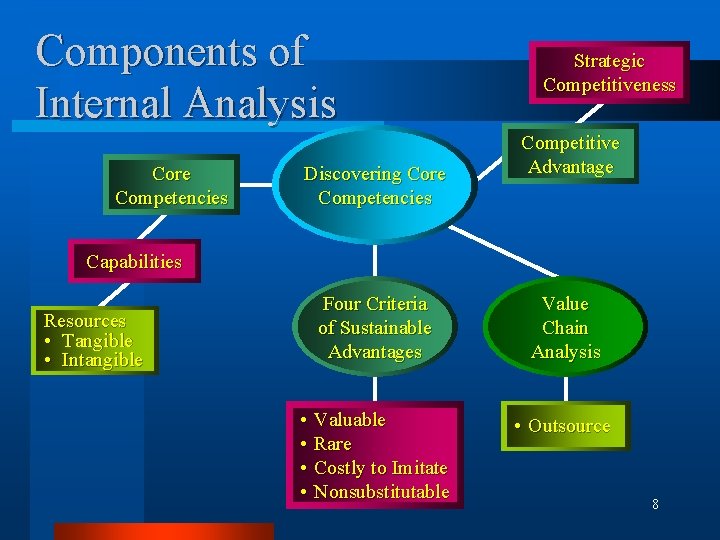
Components of Internal Analysis Core Competencies Discovering Core Competencies Strategic Competitiveness Competitive Advantage Capabilities Resources • Tangible • Intangible Four Criteria of Sustainable Advantages Value Chain Analysis • Valuable • Rare • Costly to Imitate • Nonsubstitutable • Outsource 8
Discovering Core Competencies Resources • Tangible • Intangible Resources are what a firm has to work with--its assets-including its people and the value of its brand name Resources represent inputs into a firm’s production process. . . such as capital equipment, skills of employees, brand names, finances and talented managers 9
Discovering Core Competencies Resources • Tangible • Intangible Tangible Resources • Financial • Physical • Human resources • Organizational Intangible Resources • Technological • Innovation • Reputation 10
Discovering Core Competencies Capabilities become important when they are combined in unique combinations which create core competencies which have strategic value and can lead to competitive advantage 11
Discovering Core Competencies Capabilities are what a firm does, and represent the firm’s capacity or ability to integrate individual firm resources to achieve a desired objective 12
Discovering Core Competencies Core competencies are resources and capabilities that serve as a source of competitive advantage over rivals Core competencies distinguish a company competitively and make it distinctive Mc. Kinsey and Co. recommends using three to four competencies when framing strategic actions 13
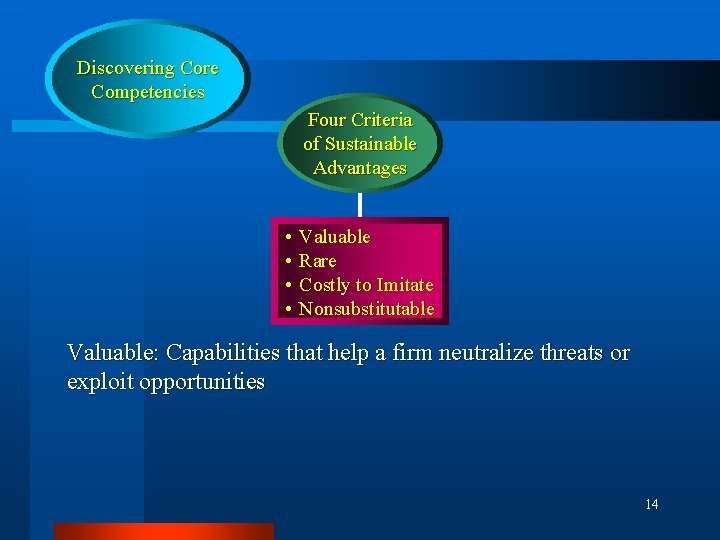
Discovering Core Competencies Four Criteria of Sustainable Advantages • Valuable • Rare • Costly to Imitate • Nonsubstitutable Valuable: Capabilities that help a firm neutralize threats or exploit opportunities 14
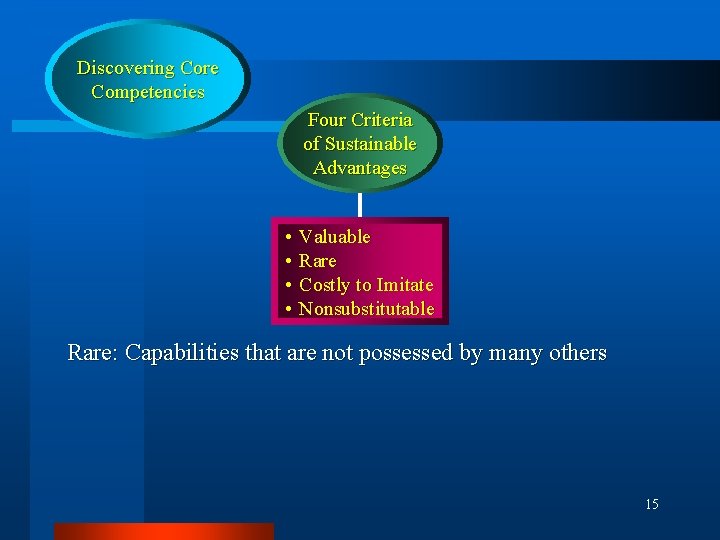
Discovering Core Competencies Four Criteria of Sustainable Advantages • Valuable • Rare • Costly to Imitate • Nonsubstitutable Rare: Capabilities that are not possessed by many others 15
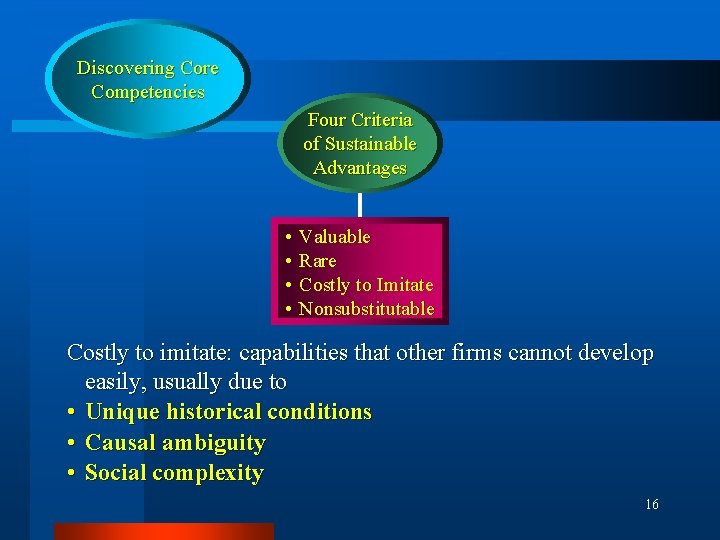
Discovering Core Competencies Four Criteria of Sustainable Advantages • Valuable • Rare • Costly to Imitate • Nonsubstitutable Costly to imitate: capabilities that other firms cannot develop easily, usually due to • Unique historical conditions • Causal ambiguity • Social complexity 16
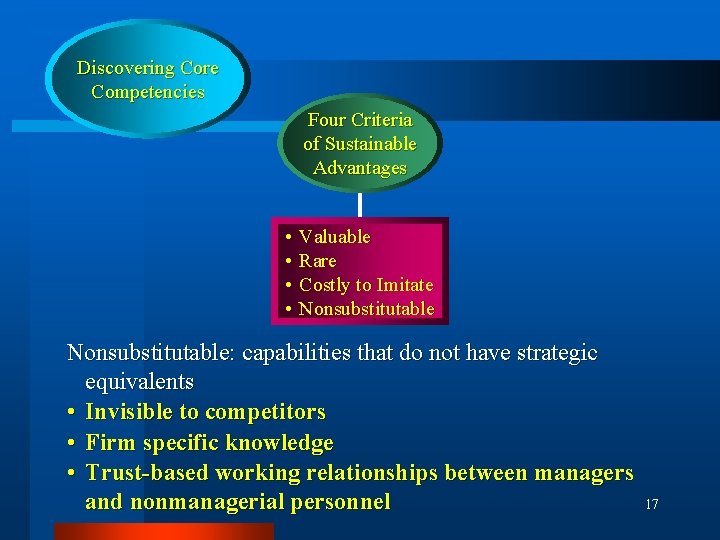
Discovering Core Competencies Four Criteria of Sustainable Advantages • Valuable • Rare • Costly to Imitate • Nonsubstitutable: capabilities that do not have strategic equivalents • Invisible to competitors • Firm specific knowledge • Trust-based working relationships between managers and nonmanagerial personnel 17
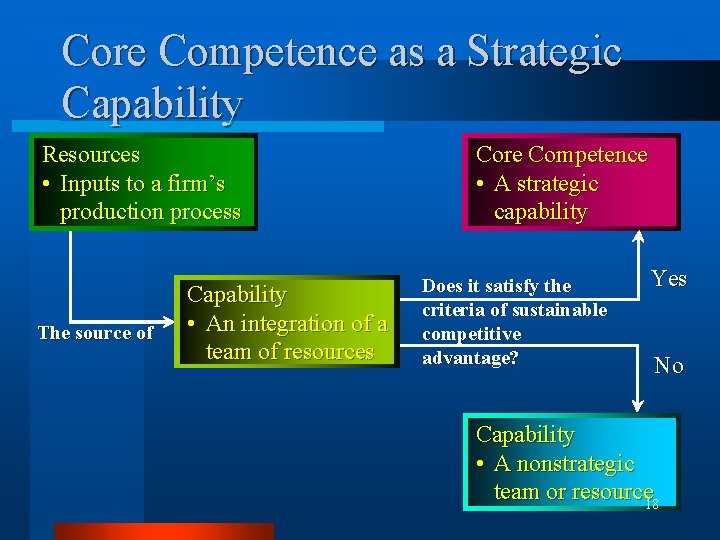
Core Competence as a Strategic Capability Resources • Inputs to a firm’s production process The source of Capability • An integration of a team of resources Core Competence • A strategic capability Does it satisfy the criteria of sustainable competitive advantage? Yes No Capability • A nonstrategic team or resource 18
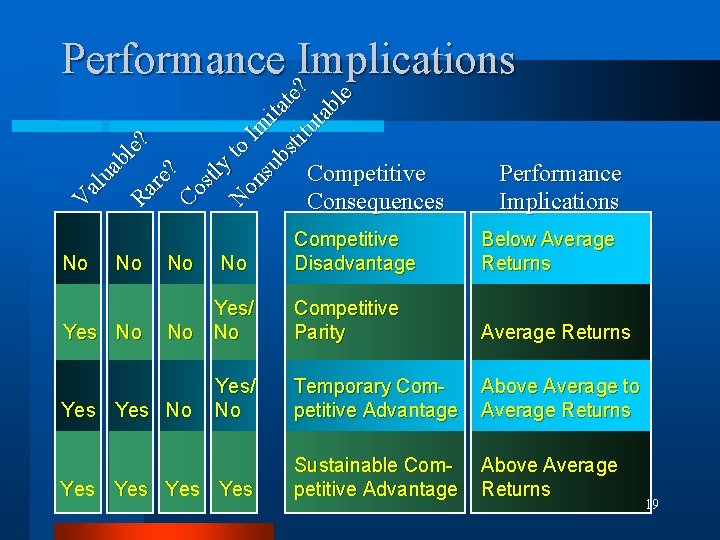
V al ua b le Ra ? re ? Co s tl y t N on o Im su bs itate t it ut ? ab le Performance Implications Competitive Consequences Performance Implications Competitive Disadvantage Below Average Returns Competitive Parity Average Returns Yes/ No Temporary Competitive Advantage Above Average to Average Returns Yes Yes Sustainable Competitive Advantage Above Average Returns No No Yes No No No Yes/ No No Yes No 19
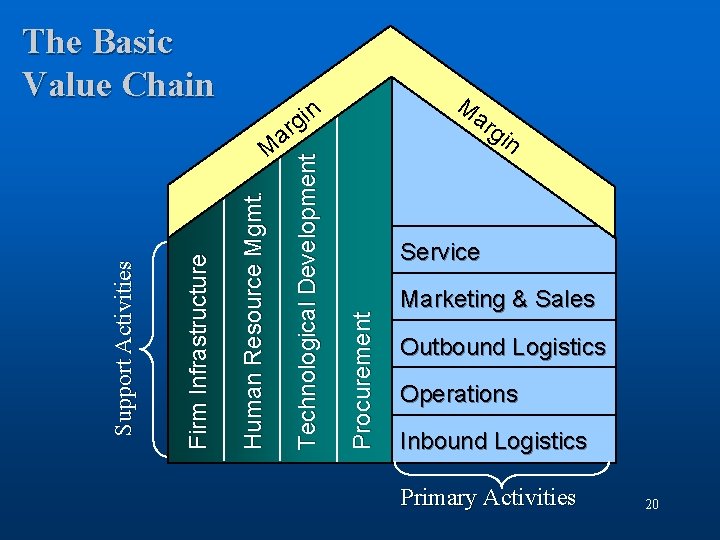
The Basic Value Chain M n gi ar gin Service Procurement Human Resource Mgmt. Firm Infrastructure Support Activities M Technological Development ar Marketing & Sales Outbound Logistics Operations Inbound Logistics Primary Activities 20
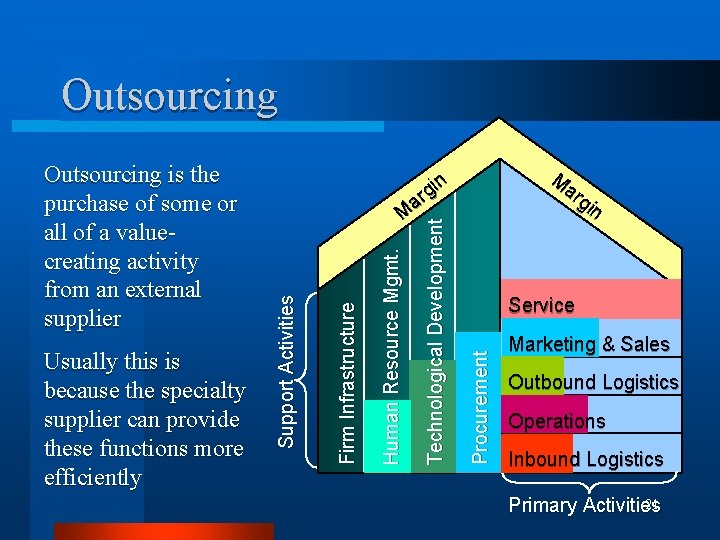
Outsourcing Service Procurement Technological Development Human Resource Mgmt. Firm Infrastructure Usually this is because the specialty supplier can provide these functions more efficiently M ar g in n gi r a M Support Activities Outsourcing is the purchase of some or all of a valuecreating activity from an external supplier Marketing & Sales Outbound Logistics Operations Inbound Logistics 21 Primary Activities
Strategic Rationales for Outsourcing l Improve Business Focus – lets company focus on broader business issues by having outside experts handle various operational details l Provide Access to World-Class Capabilities – the specialized resources of outsourcing providers makes world-class capabilities available to firms in a wide range of applications 22
Strategic Rationales for Outsourcing l Accelerate Business Re-Engineering Benefits – achieves re-engineering benefits more quickly by having outsiders--who have already achieved world-class standards--take over process l Share Risks – reduces investment requirements and makes firm more flexible, dynamic and better able to adapt to changing opportunities 23
Strategic Rationales for Outsourcing l Free Resources for Other Purposes – permits firm to redirect efforts from non-core activities toward those that serve customers more effectively 24
Outsourcing Issues l Greatest Value – outsource only to firms possessing a core competence in terms of performing the primary or support activity being outsourced l Evaluating Resources and Capabilities – don’t outsource activities in which the firm itself can create and capture value l Environmental Threats and Ongoing Tasks – do not outsource primary and support activities that are used to neutralize environmental threats or complete necessary ongoing 25 organizational tasks
Outsourcing Issues l Nonstrategic Team of Resources – do not outsource capabilities that are critical to their success, even though the capabilities are not actual sources of competitive advantage l Firm’s Knowledge Base – do not outsource activities that stimulate the development of new capabilities and competencies 26
Core Competencies: Cautions and Reminders Never take for granted that core competencies will continue to provide a source of competitive advantage l All core competencies have the potential to become core rigidities l Core rigidities are former core competencies that now generate inertia and stifle innovation l 27
- Slides: 27