
Chapter 3 The First Law of Thermodynamics The

- Slides: 25
Chapter 3 The First Law of Thermodynamics The Machinery 1
OUTLINE Partial Derivatives and the First Law 1. Partial Derivatives and the Internal Energy, U: Internal Pressure, T, and the Expansion Coefficient, 2. Partial Derivatives and the Enthalpy, H: Isothermal Compressibility, T, and the Joule-Thomson Coefficient, 3. The Relation Between Cp and CV. 2
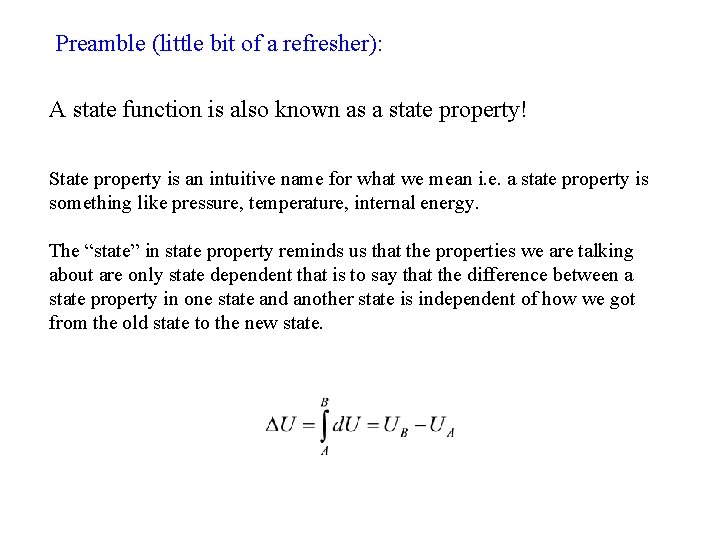
Preamble (little bit of a refresher): A state function is also known as a state property! State property is an intuitive name for what we mean i. e. a state property is something like pressure, temperature, internal energy. The “state” in state property reminds us that the properties we are talking about are only state dependent that is to say that the difference between a state property in one state and another state is independent of how we got from the old state to the new state. 3
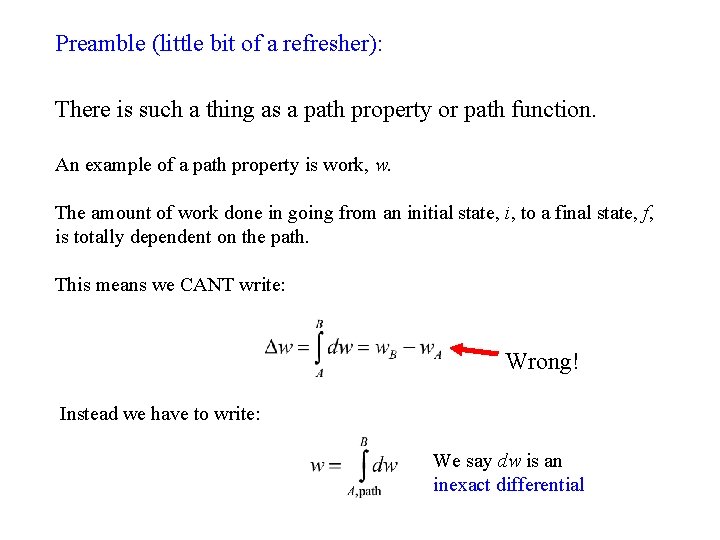
Preamble (little bit of a refresher): There is such a thing as a path property or path function. An example of a path property is work, w. The amount of work done in going from an initial state, i, to a final state, f, is totally dependent on the path. This means we CANT write: Wrong! Instead we have to write: We say dw is an inexact differential 4
Preamble (little bit of a refresher): A state function is also known as a state property! The term “state function” reminds us that the properties of a system are inter -related e. g. for a one component system: p = f ( n, V, T ) recall p. V = n. RT And also: U = f ( n, V, T ) or U = f ( n, V, p ) or U = f ( n, p, T ) The multivariable nature of these state functions means that the use of partial derivatives is very common in thermodynamics! 5
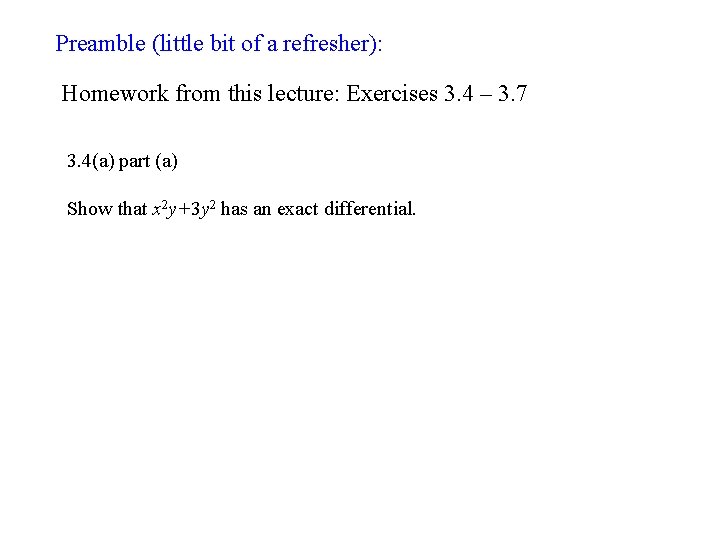
Preamble (little bit of a refresher): Homework from this lecture: Exercises 3. 4 – 3. 7 3. 4(a) part (a) Show that x 2 y+3 y 2 has an exact differential. 6
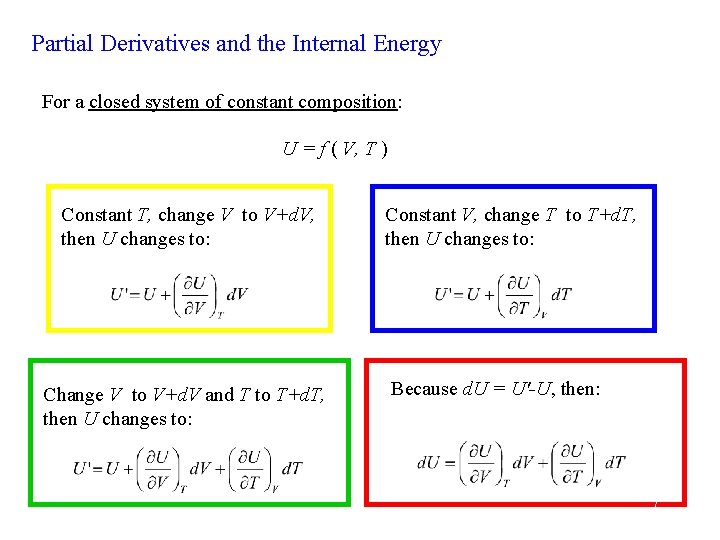
Partial Derivatives and the Internal Energy For a closed system of constant composition: U = f ( V, T ) Constant T, change V to V+d. V, then U changes to: Change V to V+d. V and T to T+d. T, then U changes to: Constant V, change T to T+d. T, then U changes to: Because d. U = U'-U, then: 7
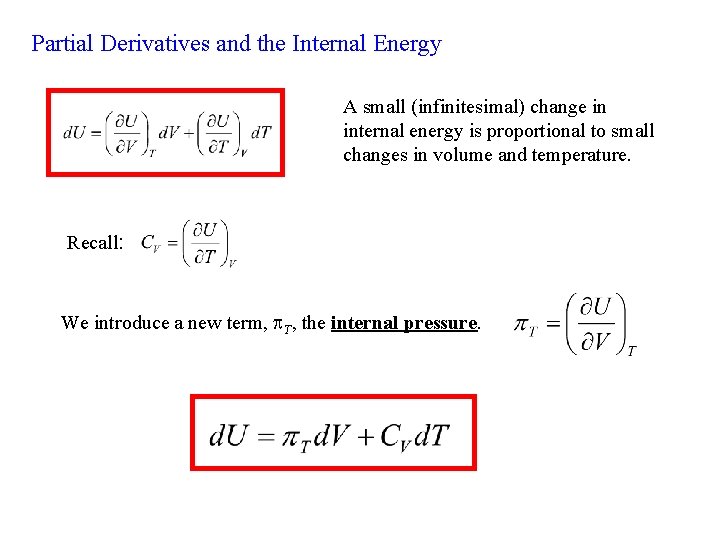
Partial Derivatives and the Internal Energy A small (infinitesimal) change in internal energy is proportional to small changes in volume and temperature. Recall: We introduce a new term, T, the internal pressure. 8
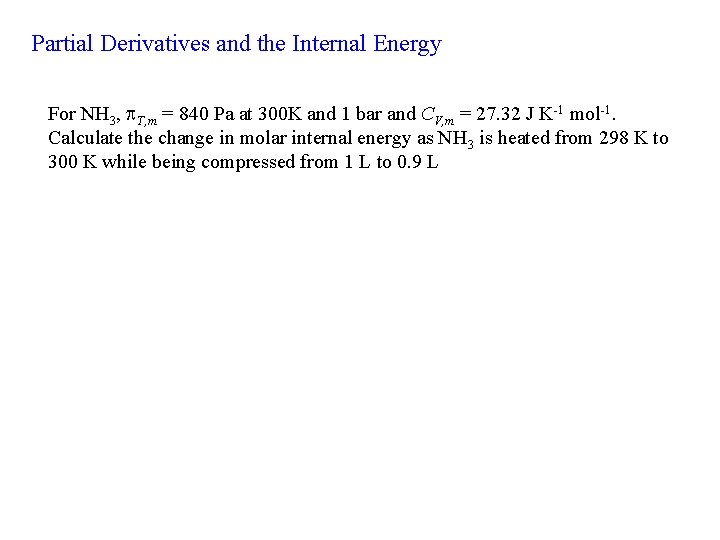
Partial Derivatives and the Internal Energy For NH 3, T, m = 840 Pa at 300 K and 1 bar and CV, m = 27. 32 J K-1 mol-1. Calculate the change in molar internal energy as NH 3 is heated from 298 K to 300 K while being compressed from 1 L to 0. 9 L 9
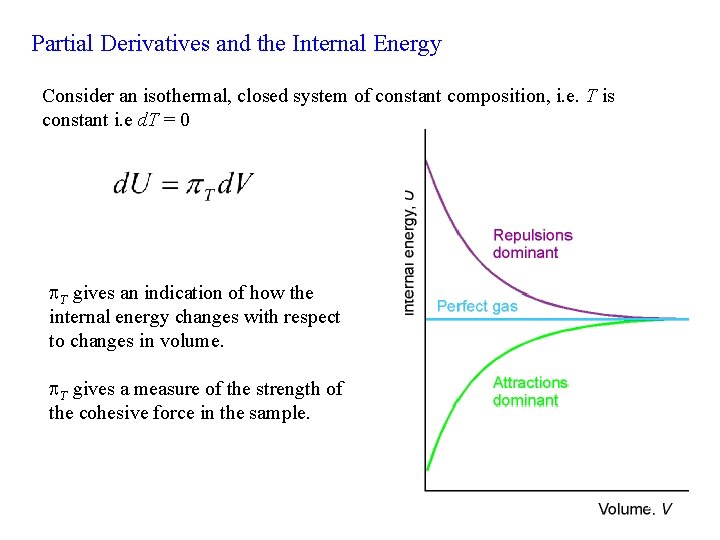
Partial Derivatives and the Internal Energy Consider an isothermal, closed system of constant composition, i. e. T is constant i. e d. T = 0 T gives an indication of how the internal energy changes with respect to changes in volume. T gives a measure of the strength of the cohesive force in the sample. 10
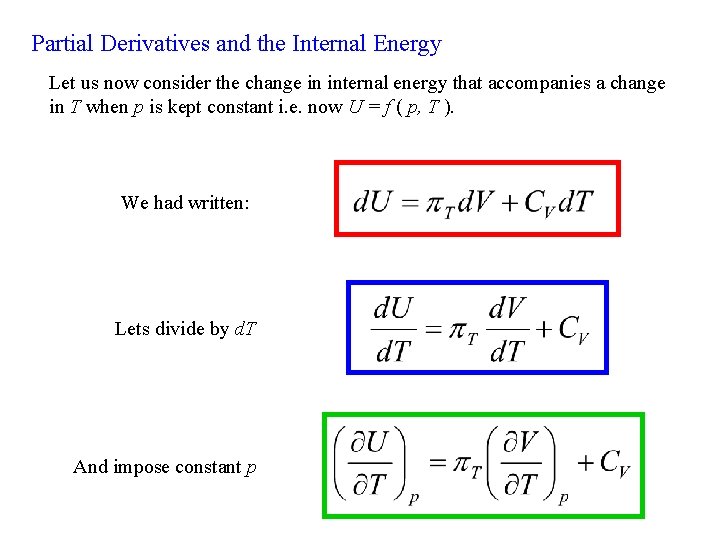
Partial Derivatives and the Internal Energy Let us now consider the change in internal energy that accompanies a change in T when p is kept constant i. e. now U = f ( p, T ). We had written: Lets divide by d. T And impose constant p 11
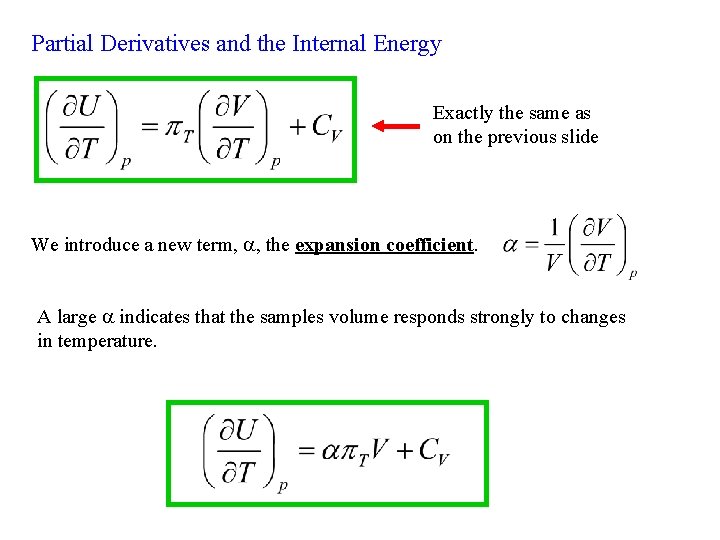
Partial Derivatives and the Internal Energy Exactly the same as on the previous slide We introduce a new term, , the expansion coefficient. A large indicates that the samples volume responds strongly to changes in temperature. 12
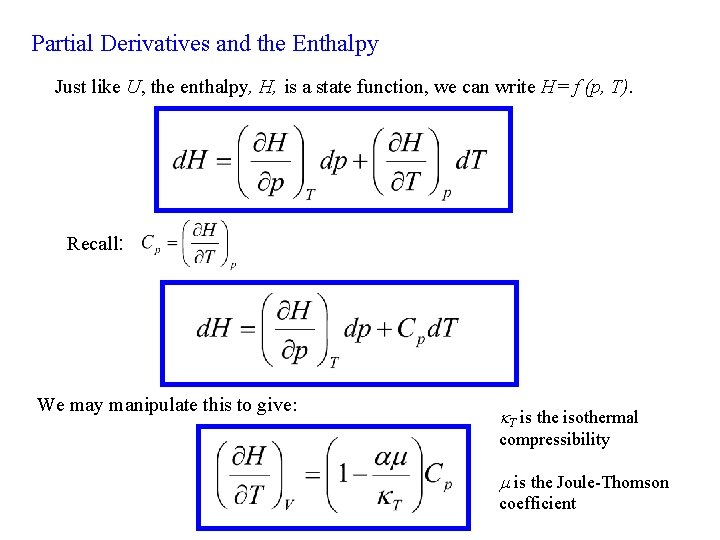
Partial Derivatives and the Enthalpy Just like U, the enthalpy, H, is a state function, we can write H= f (p, T). Recall: We may manipulate this to give: T is the isothermal compressibility is the Joule-Thomson coefficient 13
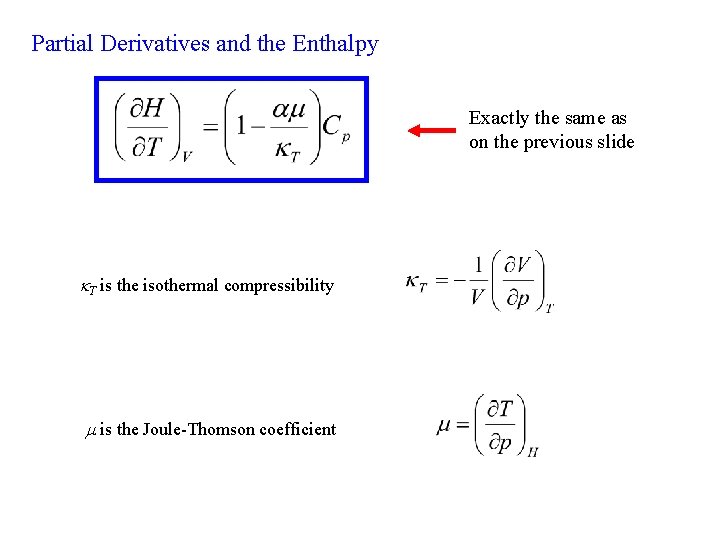
Partial Derivatives and the Enthalpy Exactly the same as on the previous slide T is the isothermal compressibility is the Joule-Thomson coefficient 14
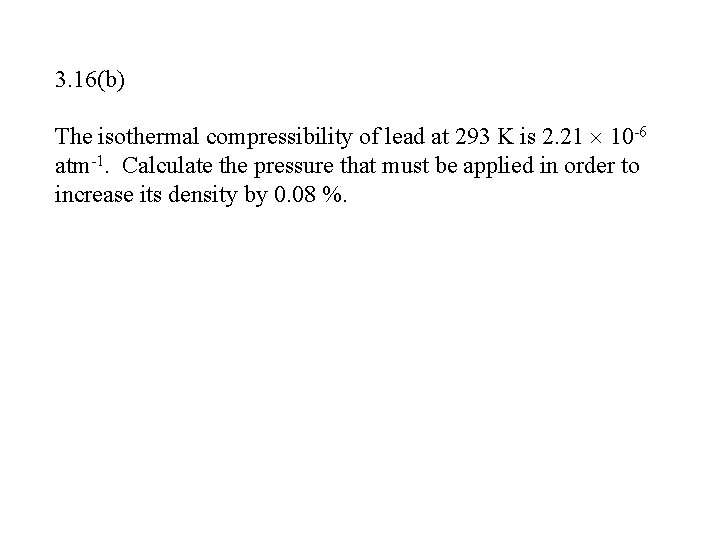
3. 16(b) The isothermal compressibility of lead at 293 K is 2. 21 10 -6 atm-1. Calculate the pressure that must be applied in order to increase its density by 0. 08 %. 15
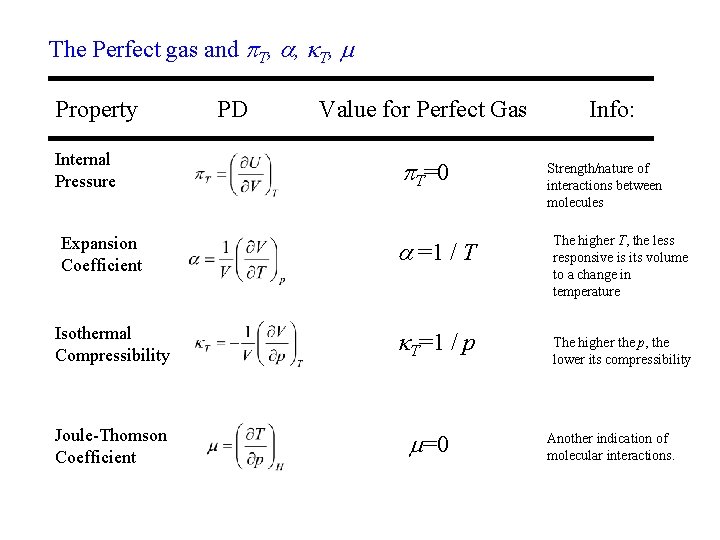
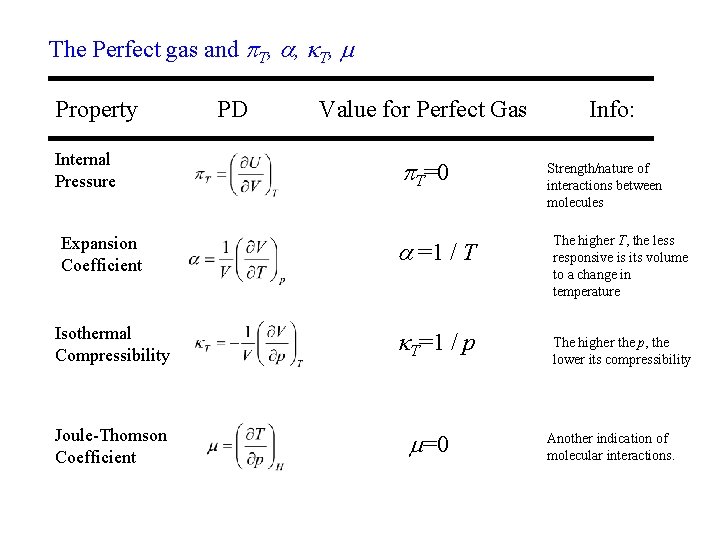
The Perfect gas and p. T, a, T, Property Internal Pressure Expansion Coefficient Isothermal Compressibility Joule-Thomson Coefficient PD Value for Perfect Gas p. T=0 a =1 / T T=1 / p =0 Info: Strength/nature of interactions between molecules The higher T, the less responsive is its volume to a change in temperature The higher the p, the lower its compressibility Another indication of molecular interactions. 16
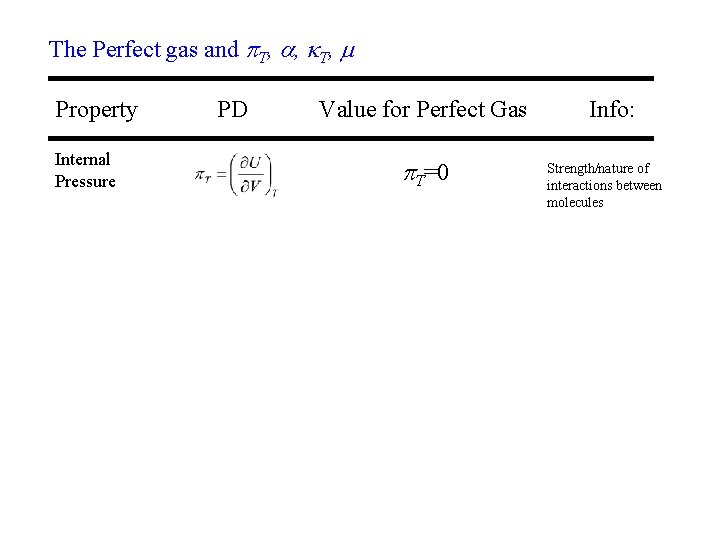
The Perfect gas and p. T, a, T, Property Internal Pressure PD Value for Perfect Gas p. T=0 Info: Strength/nature of interactions between molecules 17
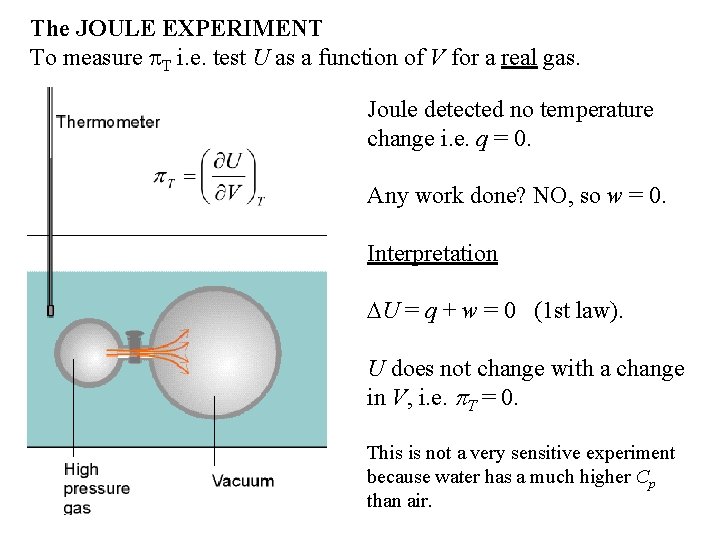
The JOULE EXPERIMENT To measure T i. e. test U as a function of V for a real gas. Joule detected no temperature change i. e. q = 0. Any work done? NO, so w = 0. Interpretation DU = q + w = 0 (1 st law). U does not change with a change in V, i. e. p. T = 0. This is not a very sensitive experiment because water has a much higher Cp than air. 18
James Joule and the Gothic Era. 19
The Perfect gas and p. T, a, T, Property Internal Pressure Expansion Coefficient Isothermal Compressibility Joule-Thomson Coefficient PD Value for Perfect Gas p. T=0 a =1 / T T=1 / p =0 Info: Strength/nature of interactions between molecules The higher T, the less responsive is its volume to a change in temperature The higher the p, the lower its compressibility Another indication of molecular interactions. 20
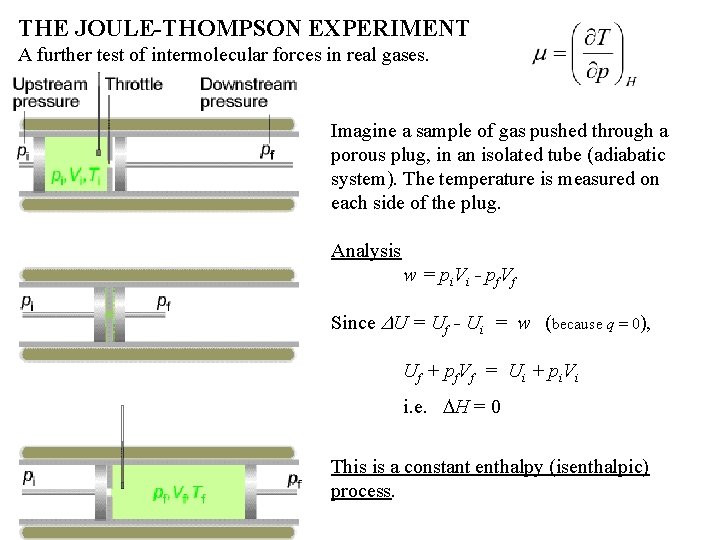
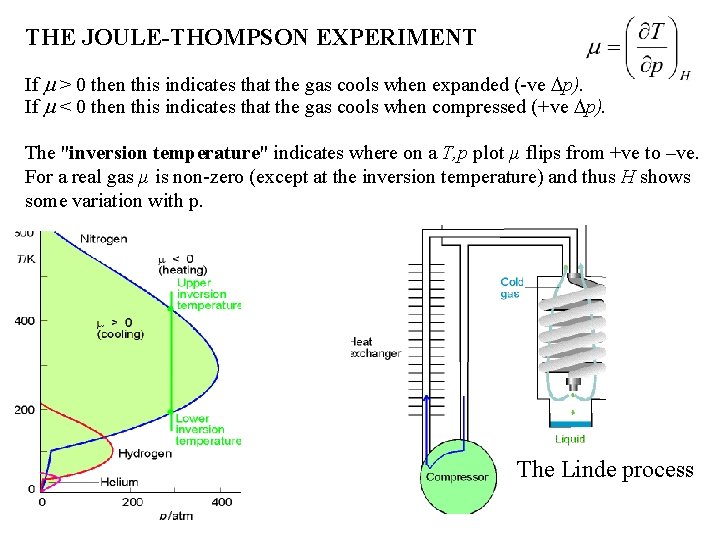
THE JOULE-THOMPSON EXPERIMENT A further test of intermolecular forces in real gases. Imagine a sample of gas pushed through a porous plug, in an isolated tube (adiabatic system). The temperature is measured on each side of the plug. Analysis w = pi. Vi - pf. Vf Since DU = Uf - Ui = w (because q = 0), Uf + pf. Vf = Ui + pi. Vi i. e. DH = 0 This is a constant enthalpy (isenthalpic) process. 21
THE JOULE-THOMPSON EXPERIMENT If > 0 then this indicates that the gas cools when expanded (-ve Dp). If < 0 then this indicates that the gas cools when compressed (+ve Dp). The "inversion temperature" indicates where on a T, p plot µ flips from +ve to –ve. For a real gas µ is non-zero (except at the inversion temperature) and thus H shows some variation with p. The Linde process 22
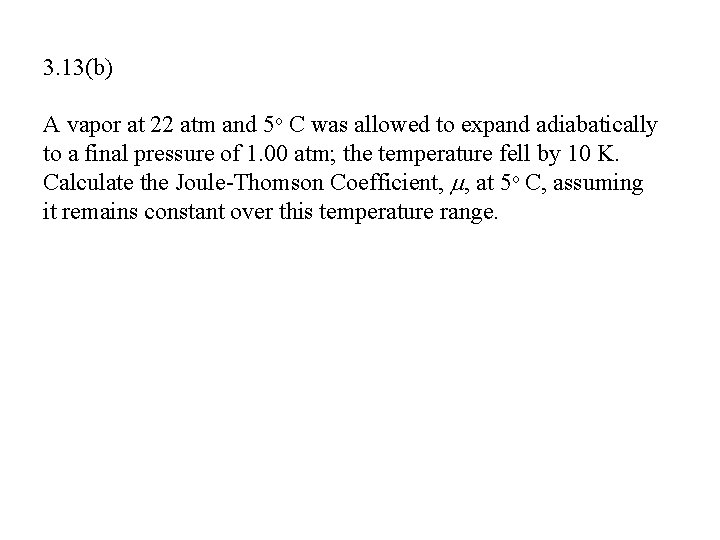
3. 13(b) A vapor at 22 atm and 5 o C was allowed to expand adiabatically to a final pressure of 1. 00 atm; the temperature fell by 10 K. Calculate the Joule-Thomson Coefficient, , at 5 o C, assuming it remains constant over this temperature range. 23
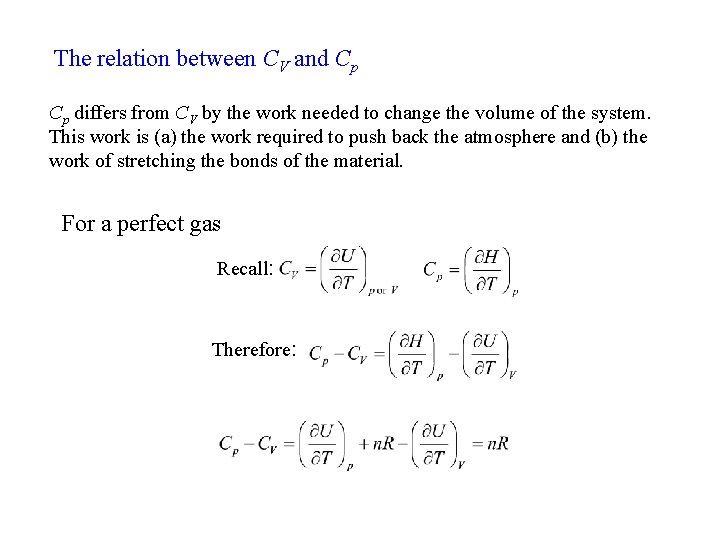
The relation between CV and Cp Cp differs from CV by the work needed to change the volume of the system. This work is (a) the work required to push back the atmosphere and (b) the work of stretching the bonds of the material. For a perfect gas Recall: Therefore: 24
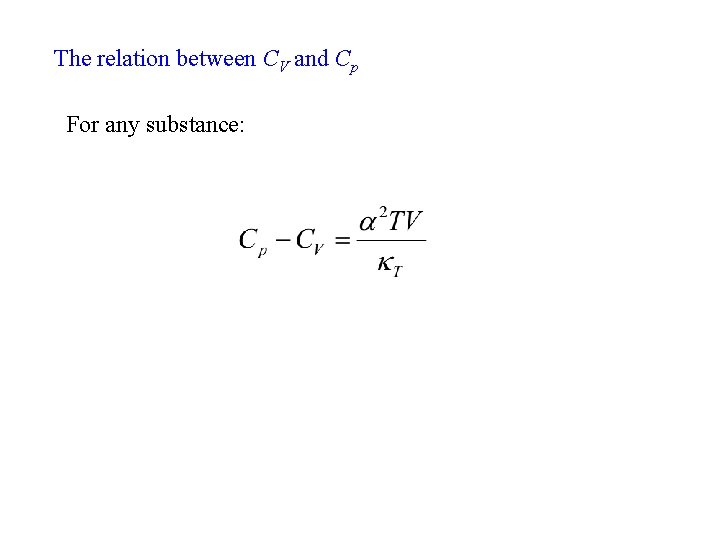
The relation between CV and Cp For any substance: 25