
Chapter 3 The External Environment Opportunities Threats Industry
- Slides: 34
Chapter 3 The External Environment: Opportunities, Threats, Industry Competition, and Competitor Analysis Robert E. Hoskisson Michael A. Hitt R. Duane Ireland © 2004 by South-Western/Thomson Learning 1
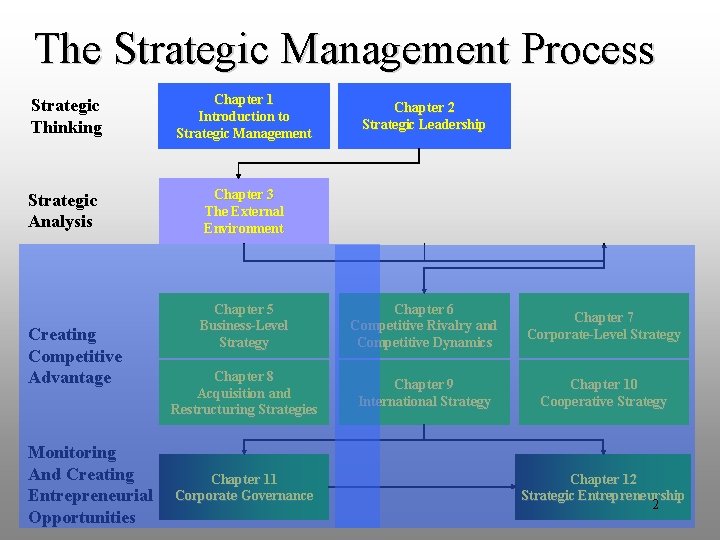
The Strategic Management Process Strategic Thinking Chapter 1 Introduction to Strategic Management Strategic Analysis Chapter 3 The External Environment Creating Competitive Advantage Monitoring And Creating Entrepreneurial Opportunities Chapter 2 Strategic Leadership Chapter 5 Business-Level Strategy Chapter 6 Competitive Rivalry and Competitive Dynamics Chapter 7 Corporate-Level Strategy Chapter 8 Acquisition and Restructuring Strategies Chapter 9 International Strategy Chapter 10 Cooperative Strategy Chapter 11 Corporate Governance Chapter 12 Strategic Entrepreneurship 2
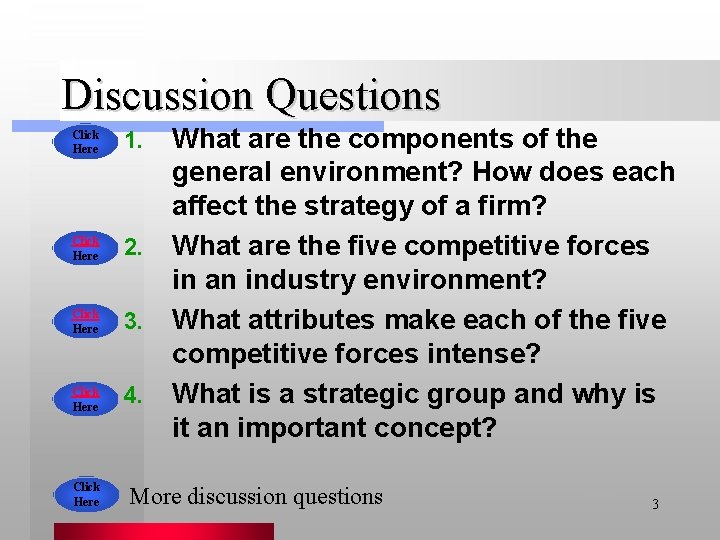
Discussion Questions Click Here 1. Click Here 2. Click Here 3. Click Here 4. Click Here What are the components of the general environment? How does each affect the strategy of a firm? What are the five competitive forces in an industry environment? What attributes make each of the five competitive forces intense? What is a strategic group and why is it an important concept? More discussion questions 3
Discussion Questions (cont. ) Click Here 5. How do you conduct a competitor analysis? 4
Discussion Question 1 What are the components of the general environment? How does each affect the strategy of a firm? 5
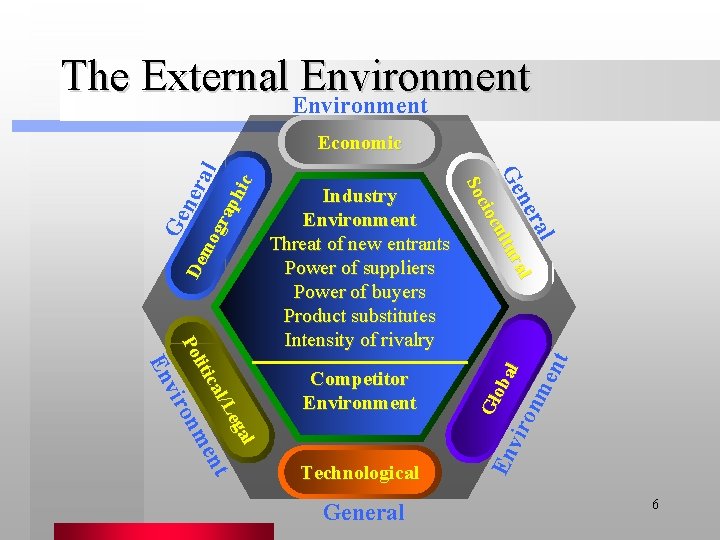
The External Environment Technological General nm ent Gl ob En al vir o Competitor Environment Ge al i v En l ga /Le nt cal l iti me Po ron Industry Environment Threat of new entrants Power of suppliers Power of buyers Product substitutes Intensity of rivalry ner al Ge ultur c cio So ner De mo al gra ph ic Economic 6
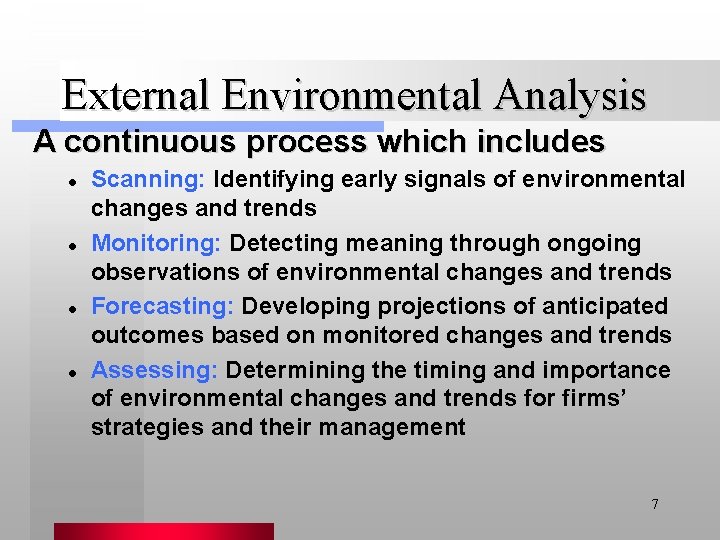
External Environmental Analysis A continuous process which includes l l Scanning: Identifying early signals of environmental changes and trends Monitoring: Detecting meaning through ongoing observations of environmental changes and trends Forecasting: Developing projections of anticipated outcomes based on monitored changes and trends Assessing: Determining the timing and importance of environmental changes and trends for firms’ strategies and their management 7
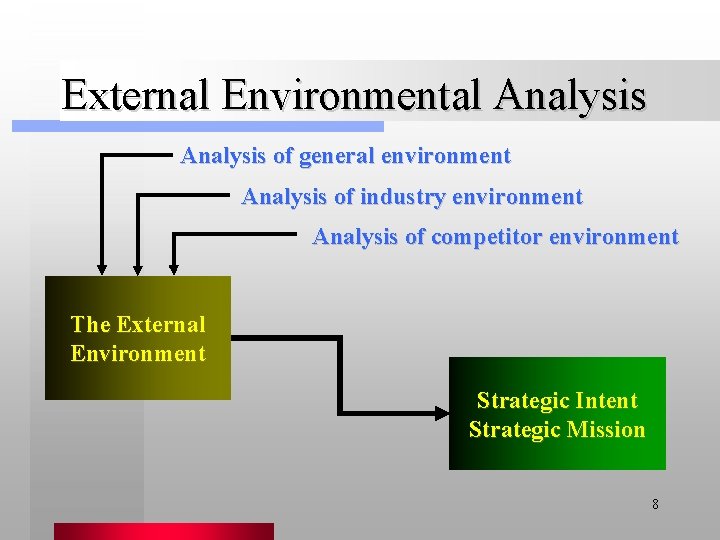
External Environmental Analysis of general environment Analysis of industry environment Analysis of competitor environment The External Environment Strategic Intent Strategic Mission 8
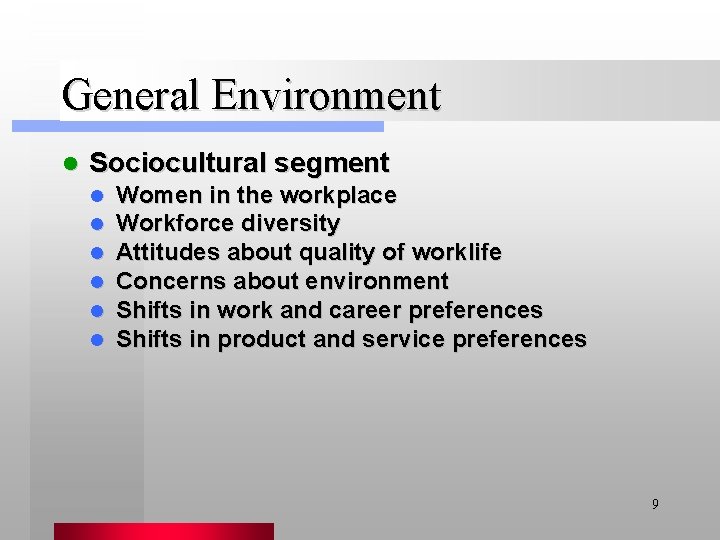
General Environment l Sociocultural segment l l l Women in the workplace Workforce diversity Attitudes about quality of worklife Concerns about environment Shifts in work and career preferences Shifts in product and service preferences 9
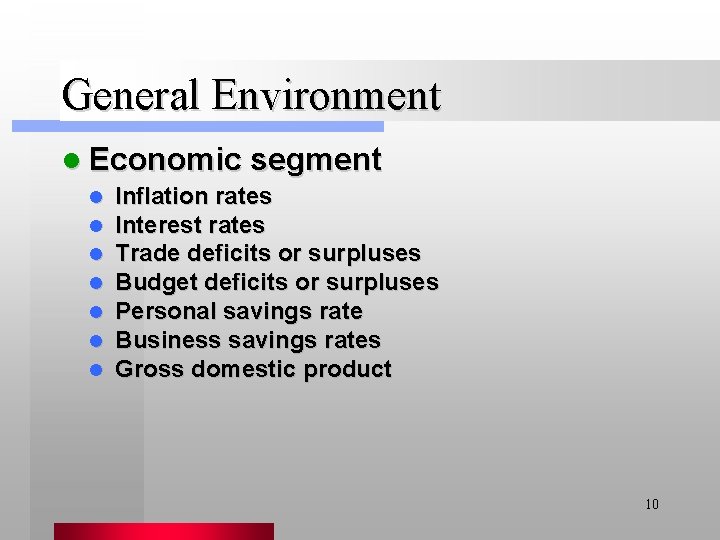
General Environment l Economic segment l l l l Inflation rates Interest rates Trade deficits or surpluses Budget deficits or surpluses Personal savings rate Business savings rates Gross domestic product 10
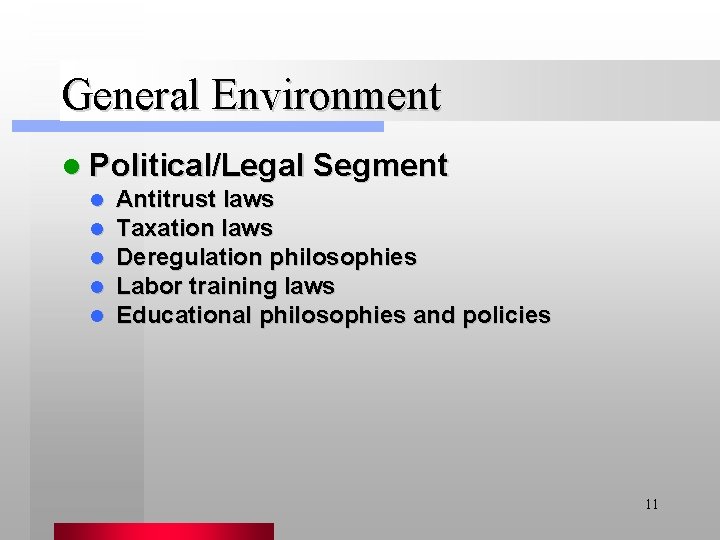
General Environment l Political/Legal Segment l l l Antitrust laws Taxation laws Deregulation philosophies Labor training laws Educational philosophies and policies 11
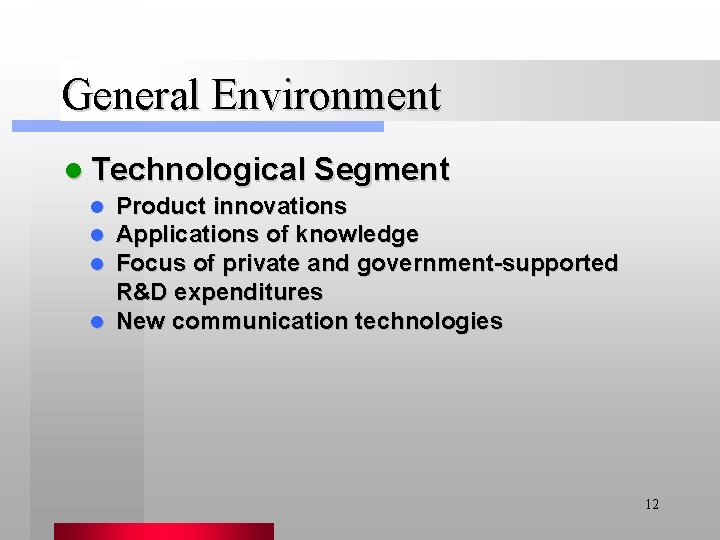
General Environment l Technological Segment Product innovations Applications of knowledge Focus of private and government-supported R&D expenditures l New communication technologies l l l 12
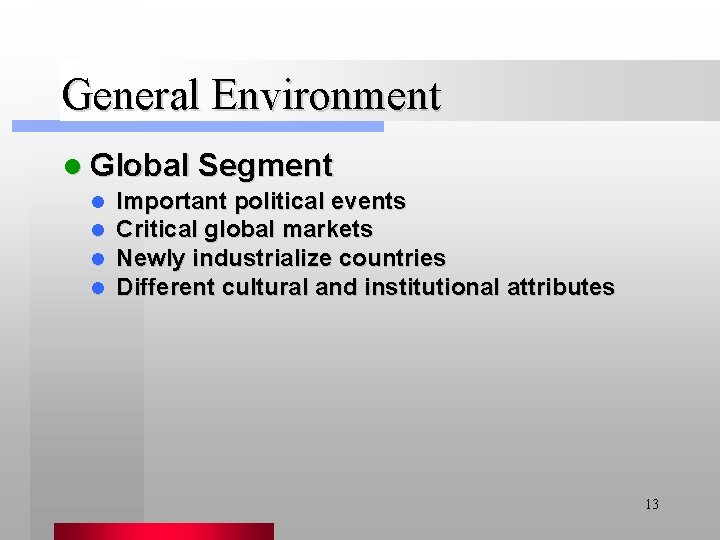
General Environment l Global Segment l l Important political events Critical global markets Newly industrialize countries Different cultural and institutional attributes 13
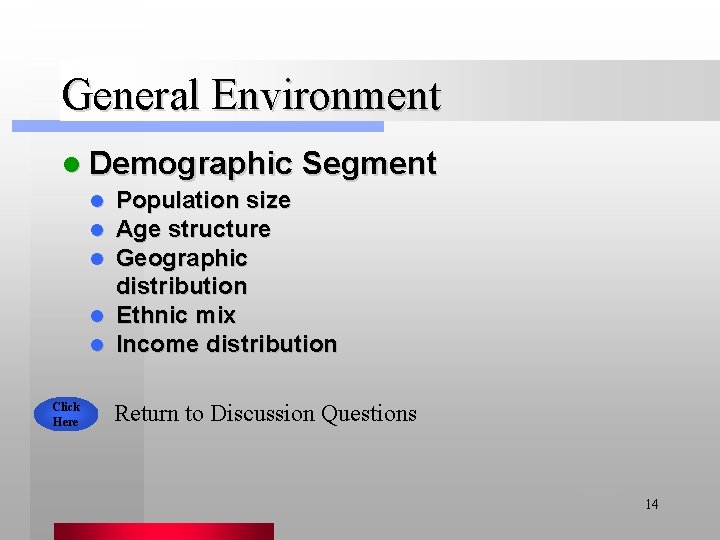
General Environment l Demographic Segment Population size Age structure Geographic distribution l Ethnic mix l Income distribution l l l Click Here Return to Discussion Questions 14
Discussion Question 2 What are the five competitive forces in an industry environment? 15
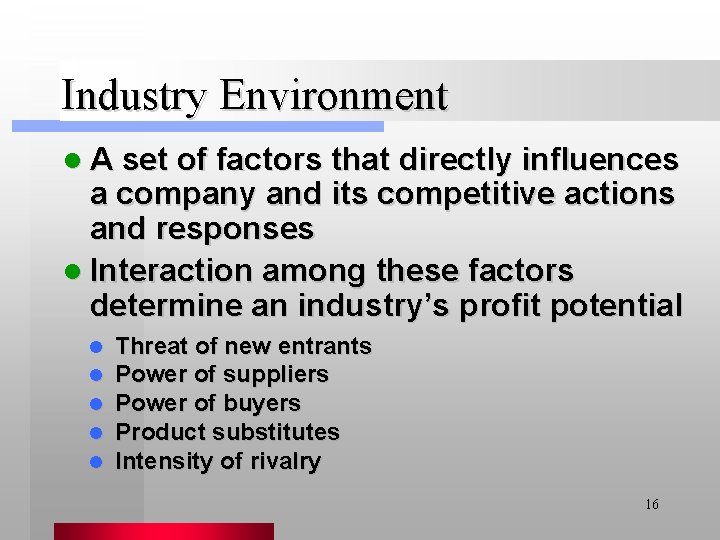
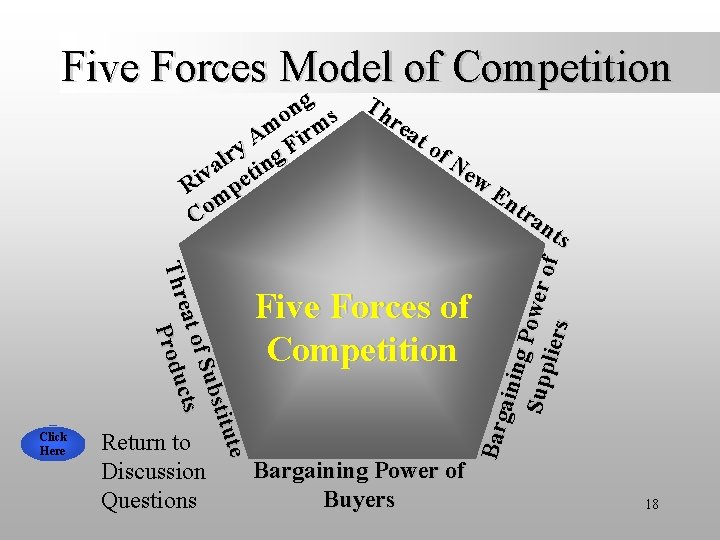
Industry Environment l A set of factors that directly influences a company and its competitive actions and responses l Interaction among these factors determine an industry’s profit potential l l Threat of new entrants Power of suppliers Power of buyers Product substitutes Intensity of rivalry 16
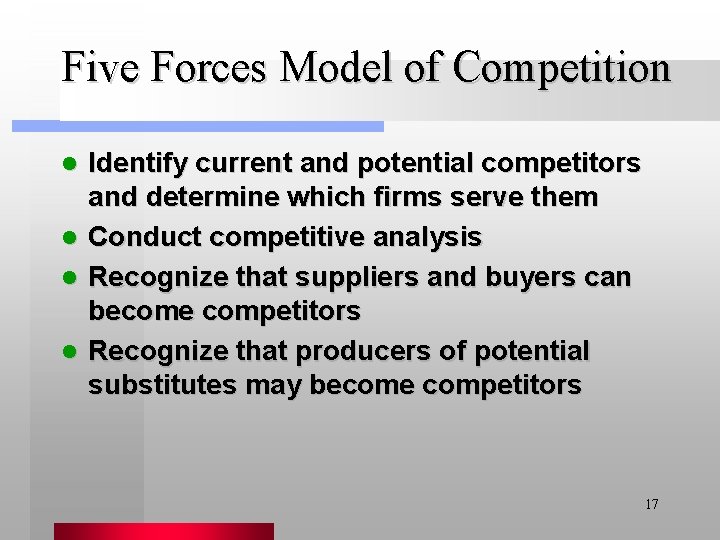
Five Forces Model of Competition Identify current and potential competitors and determine which firms serve them l Conduct competitive analysis l Recognize that suppliers and buyers can become competitors l Recognize that producers of potential substitutes may become competitors l 17
Five Forces Model of Competition tute bsti f Su eat o cts Thr Produ Click Here Return to Discussion Questions Five Forces of Competition Bargaining Power of Buyers Barg ainin g Po wer Supp of liers ng s Thr o ea m irm to A F y f. N lr ing a ew v et i R p En m tra Co nt s 18
Discussion Question 3 What attributes make each of the five competitive forces intense? 19
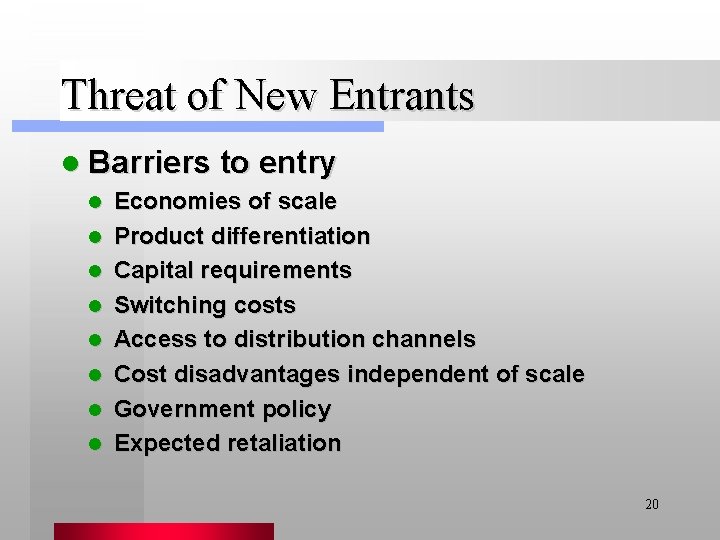
Threat of New Entrants l Barriers to entry l l l l Economies of scale Product differentiation Capital requirements Switching costs Access to distribution channels Cost disadvantages independent of scale Government policy Expected retaliation 20
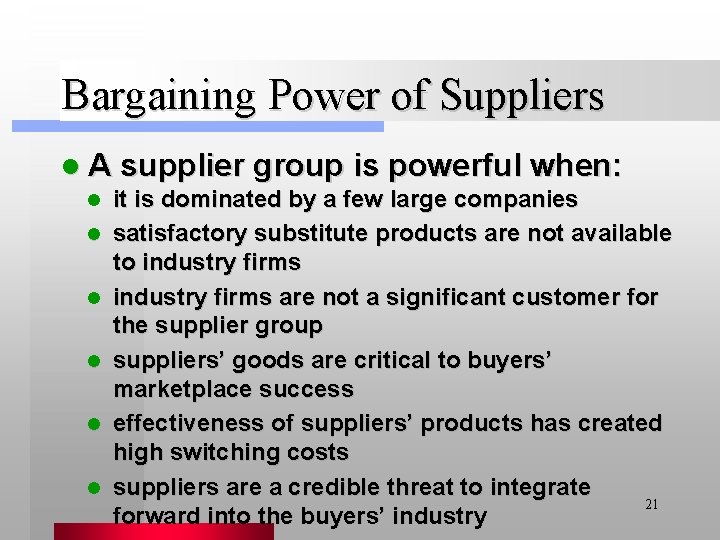
Bargaining Power of Suppliers l A supplier group is powerful when: l l l it is dominated by a few large companies satisfactory substitute products are not available to industry firms are not a significant customer for the supplier group suppliers’ goods are critical to buyers’ marketplace success effectiveness of suppliers’ products has created high switching costs suppliers are a credible threat to integrate 21 forward into the buyers’ industry
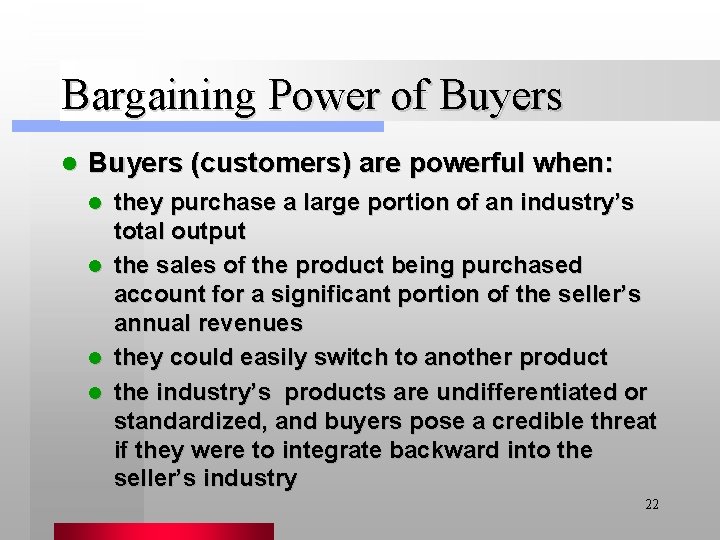
Bargaining Power of Buyers l Buyers (customers) are powerful when: they purchase a large portion of an industry’s total output l the sales of the product being purchased account for a significant portion of the seller’s annual revenues l they could easily switch to another product l the industry’s products are undifferentiated or standardized, and buyers pose a credible threat if they were to integrate backward into the seller’s industry l 22
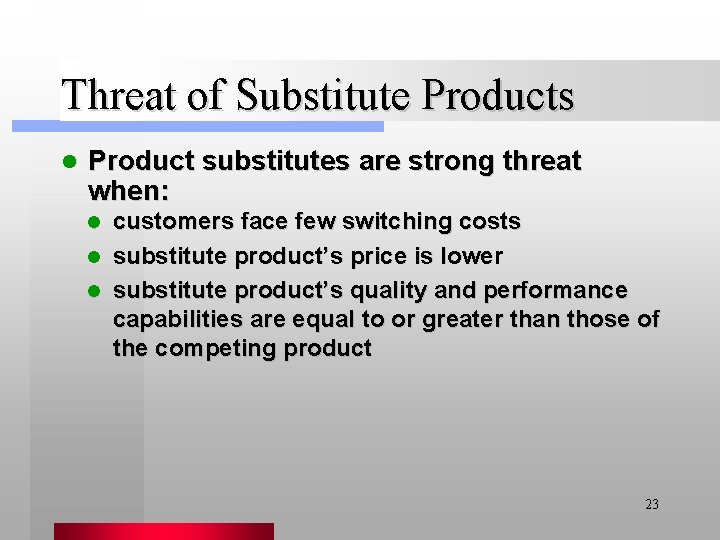
Threat of Substitute Products l Product substitutes are strong threat when: customers face few switching costs l substitute product’s price is lower l substitute product’s quality and performance capabilities are equal to or greater than those of the competing product l 23
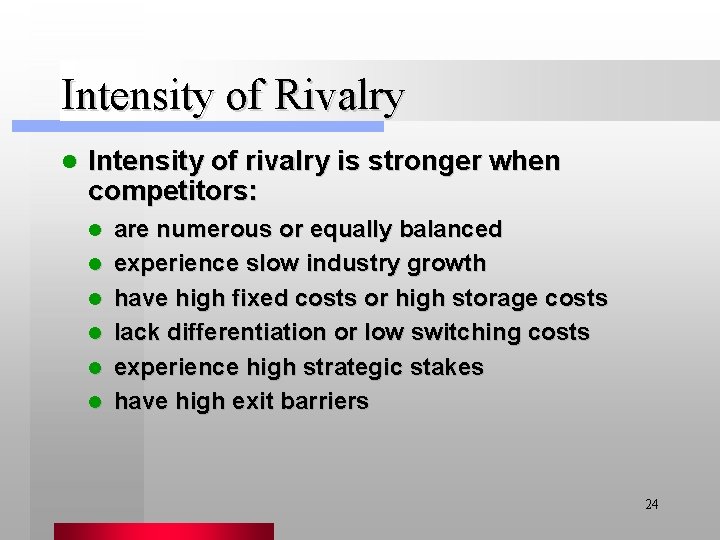
Intensity of Rivalry l Intensity of rivalry is stronger when competitors: l l l are numerous or equally balanced experience slow industry growth have high fixed costs or high storage costs lack differentiation or low switching costs experience high strategic stakes have high exit barriers 24
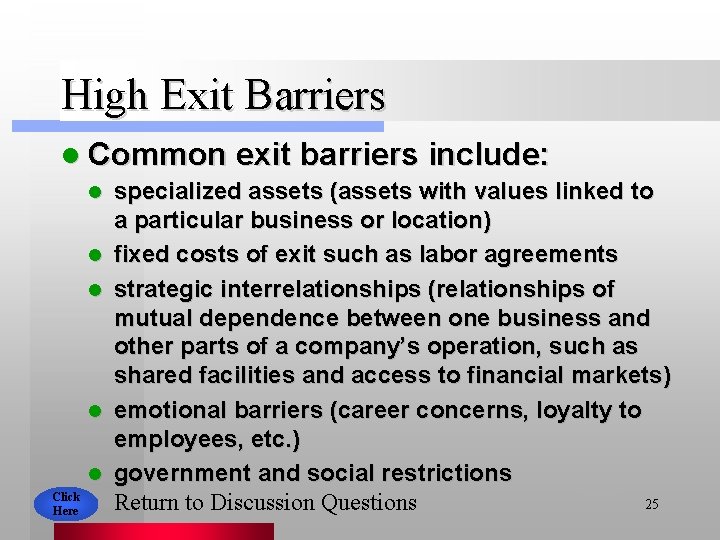
High Exit Barriers l Common exit barriers include: l l l Click Here specialized assets (assets with values linked to a particular business or location) fixed costs of exit such as labor agreements strategic interrelationships (relationships of mutual dependence between one business and other parts of a company’s operation, such as shared facilities and access to financial markets) emotional barriers (career concerns, loyalty to employees, etc. ) government and social restrictions 25 Return to Discussion Questions
Discussion Question 4 What is a strategic group and why is it an important concept? 26
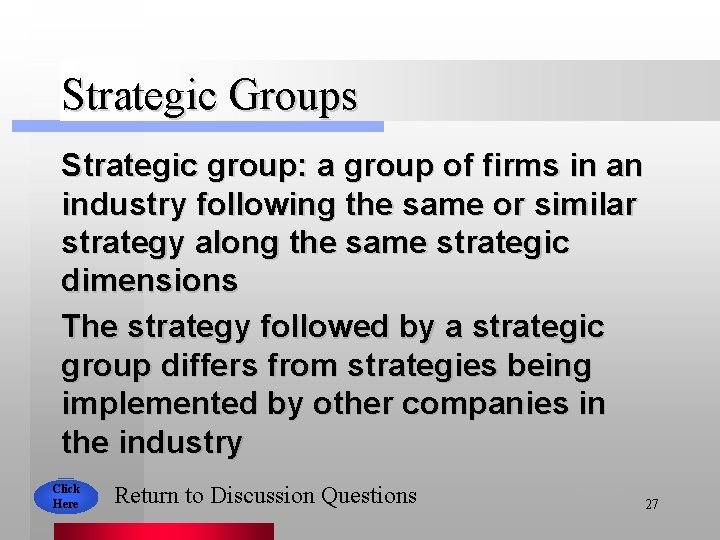
Strategic Groups Strategic group: a group of firms in an industry following the same or similar strategy along the same strategic dimensions The strategy followed by a strategic group differs from strategies being implemented by other companies in the industry Click Here Return to Discussion Questions 27
Discussion Question 5 How do you conduct a competitor analysis? 28
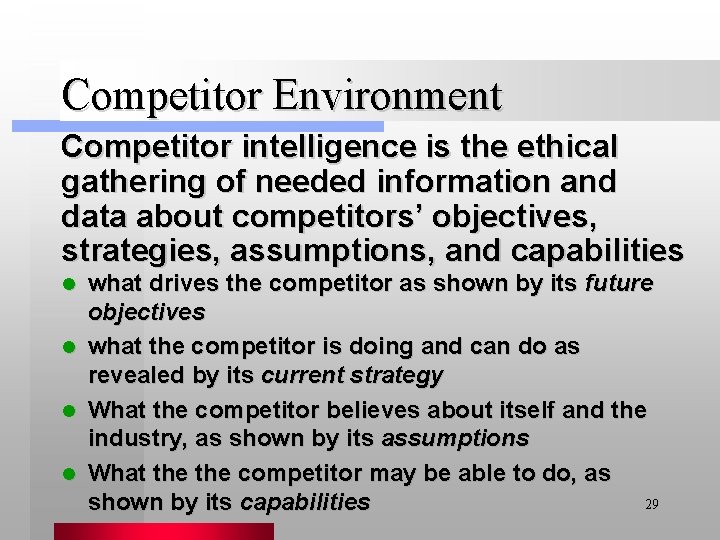
Competitor Environment Competitor intelligence is the ethical gathering of needed information and data about competitors’ objectives, strategies, assumptions, and capabilities what drives the competitor as shown by its future objectives l what the competitor is doing and can do as revealed by its current strategy l What the competitor believes about itself and the industry, as shown by its assumptions l What the competitor may be able to do, as 29 shown by its capabilities l
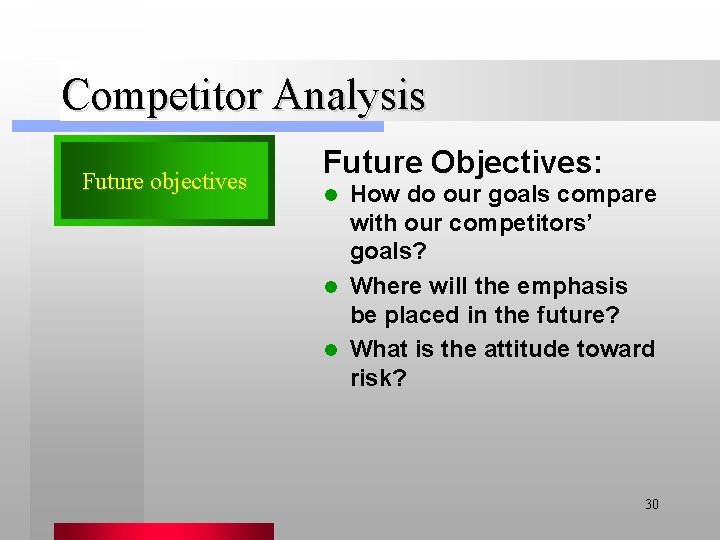
Competitor Analysis Future objectives Future Objectives: How do our goals compare with our competitors’ goals? l Where will the emphasis be placed in the future? l What is the attitude toward risk? l 30
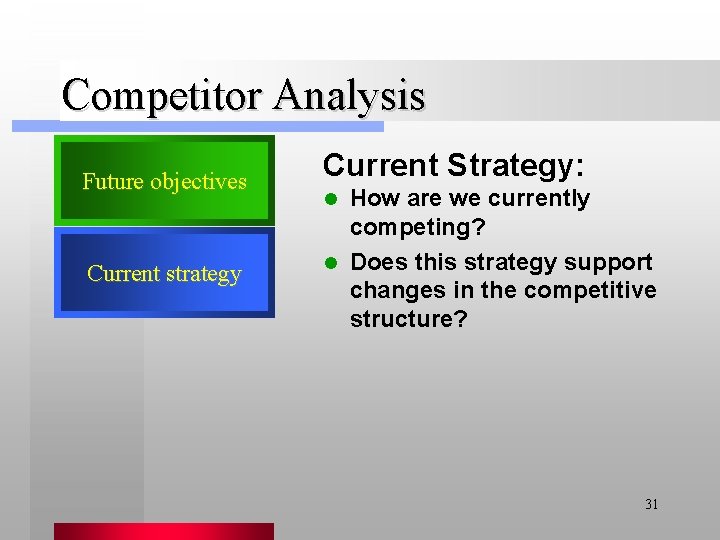
Competitor Analysis Future objectives Current strategy Current Strategy: How are we currently competing? l Does this strategy support changes in the competitive structure? l 31
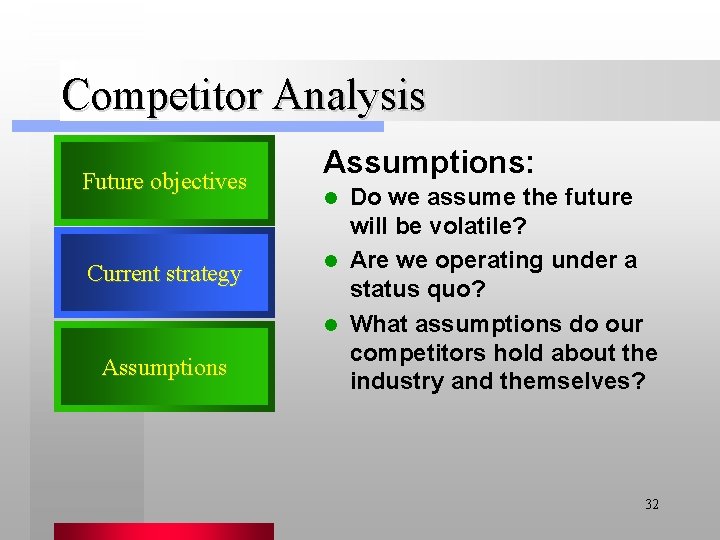
Competitor Analysis Future objectives Current strategy Assumptions: Do we assume the future will be volatile? l Are we operating under a status quo? l What assumptions do our competitors hold about the industry and themselves? l 32
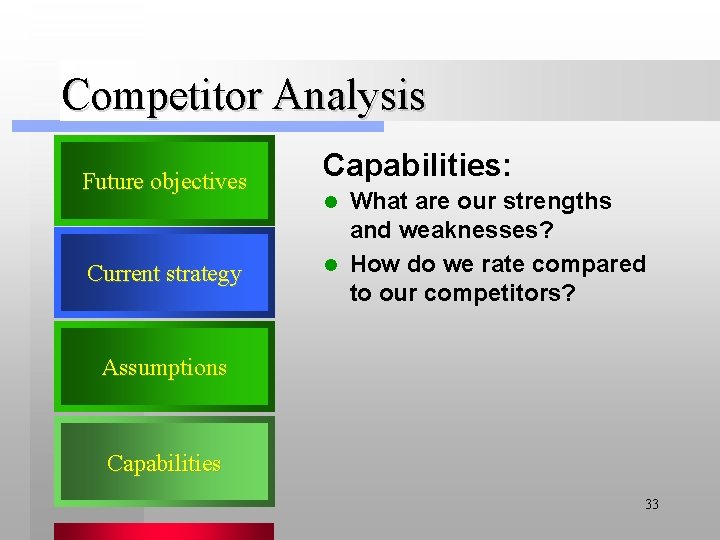
Competitor Analysis Future objectives Current strategy Capabilities: What are our strengths and weaknesses? l How do we rate compared to our competitors? l Assumptions Capabilities 33
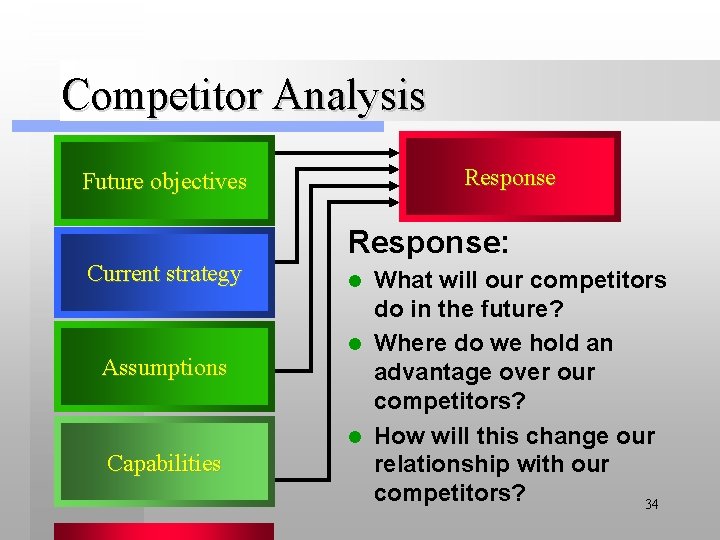
Competitor Analysis Response Future objectives Current strategy Assumptions Capabilities Response: What will our competitors do in the future? l Where do we hold an advantage over our competitors? l How will this change our relationship with our competitors? 34 l