
Chapter 3 The Emergence of Colonial Societies 1625
- Slides: 66
Chapter 3 The Emergence of Colonial Societies 1625 -1700
Introduction • By 1700, more than 250, 000 people of European ancestry, mostly English, lived in what would one day be the U. S. • During the 16 th century, 300, 000 West African slaves were brought to North America and the Caribbean – the majority to the West Indian sugar colonies and the remainder to the mainland • These great migrations from Europe and Africa resulted in the depopulation and uprooting of the native inhabitants
4 major questions: 1. Why did Chesapeake planters shift from using white indentured servants as laborers to black slaves? 2. Why did colonial New Englanders abandon John Winthrop’s vision of a “city on a hill”? 3. What were the most important differences between the Middle Colonies and other English colonial regions? 4. What factors distinguished French and Spanish colonies in mainland North America from those of England?
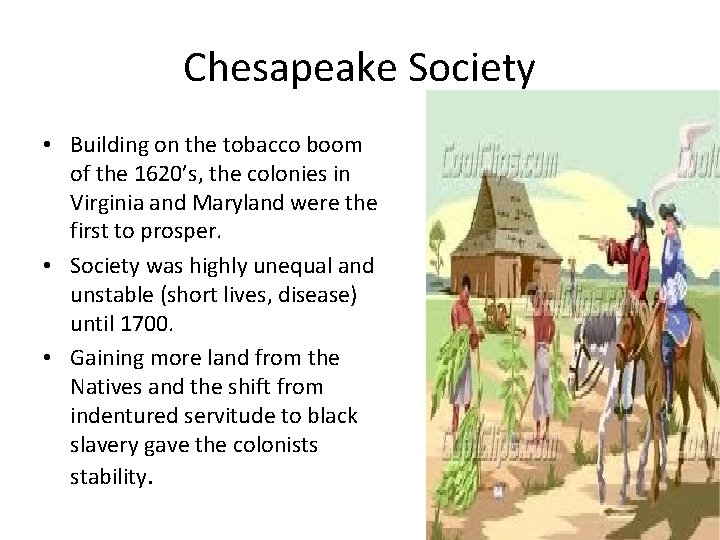
Chesapeake Society • Building on the tobacco boom of the 1620’s, the colonies in Virginia and Maryland were the first to prosper. • Society was highly unequal and unstable (short lives, disease) until 1700. • Gaining more land from the Natives and the shift from indentured servitude to black slavery gave the colonists stability.
State and Church in Virginia (cont. ) • State and Church in Virginia – 1619=Virginia Company of London granted the settlers the right to elect a representative assembly • 1622 - VA became a royal colony (one where the governor was appointed by the crown) – Settlers repeatedly petitioned the king to continue the right to elect a rep. assembly • 1639=Charles I grudgingly agreed to show support for Virginia's planters • The assembly eventually became a bicameral legislative – composed of a House of Burgesses (elected by landowners) and Royal Governor’s Council (appointed by King) • Local government had most officials appointed rather than elected
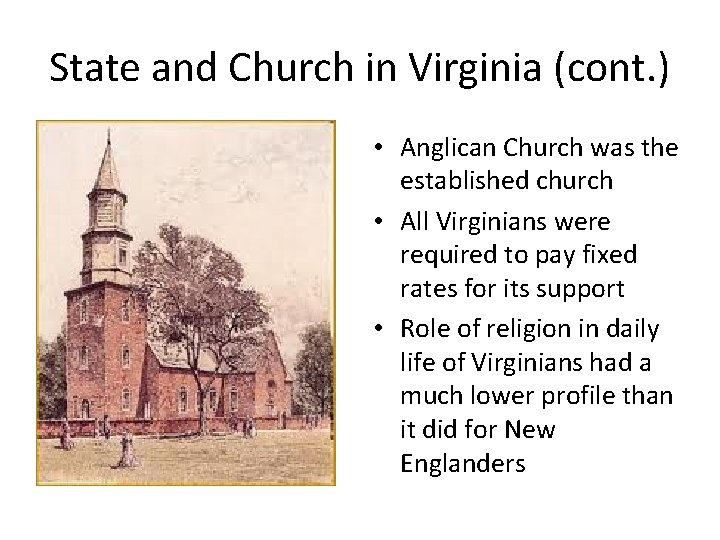
State and Church in Virginia (cont. ) • Anglican Church was the established church • All Virginians were required to pay fixed rates for its support • Role of religion in daily life of Virginians had a much lower profile than it did for New Englanders
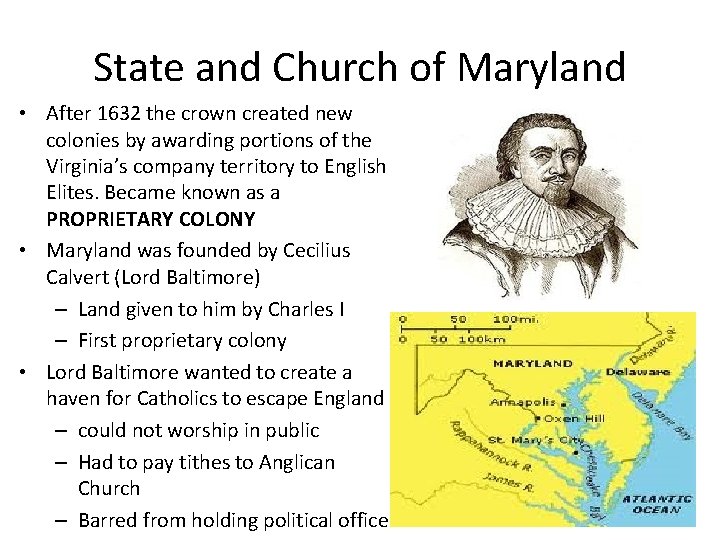
State and Church of Maryland • After 1632 the crown created new colonies by awarding portions of the Virginia’s company territory to English Elites. Became known as a PROPRIETARY COLONY • Maryland was founded by Cecilius Calvert (Lord Baltimore) – Land given to him by Charles I – First proprietary colony • Lord Baltimore wanted to create a haven for Catholics to escape England – could not worship in public – Had to pay tithes to Anglican Church – Barred from holding political office
State and Church of Maryland (cont. ) • Calvert remained in England – Governed as an absentee proprietor • More Protestants than Catholics settled in Maryland • Act of Religious Toleration- (Drafted by Lord Baltimore) – Protect Catholic minority – 1649 passed by Maryland assembly • 1654=Protestant majority disfranchised Catholics and repealed the Act • An army was raised to restore religious toleration, but it was defeated • Protestant-controlled legislature battled continuously with the proprietary and resisted any political role for the Catholic minority
Death, Gender, and Kinship • By 1700=more than 110, 000 Englishmen to Chesapeake area – Constant demand for more laborers to grow tobacco – 90% came as indentured servants (mostly male) – 1/3 males married and since there was a lack of women, favorable marriage was negotiated! • Life expectancy was 20 years shorter than in NE – Malaria, typhoid fever – 40% of servants went to grave within six years of arrival • Deaths exceeded births (only half of children would be expected to live) • Widows of the Chesapeake enjoyed greater property rights than women elsewhere • By the late 1600’s, native-born residents acquired childhood immunities and deaths from epidemics began to lessen
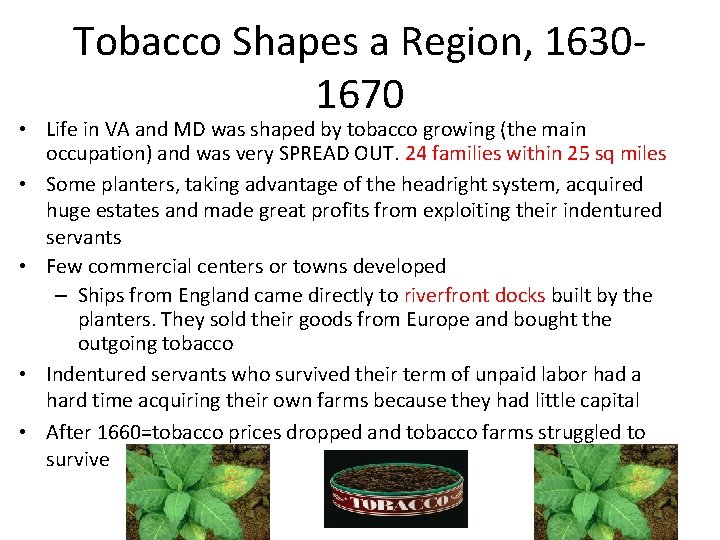
Tobacco Shapes a Region, 16301670 • Life in VA and MD was shaped by tobacco growing (the main occupation) and was very SPREAD OUT. 24 families within 25 sq miles • Some planters, taking advantage of the headright system, acquired huge estates and made great profits from exploiting their indentured servants • Few commercial centers or towns developed – Ships from England came directly to riverfront docks built by the planters. They sold their goods from Europe and bought the outgoing tobacco • Indentured servants who survived their term of unpaid labor had a hard time acquiring their own farms because they had little capital • After 1660=tobacco prices dropped and tobacco farms struggled to survive
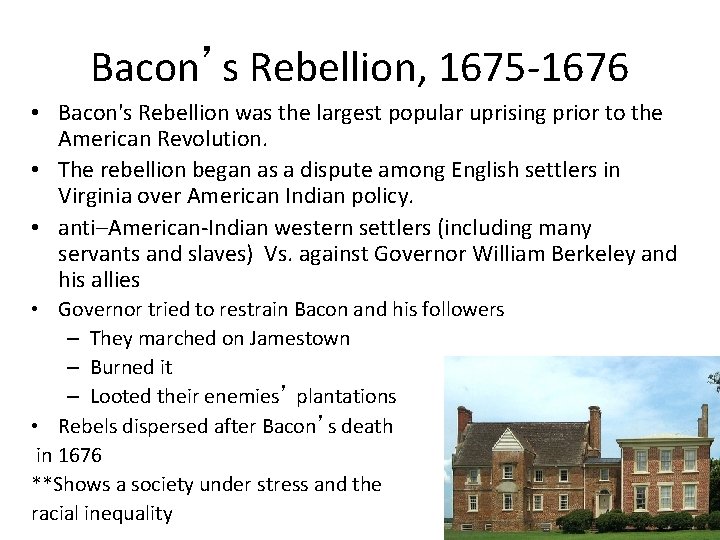
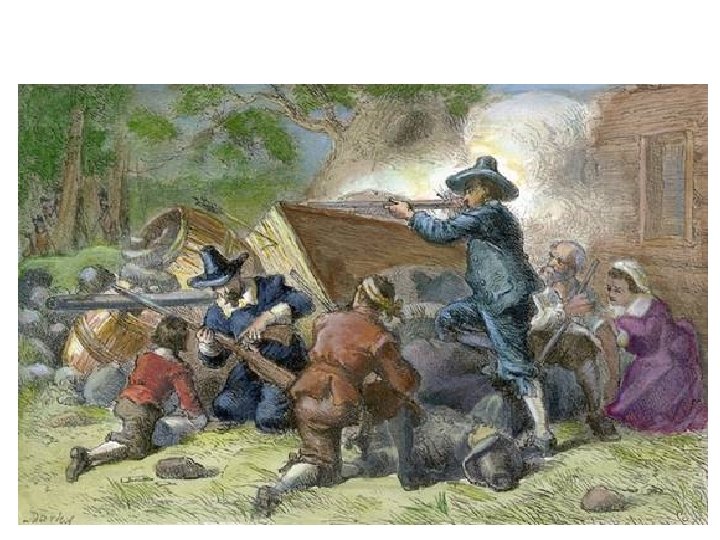
Bacon’s Rebellion, 1675 -1676 • Bacon's Rebellion was the largest popular uprising prior to the American Revolution. • The rebellion began as a dispute among English settlers in Virginia over American Indian policy. • anti–American-Indian western settlers (including many servants and slaves) Vs. against Governor William Berkeley and his allies • Governor tried to restrain Bacon and his followers – They marched on Jamestown – Burned it – Looted their enemies’ plantations • Rebels dispersed after Bacon’s death in 1676 **Shows a society under stress and the racial inequality
From Servitude to Slavery • The first African arrived in VA in 1619 – Treated initially as indentured servants • 1640 -1660 – Status deteriorated into that of lifelong slavery • After 1660, the Chesapeake colonies recognized the institution of African slavery with laws that defined the condition and rigidly controlled blacks • As late as 1660 fewer than 1, 000 slaves lived in VA and MD • Heavy importation of African slaves began in the 1680’s • By 1700 black slaves constituted 22% of the Chesapeake population
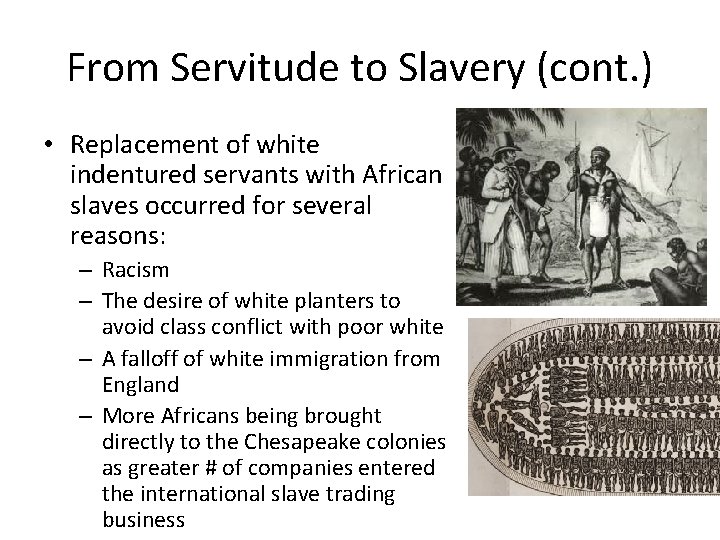
From Servitude to Slavery (cont. ) • Replacement of white indentured servants with African slaves occurred for several reasons: – Racism – The desire of white planters to avoid class conflict with poor white – A falloff of white immigration from England – More Africans being brought directly to the Chesapeake colonies as greater # of companies entered the international slave trading business
Puritanism in New England • Building a City upon a Hill, 1625 -1642 – King Charles I in 1625, began to drive out all Puritan influence from the Anglican church – Nonconforming ministers and congregation members were fined and excommunicated – 1628=a group of Puritan merchants formed the Massachusetts Bay Company • Obtained a charter from the king permitting them to establish a colony in North America • Company’s officers and stockholders would emigrate along with the settlers (Mass. Bay would not be under the control of stockholders or proprietors back in England)
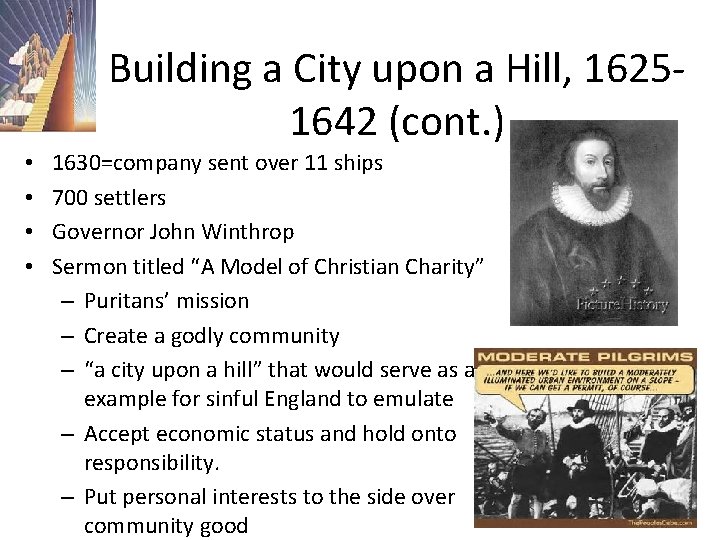
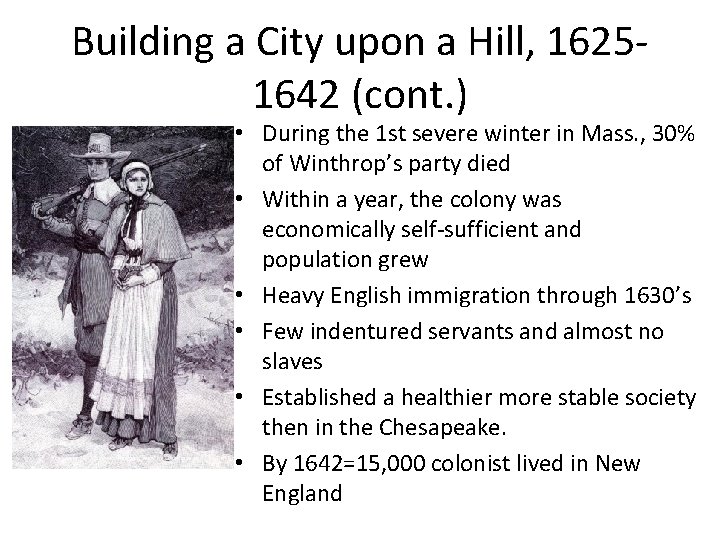
Building a City upon a Hill, 16251642 (cont. ) • • 1630=company sent over 11 ships 700 settlers Governor John Winthrop Sermon titled “A Model of Christian Charity” – Puritans’ mission – Create a godly community – “a city upon a hill” that would serve as an example for sinful England to emulate – Accept economic status and hold onto responsibility. – Put personal interests to the side over community good
Building a City upon a Hill, 16251642 (cont. ) • During the 1 st severe winter in Mass. , 30% of Winthrop’s party died • Within a year, the colony was economically self-sufficient and population grew • Heavy English immigration through 1630’s • Few indentured servants and almost no slaves • Established a healthier more stable society then in the Chesapeake. • By 1642=15, 000 colonist lived in New England
New England Ways • • • Most New Englanders belonged to the Church of England Most congregations were self-governing Ignored Anglican bishops’ authority Male “saints” controlled each congregation All residents had to attend services All residents had to pay taxes for support of the church Church must be free of state control Opposed theocracy (govt. by clergy) Required cooperation between church and state Levied taxes to support local churches
New England Ways (cont. ) • Candidates for membership had to stand before their congregation and provide convincing, soul-baring “relation” (or account) of their conversion experience • Familiarity with the Bible • Education should begin in childhood – Towns over 50 households had to appoint a teacher – Towns over 100 households had to have a grammar school • first steps toward public education • Harvard College – 1636 – Supply ministers trained in the New England Way – 1642 -1671=201 graduates (111 ministers) • Only part of English America to produce its own clergy and collegeeducated elite before 1700
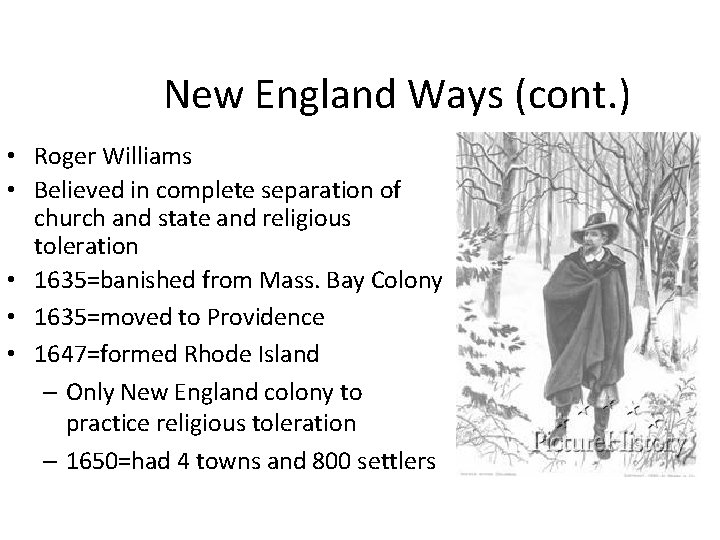
New England Ways (cont. ) • Roger Williams • Believed in complete separation of church and state and religious toleration • 1635=banished from Mass. Bay Colony • 1635=moved to Providence • 1647=formed Rhode Island – Only New England colony to practice religious toleration – 1650=had 4 towns and 800 settlers
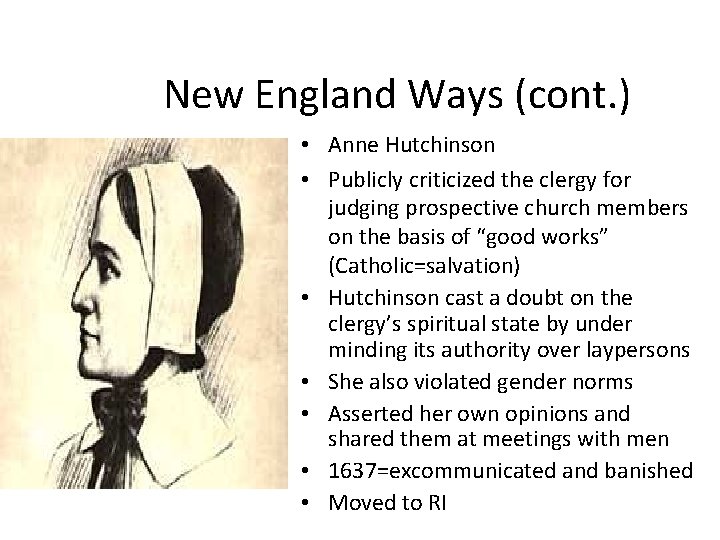
New England Ways (cont. ) • Anne Hutchinson • Publicly criticized the clergy for judging prospective church members on the basis of “good works” (Catholic=salvation) • Hutchinson cast a doubt on the clergy’s spiritual state by under minding its authority over laypersons • She also violated gender norms • Asserted her own opinions and shared them at meetings with men • 1637=excommunicated and banished • Moved to RI
Towns, Families, and Farm Life • All New England colonies provided for the establishment of towns- Distributed land themselves – Made sure that colonists would settle in communities with congregations – Families were granted no more land than was needed to support themselves. Promote unity by keeping people tightly clustered – Live in house lots near the town center • “In a proper Puritan family, the wife, children, and servants dutifully obeyed the household’s male head. ”
Towns, Families, and Farm Life (cont. ) • Puritans were allowed to divorce even though it happened rarely. • Atmosphere of mutual watchfulness- promote godly order • Healthy families were vital for the welfare of the community – COMMUNITY OF WOMEN • Courts could and discipline disobedient children, wives, and servants, and irresponsible husbands • Puritans followed English common law in giving the wife no property rights independent of her husband’s – She had significantly more rights than Englishwomen on matters such as spousal abuse and nonsupport
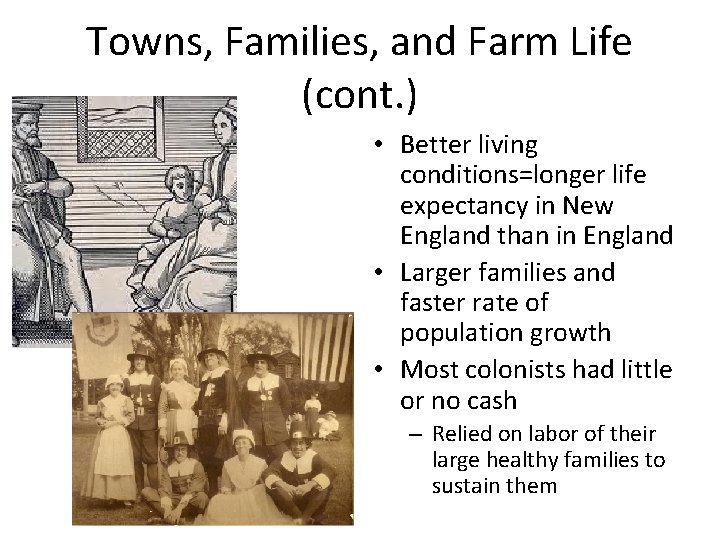
Towns, Families, and Farm Life (cont. ) • Better living conditions=longer life expectancy in New England than in England • Larger families and faster rate of population growth • Most colonists had little or no cash – Relied on labor of their large healthy families to sustain them
Towns, Families, and Farm Life (cont. ) • Rocky soil and a short growing season made it unlikely that anyone would become rich from agriculture • New Englanders seeking better opportunities turned to part-or-full time lumbering, fishing, rum distilling, and commerce • As they prospered, – became more worldly and materialistic. . SHIFT OF VALUES – less preoccupied with religion
Economic and Religious Tension • The most fundamental threat was that colonists would abandon the ideal of a close-knit community to pursue self-interest • Govt. leaders tried to limit prices so consumers would not suffer from chronic shortage of manufactured goods • Conflicts often developed between Puritan clergy and farming elite vs. merchants (messing with my $!) • Political and religious leaders sought to insulate their city upon a hill from the competitiveness and pursuit of self-interest basic to a market economy
Economic and Religious Tension (cont. ) • 1660=Some farmers wanted to expand their agricultural output and provide land for their sons – They voted themselves larger amounts of land – Insisted their scattered parcels be consolidated – Many farmers built houses away from the center of town – **CLOSE KNIT COMMUNITY WAS GIVING AWAY TO A MORE INDIVIDUALISTIC SOCIETY. • Isn’t this why they left ENGLAND in the first place? ?
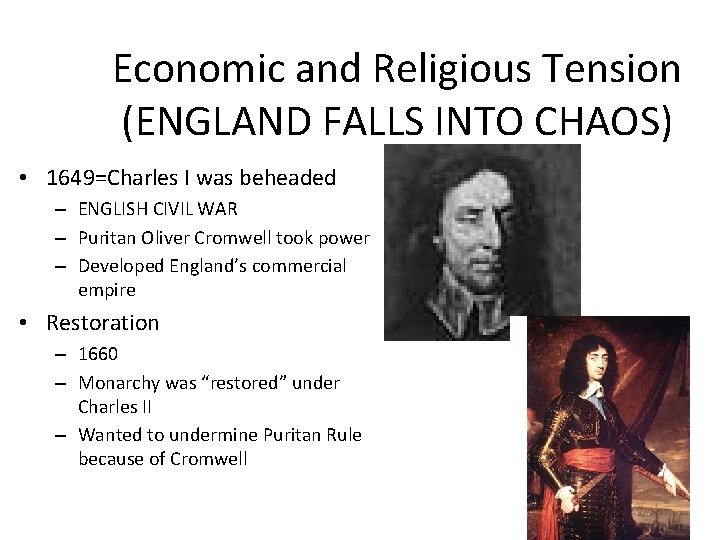
Economic and Religious Tension (ENGLAND FALLS INTO CHAOS) • 1649=Charles I was beheaded – ENGLISH CIVIL WAR – Puritan Oliver Cromwell took power – Developed England’s commercial empire • Restoration – 1660 – Monarchy was “restored” under Charles II – Wanted to undermine Puritan Rule because of Cromwell
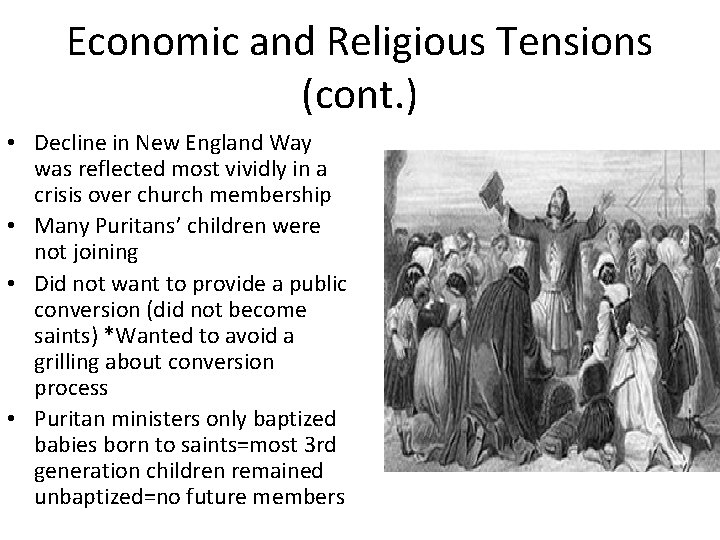
Economic and Religious Tensions (cont. ) • Decline in New England Way was reflected most vividly in a crisis over church membership • Many Puritans’ children were not joining • Did not want to provide a public conversion (did not become saints) *Wanted to avoid a grilling about conversion process • Puritan ministers only baptized babies born to saints=most 3 rd generation children remained unbaptized=no future members
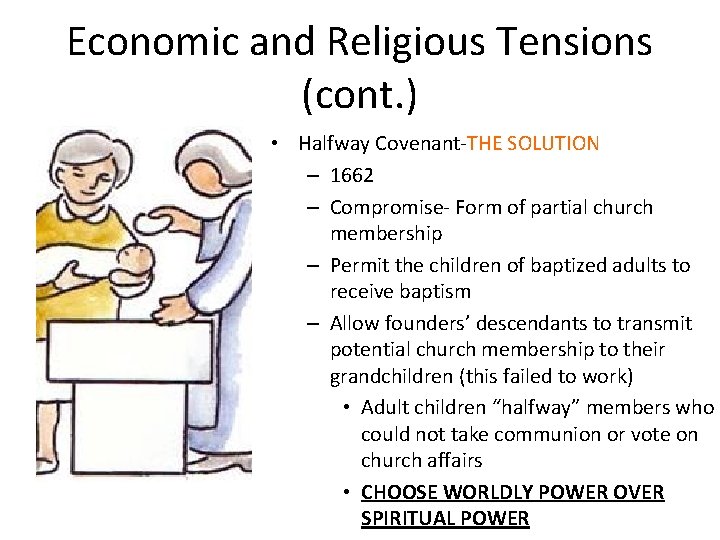
Economic and Religious Tensions (cont. ) • Halfway Covenant-THE SOLUTION – 1662 – Compromise- Form of partial church membership – Permit the children of baptized adults to receive baptism – Allow founders’ descendants to transmit potential church membership to their grandchildren (this failed to work) • Adult children “halfway” members who could not take communion or vote on church affairs • CHOOSE WORLDLY POWER OVER SPIRITUAL POWER
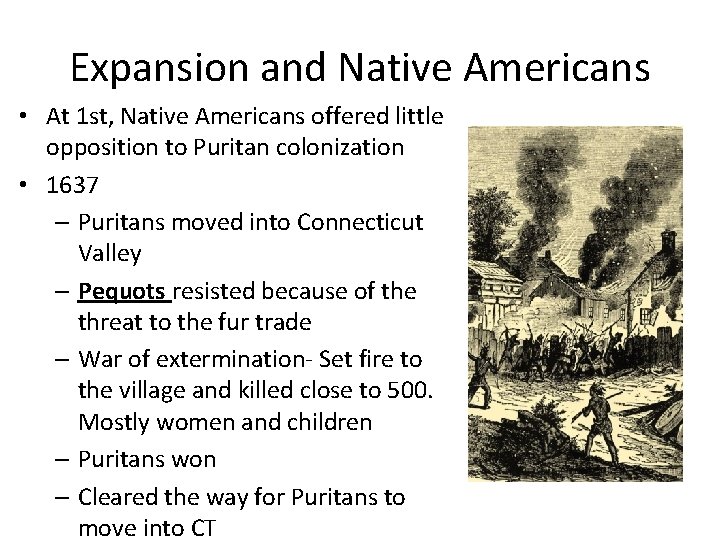
Expansion and Native Americans • At 1 st, Native Americans offered little opposition to Puritan colonization • 1637 – Puritans moved into Connecticut Valley – Pequots resisted because of the threat to the fur trade – War of extermination- Set fire to the village and killed close to 500. Mostly women and children – Puritans won – Cleared the way for Puritans to move into CT
Expansion and Native Americans (cont. ) • European settlers increased and prospered=Indian population declined – Died from diseases brought by the Europeans • Diphtheria, measles, tuberculosis – Food supply reduced • Europeans cut down forests which took away Indian hunting areas • New England’s Indian population – 1600=125, 000 – 1675=10, 000 • Native Americans were demoralized – Turned to alcohol – Convert to Christianity – Moved and lived in “praying towns”
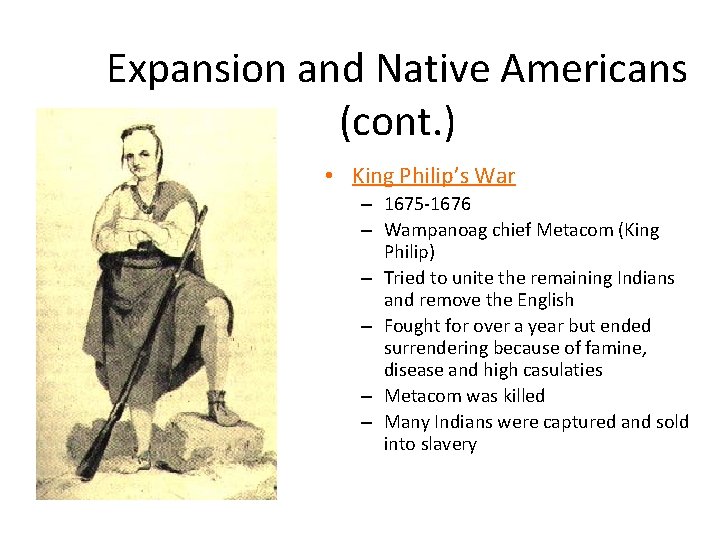
Expansion and Native Americans (cont. ) • King Philip’s War – 1675 -1676 – Wampanoag chief Metacom (King Philip) – Tried to unite the remaining Indians and remove the English – Fought for over a year but ended surrendering because of famine, disease and high casulaties – Metacom was killed – Many Indians were captured and sold into slavery
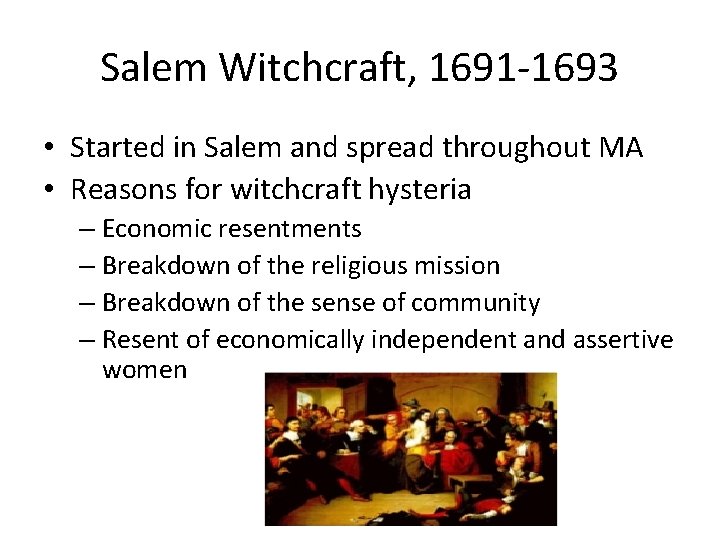
Salem Witchcraft, 1691 -1693 • Started in Salem and spread throughout MA • Reasons for witchcraft hysteria – Economic resentments – Breakdown of the religious mission – Breakdown of the sense of community – Resent of economically independent and assertive women
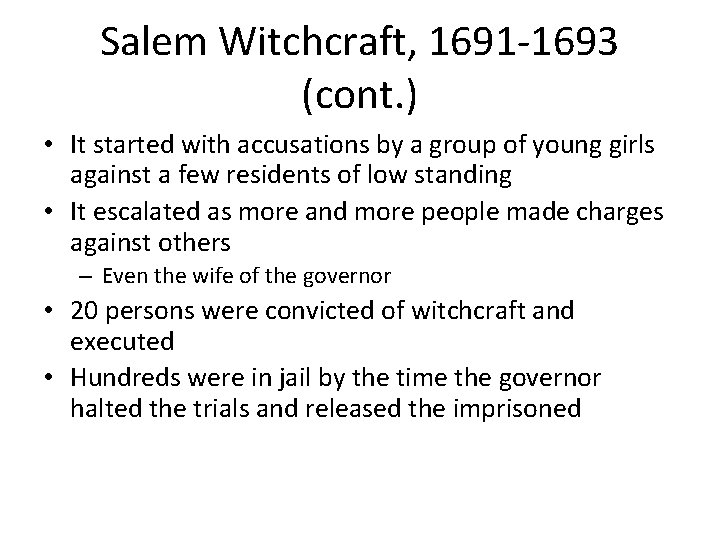
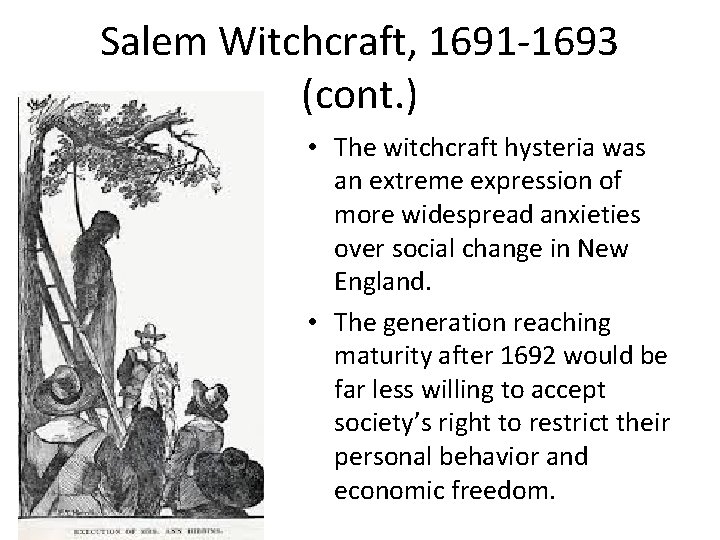
Salem Witchcraft, 1691 -1693 (cont. ) • It started with accusations by a group of young girls against a few residents of low standing • It escalated as more and more people made charges against others – Even the wife of the governor • 20 persons were convicted of witchcraft and executed • Hundreds were in jail by the time the governor halted the trials and released the imprisoned
Salem Witchcraft, 1691 -1693 (cont. ) • The witchcraft hysteria was an extreme expression of more widespread anxieties over social change in New England. • The generation reaching maturity after 1692 would be far less willing to accept society’s right to restrict their personal behavior and economic freedom.
The Spread of Slavery: The Caribbean and Carolina • Between 1630 and 1642, almost 60% of English migrants headed for the Caribbean – West Indies developed a plantation-slave economy • Concentrating on sugar growing • Some of these English colonists later resettled in the Chesapeake and Carolina colonies and brought their slaves with them • By 1710, black slaves made up the majority of the Carolina inhabitants
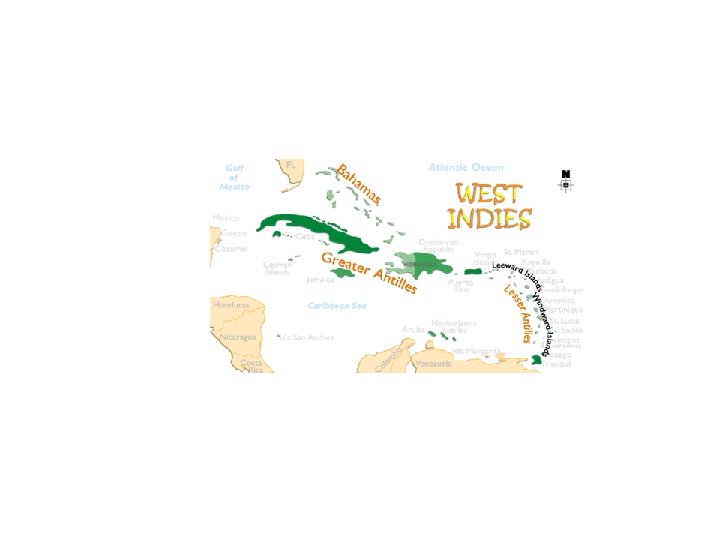
Sugar and Slaves: The West Indies • The islands of the West Indies were colonized by each of the major North American European colonialist countries – Spain, France, England, and Netherlands • Tobacco was the 1 st export – Raised primarily with the labor of white indentured servants
Sugar and Slaves: The West Indies (cont. ) • 1640’s most switched to sugar growing – Required more workers than tobacco – Planters imported more and more slaves • Until 1713, blacks outnumbered whites by 4 to 1
Rice and Slaves: Carolina • 1663=King Charles II gave a group of his English supporters a grant of land in America – Named Carolina in his honor • Proprietors adopted the headright system to attract colonists – Most settlers came from English mainland Barbados – Some French Huguenots (Protestants)
Rice and Slaves: Carolina (cont. ) • Northern Carolinians – Cultivated tobacco – Exported tobacco, lumber, pitch • Southern Carolinians – Raised livestock • Neither region used many black slaves • Used own family as labor
Rice and Slaves: Carolina (cont. ) • By 1690’s, southern Carolinians found a staple crop that would make them rich--rice • You needed sufficient capital to start to grow rice though – Invest in costly dams, dikes, slaves • Large-scale rice production became fabulously wealthy • Only mainland elite that was a wealthy as West Indians sugar planters
Rice and Slaves: Carolina (cont. ) • Humid rice patties were swarming with malaria-bearing mosquitoes – Large # of indentured English servants died rapidly – Planters’ solution was to import Africans who they believed were immune to the malaria and who were experts on growing rice
Rice and Slaves: Carolina (cont. ) • Black population in South Carolina grew • South Carolina was the only mainland British colony with an African majority • Southern Carolinian whites also allied themselves with the Yamasees and Creeks to capture Indians living in Spanish FL and sell them into slavery, mostly in the West Indies
The Middle Colonies • Precursors: New Netherland New Sweden – Dutch-founded fur-trading colony of New Netherland became America’s first multiethnic society • Population included Dutch, Germans, Swedes, Africans (free and slave) • Protestants, Catholics, Jews, Muslims • 18 different languages
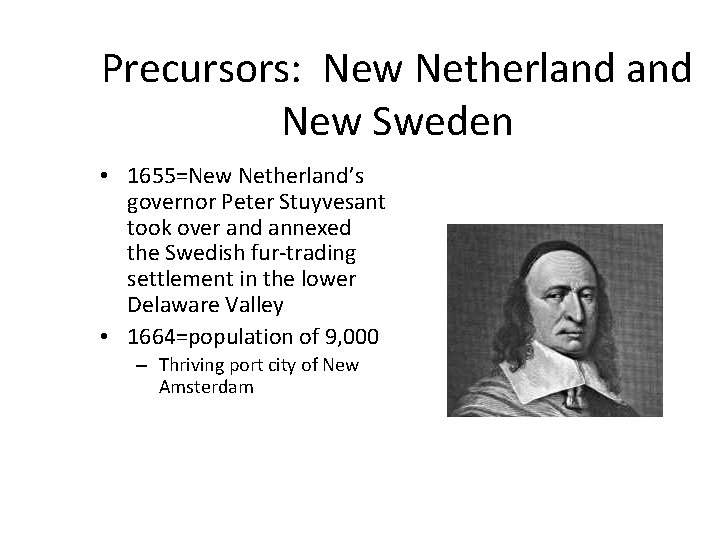
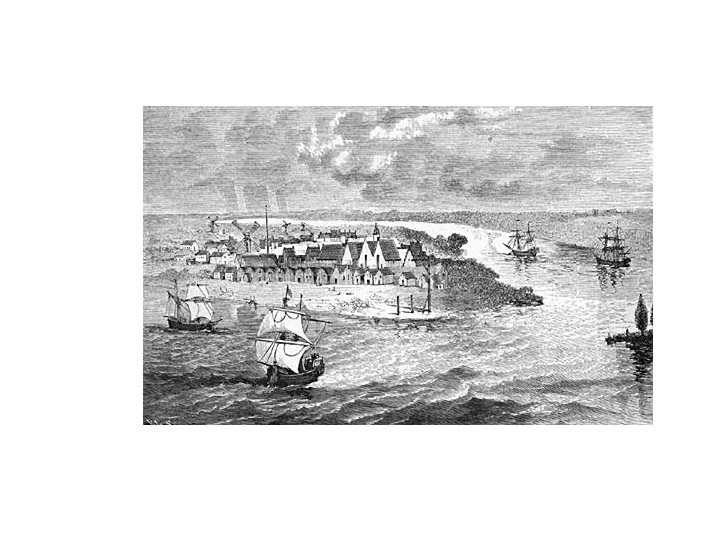
Precursors: New Netherland New Sweden • 1655=New Netherland’s governor Peter Stuyvesant took over and annexed the Swedish fur-trading settlement in the lower Delaware Valley • 1664=population of 9, 000 – Thriving port city of New Amsterdam
English Conquests: New York and New Jersey • 1664 Charles II presented the seized Dutch colony, New Netherland, to his brother James, Duke of York • James renamed it New York • Most of the Dutch settlers were allowed to keep their land remained in the colony
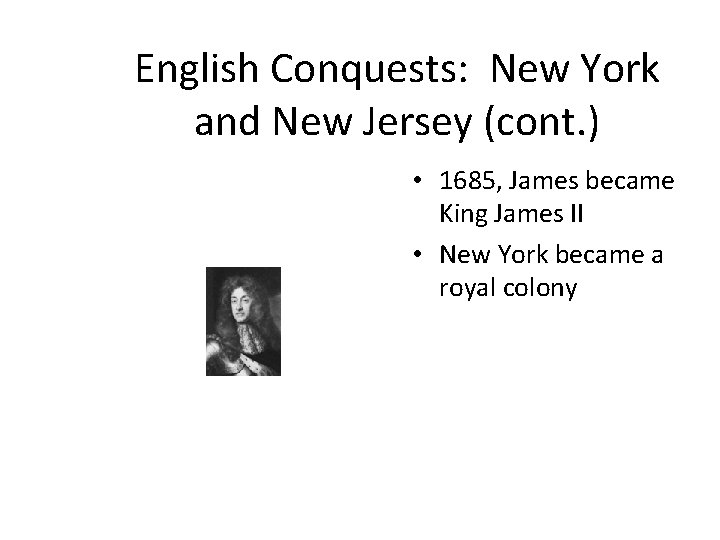
English Conquests: New York and New Jersey (cont. ) • 1685, James became King James II • New York became a royal colony
English Conquests: New York and New Jersey (cont. ) • The British royal governors rewarded their loyal followers with immense land grants, mostly along the Hudson River from New York to Albany (pg. 77 and 79) • These manor lords grew almost as wealthy as South Carolina rice planters – Rents they collected from their tenant farmers
English Conquests: New York and New Jersey (cont. ) • James gave part of the former New Netherland (which became to be known as the Jerseys) to a group of proprietors (led by Lord Berkeley and Sir Philip Carteret) • Settlers were mix of New England Puritans, Quakers, Anglicans, Scottish Presbyterians, and Swedish Lutherans – Quarreled often with each other • 1702 the crown took over NJ and it became a royal colony
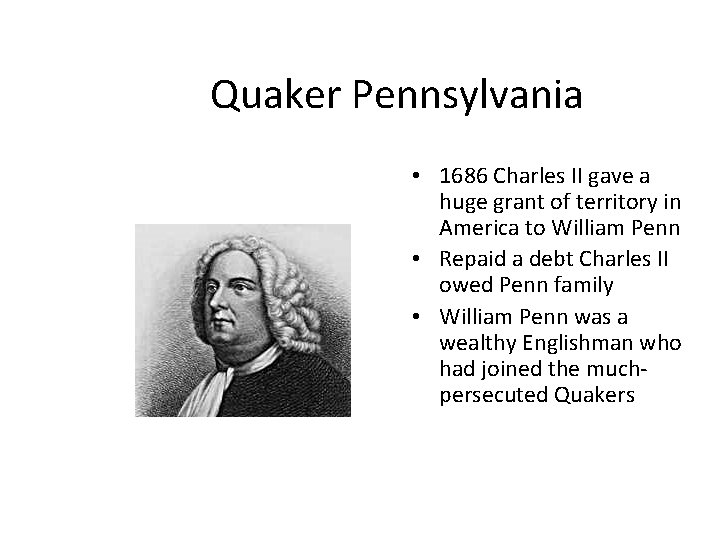
Quaker Pennsylvania • 1686 Charles II gave a huge grant of territory in America to William Penn • Repaid a debt Charles II owed Penn family • William Penn was a wealthy Englishman who had joined the muchpersecuted Quakers
Quaker Pennsylvania (cont. ) • Penn wanted to base the colony on Quaker principles that would offer a haven to his fellow worshipers • And he wanted to make a profit • 1681=laid out Philadelphia and started the settlement there • Quaker teachings he included: – No established church – Allowed people of all faiths to settle
Quaker Pennsylvania (cont. ) • He also drafted a constitution • Created a legislative assembly to give residents a voice in running the colony • Good relations with the Indians • Settlers prospered by growing grains on the fertile land selling the grain to the West Indies
Quaker Pennsylvania (cont. ) • Trade made Philadelphia a major port by 1700 • Population quickly expanded through natural increase and immigration • Some of the colonist resented Penn and his requests for rent – Swedes and Dutch in lower Delaware caused the most problems – 1704, gained the right to elect their own legislature – Separated from the rest of PA – Formed the colony of Delaware
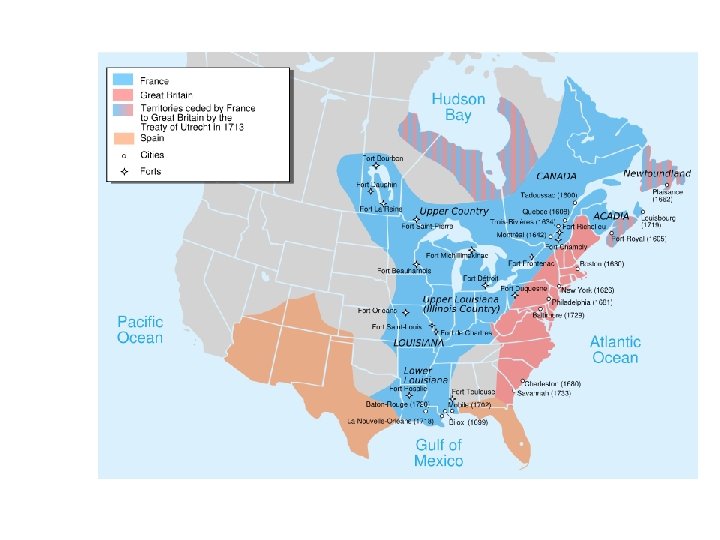
Rivals for North America: France and Spain • France Claims a Continent – French empire spread inland – 1660’s and 1670’s, Louis XIV sent 600 settlers yearly – Fur traders and missionaries – Spread out the Ohio Valley – Explored the Mississippi from WI to Gulf of Mexico
France Claims a Continent (cont. ) • By early 1700’s, French claimed the entire Mississippi basin – Called it Louisiana – Erected forts – Started fur-trading centers at Mobile, AL and Biloxi, MS – Few Frenchmen lived in this vast empire but many of those who did mingled with the Indians, carrying out fur trade
New Mexico: The Pueblo Revolt • Spain attempted to strengthen her hold on NM by subjugating the Pueblo Indians • Franciscan missionaries forced the natives to abandon their traditional way of life and convert to and practice Catholicism • Spanish landowners compelled the Indians to labor on their encomiendas • By the 1670’s, Spanish exploitation and years of drought left many Indians starving, while diseases brought by Europeans decimated their numbers
New Mexico: The Pueblo Revolt (cont. ) • 1680 Pueblo Revolt – Led by Pope • An Indian religious figure – Attempt to drive out Spanish of NM – Most successful Indian uprising in American history – Rebellion lasted until 1700 • Indians forced the Spanish to abolish the encomiendas and the forced conversions
Florida and Texas • Florida – Guale, Timucua, Apalachee Indians rebelled periodically against Spanish coerced labor and conversions – 1680’s situation further deteriorated when the English in Carolina and their Creek allies began invading FL and carrying off Indians to sell in the slave trade
Florida and Texas • Texas – France’s establishment of LA further challenged the Spanish – Spanish responded by finding the province of Texas (Tejas) in 1699 – White settlement did not begin there until 1716
Conclusion • By 1700, European nations had staked claims to most of the territory in the present-day U. S. A. east of the Mississippi River • Spanish and French North America empires were the largest territories – Low #’s of Spaniards precluded their development as a major center of colonization – French resided mostly in the St. Lawrence Valley • Commercial-agrarian economic plan • Smaller than the English
Conclusion (cont. ) • English colonies along the Atlantic coast • Most European settlers – New England • transformed from its religious beginnings to embrace a market economy based on trade and commerce – Chesapeake • revolved around tobacco growing planters who had converted from dependence on a white indentured servant work force to one of enslaved Africans
Conclusion (cont. ) • West Indies – British sugar planters had imported huge #’s of enslaved Africans • Slaves made up majority of population • Carolina rice growers had a plantation-slave economy – Created a black majority by 1700 • Middle colonies – Built on Dutch and Swedish predecessors – Greatest ethnic diversity and religious pluralism – Free market economies