
Chapter 3 The Decision Usefulness Approach to Financial
- Slides: 16
Chapter 3 The Decision Usefulness Approach to Financial Reporting Copyright © 2009 by Pearson Education Canada 3 -1
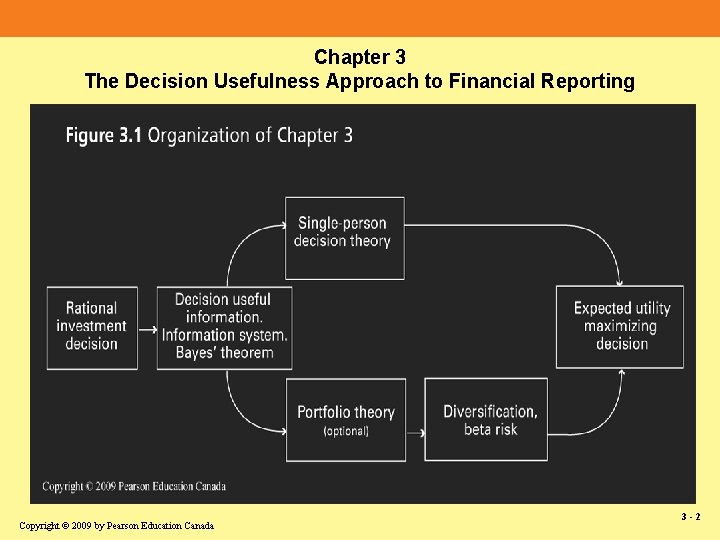
Chapter 3 The Decision Usefulness Approach to Financial Reporting Copyright © 2009 by Pearson Education Canada 3 -2
3. 2 The Decision Usefulness Approach • It is the investor’s responsibility to make investment decisions • Role of financial reporting is to supply information that is useful for this purpose • To prepare useful information, the accountant must know how investors make decisions Copyright © 2009 by Pearson Education Canada 3
3. 3 The Rational Decision Theory Model • A model of rational decision making in the face of uncertainty – Definition of rationality? • A game against nature: “nature does not think” • Other ways to make decisions? » Continued Copyright © 2009 by Pearson Education Canada 4
3. 3 The Rational Decision Theory Model (continued) • Role of the rational decision theory model in financial reporting – Helps us understand how financial statement information helps investors to make investment decisions – Captures average investor behaviour? Copyright © 2009 by Pearson Education Canada 5
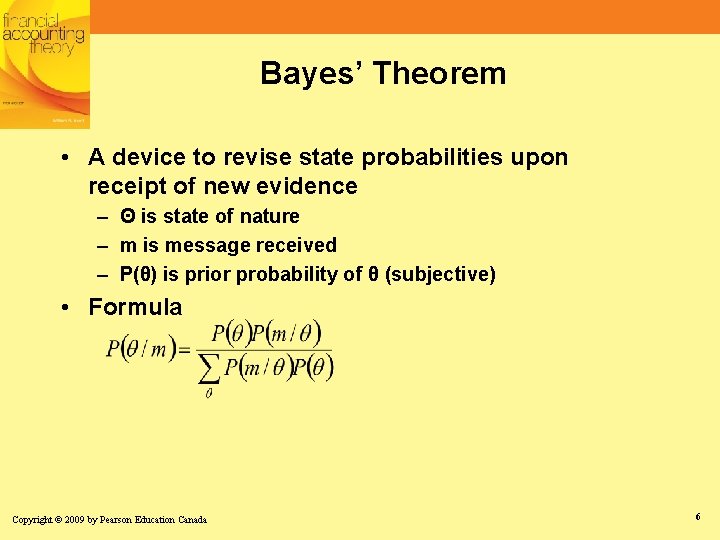
Bayes’ Theorem • A device to revise state probabilities upon receipt of new evidence – Θ is state of nature – m is message received – P(θ) is prior probability of θ (subjective) • Formula Copyright © 2009 by Pearson Education Canada 6
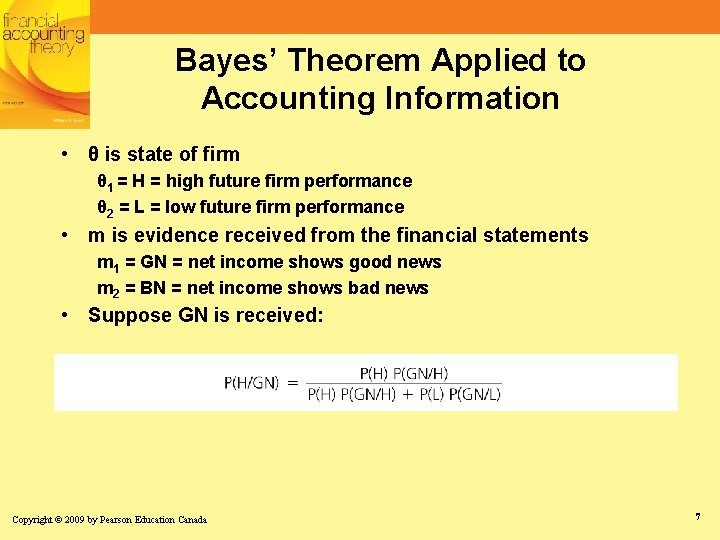
Bayes’ Theorem Applied to Accounting Information • θ is state of firm θ 1 = H = high future firm performance θ 2 = L = low future firm performance • m is evidence received from the financial statements m 1 = GN = net income shows good news m 2 = BN = net income shows bad news • Suppose GN is received: Copyright © 2009 by Pearson Education Canada 7
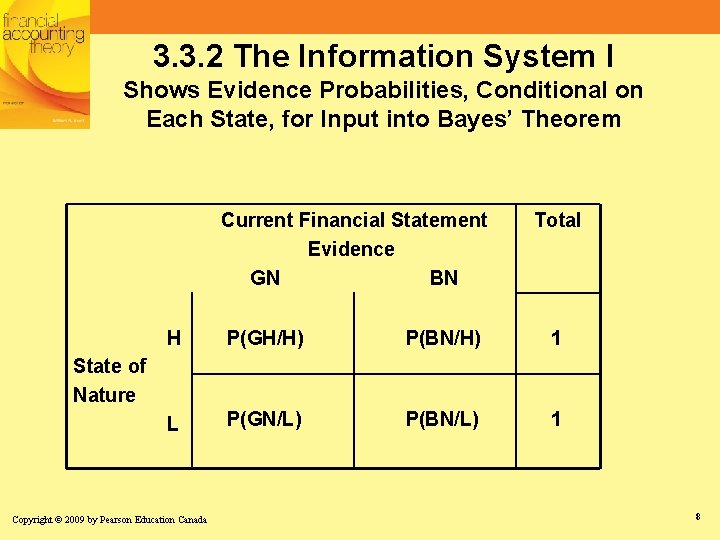
3. 3. 2 The Information System I Shows Evidence Probabilities, Conditional on Each State, for Input into Bayes’ Theorem Current Financial Statement Evidence GN BN Total H P(GH/H) P(BN/H) 1 L P(GN/L) P(BN/L) 1 State of Nature Copyright © 2009 by Pearson Education Canada 8
The Information System II • The higher the main diagonal probabilities, the better the investor can predict the state of nature (i. e. , future firm performance) – The main diagonal probabilities capture financial statement informativeness – Highly informative financial statements also called: • Transparent • Precise • High quality Copyright © 2009 by Pearson Education Canada 9
The Information System III • Information system probabilities are objective – Reflect quality of GAAP – How known by investor? • Prior probabilities are subjective – Investor assesses them based on all information available prior to the investment decision Copyright © 2009 by Pearson Education Canada 10
The Information System IV • If prior probabilities are subjective, so are posterior probabilities – However, if financial statement information is informative, posterior probabilities are better predictors of future firm performance than prior probabilities Copyright © 2009 by Pearson Education Canada 11
3. 3. 3 Definition of Information • Information is evidence that has the potential to affect an individual’s decision Copyright © 2009 by Pearson Education Canada 12
Theory of Investment • Points to note: – – The rational investor Risk aversion Portfolio diversification beta Copyright © 2009 by Pearson Education Canada 13
3. 8 Do Professional Accounting Bodies Accept the Rational Decision Theory? • SFAC 1 – – Oriented to investors Oriented to rational investment decisions Accepts that investors are risk averse Financial statements provide information to help investors assess (posterior probabilities of) the amounts, timing, and uncertainty of investment proceeds (i. e. , of future firm performance) • Note that Bayes’ theorem is implied » Continued Copyright © 2009 by Pearson Education Canada 14
3. 8 Do Professional Accounting Bodies Accept the Rational Decision Theory? (continued) • SFAC 2 – To help investors, financial statement information should be: • Relevant – Can “make a difference” • Reliable – Faithful representation – Verifiable – Neutral Copyright © 2009 by Pearson Education Canada 15
Conclusions • Rational decision theory provides a theoretical underpinning for study of information needs of investors • Conceptual framework SFAC 1 and SFAC 2 accept the rational decision theory model Copyright © 2009 by Pearson Education Canada 16