
Chapter 3 The Biological Bases of Behavior Communication
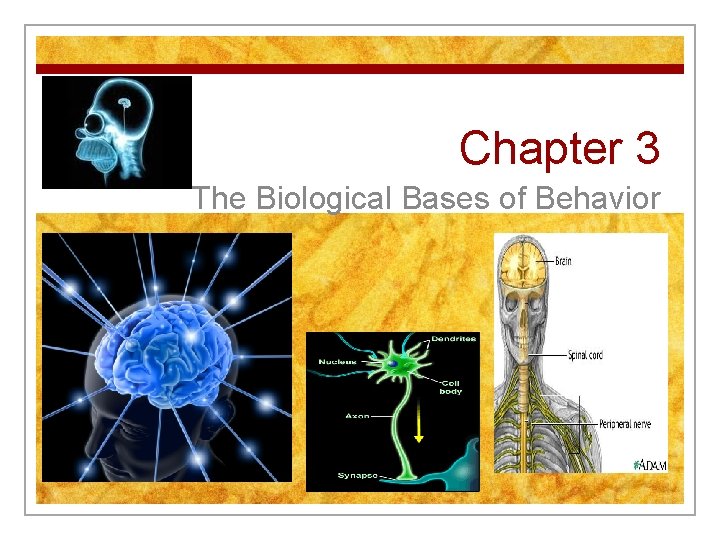
Chapter 3 The Biological Bases of Behavior
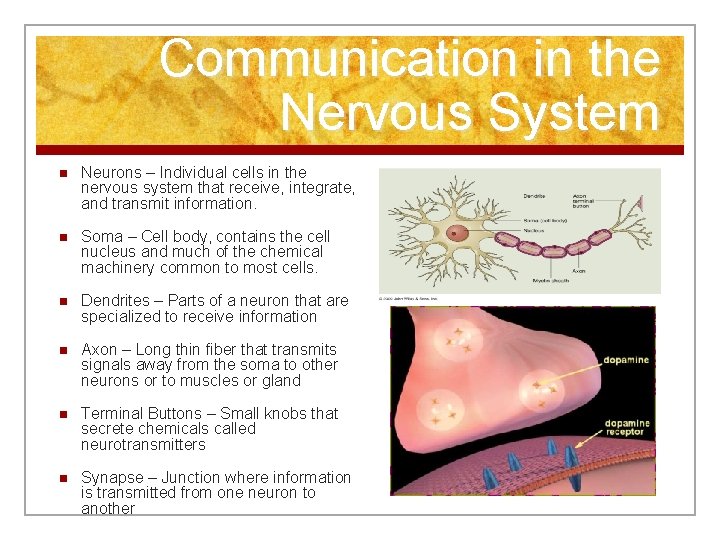
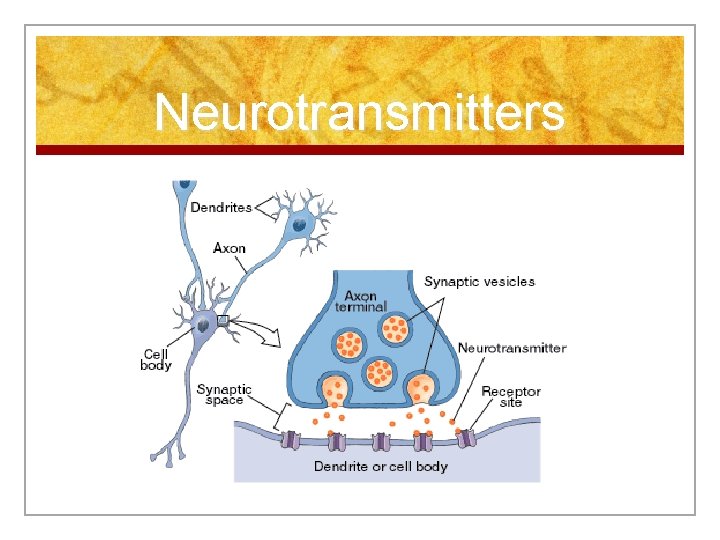
Communication in the Nervous System n Neurons – Individual cells in the nervous system that receive, integrate, and transmit information. n Soma – Cell body, contains the cell nucleus and much of the chemical machinery common to most cells. n Dendrites – Parts of a neuron that are specialized to receive information n Axon – Long thin fiber that transmits signals away from the soma to other neurons or to muscles or gland n Terminal Buttons – Small knobs that secrete chemicals called neurotransmitters n Synapse – Junction where information is transmitted from one neuron to another
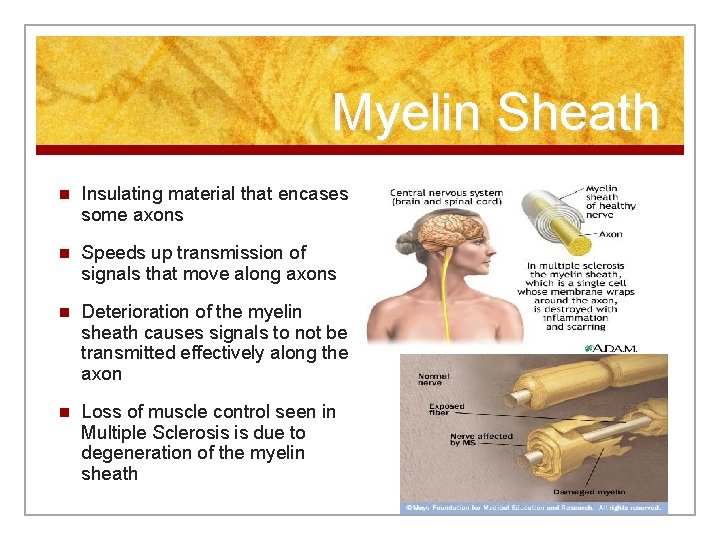
Myelin Sheath n Insulating material that encases some axons n Speeds up transmission of signals that move along axons n Deterioration of the myelin sheath causes signals to not be transmitted effectively along the axon n Loss of muscle control seen in Multiple Sclerosis is due to degeneration of the myelin sheath
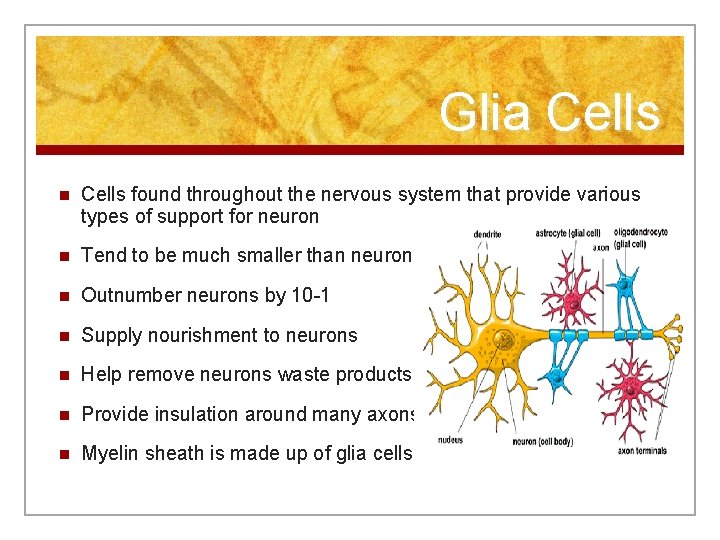
Glia Cells n Cells found throughout the nervous system that provide various types of support for neuron n Tend to be much smaller than neurons n Outnumber neurons by 10 -1 n Supply nourishment to neurons n Help remove neurons waste products n Provide insulation around many axons n Myelin sheath is made up of glia cells

The Neural Impulse Resting Potential n Inside and outside of the neuron are fluids containing electrically charged atoms and molecules called ions. n Positively charged sodium and potassium ions and negatively charged chloride ions flow back and forth across the cell membrane, but not at the same rate. n A higher concentration of negatively charged chloride ions inside the cell causes a resting potential n Resting Potential – Stable, negative charge when the cell is
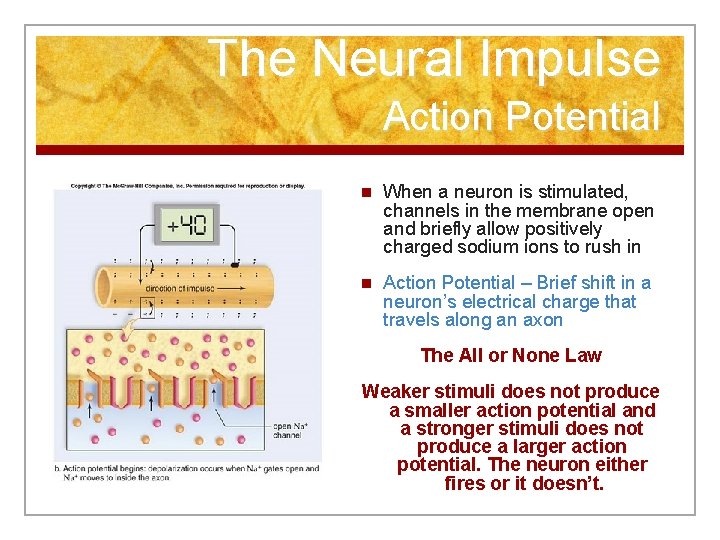
The Neural Impulse Action Potential n When a neuron is stimulated, channels in the membrane open and briefly allow positively charged sodium ions to rush in n Action Potential – Brief shift in a neuron’s electrical charge that travels along an axon The All or None Law Weaker stimuli does not produce a smaller action potential and a stronger stimuli does not produce a larger action potential. The neuron either fires or it doesn’t.
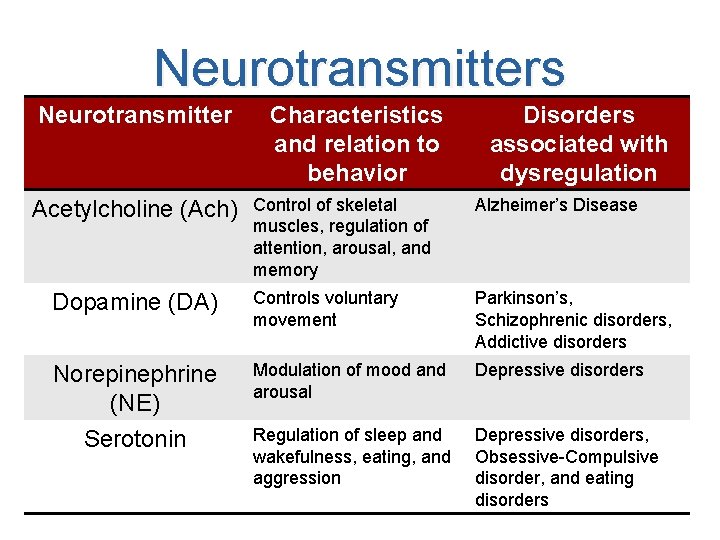
Neurotransmitters Neurotransmitter Characteristics and relation to behavior Disorders associated with dysregulation Control of skeletal muscles, regulation of attention, arousal, and memory Alzheimer’s Disease Dopamine (DA) Controls voluntary movement Parkinson’s, Schizophrenic disorders, Addictive disorders Norepinephrine (NE) Serotonin Modulation of mood and arousal Depressive disorders Regulation of sleep and wakefulness, eating, and aggression Depressive disorders, Obsessive-Compulsive disorder, and eating disorders Acetylcholine (Ach)
Neurotransmitters
The Nervous System
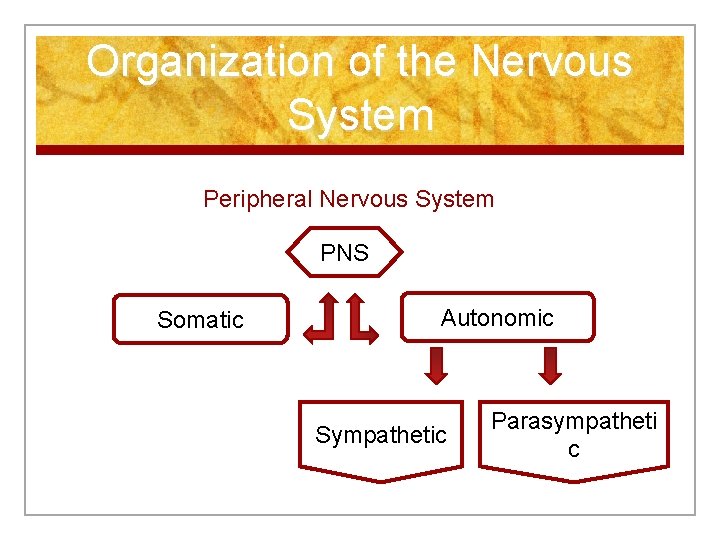
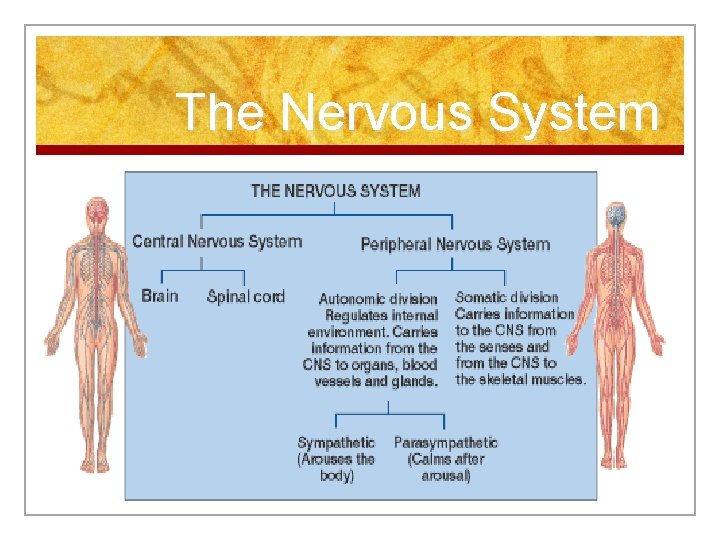
Organization of the Nervous System Peripheral Nervous System PNS Somatic Autonomic Sympathetic Parasympatheti c
Peripheral Nervous System n Made up of nerves that lie outside of the brain and spinal cord n Nerves – Bundles of neuron fibers (axons) that are routed together in the peripheral nervous system n Subdivided into the Somatic and Autonomic Nervous system
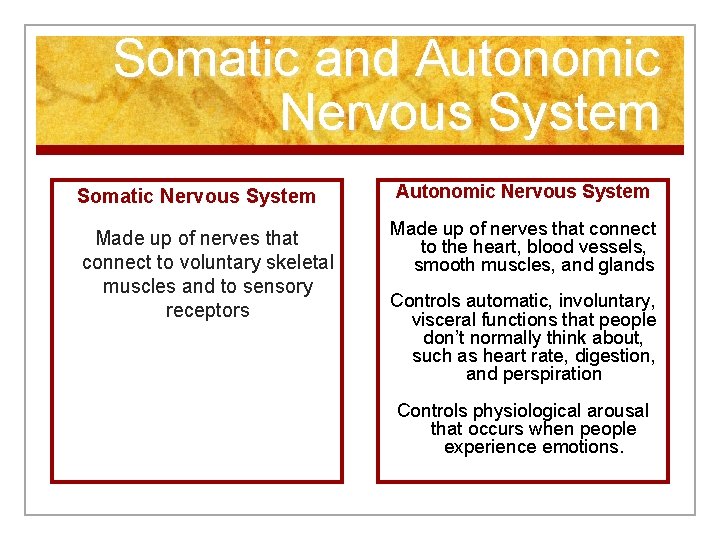
Somatic and Autonomic Nervous System Somatic Nervous System Made up of nerves that connect to voluntary skeletal muscles and to sensory receptors Autonomic Nervous System Made up of nerves that connect to the heart, blood vessels, smooth muscles, and glands Controls automatic, involuntary, visceral functions that people don’t normally think about, such as heart rate, digestion, and perspiration Controls physiological arousal that occurs when people experience emotions.
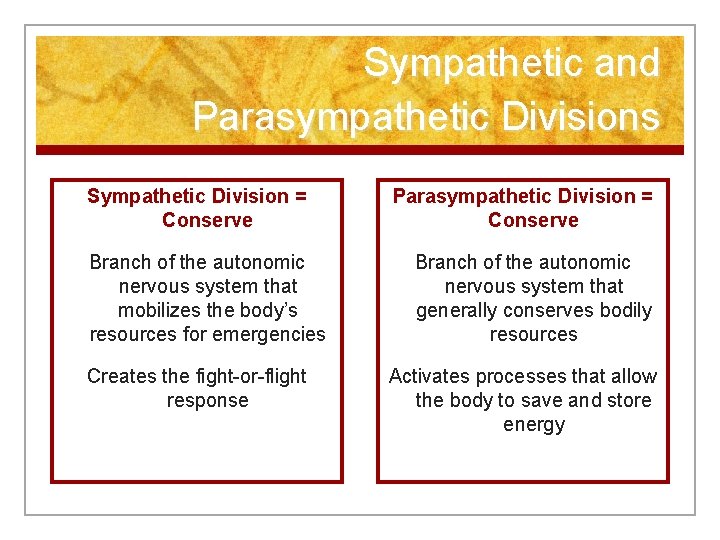
Sympathetic and Parasympathetic Divisions Sympathetic Division = Conserve Branch of the autonomic nervous system that mobilizes the body’s resources for emergencies Creates the fight-or-flight response Parasympathetic Division = Conserve Branch of the autonomic nervous system that generally conserves bodily resources Activates processes that allow the body to save and store energy
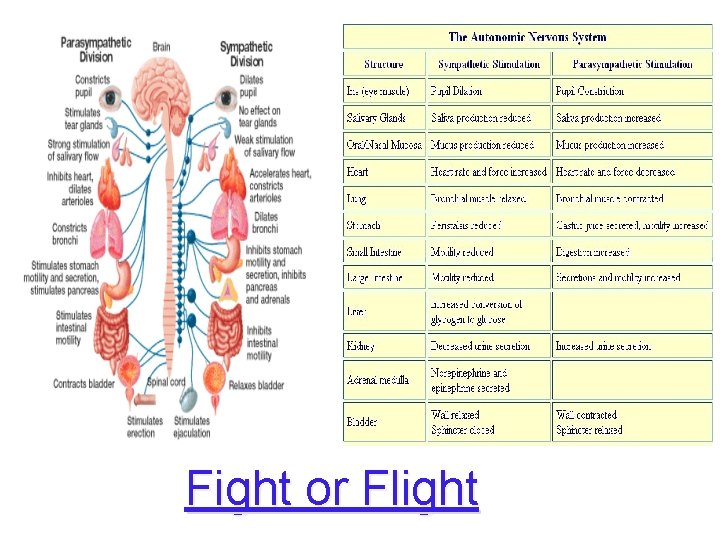
Fight or Flight
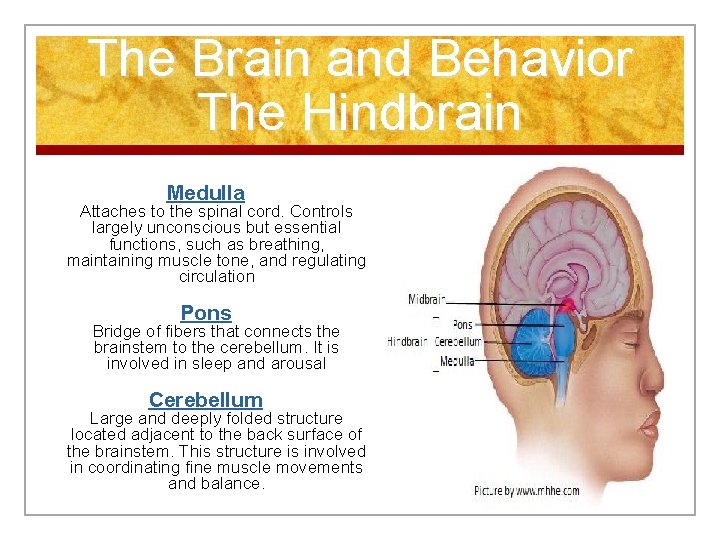
The Brain and Behavior The Hindbrain Medulla Attaches to the spinal cord. Controls largely unconscious but essential functions, such as breathing, maintaining muscle tone, and regulating circulation Pons Bridge of fibers that connects the brainstem to the cerebellum. It is involved in sleep and arousal Cerebellum Large and deeply folded structure located adjacent to the back surface of the brainstem. This structure is involved in coordinating fine muscle movements and balance.
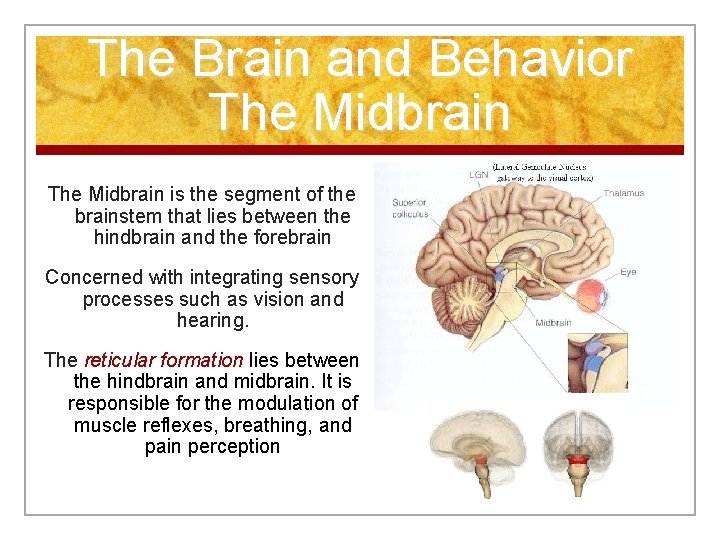
The Brain and Behavior The Midbrain is the segment of the brainstem that lies between the hindbrain and the forebrain Concerned with integrating sensory processes such as vision and hearing. The reticular formation lies between the hindbrain and midbrain. It is responsible for the modulation of muscle reflexes, breathing, and pain perception
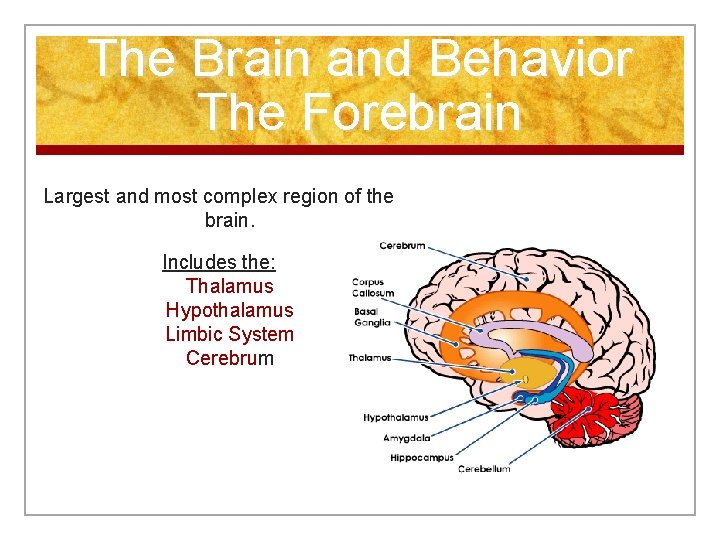
The Brain and Behavior The Forebrain Largest and most complex region of the brain. Includes the: Thalamus Hypothalamus Limbic System Cerebrum
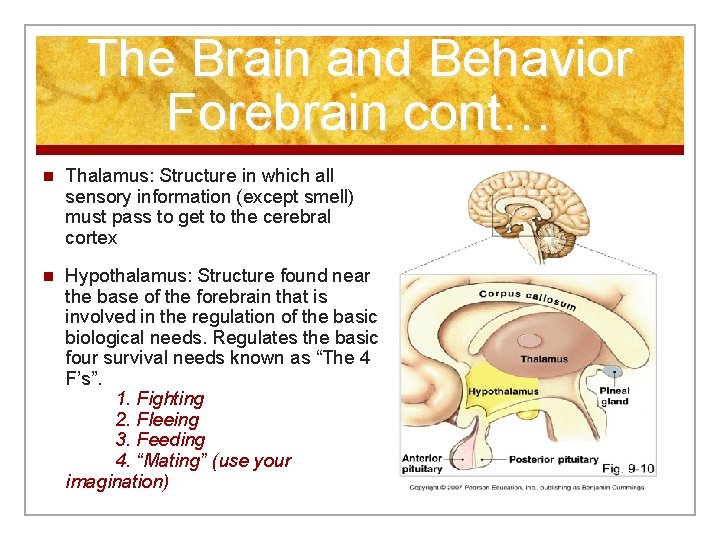
The Brain and Behavior Forebrain cont… n Thalamus: Structure in which all sensory information (except smell) must pass to get to the cerebral cortex n Hypothalamus: Structure found near the base of the forebrain that is involved in the regulation of the basic biological needs. Regulates the basic four survival needs known as “The 4 F’s”. 1. Fighting 2. Fleeing 3. Feeding 4. “Mating” (use your imagination)
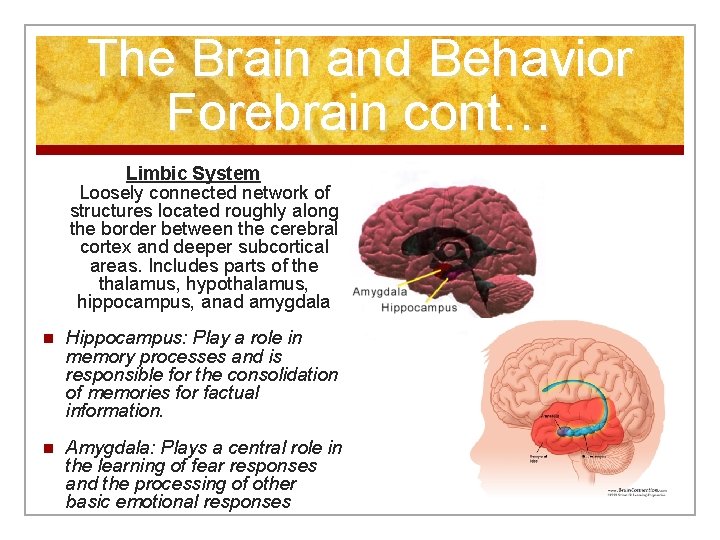
The Brain and Behavior Forebrain cont… Limbic System Loosely connected network of structures located roughly along the border between the cerebral cortex and deeper subcortical areas. Includes parts of the thalamus, hypothalamus, hippocampus, anad amygdala n Hippocampus: Play a role in memory processes and is responsible for the consolidation of memories for factual information. n Amygdala: Plays a central role in the learning of fear responses and the processing of other basic emotional responses
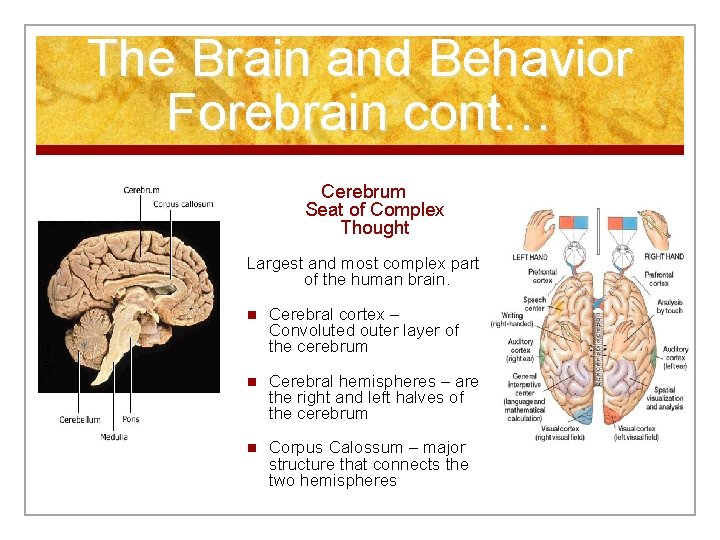
The Brain and Behavior Forebrain cont… Cerebrum Seat of Complex Thought Largest and most complex part of the human brain. n Cerebral cortex – Convoluted outer layer of the cerebrum n Cerebral hemispheres – are the right and left halves of the cerebrum n Corpus Calossum – major structure that connects the two hemispheres
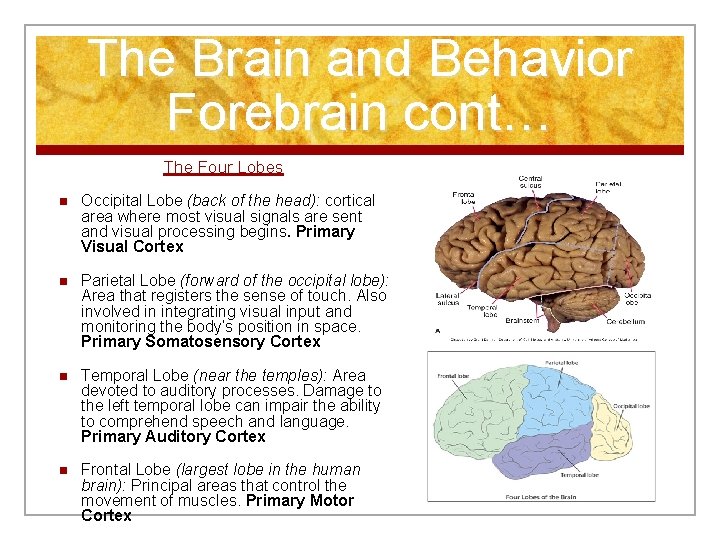
The Brain and Behavior Forebrain cont… The Four Lobes n Occipital Lobe (back of the head): cortical area where most visual signals are sent and visual processing begins. Primary Visual Cortex n Parietal Lobe (forward of the occipital lobe): Area that registers the sense of touch. Also involved in integrating visual input and monitoring the body’s position in space. Primary Somatosensory Cortex n Temporal Lobe (near the temples): Area devoted to auditory processes. Damage to the left temporal lobe can impair the ability to comprehend speech and language. Primary Auditory Cortex n Frontal Lobe (largest lobe in the human brain): Principal areas that control the movement of muscles. Primary Motor Cortex
- Slides: 21