
Chapter 3 The Basics of Digestion 2012 Pearson
Chapter 3 The Basics of Digestion © 2012 Pearson Education, Inc.
Objectives for Chapter 3 § § § § § Define digestion, absorption, and nutrient transport. Describe the organs involved in digestion and their primary functions. Explain the roles of the gallbladder, liver, and pancreas in digestion. Explain the role of enzymes in digestion. List the main carbohydrate-, protein-, and fat-digesting enzymes and the tissues that secrete them. Identify the hormones involved in digestion, including their primary action and their source of origin. Explain the role of the small intestine, villi, and microvilli in digestion. Explain how the circulatory and lymphatic systems transport absorbed nutrients throughout the body. Describe the symptoms and causes of the most common digestive disorders. Nutrition and You, 2 e © 2012 Pearson Education, Inc.
What Makes Eating So Enjoyable? Hunger and thirst: physical needs which drive how much and how often we eat Appetite: another powerful drive, but unreliable w Influenced by food preferences and psychological stimulation w May eat without being hungry or needing nourishment Nutrition and You, 2 e © 2012 Pearson Education, Inc.
We Develop a Taste for Certain Foods Taste: Five basic categories w Detected by at least 10, 000 taste buds mostly on tongue, but also throat and elsewhere in mouth w Sweet: tip of tongue w Salty: sides of tongue w Sour: sides of tongue w Bitter: back of tongue w Savory (umami): throughout mouth; not all people are sensitive to this taste sensation Nutrition and You, 2 e © 2012 Pearson Education, Inc.
We Develop a Taste for Certain Foods w Humans share an innate preference for sweet (pleasure), salty (electrolytes), and fatty (rich textures and aromas) foods w Sometimes food preferences and nutritional needs conflict and make changing food choices challenging w Brain recognizes taste: food dissolves in saliva, contacts the tongue surface, taste cells send nerve impulses to brain, translated into taste sensations Nutrition and You, 2 e © 2012 Pearson Education, Inc.
Aromas and Flavors Enhance the Pleasure of Eating Both mouth and nose contribute to tasting of foods w Aromas detected by olfactory cells in nasal cavity as food odors enter both nose and mouth (move to back of throat and into nasal cavity) w Flavor refers to both taste and aroma w Example: Chocolate tastes sweet but its flavor is “chocolate” Nutrition and You, 2 e © 2012 Pearson Education, Inc.
What Is Digestion and Why Is It Important? Digestion: a multi-step process of breaking down foods into absorbable components using mechanical and chemical means in the gastrointestinal (GI) tract § Gastrointestinal tract consists of: w Mouth w Esophagus w Stomach w Small and large intestines w Other organs w https: //www. khanacademy. org/science/health-and-medicine/human-anatomy-andphysiology/Gastrointestinal-system-introduction/v/meet-the-gastrointestinal-tract Nutrition and You, 2 e © 2012 Pearson Education, Inc.
What Is Digestion and Why Is It Important? § Main roles of the GI tract are to: w Break down food into smallest components w Absorb nutrients w Prevent microorganism or other harmful compounds in food from entering tissues of the body § GI tract is about 23 feet long with extensive surface area for nutrient absorption w Cells lining GI tract are replaced every three to five days Nutrition and You, 2 e © 2012 Pearson Education, Inc.
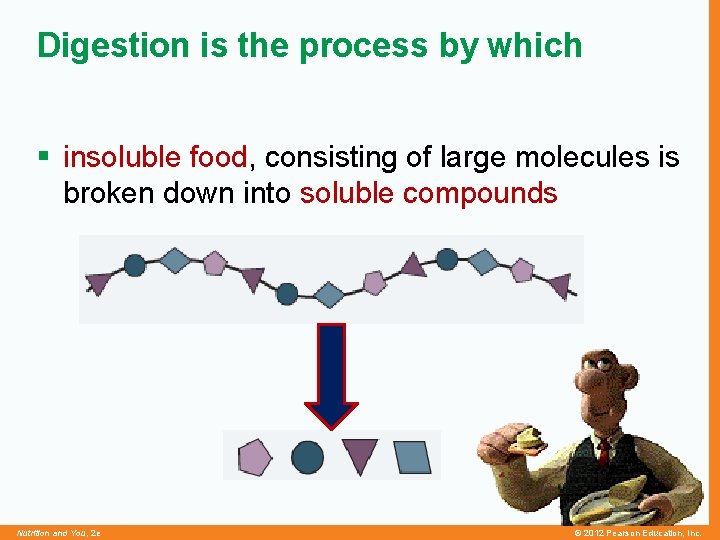
Digestion is the process by which § insoluble food, consisting of large molecules is broken down into soluble compounds Nutrition and You, 2 e © 2012 Pearson Education, Inc.
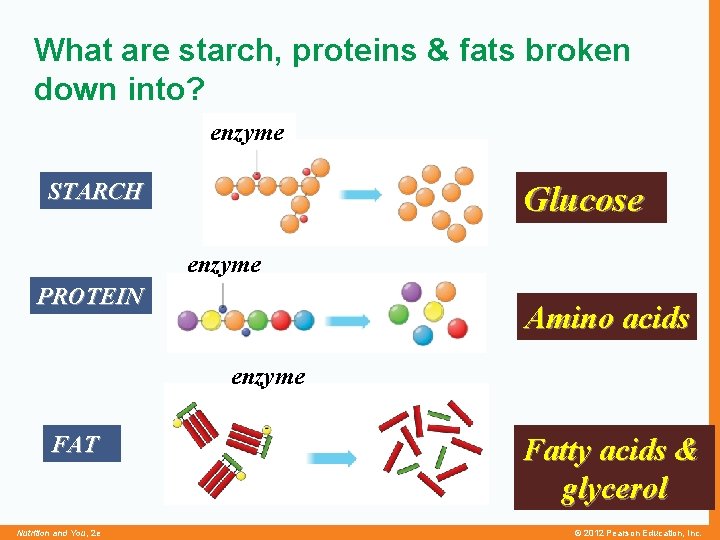
What are starch, proteins & fats broken down into? enzyme STARCH Glucose enzyme PROTEIN Amino acids enzyme FAT Nutrition and You, 2 e Fatty acids & glycerol © 2012 Pearson Education, Inc.
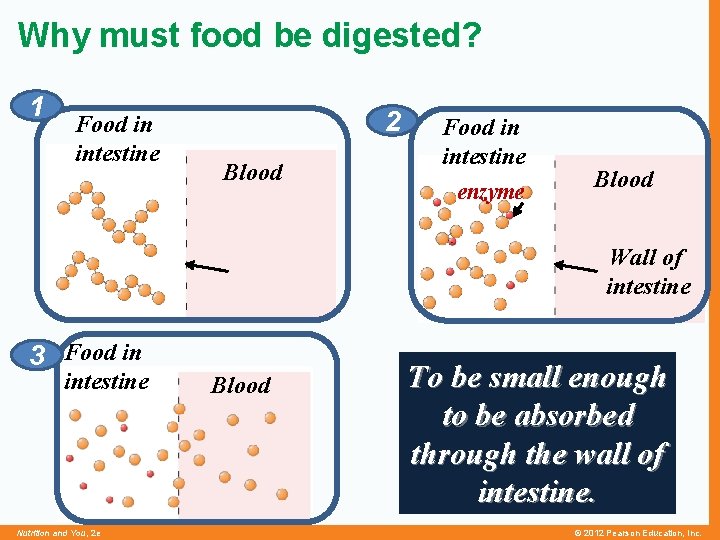
Why must food be digested? 1 Food in intestine 2 Blood Food in intestine enzyme Blood Wall of intestine 3 Food in intestine Nutrition and You, 2 e Blood To be small enough to be absorbed through the wall of intestine. © 2012 Pearson Education, Inc.
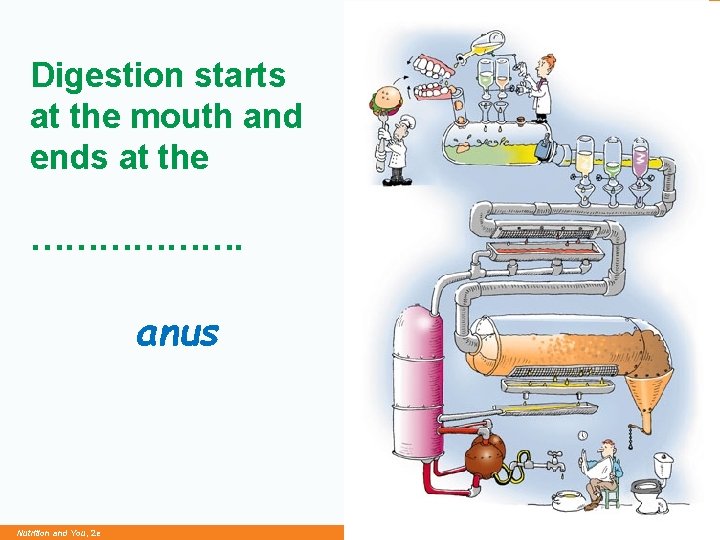
Digestion starts at the mouth and ends at the ………………. anus Nutrition and You, 2 e © 2012 Pearson Education, Inc.

Fig. 1 The human digestive system. Lower Esophageal Sphincter Nutrition and You, 2 e © 2012 Pearson Education, Inc.
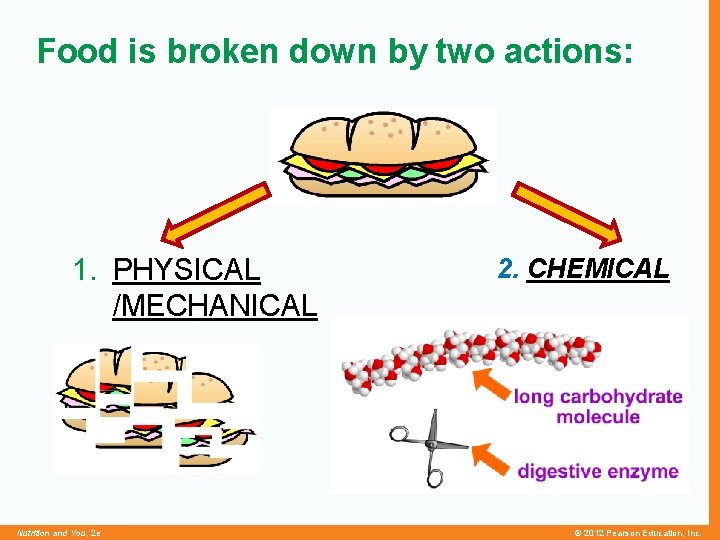
Food is broken down by two actions: 1. PHYSICAL /MECHANICAL Nutrition and You, 2 e 2. CHEMICAL © 2012 Pearson Education, Inc.
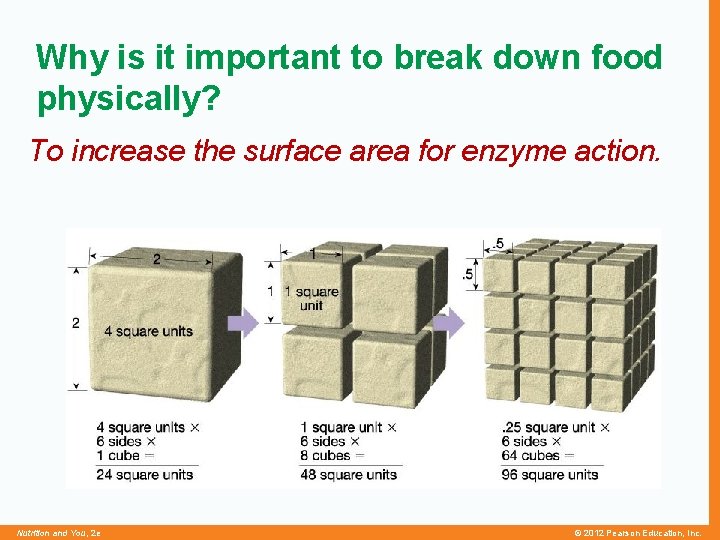
Why is it important to break down food physically? To increase the surface area for enzyme action. Nutrition and You, 2 e © 2012 Pearson Education, Inc.
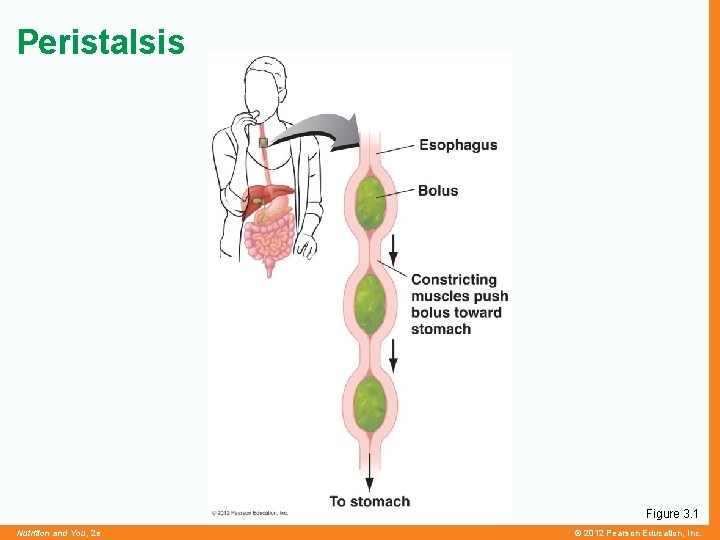
Peristalsis Figure 3. 1 Nutrition and You, 2 e © 2012 Pearson Education, Inc.
Digestion Allows Us to Absorb Nutrients from Foods After digestion, nutrients are absorbed through the walls of the intestines into the body’s two transport systems: w Circulatory system (blood) w Lymph system § Sent to the liver for processing before delivery to the body’s cells § GI tract is highly efficient: 92 to 97 percent of nutrients from food are digested and absorbed Nutrition and You, 2 e © 2012 Pearson Education, Inc.
What Are the Organs of the GI Tract and Why Are They Important? Digestion begins in the mouth w Saliva released: contains water, electrolytes, mucus and a few enzymes w Softens, lubricates, dissolves food particles w Bolus (food mass) moves into pharynx, is swallowed, and enters the esophagus w Epiglottis closes off trachea during swallowing to prevent food from lodging in the windpipe Nutrition and You, 2 e © 2012 Pearson Education, Inc.
The Stomach Stores, Mixes, and Prepares Food for Digestion § Esophagus propels food into the stomach w Bolus is pushed down esophagus by peristalsis § Lower Esophageal Sphincter (LES): at bottom of esophagus relaxes and allows food into stomach § LES then closes to prevent backflow of hydrochloric acid (HCl) from stomach w “Reflux” of stomach acid causes “heartburn” (irritation of esophagus lining) Nutrition and You, 2 e © 2012 Pearson Education, Inc.
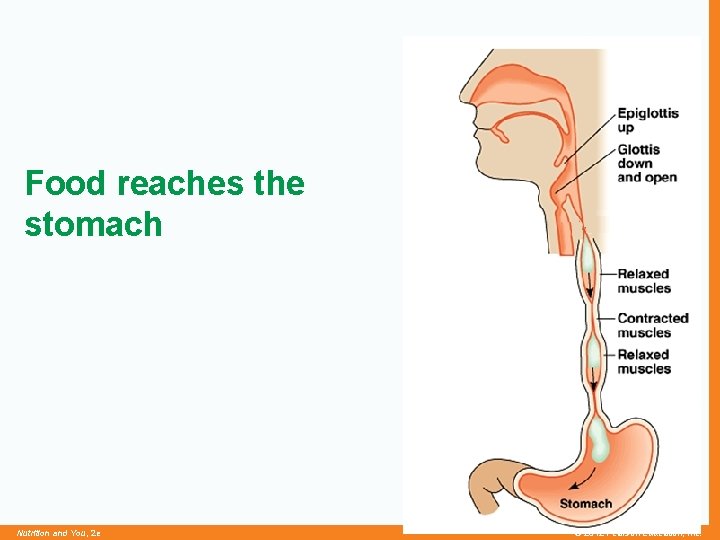
Food reaches the stomach Nutrition and You, 2 e © 2012 Pearson Education, Inc.
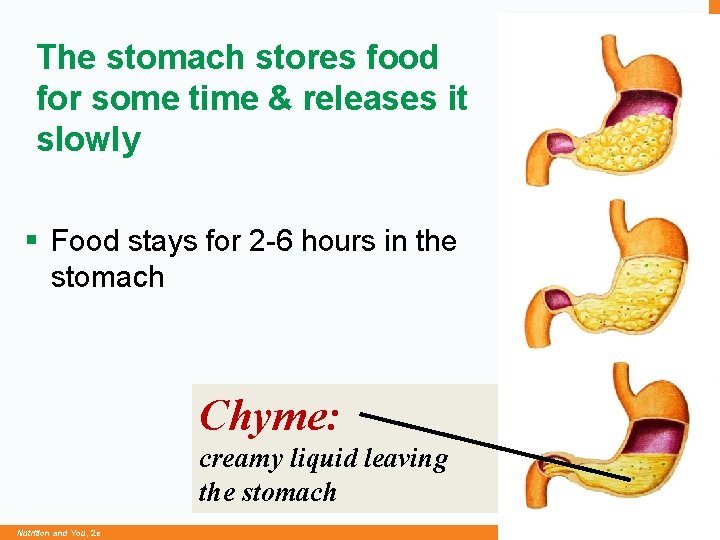
The stomach stores food for some time & releases it slowly § Food stays for 2 -6 hours in the stomach Chyme: creamy liquid leaving the stomach Nutrition and You, 2 e © 2012 Pearson Education, Inc.
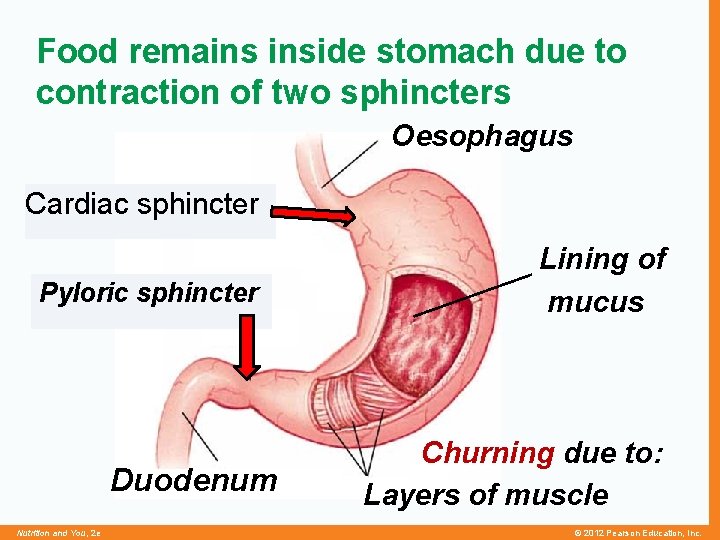
Food remains inside stomach due to contraction of two sphincters Oesophagus Cardiac sphincter Pyloric sphincter Duodenum Nutrition and You, 2 e Lining of mucus Churning due to: Layers of muscle © 2012 Pearson Education, Inc.
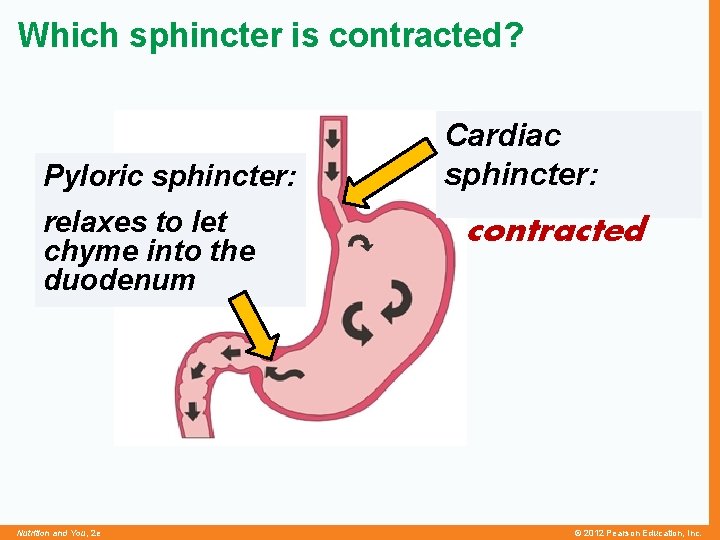
Which sphincter is contracted? Pyloric sphincter: relaxes to let chyme into the duodenum Nutrition and You, 2 e Cardiac sphincter: contracted © 2012 Pearson Education, Inc.
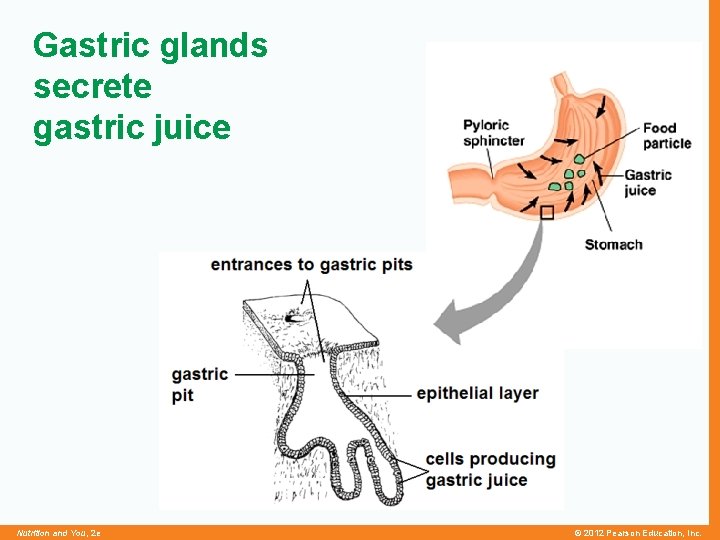
Gastric glands secrete gastric juice Nutrition and You, 2 e © 2012 Pearson Education, Inc.
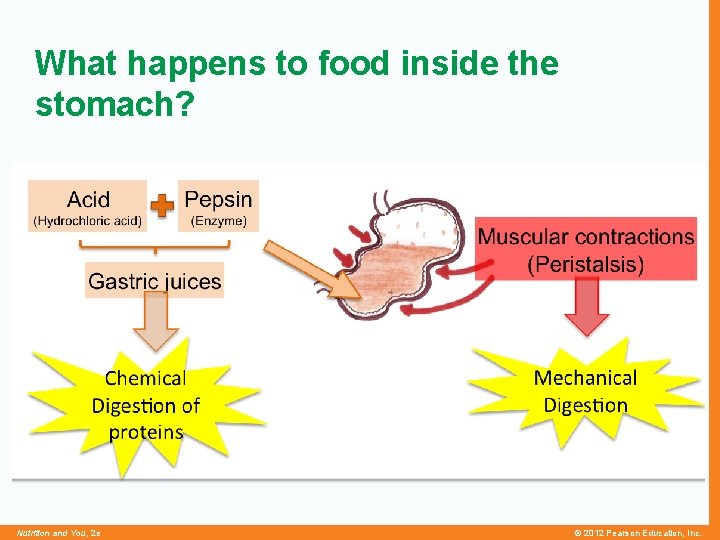
What happens to food inside the stomach? Nutrition and You, 2 e © 2012 Pearson Education, Inc.
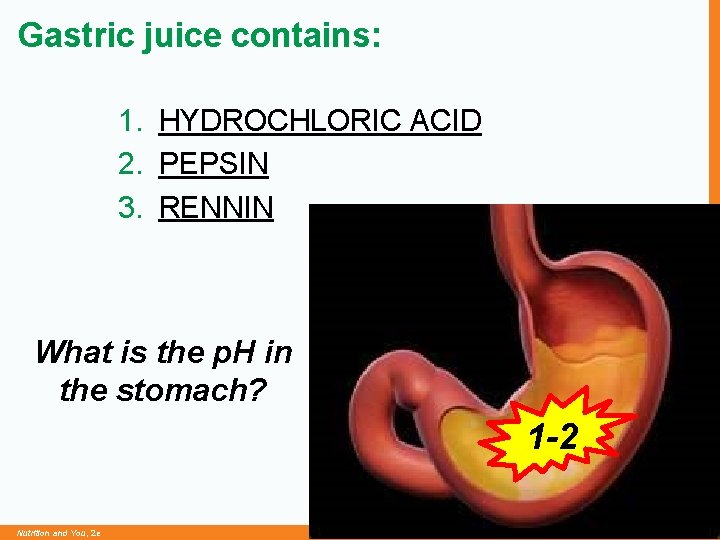
Gastric juice contains: 1. HYDROCHLORIC ACID 2. PEPSIN 3. RENNIN What is the p. H in the stomach? 1 -2 Nutrition and You, 2 e © 2012 Pearson Education, Inc.
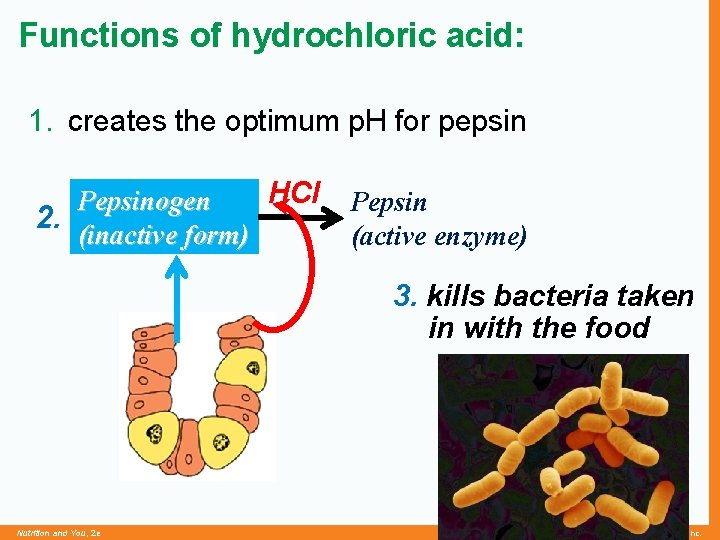
Functions of hydrochloric acid: 1. creates the optimum p. H for pepsin HCl Pepsinogen 2. (inactive form) Pepsin (active enzyme) 3. kills bacteria taken in with the food Nutrition and You, 2 e © 2012 Pearson Education, Inc.
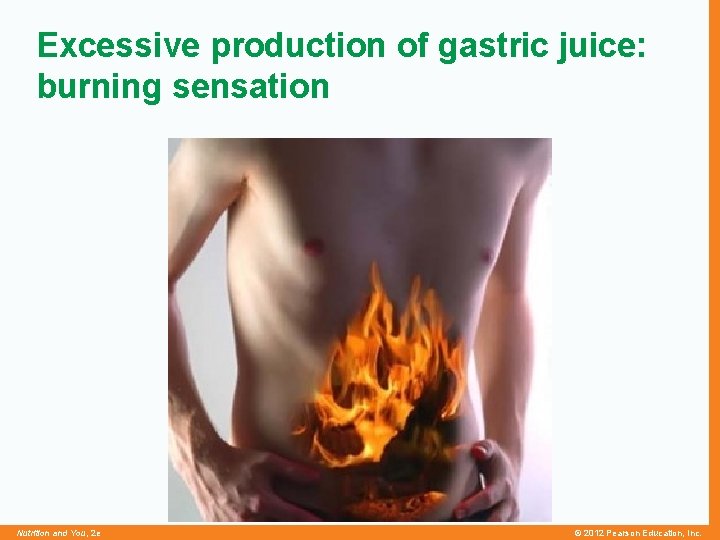
Excessive production of gastric juice: burning sensation Nutrition and You, 2 e © 2012 Pearson Education, Inc.
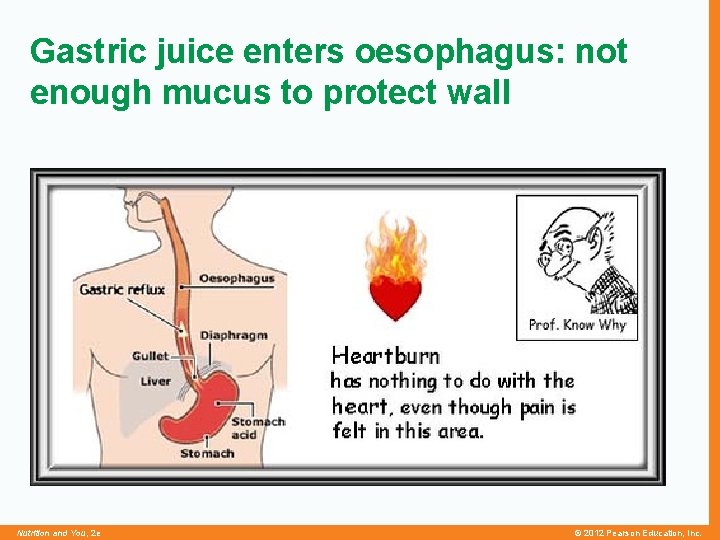
Gastric juice enters oesophagus: not enough mucus to protect wall Nutrition and You, 2 e © 2012 Pearson Education, Inc.
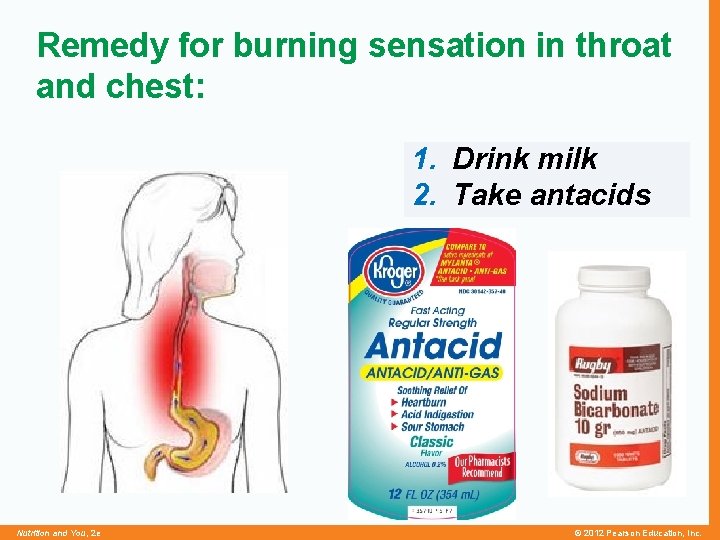
Remedy for burning sensation in throat and chest: 1. Drink milk 2. Take antacids Nutrition and You, 2 e © 2012 Pearson Education, Inc.
The Stomach Stores, Mixes and Prepares Food for Digestion § Gastrin: stimulates digestive activities and secretion of HCl; increases gastric motility and emptying § Liquids, carbohydrates, low-fiber, and low-calorie foods exit stomach faster § High fiber, fat, and protein foods exit slower, keep you feeling full longer § Pyloric sphincter: located between the stomach and small intestine; allows about 1 tsp of chyme to enter the small intestine every 30 seconds w Prevents backflow of intestinal contents Nutrition and You, 2 e © 2012 Pearson Education, Inc.
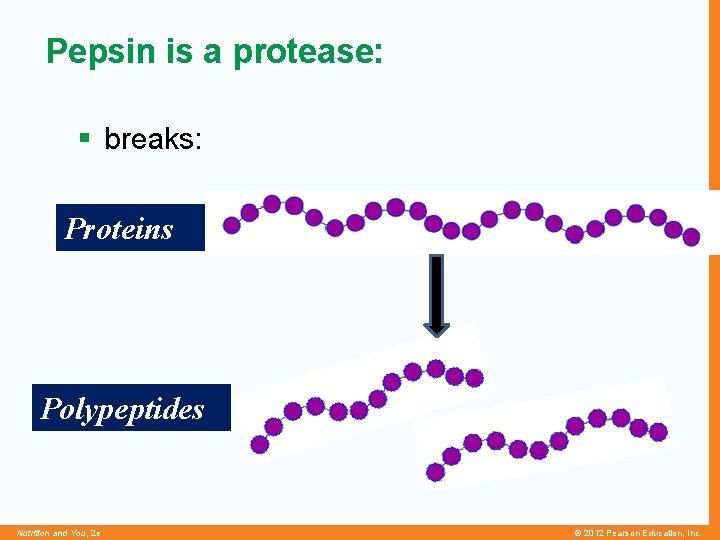
Pepsin is a protease: § breaks: Proteins Polypeptides Nutrition and You, 2 e © 2012 Pearson Education, Inc.
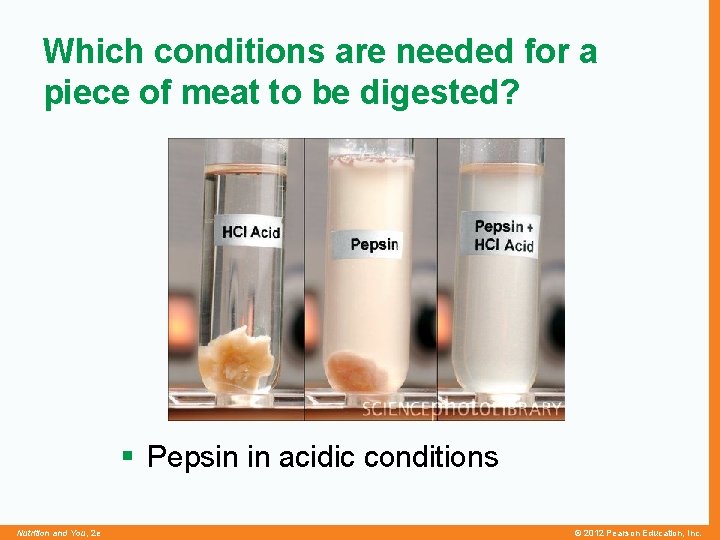
Which conditions are needed for a piece of meat to be digested? § Pepsin in acidic conditions Nutrition and You, 2 e © 2012 Pearson Education, Inc.
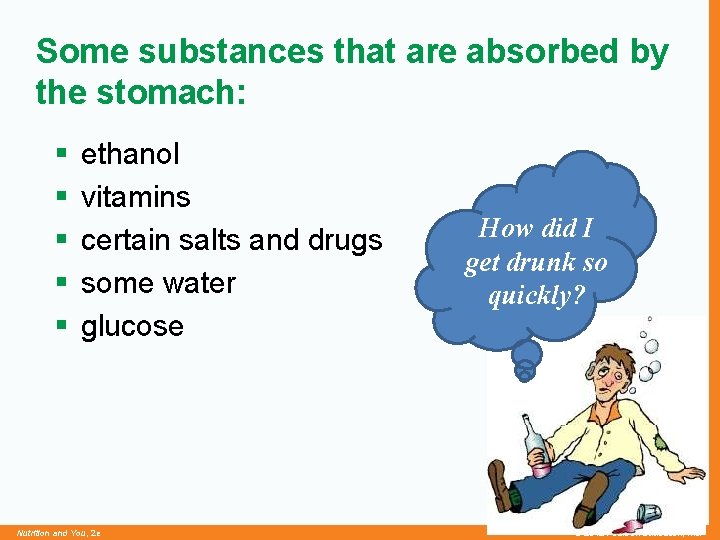
Some substances that are absorbed by the stomach: § § § ethanol vitamins certain salts and drugs some water glucose Nutrition and You, 2 e How did I get drunk so quickly? © 2012 Pearson Education, Inc.
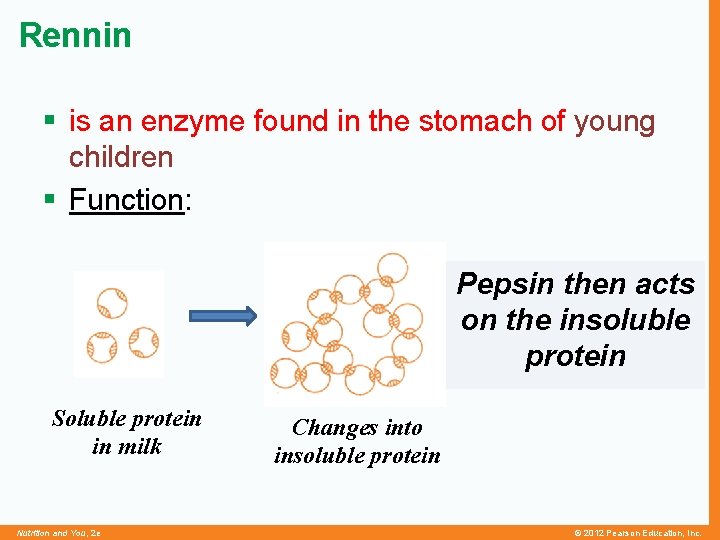
Rennin § is an enzyme found in the stomach of young children § Function: Pepsin then acts on the insoluble protein Soluble protein in milk Nutrition and You, 2 e Changes into insoluble protein © 2012 Pearson Education, Inc.
![In cheese-making, rennet [contains rennin] is added to milk Nutrition and You, 2 e](http://slidetodoc.com/presentation_image_h2/0e3c2113a1fb92b72b7da47d51ce3ba4/image-36.jpg "In cheese-making, rennet [contains rennin] is added to milk Nutrition and You, 2 e")
In cheese-making, rennet [contains rennin] is added to milk Nutrition and You, 2 e © 2012 Pearson Education, Inc.
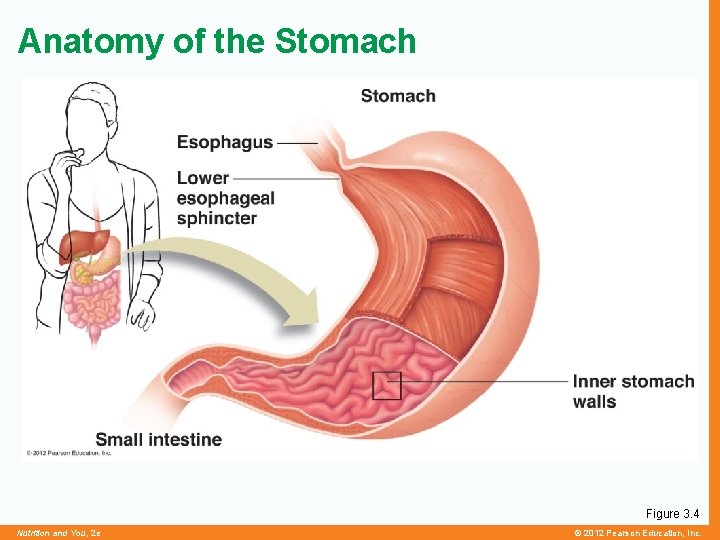
Anatomy of the Stomach Figure 3. 4 Nutrition and You, 2 e © 2012 Pearson Education, Inc.
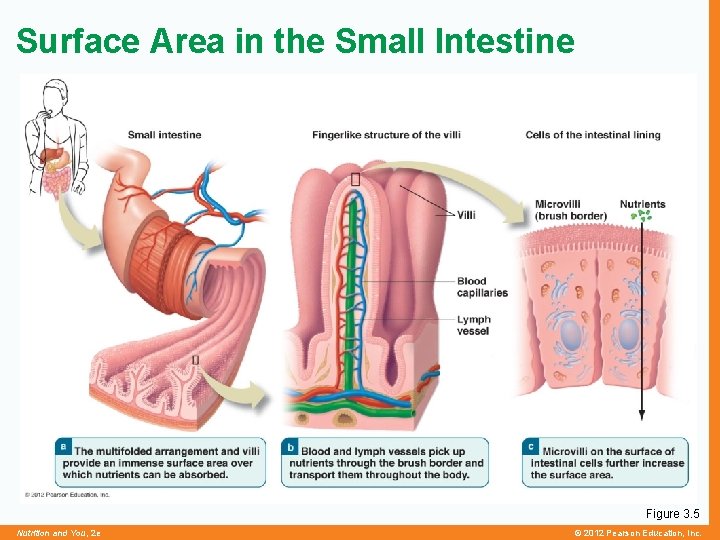
Surface Area in the Small Intestine Figure 3. 5 Nutrition and You, 2 e © 2012 Pearson Education, Inc.
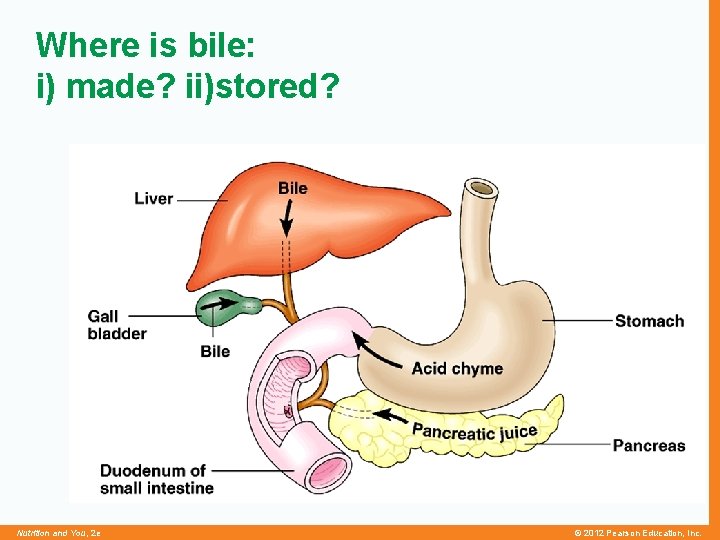
Where is bile: i) made? ii)stored? Nutrition and You, 2 e © 2012 Pearson Education, Inc.
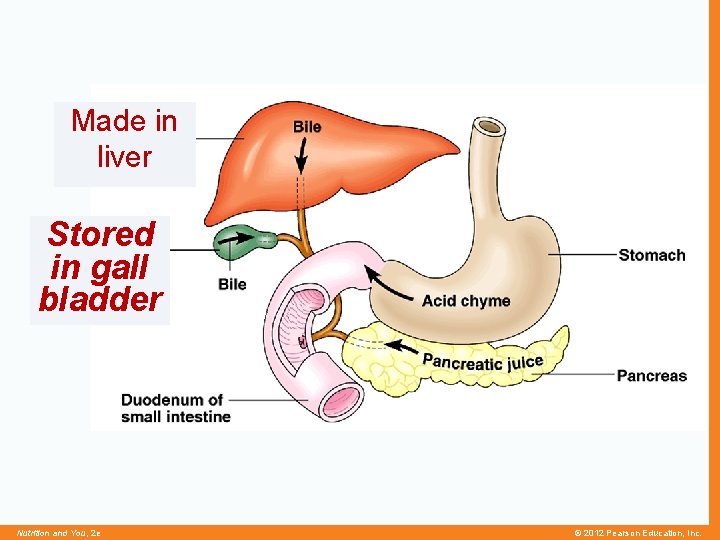
Made in liver Stored in gall bladder Nutrition and You, 2 e © 2012 Pearson Education, Inc.
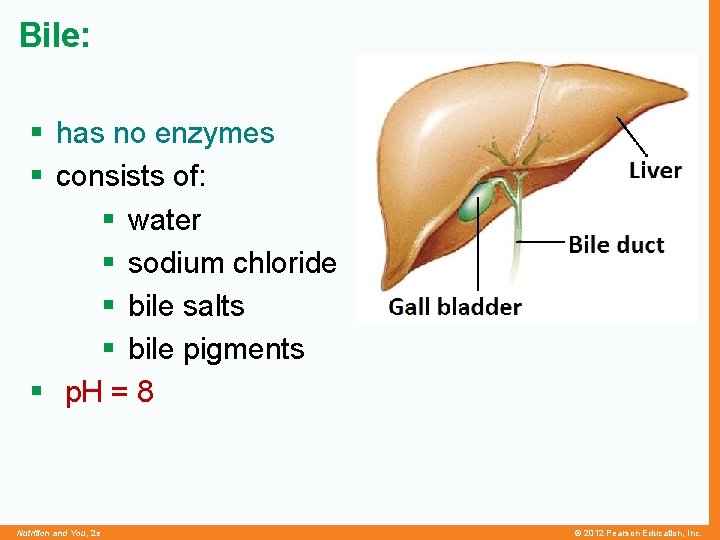
Bile: § has no enzymes § consists of: § water § sodium chloride § bile salts § bile pigments § p. H = 8 Nutrition and You, 2 e © 2012 Pearson Education, Inc.
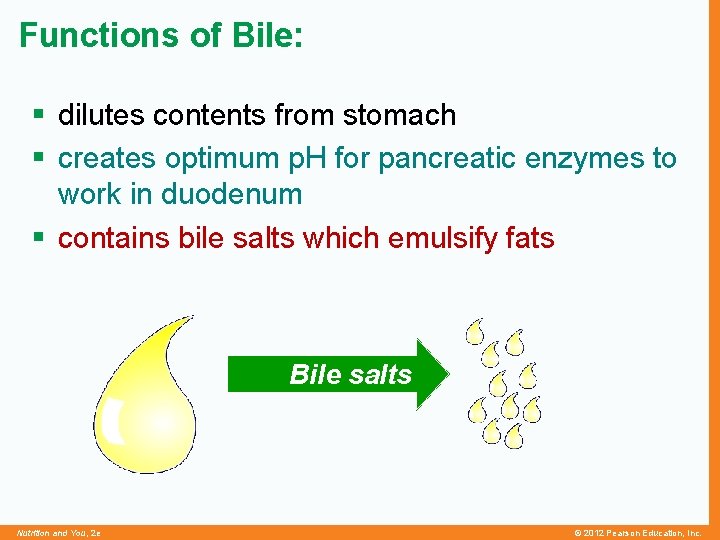
Functions of Bile: § dilutes contents from stomach § creates optimum p. H for pancreatic enzymes to work in duodenum § contains bile salts which emulsify fats Bile salts Nutrition and You, 2 e © 2012 Pearson Education, Inc.
Most Digestion and Absorption Occur in the Small Intestine Small intestine: long, narrow, coiled w Three segments: w Duodenum (10 inches) w Jejunum (8 feet) w Ileum (12 feet) w Interior surface area tremendously increased by villi, microvilli, circular folds. Nutrition and You, 2 e © 2012 Pearson Education, Inc.
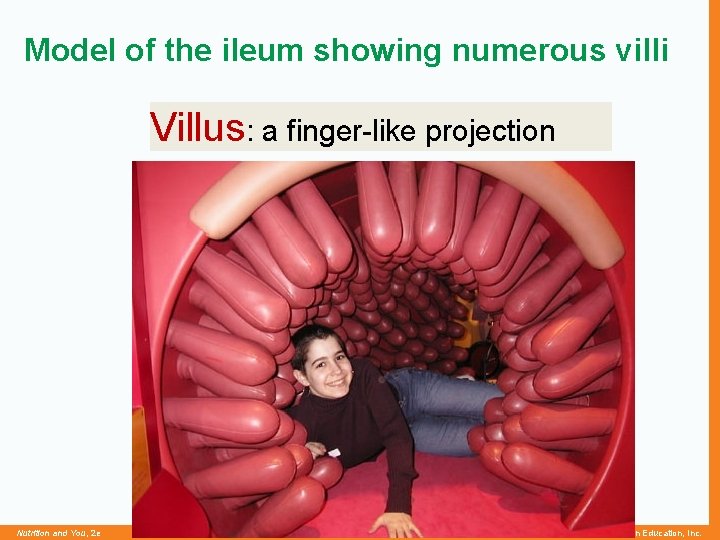
Model of the ileum showing numerous villi Villus: a finger-like projection Nutrition and You, 2 e © 2012 Pearson Education, Inc.
Most Digestion and Absorption Occur in the Small Intestine § Mechanical and chemical digestion in small intestine: w Peristalsis moves chyme through intestine w Segmentation mixes chyme with chemical secretions w Pendular movement enhances nutrient absorption § Chyme moves though at rate of 1 centimeter per minute § Total contact time 3 to 10 hours, depending on amount and type of food Nutrition and You, 2 e © 2012 Pearson Education, Inc.
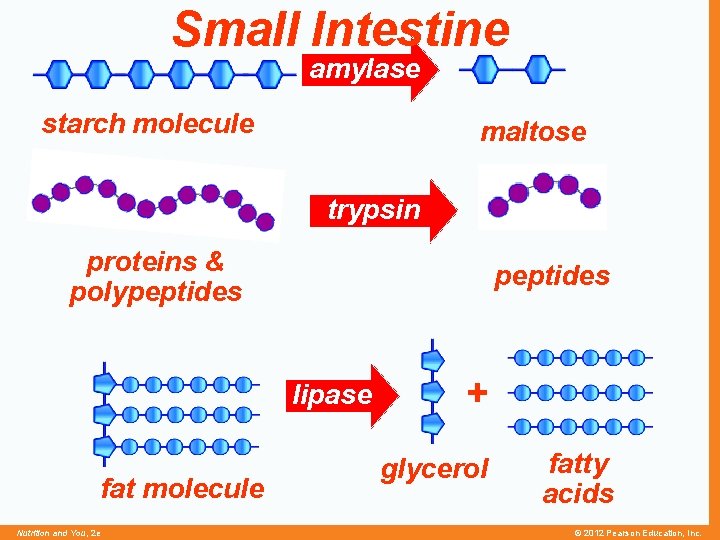
Small Intestine amylase starch molecule maltose trypsin proteins & polypeptides lipase fat molecule Nutrition and You, 2 e + glycerol fatty acids © 2012 Pearson Education, Inc.
Large Intestine Absorbs Water and Some Nutrients § Ileocecal sphincter: prevents backflow of fecal matter into ileum § Most of nutrients in chyme have been absorbed when it reaches large intestine § Large intestine has three sections: cecum, colon, rectum w About 5 feet long, 2. 5 inches in diameter w Absorbs water and electrolytes w No digestive enzymes; chemical digestion done by bacteria Nutrition and You, 2 e © 2012 Pearson Education, Inc.
Large Intestine Absorbs Water and Some Nutrients § Intestinal matter passes through colon in 12 to 70 hours depending on age, health, diet, fiber intake w Bacteria in colon produce vitamin K and biotin and break down fiber and undigested carbohydrates, producing methane, carbon dioxide, hydrogen gas, and other compounds § Stool stored in rectum § Anus controlled by two sphincters: internal and external w Final stage of defecation is under voluntary control Nutrition and You, 2 e © 2012 Pearson Education, Inc.
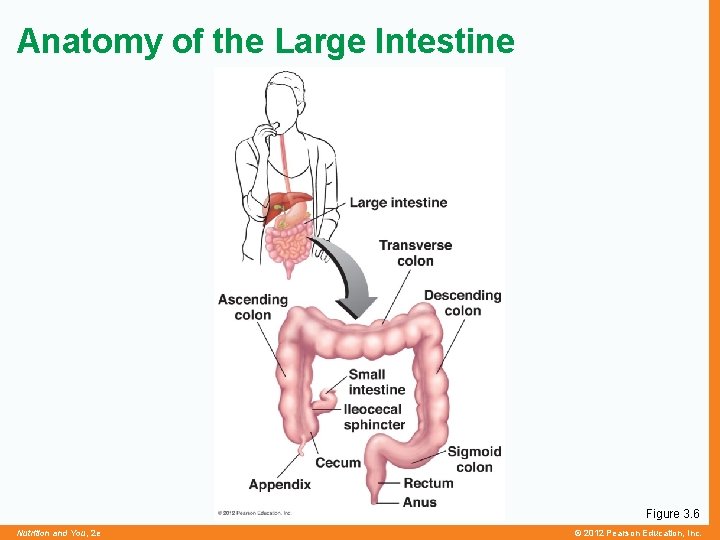
Anatomy of the Large Intestine Figure 3. 6 Nutrition and You, 2 e © 2012 Pearson Education, Inc.
Enzymes, Hormones, and Bile Aid Digestion § Complete digestion of chyme requires: w Enzymes: break down food into absorbable nutrient components w Secreted by stomach, small intestine, pancreas w Amylases, lipases, proteases w Hormones: gastrin, insulin, glucagon, secretin, cholecystokinin w Control digestive secretions and regulate enzymes Nutrition and You, 2 e © 2012 Pearson Education, Inc.
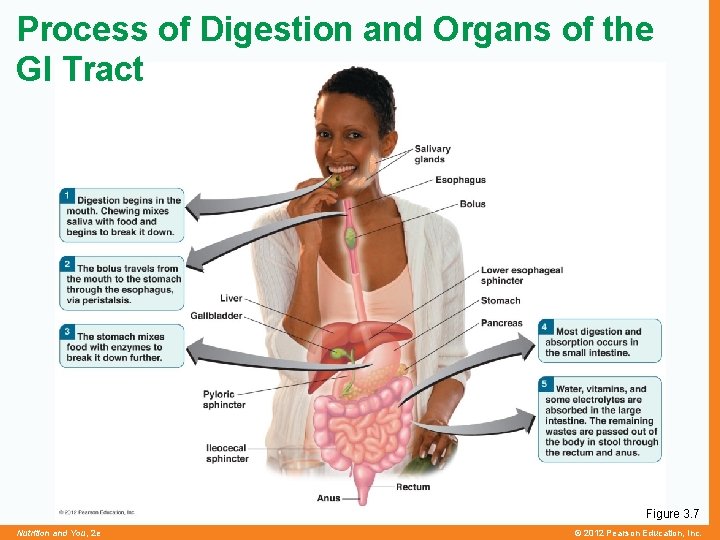
Process of Digestion and Organs of the GI Tract Figure 3. 7 Nutrition and You, 2 e © 2012 Pearson Education, Inc.
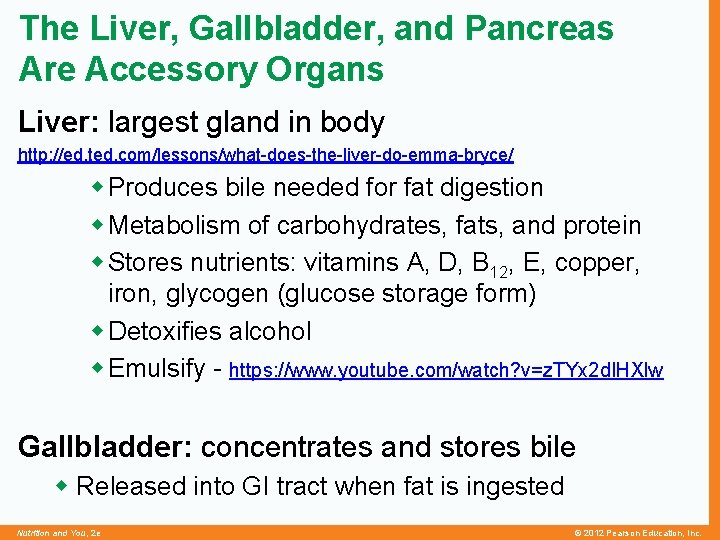
The Liver, Gallbladder, and Pancreas Are Accessory Organs Liver: largest gland in body http: //ed. ted. com/lessons/what-does-the-liver-do-emma-bryce/ w Produces bile needed for fat digestion w Metabolism of carbohydrates, fats, and protein w Stores nutrients: vitamins A, D, B 12, E, copper, iron, glycogen (glucose storage form) w Detoxifies alcohol w Emulsify - https: //www. youtube. com/watch? v=z. TYx 2 d. IHXlw Gallbladder: concentrates and stores bile w Released into GI tract when fat is ingested Nutrition and You, 2 e © 2012 Pearson Education, Inc.
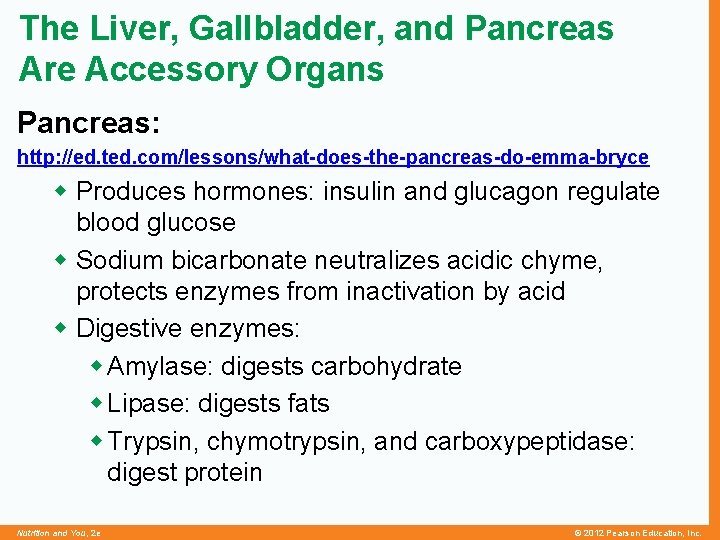
The Liver, Gallbladder, and Pancreas Are Accessory Organs Pancreas: http: //ed. ted. com/lessons/what-does-the-pancreas-do-emma-bryce w Produces hormones: insulin and glucagon regulate blood glucose w Sodium bicarbonate neutralizes acidic chyme, protects enzymes from inactivation by acid w Digestive enzymes: w Amylase: digests carbohydrate w Lipase: digests fats w Trypsin, chymotrypsin, and carboxypeptidase: digest protein Nutrition and You, 2 e © 2012 Pearson Education, Inc.
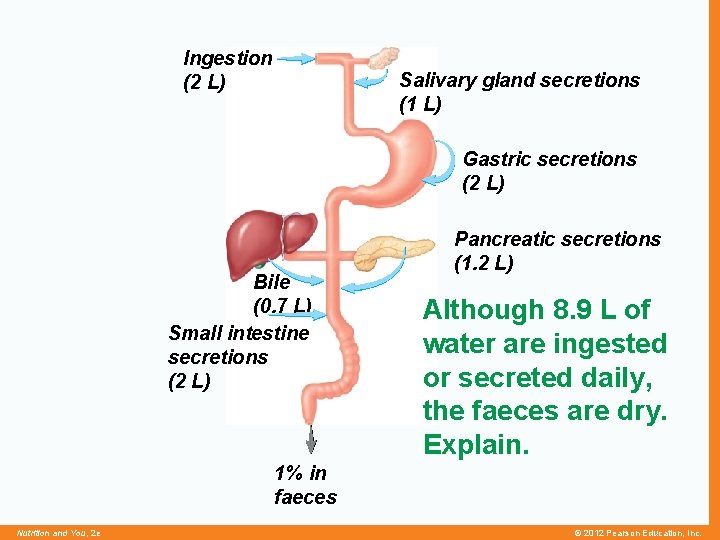
Ingestion (2 L) Salivary gland secretions (1 L) Gastric secretions (2 L) Bile (0. 7 L) Small intestine secretions (2 L) Pancreatic secretions (1. 2 L) Although 8. 9 L of water are ingested or secreted daily, the faeces are dry. Explain. 1% in faeces Nutrition and You, 2 e © 2012 Pearson Education, Inc.
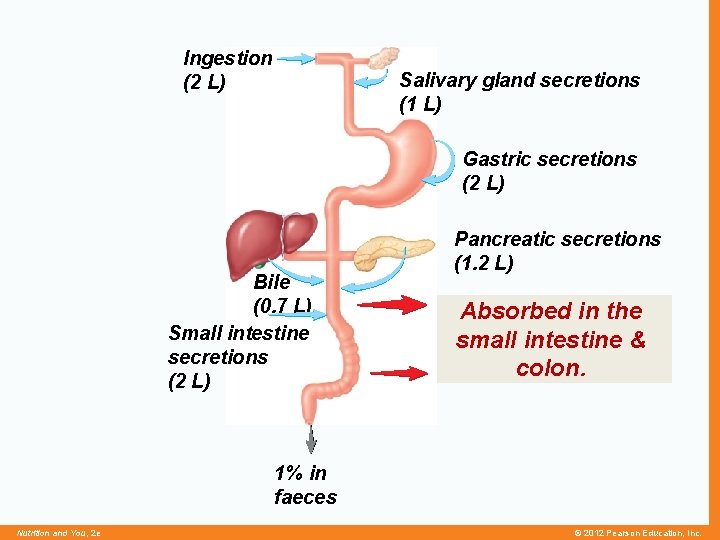
Ingestion (2 L) Salivary gland secretions (1 L) Gastric secretions (2 L) Bile (0. 7 L) Small intestine secretions (2 L) Pancreatic secretions (1. 2 L) Absorbed in the small intestine & colon. 1% in faeces Nutrition and You, 2 e © 2012 Pearson Education, Inc.
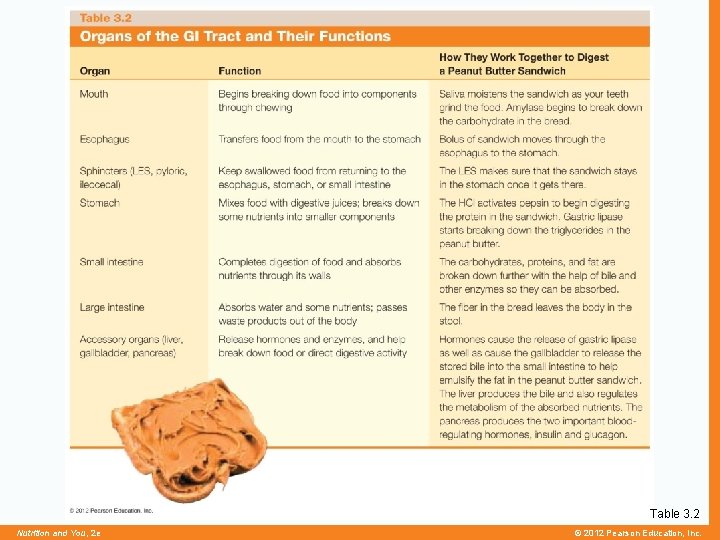
Table 3. 2 Nutrition and You, 2 e © 2012 Pearson Education, Inc.
Diet Dream Drug: Hope or Hype: Pros and Cons of Alli https: //www. youtube. com/watch? v=u. EDj 7 XNBUo. Y Discussion Questions § What does Alli claim to do in the body to help you lose weight? § What are some of the unpleasant side effects of using Alli? § What is the typical behavior of people using diet drugs? Nutrition and You, 2 e © 2012 Pearson Education, Inc.
What Other Body Systems Affect Your Use of Nutrients? § Nervous system stimulates your appetite w Hormone ghrelin signals brain to eat when stomach is empty § Circulatory system transports nutrients, oxygen, waste products through your blood § Lymphatic system distributes fat and fatsoluble nutrients through your lymph § Excretory system eliminates wastes from circulatory system via the urine Nutrition and You, 2 e © 2012 Pearson Education, Inc.
What Are Some Common Digestive Disorders? Disorders of the mouth and esophagus: w Gingivitis and periodontal disease w Swallowing problems: dysphagia w Esophageal problems w Heartburn (acid reflux) may be caused by weak LES w Certain foods, smoking, drinking alcohol, being overweight or obese, tight-fitting clothes, reclining after eating, large evening meals may worsen condition Nutrition and You, 2 e © 2012 Pearson Education, Inc.
What Are Some Common Digestive Disorders? Disorders of the stomach: w Gastroenteritis w Peptic ulcers Gallbladder disease: w Gallstones Nutrition and You, 2 e © 2012 Pearson Education, Inc.
What Are Some Common Digestive Disorders? More serious intestinal disorders: w Irritable Bowel Syndrome (IBS) w Celiac disease w Crohn’s disease w Colon cancer Nutrition and You, 2 e © 2012 Pearson Education, Inc.
THE END O S E V I HA O T H C MU ! ! T S DIGE Nutrition and You, 2 e © 2012 Pearson Education, Inc.
- Slides: 62