
Chapter 3 Taxation planning Power Point presentation by
Chapter 3 Taxation planning Power. Point presentation by Fariba Ahmadi-Pirshahid © 2014 John Wiley & Sons Australia, Ltd
Learning objectives After studying this chapter you should be able to: 1. 2. 3. 4. identify the source of Australian taxation law outline the different components of taxable income calculate net tax payable for an individual, including levies and tax offsets outline the taxation implications associated with the returns generated from different forms of investment, including capital gains tax 5. identify a range of common tax-effective strategies 6. explain the taxation implications of income splitting 7. explain the taxation implications of income versus capital growth 8. identify the various taxable entities, and compare the tax advantages and disadvantages of these different entities 9. explain the concept of negative gearing 10. explain remuneration planning and understand the taxation implications of salary packaging and fringe benefits tax (FBT) 11. explain the goods and services tax (GST).
Introduction • Taxation implications are an important factor in any investment decision • Financial planners must understand the taxation system and how it affects various investment alternatives • Financial planners must understand the difference between taxation planning, tax evasion and tax avoidance • Investors should seek to minimise their exposure to taxation within the relevant laws and regulations
The Australian Taxation System • Income tax has been levied by the Australian Government since 1942 • Sources of taxation law: – Income Tax Assessment Act 1997 (ITAA 97) – Case law – Australian Taxation Office (ATO) rulings and determinations • The ITAA 97 was a rewrite and improvement on the existing 1936 Income Tax Assessment Act

The Australian Taxation System continued • The major forms of taxation in Australia are: – Income tax – Capital gains tax (CGT) – Fringe benefits tax (FBT) – Goods and services tax (GST)
Components of taxable income Taxable income involves consideration of both income and deductions: Taxable income = Assessable Income – Allowable Deductions
Components of taxable income continued • Assessable Income: – includes salary and wages, rent, dividends, interest, annuities – must distinguish between income receipts and capital receipts – amounts may or may not be required to be received in cash in order to be included as assessable income
Components of taxable income continued • Allowable Deductions: – expenses may be deducted from assessable income if they are incurred in gaining that assessable income – no deduction for capital or domestic outgoings or expenses incurred in producing exempt income – non-cash expenses may also be considered allowable deductions if they have been incurred
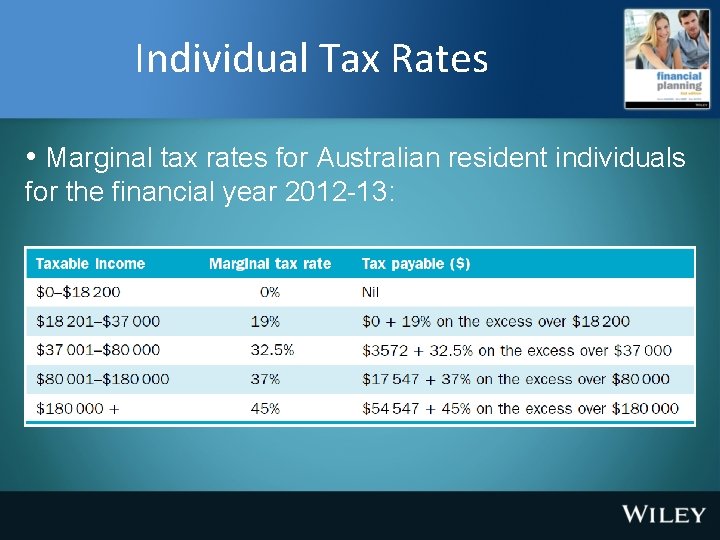
Individual Tax Rates • Marginal tax rates for Australian resident individuals for the financial year 2012 -13:
Tax Rates Payable by Other Entities • Companies: – pay a flat rate of 30% on their taxable income • Superannuation funds: – pay a flat rate of 15% on their taxable income • Partnerships: – profits are allocated to each partner and tax is paid by each partner at their marginal tax rate • Trusts: – trust income is distributed between members and tax is paid by each member at their marginal tax rate

Calculating net tax payable Taxpayers pay income tax for each financial year, normally ending 30 June: Net tax payable = (Taxable income x Marginal personal tax rate) Less any Tax offsets Add levies and charges
Tax Offsets • Tax offsets directly reduce the amount of tax you must pay - they are not the same as deductions • With a tax offset the ATO works out the tax due on the taxable income then reduce it by the amount of the tax offset/s • Tax offsets can only be used to eliminate gross tax payable • Low income tax offset available for low income earners
Levies and Charges • Medicare levy – 1. 5% of taxable income – used to fund the Australian national health system • Medicare levy surcharge – 1% to 1. 5% – applies if your income is above a certain threshold and you don’t have private patient hospital cover • HECS and HELP charge – Higher Education Loan Program (HELP) allows students to defer the cost of their education

Taxation of minors • Special regulation to prevent taxpayers avoiding tax by directing income to children • A minor is defined as unmarried persons under 18 years of age and not in full employment • Special tax rules applies to minor’s unearned income • Tax rates as high as 66% are applied to unearned income over $416
Impact of tax on Investment Income • Income received from most forms of investments such as shares and property are assessable for tax • These include interest income, dividend income, rental income and income from managed investment schemes • Interest received by a taxpayer is assessable income • Dividends received is also assessable income even in the form of additional shares • Dividend imputation — any tax paid by the company is credited to the receiver of the dividend
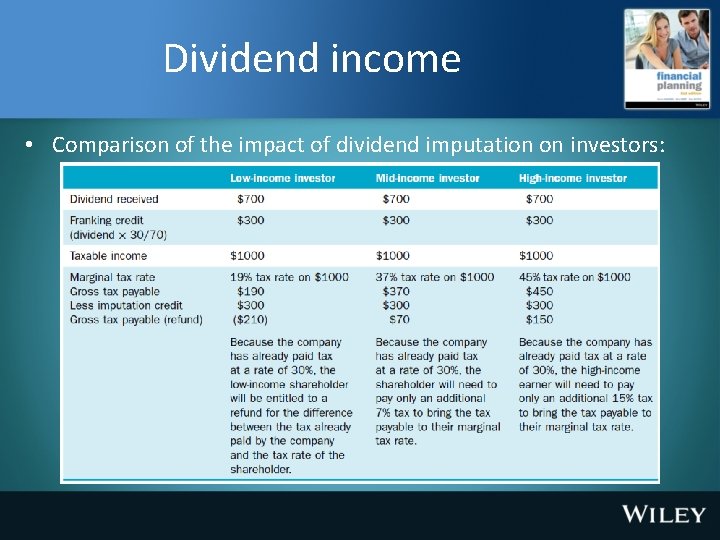
Dividend income • Comparison of the impact of dividend imputation on investors:
Rental income • Rental income is assessable for tax • Expenditure incurred in earning the rental income may be allowable deduction • Some complex deductions include: – Interest — only when incurred on loans used for financing the investment – Capital works — if incurred for investment purposes – Decline in value of assets over their useful life
Income from managed investment scheme • Managed investment schemes (managed funds) are unit trust structures that invest pooled funds collected from unit holders in various types of investments • All income earned within the fund such as interest, dividends, rental income and capital gains are distributed amongst members and taxed at their marginal tax rate
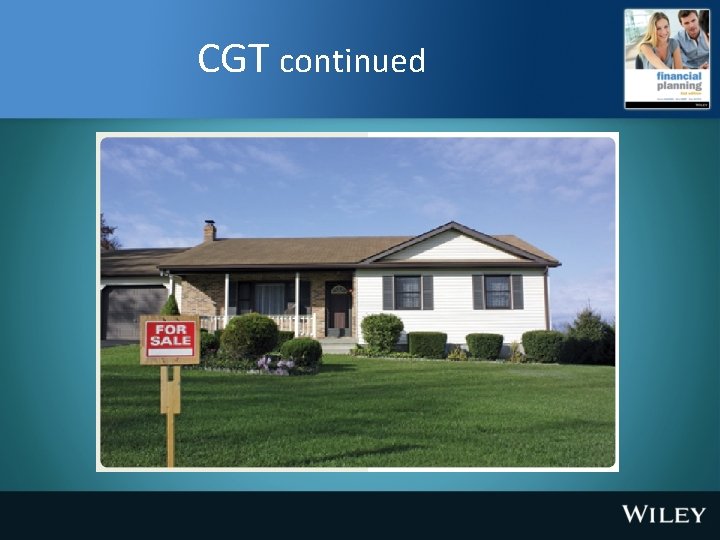
Capital Gains Tax (CGT) • Capital gains tax (CGT) is a tax on realised capital gains • CGT applies to the sale of assets acquired after 19 September 1985 • Net capital gain equals total capital gains for the year, less total capital losses from current year and previous years • Some assets such as main place of residence are exempt from CGT • Net capital gain is added to assessable income
CGT continued • The assessable capital gain is: – all the gain if the asset is held for less than 12 months – part of the gain if the asset is held for more than 12 months • Two methods for calculating assessable capital gain for assets held more than 12 months: – Discount method — where only 50% of the gain is assessable for individuals and 33. 33% for superannuation funds – Indexation method — where the cost base of the asset is indexed at specific rates (this method only applies to assets purchased prior to 21 September 1999
CGT continued • Tax planning for CGT includes consideration of: – structure used for investment – nature of investment – period of time the investment is held – timing of the disposal – method applied for capital gain or loss is calculation.
CGT continued
Taxation planning • Financial planners should consider strategies to minimise their clients tax payable within the legal framework • ‘Best interest duty’ requires financial planners to act in the best interest of their clients • Taxation law is very complex so clients may be encouraged to seek advice of a tax adviser or an accountant to confirm the taxation implication of the advice given
Taxation planning continued • Some taxation planning strategies include: – Income Splitting – Income versus capital growth – Tax structures – Negative gearing – Salary packaging and remuneration planning
Income splitting • Transfer of income from an individual at higher marginal tax rates to one at lower marginal tax rates • Income from business activities only can be split • Income can be transferred through the transfer of assets or investments to individuals at low marginal tax rates • Some tax consequences that must be considered are: – transfer of income to a child as unearned income – actual payment of income may be required – transfer of assets may give rise to CGT.
Income versus capital growth • An investment may provide income or capital growth or both • Investment preferences depend on their cash flow needs and investment time horizon • Income earned from an investment is assessable • Capital gains tax however may be taxed at a concessional manner • Tax planning involves distinguishing between the two and developing strategies to minimise payments
Tax structures • Basic tax structures that can be used for taxation planning are: – – – sole ownership partnerships trusts companies superannuation funds (a specific type of trust). • Each structure has advantage and disadvantages • These structures can be used in diverting income to family members with lower marginal tax rates

Tax structures continued • Sole ownership
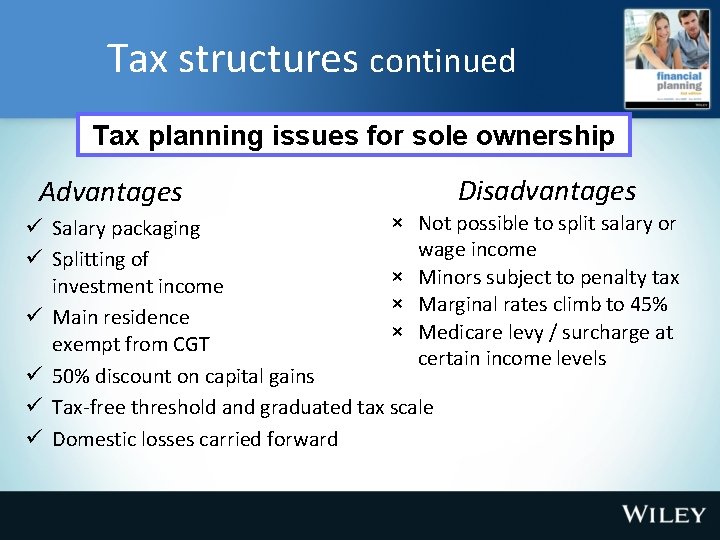
Tax structures continued Tax planning issues for sole ownership Advantages Disadvantages × Not possible to split salary or ü Salary packaging wage income ü Splitting of × Minors subject to penalty tax investment income × Marginal rates climb to 45% ü Main residence × Medicare levy / surcharge at exempt from CGT certain income levels ü 50% discount on capital gains ü Tax-free threshold and graduated tax scale ü Domestic losses carried forward
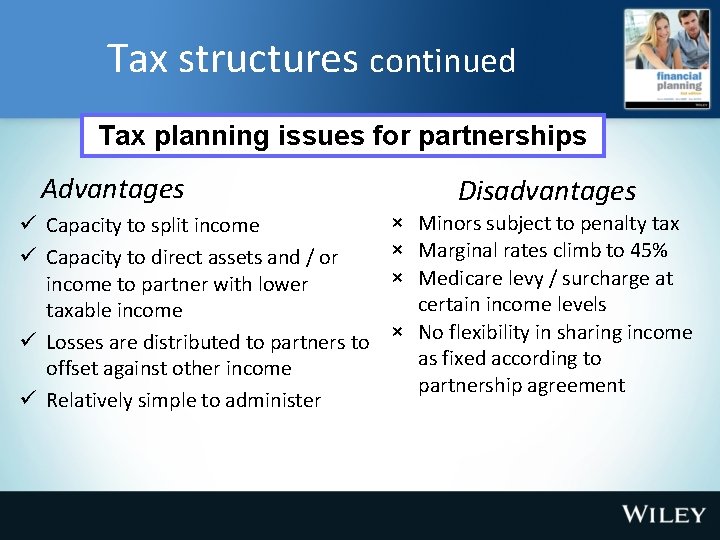
Tax structures continued Tax planning issues for partnerships Advantages ü Capacity to split income ü Capacity to direct assets and / or income to partner with lower taxable income ü Losses are distributed to partners to offset against other income ü Relatively simple to administer Disadvantages × Minors subject to penalty tax × Marginal rates climb to 45% × Medicare levy / surcharge at certain income levels × No flexibility in sharing income as fixed according to partnership agreement
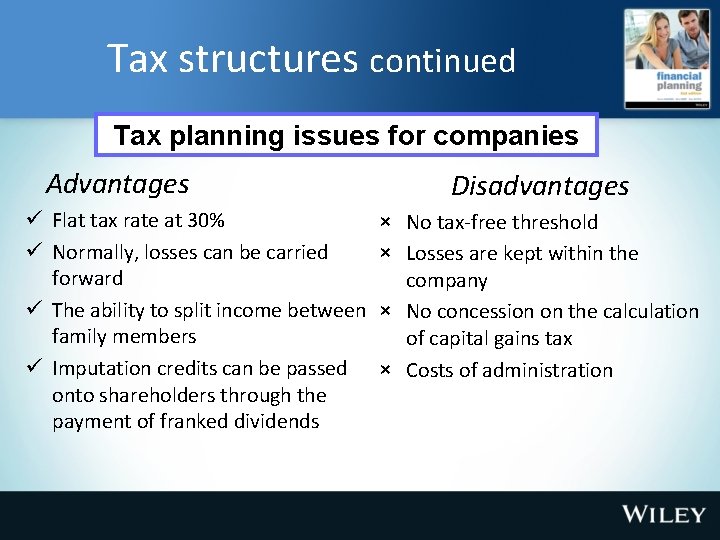
Tax structures continued Tax planning issues for companies Advantages ü Flat tax rate at 30% ü Normally, losses can be carried forward ü The ability to split income between family members ü Imputation credits can be passed onto shareholders through the payment of franked dividends Disadvantages × No tax-free threshold × Losses are kept within the company × No concession on the calculation of capital gains tax × Costs of administration
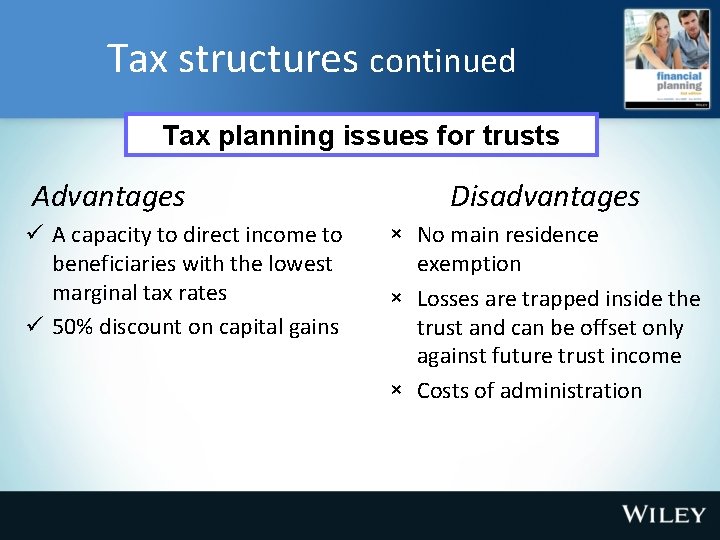
Tax structures continued Tax planning issues for trusts Advantages ü A capacity to direct income to beneficiaries with the lowest marginal tax rates ü 50% discount on capital gains Disadvantages × No main residence exemption × Losses are trapped inside the trust and can be offset only against future trust income × Costs of administration
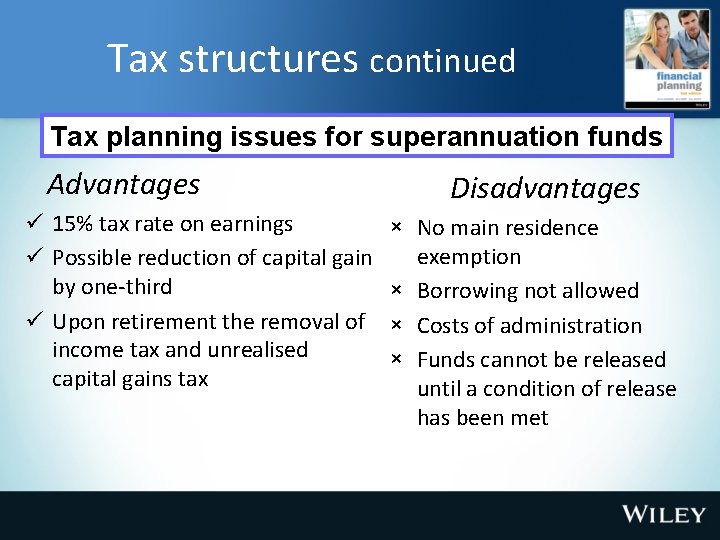
Tax structures continued Tax planning issues for superannuation funds Advantages ü 15% tax rate on earnings ü Possible reduction of capital gain by one-third ü Upon retirement the removal of income tax and unrealised capital gains tax Disadvantages × No main residence exemption × Borrowing not allowed × Costs of administration × Funds cannot be released until a condition of release has been met
Negative gearing • Arises where total deductions associated with an investment exceed assessable income generated • The loss can be used to reduce income from other sources such as salary and wages • An investor may be willing to generate a tax loss each year as long as there is the potential to generate capital gain • Positive gearing is where total assessable income generated from an investment exceeds total deductions associated with that investment

Salary packaging and remuneration planning
Salary packaging and remuneration planning • Salary packaging is an arrangement whereby an employee agrees to substitute part of their salary with non-cash benefits provided by the employer • Relative attractiveness of salary packaging: – increases with higher levels of assessable income (since marginal tax rate applicable will be higher) – influenced by cash needs of employee
Salary packaging and remuneration planning continued • Most common non-cash benefits include: – Superannuation contributions made in addition to the mandatory superannuation guarantee contributions – Use of fully maintained car – Payment of car-parking costs – Providing reduced-interest or interest-free loans – Payment of school fees for the employee’s children – Providing a laptop, mobile phone or other electronic device
Fringe benefit tax • Employers must disclose value of non-cash benefits also called fringe benefits provided to employees on annual payment summaries if they are above threshold level • Such benefits may be subject to fringe benefits tax (FBT) paid by the employer but passed onto the employee • FBT is determined under the following process: 1. Determine the taxable value of the benefit 2. Apply a gross-up rate 3. Apply FBT rate of 47%
Fringe benefit tax continued • Non-cash benefits are divided into four main categories for FBT purposes: – – Fully taxed fringe benefits Concessionally taxed fringed benefits Exempt fringe benefits Excluded fringe benefits • A different process is applied to benefits in each category for the calculation of FBT payable
Goods and Services Tax (GST) • Introduced in July 2000, it is a 10% tax applied on most goods and services • Some exemptions include second-hand goods, unprocessed food and council rates • The investment affected the greatest by GST has been property from the following sections: – rents – expenses – acquisition and realisation of investment.
Summary • Financial planners must understand the different types of taxation and the major tax entities if they are to offer effective investment advice • Taxation imposts have the potential to drastically reduce investor returns • Overall financial planning objective should be to maximise risk-adjusted after tax investment returns

- Slides: 42