
Chapter 3 Systems Analysis and Design in a















- Slides: 37
Chapter 3 Systems Analysis and Design in a Changing World, 7 th Edition - Chapter 3 © 2016. Cengage Learning. All rights reserved. 1
Identifying User Stories and Use Cases Chapter 3 Systems Analysis and Design in a Changing World 7 th Ed Satzinger, Jackson & Burd Systems Analysis and Design in a Changing World, 7 th Edition - Chapter 3 © 2016. Cengage Learning. All rights reserved. 2
Chapter 3: Outline User Stories and Use Cases and the User Goal Technique Use Cases and Event Decomposition Use Cases in the Ridgeline Mountain Outfitters Case Systems Analysis and Design in a Changing World, 7 th Edition - Chapter 3 © 2016. Cengage Learning. All rights reserved. 3
Learning Objectives Explain why identifying use cases is the key to defining functional requirements Write user stories with acceptance criteria Describe the two techniques for identifying use cases Apply the user goal technique to identify use cases Apply the event decomposition technique to identify use cases Describe the notation and purpose for the use case diagram Systems Analysis and Design in a Changing World, 7 th Edition - Chapter 3 © 2016. Cengage Learning. All rights reserved. 4
Overview Chapter 2 provided an overview of systems analysis activities, functional and non-functional requirements, modeling, and information gathering techniques This chapter focuses on identifying and modeling the key aspect of functional requirements– use cases In the RMO Tradeshow System from Chapter 1, some use cases are Look up supplier, Enter/update product information, Enter/Update contact information In this chapter’s opening case Waiters on Call, examples of use cases are Record an order, Record delivery, Update an order, Sign in driver, Reconcile driver receipts, Produce end of day deposit slip, and Produce weekly sales reports Systems Analysis and Design in a Changing World, 7 th Edition - Chapter 3 © 2016. Cengage Learning. All rights reserved. 5
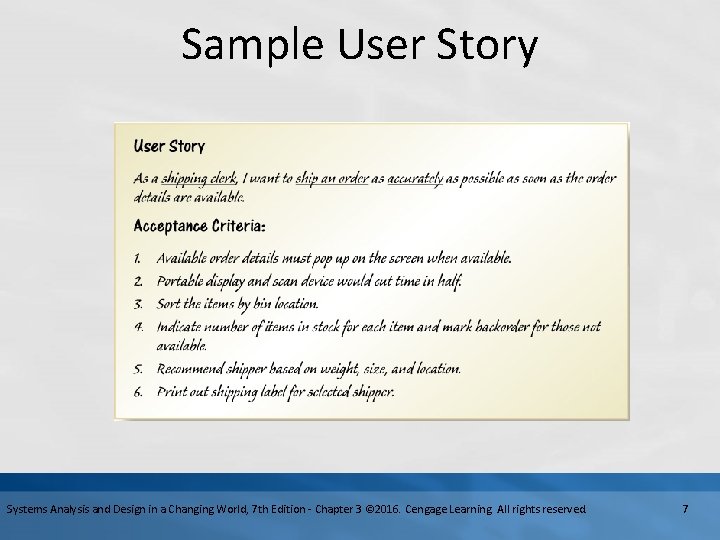
User Stories A User Story is a one-sentence description of a work-related task done by a user to achieve some goal or result Acceptance Criteria identify the features that must be present at the completion of the task The template for a user story description is: “As a <role> I want to <goal> so that <benefit> Systems Analysis and Design in a Changing World, 7 th Edition - Chapter 3 © 2016. Cengage Learning. All rights reserved. 6
Sample User Story Systems Analysis and Design in a Changing World, 7 th Edition - Chapter 3 © 2016. Cengage Learning. All rights reserved. 7
Use Cases Use case— an activity that the system performs, usually in response to a request by a user Use cases define functional requirements Analysts decompose the system into a set of use cases (functional decomposition) Two techniques for Identifying use cases User goal technique Event decomposition technique Name each use case using Verb-Noun Systems Analysis and Design in a Changing World, 7 th Edition - Chapter 3 © 2016. Cengage Learning. All rights reserved. 8
User Goal Technique This technique is the most common in industry Simple and effective Identify all of the potential categories of users of the system Interview and ask them to describe the tasks the computer can help them with Probe further to refine the tasks into specific user goals, “I need to Ship items, Track a shipment, Create a return” Systems Analysis and Design in a Changing World, 7 th Edition - Chapter 3 © 2016. Cengage Learning. All rights reserved. 9
User Goal Technique: Some RMO CSMS Users and Goals User goal and resulting use case Potential customer Search for item Fill shopping cart View product rating and comments Marketing manager Add/update product information Add/update promotion Produce sales history report Shipping personnel Ship items Track shipment Create item return Systems Analysis and Design in a Changing World, 7 th Edition - Chapter 3 © 2016. Cengage Learning. All rights reserved. 10
User Goal Technique: Specific Steps (1 of 2) 1. Identify all the potential users for the new system 2. Classify the potential users in terms of their functional role (e. g. , shipping, marketing, sales) 3. Further classify potential users by organizational level (e. g. , operational, management, executive) 4. For each type of user, interview them to find a list of specific goals they will have when using the new system (current goals and innovative functions to add value) Systems Analysis and Design in a Changing World, 7 th Edition - Chapter 3 © 2016. Cengage Learning. All rights reserved. 11
User Goal Technique: Specific Steps (2 of 2) 5. Create a list of preliminary use cases organized by type of user 6. Look for duplicates with similar use case names and resolve inconsistencies 7. Identify where different types of users need the same use cases 8. Review the completed list with each type of user and then with interested stakeholders Systems Analysis and Design in a Changing World, 7 th Edition - Chapter 3 © 2016. Cengage Learning. All rights reserved. 12
Event Decomposition Technique More Comprehensive and Complete Technique Identify the events that occur to which the system must respond. For each event, name a use case (verb-noun) that describes what the system does when the event occurs Event– something that occurs at a specific time and place, can be described, and should be remembered by the system Systems Analysis and Design in a Changing World, 7 th Edition - Chapter 3 © 2016. Cengage Learning. All rights reserved. 13
Events and Use Cases Systems Analysis and Design in a Changing World, 7 th Edition - Chapter 3 © 2016. Cengage Learning. All rights reserved. 14
Types of Events External Event an event that occurs outside the system, usually initiated by an external agent or actor Temporal Event an event that occurs as a result of reaching a point in time State Event an event that occurs when something happens inside the system that triggers some process reorder point is reached for inventory item Systems Analysis and Design in a Changing World, 7 th Edition - Chapter 3 © 2016. Cengage Learning. All rights reserved. 15
External Event Checklist External agent or actor wants something resulting in a transaction Customer buys a product External agent or actor wants some information Customer wants to know product details External data changed and needs to be updated Customer has new address and phone Management wants some information Sales manager wants update on production plans Systems Analysis and Design in a Changing World, 7 th Edition - Chapter 3 © 2016. Cengage Learning. All rights reserved. 16
Temporal Event Checklist Internal outputs needed at points in time Management reports (summary or exception) Operational reports (detailed transactions) Internal statements and documents (including payroll) External outputs needed at points of time Statements, status reports, bills, reminders Systems Analysis and Design in a Changing World, 7 th Edition - Chapter 3 © 2016. Cengage Learning. All rights reserved. 17
Finding the actual event that affects the system Systems Analysis and Design in a Changing World, 7 th Edition - Chapter 3 © 2016. Cengage Learning. All rights reserved. 18
Tracing a sequence of transactions resulting in many events Systems Analysis and Design in a Changing World, 7 th Edition - Chapter 3 © 2016. Cengage Learning. All rights reserved. 19
Perfect Technology Assumption Don’t worry about functions built into system because of limits in technology and people. Wait until design. Systems Analysis and Design in a Changing World, 7 th Edition - Chapter 3 © 2016. Cengage Learning. All rights reserved. 20
Event Decomposition Technique: Specific Steps (1 of 2) 1. Consider the external events in the system environment that require a response from the system by using the checklist shown in Figure 3 -3 2. For each external event, identify and name the use case that the system requires 3. Consider the temporal events that require a response from the system by using the checklist shown in Figure 3 -4 4. For each temporal event, identify and name the use case that the system requires and then establish the point of time that will trigger the use case Systems Analysis and Design in a Changing World, 7 th Edition - Chapter 3 © 2016. Cengage Learning. All rights reserved. 21
Event Decomposition Technique: Specific Steps (2 of 2) 5. Consider the state events that the system might respond to, particularly if it is a real-time system in which devices or internal state changes trigger use cases. 6. For each state event, identify and name the use case that the system requires and then define the state change. 7. When events and use cases are defined, check to see if they are required by using the perfect technology assumption. Do not include events that involve such system controls as login, logout, change password, and backup or restore the database, as these are put in later. Systems Analysis and Design in a Changing World, 7 th Edition - Chapter 3 © 2016. Cengage Learning. All rights reserved. 22
Event Decomposition Technique: Benefits Events are broader than user goal: Capture temporal and state events Help decompose at the right level of analysis: an elementary business process (EBP) EBP is a fundamental business process performed by one person, in one place, in response to a business event Uses perfect technology assumption to make sure functions that support the users work are identified and not additional functions for security and system controls Systems Analysis and Design in a Changing World, 7 th Edition - Chapter 3 © 2016. Cengage Learning. All rights reserved. 23
Use Cases and Brief Use Case Descriptions Brief use case description is often a one sentence description showing the main steps in a use case Use case Brief use case description Create customer account User/actor enters new customer account data, and the system assigns account number, creates a customer record, and creates an account record. Look up customer User/actor enters customer account number, and the system retrieves and displays customer and account data. Process account adjustment User/actor enters order number, and the system retrieves customer and order data; actor enters adjustment amount, and the system creates a transaction record for the adjustment. Systems Analysis and Design in a Changing World, 7 th Edition - Chapter 3 © 2016. Cengage Learning. All rights reserved. 24
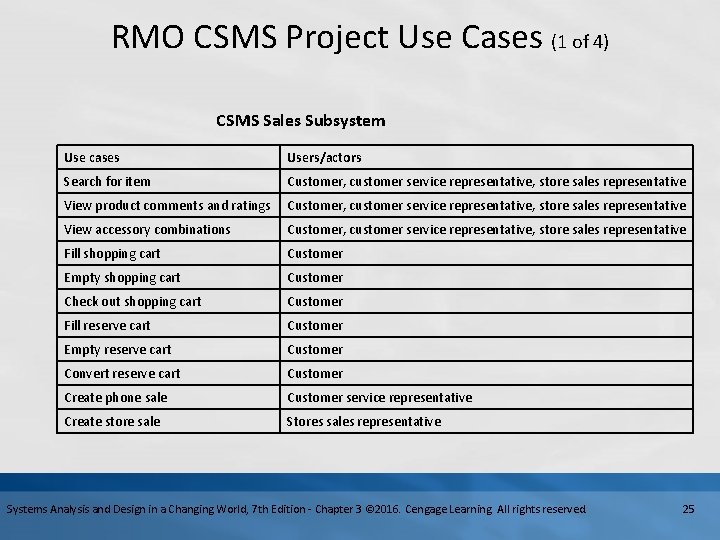
RMO CSMS Project Use Cases (1 of 4) CSMS Sales Subsystem Use cases Users/actors Search for item Customer, customer service representative, store sales representative View product comments and ratings Customer, customer service representative, store sales representative View accessory combinations Customer, customer service representative, store sales representative Fill shopping cart Customer Empty shopping cart Customer Check out shopping cart Customer Fill reserve cart Customer Empty reserve cart Customer Convert reserve cart Customer Create phone sale Customer service representative Create store sale Stores sales representative Systems Analysis and Design in a Changing World, 7 th Edition - Chapter 3 © 2016. Cengage Learning. All rights reserved. 25
RMO CSMS Project Use Cases (2 of 4) CSMS Order Fulfillment Subsystem Use cases Users/actors Ship items Shipping Manage shippers Shipping Create backborder Shipping Create item return Shipping, customer Look up order status Shipping, customer, management Track shipment Shipping, customer, marketing Rate and comment on product Customer Provide suggestion Customer Review suggestions Management Systems Analysis and Design in a Changing World, 7 th Edition - Chapter 3 © 2016. Cengage Learning. All rights reserved. 26
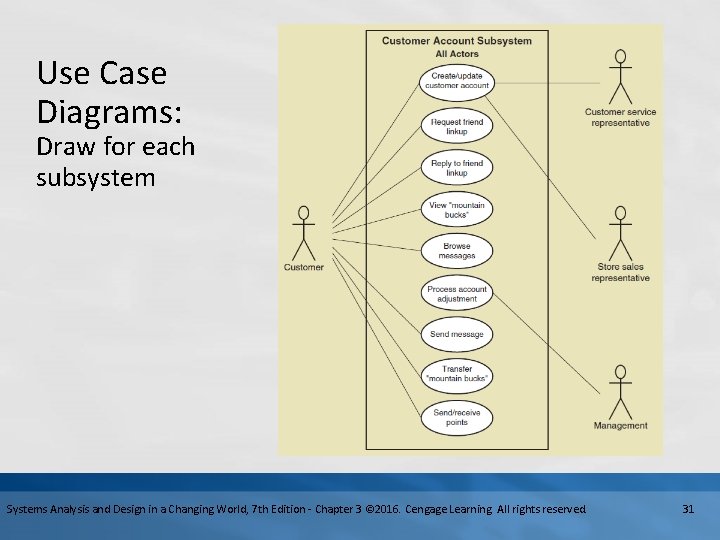
RMO CSMS Project Use Cases (3 of 4) CSMS Customer Account Subsystem Use cases Users/actors Create/update customer account Customer, customer service representative, store sales representative Process account adjustment Management Send message Customer Browse messages Customer Request friend linkup Customer Reply to linkup request Customer Send/receive partner credits Customer View “mountain bucks” Customer Transfer “mountain bucks” Customer Systems Analysis and Design in a Changing World, 7 th Edition - Chapter 3 © 2016. Cengage Learning. All rights reserved. 27
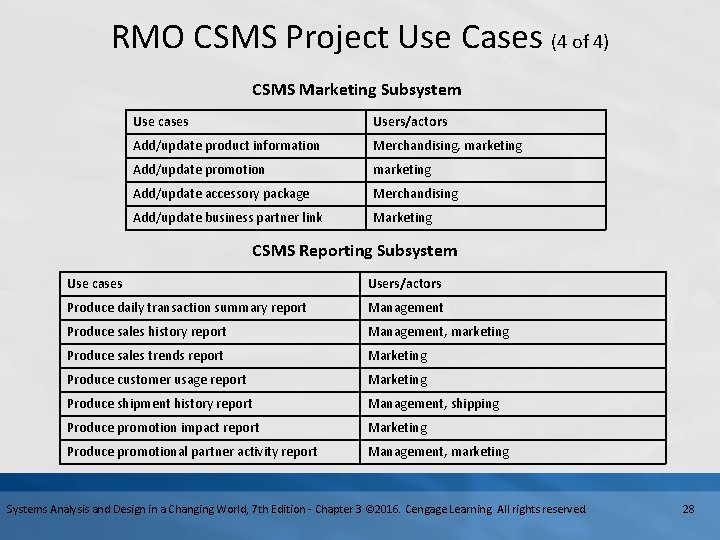
RMO CSMS Project Use Cases (4 of 4) CSMS Marketing Subsystem Use cases Users/actors Add/update product information Merchandising, marketing Add/update promotion marketing Add/update accessory package Merchandising Add/update business partner link Marketing CSMS Reporting Subsystem Use cases Users/actors Produce daily transaction summary report Management Produce sales history report Management, marketing Produce sales trends report Marketing Produce customer usage report Marketing Produce shipment history report Management, shipping Produce promotion impact report Marketing Produce promotional partner activity report Management, marketing Systems Analysis and Design in a Changing World, 7 th Edition - Chapter 3 © 2016. Cengage Learning. All rights reserved. 28
Use Case Diagrams Use case diagram— a UML model used to graphically show uses cases and their relationships to actors Recall UML is Unified Modeling Language, the standard for diagrams and terminology for developing information systems Actor is the UML name for a end user Automation boundary— the boundary between the computerized portion of the application and the users who operate the application Systems Analysis and Design in a Changing World, 7 th Edition - Chapter 3 © 2016. Cengage Learning. All rights reserved. 29
Use Case Diagrams Symbols Systems Analysis and Design in a Changing World, 7 th Edition - Chapter 3 © 2016. Cengage Learning. All rights reserved. 30
Use Case Diagrams: Draw for each subsystem Systems Analysis and Design in a Changing World, 7 th Edition - Chapter 3 © 2016. Cengage Learning. All rights reserved. 31
Use Case Diagrams: Draw for a single actor, such as customer Systems Analysis and Design in a Changing World, 7 th Edition - Chapter 3 © 2016. Cengage Learning. All rights reserved. 32
Use Case Diagrams: Draw for internal RMO actors Systems Analysis and Design in a Changing World, 7 th Edition - Chapter 3 © 2016. Cengage Learning. All rights reserved. 33
Use Case Diagrams— The <<Includes>> relationship A relationship between use cases where one use case is stereotypically included within the other use case— like a called subroutine. Arrow points to subroutine Systems Analysis and Design in a Changing World, 7 th Edition - Chapter 3 © 2016. Cengage Learning. All rights reserved. 34
Use Case Diagrams: Steps 1. Identify all the stakeholders and users who would benefit by seeing a use case diagram 2. Determine what each stakeholder or user needs to review in a use case diagram: each subsystem, for each type of user, for use cases that are of interest 3. For each potential communication need, select the use cases and actors to show and draw the use case diagram. There are many software packages that can be used to draw use case diagrams 4. Carefully name each use case diagram and then note how and when the diagram should be used to review use cases with stakeholders and users Systems Analysis and Design in a Changing World, 7 th Edition - Chapter 3 © 2016. Cengage Learning. All rights reserved. 35
Summary (1 of 2) This chapter is the first of three that focuses on modeling functional requirements as a part of systems analysis Use cases are the functions identified, the activities the system carries out usually in response to a user request Two techniques for identifying use cases are the user goal technique and the event decomposition technique The user goal technique begins by identifying end users called actors and asking what specific goals they have when interacting with the system The event decomposition technique begins by identifying events that occur that require the system to respond. Systems Analysis and Design in a Changing World, 7 th Edition - Chapter 3 © 2016. Cengage Learning. All rights reserved. 36
Summary (2 of 2) Three types of events include external, temporal, and state events Brief use case descriptions are written for use cases The use case diagram is the UML diagram used to show the use cases and the actors The use case diagram shows the actors, the automation boundary, the uses cases that involve each actor, and the <<includes>> relationship. A variety of use case diagrams are draw depending on the presentation needs of the analysis Systems Analysis and Design in a Changing World, 7 th Edition - Chapter 3 © 2016. Cengage Learning. All rights reserved. 37