
CHAPTER 3 SWITCHES AND RELAYS 3 1 SWITCHES
- Slides: 20
CHAPTER -3 SWITCHES AND RELAYS
3. 1 SWITCHES
Definition/General specifications of switch • The device used in electric circuit to switch off or switch on electric supply is called switch. • Specifications: • Contact resistance: voltage drop occurs the switch due to contact resistance when current passes through its contacts. contact resistance is expressed in mΩ. • Break down voltage/Flash over voltage: when the voltage across the contacts of the switch is gradually increased, a flash over will occur across the contact. This voltage is called the break down voltage or flash over voltage.
• Insulation resistance: It Is the resistance between the contacts and the body of the switch. It is expressed in MΩ. • Contact current rating: The max. D. C. or A. C. current which can be passed though it continuously is known as its current rating. Current is expressed for 25°C. • Voltage rating: Voltage rating of the switch means the voltage at which the switch can be used.
Characteristics of Switch • When the switch is operated the contacts do not close or open instantaneously but there is some definite time lag. Moreover there is contact bounce also. These times are known as the characteristics of the switch or relay. • These are as follows: • Operating Time: The time elapsed between closing of the switch and the instant at which the make contact close for the first time is known as the operating time. • Release Time: The time elapsed between the operating of the switch and the instant at which the contact opens for the first time is called the release time.
• Bounce time: The time elapsed between first closing of the contacts and final closing of the contacts or time elapsed between first opening of the contacts and final opening of the contacts is known as the bounce time.
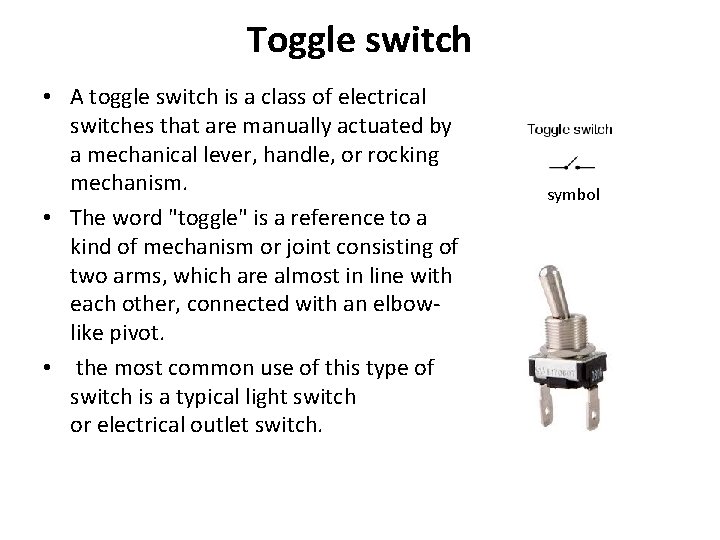
Toggle switch • A toggle switch is a class of electrical switches that are manually actuated by a mechanical lever, handle, or rocking mechanism. • The word "toggle" is a reference to a kind of mechanism or joint consisting of two arms, which are almost in line with each other, connected with an elbowlike pivot. • the most common use of this type of switch is a typical light switch or electrical outlet switch. symbol
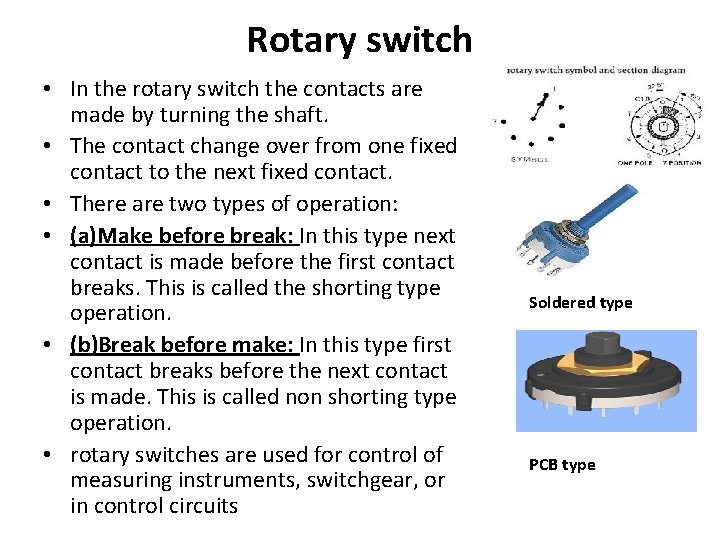
Rotary switch • In the rotary switch the contacts are made by turning the shaft. • The contact change over from one fixed contact to the next fixed contact. • There are two types of operation: • (a)Make before break: In this type next contact is made before the first contact breaks. This is called the shorting type operation. • (b)Break before make: In this type first contact breaks before the next contact is made. This is called non shorting type operation. • rotary switches are used for control of measuring instruments, switchgear, or in control circuits Soldered type PCB type
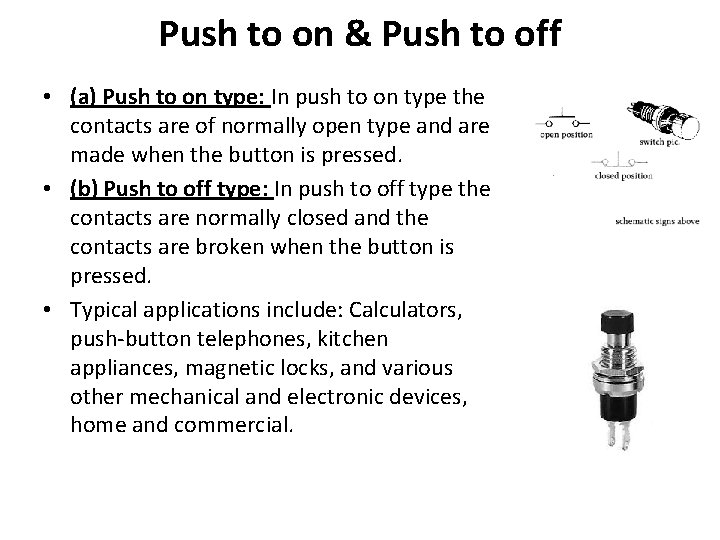
Push to on & Push to off • (a) Push to on type: In push to on type the contacts are of normally open type and are made when the button is pressed. • (b) Push to off type: In push to off type the contacts are normally closed and the contacts are broken when the button is pressed. • Typical applications include: Calculators, push-button telephones, kitchen appliances, magnetic locks, and various other mechanical and electronic devices, home and commercial.
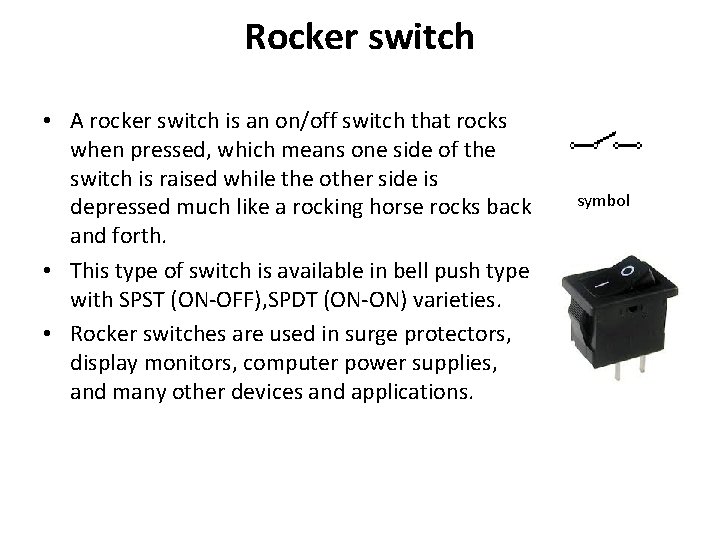
Rocker switch • A rocker switch is an on/off switch that rocks when pressed, which means one side of the switch is raised while the other side is depressed much like a rocking horse rocks back and forth. • This type of switch is available in bell push type with SPST (ON-OFF), SPDT (ON-ON) varieties. • Rocker switches are used in surge protectors, display monitors, computer power supplies, and many other devices and applications. symbol
3. 2 Relays
Definition/Characteristics of Relay • Relay is a device which operates when its coil carries the specified current. • Operating time: The time elapsed between closing of the energizing circuit and first closing of the make contacts is called the operating time. • Release time: The time elapsed between opening of the energizing circuit and first opening of the break contacts is called the release time. • Bounce time: The time taken between the first closing and final closing of the contacts or time taken between the first opening and final opening of the contacts is known as the bounce time.
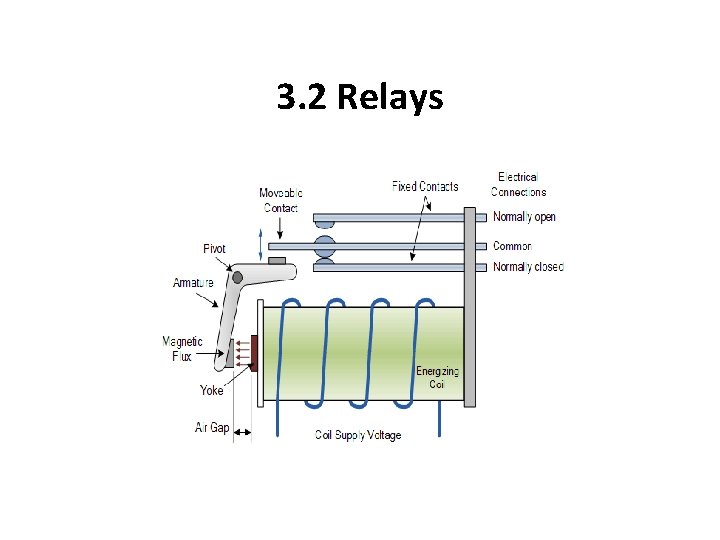
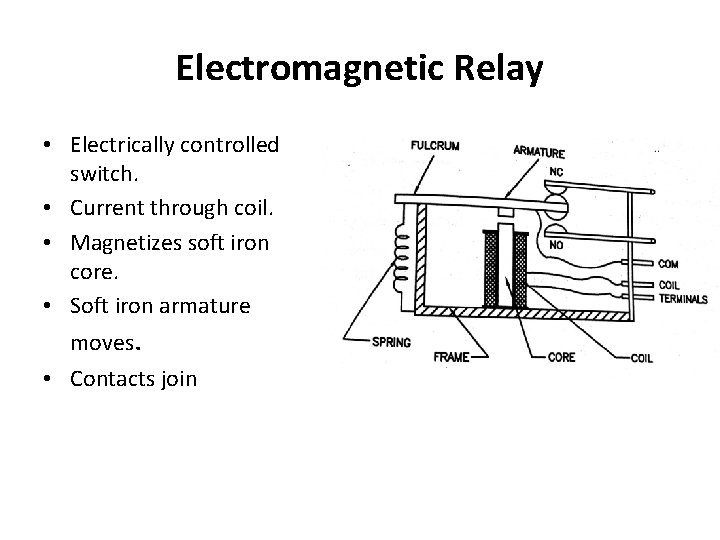
Electromagnetic Relay • Electrically controlled switch. • Current through coil. • Magnetizes soft iron core. • Soft iron armature moves. • Contacts join
• Arrangement of contacts: (1) Normally open contacts(NO): -No current flowing through the coil. -contacts are not made. -Coil must be energized for switched circuit to work. (2) Normally closed(NC): -No current flowing through the coil. -contacts are made. -Coil must be energized for switched circuit to stop working. (3) Change over contacts(c/o): -Relay coil is not energized, the common contact is connected to the NC contact. -Relay coil is energized, the closed contact breaks the common contact breaks & the common contact makes the contact to the open one.
Reed Relay • It consists of small glass tube. • Two reeds of iron-nickel material are placed inside. • The tube is filled with inert gas like argon. • The contact areas of the reed are gold plated. • Operating coil is wound round the glass tube. • Following three types of reed relays are available: (1) Normally open contact type reed relay (2) Normally closed contact type reed relay (3) Change over contact type
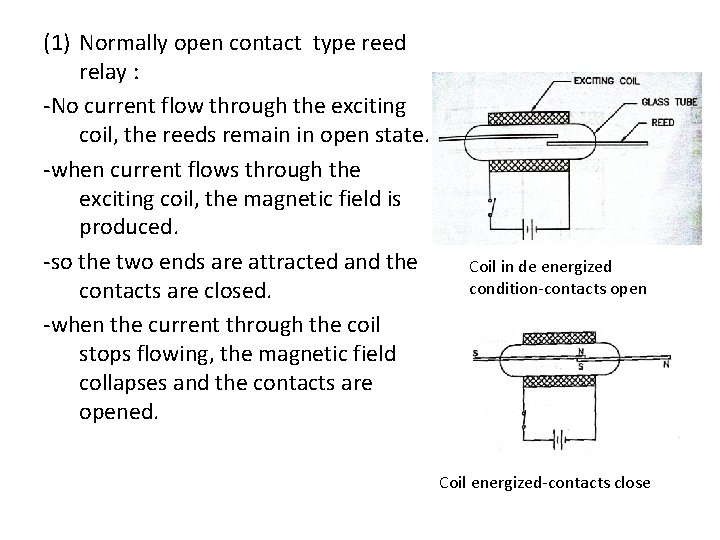
(1) Normally open contact type reed relay : -No current flow through the exciting coil, the reeds remain in open state. -when current flows through the exciting coil, the magnetic field is produced. -so the two ends are attracted and the contacts are closed. -when the current through the coil stops flowing, the magnetic field collapses and the contacts are opened. Coil in de energized condition-contacts open Coil energized-contacts close
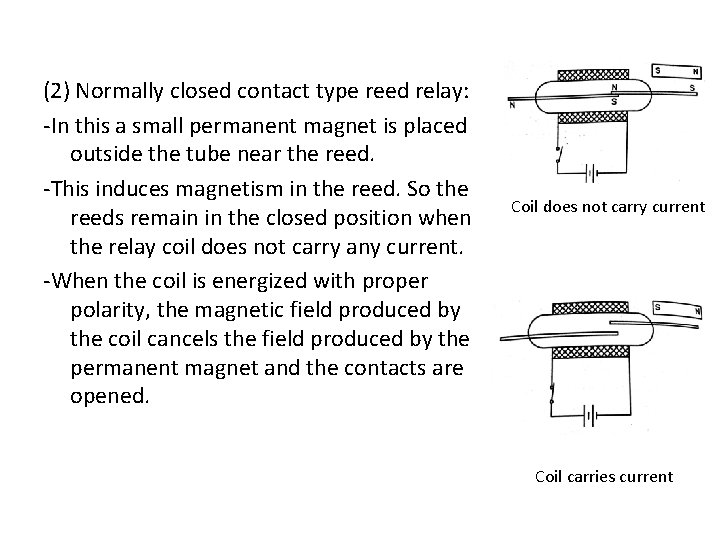
(2) Normally closed contact type reed relay: -In this a small permanent magnet is placed outside the tube near the reed. -This induces magnetism in the reed. So the reeds remain in the closed position when the relay coil does not carry any current. -When the coil is energized with proper polarity, the magnetic field produced by the coil cancels the field produced by the permanent magnet and the contacts are opened. Coil does not carry current Coil carries current
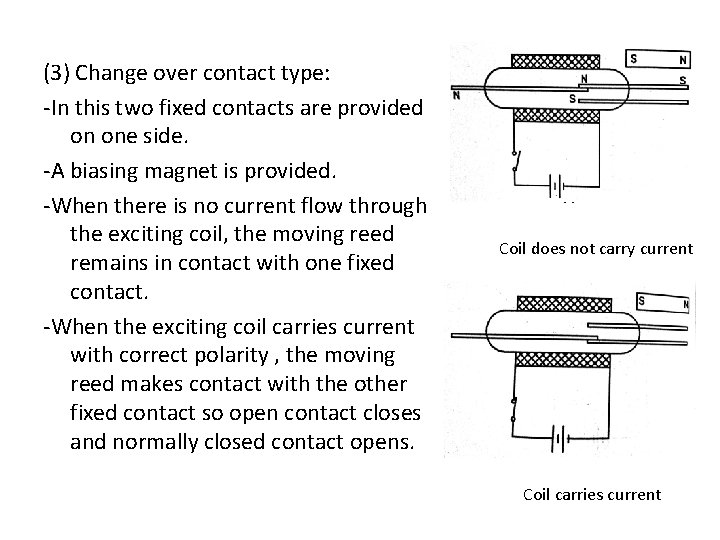
(3) Change over contact type: -In this two fixed contacts are provided on one side. -A biasing magnet is provided. -When there is no current flow through the exciting coil, the moving reed remains in contact with one fixed contact. -When the exciting coil carries current with correct polarity , the moving reed makes contact with the other fixed contact so open contact closes and normally closed contact opens. Coil does not carry current Coil carries current
Solid state relay • In the solid state type relays there is no mechanical movement. • Sensing of quantity like voltage, temperature etc. is made by sensors. • When the quantity reaches to the set value, power transistor or triac is made on or off depending upon the requirement. • Such types of relays are of instantaneous type as there is absence of mechanical movement. • Maintenance of such relay is less, occupies small space and has more sensitivity.
Difference between switch & relay • Both the Relay and switches are used to make the circuit on or off. • Switch is manually operated device while relay is automatically operated device. • Relays are of electromagnetic or reed type.