
Chapter 3 Supply and Demand In Introduction Demand











- Slides: 48
Chapter 3 Supply and Demand: In Introduction (Demand, Supply and Market Equilibrium)
Topics n Demand n Supply n Market Equilibrium – Tendency to change – Intervention – Comparative study 2
Demand n The quantity of a good that buyers wish to buy at each price n Demand curve: a schedule or graph showing demand 3
Demand: key points willingness and ability to buy a relationship between quantity demanded and product price n Qd = f (P) n n – quantity demanded is a function of price – quantity demanded is determined by price The law of demand: Qd and P are negatively related n Demand Curve: downward sloping n Market demand: the sum of individual demand n 4
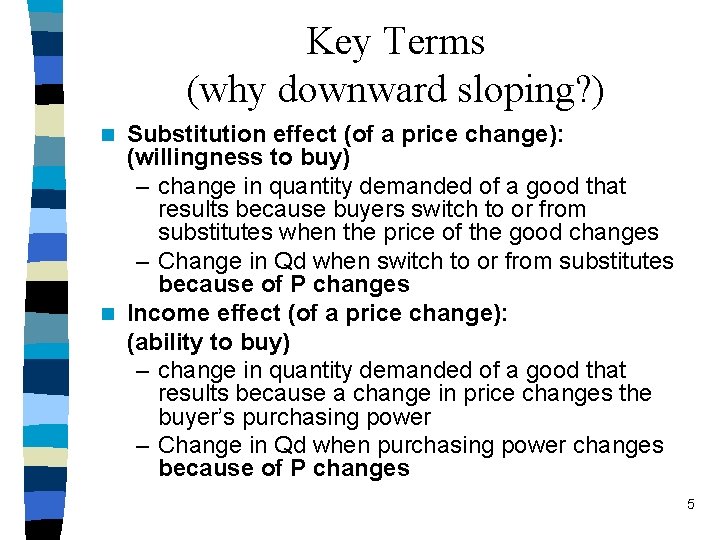
Key Terms (why downward sloping? ) Substitution effect (of a price change): (willingness to buy) – change in quantity demanded of a good that results because buyers switch to or from substitutes when the price of the good changes – Change in Qd when switch to or from substitutes because of P changes n Income effect (of a price change): (ability to buy) – change in quantity demanded of a good that results because a change in price changes the buyer’s purchasing power – Change in Qd when purchasing power changes because of P changes n 5
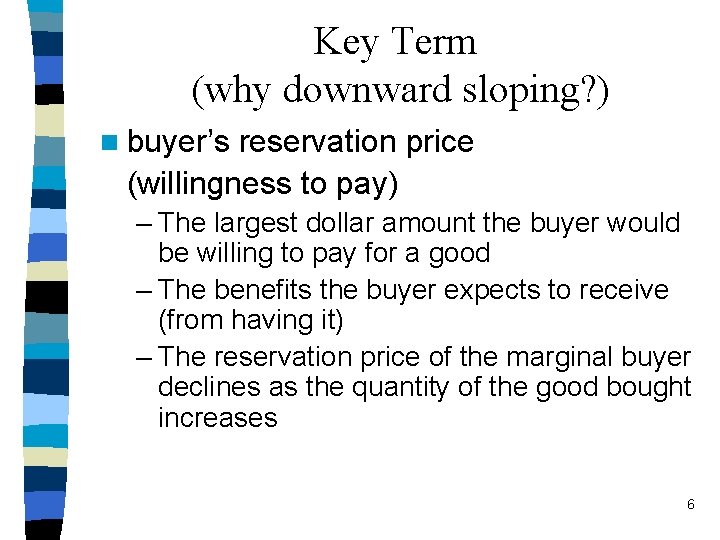
Key Term (why downward sloping? ) n buyer’s reservation price (willingness to pay) – The largest dollar amount the buyer would be willing to pay for a good – The benefits the buyer expects to receive (from having it) – The reservation price of the marginal buyer declines as the quantity of the good bought increases 6
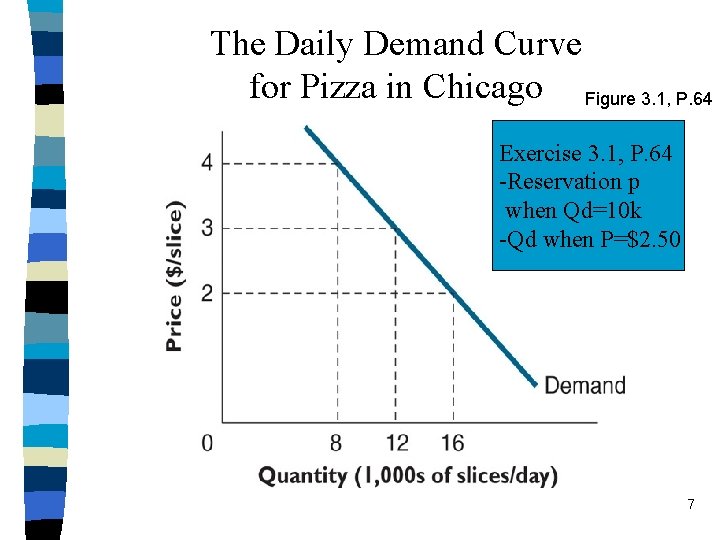
The Daily Demand Curve for Pizza in Chicago Figure 3. 1, P. 64 Exercise 3. 1, P. 64 -Reservation p when Qd=10 k -Qd when P=$2. 50 7
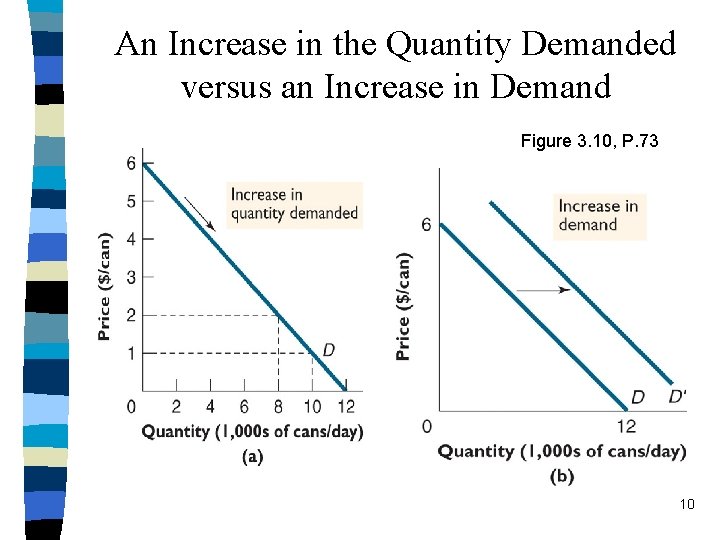
D vs. Qd D Qd A relationship between P and Qd A curve A number at a given P A point on the curve Reasons for change: change in factors other than P Change: a shift of the entire curve Reasons for change: change in P only Change: a movement along the curve 8
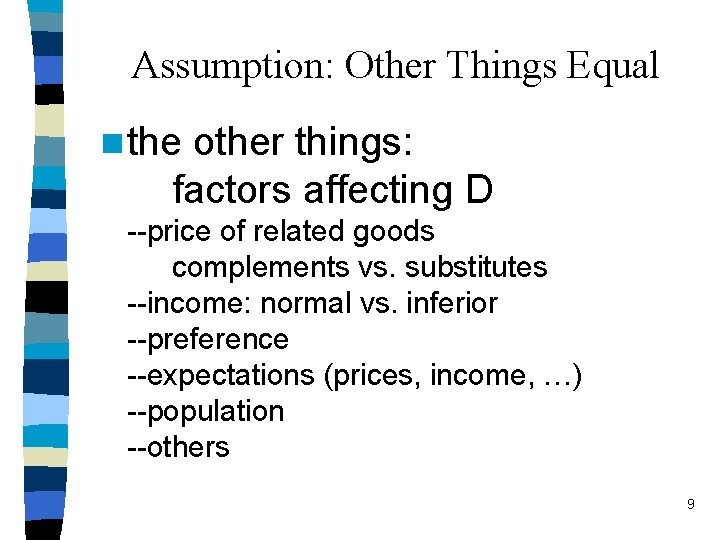
Assumption: Other Things Equal n the other things: factors affecting D --price of related goods complements vs. substitutes --income: normal vs. inferior --preference --expectations (prices, income, …) --population --others 9
An Increase in the Quantity Demanded versus an Increase in Demand Figure 3. 10, P. 73 10
Supply: n Quantity of a good that sellers wish to sell at each price n Supply curve: a schedule or graph showing supply 11
Supply: Key Points willingness and ability to sell n a relationship between price and quantity supplied n Qs = f (P) n – Quantity supplied is a function of price – quantity supplied is determined by price The Law of Supply: Qs and P are positively related n Supply Curve: upward sloping n Market supply: the sum of individual supply n 12
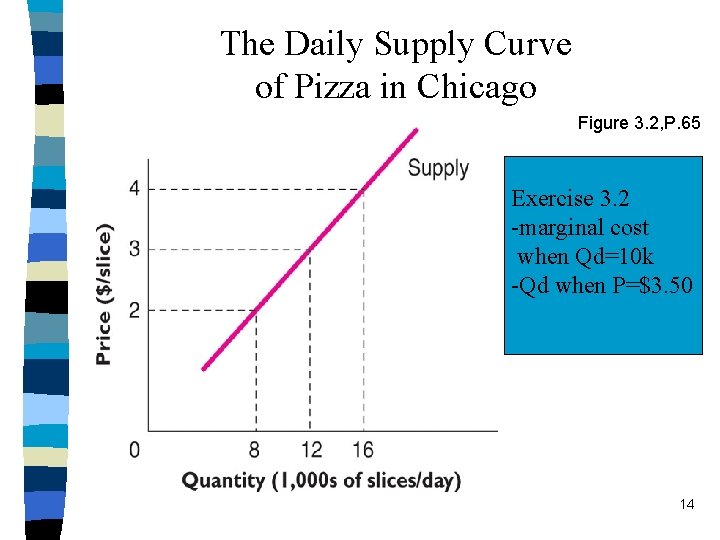
Why upward sloping? n Increasin opportunity cost (the lowhanging-fruit principle) n Seller’s reservation price: the smallest dollar amount for which a seller would be willing to sell an additional unit (marginal cost) 13
The Daily Supply Curve of Pizza in Chicago Figure 3. 2, P. 65 Exercise 3. 2 -marginal cost when Qd=10 k -Qd when P=$3. 50 14
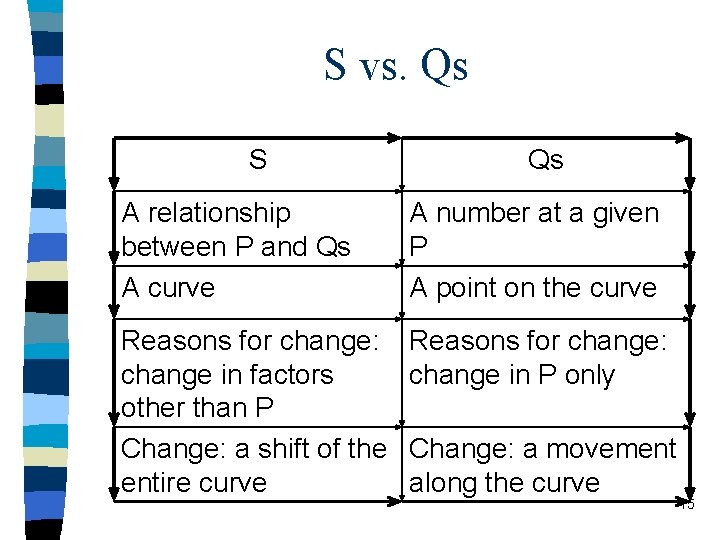
S vs. Qs S Qs A relationship between P and Qs A curve A number at a given P A point on the curve Reasons for change: change in factors other than P Change: a shift of the entire curve Reasons for change: change in P only Change: a movement along the curve 15
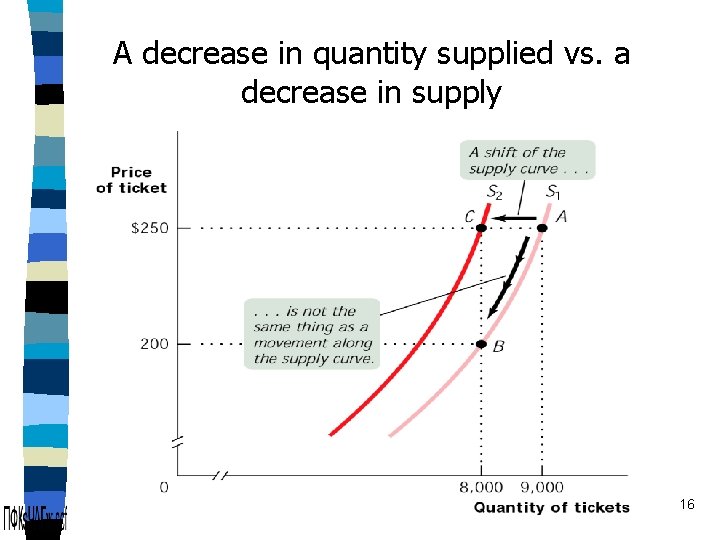
A decrease in quantity supplied vs. a decrease in supply 16
Assumption: Other Things Equal n the other things: factors affecting S --prices of inputs goods used to produce other goods --price of related goods that use the same resources --technology --expectations --others 17
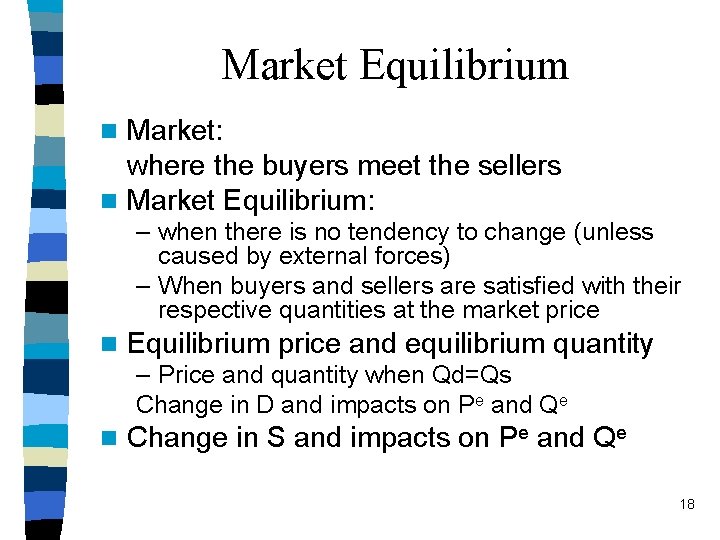
Market Equilibrium Market: where the buyers meet the sellers n Market Equilibrium: n – when there is no tendency to change (unless caused by external forces) – When buyers and sellers are satisfied with their respective quantities at the market price n Equilibrium price and equilibrium quantity – Price and quantity when Qd=Qs Change in D and impacts on Pe and Qe n Change in S and impacts on Pe and Qe 18
Equilibrium Price &Equilibrium Quantity of Pizza in Chicago Figure 3. 3, P. 66 Why no tendency to change? 19
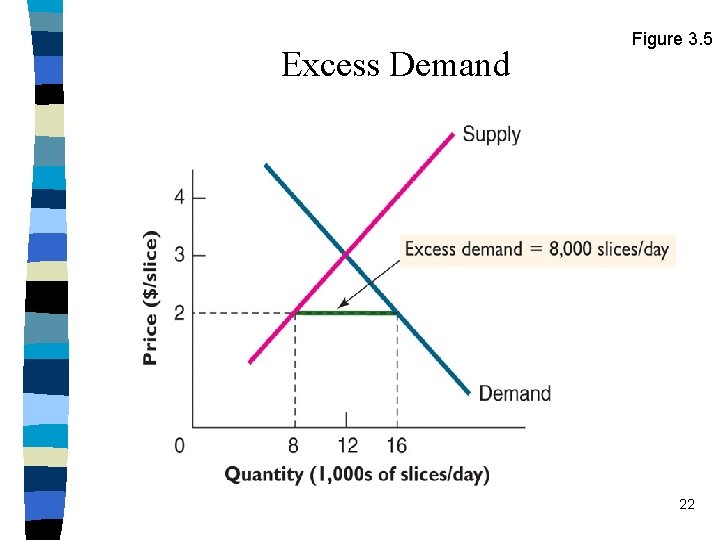
Key Terms n Excess supply: (surplus) – Qs > Qd when P>Pe n Excess demand: (shortage) – Qd > Qs when P<Pe 20
Excess Supply Figure 3. 4 21
Excess Demand Figure 3. 5 22
What happens when there is excess demand? Excess supply? n Tendency to change (not in equilibrium) until reaching equilibrium 23
Graphing Supply and Demand Finding the Equilibrium Price and Quantity Figure 3. 6 24
What if intentionally stay away from market equilibrium? n Government intervention – Price ceiling • rent control • pizza price control – Price floor • agricultural products • minimum wage 25
Interventions n Interntions: welfare concerns or political interests n Results: inefficiencies in markets 26
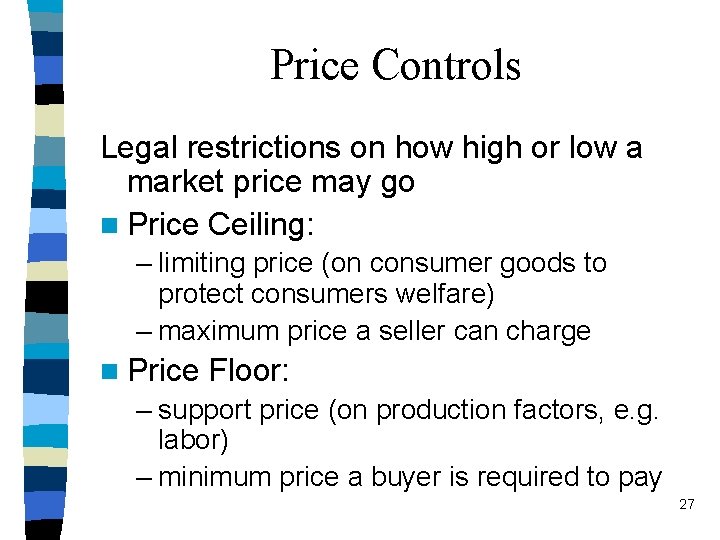
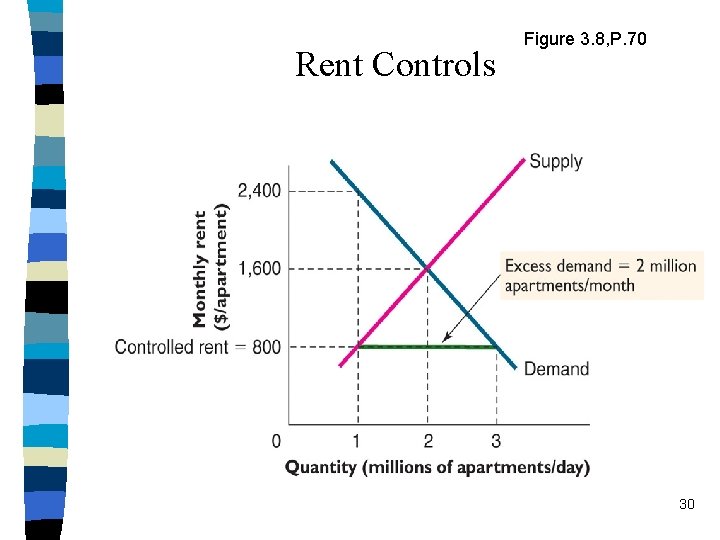
Price Controls Legal restrictions on how high or low a market price may go n Price Ceiling: – limiting price (on consumer goods to protect consumers welfare) – maximum price a seller can charge n Price Floor: – support price (on production factors, e. g. labor) – minimum price a buyer is required to pay 27
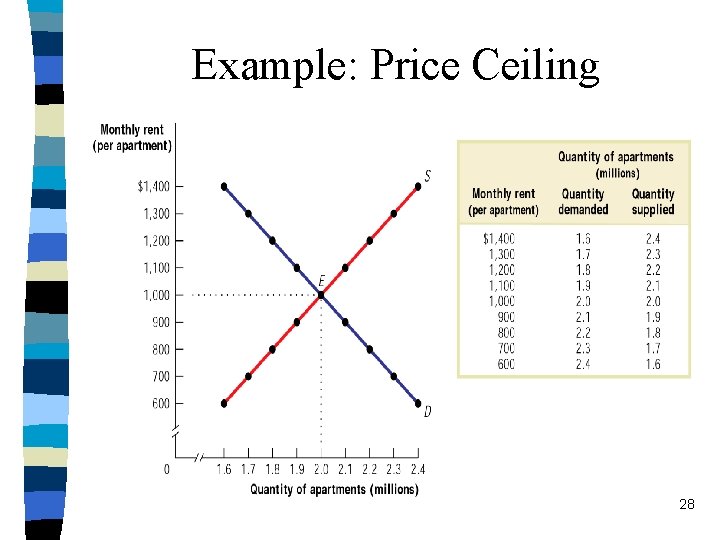
Example: Price Ceiling 28
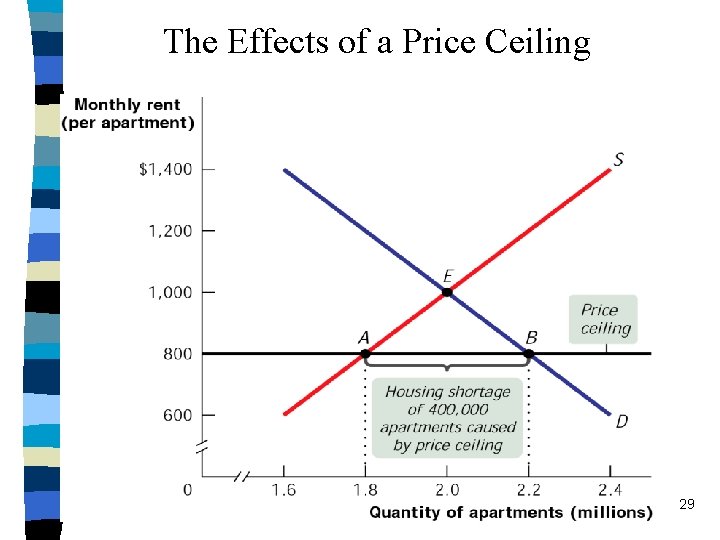
The Effects of a Price Ceiling 29
Rent Controls Figure 3. 8, P. 70 30
Figure 3. 9 Price Controls in the Pizza Market 31
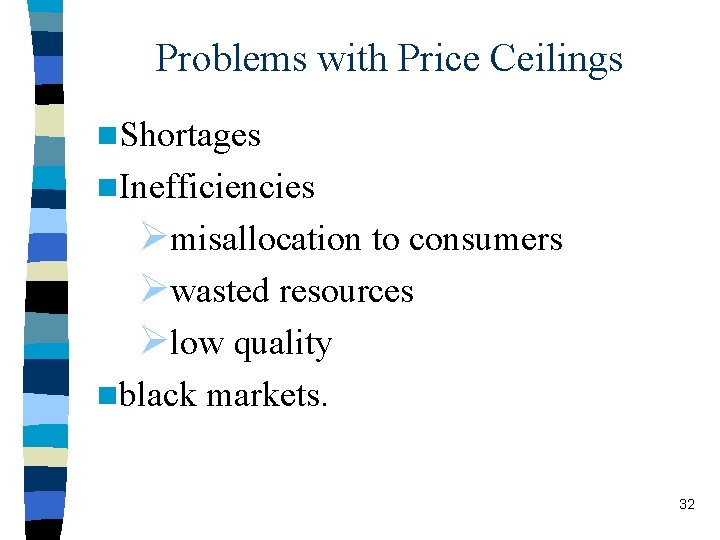
Problems with Price Ceilings n. Shortages n. Inefficiencies Ømisallocation to consumers Øwasted resources Ølow quality nblack markets. 32
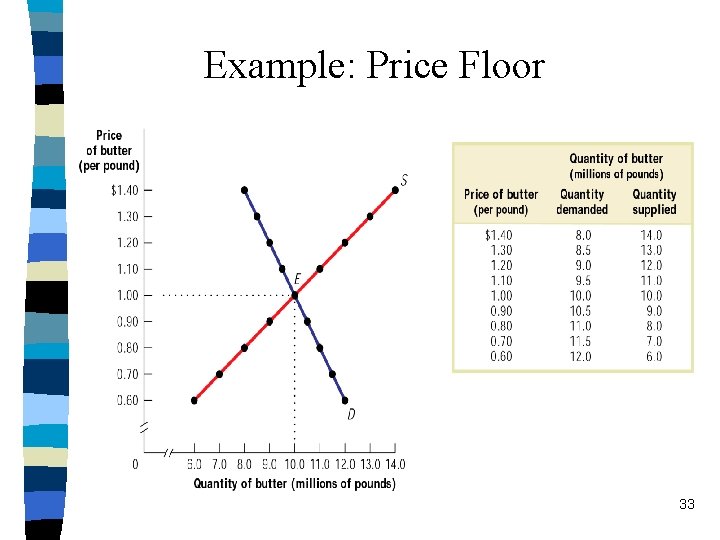
Example: Price Floor 33
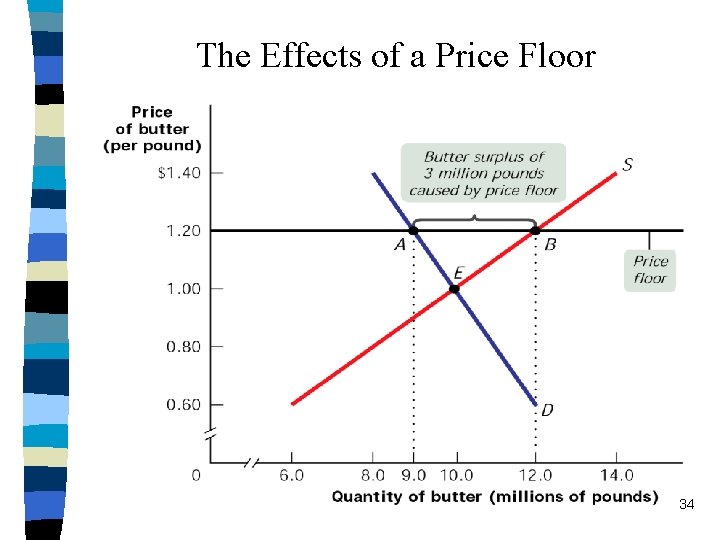
The Effects of a Price Floor 34
Problems with Price Floors n. Surplus n. Inefficiencies Ømisallocation of sales among sellers ØWasted resources ØInefficiently high quality n. Illegal activity 35
Price Controls cause Inefficiency n Consumer surplus n Producer surplus n Total surplus n Deadweight loss 36
Recall: Demand--the definition The quantity of a good or service consumers’ are willing and able to buy at various prices The maximum price the consumer is willing and able to pay for the next unit of the good or service. 37
Two Different Prices The maximum price the consumers are willing to pay for Vs. The market price the consumers actually paid for 38
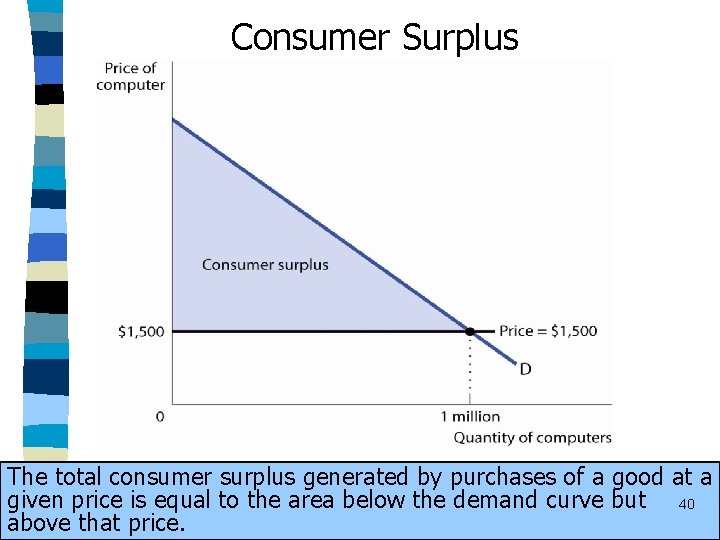
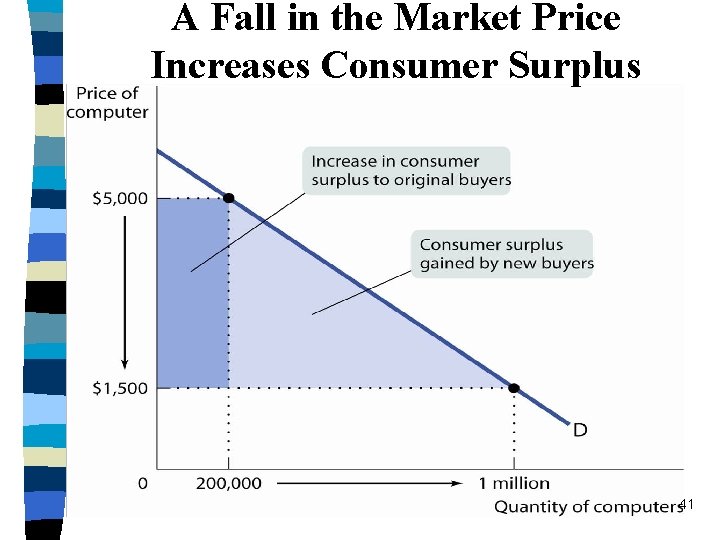
Consumer Surplus n. Individual consumer surplus the net gain to an individual buyer from the purchase of a good. equal to the difference between the buyer’s willingness to pay and the price paid. n. Total consumer surplus the sum of the individual consumer surpluses of all the buyers of a good 39
Consumer Surplus The total consumer surplus generated by purchases of a good at a given price is equal to the area below the demand curve but 40 above that price.
A Fall in the Market Price Increases Consumer Surplus 41
Recall: Supply--the definition The quantity of a good or service producers are willing and able to sell at various prices The minimum price the producer is willing and able to accept for providing the next unit of the good or service 42
Two Different Prices The minimum price the producers are willing to accept Vs. The market price the producers actually get 43
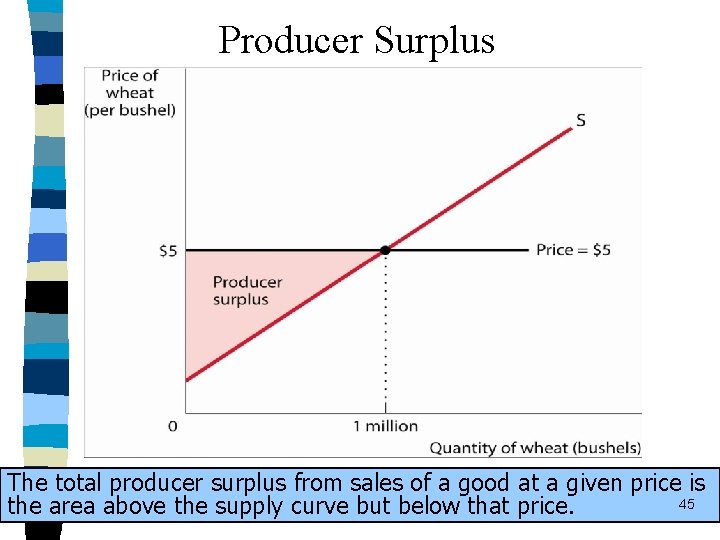
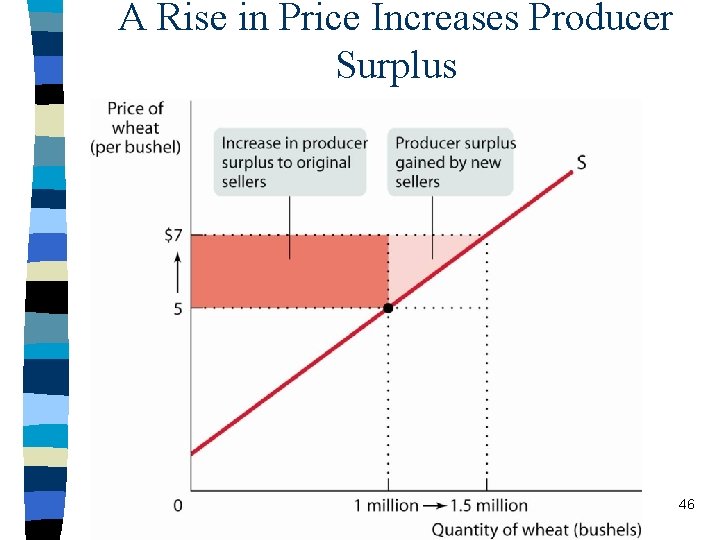
Producer Surplus and the Supply Curve n. Individual producer surplus the net gain to a seller from selling a good equal to the difference between the price received and the seller’s cost (the minimum price the producer is willing to accept) n. Total producer surplus the sum of the individual producer surpluses of all the sellers of a good 44
Producer Surplus The total producer surplus from sales of a good at a given price is 45 the area above the supply curve but below that price.
A Rise in Price Increases Producer Surplus 46
Putting it together: Total Surplus the total net gain to consumers and producers from trading in the market the sum of the producer surplus and the consumer surplus 47
Total Surplus 48