
Chapter 3 Student Similarities and Differences Your Introduction
- Slides: 23
Chapter 3: Student Similarities and Differences Your Introduction to Education: Explorations in Teaching, 2 e Sara Davis Powell © 2012, 2009 Pearson Education, Inc. All rights reserved.
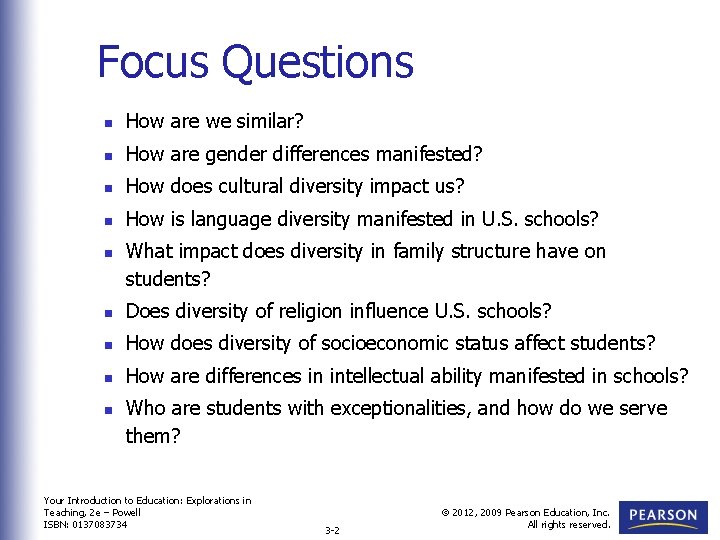
Focus Questions n How are we similar? n How are gender differences manifested? n How does cultural diversity impact us? n How is language diversity manifested in U. S. schools? n What impact does diversity in family structure have on students? n Does diversity of religion influence U. S. schools? n How does diversity of socioeconomic status affect students? n How are differences in intellectual ability manifested in schools? n Who are students with exceptionalities, and how do we serve them? Your Introduction to Education: Explorations in Teaching, 2 e – Powell ISBN: 0137083734 3 -2 © 2012, 2009 Pearson Education, Inc. All rights reserved.
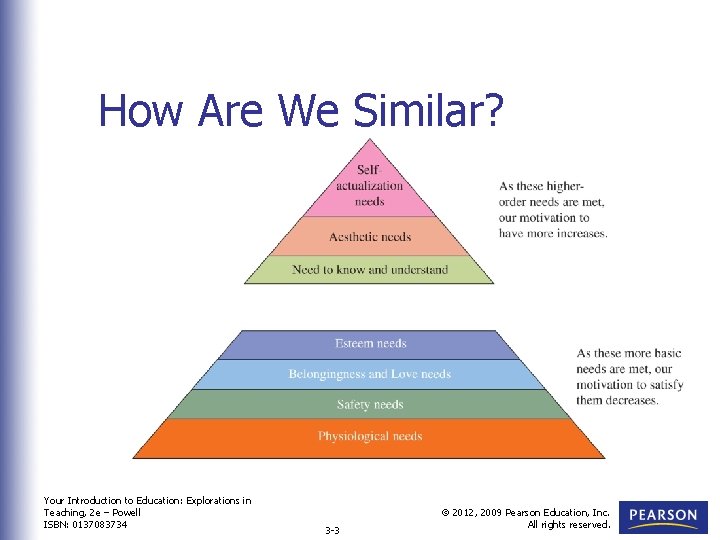
How Are We Similar? Your Introduction to Education: Explorations in Teaching, 2 e – Powell ISBN: 0137083734 3 -3 © 2012, 2009 Pearson Education, Inc. All rights reserved.
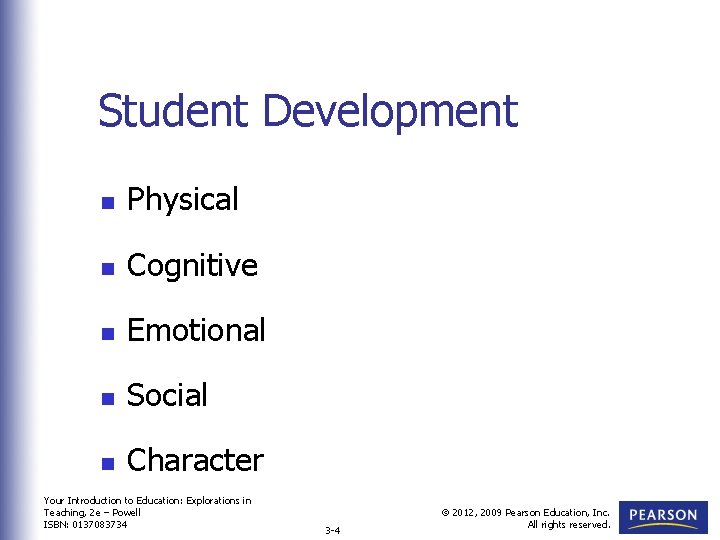
Student Development n Physical n Cognitive n Emotional n Social n Character Your Introduction to Education: Explorations in Teaching, 2 e – Powell ISBN: 0137083734 3 -4 © 2012, 2009 Pearson Education, Inc. All rights reserved.
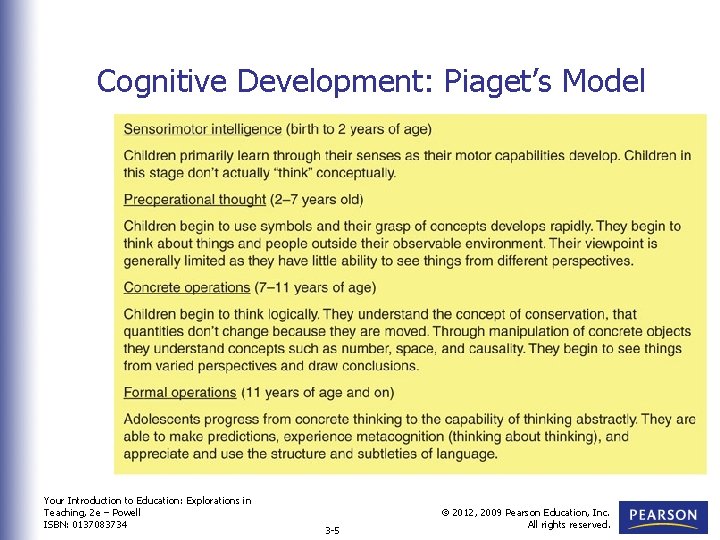
Cognitive Development: Piaget’s Model Your Introduction to Education: Explorations in Teaching, 2 e – Powell ISBN: 0137083734 3 -5 © 2012, 2009 Pearson Education, Inc. All rights reserved.
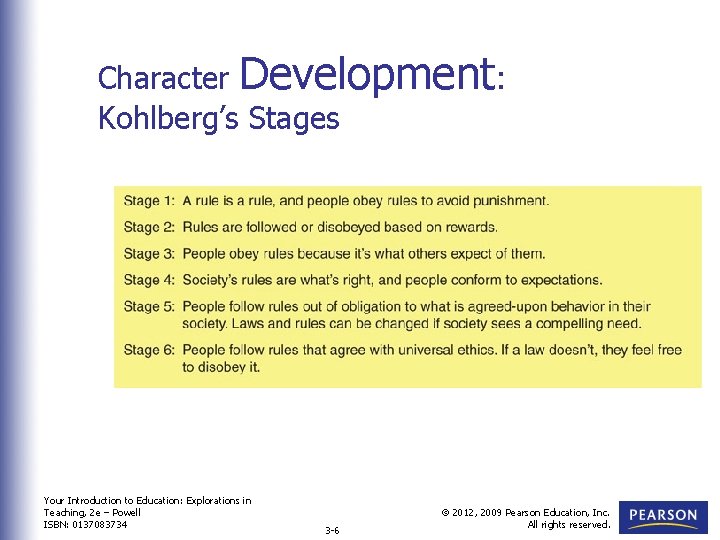
Character Development: Kohlberg’s Stages Your Introduction to Education: Explorations in Teaching, 2 e – Powell ISBN: 0137083734 3 -6 © 2012, 2009 Pearson Education, Inc. All rights reserved.
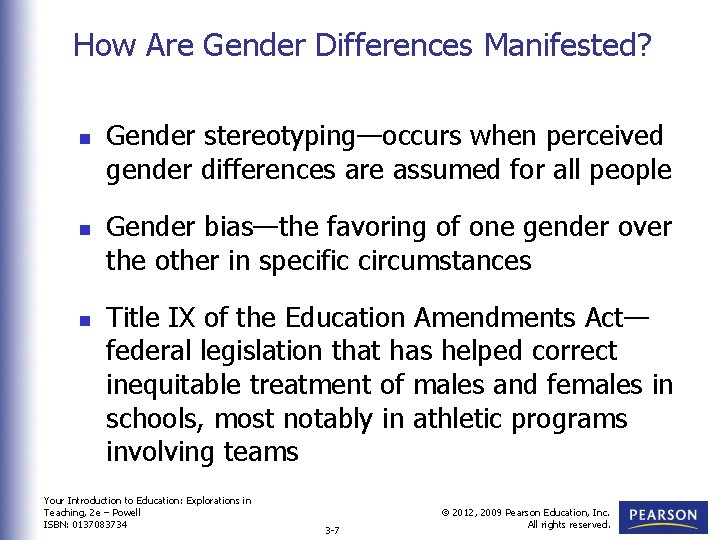
How Are Gender Differences Manifested? n n n Gender stereotyping—occurs when perceived gender differences are assumed for all people Gender bias—the favoring of one gender over the other in specific circumstances Title IX of the Education Amendments Act— federal legislation that has helped correct inequitable treatment of males and females in schools, most notably in athletic programs involving teams Your Introduction to Education: Explorations in Teaching, 2 e – Powell ISBN: 0137083734 3 -7 © 2012, 2009 Pearson Education, Inc. All rights reserved.
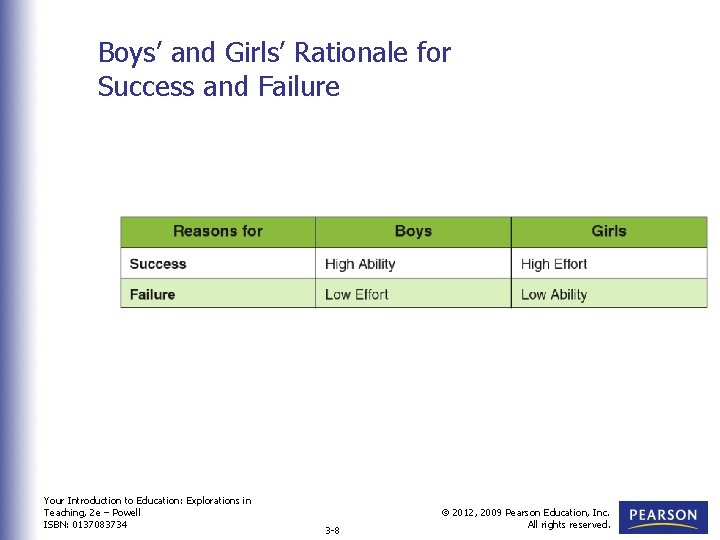
Boys’ and Girls’ Rationale for Success and Failure Your Introduction to Education: Explorations in Teaching, 2 e – Powell ISBN: 0137083734 3 -8 © 2012, 2009 Pearson Education, Inc. All rights reserved.
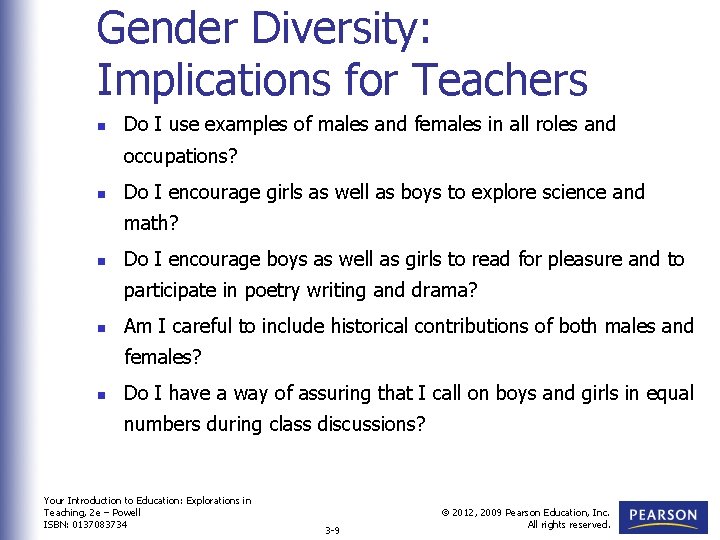
Gender Diversity: Implications for Teachers n Do I use examples of males and females in all roles and occupations? n Do I encourage girls as well as boys to explore science and math? n Do I encourage boys as well as girls to read for pleasure and to participate in poetry writing and drama? n Am I careful to include historical contributions of both males and females? n Do I have a way of assuring that I call on boys and girls in equal numbers during class discussions? Your Introduction to Education: Explorations in Teaching, 2 e – Powell ISBN: 0137083734 3 -9 © 2012, 2009 Pearson Education, Inc. All rights reserved.
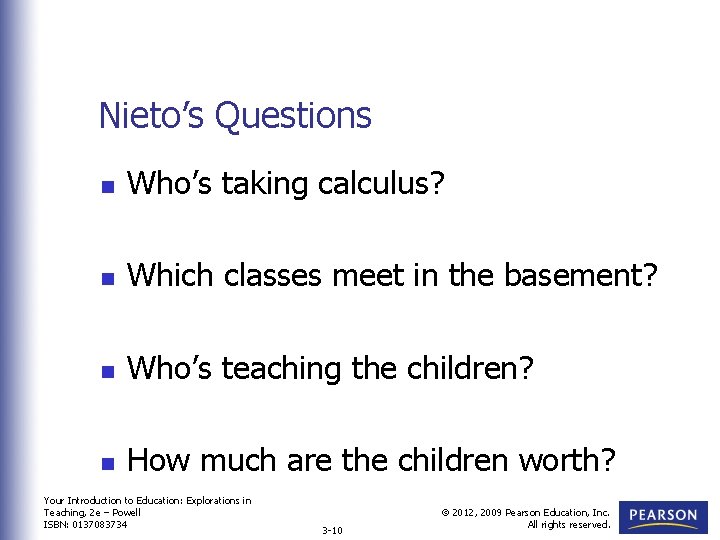
Nieto’s Questions n Who’s taking calculus? n Which classes meet in the basement? n Who’s teaching the children? n How much are the children worth? Your Introduction to Education: Explorations in Teaching, 2 e – Powell ISBN: 0137083734 3 -10 © 2012, 2009 Pearson Education, Inc. All rights reserved.
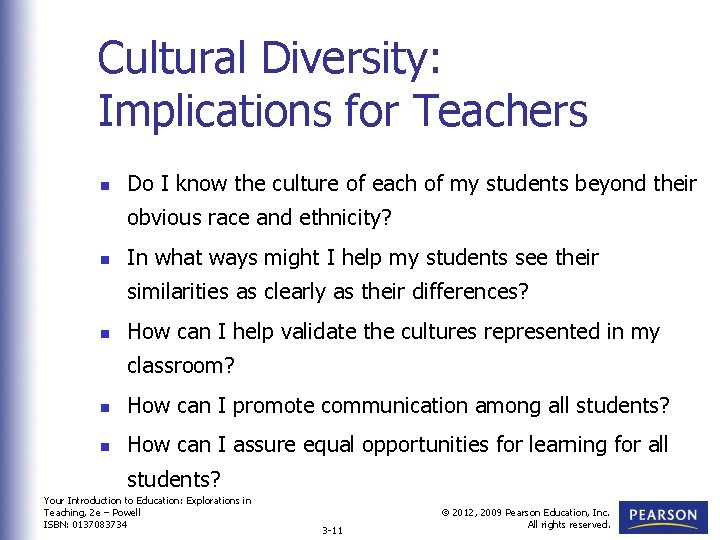
Cultural Diversity: Implications for Teachers n Do I know the culture of each of my students beyond their obvious race and ethnicity? n In what ways might I help my students see their similarities as clearly as their differences? n How can I help validate the cultures represented in my classroom? n How can I promote communication among all students? n How can I assure equal opportunities for learning for all students? Your Introduction to Education: Explorations in Teaching, 2 e – Powell ISBN: 0137083734 3 -11 © 2012, 2009 Pearson Education, Inc. All rights reserved.
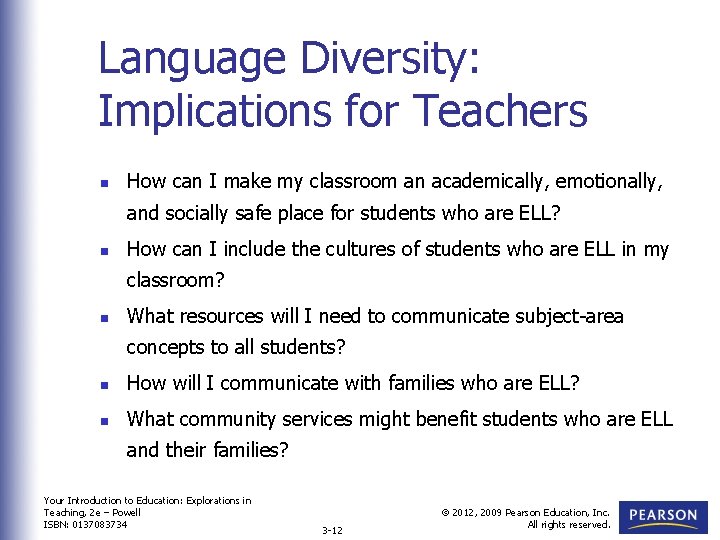
Language Diversity: Implications for Teachers n How can I make my classroom an academically, emotionally, and socially safe place for students who are ELL? n How can I include the cultures of students who are ELL in my classroom? n What resources will I need to communicate subject-area concepts to all students? n How will I communicate with families who are ELL? n What community services might benefit students who are ELL and their families? Your Introduction to Education: Explorations in Teaching, 2 e – Powell ISBN: 0137083734 3 -12 © 2012, 2009 Pearson Education, Inc. All rights reserved.
Family Diversity: Implications for Teachers n How can I restructure volunteer opportunities to include evenings and weekends? n Are options available for child care that might lead to greater parental participation? n Can the school provide easily accessible transportation to boost family involvement? n Can I be more inclusive by practicing simple tactics such as addressing correspondence with “Dear family” rather than “Dear parents”? Your Introduction to Education: Explorations in Teaching, 2 e – Powell ISBN: 0137083734 3 -13 © 2012, 2009 Pearson Education, Inc. All rights reserved.
Religious Diversity: Implications for Teachers n How do I make sure tolerance is modeled in my classroom? n How can I guard against being offensive to students of varying faiths? n How should holidays be observed? n How can I best respond to the community in which I live and teach? Your Introduction to Education: Explorations in Teaching, 2 e – Powell ISBN: 0137083734 3 -14 © 2012, 2009 Pearson Education, Inc. All rights reserved.
SES Diversity: Implications for Teachers n Teachers can support students and families in poverty by attending to their resource needs which include: n n n n Emotional resources Mental resources Spiritual resources Physical resources Support systems Relationships/role models Knowledge of hidden rules Your Introduction to Education: Explorations in Teaching, 2 e – Powell ISBN: 0137083734 3 -15 © 2012, 2009 Pearson Education, Inc. All rights reserved.
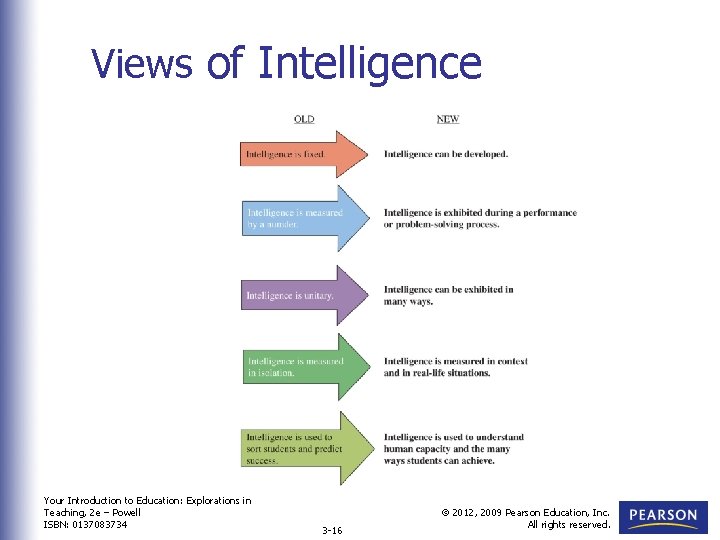
Views of Intelligence Your Introduction to Education: Explorations in Teaching, 2 e – Powell ISBN: 0137083734 3 -16 © 2012, 2009 Pearson Education, Inc. All rights reserved.
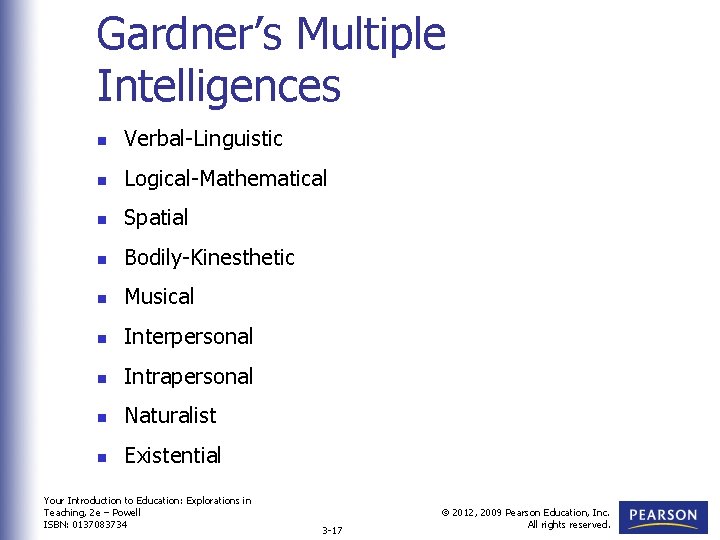
Gardner’s Multiple Intelligences n Verbal-Linguistic n Logical-Mathematical n Spatial n Bodily-Kinesthetic n Musical n Interpersonal n Intrapersonal n Naturalist n Existential Your Introduction to Education: Explorations in Teaching, 2 e – Powell ISBN: 0137083734 3 -17 © 2012, 2009 Pearson Education, Inc. All rights reserved.
Intellectual Ability Diversity: Implications for Teachers n Do I view the students in my classroom as a collection of individuals, each with unique ways of being smart? n Do I continually seek to understand the ways in which my students learn best? n Do I plan some experiences that address and incorporate each of the multiple intelligences? n Does my awareness of my students’ various learning styles change how I teach? n Do I consciously seek to identify, and then expand, each student’s zone of proximal development? Your Introduction to Education: Explorations in Teaching, 2 e – Powell ISBN: 0137083734 3 -18 © 2012, 2009 Pearson Education, Inc. All rights reserved.
Learning Disabilities n Students with learning disabilities (LD) may… n have difficulties with word recognition and text comprehension n feel overwhelmed by the idea of getting started n struggle to organize and use the mechanics of writing n have difficulty differentiating numbers or copying shapes n have difficulty identifying, using, and monitoring problem-solving strategies (Turnbull et al. , 2007) Your Introduction to Education: Explorations in Teaching, 2 e – Powell ISBN: 0137083734 3 -19 © 2012, 2009 Pearson Education, Inc. All rights reserved.
Inclusion n Inclusion means that students with disabilities: n attend regular school with age and grade appropriate peers n participate in extracurricular activities n receive special education and support services n are part of general education classrooms to the maximum extent possible Your Introduction to Education: Explorations in Teaching, 2 e – Powell ISBN: 0137083734 3 -20 © 2012, 2009 Pearson Education, Inc. All rights reserved.
Gifted and Talented Students n Teachers may best meet the needs of students who are gifted and talented by n being flexible n accepting unusual ideas and encouraging alternative solutions to problems n not being intimidated by the intellectual and creative capabilities of students who have IQs that exceed our own n differentiating instruction often Your Introduction to Education: Explorations in Teaching, 2 e – Powell ISBN: 0137083734 3 -21 © 2012, 2009 Pearson Education, Inc. All rights reserved.
Students with Exceptionalities: Implications for Teachers n Do I take the time to get to know each student as an individual? n Do I look for the strengths and abilities of all my students? n Is differentiating instruction a primary goal? n Is cooperative learning used frequently in my classroom? n Do I continually diagnose the progress of my students and adjust my instruction appropriately? Your Introduction to Education: Explorations in Teaching, 2 e – Powell ISBN: 0137083734 3 -22 © 2012, 2009 Pearson Education, Inc. All rights reserved.
Concluding Thoughts Yes, all children can learn. These complex questions about children logically follow this statement: n What can they learn? n When can they learn it? n In what ways will they learn it best? n As always, “And how are the children? Are they all well? ” should be the center of our focus. Your Introduction to Education: Explorations in Teaching, 2 e – Powell ISBN: 0137083734 3 -23 © 2012, 2009 Pearson Education, Inc. All rights reserved.