
Chapter 3 Stress and Health Psychology Chapter 3
- Slides: 40
Chapter 3: Stress and Health Psychology
Chapter 3 Overview n Understanding Stress (Section 1) Sources of Stress n Effects of Stress n n Stress and Illness (Section 2) Cancer n Cardiovascular Disease n Posttraumatic Stress Disorder (PTSD) n
Chapter 3 Overview n Stress and Health Management (Section 3) n Forms of Coping n Substance Abuse n Resources for Healthy Living
I. Understanding Stress n Stress the body’s nonspecific response to any demand made on it. Any stimulus that causes stress is called a STRESSOR n There are two different types of stress n Distress Negative forms of stress n n Most n of you are familiar with this type Eustress Beneficial forms of stress
I. Understanding Stress Eustress n Positive form of stress n Increases sharpness and motivation n Can keep people alert and involved n Eustress is a sign that a person may be taking a challenge to reach a certain goal n Ex: sporting events, job interviews, etc. n
I. Understanding Stress Distress n Negative types of stress n Linked to intense pressure or anxiety n Strains people’s ability to adjust or adapt to various situations n Can dampen mood, impair ability and harm the body n Ex: Divorce, loss of job, moving n
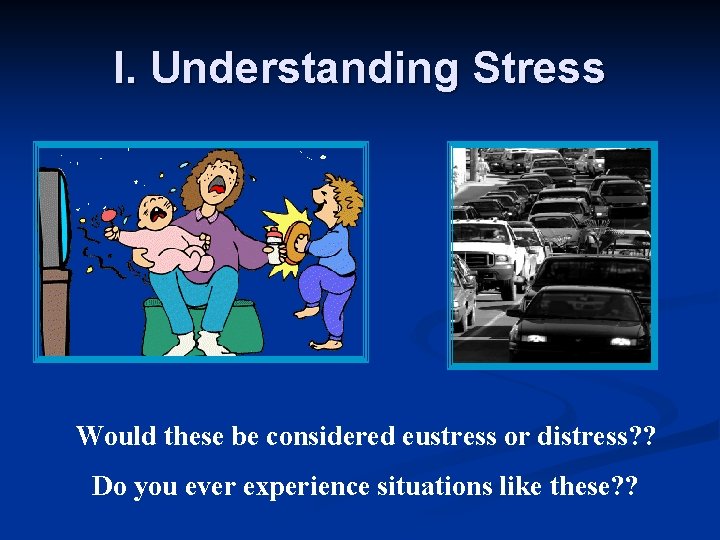
I. Understanding Stress Would these be considered eustress or distress? ? Do you ever experience situations like these? ?
I. Understanding Stress n n There are several different sources of stress Daily Hassles • n Frustration n Everyday frustrations: household, health, time-pressure, innerconcern, environmental, financial, work, future-security Being blocked from attaining a goal, such as being late to an appointment or lacking money Many frustrations are minor, but more serious ones can be extremely stressful Life Changes n n Major events such as moving, serious illness, or a death Many life changes are positive, and tend to happen less often
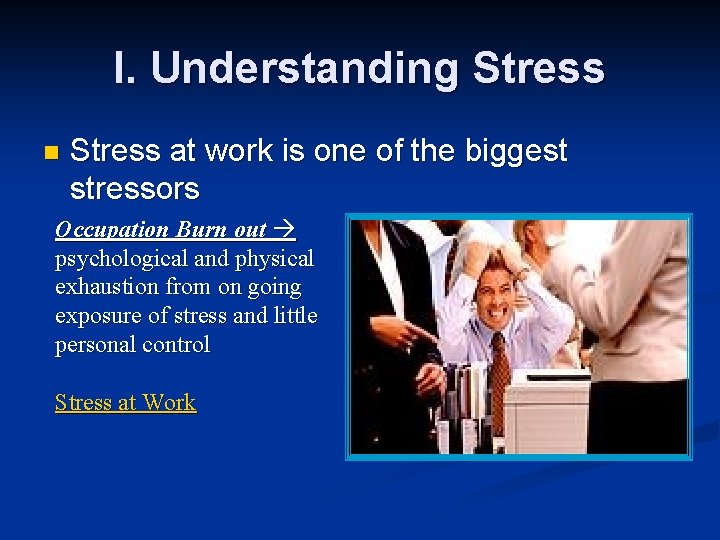
I. Understanding Stress n Stress at work is one of the biggest stressors Occupation Burn out psychological and physical exhaustion from on going exposure of stress and little personal control Stress at Work
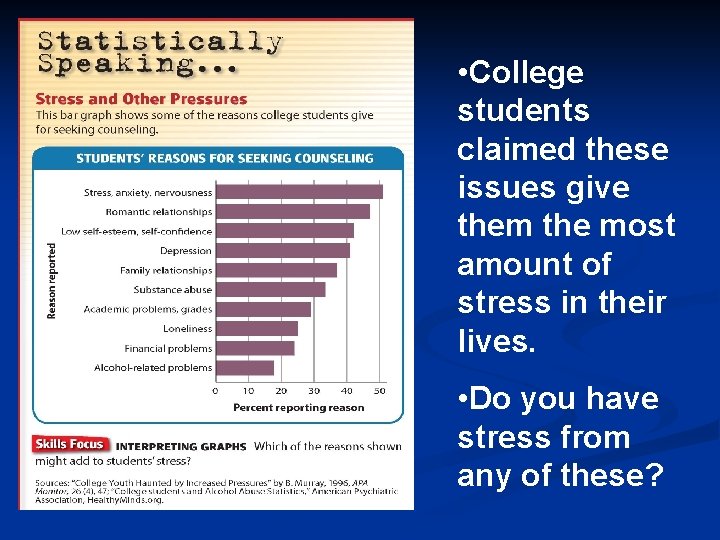
• College students claimed these issues give them the most amount of stress in their lives. • Do you have stress from any of these?
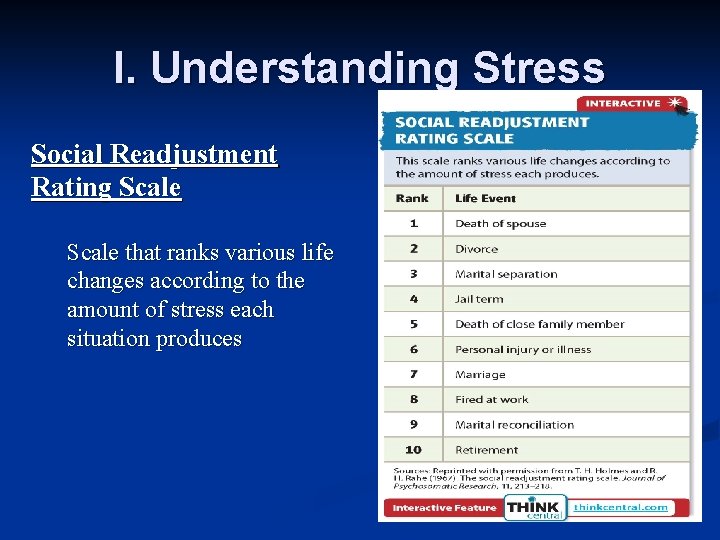
I. Understanding Stress Social Readjustment Rating Scale that ranks various life changes according to the amount of stress each situation produces
I. Understanding Stress Case Study n The Slow – Food, Low – Stress Diet n Discusses eating habits of people in France vs. eating habits of people in the US. n What do you think? ? n
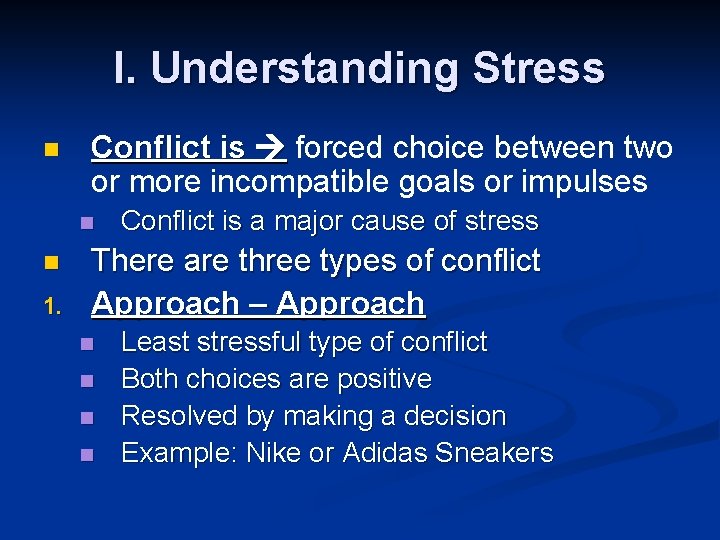
I. Understanding Stress n Conflict is forced choice between two or more incompatible goals or impulses n n 1. Conflict is a major cause of stress There are three types of conflict Approach – Approach n n Least stressful type of conflict Both choices are positive Resolved by making a decision Example: Nike or Adidas Sneakers
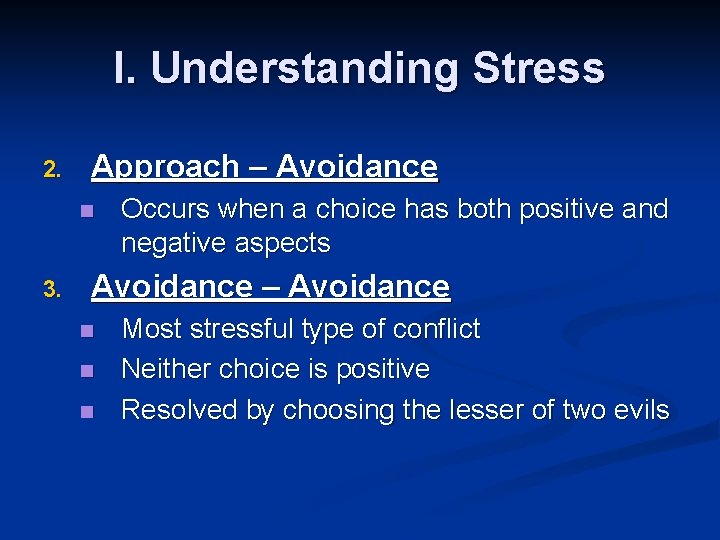
I. Understanding Stress 2. Approach – Avoidance n 3. Occurs when a choice has both positive and negative aspects Avoidance – Avoidance n n n Most stressful type of conflict Neither choice is positive Resolved by choosing the lesser of two evils
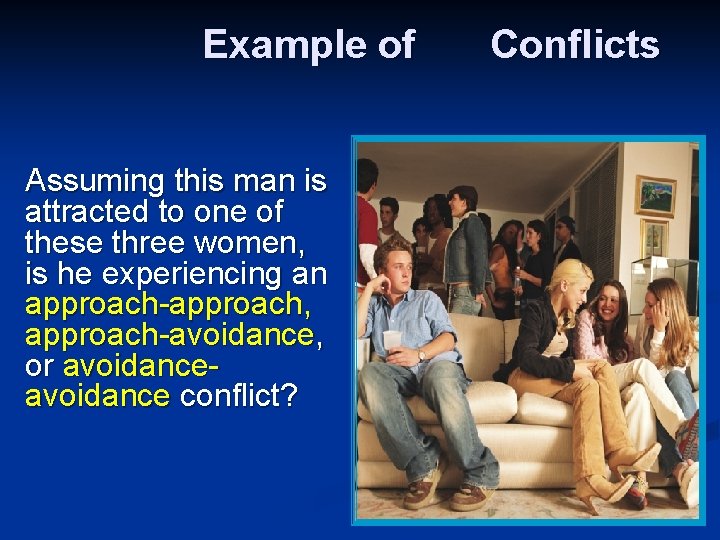
Example of Assuming this man is attracted to one of these three women, is he experiencing an approach-approach, approach-avoidance, or avoidance conflict? Conflicts
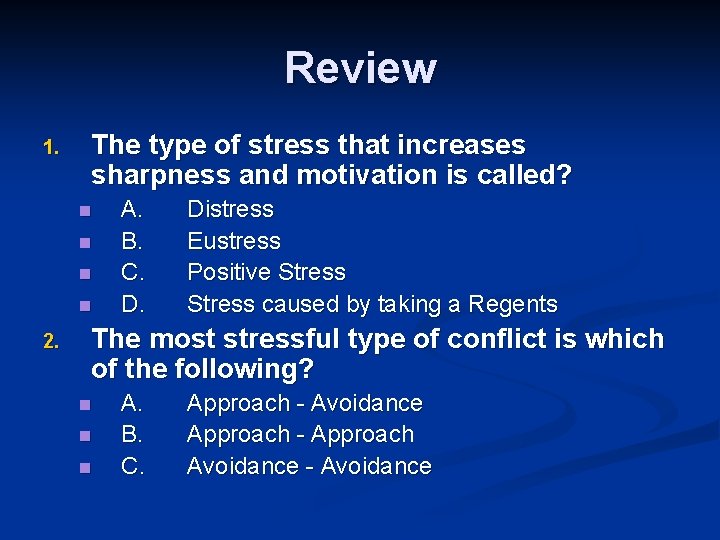
Review 1. The type of stress that increases sharpness and motivation is called? n n 2. A. B. C. D. Distress Eustress Positive Stress caused by taking a Regents The most stressful type of conflict is which of the following? n n n A. B. C. Approach - Avoidance Approach - Approach Avoidance - Avoidance
I. Understanding Stress Effects of Stress: there are several effects on the body when stressed n The body undergoes physiological changes n Sympathetic part of autonomic nervous system is activated which means n n Heart rate increases n Blood pressure increases n Hormone increase n Fight or Flight Response is activated
I. Understanding Stress Fight or Flight Response n Reaction that mobilizes the body for defensive action when a person first perceives a stressor n Blood flows from surface area to major muscle groups giving them energy n Body receives a burst of energy n Person becomes ready for Fight (confront the stressor) or Flight (run away from stressor) n
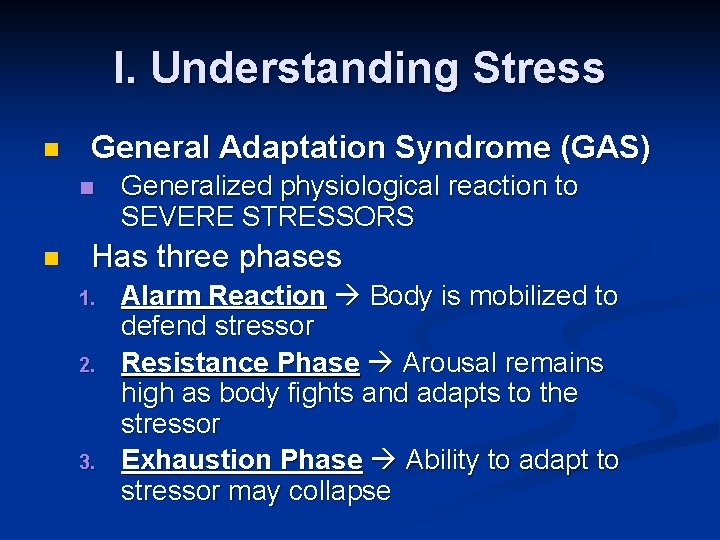
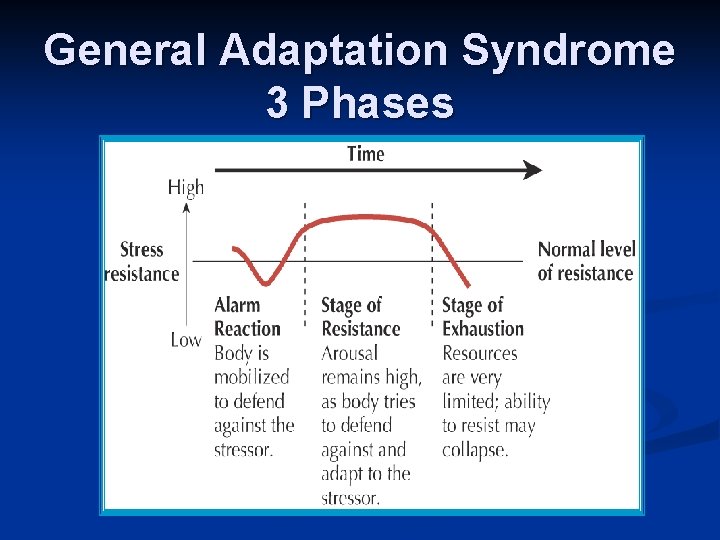
I. Understanding Stress n General Adaptation Syndrome (GAS) n n Generalized physiological reaction to SEVERE STRESSORS Has three phases 1. 2. 3. Alarm Reaction Body is mobilized to defend stressor Resistance Phase Arousal remains high as body fights and adapts to the stressor Exhaustion Phase Ability to adapt to stressor may collapse
General Adaptation Syndrome 3 Phases
II. Stress and Illness n Stress on the Immune System Most people are exposed to a great variety of disease-causing organisms, but an intact immune system fights off most of them n White blood cells destroy disease-causing microorganisms n n One reason stress exhausts people is that it stimulates bodies to produce steroids, which suppress the immune system
II. Stress and Illness n Studies relating to stress and the immune system 1. One study showed lower immunesystem functioning during more stressful periods 2. Another study showed that training in coping skills improved the functioning of the immune system during stressful times
II. Stress and Illness n Stress and Cancer can be caused by environmental factors including cigarette smoke, asbestos, etc. n Cancer is also related to genetic predisposition n n During times of stress the body may be less able to fight cancerous cells because our immune system is suppressed because of the stressor n When our immune system is suppressed it is very difficult to fight off any other negative
II. Stress and Illness n Risk factors indicating someone may be at risk for cancer: People may inherit a tendency to develop certain kinds of cancer (Family History) n Certain behaviors increase risk n n Examples n smoking, high fat diet, etc. Stress may be a risk factor n Distress would increase the chances of someone having cancer
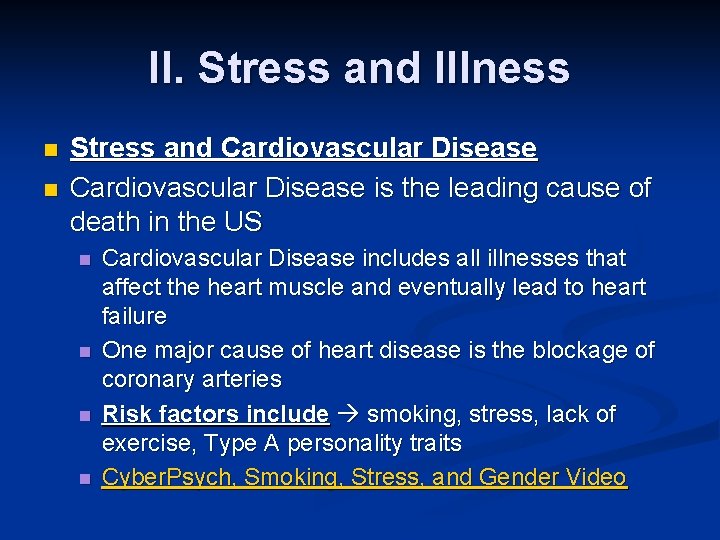
II. Stress and Illness n n Stress and Cardiovascular Disease is the leading cause of death in the US n n Cardiovascular Disease includes all illnesses that affect the heart muscle and eventually lead to heart failure One major cause of heart disease is the blockage of coronary arteries Risk factors include smoking, stress, lack of exercise, Type A personality traits Cyber. Psych, Smoking, Stress, and Gender Video
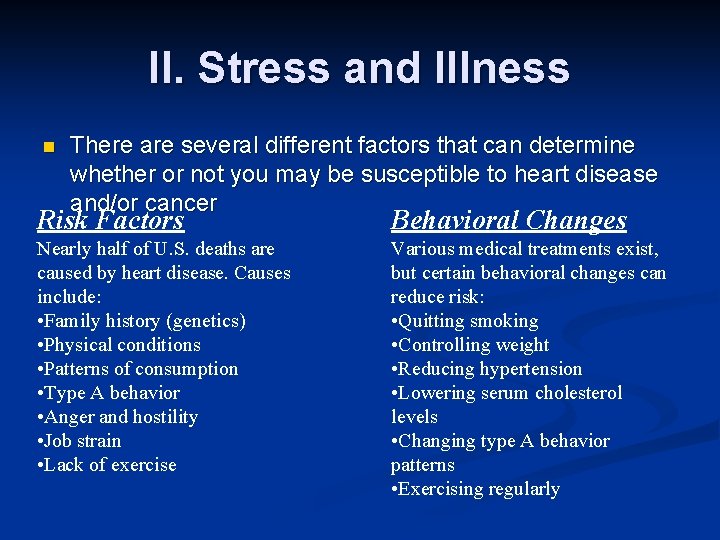
II. Stress and Illness n There are several different factors that can determine whether or not you may be susceptible to heart disease and/or cancer Risk Factors Behavioral Changes Nearly half of U. S. deaths are caused by heart disease. Causes include: • Family history (genetics) • Physical conditions • Patterns of consumption • Type A behavior • Anger and hostility • Job strain • Lack of exercise Various medical treatments exist, but certain behavioral changes can reduce risk: • Quitting smoking • Controlling weight • Reducing hypertension • Lowering serum cholesterol levels • Changing type A behavior patterns • Exercising regularly
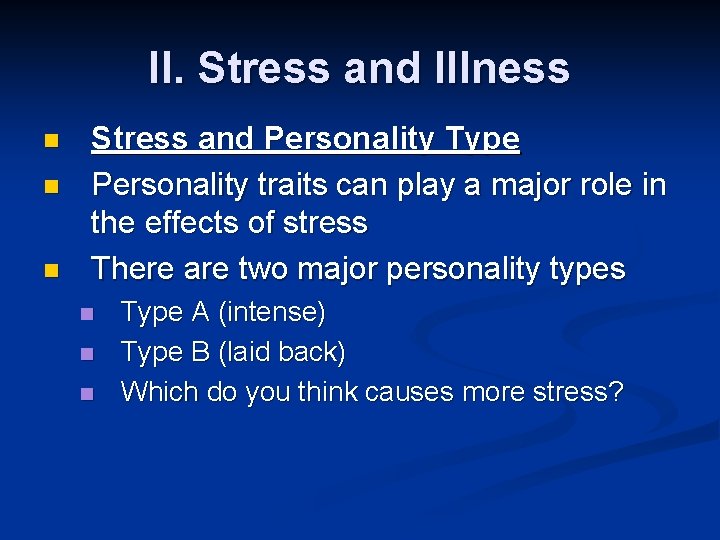
II. Stress and Illness n n n Stress and Personality Type Personality traits can play a major role in the effects of stress There are two major personality types n n n Type A (intense) Type B (laid back) Which do you think causes more stress?
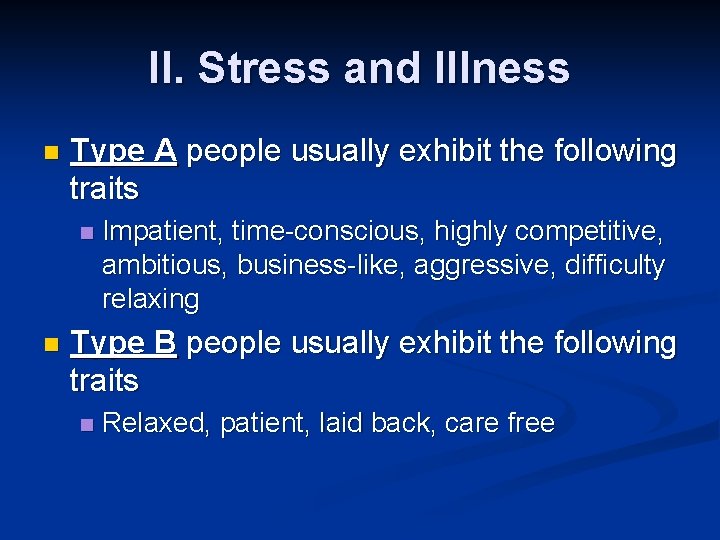
II. Stress and Illness n Type A people usually exhibit the following traits n n Impatient, time-conscious, highly competitive, ambitious, business-like, aggressive, difficulty relaxing Type B people usually exhibit the following traits n Relaxed, patient, laid back, care free
II. Stress and Illness n Personality Traits n Type A people usually “achieve” more than type B people, but their success comes with a price of heightened stress n Type B people are usually not as concerned with “achievements” some of the time
II. Stress and Illness n Personality Type Activity n You will characterizing your traits and the way you behave so you can figure out whether your Type A or Type B n Are your personality traits causing you stress?
II. Stress and Illness Marcy Borders n 9/11 survivor who cannot work anymore n Has trouble sleeping n 1) What are some things she can do to cope with the tragic event she went through? n 2) Do you feel enough is being done by the people in power for the victims of 9/11? n
II. Stress and Illness Posttraumatic Stress Disorder (PTSD) an emotional illness that usually develops as a result of a terribly frightening, life-threatening, or otherwise highly unsafe experience. n PTSD sufferers re – experience their traumatic event when reminded of certain things n They will try to stay away from these situations n
II. Stress and Illness n Effects of PTSD include: High risk of using alcohol, drugs, cigarettes, etc. n Babies whose mothers have PTSD are at a high risk for experiencing PTSD n Negative effects on social and emotional lives n n PTSD - Victims of Casualties
Review Type A people are said to be all of the following except? 1. n n A. B. C. D. Goal oriented Intense Competitive Laid – back The leading cause of death in the United States is? 2. n n A. B. C. D. Alcoholism Cardiovascular disease Cancer PTSD
III. Coping with Stress People handle stress using Defensive coping methods as well as Active coping methods n Defensive Coping: means of handling stress that is usually self – defeating and harmful n Active Coping: More effective method for handling stress n Exercising n Relaxing n Meditating n
III. Coping with Stress Defensive Coping: a way to handle stress and reduce immediate effects, but not the most desirable way n It may involve socially unacceptable behavior n Substance abuse n n People may become psychologically dependent on these substances in an effort to decrease their awareness of stress or disguise an unpleasant reality
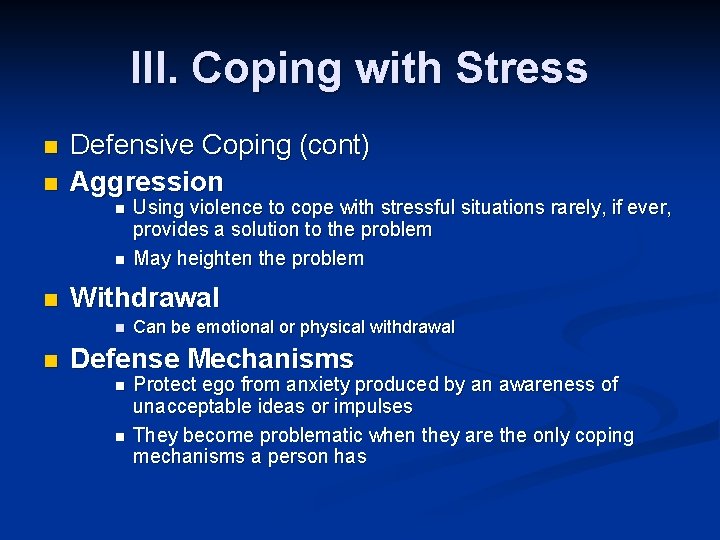
III. Coping with Stress n n Defensive Coping (cont) Aggression n Withdrawal n n Using violence to cope with stressful situations rarely, if ever, provides a solution to the problem May heighten the problem Can be emotional or physical withdrawal Defense Mechanisms n n Protect ego from anxiety produced by an awareness of unacceptable ideas or impulses They become problematic when they are the only coping mechanisms a person has
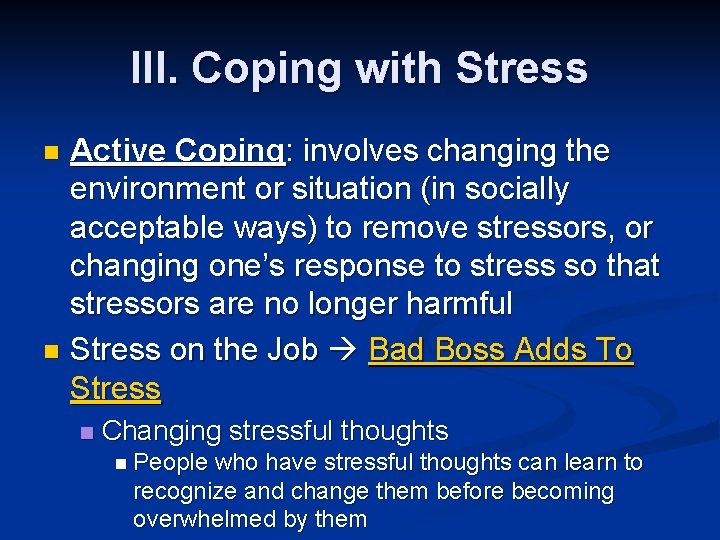
III. Coping with Stress Active Coping: involves changing the environment or situation (in socially acceptable ways) to remove stressors, or changing one’s response to stress so that stressors are no longer harmful n Stress on the Job Bad Boss Adds To Stress n n Changing stressful thoughts n People who have stressful thoughts can learn to recognize and change them before becoming overwhelmed by them
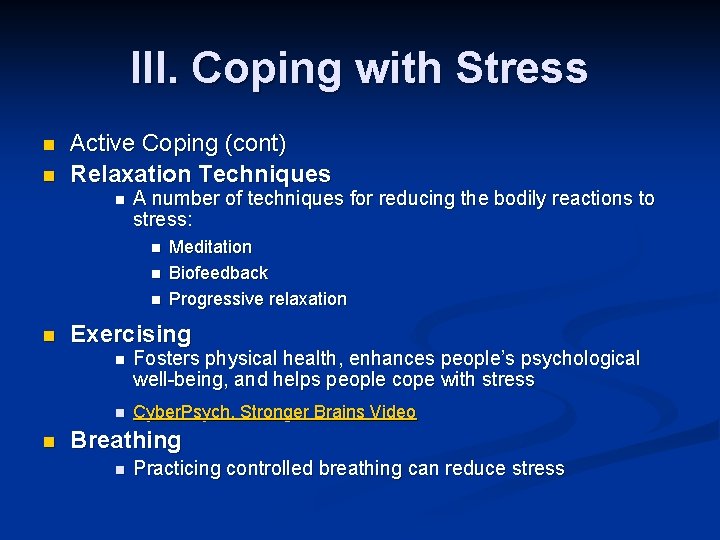
III. Coping with Stress n n Active Coping (cont) Relaxation Techniques n A number of techniques for reducing the bodily reactions to stress: n n n Meditation Biofeedback Progressive relaxation Exercising n Fosters physical health, enhances people’s psychological well-being, and helps people cope with stress n Cyber. Psych, Stronger Brains Video Breathing n Practicing controlled breathing can reduce stress
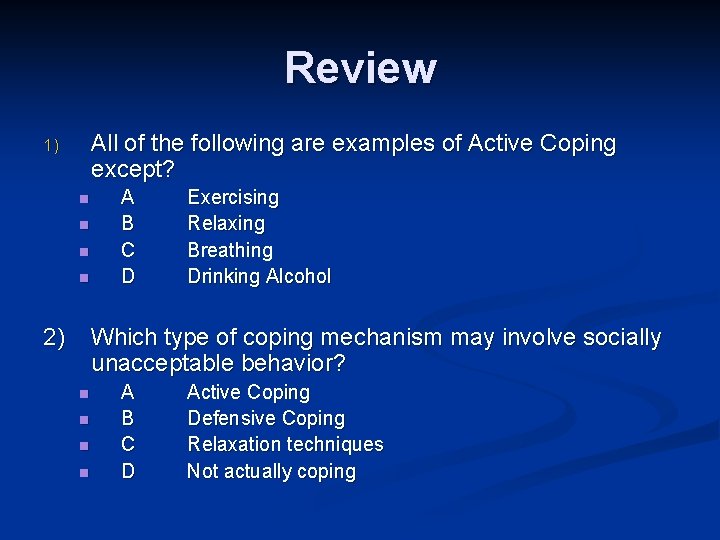
Review All of the following are examples of Active Coping except? 1) n n 2) A B C D Exercising Relaxing Breathing Drinking Alcohol Which type of coping mechanism may involve socially unacceptable behavior? n n A B C D Active Coping Defensive Coping Relaxation techniques Not actually coping