
Chapter 3 Strategy Formulation Action Plan Choice References

- Slides: 44
Chapter # 3 Strategy Formulation: Action Plan Choice § References Strategic Management Concepts & Cases, Fred R. David Ø Wikipedia. com Ø Internet Ø Resource Person: Furqan-ul-haq Siddiqui
Long-Term Objectives: n Results that an organization seek over a multiyear period through certain strategies Ø Time frame — 2 to 5 years Ø include specific improvements in the organization's competitive position, technology leadership, profitability, return on investment, employee relations and productivity, and corporate image. Ø The objectives should be SMART
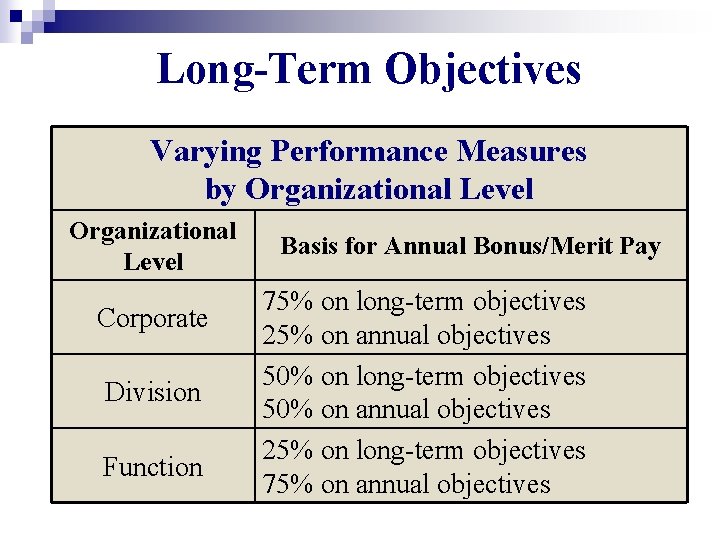
Long-Term Objectives Varying Performance Measures by Organizational Level Corporate Division Function Basis for Annual Bonus/Merit Pay 75% on long-term objectives 25% on annual objectives 50% on long-term objectives 50% on annual objectives 25% on long-term objectives 75% on annual objectives
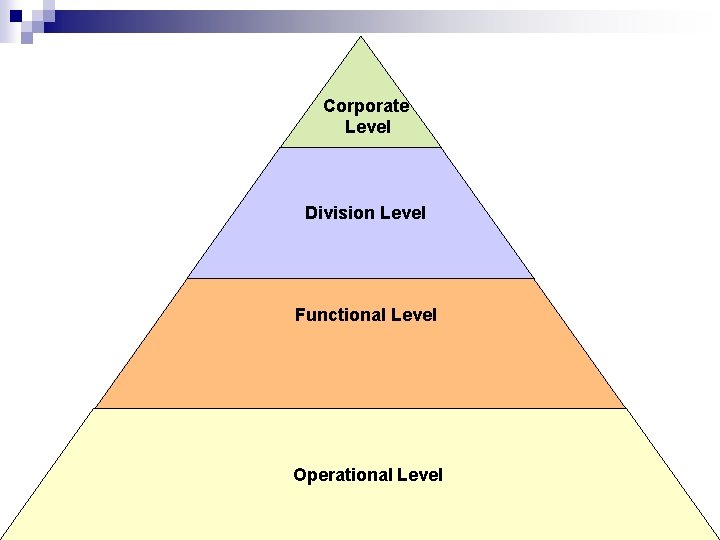
Corporate Level Division Level Functional Level Operational Level
Objectives are the basis for: • Designing jobs • Organizing activities • Providing direction • Organizational synergy • Standards for evaluation Strategists should avoid – N Managing by Extrapolation- keep on doing the same things in same ways because things are going well. N Managing by Crisis- (proactive vs. reactive) N Managing by Subjectives- Mystery approach of decision making. No general plan for which to go & what to do; just do best to accomplish. N Managing by Hope-
Types of Strategies 1. i. ii. 2. i. iii. Integration Strategies Vertical Horizontal Intensive Strategies Market Penetration Market Development Product 3. i. iii. 4. i. ii. Diversification Strategies Concentric Diversification Horizontal Diversification Conglomerate Diversification Defensive Strategies Retrenchment Divestiture
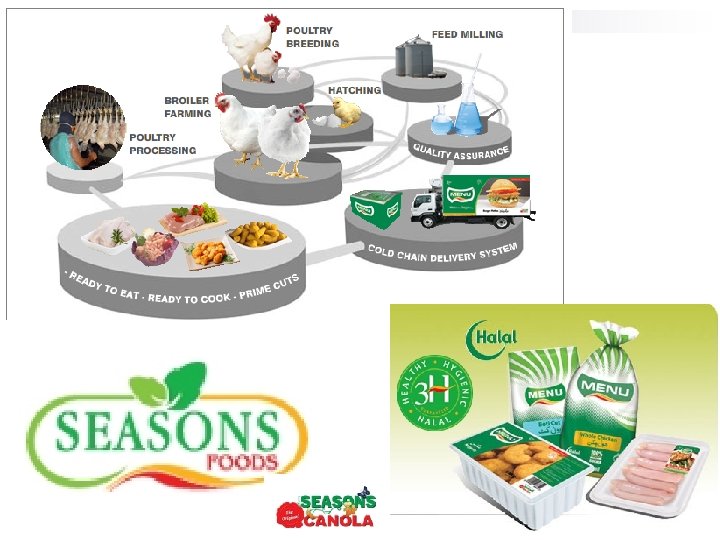
1. Integration Strategies i. Vertical integration The degree to which a firm owns its upstream suppliers and its downstream buyers. Ø Vertically integrated companies in a supply chain are united through a common owner. Usually each member of the supply chain produces a different product or (marketspecific) service, and the products combine to satisfy a common need. n
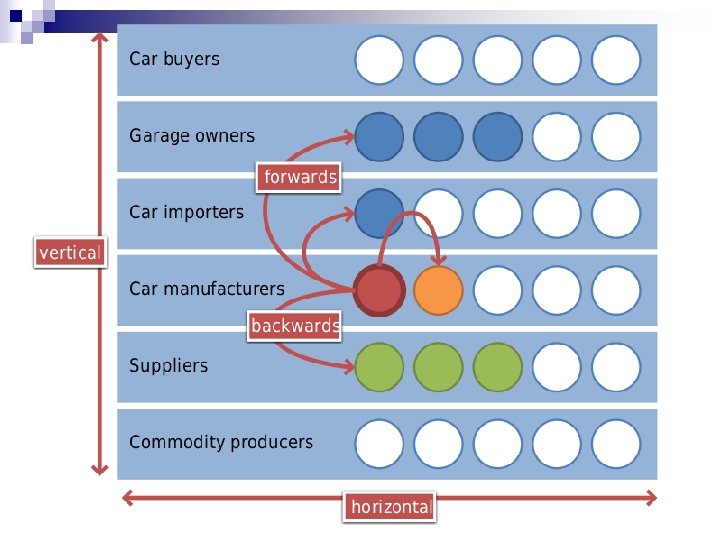
Types of Vertical integration a. b. c. Backward vertical integration when it controls/owns firms that produce some of the inputs used in the production of its products. For example, an automobile company may own a tire company, a glass company, and a metal company. Forward vertical integration is when it controls distribution centers and retailers where its products are sold. Balanced vertical integration means a firm controls all of these components, from raw materials to final delivery.
Example Ø Oil companies often adopt a vertically integrated structure. This means that they are active along the entire supply chain from locating crude oil deposits, drilling and extracting crude, transporting it around the world, refining it into petroleum products such as petrol/gasoline, to distributing the fuel to companyowned retail stations, for sale to consumers.
ii. Horizontal Integration q The acquisition of additional business activities at the same level of the value chain is referred to as horizontal integration. When a company expands its business into different products that are similar to current lines. Horizontal integration occurs when a firm is being taken over by, or merged with, another firm which is in the same industry and in the same stage of production as the merged firm. ("buy out" or "take-over). Ø A car manufacturer merging with another car manufacturer. In this case both the companies are in the same stage of production and also in the same industry. 11 •
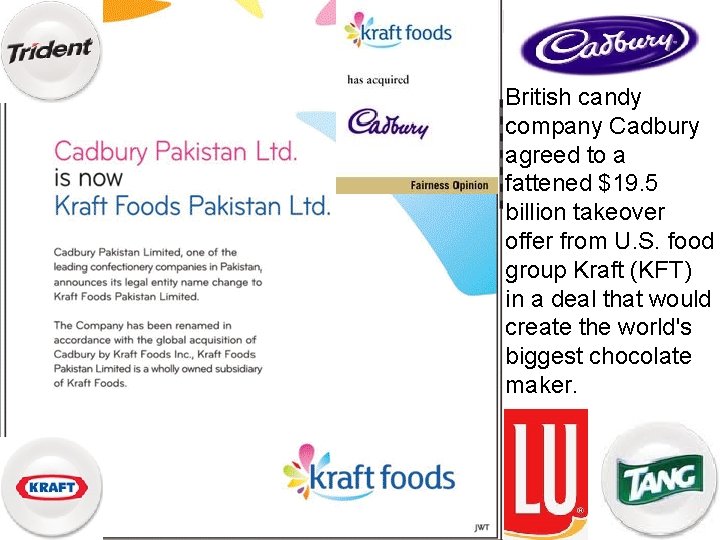
British candy company Cadbury agreed to a fattened $19. 5 billion takeover offer from U. S. food group Kraft (KFT) in a deal that would create the world's biggest chocolate maker.
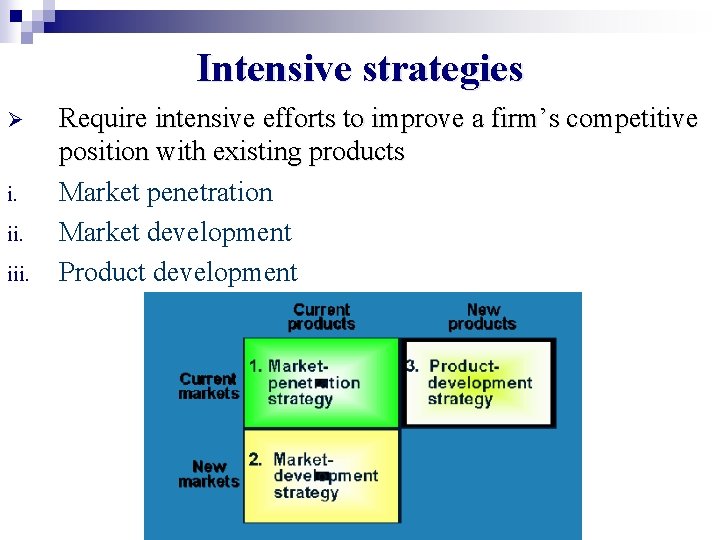
Intensive strategies Ø i. iii. Require intensive efforts to improve a firm’s competitive position with existing products Market penetration Market development Product development
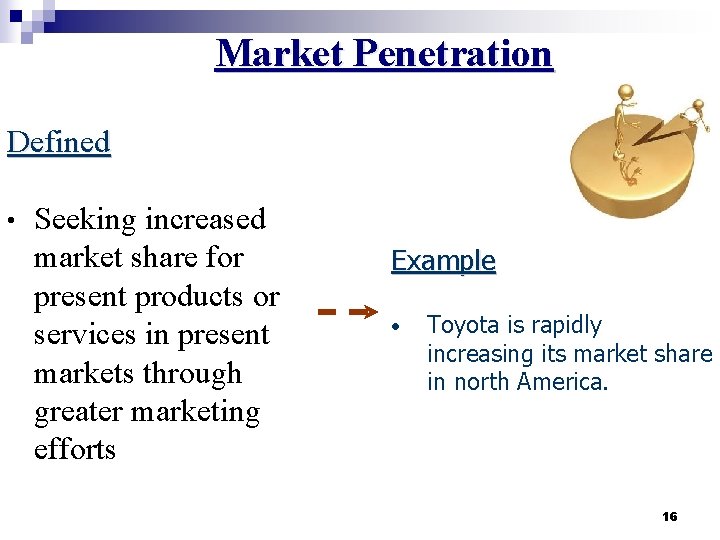
Market Penetration Defined • Seeking increased market share for present products or services in present markets through greater marketing efforts Example • Toyota is rapidly increasing its market share in north America. 16
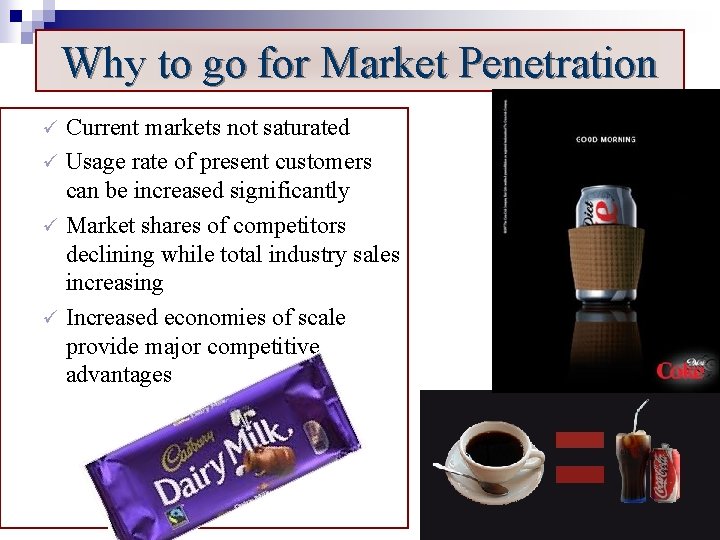
Why to go for Market Penetration Current markets not saturated ü Usage rate of present customers can be increased significantly ü Market shares of competitors declining while total industry sales increasing ü Increased economies of scale provide major competitive advantages ü 17
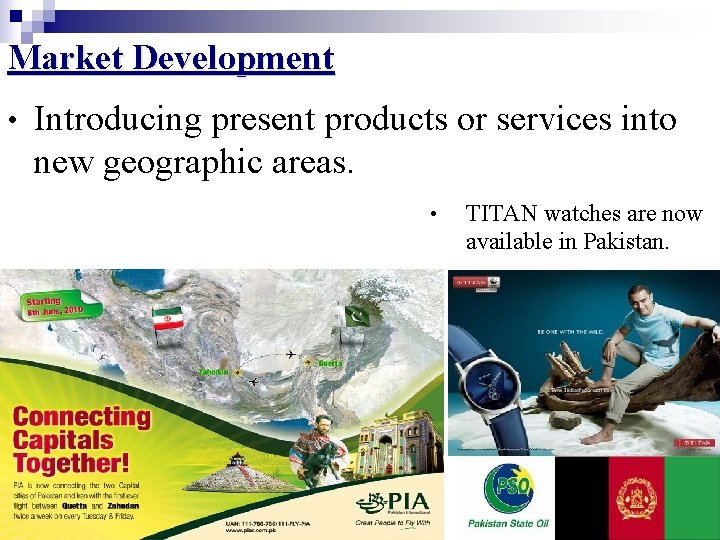
Market Development • Introducing present products or services into new geographic areas. • TITAN watches are now available in Pakistan. 18
Guidelines for Market Development ü New channels of distribution that are reliable, inexpensive, and good quality ü Firm is very successful at what it does ü Untapped or unsaturated markets ü Capital and human resources necessary to manage expanded operations ü Excess production capacity ü Basic industry rapidly becoming global 19
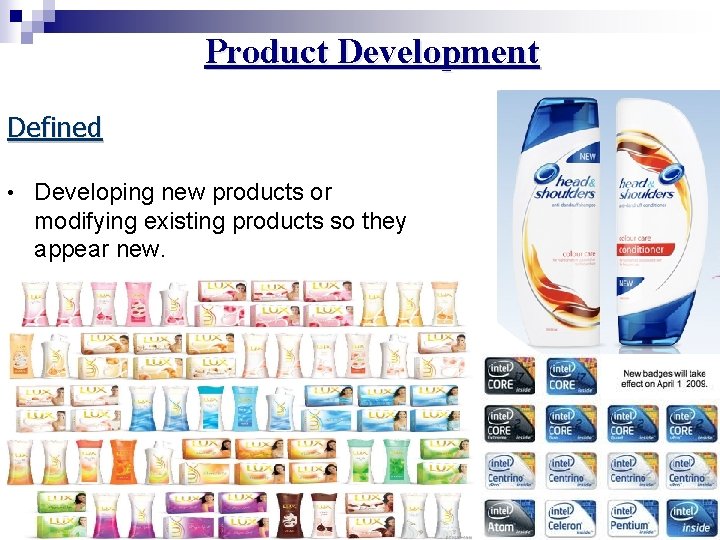
Product Development Defined • Developing new products or modifying existing products so they appear new. 20
Guidelines for Product Development Products in maturity stage of life cycle ü Competes in industry characterized by rapid technological developments ü Major competitors offer better-quality products at comparable prices ü Compete in high-growth industry ü Strong research and development capabilities ü 21
2. Diversification Strategies Ø Movement by a manufacturer or trader into a wider field of Products i. Concentric diversification ii. Conglomerate diversification iii. Horizontal diversification 22
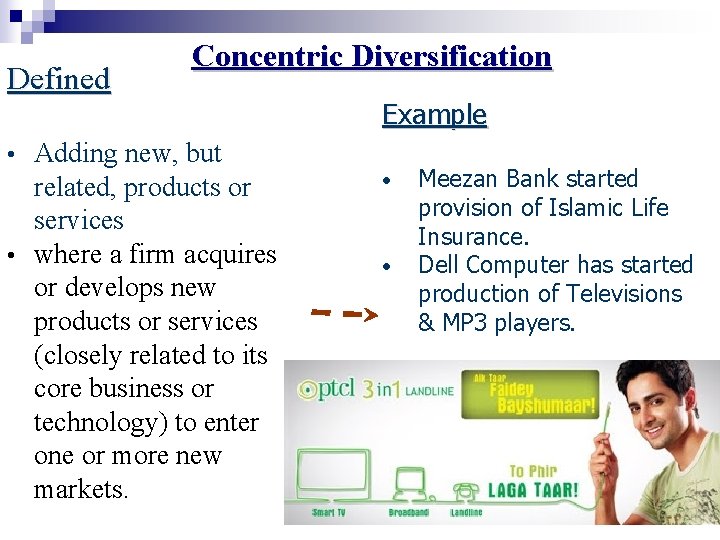
Defined Concentric Diversification Adding new, but related, products or services • where a firm acquires or develops new products or services (closely related to its core business or technology) to enter one or more new markets. Example • • • Meezan Bank started provision of Islamic Life Insurance. Dell Computer has started production of Televisions & MP 3 players. 23
Guidelines for Concentric Diversification Competes in no- or slow-growth industry ü Adding new & related products increases sales of current products ü New & related products offered at competitive prices ü Current products are in decline stage of the product life cycle ü Strong management team ü 24
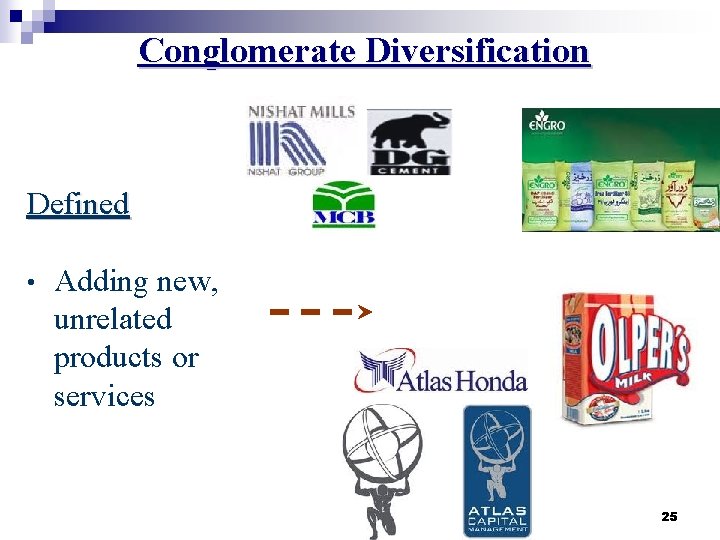
Conglomerate Diversification Defined • Adding new, unrelated products or services 25
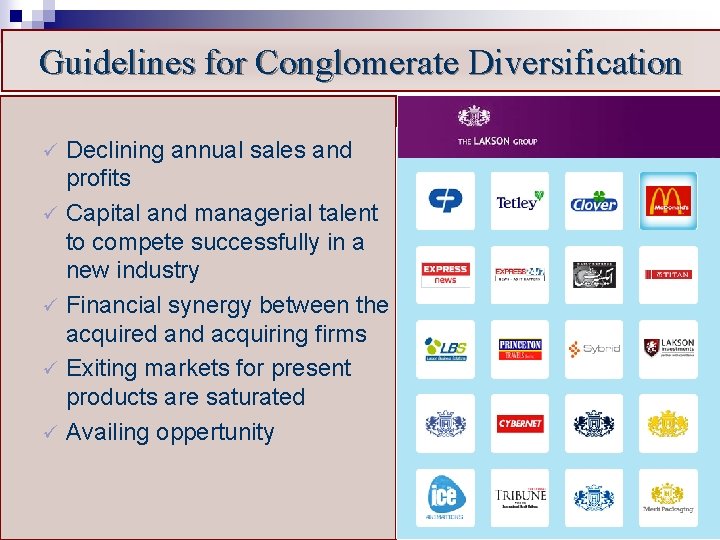
Guidelines for Conglomerate Diversification Declining annual sales and profits ü Capital and managerial talent to compete successfully in a new industry ü Financial synergy between the acquired and acquiring firms ü Exiting markets for present products are saturated ü Availing oppertunity ü 26
Horizontal Diversification Defined Adding new, unrelated products or services for present customers. • this form of diversification is desirable if the present customers are loyal to the current products and if the new products have a good quality and are well promoted and priced • Example • company was making note books earlier now they are also entering into pen market through its new product. 27
Guidelines for Horizontal Diversification ü Revenues from current products/services would increase significantly by adding the new unrelated products ü Highly competitive and/or no-growth industry w/low margins and returns ü Present distribution channels can be used to market new products to current customers ü New products have counter cyclical sales patterns compared to existing products 28
Defensive Strategies i. Joint venture ii. Retrenchment iii. Divestiture iv. Liquidation 29
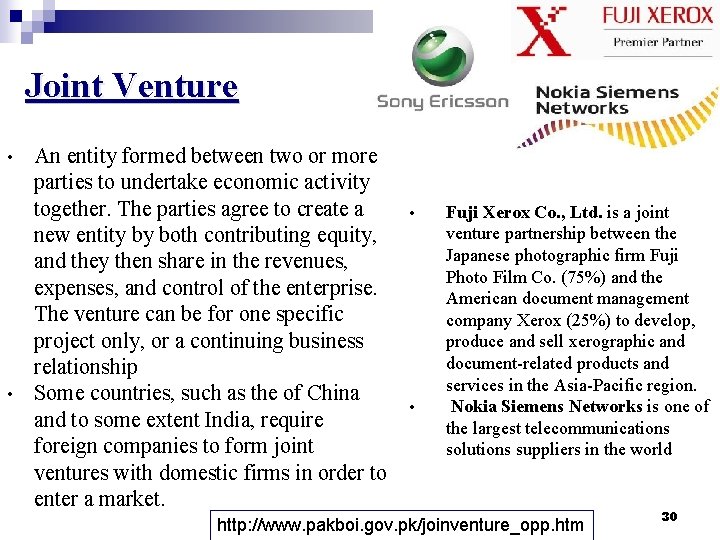
Joint Venture An entity formed between two or more parties to undertake economic activity together. The parties agree to create a new entity by both contributing equity, and they then share in the revenues, expenses, and control of the enterprise. The venture can be for one specific project only, or a continuing business relationship • Some countries, such as the of China and to some extent India, require foreign companies to form joint ventures with domestic firms in order to enter a market. • • • Fuji Xerox Co. , Ltd. is a joint venture partnership between the Japanese photographic firm Fuji Photo Film Co. (75%) and the American document management company Xerox (25%) to develop, produce and sell xerographic and document-related products and services in the Asia-Pacific region. Nokia Siemens Networks is one of the largest telecommunications solutions suppliers in the world http: //www. pakboi. gov. pk/joinventure_opp. htm 30
ØUninor is India's eighth nation-wide mobile operator, in a competitive landscape of 13 nation-wide or regional mobile operators. The company Unitech Wireless was until 2009 a subsidiary of Unitech Group, holding a wireless services licence for all 22 Indian telecom circles since 2008. Ø In early 2009, Unitech Group and Telenor agreed on a majority take-over by Telenor of Unitech's wireless business, including Unitech Wireless' national-wide mobile licence. Ø Uninor is now 67. 25% owned by Norwegian telecom giant Telenor, and 32. 75% by UNITECH. Ø
Guidelines for Joint Venture Combination of privately held and publicly held can be synergistically combined ü Domestic forms joint venture with foreign firm, can obtain local management to reduce certain risks ü Distinctive competencies of two or more firms are complementary ü Huge resources and risks where project is potentially very profitable (e. g. , Iran-Pak-India Pipeline) ü Two or more smaller firms have trouble competing with larger firm ü A need exists to introduce a new technology quickly ü 32
Retrenchment Defined • Regrouping through cost and asset reduction to reverse declining sales and profit Example • PTCL’s operating profit decreased by 32 per cent in 2007 as compared to 2006 which became the reason of retrenchment of employees. 33
Guidelines for Retrenchment Firm has failed to meet its objectives and goals consistently over time but has distinctive competencies ü Firm is one of the weaker competitors ü Inefficiency, low profitability, poor employee morale, and pressure from stockholders to improve performance. ü When an organization’s strategic managers have failed ü Very quick growth to large organization where a major internal reorganization is needed. ü 34
Divestiture Defined Selling a division or part of an organization. also known as divestment Example • • The next edition of the Oxford English Dictionary, the word reference bible of the English language, may never appear in print and instead be accessible only online (August, 2010) A bank may sell branch offices, or even an entire operating division, to cut operating expenses or carry out its business plan for long-term growth. 35
Guidelines for Divestiture When firm has pursued retrenchment but failed to attain needed improvements ü When a division needs more resources than the firm can provide ü When a division is responsible for the firm’s overall poor performance ü When a division is a misfit with the organization ü When a large amount of cash is needed and cannot be obtained from other sources. ü 36
Liquidation Defined Selling all of a company’s assets, in parts. • Most common in partnership enterprises • Example • Ribol sold all its assets and ceased business. 37
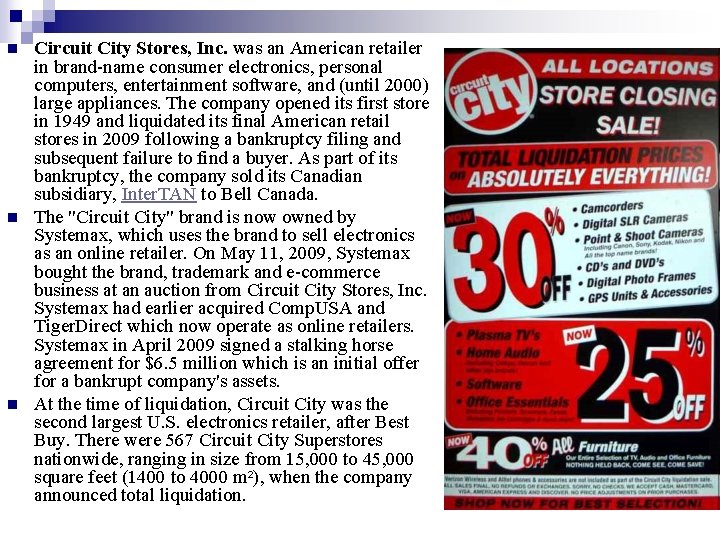
n n n Circuit City Stores, Inc. was an American retailer in brand-name consumer electronics, personal computers, entertainment software, and (until 2000) large appliances. The company opened its first store in 1949 and liquidated its final American retail stores in 2009 following a bankruptcy filing and subsequent failure to find a buyer. As part of its bankruptcy, the company sold its Canadian subsidiary, Inter. TAN to Bell Canada. The "Circuit City" brand is now owned by Systemax, which uses the brand to sell electronics as an online retailer. On May 11, 2009, Systemax bought the brand, trademark and e-commerce business at an auction from Circuit City Stores, Inc. Systemax had earlier acquired Comp. USA and Tiger. Direct which now operate as online retailers. Systemax in April 2009 signed a stalking horse agreement for $6. 5 million which is an initial offer for a bankrupt company's assets. At the time of liquidation, Circuit City was the second largest U. S. electronics retailer, after Best Buy. There were 567 Circuit City Superstores nationwide, ranging in size from 15, 000 to 45, 000 square feet (1400 to 4000 m²), when the company announced total liquidation.
Guidelines for Liquidation When both retrenchment and divestiture have been pursued unsuccessfully ü If the only alternative is bankruptcy, liquidation is an orderly alternative ü When stockholders can minimize their losses by selling the firm’s assets ü 39
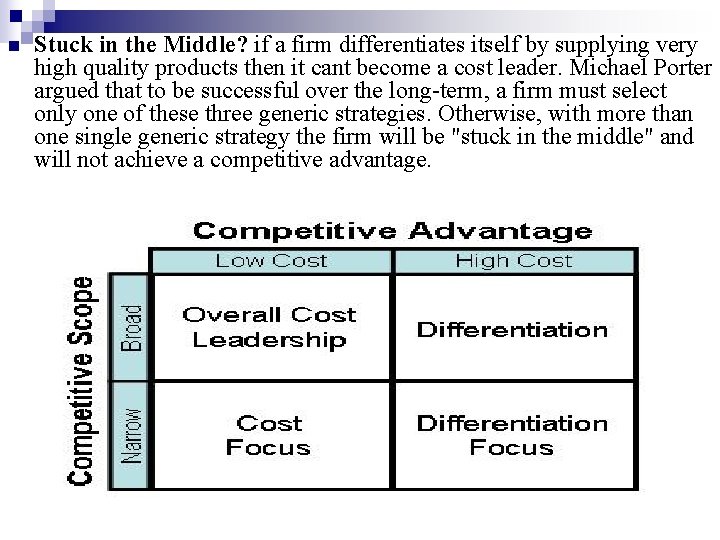
Porter Generic Strategies n 1. 2. 3. Michael Porter has described three general types of strategies to achieve and maintain competitive advantage. These three generic strategies Cost Leadership Strategy- Being lowest cost producer within a industry. The organization aims to drive cost down through all the elements of the Business. The cost leader usually aims at a broad market, so sufficient sales can cover costs. Differentiation Strategy- Development of a product or service that offers unique attributes that are valued by customers and that customers perceive to be better than or different from the products of the competition at premium prices. Focus Strategy- Concentration on a arrow segment/niche and within that segment attempts to achieve either a cost advantage or differentiation. The premise is that the needs of the group can be better serviced by focusing entirely on it, resulting high degree of customer loyalty which discourages other firms from competing directly.
n Stuck in the Middle? if a firm differentiates itself by supplying very high quality products then it cant become a cost leader. Michael Porter argued that to be successful over the long-term, a firm must select only one of these three generic strategies. Otherwise, with more than one single generic strategy the firm will be "stuck in the middle" and will not achieve a competitive advantage.
Some other terms/means of achieving goals 1. i. ii. Ø 2. 3. 4. 5. 6. 7. Acquisition (takeover/buyout)- the buying of one company by another. Friendly buyout- the companies cooperate in negotiations; in the latter case, Hostile takeover- the takeover target is unwilling to be bought or the target's board has no prior knowledge of the offer. If a smaller firm acquires management control of a larger company and keep its name for the combined entity. This is known as a reverse takeover. First Mover Advantage. Business Process Outsourcing (BPO) Merger. Leapfrog Strategy/Bypass Strategy- This strategy undertakes a challenger bypassing its opposition totally and capturing the competitor’s clients in one rapid action. Guerilla warfare- Involves winning small victories that can over time amount to large gain in market share. It uses both conventional and unconventional means of attack. A preemptive war is a war that is commenced in an attempt to repel or defeat a perceived offensive or invasion.
n First-mover advantage or FMA is the advantage gained by the initial occupant of a market segment. This advantage may stem from the fact that the first entrant can gain control of resources that followers may not be able to match. n Sometimes the first mover is not able to capitalize on its advantage, leaving the opportunity for another firm to gain secondmover advantage.
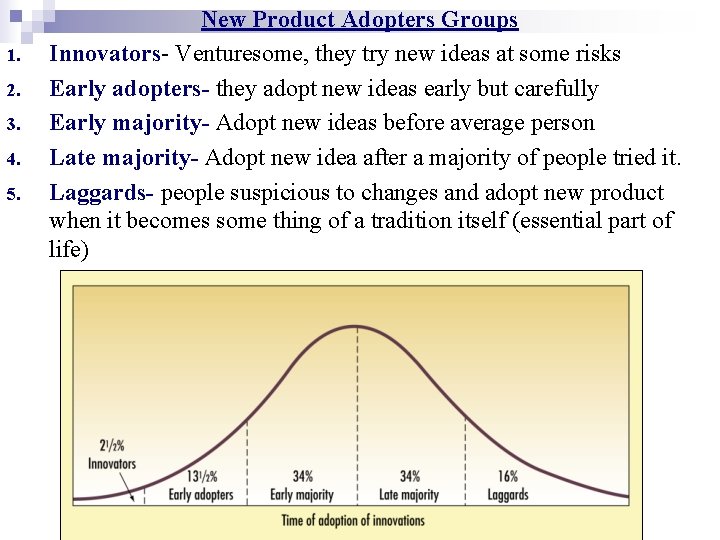
1. 2. 3. 4. 5. New Product Adopters Groups Innovators- Venturesome, they try new ideas at some risks Early adopters- they adopt new ideas early but carefully Early majority- Adopt new ideas before average person Late majority- Adopt new idea after a majority of people tried it. Laggards- people suspicious to changes and adopt new product when it becomes some thing of a tradition itself (essential part of life)