
CHAPTER 3 STRATEGIC PLANNING Copyright 2005 SouthWestern All
- Slides: 31
CHAPTER 3: STRATEGIC PLANNING Copyright © 2005 South-Western. All rights reserved.
Strategic Management • Strategic Human Resource Management – Involves aligning initiatives involving how people are managed with organizational mission & objectives • Strategic Management Process – Determining what needs to be done to achieve corporate objectives over 3 - 5 years – Examining organization & competitive environment – Establishing optimal fit between organization & its environment – Reviewing & revising strategic plan Copyright © 2005 South-Western. All rights reserved. 1– 2
Models of Strategy • Industrial Organization (O/I) Model – External environment is primary determinant of organizational strategy rather than internal decisions of managers – Environment presents threats & opportunities – All competing organizations control or have equal access to resources – Resources are highly mobile between firms – Organizational success is achieved by • Offering goods & services at lower costs than competitors • Differentiating products to bring premium prices Copyright © 2005 South-Western. All rights reserved. 1– 3
Models of Strategy • Resource-Based View (RBV) –An organization’s resources & capabilities, not external environmental conditions, should be basis for strategic decisions –Competitive advantage is gained through acquisition & value of organizational resources –Organizations can identify, locate & acquire key valuable resources –Resources are not highly mobile across organizations & once acquired are retained –Valuable resources are costly to imitate & nonsubstitutable Copyright © 2005 South-Western. All rights reserved. 1– 4
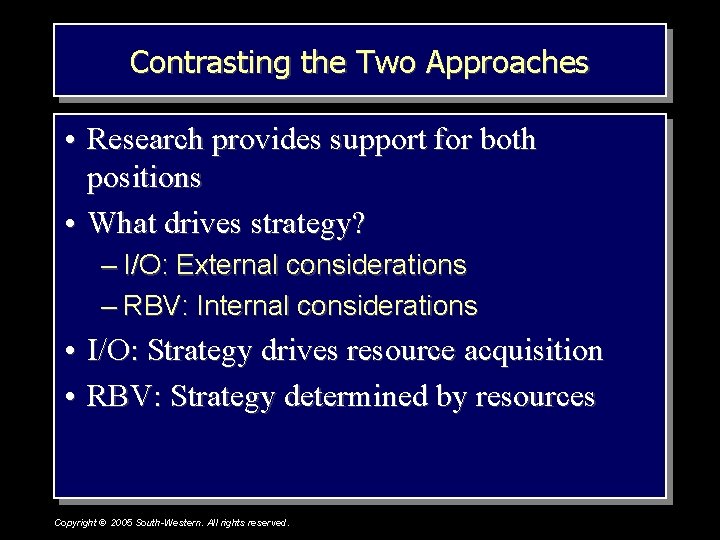
Contrasting the Two Approaches • Research provides support for both positions • What drives strategy? – I/O: External considerations – RBV: Internal considerations • I/O: Strategy drives resource acquisition • RBV: Strategy determined by resources Copyright © 2005 South-Western. All rights reserved. 1– 5
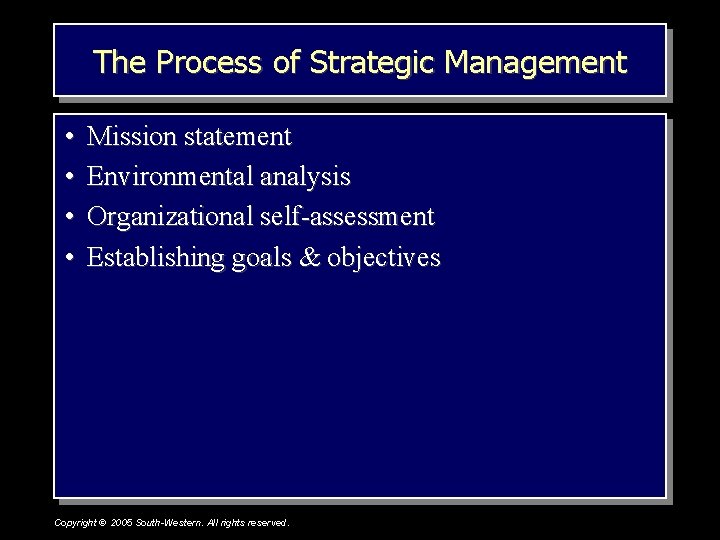
The Process of Strategic Management • • Mission statement Environmental analysis Organizational self-assessment Establishing goals & objectives Copyright © 2005 South-Western. All rights reserved. 1– 6
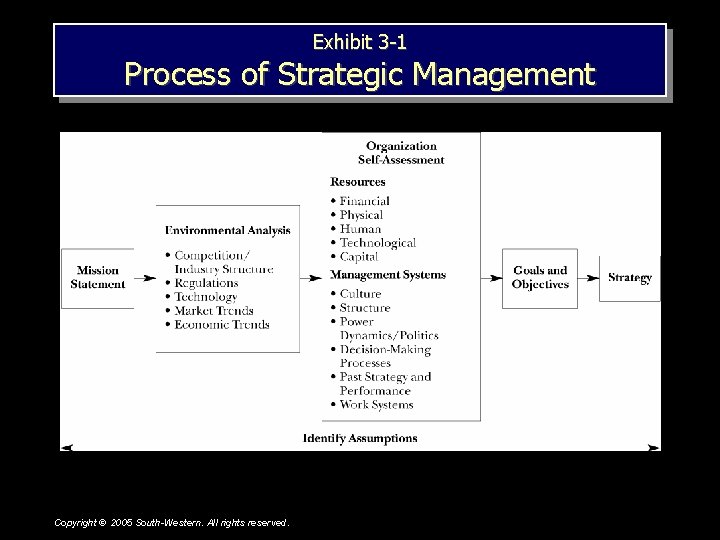
Exhibit 3 -1 Process of Strategic Management Copyright © 2005 South-Western. All rights reserved. 1– 7
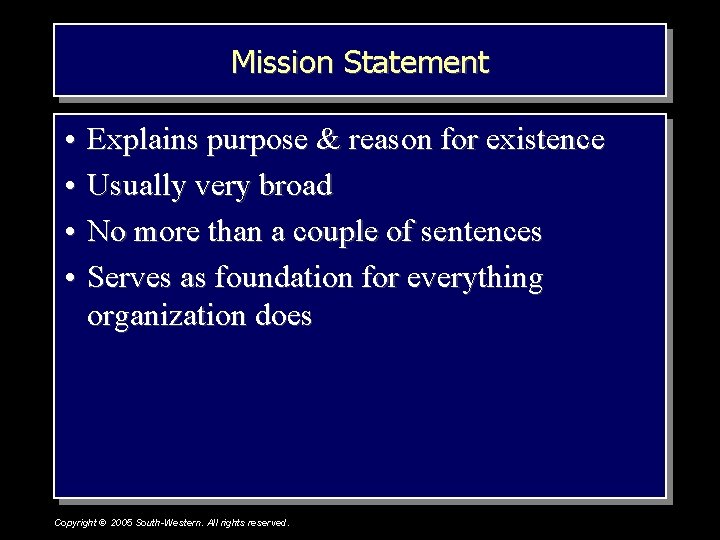
Mission Statement • Explains purpose & reason for existence • Usually very broad • No more than a couple of sentences • Serves as foundation for everything organization does Copyright © 2005 South-Western. All rights reserved. 1– 8
Solectron Mission Statement “Our mission is to provide worldwide responsiveness to our customers by offering the highest quality, lowest total cost, customized, integrated, design, supply-chain and manufacturing solutions through long-term partnerships based on integrity and ethical business practices. ” Copyright © 2005 South-Western. All rights reserved. 1– 9
Analysis of Environment • Critical components of external environment – Competition – Industry structure – Government regulations – Technology – Market trends – Economic tends Copyright © 2005 South-Western. All rights reserved. 1– 10
Organization Self-Assessment • Identify primary strengths & weaknesses • Find ways to capitalize on strengths • Find ways to improve or minimize weaknesses • Examine resources – Physical – Human – Technological – Capital Copyright © 2005 South-Western. All rights reserved. 1– 11
Organization Self-Assessment • Examine internal management systems – Culture – Organization structure – Power dynamics & policy – Decision-making processes – Past strategy & performance – Work systems Copyright © 2005 South-Western. All rights reserved. 1– 12
Establishing Goals & Objectives • Goals should be: – Specific – Measurable – Flexible Copyright © 2005 South-Western. All rights reserved. 1– 13
Corporate Strategies: Growth • Benefits – Gaining economies of scale in operations & functions – Enhancing competitive position vis-à-vis industry competitors – Providing opportunities for employee professional development & advancement • HR Issues – Planning for new hiring – Alerting current employees – Ensuring quality & Copyright © 2005 South-Western. All rights reserved. • Internal Methods – Penetration of existing markets – Developing new products or services for existing or new markets • External Methods – Acquiring other organizations – Vertical integration • HR Issues – Merging organizations – Dismissing redundant employees 1– 14
Corporate Strategies: Stability • Maintaining status quo due to limited environmental opportunities for gaining competitive advantage • Few employees will have opportunities for advancement • Critical that management identify key employees & develop specific HR retention strategies to keep them Copyright © 2005 South-Western. All rights reserved. 1– 15
Corporate Strategies: Turnaround or Retrenchment • Downsizing or streamlining organization in cost-cutting attempt to adjust to competitive environment • Few opportunities & many environmental threats • Important to develop HR practices to manage “survivors” Copyright © 2005 South-Western. All rights reserved. 1– 16
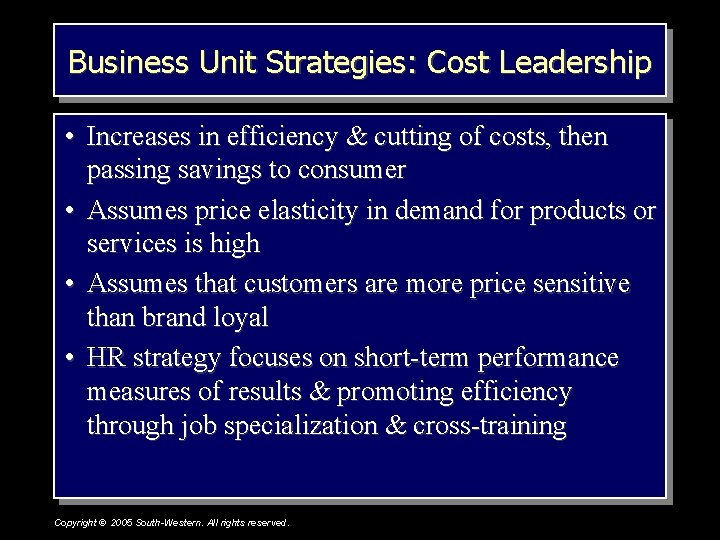
Business Unit Strategies: Cost Leadership • Increases in efficiency & cutting of costs, then passing savings to consumer • Assumes price elasticity in demand for products or services is high • Assumes that customers are more price sensitive than brand loyal • HR strategy focuses on short-term performance measures of results & promoting efficiency through job specialization & cross-training Copyright © 2005 South-Western. All rights reserved. 1– 17
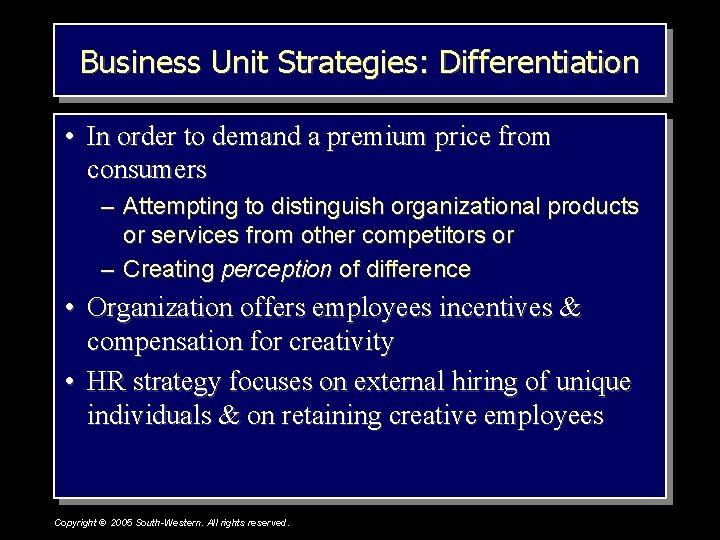
Business Unit Strategies: Differentiation • In order to demand a premium price from consumers – Attempting to distinguish organizational products or services from other competitors or – Creating perception of difference • Organization offers employees incentives & compensation for creativity • HR strategy focuses on external hiring of unique individuals & on retaining creative employees Copyright © 2005 South-Western. All rights reserved. 1– 18
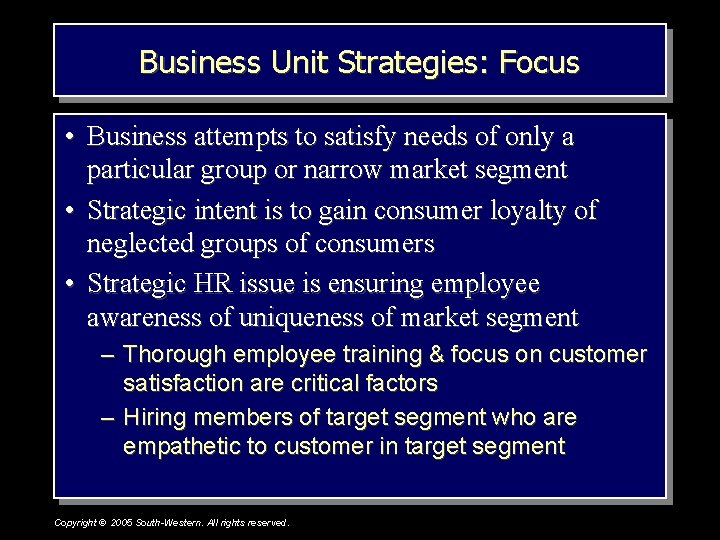
Business Unit Strategies: Focus • Business attempts to satisfy needs of only a particular group or narrow market segment • Strategic intent is to gain consumer loyalty of neglected groups of consumers • Strategic HR issue is ensuring employee awareness of uniqueness of market segment – Thorough employee training & focus on customer satisfaction are critical factors – Hiring members of target segment who are empathetic to customer in target segment Copyright © 2005 South-Western. All rights reserved. 1– 19
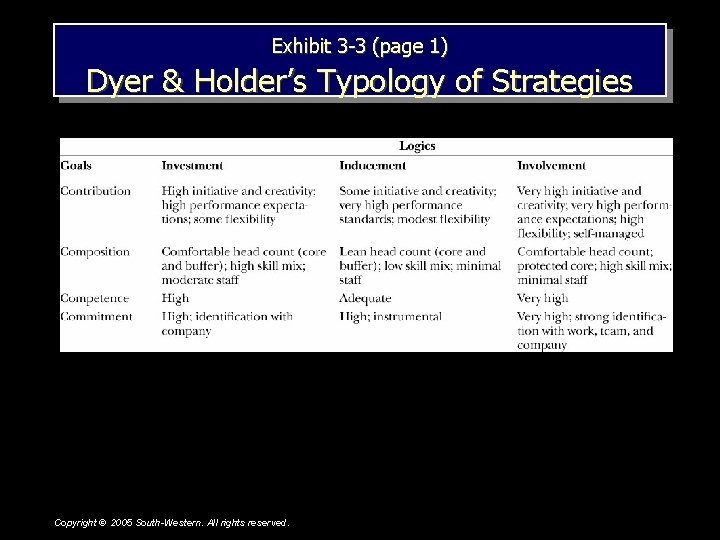
Exhibit 3 -3 (page 1) Dyer & Holder’s Typology of Strategies Copyright © 2005 South-Western. All rights reserved. 1– 20
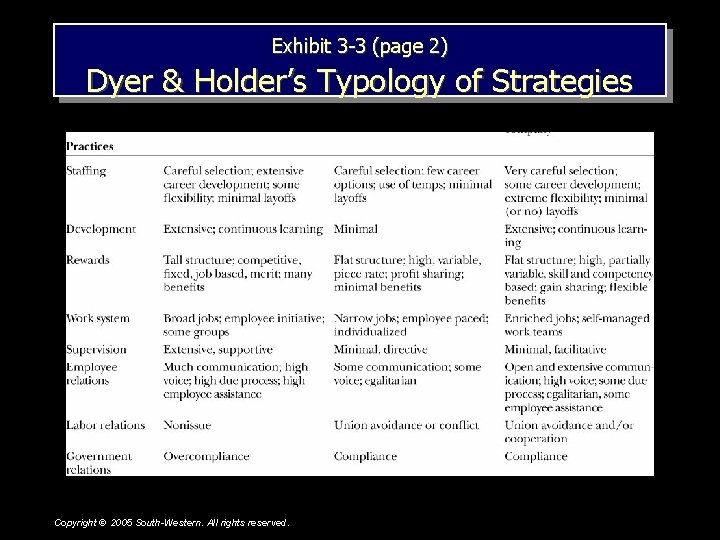
Exhibit 3 -3 (page 2) Dyer & Holder’s Typology of Strategies Copyright © 2005 South-Western. All rights reserved. 1– 21
Benefits of a Strategic Approach to HR • Facilitates development of high-quality workforce through focus on types of people & skills needed • Facilitates cost-effective utilization of labor, particularly in service industries where labor is generally greatest cost • Facilitates planning & assessment of environmental uncertainty & adaptation of organization to external forces Copyright © 2005 South-Western. All rights reserved. 1– 22
Reading 3. 1 Human Resources & Resource Based View • People management systems construct – Not all competitive advantage begins with people management systems – These systems create value to extent that they impact stock, flow, & change of intellectual capital/knowledge – Basis of core competencies Copyright © 2005 South-Western. All rights reserved. 1– 23
Reading 3. 1 Human Resources & Resource Based View • “Skill” concept expanded to consider stock of intellectual capital in firm • “Behavior” concept reconceptualized as flow of knowledge within firm through its creation, transfer, & integration • Core competence arises from combination of firm’s stock of knowledge & flow of knowledge through creation, transfer, & integration in a way that is valuable, rare, inimitable, & organized Copyright © 2005 South-Western. All rights reserved. 1– 24
Reading 3. 1 Human Resources & Resource Based View • Dynamic capability construct illustrates interdependent interplay between workforce & core competence as it changes over time Copyright © 2005 South-Western. All rights reserved. 1– 25
Reading 3. 2 Distinctive Human Resources • “Flexibility” dimension associated with “prospectors” • “Established markets” category linked to classifications like “defenders” • Employment practices are difficult to change & transfer • Core competencies should drive business strategy & not vice versa Copyright © 2005 South-Western. All rights reserved. 1– 26
Reading 3. 2 Distinctive Human Resources • If competencies are available to everyone on open market, how can they generate a unique competency & competitive advantage for any one firm? Copyright © 2005 South-Western. All rights reserved. 1– 27
Reading 3. 3 The Five P’s Model of SHRM • Philosophy – Statements of how organization values & treats employees; essentially culture of the organization • Policies – Expressions of shared values & guidelines for action on employee-related business issues • Programs – Coordinated & strategized approaches to initiate, disseminate, & sustain strategic organizational change efforts necessitated by strategic business needs Copyright © 2005 South-Western. All rights reserved. 1– 28
Reading 3. 3 The Five P’s Model of SHRM • Practices – HR practices motivate behaviors that allow individuals to assume roles consistent with organization’s strategic objectives – Three categories of roles: • Leadership • Managerial • Operational Copyright © 2005 South-Western. All rights reserved. 1– 29
Reading 3. 3 The Five P’s Model of SHRM • Processes – Continuum of participation by all employees in specific activities to facilitate formulation & implementation of other activities Copyright © 2005 South-Western. All rights reserved. 1– 30
Reading 3. 3 The Five P’s Model of SHRM • Successful SHRM efforts begin with identification of strategic needs • Employee participation is critical to linking strategy & HR practices • Strategic HR depends on systematic & analytical mindset • Corporate HR departments can have impact on organization’s efforts to launch strategic initiatives Copyright © 2005 South-Western. All rights reserved. 1– 31