
Chapter 3 Storage Systems Sections 1 Storage System

- Slides: 24
Chapter 3 Storage Systems Sections: 1. Storage System Performance and Location Strategies 2. Conventional Storage Methods and Equipment 3. Automated Storage Systems 4. Engineering Analysis of Storage Systems by: Dr. Muhammad Hafidz Fazli Bin Md Fauadi hafidz@utem. edu. my hafidzfazli. wordpress. com
Storage Systems Function – to store materials (e. g. , parts, work-in-process, finished goods) for a period of time and permit retrieval when required § Used in factories, warehouses, distribution centers, wholesale dealerships, and retail stores § Important supply chain component § Automation available to improve efficiency
Storage System Performance measures for storage systems: § Storage capacity - two measures: § Total volumetric space § Total number of storage compartments (e. g. , unit loads) § Storage density - volumetric space available for storage relative to total volumetric space in facility § Accessibility - capability to access any item in storage § System throughput - hourly rate of storage/retrieval transactions § Utilization and availability (reliability)
Storage Location Strategies Two strategies: 1. Randomized, and 2. Dedicated Randomized storage –. Incoming items are stored in any available location. Usually means nearest available open location § Dedicated storage – Incoming items are assigned to specific locations in the storage facility § Typical bases for deciding locations: § Items stored in item number sequence § Items stored according to activity level § Items stored according to activity-to-space ratios
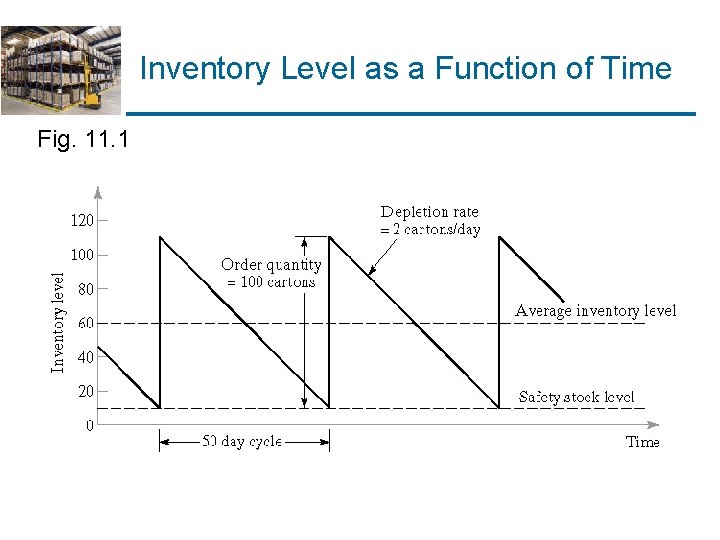
Inventory Level as a Function of Time Fig. 11. 1
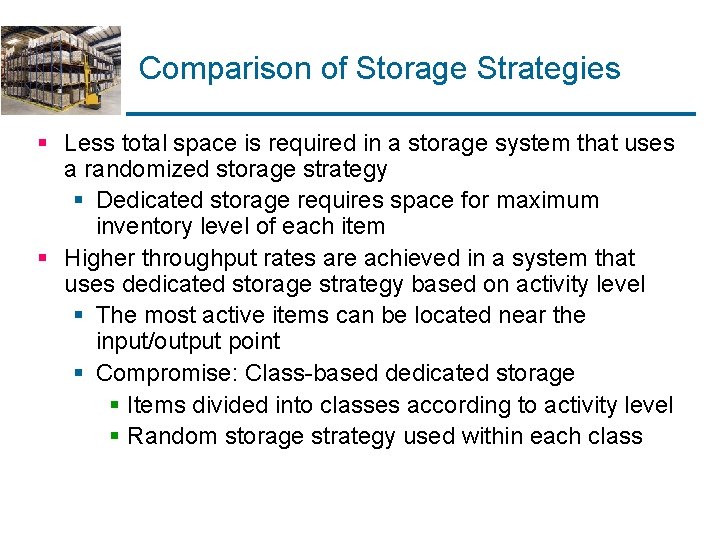
Comparison of Storage Strategies § Less total space is required in a storage system that uses a randomized storage strategy § Dedicated storage requires space for maximum inventory level of each item § Higher throughput rates are achieved in a system that uses dedicated storage strategy based on activity level § The most active items can be located near the input/output point § Compromise: Class-based dedicated storage § Items divided into classes according to activity level § Random storage strategy used within each class
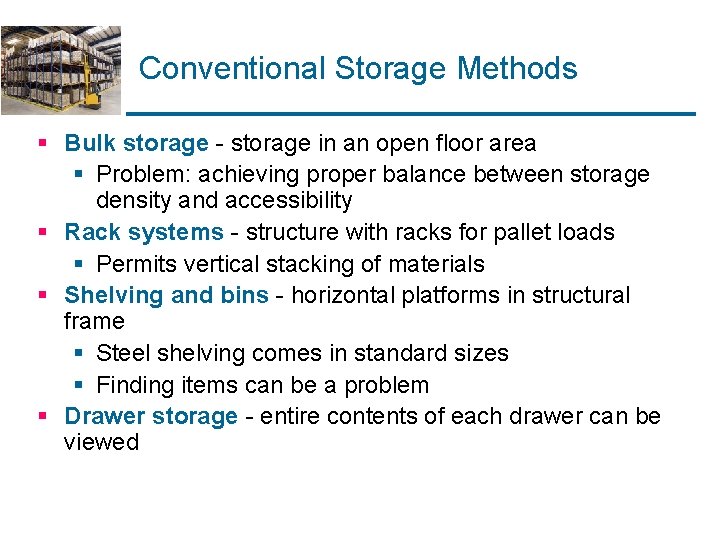
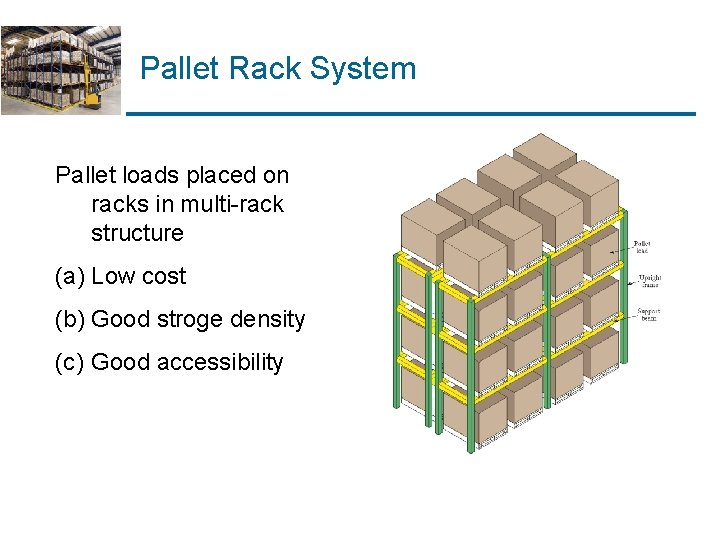
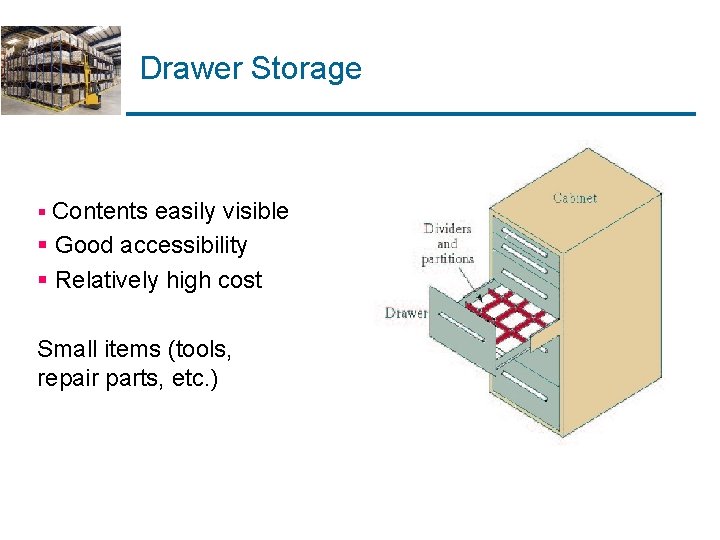
Conventional Storage Methods § Bulk storage - storage in an open floor area § Problem: achieving proper balance between storage density and accessibility § Rack systems - structure with racks for pallet loads § Permits vertical stacking of materials § Shelving and bins - horizontal platforms in structural frame § Steel shelving comes in standard sizes § Finding items can be a problem § Drawer storage - entire contents of each drawer can be viewed
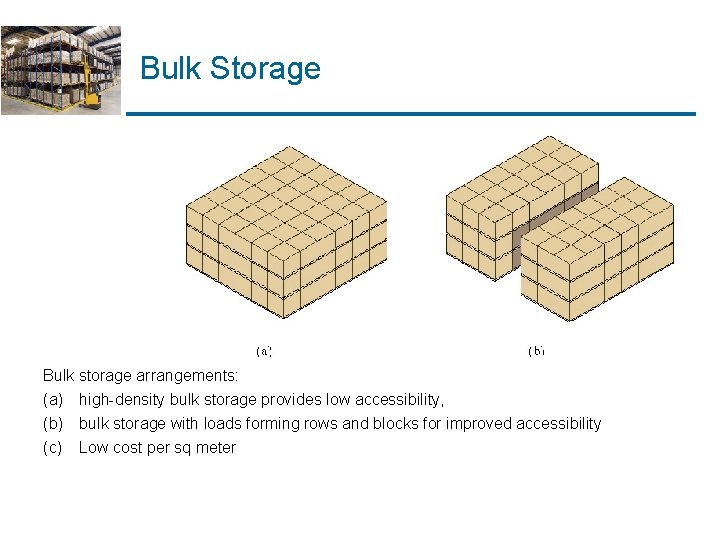
Bulk Storage Bulk storage arrangements: (a) high-density bulk storage provides low accessibility, (b) bulk storage with loads forming rows and blocks for improved accessibility (c) Low cost per sq meter
Pallet Rack System Pallet loads placed on racks in multi-rack structure (a) Low cost (b) Good stroge density (c) Good accessibility
Drawer Storage § Contents easily visible § Good accessibility § Relatively high cost Small items (tools, repair parts, etc. )
Automated Storage Systems Mechanized and automated storage equipment to reduce the human resources required to operate a storage facility § Significant investment § Level of automation varies § In mechanized systems, an operator participates in each storage/retrieval transaction § In highly automated systems, loads are entered or retrieved under computer control
Objectives and Reasons for Automating Storage Operations § § § § § To increase storage capacity To increase storage density To recover factory floor space currently used for WIP To improve security and reduce pilferage To reduce labor cost and/or increase productivity To improve safety To improve inventory control To improve stock rotation To improve customer service To increase throughput
Types of Automated Storage System 1. Automated Storage/Retrieval System (AS/RS) § Rack system with mechanized or automated crane to store/retrieve loads 2. Carousel Storage System § Oval conveyor system with bins to contain individual items
AS/RS Unit load on pallet AS/RS with one aisle
AS/RS Types § Unit load AS/RS - large automated system for pallet loads § Deep-lane AS/RS - uses flow-through racks and fewer access aisles § Miniload AS/RS - handles small loads contained in bins or drawers to perform order picking § Man-on-board AS/RS - human operator rides on the carriage to pick individual items from storage § Automated item retrieval system - picks individual items § Vertical lift storage modules (VLSM) - uses a vertical aisle rather than a horizontal aisle as in other AS/RS types
AS/RS Applications 1. Unit load storage and retrieval § Warehousing and distribution operations § AS/RS types: unit load, deep lane (food industry) 2. Order picking § AS/RS types: miniload, man-on-board, item retrieval 3. Work-in-process storage § Helps to manage WIP in factory operations § Buffer storage between operations with different production rates § Supports JIT manufacturing strategy § Kitting of parts for assembly
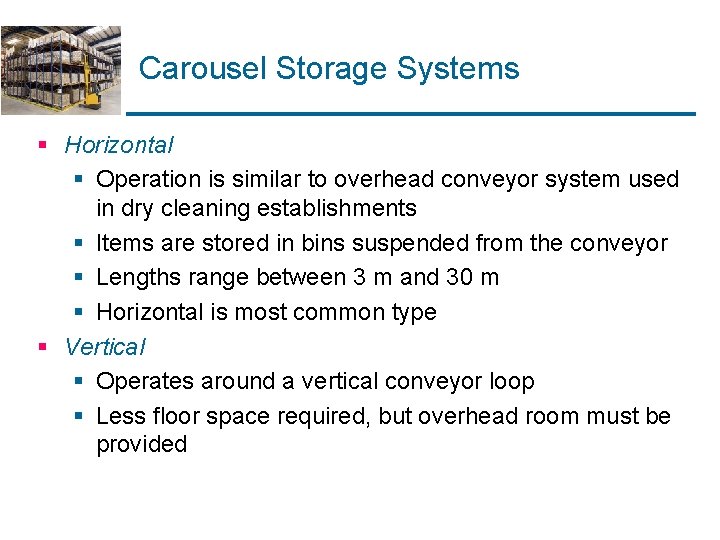
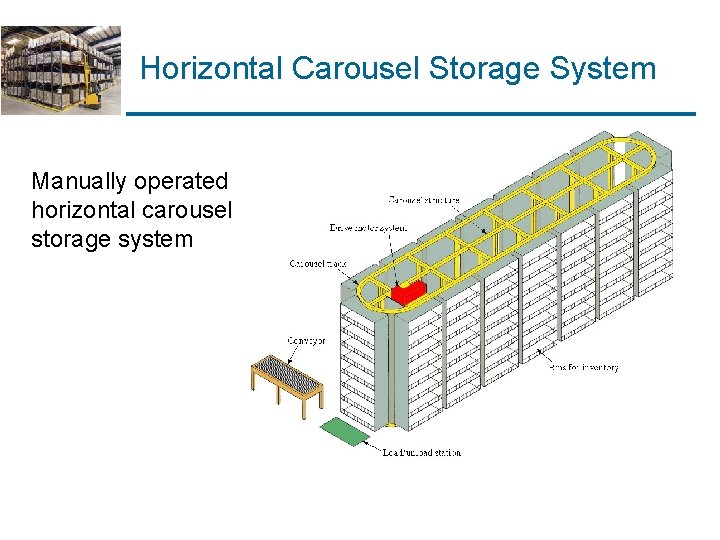
Carousel Storage Systems § Horizontal § Operation is similar to overhead conveyor system used in dry cleaning establishments § Items are stored in bins suspended from the conveyor § Lengths range between 3 m and 30 m § Horizontal is most common type § Vertical § Operates around a vertical conveyor loop § Less floor space required, but overhead room must be provided
Horizontal Carousel Storage System Manually operated horizontal carousel storage system
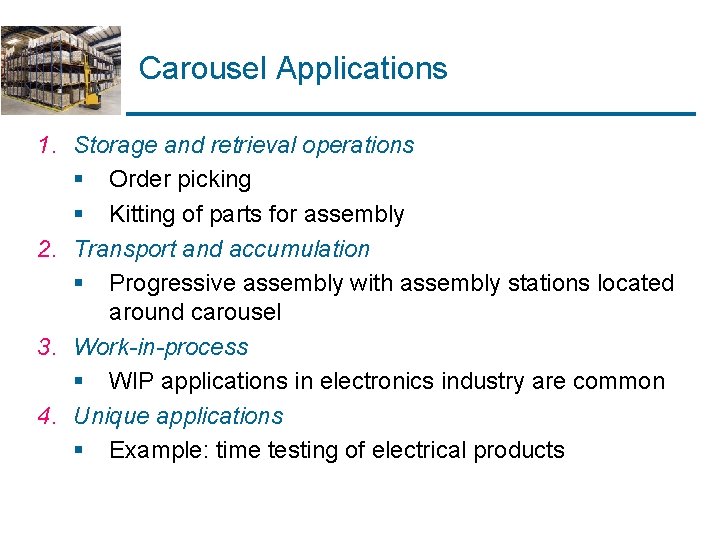
Carousel Applications 1. Storage and retrieval operations § Order picking § Kitting of parts for assembly 2. Transport and accumulation § Progressive assembly with assembly stations located around carousel 3. Work-in-process § WIP applications in electronics industry are common 4. Unique applications § Example: time testing of electrical products
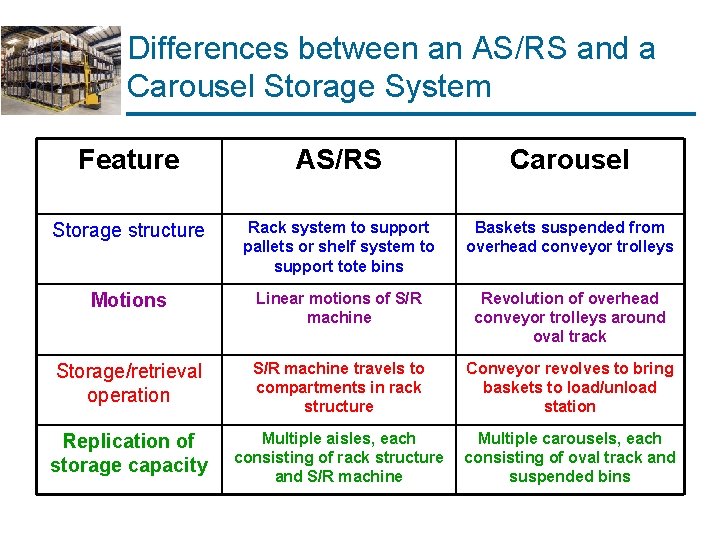
Differences between an AS/RS and a Carousel Storage System Feature AS/RS Carousel Storage structure Rack system to support pallets or shelf system to support tote bins Baskets suspended from overhead conveyor trolleys Motions Linear motions of S/R machine Revolution of overhead conveyor trolleys around oval track Storage/retrieval operation S/R machine travels to compartments in rack structure Conveyor revolves to bring baskets to load/unload station Replication of storage capacity Multiple aisles, each consisting of rack structure and S/R machine Multiple carousels, each consisting of oval track and suspended bins
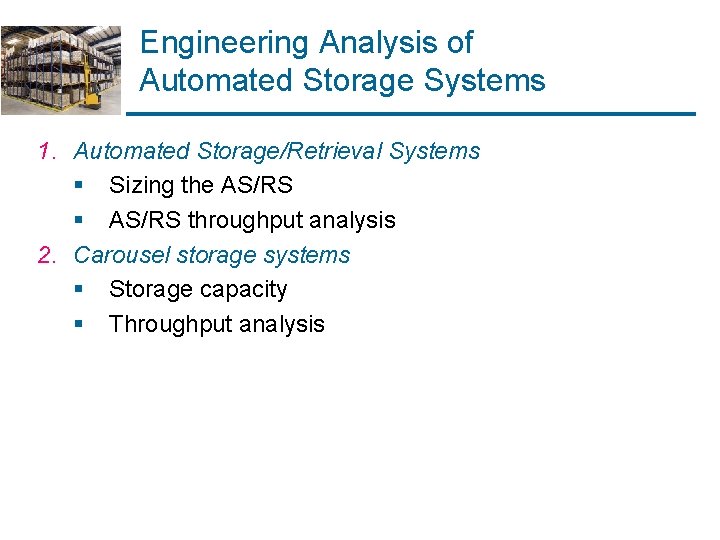
Engineering Analysis of Automated Storage Systems 1. Automated Storage/Retrieval Systems § Sizing the AS/RS § AS/RS throughput analysis 2. Carousel storage systems § Storage capacity § Throughput analysis
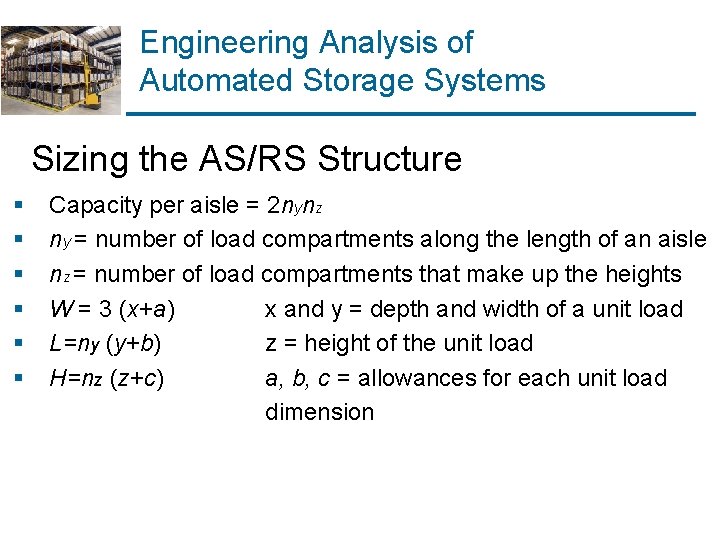
Engineering Analysis of Automated Storage Systems Sizing the AS/RS Structure § § § Capacity per aisle = 2 nynz ny = number of load compartments along the length of an aisle nz = number of load compartments that make up the heights W = 3 (x+a) x and y = depth and width of a unit load L=ny (y+b) z = height of the unit load H=nz (z+c) a, b, c = allowances for each unit load dimension
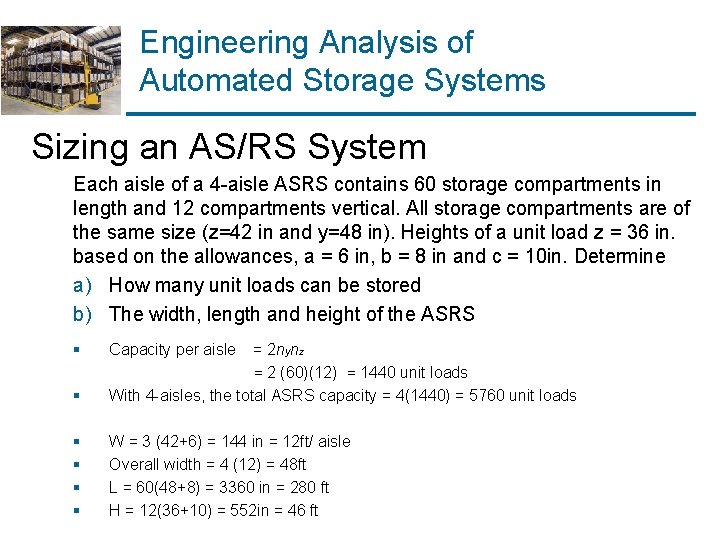
Engineering Analysis of Automated Storage Systems Sizing an AS/RS System Each aisle of a 4 -aisle ASRS contains 60 storage compartments in length and 12 compartments vertical. All storage compartments are of the same size (z=42 in and y=48 in). Heights of a unit load z = 36 in. based on the allowances, a = 6 in, b = 8 in and c = 10 in. Determine a) How many unit loads can be stored b) The width, length and height of the ASRS § Capacity per aisle § = 2 nynz = 2 (60)(12) = 1440 unit loads With 4 -aisles, the total ASRS capacity = 4(1440) = 5760 unit loads § § W = 3 (42+6) = 144 in = 12 ft/ aisle Overall width = 4 (12) = 48 ft L = 60(48+8) = 3360 in = 280 ft H = 12(36+10) = 552 in = 46 ft
More details in tutorial session. .