
Chapter 3 Staying Focused Concentration We know it

- Slides: 19
Chapter 3 Staying Focused
Concentration: We know it when we see it • The intense expression of a bowler as she prepares to roll • A quarterback who directs a pass to an open receiver despite onrushing linebackers • A student who is reading an assignment so intently that she talks back to the author • A note-taker so absorbed that two full hours seem to tick by in just a few minutes. Copyright © Houghton Mifflin Company. All rights reserved. 3|2
But what is concentration? • • Concentration is focused thinking Concentration is undivided attention But concentration is elusive If you realize you’re concentrating, you’ve stopped concentrating Copyright © Houghton Mifflin Company. All rights reserved. 3|3
How do you create the conditions for concentration? • By eliminating distractions • By minimizing multitasking • By adopting concentration strategies Copyright © Houghton Mifflin Company. All rights reserved. 3|4
Two kinds of distractions • External: Anything that stimulates the senses and disrupts concentration • Internal: Distractions that come from within Copyright © Houghton Mifflin Company. All rights reserved. 3|5
External distractions • • • Loud or annoying noises Bad smells, good smells Attention-getting sights in your field of view Itches, uncomfortable clothing What else? Copyright © Houghton Mifflin Company. All rights reserved. 3|6
Internal distractions • • • Worries Daydreams Anxiety Indecision What else? Copyright © Houghton Mifflin Company. All rights reserved. 3|7
External distractions can be reduced by • Selecting the proper environment • Having the right equipment handy Copyright © Houghton Mifflin Company. All rights reserved. 3|8
What is the right environment? • A place dedicated to study • A place free of visual distractions • A place with no noise or distracting music • A place where the computer is not in the way Copyright © Houghton Mifflin Company. All rights reserved. 3|9
What makes up the right equipment? • • • Sufficient lighting A comfortable chair A pencil to catalyze concentration A bookstand Other supplies standing by Copyright © Houghton Mifflin Company. All rights reserved. 3 | 10
Internal distractions can be discouraged by using • A concentration score sheet • A worry pad • The Stop! Technique Copyright © Houghton Mifflin Company. All rights reserved. 3 | 11
What is multitasking? • Working on several tasks simultaneously or • Shifting rapidly back and forth between them Copyright © Houghton Mifflin Company. All rights reserved. 3 | 12
Multitasking makes you less productive • It causes forgetfulness • It interferes with concentration Copyright © Houghton Mifflin Company. All rights reserved. 3 | 13
Multitasking increases stress • • It facilitates procrastination It creates a loss of control It can lead to insomnia It can lead to Attention Deficit Trait Copyright © Houghton Mifflin Company. All rights reserved. 3 | 14
Ways to minimize multitasking • Slow down and plan out your day • Finishing one task before starting another • Keep a notepad handy to deal with distractions Copyright © Houghton Mifflin Company. All rights reserved. 3 | 15
Concentrating doesn’t have to be negative • Yes, you need to stop distractions • But you can also promote concentration Copyright © Houghton Mifflin Company. All rights reserved. 3 | 16
Ways to promote concentration • Make lists. Keep your mind uncluttered by writing things down • Take breaks: Don’t discourage consolidation or create fatigue. Give yourself regular rests • Maintain a balance: Create equilibrium between an assignment’s challenge and your skill level Copyright © Houghton Mifflin Company. All rights reserved. 3 | 17
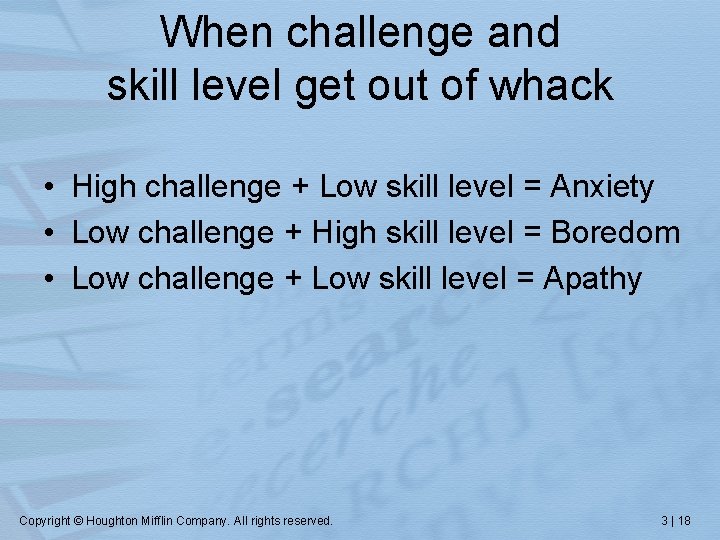
When challenge and skill level get out of whack • High challenge + Low skill level = Anxiety • Low challenge + High skill level = Boredom • Low challenge + Low skill level = Apathy Copyright © Houghton Mifflin Company. All rights reserved. 3 | 18
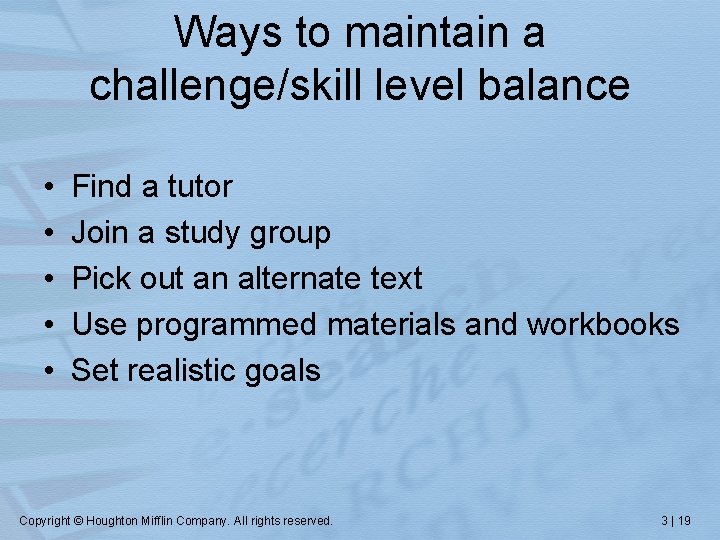
Ways to maintain a challenge/skill level balance • • • Find a tutor Join a study group Pick out an alternate text Use programmed materials and workbooks Set realistic goals Copyright © Houghton Mifflin Company. All rights reserved. 3 | 19