
Chapter 3 Statistical Process Control Operations Management 5
- Slides: 42
Chapter 3 Statistical Process Control Operations Management - 5 th Edition Roberta Russell & Bernard W. Taylor, III Copyright 2009, John Wiley & Sons, Inc. Beni Asllani University of Tennessee at Chattanooga
Lecture Outline w w w w Basics of Statistical Process Control Charts for Attributes Control Charts for Variables Control Chart Patterns SPC with Excel Process Capability Copyright 2009, John Wiley & Sons, Inc. 4 -2
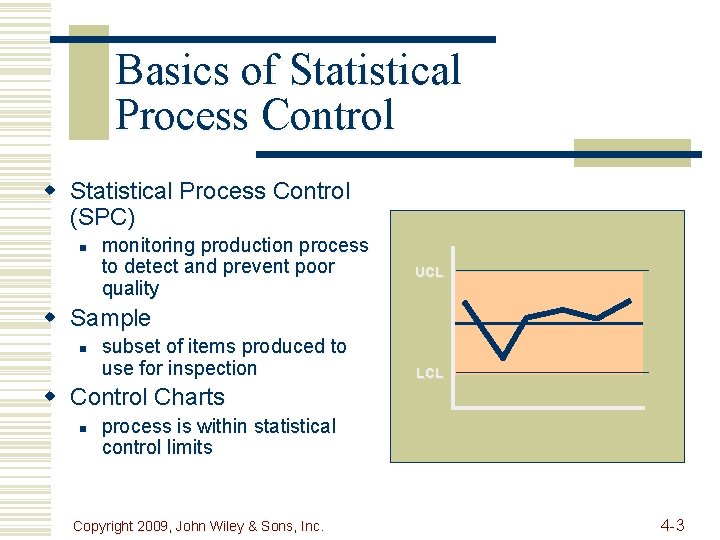
Basics of Statistical Process Control w Statistical Process Control (SPC) n monitoring production process to detect and prevent poor quality UCL w Sample n subset of items produced to use for inspection LCL w Control Charts n process is within statistical control limits Copyright 2009, John Wiley & Sons, Inc. 4 -3
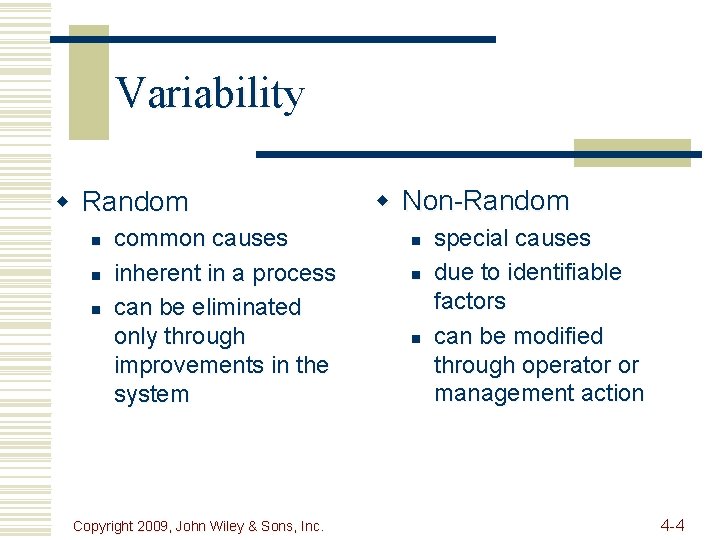
Variability w Random n n n common causes inherent in a process can be eliminated only through improvements in the system Copyright 2009, John Wiley & Sons, Inc. w Non-Random n n n special causes due to identifiable factors can be modified through operator or management action 4 -4
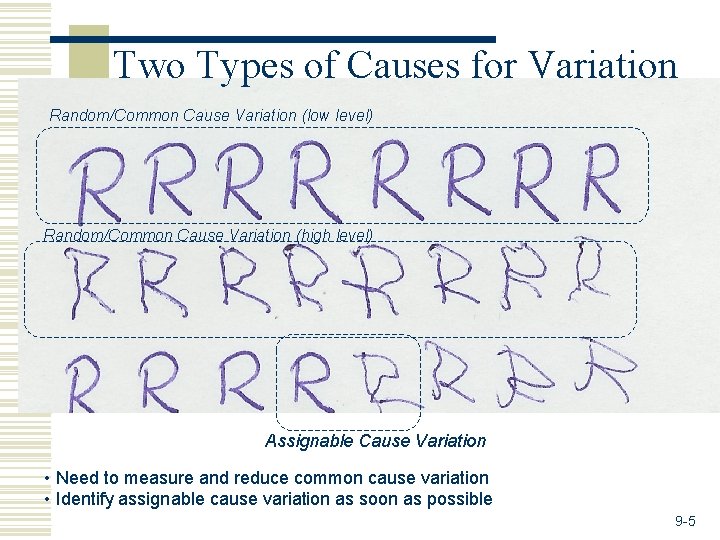
Two Types of Causes for Variation Random/Common Cause Variation (low level) Random/Common Cause Variation (high level) Assignable Cause Variation • Need to measure and reduce common cause variation • Identify assignable cause variation as soon as possible 9 -5
Quality Measures w Attribute n n a product characteristic that can be evaluated with a discrete response good – bad; yes - no w Variable n n a product characteristic that is continuous and can be measured weight ; length Copyright 2009, John Wiley & Sons, Inc. 4 -6
Applying SPC to Service w w Nature of defect is different in services Service defect is a failure to meet customer requirements Monitor times, customer satisfaction Examples w Hospitals timeliness and quickness of care, accuracy of lab tests, cleanliness, courtesy, accuracy of paperwork, speed of admittance and checkouts n w Airlines n flight delays, lost luggage, waiting time at ticket counters and check-in, agent and flight attendant courtesy, accurate flight information, passenger cabin cleanliness and maintenance Copyright 2009, John Wiley & Sons, Inc. 4 -7
Where to Use Control Charts w Process has a tendency to go out of control w Process is particularly harmful and costly if it goes out of control w Examples n n at the beginning of a process because it is a waste of time and money to begin production process with bad supplies before a costly or irreversible point, after which product is difficult to rework or correct before and after assembly or painting operations that might cover defects before the outgoing final product or service is delivered Copyright 2009, John Wiley & Sons, Inc. 4 -8
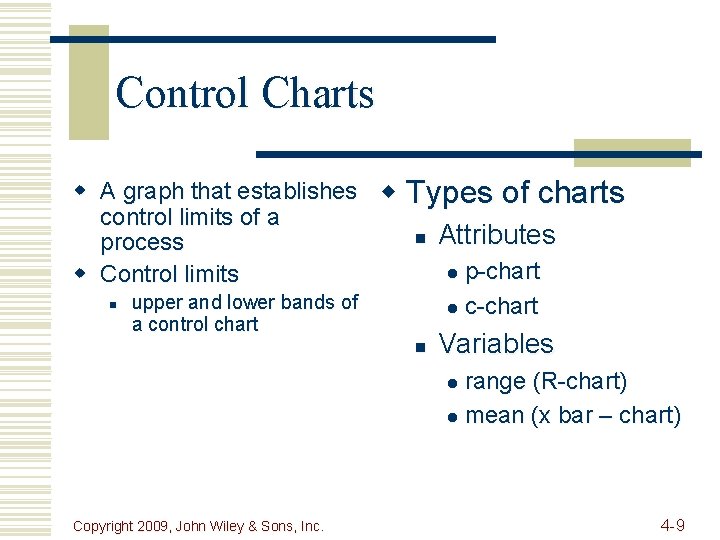
Control Charts w A graph that establishes control limits of a process w Control limits n w Types of charts n Attributes p-chart l c-chart l upper and lower bands of a control chart n Variables range (R-chart) l mean (x bar – chart) l Copyright 2009, John Wiley & Sons, Inc. 4 -9
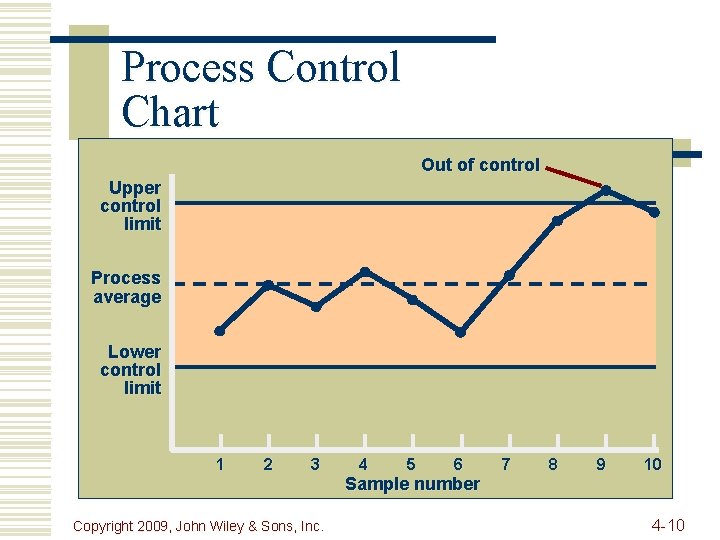
Process Control Chart Out of control Upper control limit Process average Lower control limit 1 2 3 4 5 6 7 8 9 10 Sample number Copyright 2009, John Wiley & Sons, Inc. 4 -10
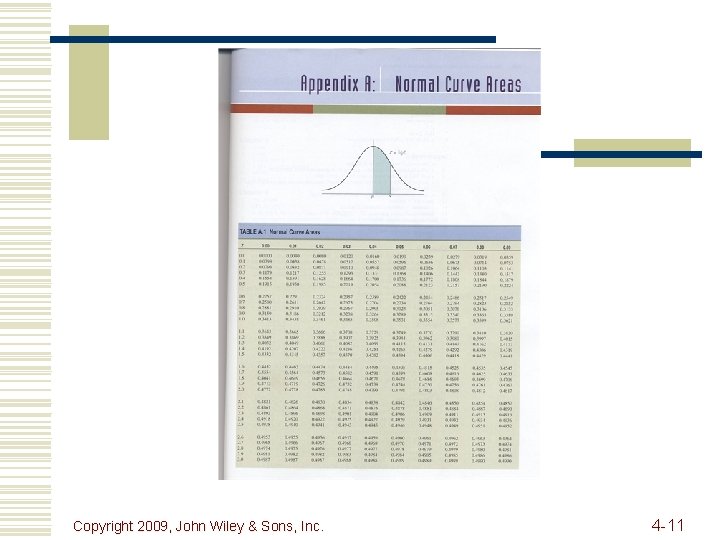
Copyright 2009, John Wiley & Sons, Inc. 4 -11
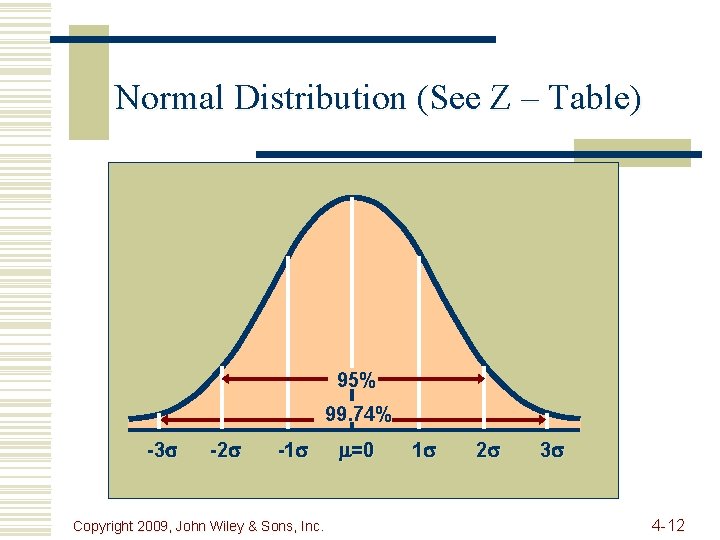
Normal Distribution (See Z – Table) 95% 99. 74% -3 -2 -1 Copyright 2009, John Wiley & Sons, Inc. =0 1 2 3 4 -12
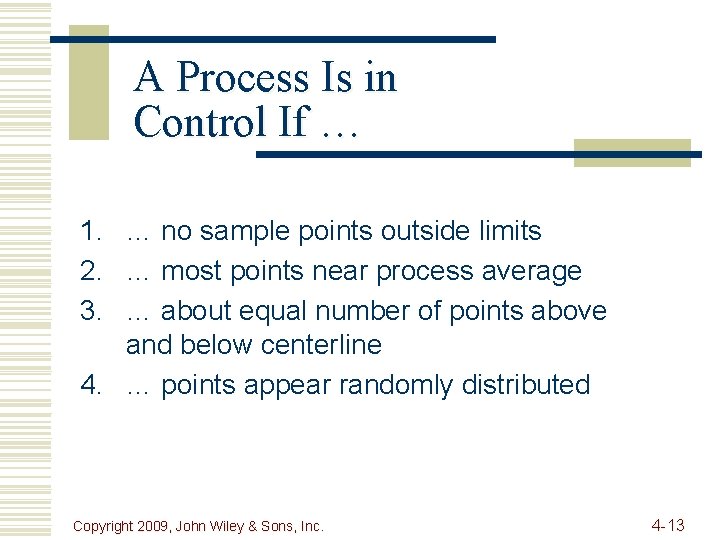
A Process Is in Control If … 1. … no sample points outside limits 2. … most points near process average 3. … about equal number of points above and below centerline 4. … points appear randomly distributed Copyright 2009, John Wiley & Sons, Inc. 4 -13
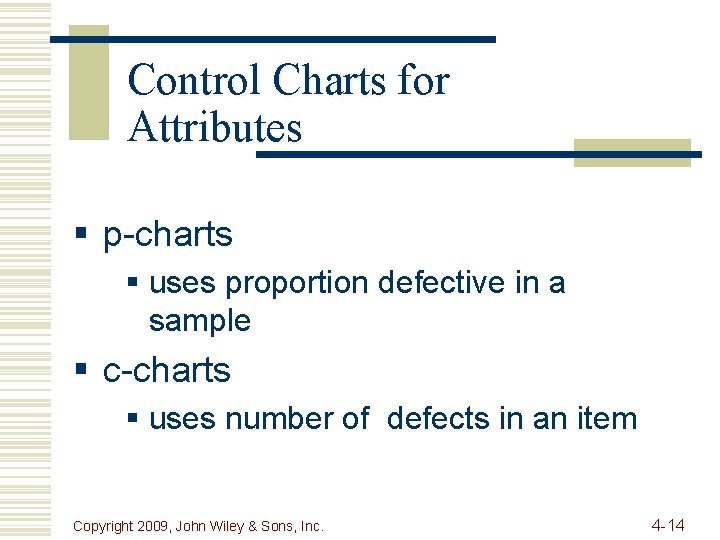
Control Charts for Attributes § p-charts § uses proportion defective in a sample § c-charts § uses number of defects in an item Copyright 2009, John Wiley & Sons, Inc. 4 -14
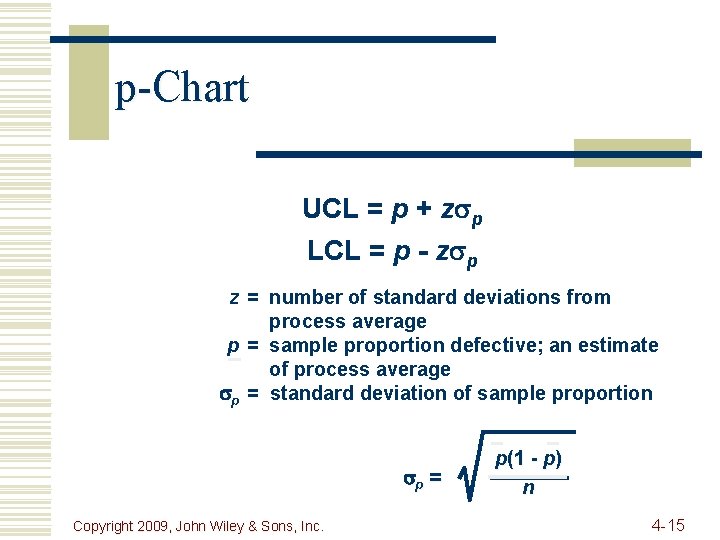
p-Chart UCL = p + z p LCL = p - z p z = number of standard deviations from process average p = sample proportion defective; an estimate of process average p = standard deviation of sample proportion p = Copyright 2009, John Wiley & Sons, Inc. p(1 - p) n 4 -15
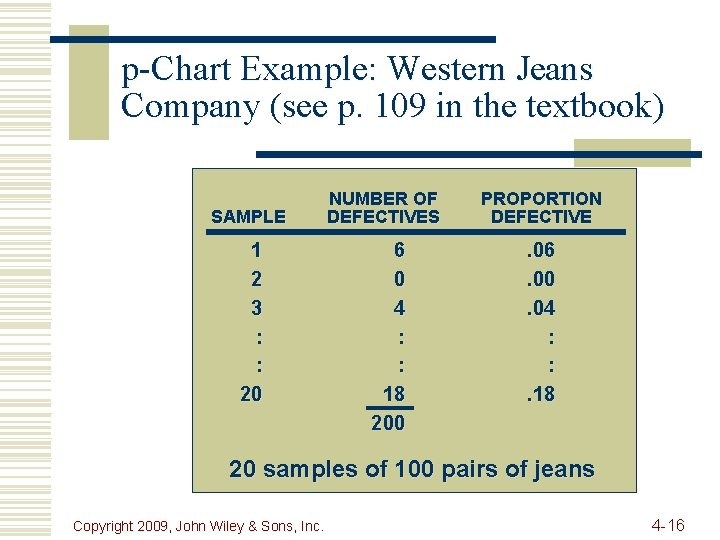
p-Chart Example: Western Jeans Company (see p. 109 in the textbook) SAMPLE 1 2 3 : : 20 NUMBER OF DEFECTIVES PROPORTION DEFECTIVE 6 0 4 : : 18 200 . 06. 00. 04 : : . 18 20 samples of 100 pairs of jeans Copyright 2009, John Wiley & Sons, Inc. 4 -16
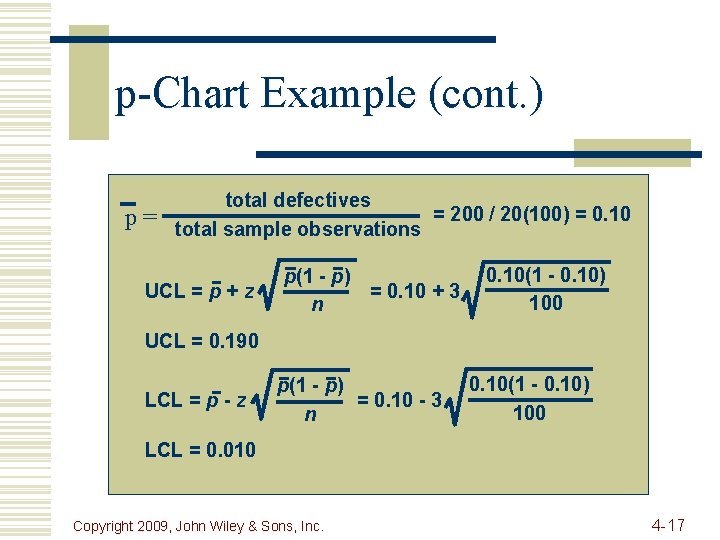
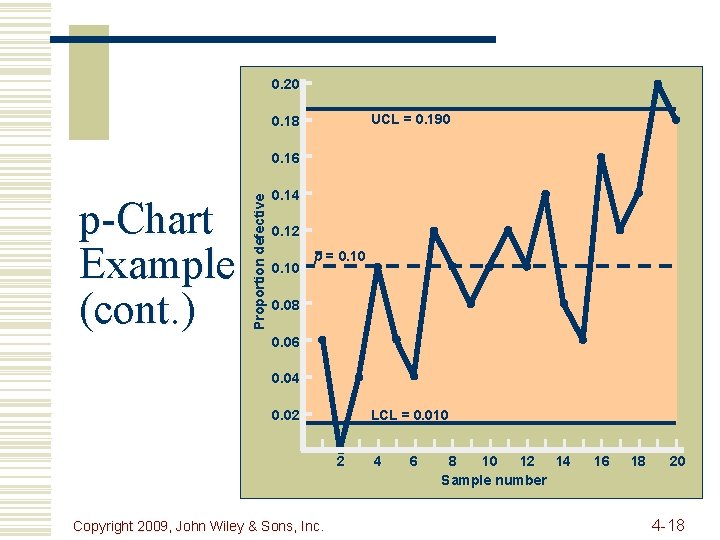
p-Chart Example (cont. ) p= total defectives = 200 / 20(100) = 0. 10 total sample observations UCL = p + z p(1 - p) = 0. 10 + 3 n 0. 10(1 - 0. 10) 100 UCL = 0. 190 LCL = p - z p(1 - p) = 0. 10 - 3 n 0. 10(1 - 0. 10) 100 LCL = 0. 010 Copyright 2009, John Wiley & Sons, Inc. 4 -17
0. 20 UCL = 0. 190 0. 18 p-Chart Example (cont. ) Proportion defective 0. 16 0. 14 0. 12 0. 10 p = 0. 10 0. 08 0. 06 0. 04 0. 02 LCL = 0. 010 2 Copyright 2009, John Wiley & Sons, Inc. 4 6 8 10 12 14 Sample number 16 18 20 4 -18
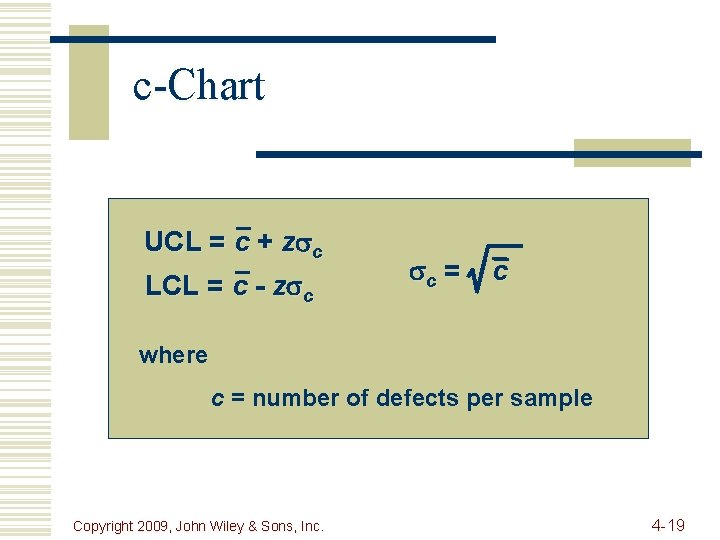
c-Chart UCL = c + z c LCL = c - z c c = c where c = number of defects per sample Copyright 2009, John Wiley & Sons, Inc. 4 -19
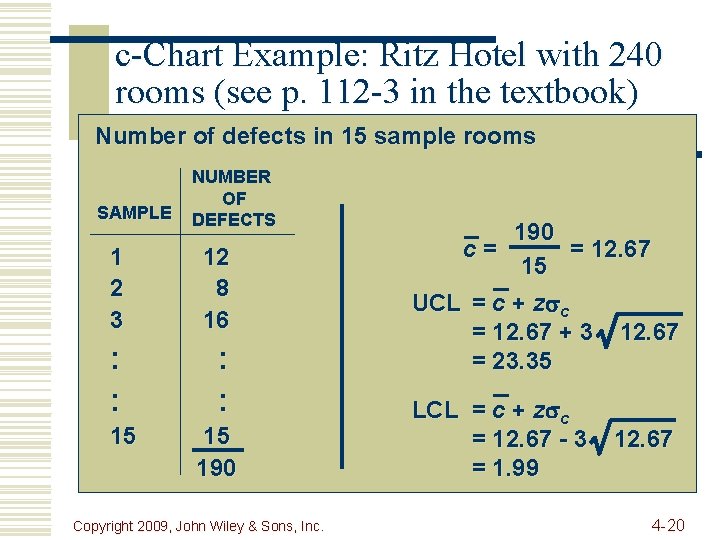
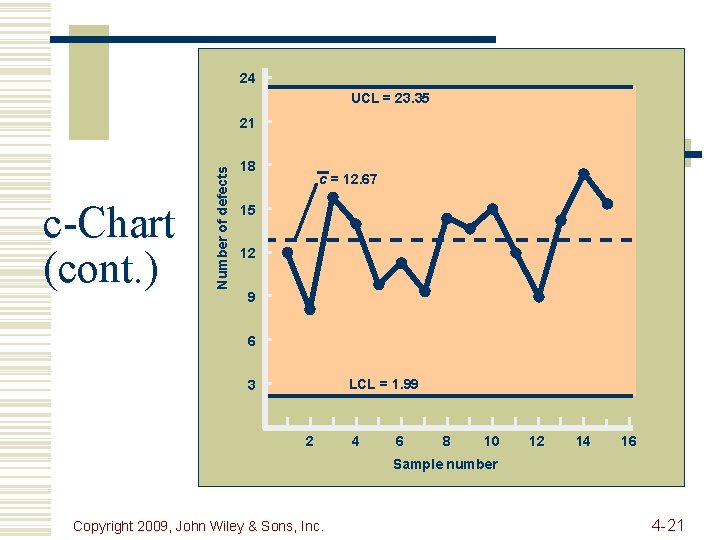
c-Chart Example: Ritz Hotel with 240 rooms (see p. 112 -3 in the textbook) Number of defects in 15 sample rooms SAMPLE NUMBER OF DEFECTS 1 2 3 12 8 16 : : 15 15 190 Copyright 2009, John Wiley & Sons, Inc. 190 c= = 12. 67 15 UCL = c + z c = 12. 67 + 3 = 23. 35 12. 67 LCL = c + z c = 12. 67 - 3 = 1. 99 12. 67 4 -20
24 UCL = 23. 35 c-Chart (cont. ) Number of defects 21 18 c = 12. 67 15 12 9 6 LCL = 1. 99 3 2 4 6 8 10 12 14 16 Sample number Copyright 2009, John Wiley & Sons, Inc. 4 -21
Control Charts for Variables § Mean chart ( x -Chart ) § uses average of a sample § Range chart ( R-Chart ) § uses amount of dispersion in a sample Copyright 2009, John Wiley & Sons, Inc. 4 -22
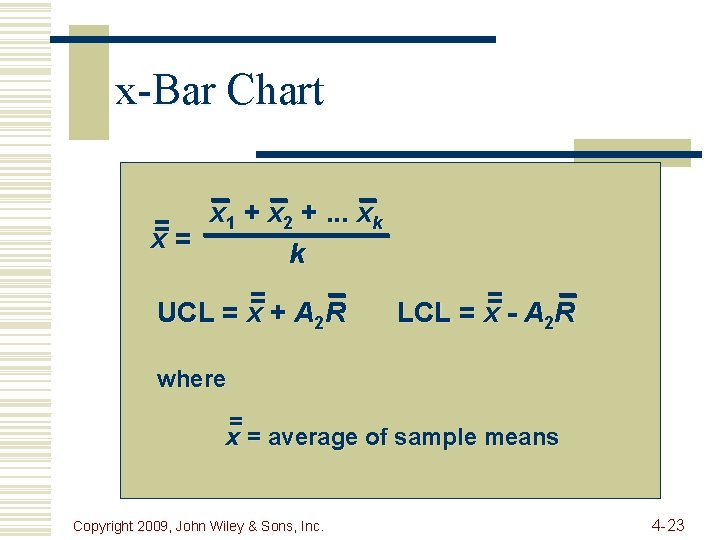
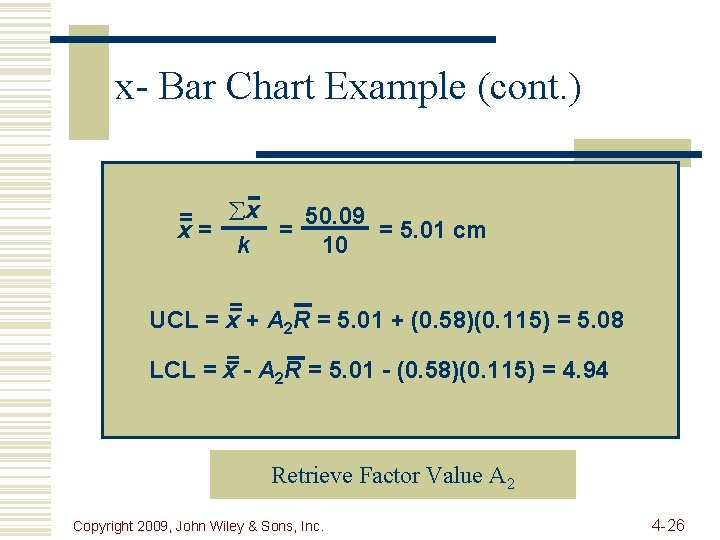
x-Bar Chart x 1 + x 2 +. . . xk = x= k = UCL = x + A 2 R = LCL = x - A 2 R where = x = average of sample means Copyright 2009, John Wiley & Sons, Inc. 4 -23
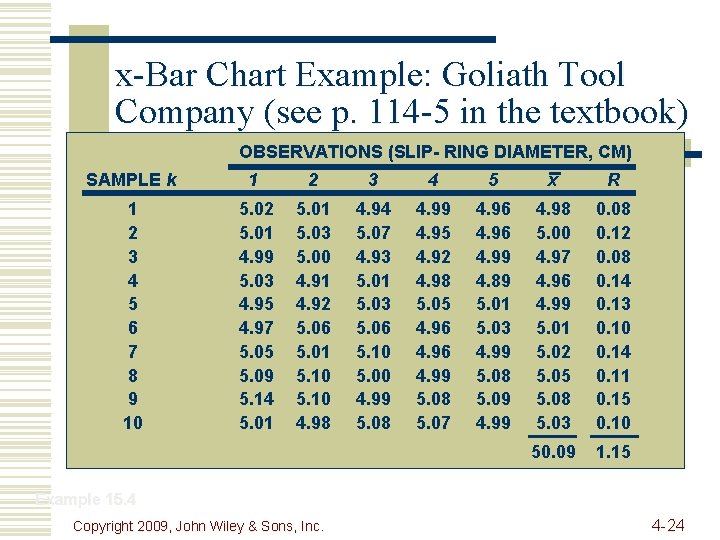
x-Bar Chart Example: Goliath Tool Company (see p. 114 -5 in the textbook) OBSERVATIONS (SLIP- RING DIAMETER, CM) SAMPLE k 1 2 3 4 5 x R 1 2 3 4 5 6 7 8 9 10 5. 02 5. 01 4. 99 5. 03 4. 95 4. 97 5. 05 5. 09 5. 14 5. 01 5. 03 5. 00 4. 91 4. 92 5. 06 5. 01 5. 10 4. 98 4. 94 5. 07 4. 93 5. 01 5. 03 5. 06 5. 10 5. 00 4. 99 5. 08 4. 99 4. 95 4. 92 4. 98 5. 05 4. 96 4. 99 5. 08 5. 07 4. 96 4. 99 4. 89 5. 01 5. 03 4. 99 5. 08 5. 09 4. 98 5. 00 4. 97 4. 96 4. 99 5. 01 5. 02 5. 05 5. 08 5. 03 0. 08 0. 12 0. 08 0. 14 0. 13 0. 10 0. 14 0. 11 0. 15 0. 10 50. 09 1. 15 Example 15. 4 Copyright 2009, John Wiley & Sons, Inc. 4 -24
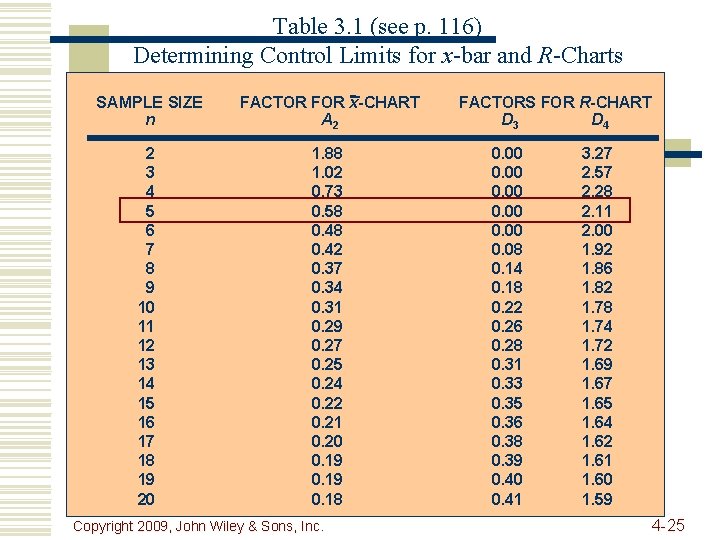
Table 3. 1 (see p. 116) Determining Control Limits for x-bar and R-Charts SAMPLE SIZE n FACTOR FOR x-CHART A 2 2 3 4 5 6 7 8 9 10 11 12 13 14 15 16 17 18 19 20 1. 88 1. 02 0. 73 0. 58 0. 42 0. 37 0. 34 0. 31 0. 29 0. 27 0. 25 0. 24 0. 22 0. 21 0. 20 0. 19 0. 18 Fact ors Copyright 2009, John Wiley & Sons, Inc. FACTORS FOR R-CHART D 3 D 4 0. 00 0. 08 0. 14 0. 18 0. 22 0. 26 0. 28 0. 31 0. 33 0. 35 0. 36 0. 38 0. 39 0. 40 0. 41 3. 27 2. 57 2. 28 2. 11 2. 00 1. 92 1. 86 1. 82 1. 78 1. 74 1. 72 1. 69 1. 67 1. 65 1. 64 1. 62 1. 61 1. 60 1. 59 4 -25
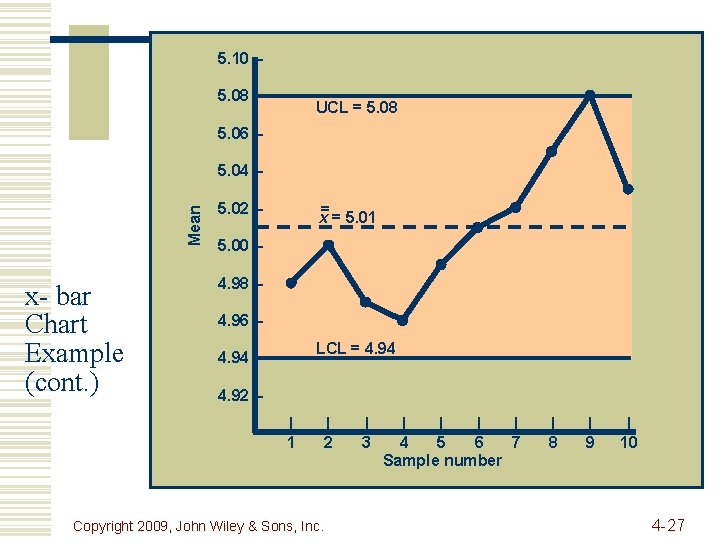
x- Bar Chart Example (cont. ) 50. 09 = åx x= = = 5. 01 cm 10 k = UCL = x + A 2 R = 5. 01 + (0. 58)(0. 115) = 5. 08 LCL = x= - A 2 R = 5. 01 - (0. 58)(0. 115) = 4. 94 Retrieve Factor Value A 2 Copyright 2009, John Wiley & Sons, Inc. 4 -26
5. 10 – 5. 08 – UCL = 5. 08 5. 06 – Mean 5. 04 – x- bar Chart Example (cont. ) 5. 02 – x= = 5. 01 5. 00 – 4. 98 – 4. 96 – LCL = 4. 94 – 4. 92 – | 1 Copyright 2009, John Wiley & Sons, Inc. | 2 | 3 | | 4 5 6 7 Sample number | 8 | 9 | 10 4 -27
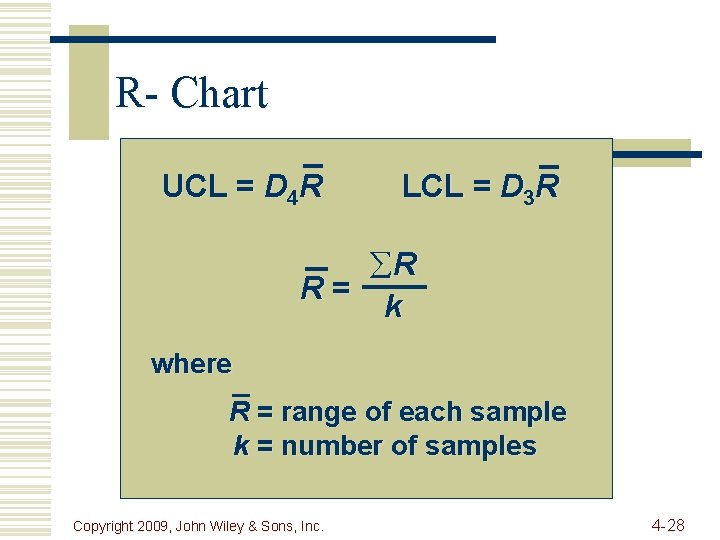
R- Chart UCL = D 4 R LCL = D 3 R åR R= k where R = range of each sample k = number of samples Copyright 2009, John Wiley & Sons, Inc. 4 -28
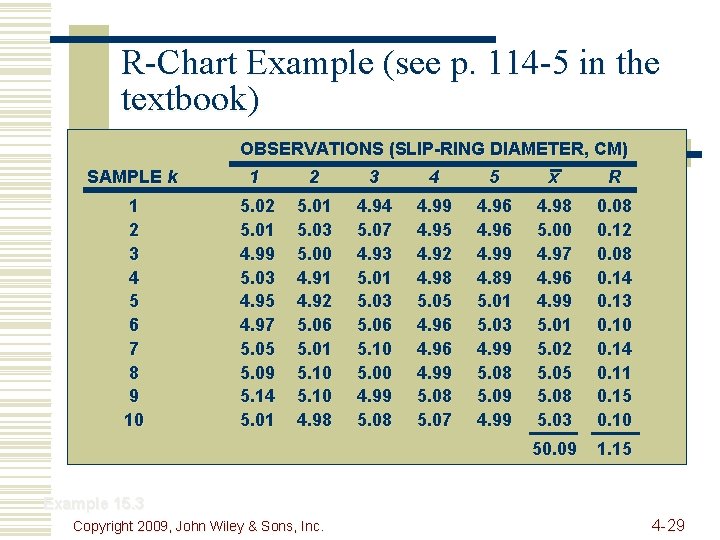
R-Chart Example (see p. 114 -5 in the textbook) OBSERVATIONS (SLIP-RING DIAMETER, CM) SAMPLE k 1 2 3 4 5 x R 1 2 3 4 5 6 7 8 9 10 5. 02 5. 01 4. 99 5. 03 4. 95 4. 97 5. 05 5. 09 5. 14 5. 01 5. 03 5. 00 4. 91 4. 92 5. 06 5. 01 5. 10 4. 98 4. 94 5. 07 4. 93 5. 01 5. 03 5. 06 5. 10 5. 00 4. 99 5. 08 4. 99 4. 95 4. 92 4. 98 5. 05 4. 96 4. 99 5. 08 5. 07 4. 96 4. 99 4. 89 5. 01 5. 03 4. 99 5. 08 5. 09 4. 98 5. 00 4. 97 4. 96 4. 99 5. 01 5. 02 5. 05 5. 08 5. 03 0. 08 0. 12 0. 08 0. 14 0. 13 0. 10 0. 14 0. 11 0. 15 0. 10 50. 09 1. 15 Example 15. 3 Copyright 2009, John Wiley & Sons, Inc. 4 -29
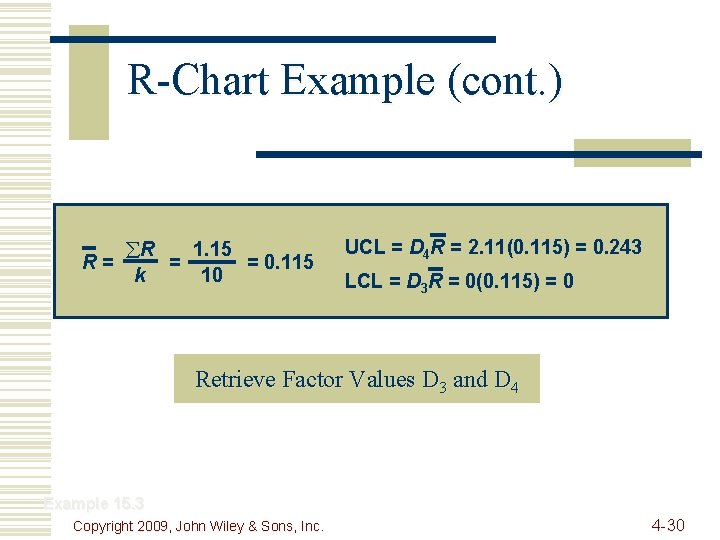
R-Chart Example (cont. ) åR 1. 15 R= = = 0. 115 k 10 UCL = D 4 R = 2. 11(0. 115) = 0. 243 LCL = D 3 R = 0(0. 115) = 0 Retrieve Factor Values D 3 and D 4 Example 15. 3 Copyright 2009, John Wiley & Sons, Inc. 4 -30
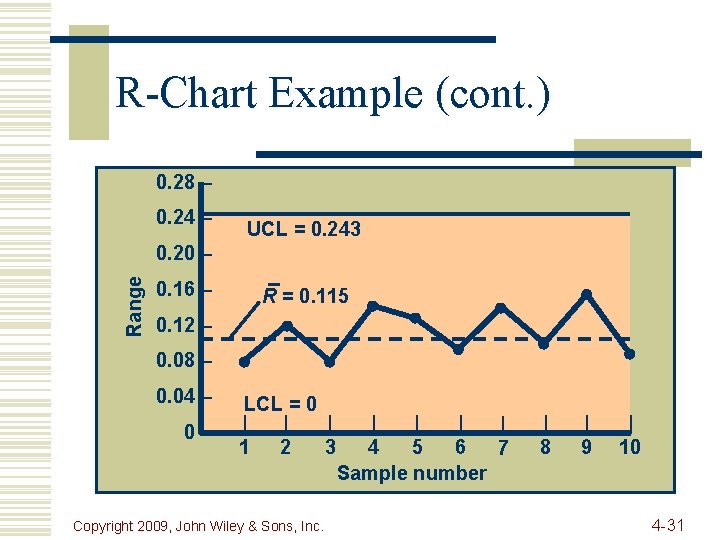
R-Chart Example (cont. ) 0. 28 – 0. 24 – UCL = 0. 243 Range 0. 20 – 0. 16 – R = 0. 115 0. 12 – 0. 08 – 0. 04 – 0– LCL = 0 | | | 1 2 3 Copyright 2009, John Wiley & Sons, Inc. | | 4 5 6 7 Sample number | 8 | 9 | 10 4 -31
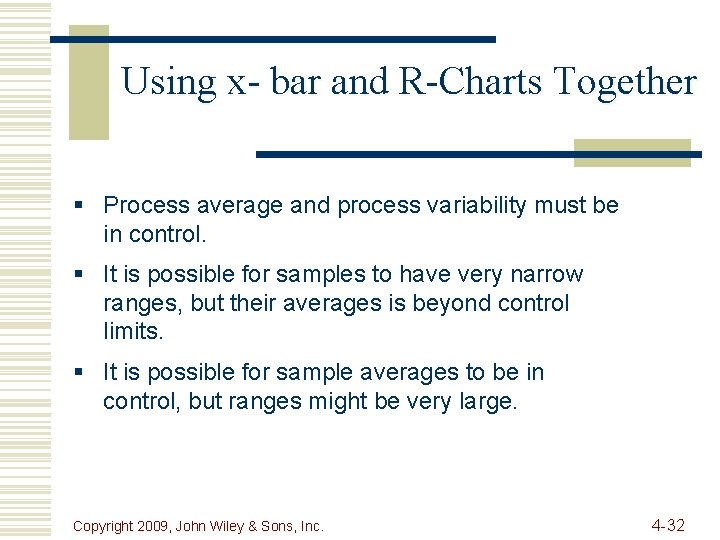
Using x- bar and R-Charts Together § Process average and process variability must be in control. § It is possible for samples to have very narrow ranges, but their averages is beyond control limits. § It is possible for sample averages to be in control, but ranges might be very large. Copyright 2009, John Wiley & Sons, Inc. 4 -32
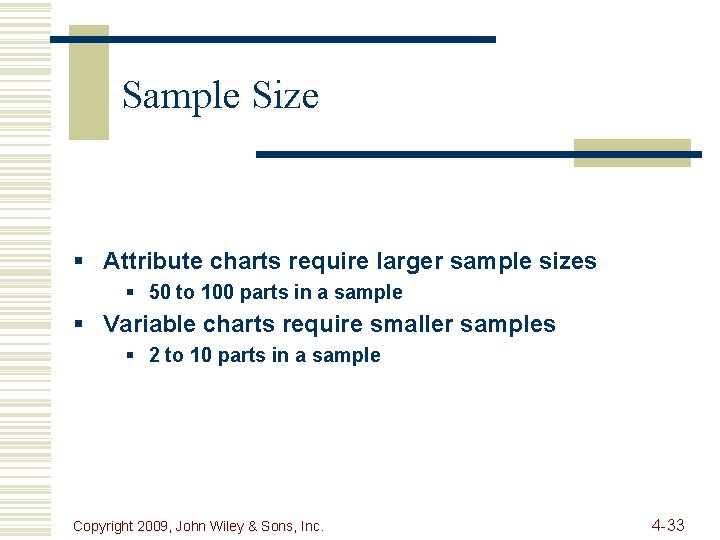
Sample Size § Attribute charts require larger sample sizes § 50 to 100 parts in a sample § Variable charts require smaller samples § 2 to 10 parts in a sample Copyright 2009, John Wiley & Sons, Inc. 4 -33
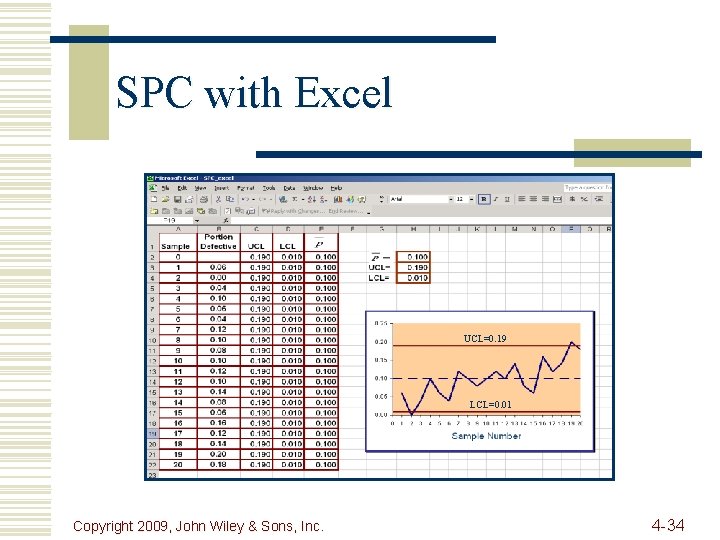
SPC with Excel UCL=0. 19 LCL=0. 01 Copyright 2009, John Wiley & Sons, Inc. 4 -34
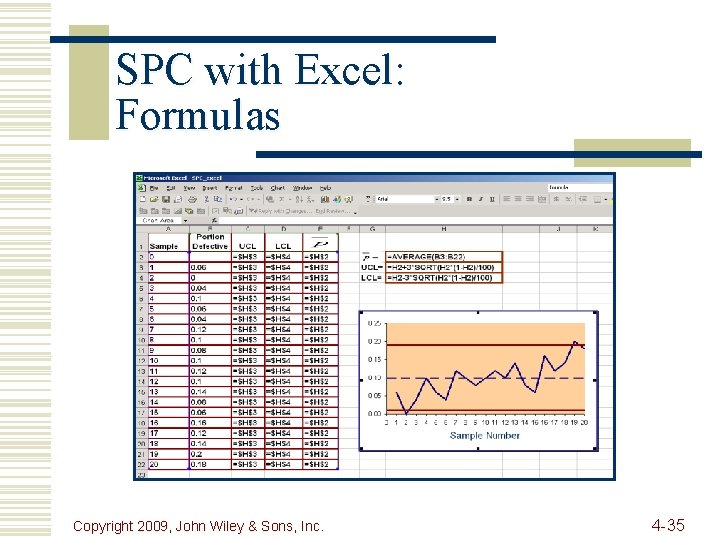
SPC with Excel: Formulas Copyright 2009, John Wiley & Sons, Inc. 4 -35
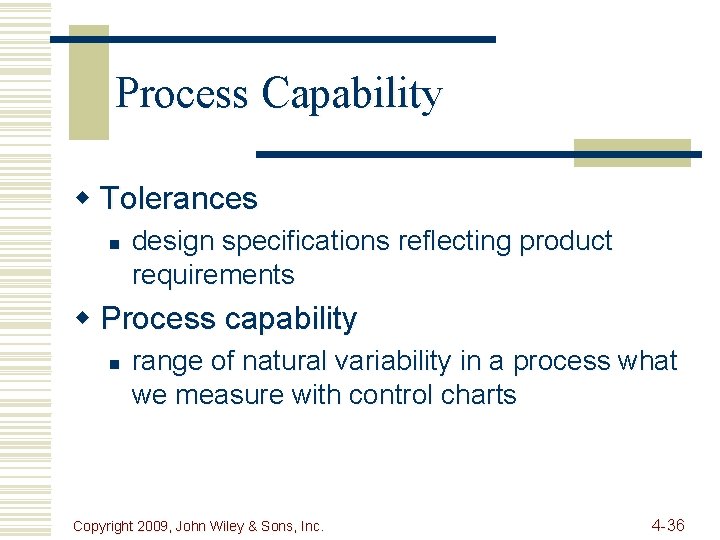
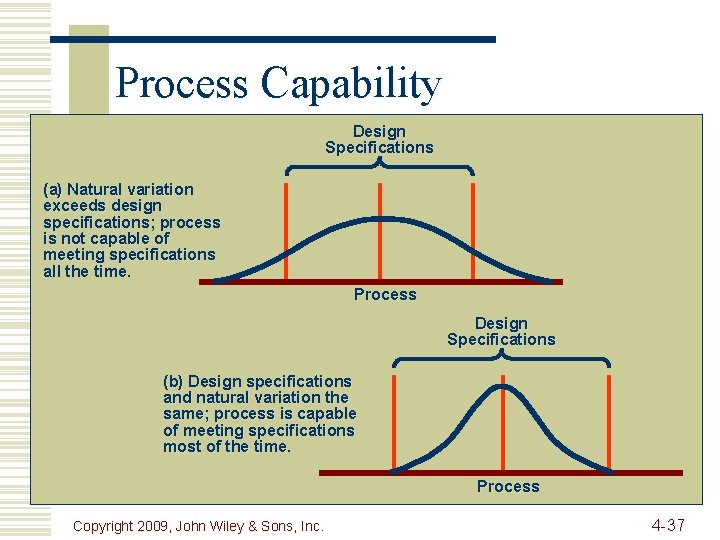
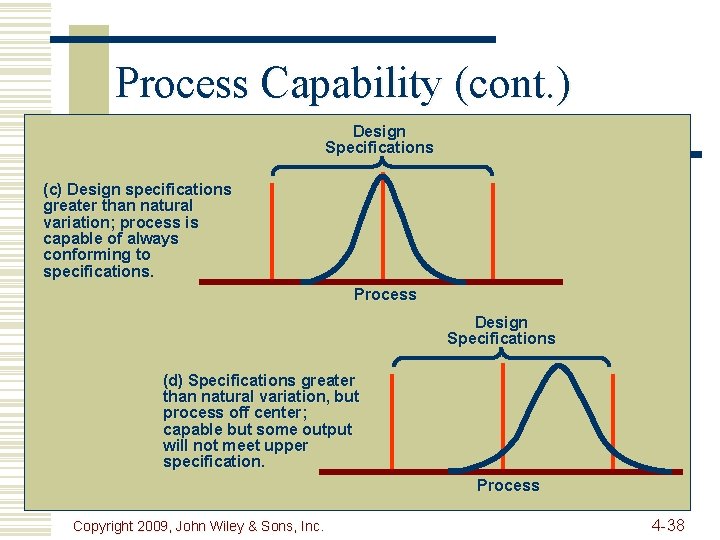
Process Capability w Tolerances n design specifications reflecting product requirements w Process capability n range of natural variability in a process what we measure with control charts Copyright 2009, John Wiley & Sons, Inc. 4 -36
Process Capability Design Specifications (a) Natural variation exceeds design specifications; process is not capable of meeting specifications all the time. Process Design Specifications (b) Design specifications and natural variation the same; process is capable of meeting specifications most of the time. Process Copyright 2009, John Wiley & Sons, Inc. 4 -37
Process Capability (cont. ) Design Specifications (c) Design specifications greater than natural variation; process is capable of always conforming to specifications. Process Design Specifications (d) Specifications greater than natural variation, but process off center; capable but some output will not meet upper specification. Process Copyright 2009, John Wiley & Sons, Inc. 4 -38
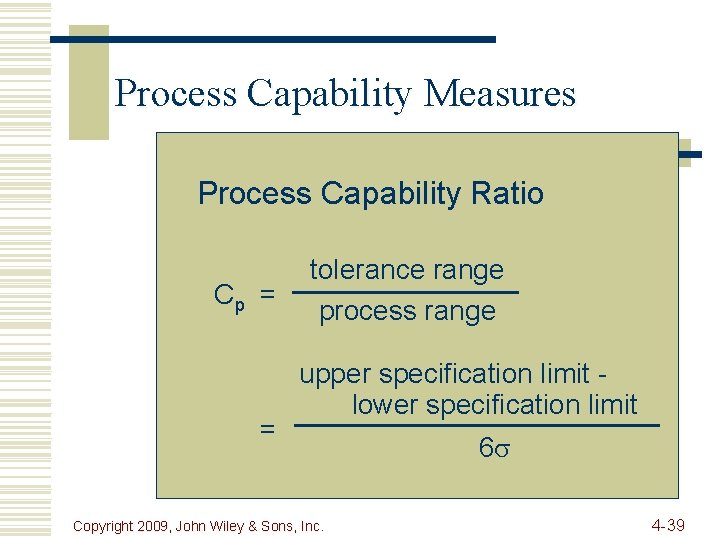
Process Capability Measures Process Capability Ratio Cp = = tolerance range process range upper specification limit lower specification limit Copyright 2009, John Wiley & Sons, Inc. 6 4 -39
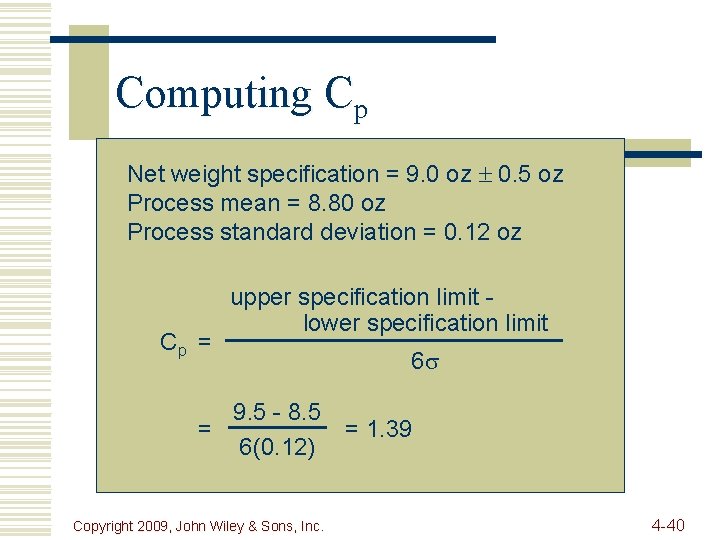
Computing Cp Net weight specification = 9. 0 oz 0. 5 oz Process mean = 8. 80 oz Process standard deviation = 0. 12 oz Cp = upper specification limit lower specification limit 6 9. 5 - 8. 5 = = 1. 39 6(0. 12) Copyright 2009, John Wiley & Sons, Inc. 4 -40
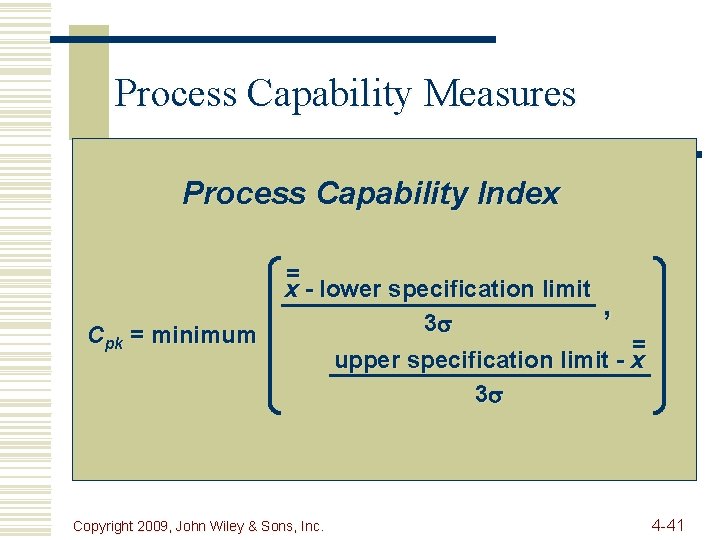
Process Capability Measures Process Capability Index Cpk = minimum = x - lower specification limit , 3 = upper specification limit - x 3 Copyright 2009, John Wiley & Sons, Inc. 4 -41
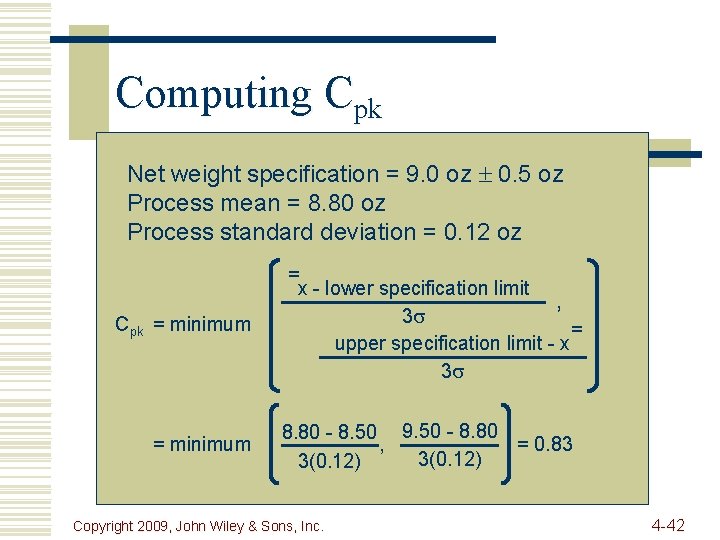
Computing Cpk Net weight specification = 9. 0 oz 0. 5 oz Process mean = 8. 80 oz Process standard deviation = 0. 12 oz Cpk = minimum = x - lower specification limit , 3 = upper specification limit - x 3 8. 80 - 8. 50 9. 50 - 8. 80 , = 0. 83 3(0. 12) Copyright 2009, John Wiley & Sons, Inc. 4 -42