
Chapter 3 Special Techniques for Calculating Potential 3
![3. 2. 4 (3) Force [Note : how about conducting circular cylinder? ]](https://slidetodoc.com/presentation_image/3aadc70709b3f72f8725625b0d368c24/image-24.jpg "3. 2. 4 (3) Force [Note : how about conducting circular cylinder? ]")
![3. 3. 0 (3) for any , odd even [sinkx] [coskx] Fourier transform and](https://slidetodoc.com/presentation_image/3aadc70709b3f72f8725625b0d368c24/image-28.jpg "3. 3. 0 (3) for any , odd even [sinkx] [coskx] Fourier transform and")
- Slides: 41
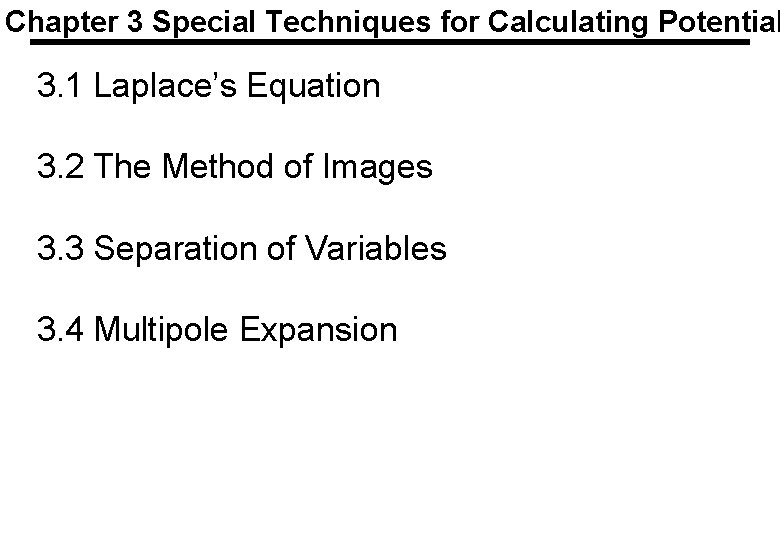
Chapter 3 Special Techniques for Calculating Potential 3. 1 Laplace’s Equation 3. 2 The Method of Images 3. 3 Separation of Variables 3. 4 Multipole Expansion
3. 1 Laplace’s Equation 3. 1. 1 Introduction 3. 1. 2 Laplace’s Equation in One Dimension 3. 1. 3 Laplace’s Equation in Two Dimensions 3. 1. 4 Laplace’s Equation in Three Dimensions 3. 1. 5 Boundary Conditions and Uniqueness Theorems 3. 1. 6 Conducts and the Second Uniqueness Theorem
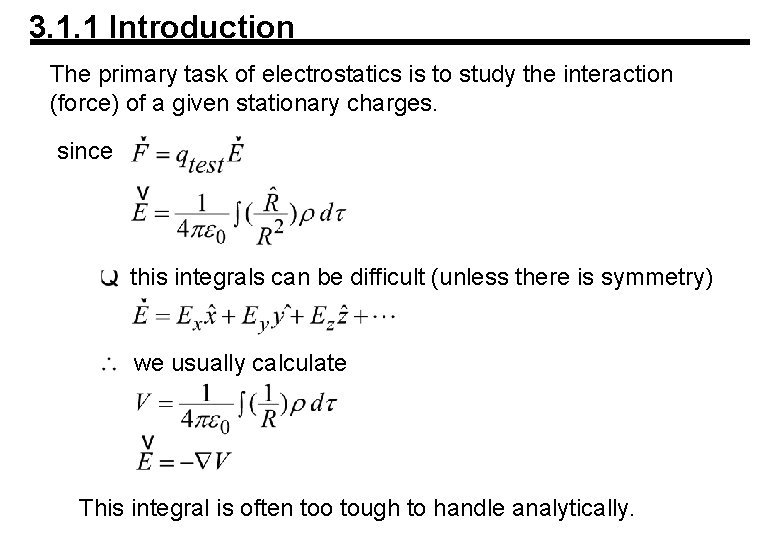
3. 1. 1 Introduction The primary task of electrostatics is to study the interaction (force) of a given stationary charges. since this integrals can be difficult (unless there is symmetry) we usually calculate This integral is often too tough to handle analytically.
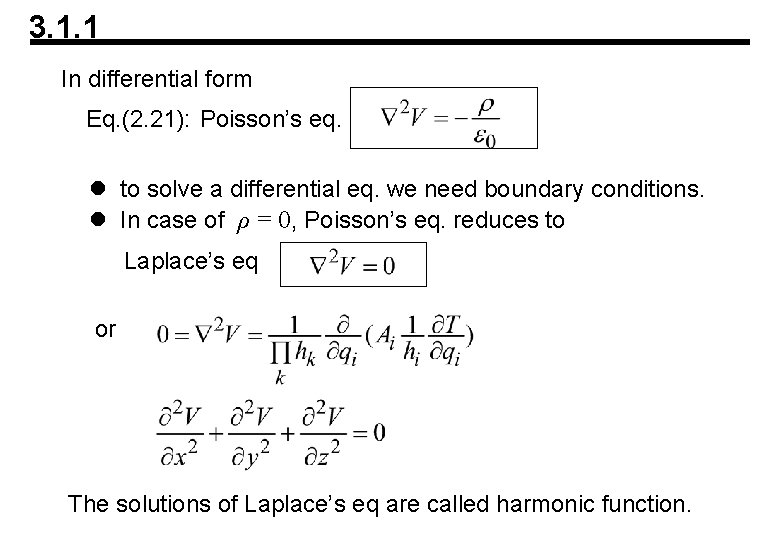
3. 1. 1 In differential form Eq. (2. 21): Poisson’s eq. l to solve a differential eq. we need boundary conditions. l In case of ρ = 0, Poisson’s eq. reduces to Laplace’s eq or The solutions of Laplace’s eq are called harmonic function.
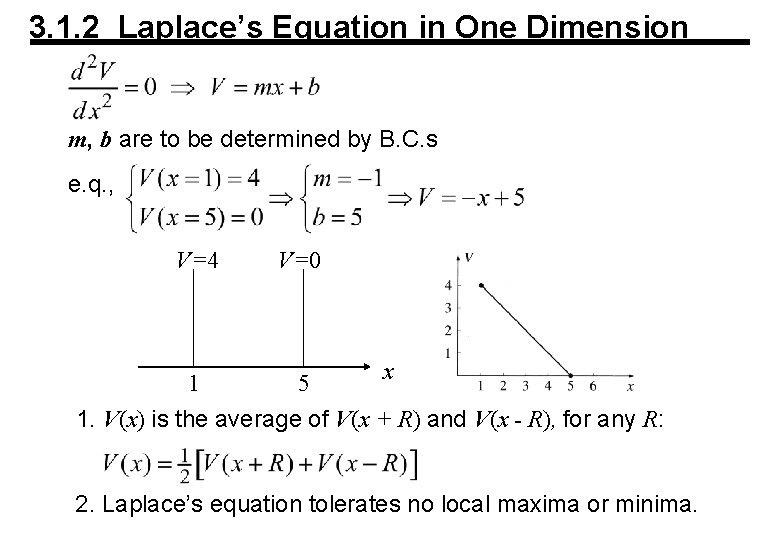
3. 1. 2 Laplace’s Equation in One Dimension m, b are to be determined by B. C. s e. q. , V=4 V=0 1 5 x 1. V(x) is the average of V(x + R) and V(x - R), for any R: 2. Laplace’s equation tolerates no local maxima or minima.
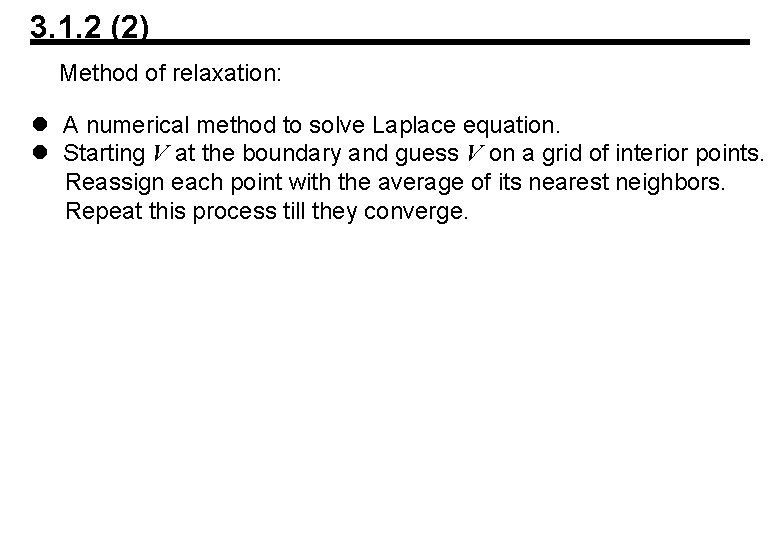
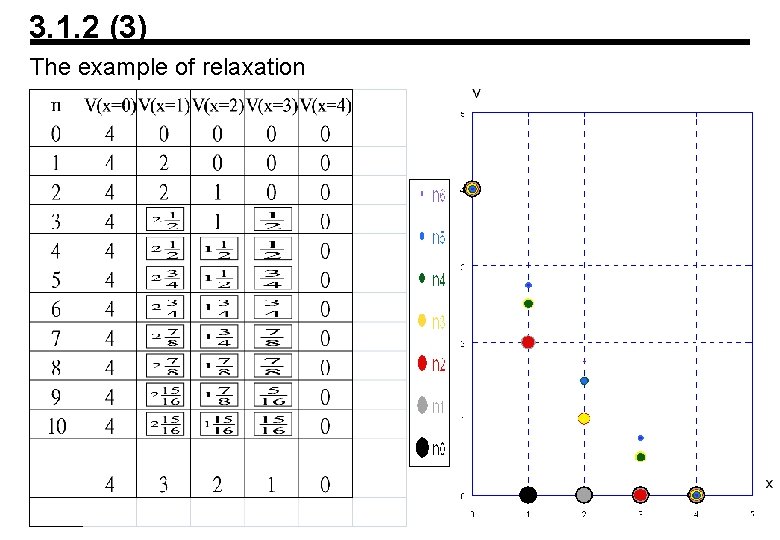
3. 1. 2 (2) Method of relaxation: l A numerical method to solve Laplace equation. l Starting V at the boundary and guess V on a grid of interior points. Reassign each point with the average of its nearest neighbors. Repeat this process till they converge.
3. 1. 2 (3) The example of relaxation
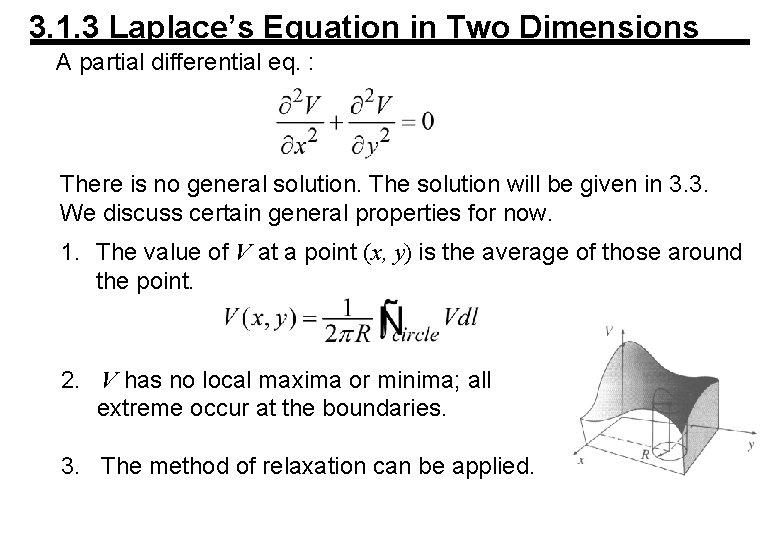
3. 1. 3 Laplace’s Equation in Two Dimensions A partial differential eq. : There is no general solution. The solution will be given in 3. 3. We discuss certain general properties for now. 1. The value of V at a point (x, y) is the average of those around the point. 2. V has no local maxima or minima; all extreme occur at the boundaries. 3. The method of relaxation can be applied.
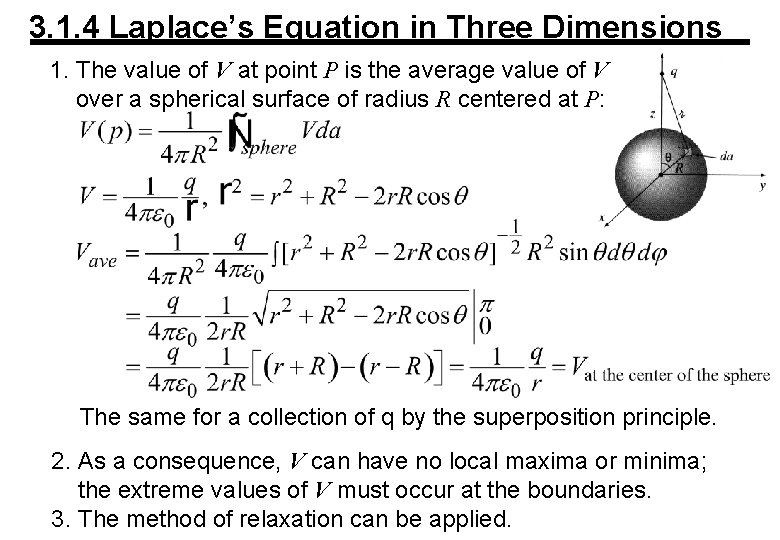
3. 1. 4 Laplace’s Equation in Three Dimensions 1. The value of V at point P is the average value of V over a spherical surface of radius R centered at P: The same for a collection of q by the superposition principle. 2. As a consequence, V can have no local maxima or minima; the extreme values of V must occur at the boundaries. 3. The method of relaxation can be applied.
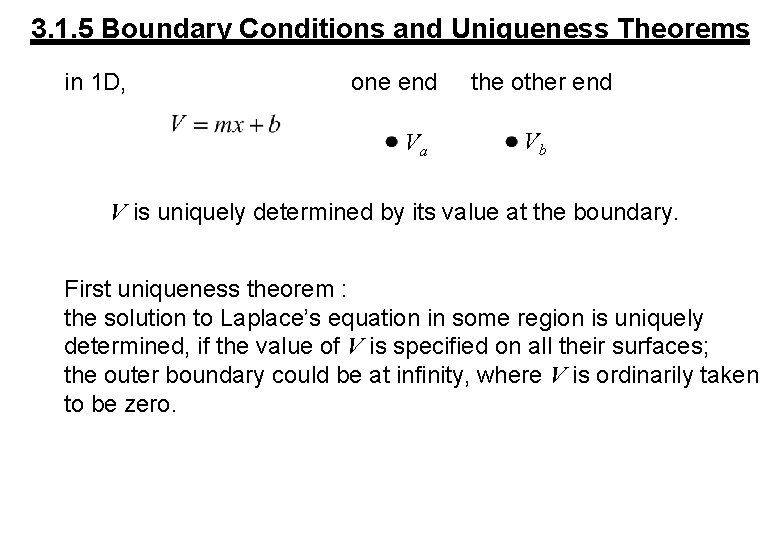
3. 1. 5 Boundary Conditions and Uniqueness Theorems in 1 D, one end Va the other end Vb V is uniquely determined by its value at the boundary. First uniqueness theorem : the solution to Laplace’s equation in some region is uniquely determined, if the value of V is specified on all their surfaces; the outer boundary could be at infinity, where V is ordinarily taken to be zero.
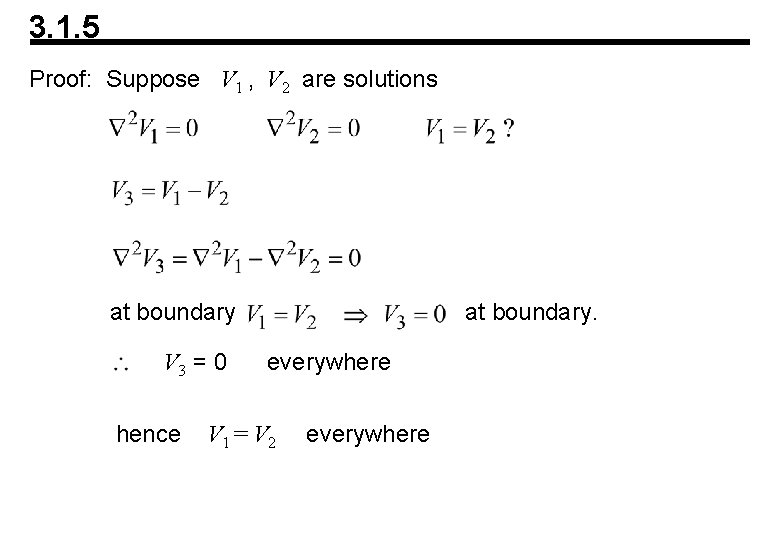
3. 1. 5 Proof: Suppose V 1 , V 2 are solutions at boundary V 3 = 0 hence everywhere V 1 = V 2 everywhere
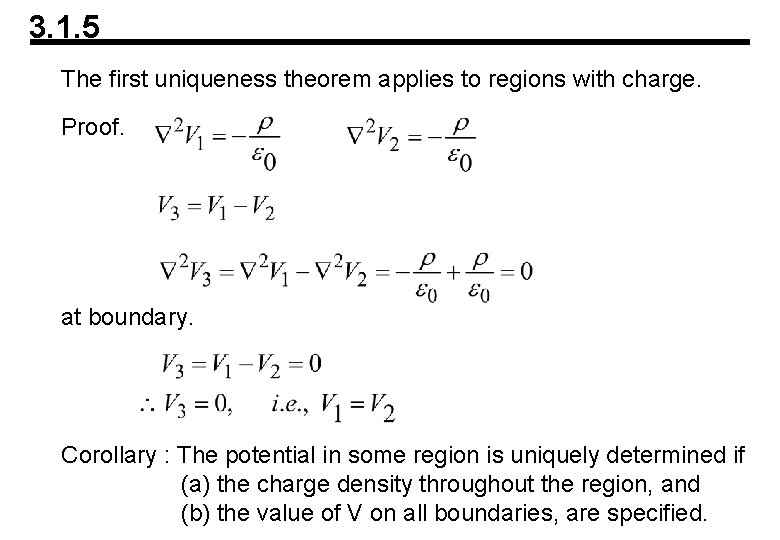
3. 1. 5 The first uniqueness theorem applies to regions with charge. Proof. at boundary. Corollary : The potential in some region is uniquely determined if (a) the charge density throughout the region, and (b) the value of V on all boundaries, are specified.
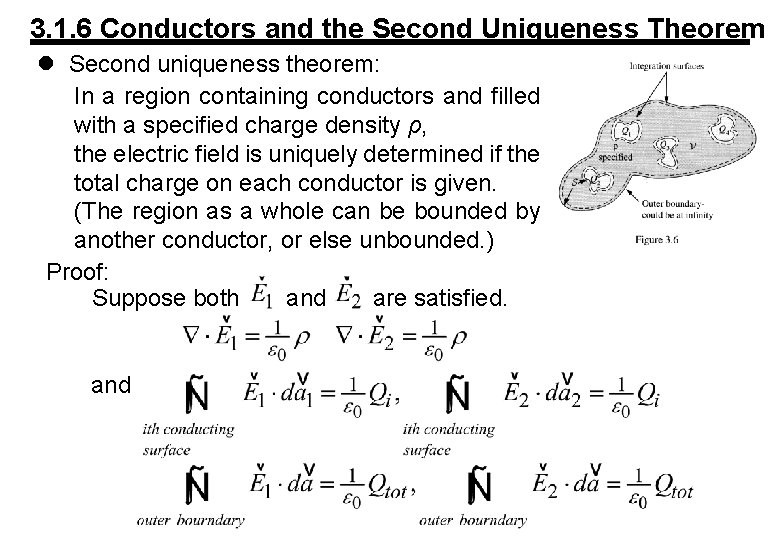
3. 1. 6 Conductors and the Second Uniqueness Theorem l Second uniqueness theorem: In a region containing conductors and filled with a specified charge density ρ, the electric field is uniquely determined if the total charge on each conductor is given. (The region as a whole can be bounded by another conductor, or else unbounded. ) Proof: Suppose both and are satisfied. and
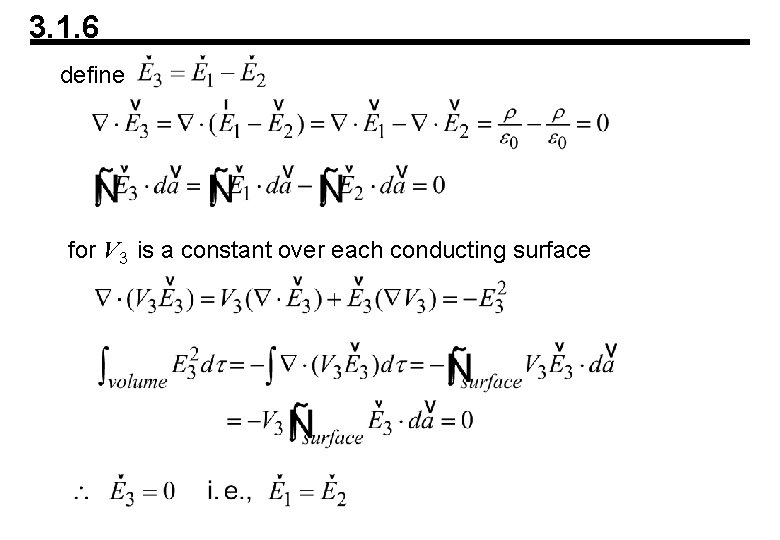
3. 1. 6 define for V 3 is a constant over each conducting surface
3. 2 The Method of Images 3. 2. 1 The Classical Image Problem 3. 2. 2 The Induced Surface Charge 3. 2. 3 Force and Energy 3. 2. 4 Other Image Problems
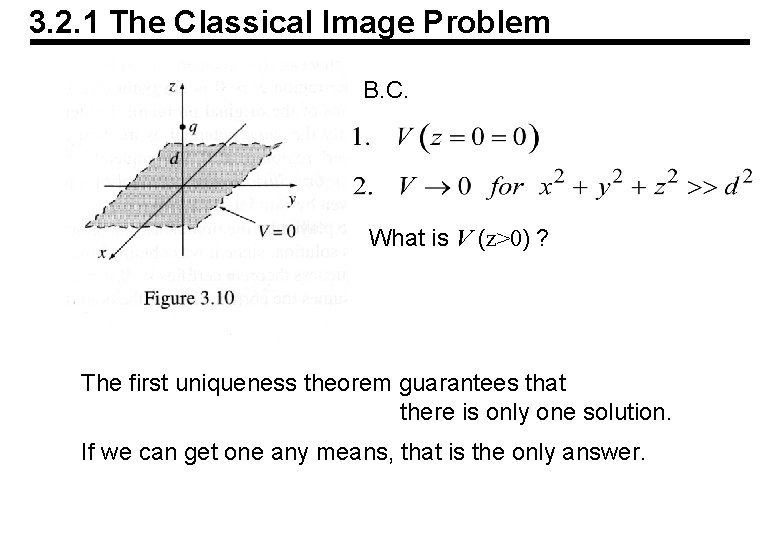
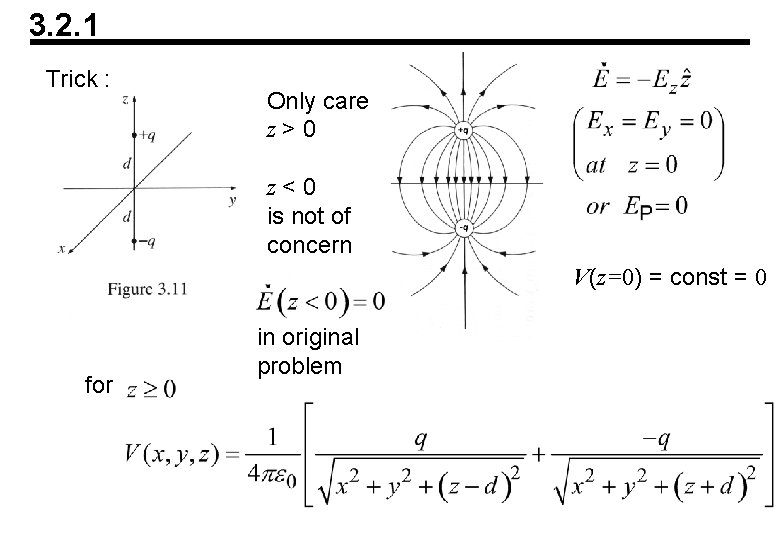
3. 2. 1 The Classical Image Problem B. C. What is V (z>0) ? The first uniqueness theorem guarantees that there is only one solution. If we can get one any means, that is the only answer.
3. 2. 1 Trick : Only care z>0 z<0 is not of concern V(z=0) = const = 0 for in original problem
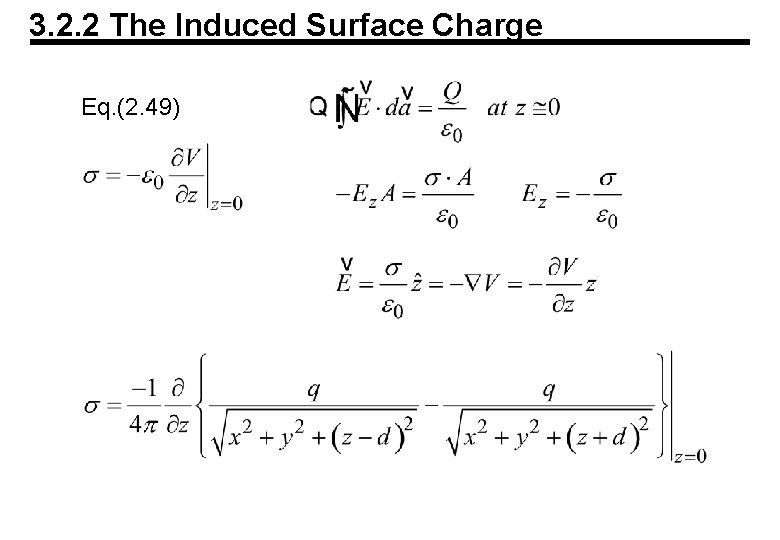
3. 2. 2 The Induced Surface Charge Eq. (2. 49)
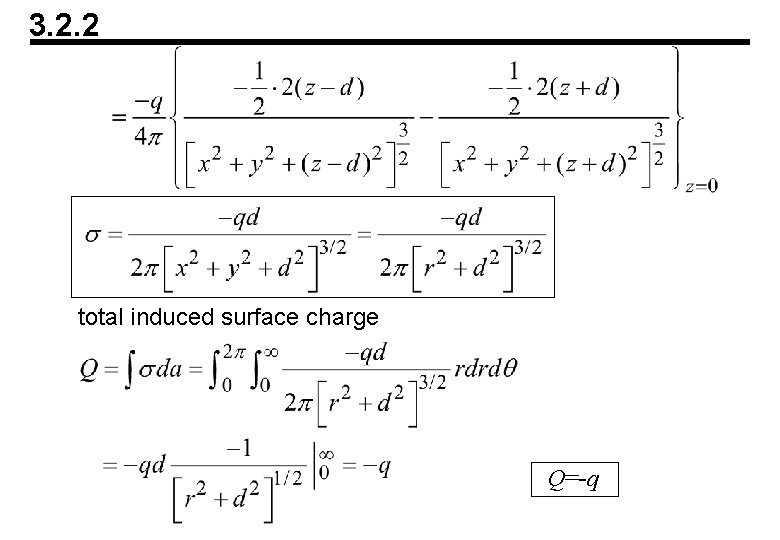
3. 2. 2 total induced surface charge Q=-q
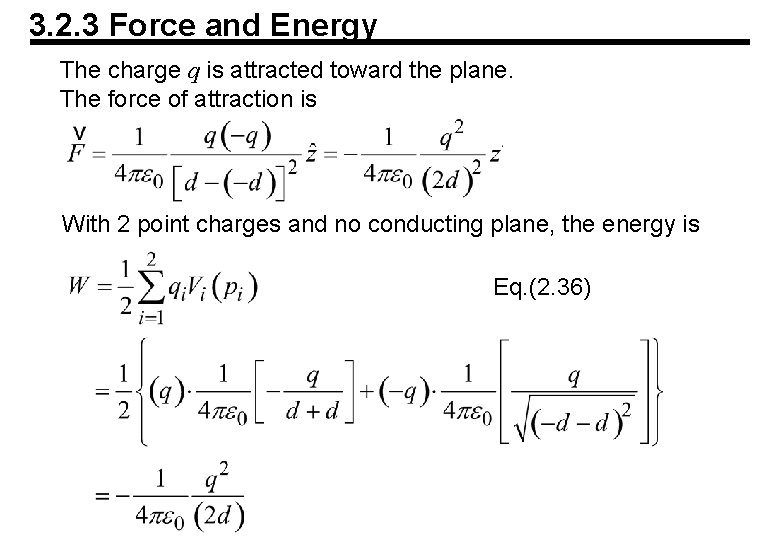
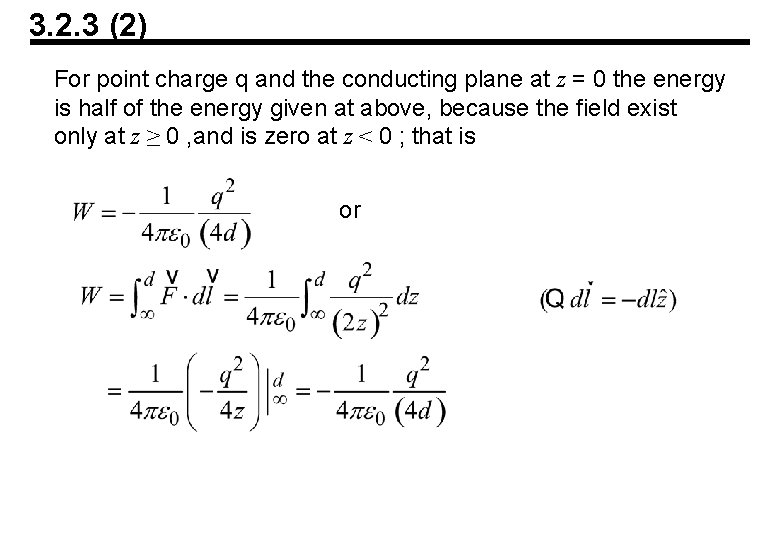
3. 2. 3 Force and Energy The charge q is attracted toward the plane. The force of attraction is With 2 point charges and no conducting plane, the energy is Eq. (2. 36)
3. 2. 3 (2) For point charge q and the conducting plane at z = 0 the energy is half of the energy given at above, because the field exist only at z ≥ 0 , and is zero at z < 0 ; that is or
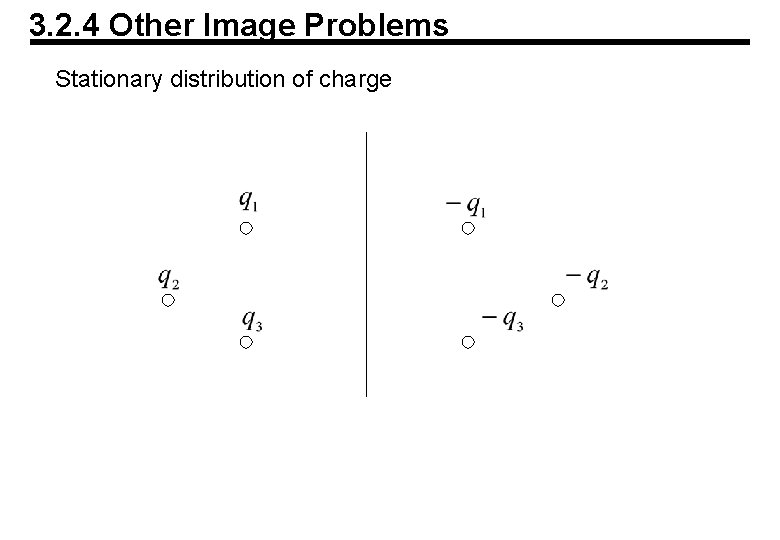
3. 2. 4 Other Image Problems Stationary distribution of charge
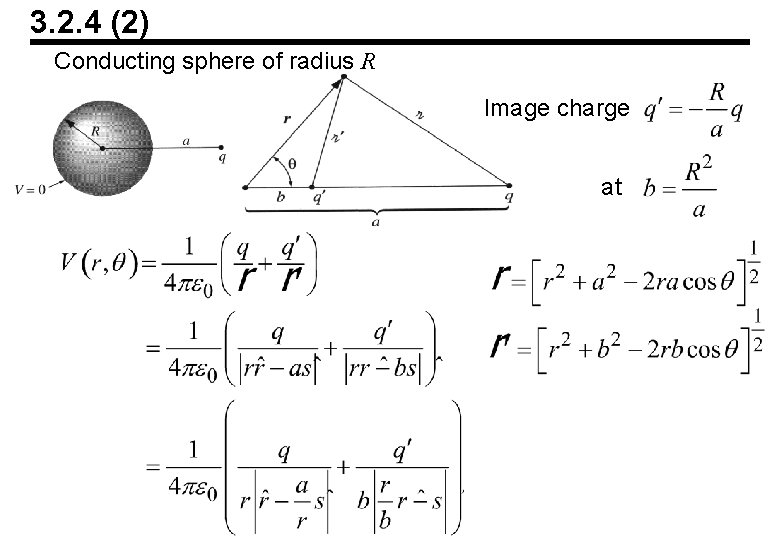
3. 2. 4 (2) Conducting sphere of radius R Image charge at
3. 2. 4 (3) Force [Note : how about conducting circular cylinder? ]
3. 3 Separation of Variables 3. 3. 0 Fourier series and Fourier transform 3. 3. 1 Cartesian Coordinate 3. 3. 2 Spherical Coordinate
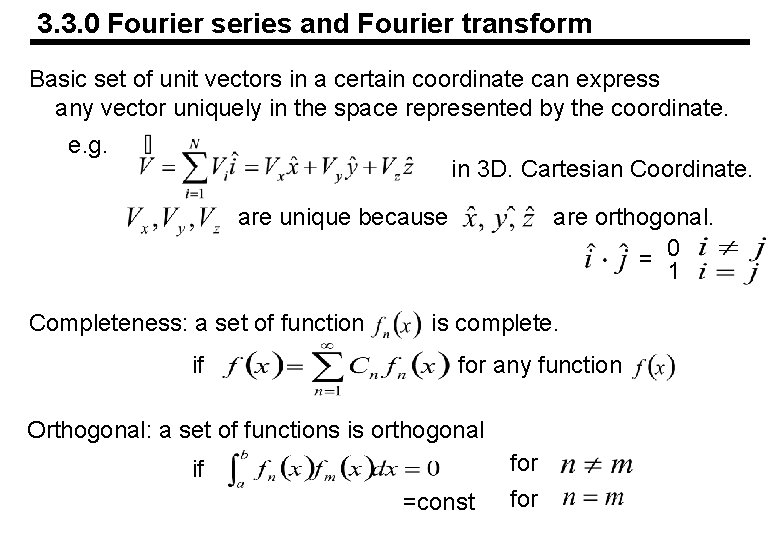
3. 3. 0 Fourier series and Fourier transform Basic set of unit vectors in a certain coordinate can express any vector uniquely in the space represented by the coordinate. e. g. in 3 D. Cartesian Coordinate. are unique because Completeness: a set of function if are orthogonal. = 0 1 is complete. for any function Orthogonal: a set of functions is orthogonal if =const for
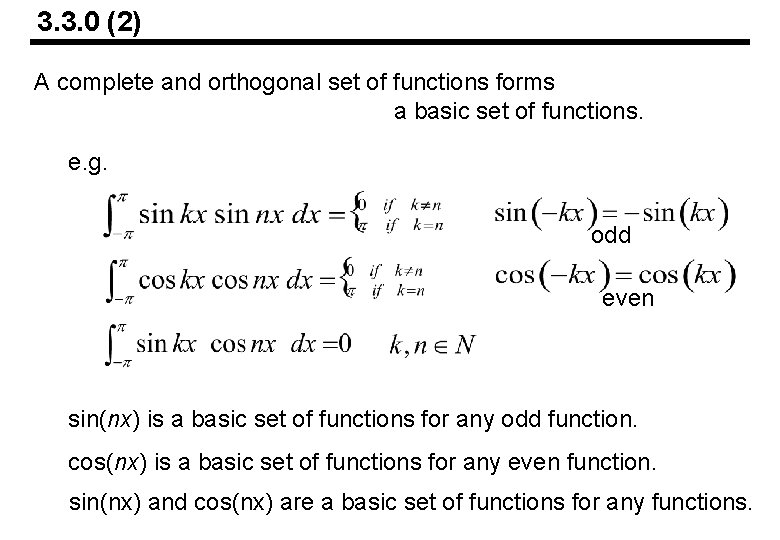
3. 3. 0 (2) A complete and orthogonal set of functions forms a basic set of functions. e. g. odd even sin(nx) is a basic set of functions for any odd function. cos(nx) is a basic set of functions for any even function. sin(nx) and cos(nx) are a basic set of functions for any functions.
3. 3. 0 (3) for any , odd even [sinkx] [coskx] Fourier transform and Fourier series odd ; even
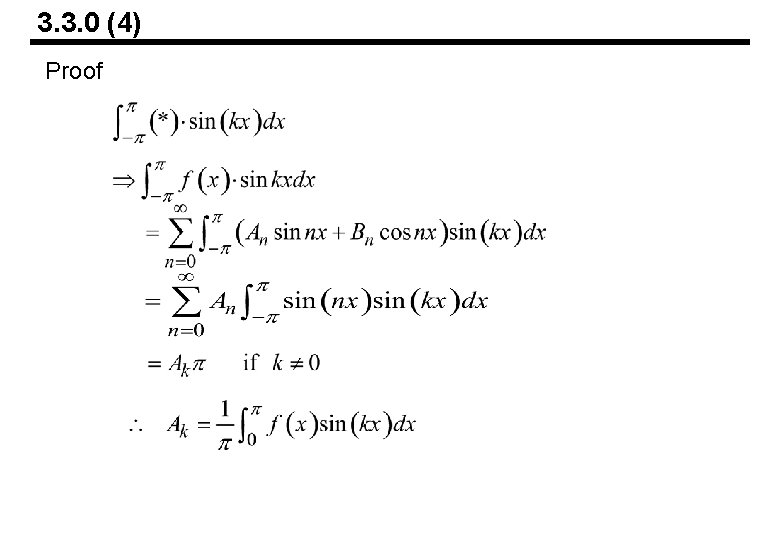
3. 3. 0 (4) Proof
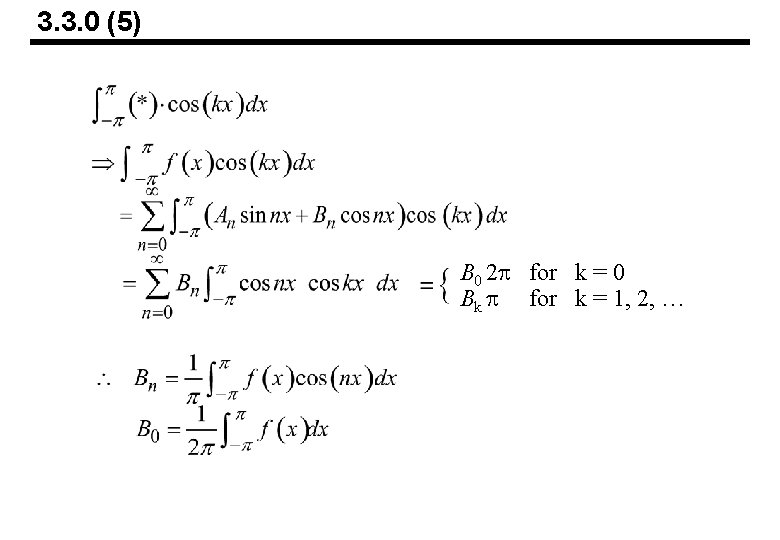
3. 3. 0 (5) B 0 2 p for k = 0 Bk p for k = 1, 2, …
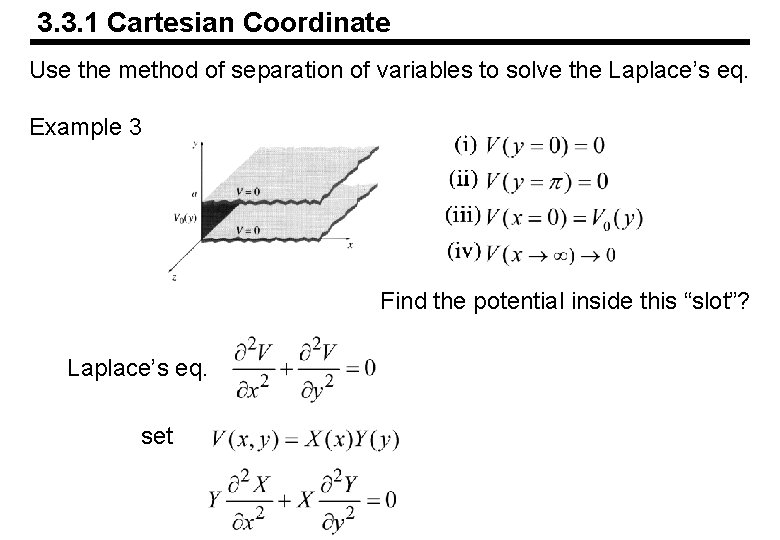
3. 3. 1 Cartesian Coordinate Use the method of separation of variables to solve the Laplace’s eq. Example 3 Find the potential inside this “slot”? Laplace’s eq. set
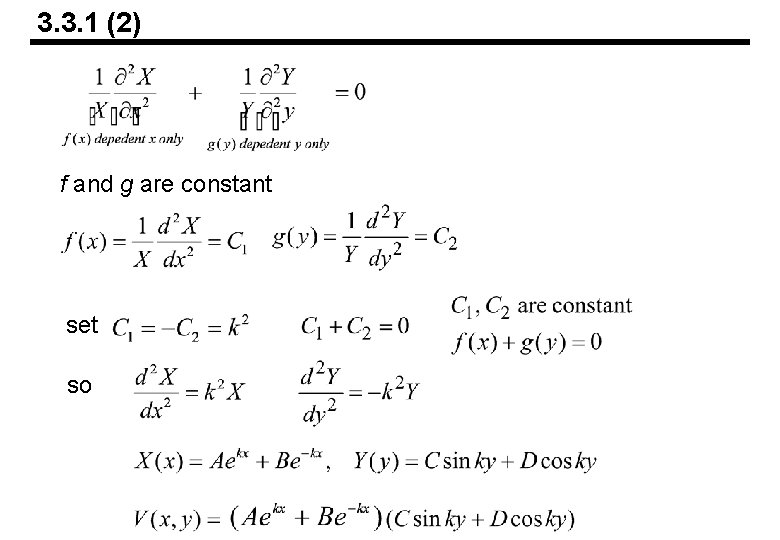
3. 3. 1 (2) f and g are constant set so
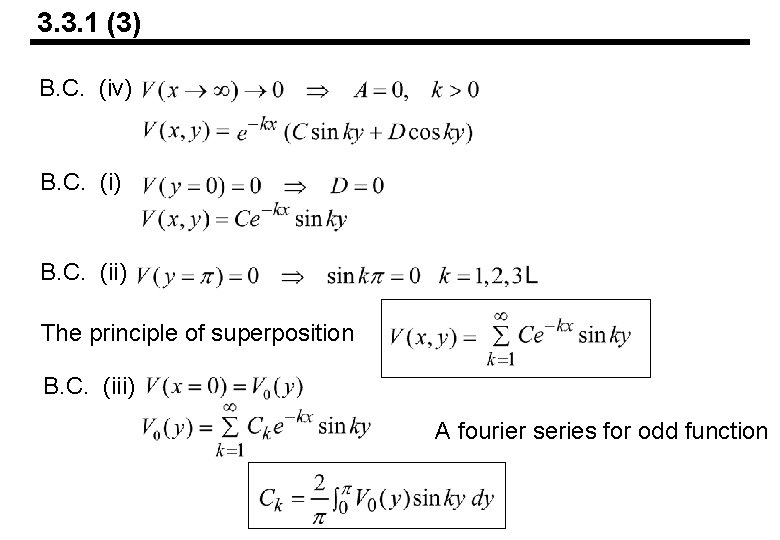
3. 3. 1 (3) B. C. (iv) B. C. (ii) The principle of superposition B. C. (iii) A fourier series for odd function
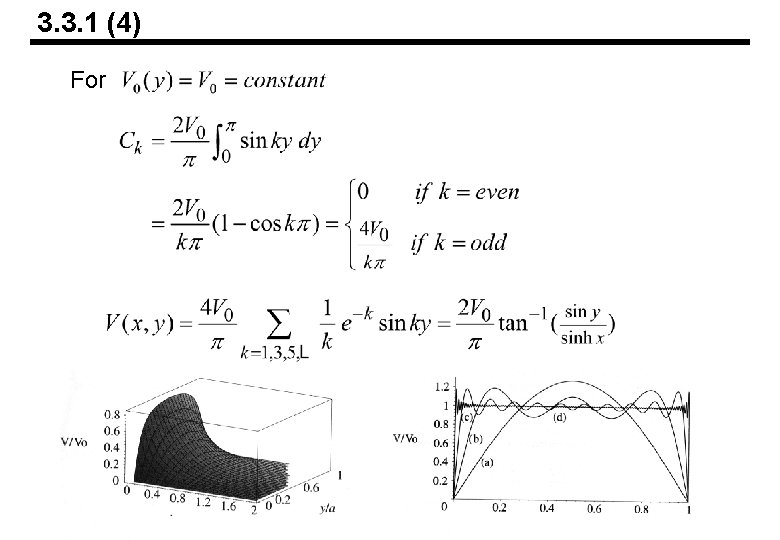
3. 3. 1 (4) For
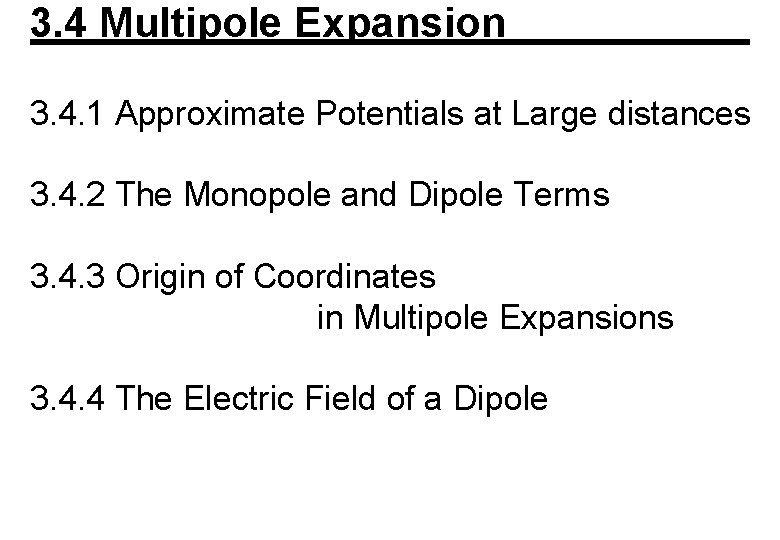
3. 4 Multipole Expansion 3. 4. 1 Approximate Potentials at Large distances 3. 4. 2 The Monopole and Dipole Terms 3. 4. 3 Origin of Coordinates in Multipole Expansions 3. 4. 4 The Electric Field of a Dipole
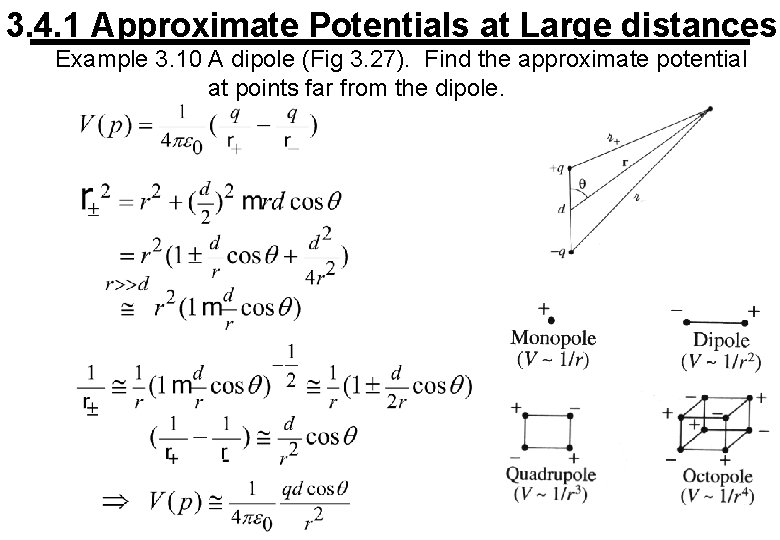
3. 4. 1 Approximate Potentials at Large distances Example 3. 10 A dipole (Fig 3. 27). Find the approximate potential at points far from the dipole.
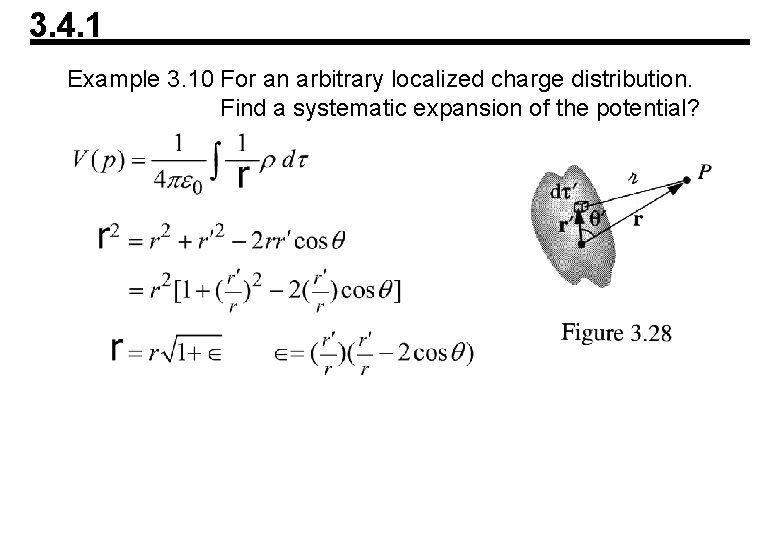
3. 4. 1 Example 3. 10 For an arbitrary localized charge distribution. Find a systematic expansion of the potential?
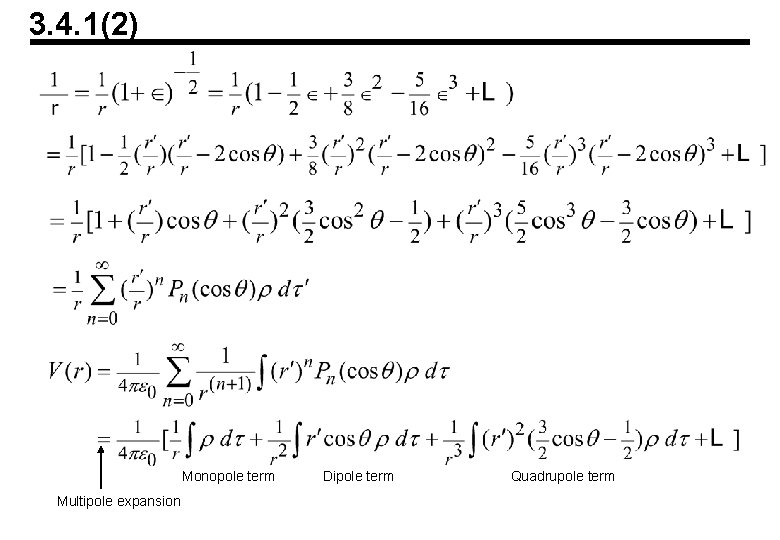
3. 4. 1(2) Monopole term Multipole expansion Dipole term Quadrupole term
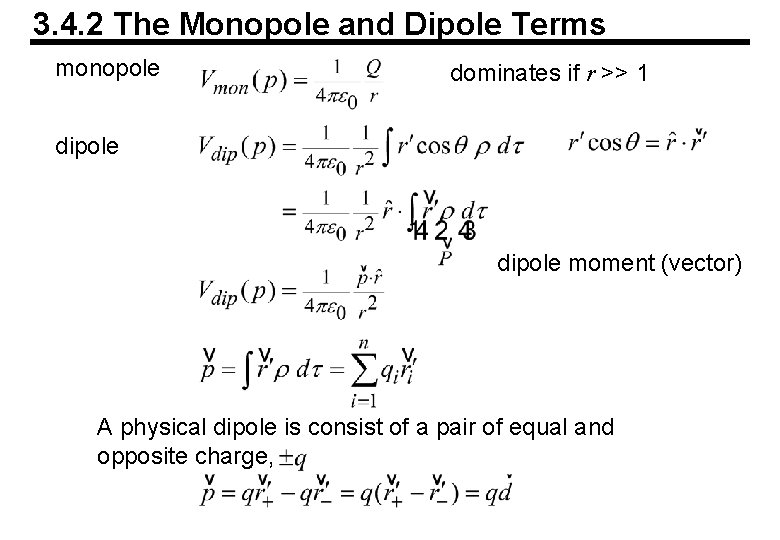
3. 4. 2 The Monopole and Dipole Terms monopole dominates if r >> 1 dipole moment (vector) A physical dipole is consist of a pair of equal and opposite charge,
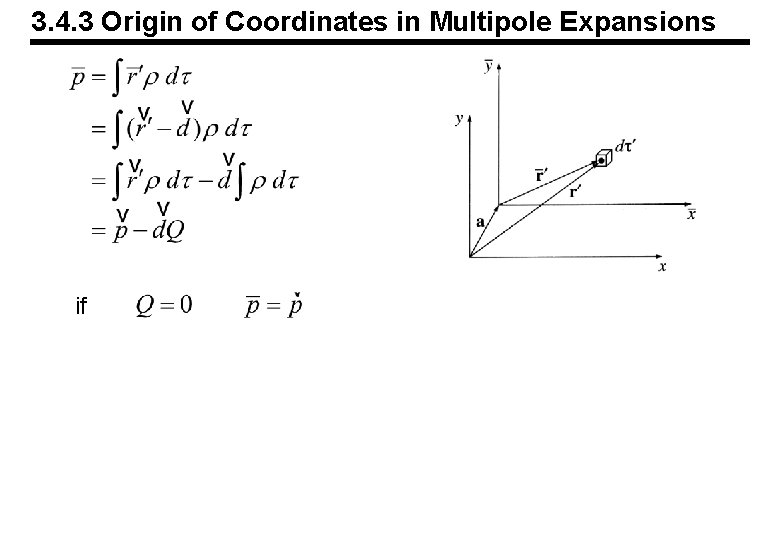
3. 4. 3 Origin of Coordinates in Multipole Expansions if
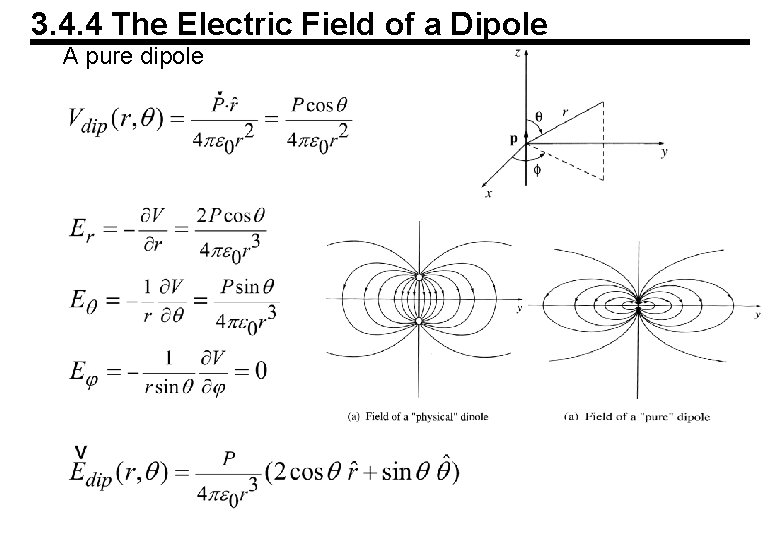
3. 4. 4 The Electric Field of a Dipole A pure dipole