
Chapter 3 Solar and Terrestrial Radiation Electromagnetic Spectrum

- Slides: 16
Chapter 3 Solar and Terrestrial Radiation
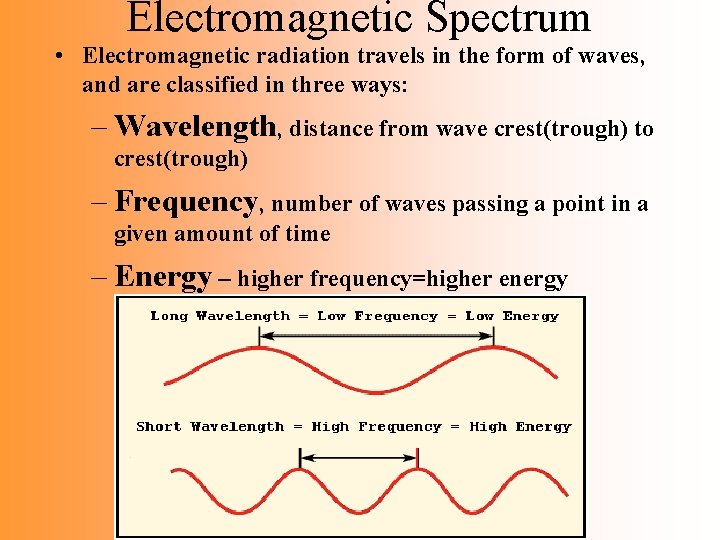
Electromagnetic Spectrum • Electromagnetic radiation travels in the form of waves, and are classified in three ways: – Wavelength, distance from wave crest(trough) to crest(trough) – Frequency, number of waves passing a point in a given amount of time – Energy – higher frequency=higher energy
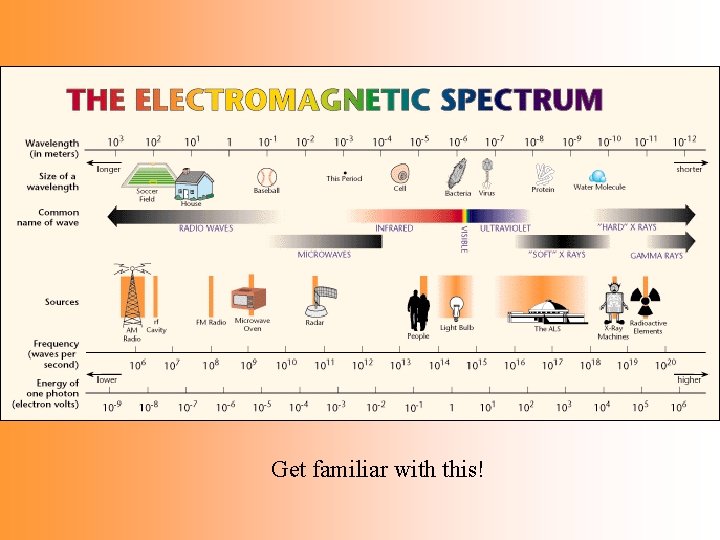
Get familiar with this!
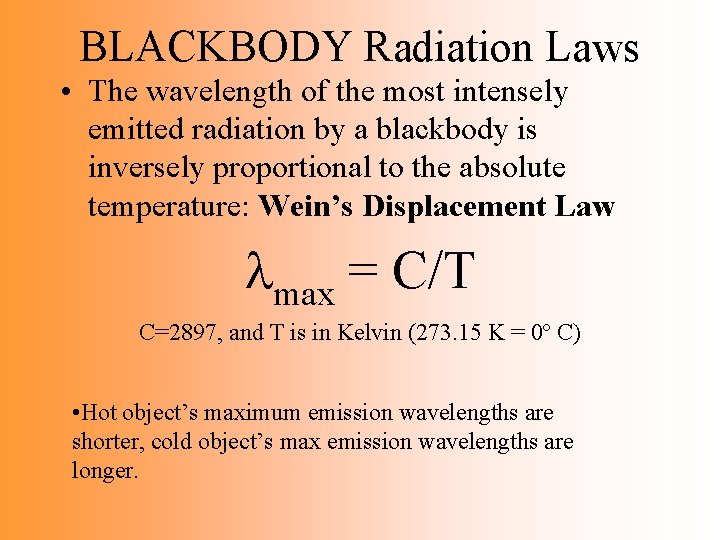
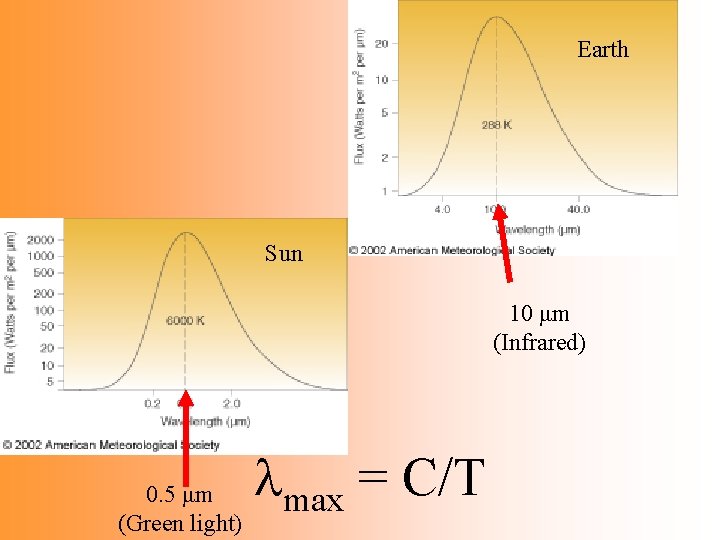
BLACKBODY Radiation Laws • The wavelength of the most intensely emitted radiation by a blackbody is inversely proportional to the absolute temperature: Wein’s Displacement Law lmax = C/T C=2897, and T is in Kelvin (273. 15 K = 0º C) • Hot object’s maximum emission wavelengths are shorter, cold object’s max emission wavelengths are longer.
Earth Sun 10 μm (Infrared) 0. 5 μm (Green light) lmax = C/T
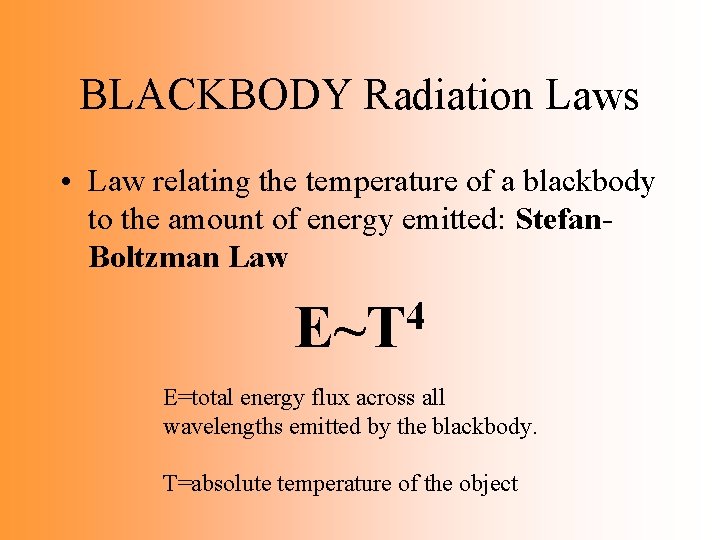
BLACKBODY Radiation Laws • Law relating the temperature of a blackbody to the amount of energy emitted: Stefan. Boltzman Law 4 E~T E=total energy flux across all wavelengths emitted by the blackbody. T=absolute temperature of the object
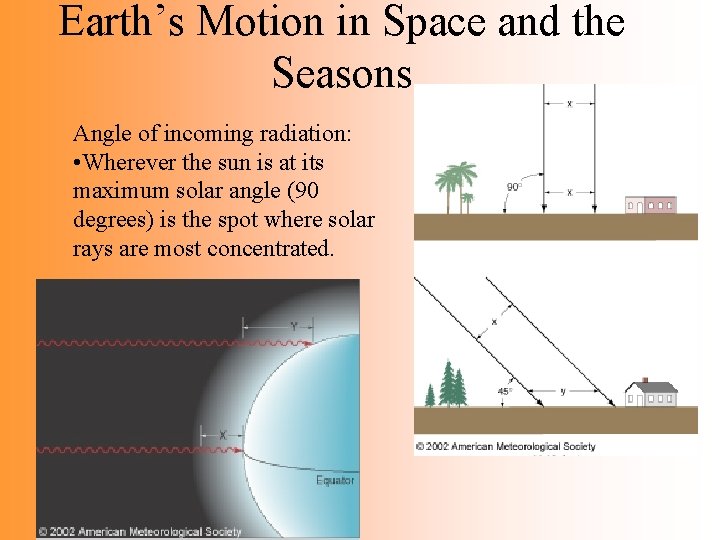
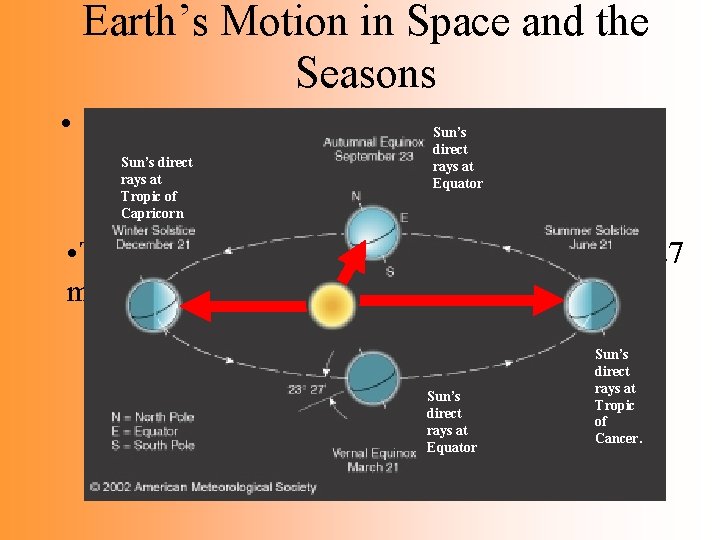
Earth’s Motion in Space and the Seasons Angle of incoming radiation: • Wherever the sun is at its maximum solar angle (90 degrees) is the spot where solar rays are most concentrated.
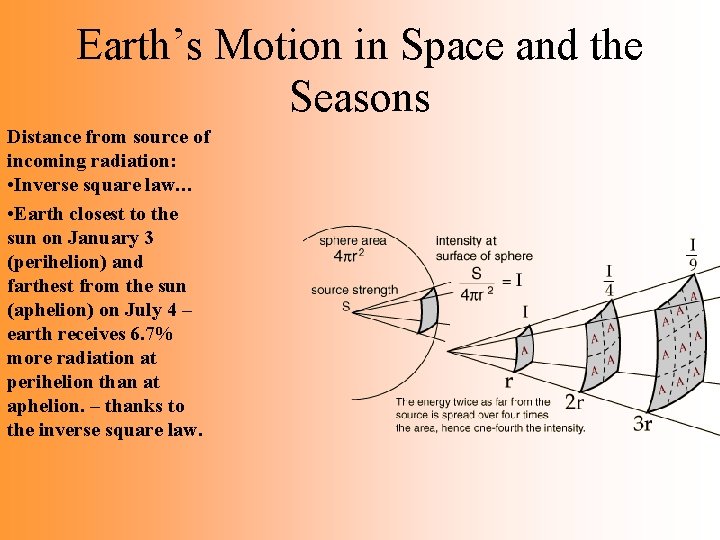
Earth’s Motion in Space and the Seasons Distance from source of incoming radiation: • Inverse square law… • Earth closest to the sun on January 3 (perihelion) and farthest from the sun (aphelion) on July 4 – earth receives 6. 7% more radiation at perihelion than at aphelion. – thanks to the inverse square law.
Earth’s Motion in Space and the Seasons • So…the earth is closest to the Sun’s sun in OUR direct Sun’s direct winter…then why is it colder rays athere during rays at Equator of the. Tropic winter? Capricorn • The tilt of the Earth’s spin axis – 23 degrees 27 minutes. Sun’s direct rays at Equator Sun’s direct rays at Tropic of Cancer.
Solar Radiation and the Atmosphere • Solar radiation interacts with gasses and aerosols as it travels through the atmosphere… – Reflection = angle of incident radiation equals angle of reflected radiation, albedo = (reflected radiation)/incident radiation)] – Scattering = Scattering by molecules is wavelengthdependant – Absorption = Absorption is actually an energy conversion process – radiation striking the surface of a particle is converted to heat energy
Solar radiation and the earth’s surface • The fraction of solar radiation that does make it to the earth’s surface is either reflected or absorbed (increasing the surface’s temperature) – Common Albedos • Urban area: 14 -18 – daytime highs warmer during sunny days • Cirrus clouds: 40 -50 – keeps nighttime temperatures warmer – daytime cooler • Fresh snow: 75 -95 – daytime temps cooler
Infrared Response and the Greenhouse Effect • Remember that “Absorption by atmospheric gasses varies greatly by wavelength – will strongly absorb some wavelengths and others little or not at all” • Greenhouse gasses are very transparent to solar radiation, but absorb infrared radiation (emitted by the earth) very well. – These gasses in turn heat, and emit infrared radiation back toward the surface = Greenhouse effect • Global radiative equilibrium keeps the planet’s temperature in check – emission of heat to space in the form of infrared radiation balances the solar radiation’s heating – this equilibrium can be
Infrared Response and the Greenhouse Effect • Principle greenhouse gasses: – Water vapor – evaporated water – example=DESERT DAILY TEMPERATURE VARIATION – Carbon dioxide – respiration, burning fossil fuels – Methane – decomposition, cows – Nitrous oxide – Ozone…
The Stratospheric Ozone Shield • Ozone (O 3) – 3 oxygen atoms – relatively unstable • Near the surface – ozone is a air pollutant, and a major contributor photochemical smog (Chapter 2) • Ozone in the stratosphere shields us from lethal intensities of Ultraviolet (UV) radiation – great absorber at UV wavelengths.
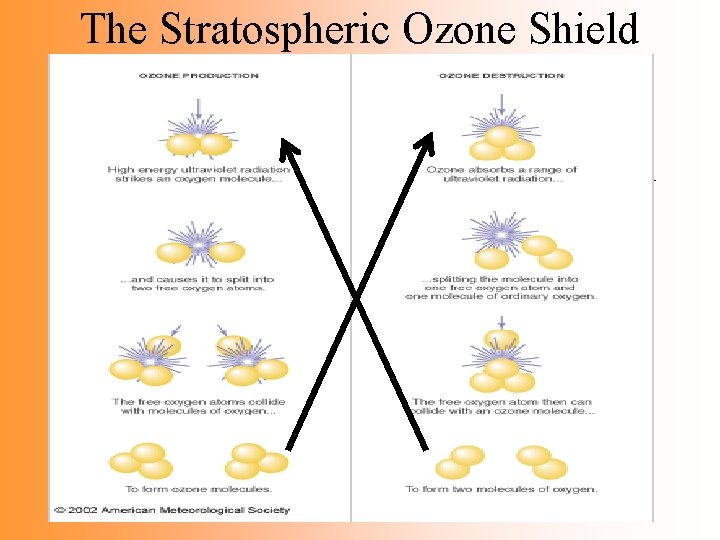
The Stratospheric Ozone Shield • Ozone is both created and destroyed by UV light – balanced cycle • Creation – UV strikes O 2 atoms, causing them to split, and then the two free O attoms collide with existing )two molecules to form O 3 (ozone) • Destruction – ozone absorbs UV radiation, slitting the O 3 into an O 2 molecule and O atom. The free O atom then collides with an O 3 atom, forming two separate O 2 atoms.
The Stratospheric Ozone Shield • CFCs – chlorofluorocarbons • UV radiation breaks CFCs up, yielding Chlorine (Cl) gas…which reacts with and destroys ozone