
CHAPTER 3 Social Justice Counseling Developing Multicultural Counseling

- Slides: 14
CHAPTER 3: Social Justice Counseling Developing Multicultural Counseling Competence: A Systems Approach Second Edition Danica G. Hays and Bradley T. Erford
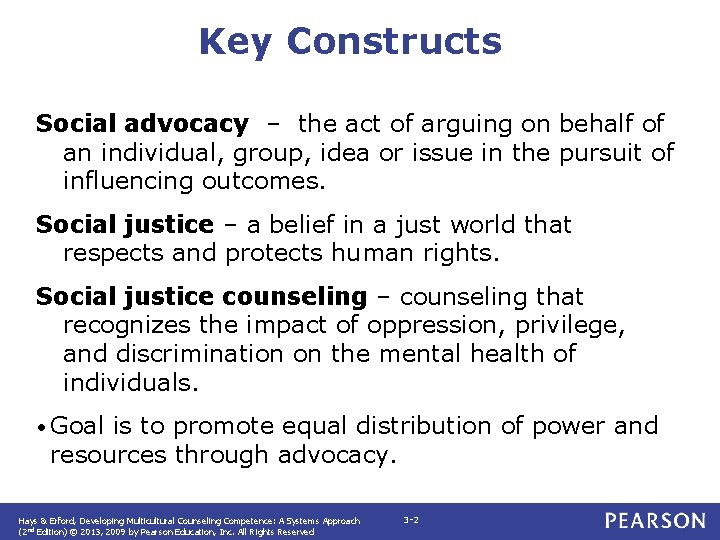
Key Constructs Social advocacy – the act of arguing on behalf of an individual, group, idea or issue in the pursuit of influencing outcomes. Social justice – a belief in a just world that respects and protects human rights. Social justice counseling – counseling that recognizes the impact of oppression, privilege, and discrimination on the mental health of individuals. • Goal is to promote equal distribution of power and resources through advocacy. Hays & Erford, Developing Multicultural Counseling Competence: A Systems Approach (2 nd Edition) © 2013, 2009 by Pearson Education, Inc. All Rights Reserved 3 -2
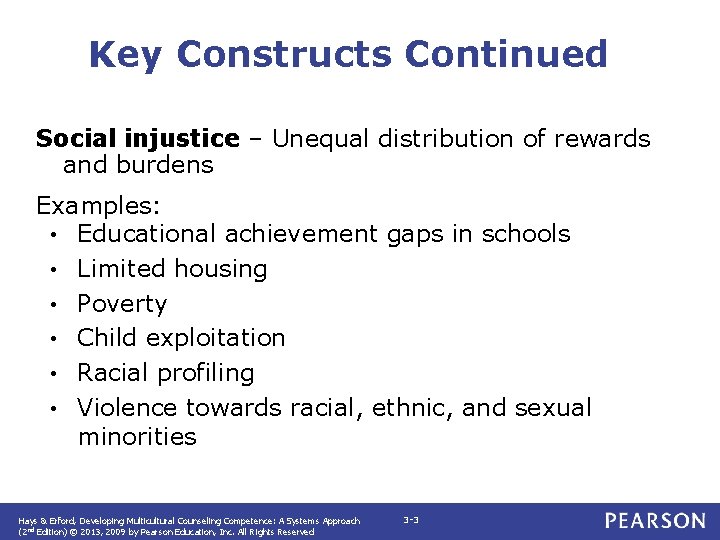
Key Constructs Continued Social injustice – Unequal distribution of rewards and burdens Examples: • Educational achievement gaps in schools • Limited housing • Poverty • Child exploitation • Racial profiling • Violence towards racial, ethnic, and sexual minorities Hays & Erford, Developing Multicultural Counseling Competence: A Systems Approach (2 nd Edition) © 2013, 2009 by Pearson Education, Inc. All Rights Reserved 3 -3
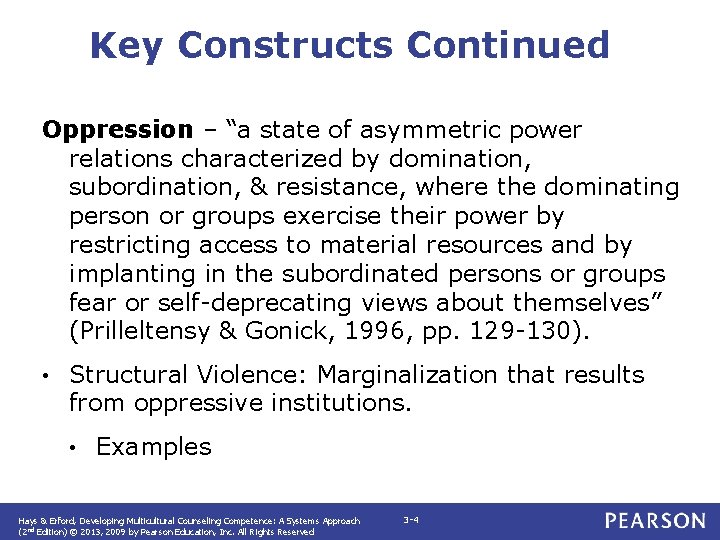
Key Constructs Continued Oppression – “a state of asymmetric power relations characterized by domination, subordination, & resistance, where the dominating person or groups exercise their power by restricting access to material resources and by implanting in the subordinated persons or groups fear or self-deprecating views about themselves” (Prilleltensy & Gonick, 1996, pp. 129 -130). • Structural Violence: Marginalization that results from oppressive institutions. • Examples Hays & Erford, Developing Multicultural Counseling Competence: A Systems Approach (2 nd Edition) © 2013, 2009 by Pearson Education, Inc. All Rights Reserved 3 -4
Key Constructs Continued Oppression is the intersection of 2 modalities & 3 types: Modalities • Oppression by force: imposing on an individual or group an object, label, role, experience, or living condition that is unwanted and causes physical & psychological pain. • Oppression by deprivation: depriving an individual or group an object, label, role, experience, or living condition that hinders the physical & psychological well-being. Types • Primary • Secondary • Tertiary/internalized oppression Hays & Erford, Developing Multicultural Counseling Competence: A Systems Approach (2 nd Edition) © 2013, 2009 by Pearson Education, Inc. All Rights Reserved 3 -5
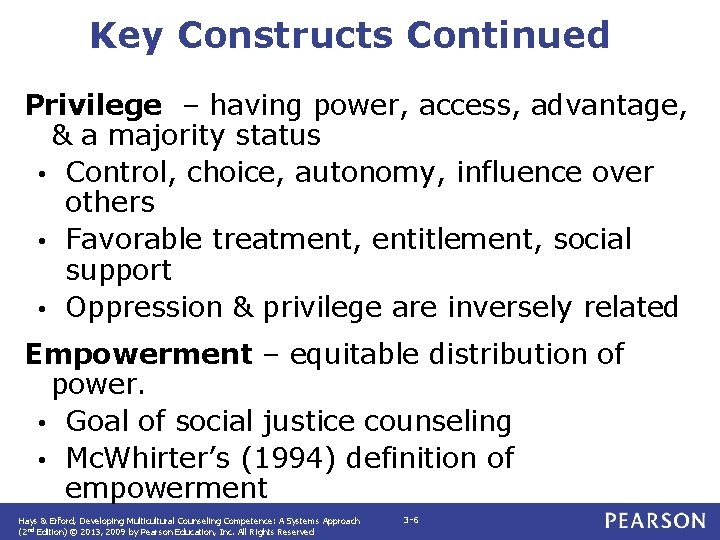
Key Constructs Continued Privilege – having power, access, advantage, & a majority status • Control, choice, autonomy, influence over others • Favorable treatment, entitlement, social support • Oppression & privilege are inversely related Empowerment – equitable distribution of power. • Goal of social justice counseling • Mc. Whirter’s (1994) definition of empowerment Hays & Erford, Developing Multicultural Counseling Competence: A Systems Approach (2 nd Edition) © 2013, 2009 by Pearson Education, Inc. All Rights Reserved 3 -6
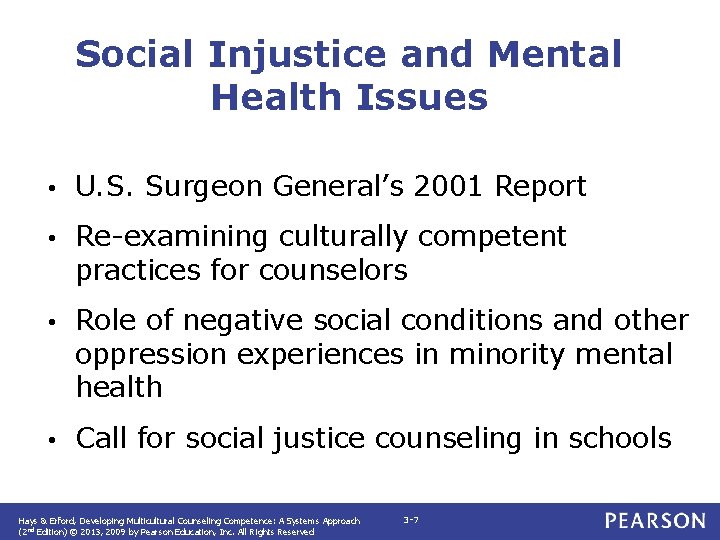
Social Injustice and Mental Health Issues • U. S. Surgeon General’s 2001 Report • Re-examining culturally competent practices for counselors • Role of negative social conditions and other oppression experiences in minority mental health • Call for social justice counseling in schools Hays & Erford, Developing Multicultural Counseling Competence: A Systems Approach (2 nd Edition) © 2013, 2009 by Pearson Education, Inc. All Rights Reserved 3 -7
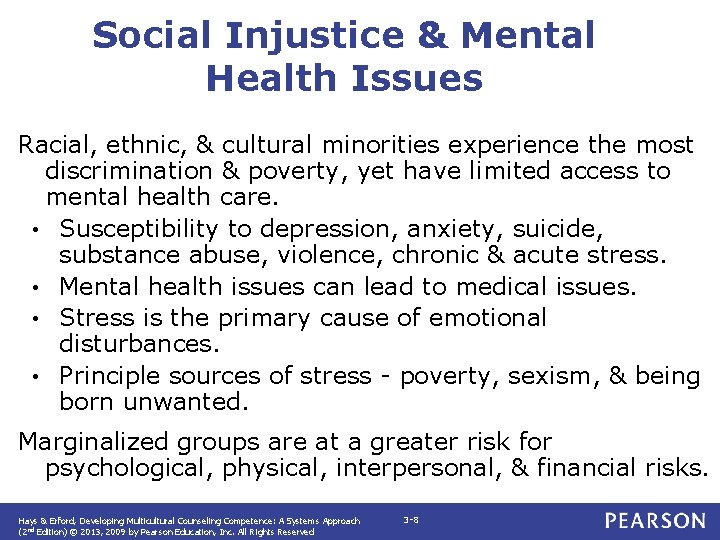
Social Injustice & Mental Health Issues Racial, ethnic, & cultural minorities experience the most discrimination & poverty, yet have limited access to mental health care. • Susceptibility to depression, anxiety, suicide, substance abuse, violence, chronic & acute stress. • Mental health issues can lead to medical issues. • Stress is the primary cause of emotional disturbances. • Principle sources of stress - poverty, sexism, & being born unwanted. Marginalized groups are at a greater risk for psychological, physical, interpersonal, & financial risks. Hays & Erford, Developing Multicultural Counseling Competence: A Systems Approach (2 nd Edition) © 2013, 2009 by Pearson Education, Inc. All Rights Reserved 3 -8
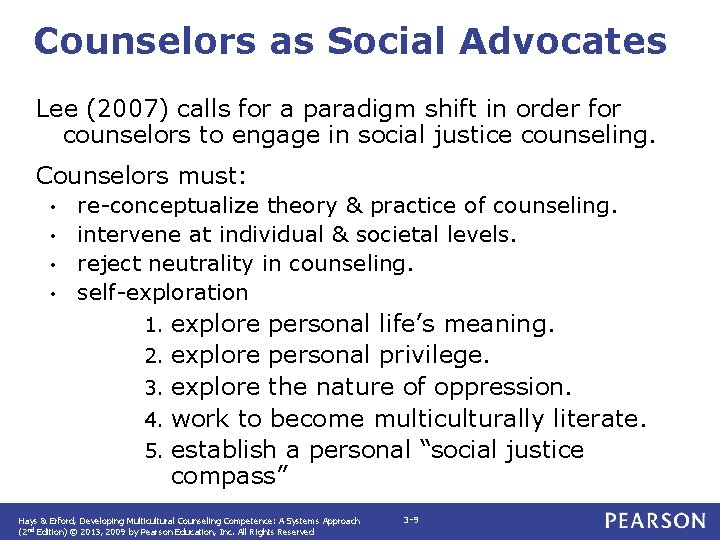
Counselors as Social Advocates Lee (2007) calls for a paradigm shift in order for counselors to engage in social justice counseling. Counselors must: re-conceptualize theory & practice of counseling. • intervene at individual & societal levels. • reject neutrality in counseling. • self-exploration • 1. 2. 3. 4. 5. explore personal life’s meaning. explore personal privilege. explore the nature of oppression. work to become multiculturally literate. establish a personal “social justice compass” Hays & Erford, Developing Multicultural Counseling Competence: A Systems Approach (2 nd Edition) © 2013, 2009 by Pearson Education, Inc. All Rights Reserved 3 -9
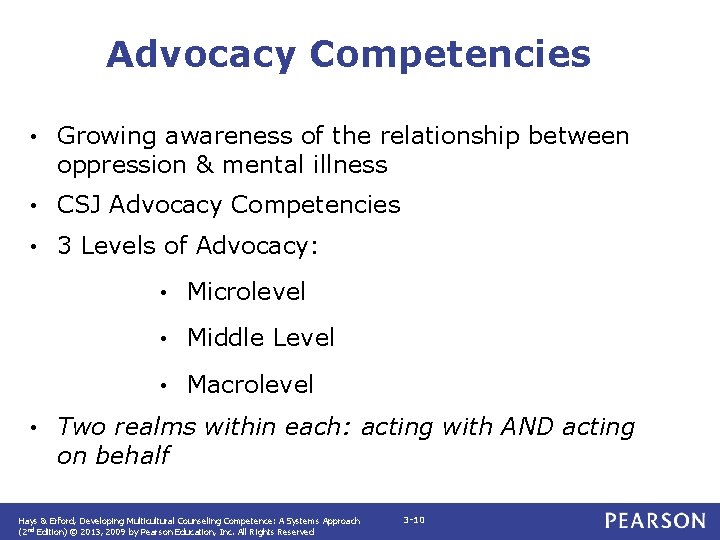
Advocacy Competencies • Growing awareness of the relationship between oppression & mental illness • CSJ Advocacy Competencies • 3 Levels of Advocacy: • • Microlevel • Middle Level • Macrolevel Two realms within each: acting with AND acting on behalf Hays & Erford, Developing Multicultural Counseling Competence: A Systems Approach (2 nd Edition) © 2013, 2009 by Pearson Education, Inc. All Rights Reserved 3 -10
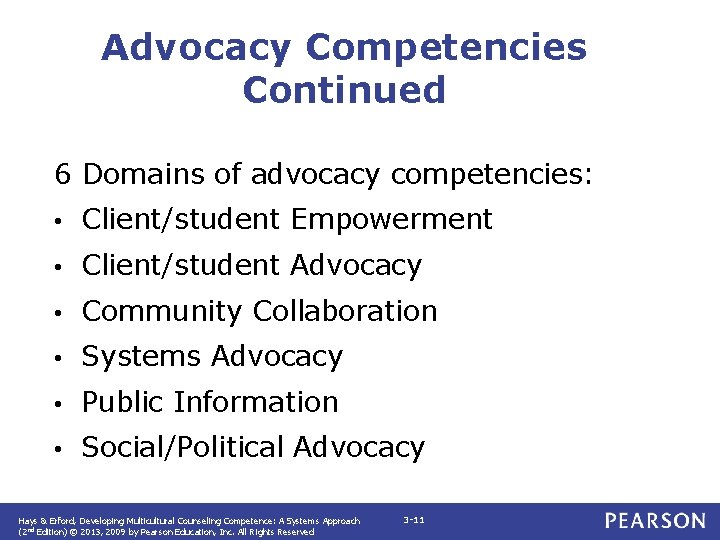
Advocacy Competencies Continued 6 Domains of advocacy competencies: • Client/student Empowerment • Client/student Advocacy • Community Collaboration • Systems Advocacy • Public Information • Social/Political Advocacy Hays & Erford, Developing Multicultural Counseling Competence: A Systems Approach (2 nd Edition) © 2013, 2009 by Pearson Education, Inc. All Rights Reserved 3 -11
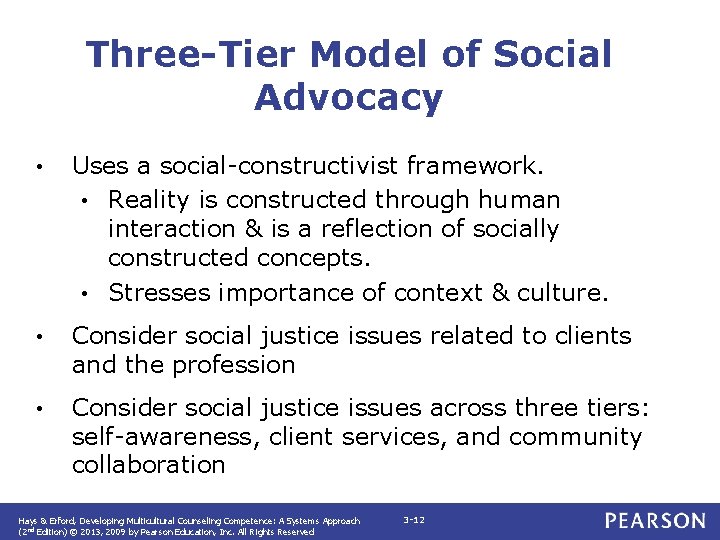
Three-Tier Model of Social Advocacy • Uses a social-constructivist framework. • Reality is constructed through human interaction & is a reflection of socially constructed concepts. • Stresses importance of context & culture. • Consider social justice issues related to clients and the profession • Consider social justice issues across three tiers: self-awareness, client services, and community collaboration Hays & Erford, Developing Multicultural Counseling Competence: A Systems Approach (2 nd Edition) © 2013, 2009 by Pearson Education, Inc. All Rights Reserved 3 -12
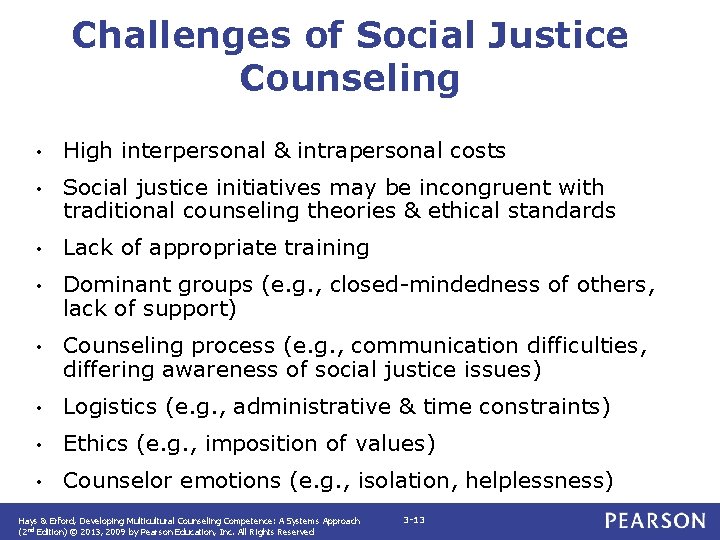
Challenges of Social Justice Counseling • High interpersonal & intrapersonal costs • Social justice initiatives may be incongruent with traditional counseling theories & ethical standards • Lack of appropriate training • Dominant groups (e. g. , closed-mindedness of others, lack of support) • Counseling process (e. g. , communication difficulties, differing awareness of social justice issues) • Logistics (e. g. , administrative & time constraints) • Ethics (e. g. , imposition of values) • Counselor emotions (e. g. , isolation, helplessness) Hays & Erford, Developing Multicultural Counseling Competence: A Systems Approach (2 nd Edition) © 2013, 2009 by Pearson Education, Inc. All Rights Reserved 3 -13
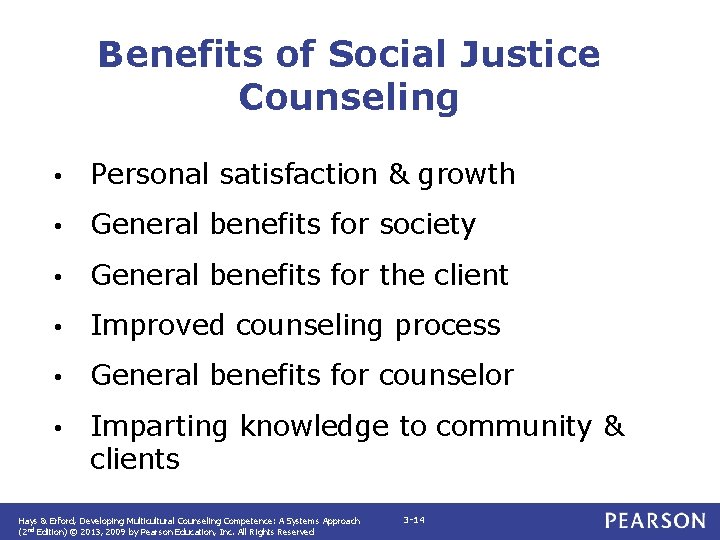
Benefits of Social Justice Counseling • Personal satisfaction & growth • General benefits for society • General benefits for the client • Improved counseling process • General benefits for counselor • Imparting knowledge to community & clients Hays & Erford, Developing Multicultural Counseling Competence: A Systems Approach (2 nd Edition) © 2013, 2009 by Pearson Education, Inc. All Rights Reserved 3 -14