
Chapter 3 Selection Control Structure M Bahrul Ulum

Chapter 3 Selection Control Structure M. Bahrul Ulum, M. Kom Informatics Engineering Computer Science Faculty
Objectives • Elaborate on the uses of simple selection, multiple selection, and nested selection in algorithms • Introduce the case construct in pseudocode • Develop algorithms using variations of the selection control structure
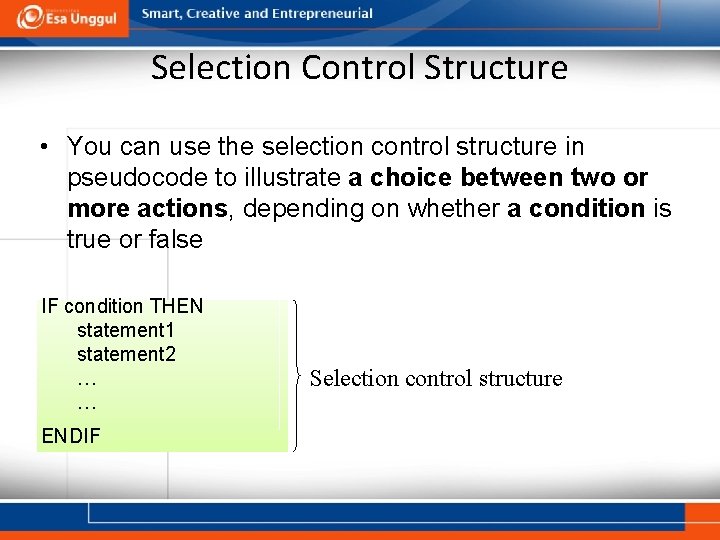
Selection Control Structure • You can use the selection control structure in pseudocode to illustrate a choice between two or more actions, depending on whether a condition is true or false IF condition THEN statement 1 statement 2 … … ENDIF Selection control structure
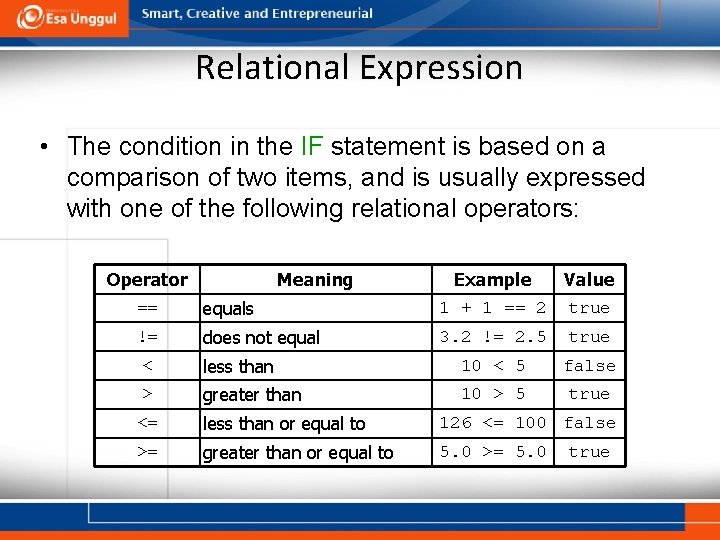
Relational Expression • The condition in the IF statement is based on a comparison of two items, and is usually expressed with one of the following relational operators: Operator Meaning == equals != does not equal Example Value 1 + 1 == 2 true 3. 2 != 2. 5 true < less than 10 < 5 false > greater than 10 > 5 true <= less than or equal to 126 <= 100 false >= greater than or equal to 5. 0 >= 5. 0 true
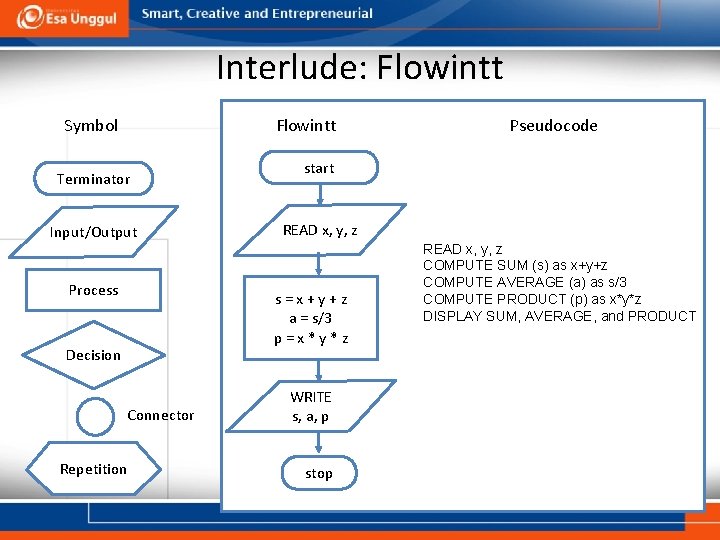
Interlude: Flowintt Symbol Flowintt Terminator Input/Output Process start READ x, y, z s=x+y+z a = s/3 p=x*y*z Decision Connector Repetition Pseudocode WRITE s, a, p stop READ x, y, z COMPUTE SUM (s) as x+y+z COMPUTE AVERAGE (a) as s/3 COMPUTE PRODUCT (p) as x*y*z DISPLAY SUM, AVERAGE, and PRODUCT
1. Simple Selection • Simple selection occurs when a choice is made between two alternate paths, depending on the result of a condition being true or false • The structure is represented in pseudocode using the keywords IF, THEN, ELSE, and ENDIF • Only one of the THEN or ELSE paths will be followed, depending on the result of the condition in the IF clause
1. Simple Selection • The IF. . . THEN. . . ELSE. . . construct has a process at each branch of the decision symbol. IF condition THEN statement. A ELSE statement. B ENDIF
1. Simple Selection • The IF. . . THEN. . . ELSE. . . construct has a process at each branch of the decision symbol. • Example IF account_balance < $300 THEN service_intge = $5. 00 ELSE service_intge = $2. 00 ENDIF
2. Simple Selection with Null false branch • The null ELSE structure is a variation of the simple IF structure • It is used when a task is performed only when a particular condition is true • If the condition is false, then no processing will take place and the IF statement will be bypassed
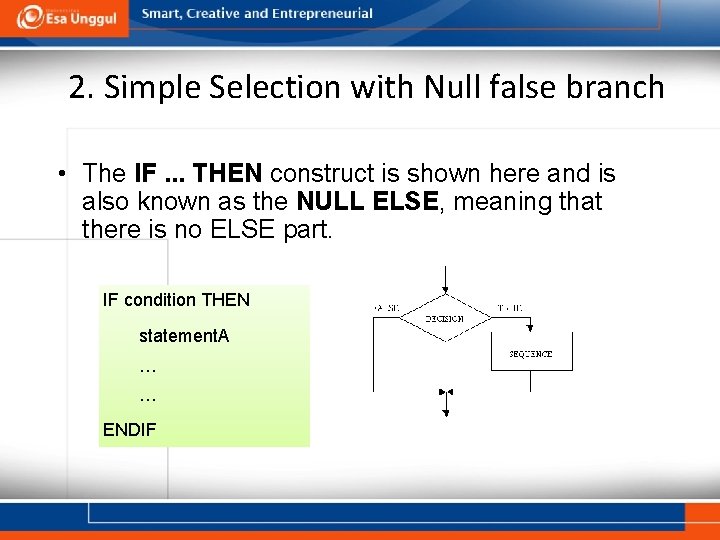
2. Simple Selection with Null false branch • The IF. . . THEN construct is shown here and is also known as the NULL ELSE, meaning that there is no ELSE part. IF condition THEN statement. A … … ENDIF
2. Simple Selection with Null false branch • NULL ELSE • Example IF student_attendance = part_time THEN add 1 to part_time_count ENDIF
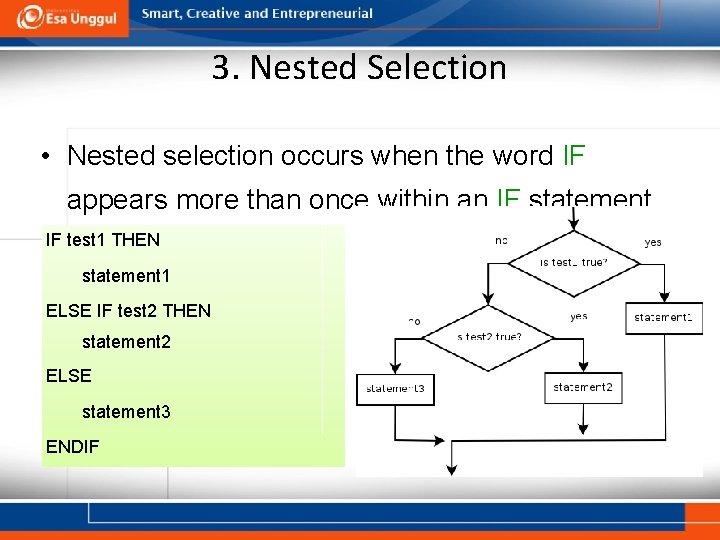
3. Nested Selection • Nested selection occurs when the word IF appears more than once within an IF statement IF test 1 THEN statement 1 ELSE IF test 2 THEN statement 2 ELSE statement 3 ENDIF
3. Nested Selection • Nested IF statements can be classified as linear or non-linear • The linear nested IF statement is used when a field is being tested for various values and a different action is to be taken for each value. • A non-linear nested IF occurs when a number of different conditions need to be satisfied before a particular action can occur
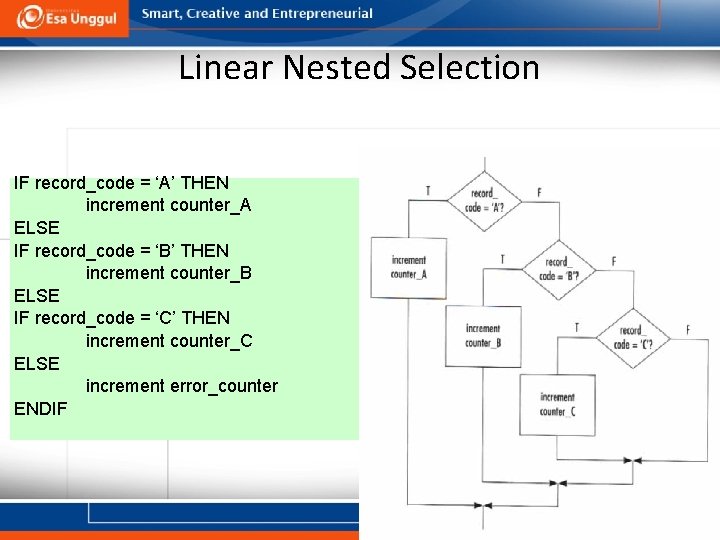
Linear Nested Selection IF record_code = ‘A’ THEN increment counter_A ELSE IF record_code = ‘B’ THEN increment counter_B ELSE IF record_code = ‘C’ THEN increment counter_C ELSE increment error_counter ENDIF
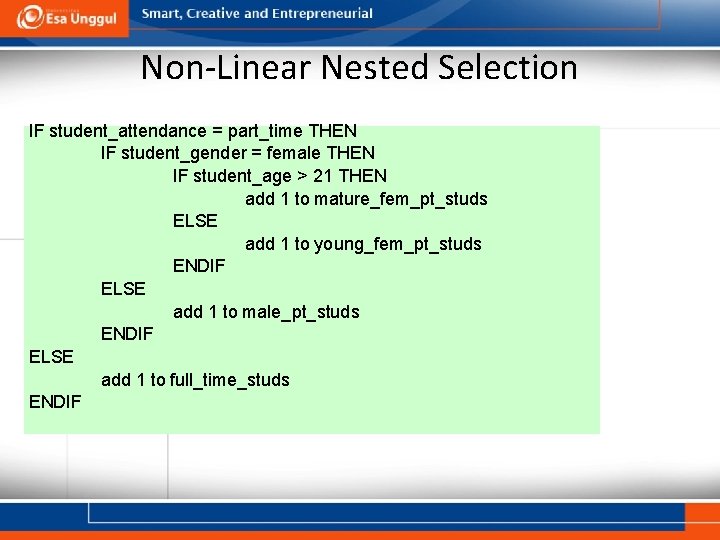
Non-Linear Nested Selection IF student_attendance = part_time THEN IF student_gender = female THEN IF student_age > 21 THEN add 1 to mature_fem_pt_studs ELSE add 1 to young_fem_pt_studs ENDIF ELSE add 1 to male_pt_studs ENDIF ELSE add 1 to full_time_studs ENDIF
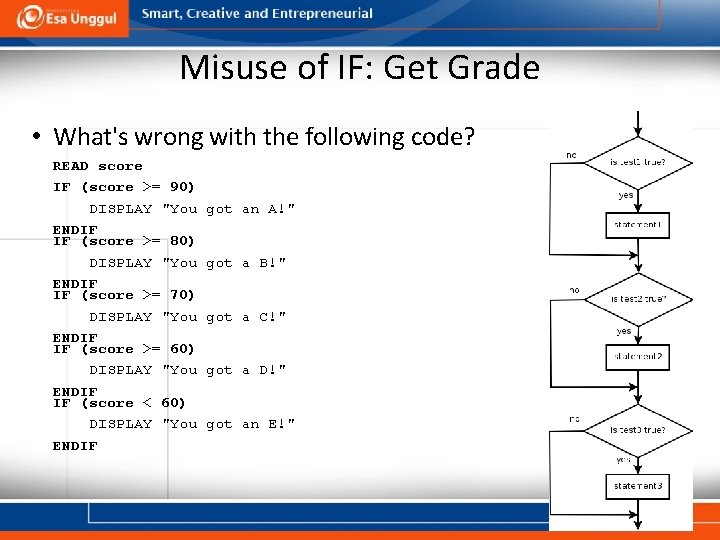
Misuse of IF: Get Grade • What's wrong with the following code? READ score IF (score >= 90) DISPLAY "You ENDIF IF (score >= 80) DISPLAY "You ENDIF IF (score >= 70) DISPLAY "You ENDIF IF (score >= 60) DISPLAY "You ENDIF IF (score < 60) DISPLAY "You ENDIF got an A!" got a B!" got a C!" got a D!" got an E!"
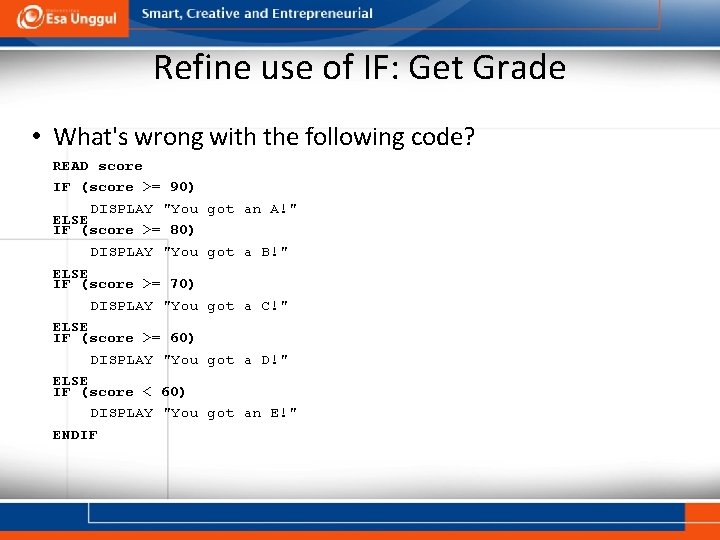
Refine use of IF: Get Grade • What's wrong with the following code? READ score IF (score >= 90) DISPLAY "You ELSE IF (score >= 80) DISPLAY "You ELSE IF (score >= 70) DISPLAY "You ELSE IF (score >= 60) DISPLAY "You ELSE IF (score < 60) DISPLAY "You ENDIF got an A!" got a B!" got a C!" got a D!" got an E!"
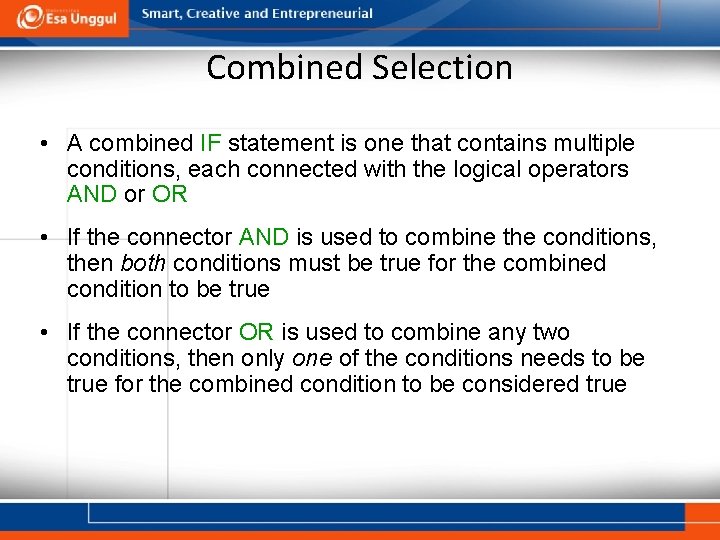
Combined Selection • A combined IF statement is one that contains multiple conditions, each connected with the logical operators AND or OR • If the connector AND is used to combine the conditions, then both conditions must be true for the combined condition to be true • If the connector OR is used to combine any two conditions, then only one of the conditions needs to be true for the combined condition to be considered true
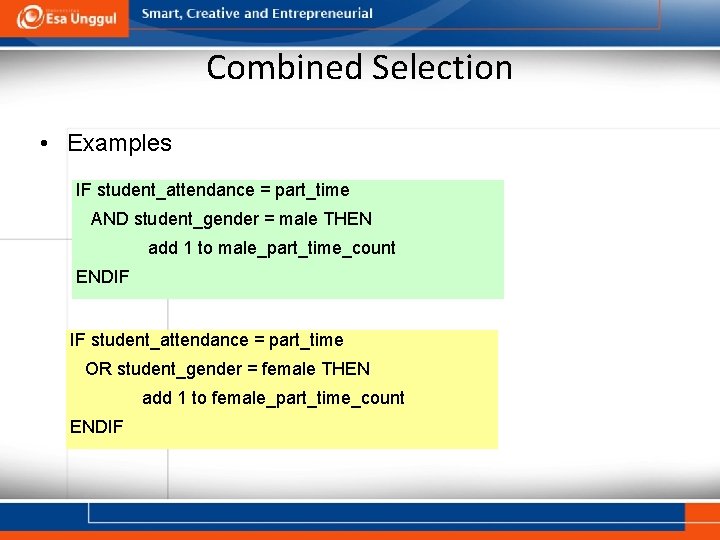
Combined Selection • Examples IF student_attendance = part_time AND student_gender = male THEN add 1 to male_part_time_count ENDIF IF student_attendance = part_time OR student_gender = female THEN add 1 to female_part_time_count ENDIF
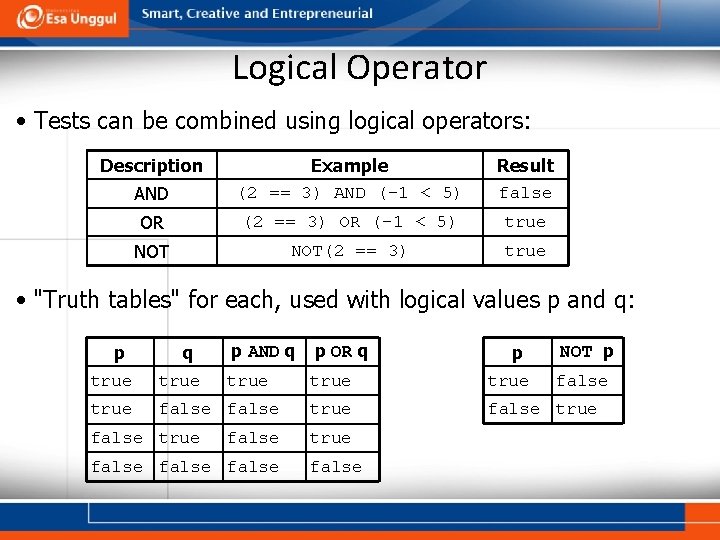
Logical Operator • Tests can be combined using logical operators: Description AND Example (2 == 3) AND (-1 < 5) Result false OR (2 == 3) OR (-1 < 5) true NOT(2 == 3) true • "Truth tables" for each, used with logical values p and q: p AND q p true q true false false p OR q NOT p true false true false
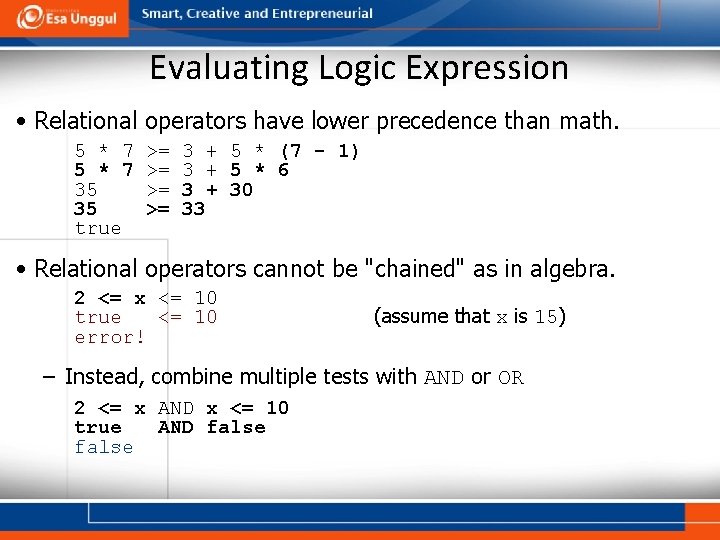
Evaluating Logic Expression • Relational operators have lower precedence than math. 5 * 7 35 35 true >= >= 3 + 5 * (7 - 1) 3 + 5 * 6 3 + 30 33 • Relational operators cannot be "chained" as in algebra. 2 <= x <= 10 true <= 10 error! (assume that x is 15) – Instead, combine multiple tests with AND or OR 2 <= x AND x <= 10 true AND false
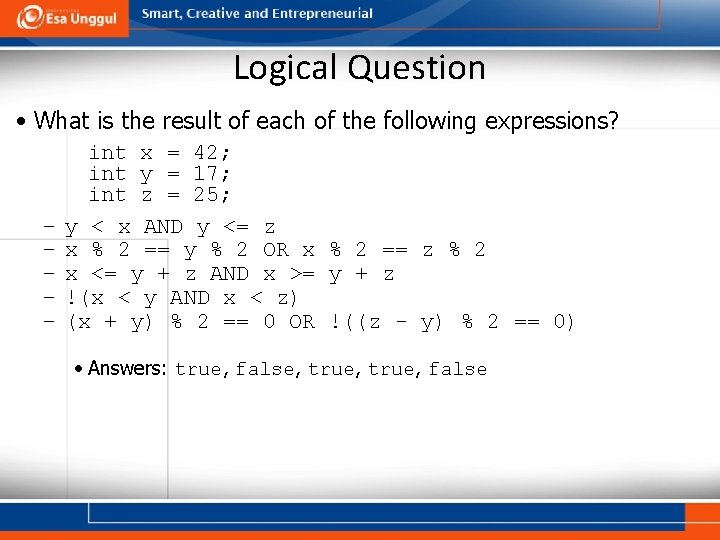
Logical Question • What is the result of each of the following expressions? – – – int x = 42; int y = 17; int z = 25; y < x AND y <= z x % 2 == y % 2 OR x % 2 == z % 2 x <= y + z AND x >= y + z !(x < y AND x < z) (x + y) % 2 == 0 OR !((z - y) % 2 == 0) • Answers: true, false, true, false
Reference • Simple Design Program: A Step by Step Approach, Lesley Anne Robertson
- Slides: 23