
Chapter 3 section 2 Properties of Magma Introduction
- Slides: 17
Chapter 3 section 2 Properties of Magma
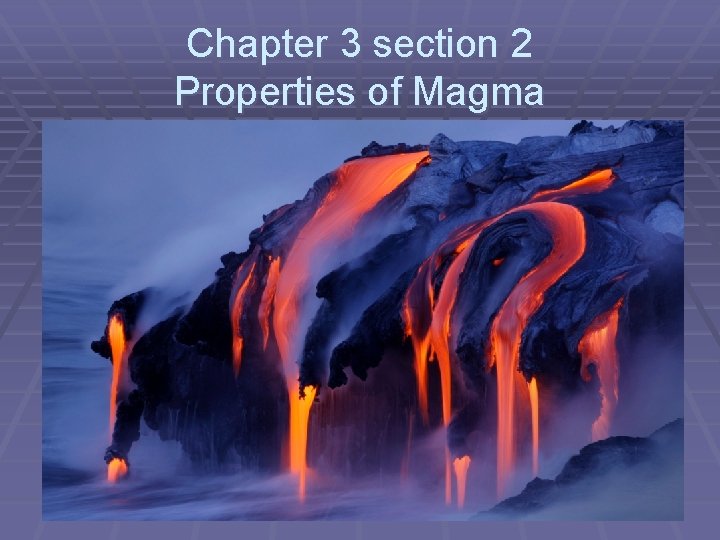
Introduction a. Measured from the bottom of the Pacific Ocean, the Big Island of Hawaii is the largest mountain on Earth. b. This island is made up of massive volcanoes. c. One of these volcanoes, Mt. Kilauea erupts frequently and produces huge amounts of lava.
Physical and Chemical Properties § Magma and Lava are made up of elements & compounds § Element – a substance that cannot be broken down into other substances § Examples: C (carbon); O (oxygen); Fe (iron) § Compound – a substance made of two or more elements chemically combined § Examples: CO 2 (carbon dioxide); H 2 O (water); Na. Cl (sodium chloride)
Physical & Chemical Properties § Each substance has a particular set of physical & chemical properties § These properties can be used to identify a substance and predict how it will behave
Physical & Chemical Properties § Physical properties § Any characteristic that can be observed or measured without changing the composition of a substance. § Examples: Density, melting point, boiling point,
Physical & Chemical Properties § Any property that produces a change in the composition of matter § Examples: ability to burn, combine or react with other substances § You can often tell that one substance has reacted with another if: § Color changes § Production of a gas § New solid formation
What is viscosity? § Viscosity § a familiar physical property of liquids in which the particles in a liquid are free to move around one another and a liquid can flow from place to place. § Viscosity - Resistance of a liquid to flowing § Because liquids differ in viscosity, some flow more easily than others.
What is viscosity? § Greater viscosity = the slower the liquid flows §ex. honey § Lower viscosity = the easier/faster the liquid flows §ex. water § Liquids that have a greater degree of friction among the particles have a greater viscosity.
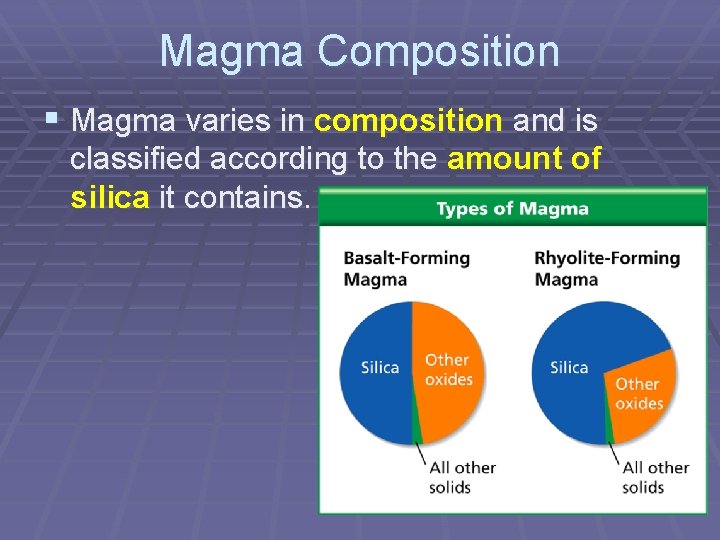
Magma Composition § Magma varies in composition and is classified according to the amount of silica it contains.
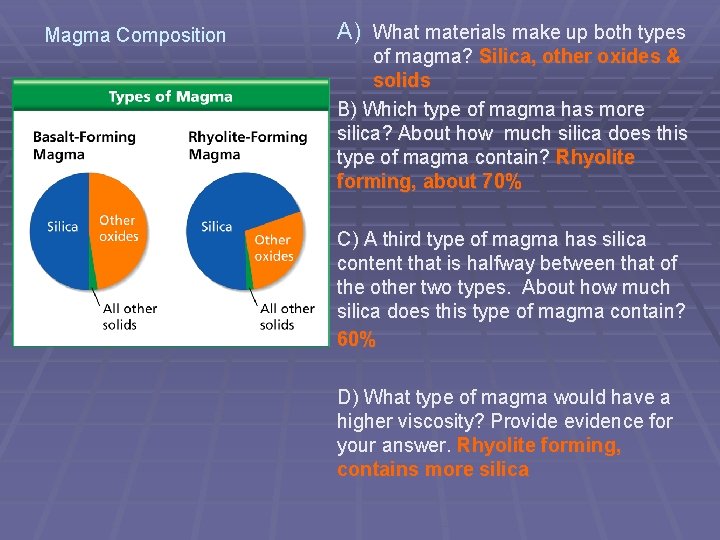
Magma Composition A) What materials make up both types of magma? Silica, other oxides & solids B) Which type of magma has more silica? About how much silica does this type of magma contain? Rhyolite forming, about 70% C) A third type of magma has silica content that is halfway between that of the other two types. About how much silica does this type of magma contain? 60% D) What type of magma would have a higher viscosity? Provide evidence for your answer. Rhyolite forming, contains more silica
Viscosity of Magma § Inside of Earth the extremely high temperatures and pressures causes the mantle rock to melt and form magma. § Not all types of magma have the same properties. § The viscosity of magma depends upon its silica content and temperature.
Silica Content § Magma is a complex mixture but its major ingredient is Silica (Si. O 2) § Silica is made up of particles of the elements oxygen and silicon § Silica is one of the most abundant materials in the Earth’s crust. § The silica content of magma ranges from 50 to 70%
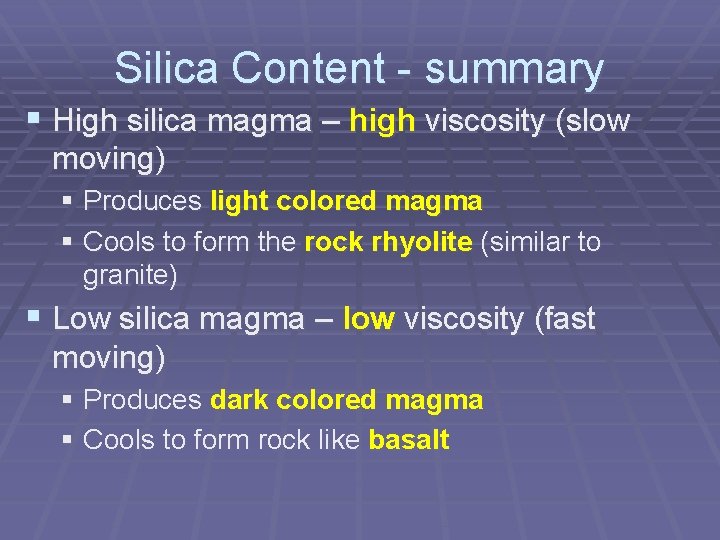
Silica Content - summary § High silica magma – high viscosity (slow moving) § Produces light colored magma § Cools to form the rock rhyolite (similar to granite) § Low silica magma – low viscosity (fast moving) § Produces dark colored magma § Cools to form rock like basalt
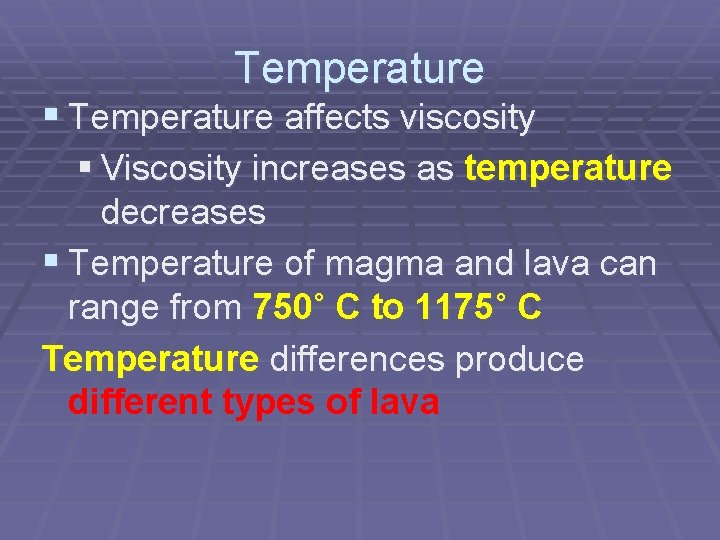
Temperature § Temperature affects viscosity § Viscosity increases as temperature decreases § Temperature of magma and lava can range from 750˚ C to 1175˚ C Temperature differences produce different types of lava
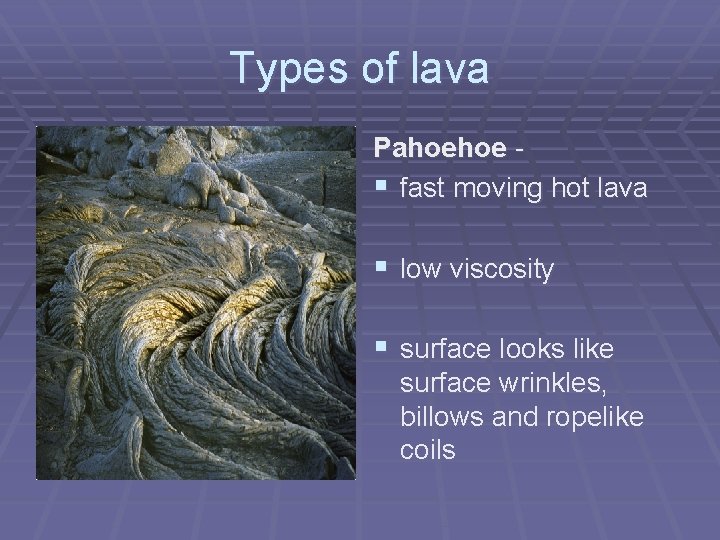
Types of lava Pahoehoe § fast moving hot lava § low viscosity § surface looks like surface wrinkles, billows and ropelike coils
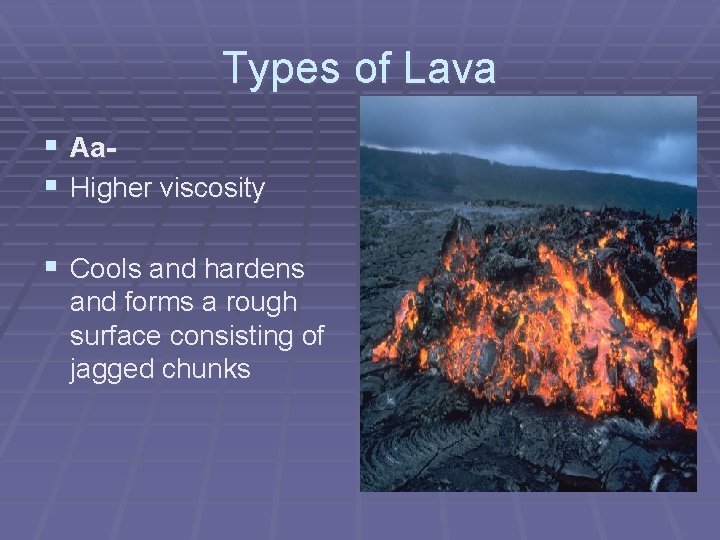
Types of Lava § Aa§ Higher viscosity § Cools and hardens and forms a rough surface consisting of jagged chunks
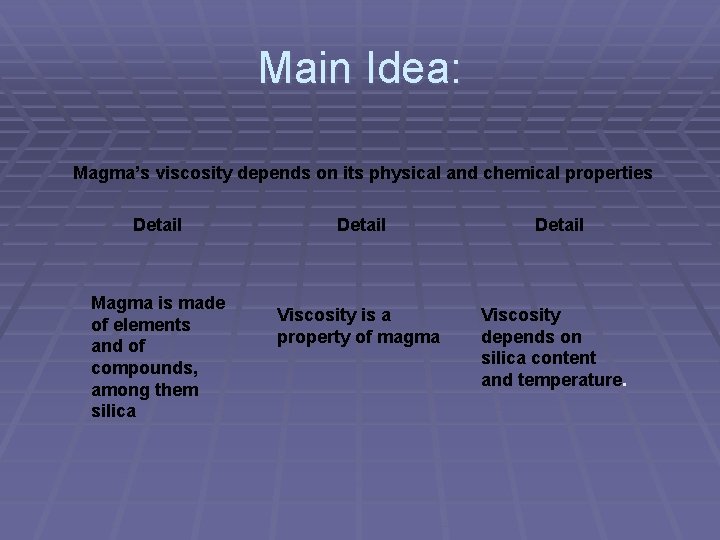
Main Idea: Magma’s viscosity depends on its physical and chemical properties Detail Magma is made of elements and of compounds, among them silica Detail Viscosity is a property of magma Detail Viscosity depends on silica content and temperature.