
Chapter 3 Section 2 Cell Features Objectives List
Chapter 3 Section 2 Cell Features Objectives • List the three parts of the cell theory. • Determine why cells must be relatively small. • Compare the structure of prokaryotic cells with that of eukaryotic cells. • Describe the structure of cell membranes. Chapter menu Resources Copyright © by Holt, Rinehart and Winston. All rights reserved.
New Vocabulary • • • Cell theory Cell membrane Cytoplasm Cytoskeleton Ribosome Prokaryote Cell wall Flagellum Eukaryote • • • Nucleus Organelle Cilium Phospholipid Lipid bilayer Chapter menu Resources Copyright © by Holt, Rinehart and Winston. All rights reserved.
• After Robert Hooke named the “cell” in 1665, it took 150 many scientists who were working together ______ years to understand what a cell was Schleiden – Matthias _______, a German botanist, viewed many plants under a microscope • In 1838, he concluded that all plant parts are made of ________ cells Chapter menu Resources Copyright © by Holt, Rinehart and Winston. All rights reserved.
Schwann • One year later, in ____, Theodore _____ 1839 concluded that all _____ animal parts are made of cells – Hint…Schwann sounds like swan Virchow determined that all cells • In 1858, Robert _____ preexisting come from _________ cells that reproduced Chapter menu Resources Copyright © by Holt, Rinehart and Winston. All rights reserved.
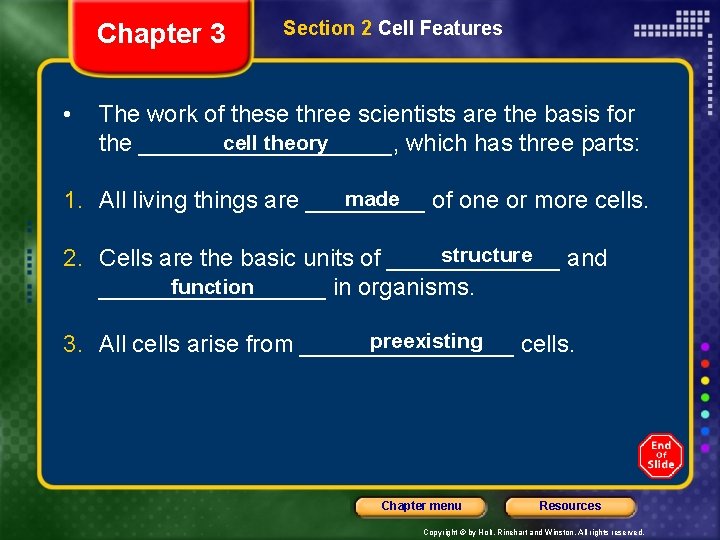
Chapter 3 • Section 2 Cell Features The work of these three scientists are the basis for cell theory the __________, which has three parts: made 1. All living things are _____ of one or more cells. structure 2. Cells are the basic units of _______ and function _________ in organisms. preexisting 3. All cells arise from ________ cells. Chapter menu Resources Copyright © by Holt, Rinehart and Winston. All rights reserved.

Chapter 3 Section 2 Cell Features Cell Size • Cells cannot grow too large because small cells efficiently function more ________ than large cells volume • This is due to the fact that ________ surface area increases more quickly than _________ • The surface area of this cube represents the cell membrane ______. Its volume contains all of its parts cell _____ Chapter menu Resources Copyright © by Holt, Rinehart and Winston. All rights reserved.
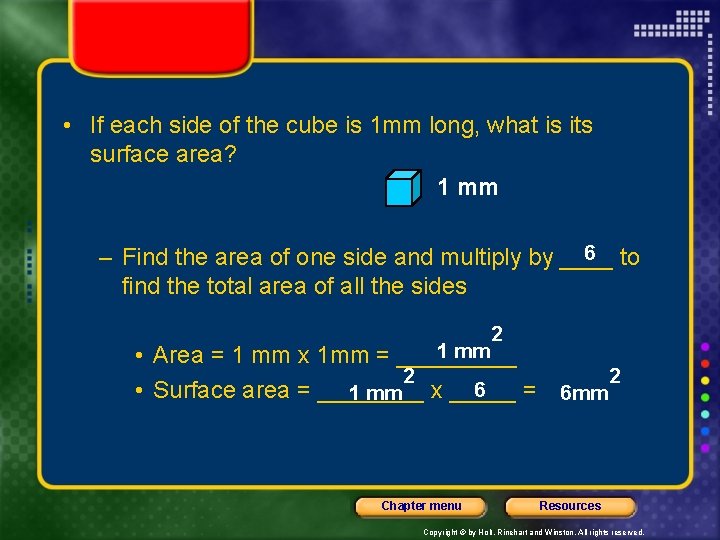
• If each side of the cube is 1 mm long, what is its surface area? 1 mm 6 to – Find the area of one side and multiply by ____ find the total area of all the sides 2 1 mm • Area = 1 mm x 1 mm = _____ 2 2 6 • Surface area = ____ = 6 mm 1 mm x _____ Chapter menu Resources Copyright © by Holt, Rinehart and Winston. All rights reserved.
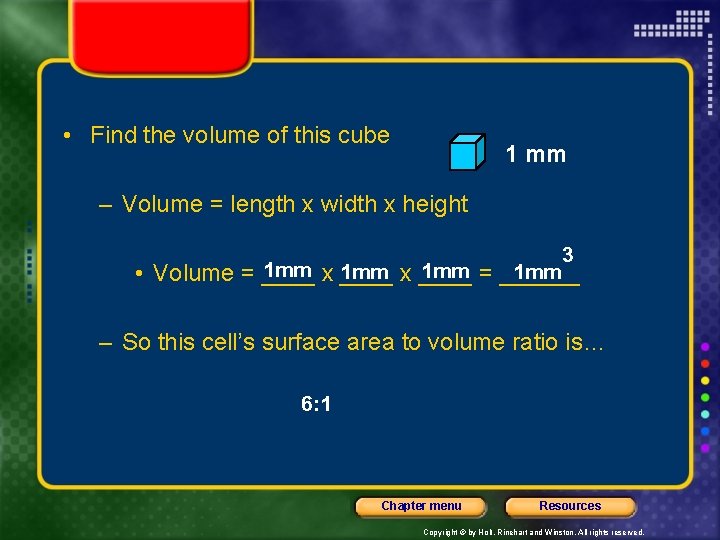
• Find the volume of this cube 1 mm – Volume = length x width x height 3 1 mm x 1 mm = ______ 1 mm • Volume = ____ x ____ – So this cell’s surface area to volume ratio is… 6: 1 Chapter menu Resources Copyright © by Holt, Rinehart and Winston. All rights reserved.
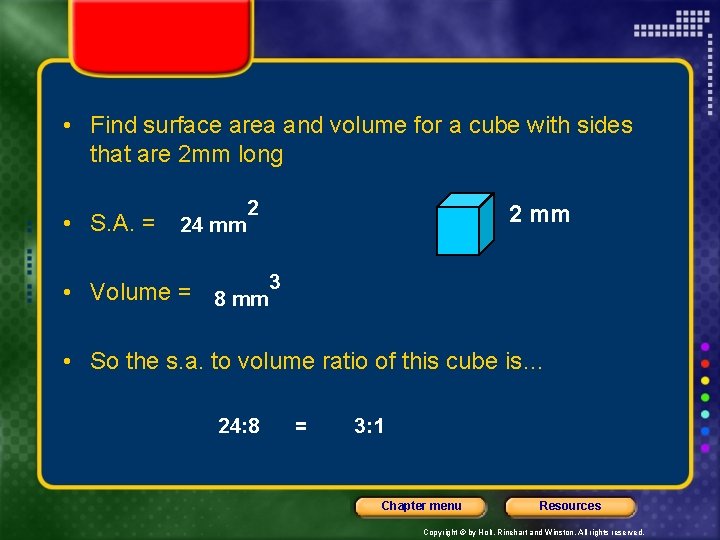
• Find surface area and volume for a cube with sides that are 2 mm long • S. A. = 24 mm 2 2 mm • Volume = 8 mm 3 • So the s. a. to volume ratio of this cube is… 24: 8 = 3: 1 Chapter menu Resources Copyright © by Holt, Rinehart and Winston. All rights reserved.
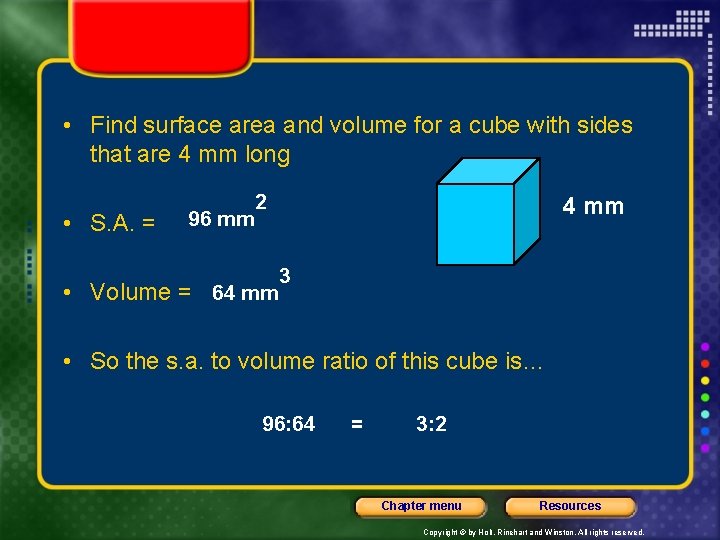
• Find surface area and volume for a cube with sides that are 4 mm long • S. A. = 96 mm 2 • Volume = 64 mm 3 • So the s. a. to volume ratio of this cube is… 96: 64 = 3: 2 Chapter menu Resources Copyright © by Holt, Rinehart and Winston. All rights reserved.
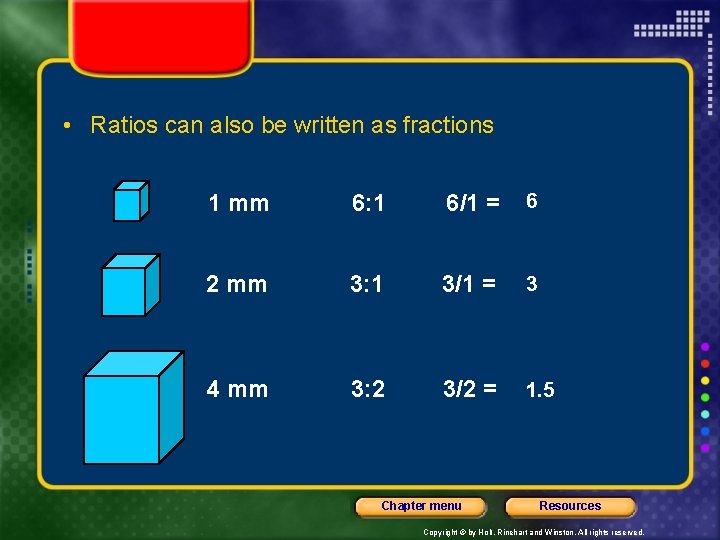
• Ratios can also be written as fractions 1 mm 6: 1 6/1 = 6 2 mm 3: 1 3/1 = 3 4 mm 3: 2 3/2 = 1. 5 Chapter menu Resources Copyright © by Holt, Rinehart and Winston. All rights reserved.
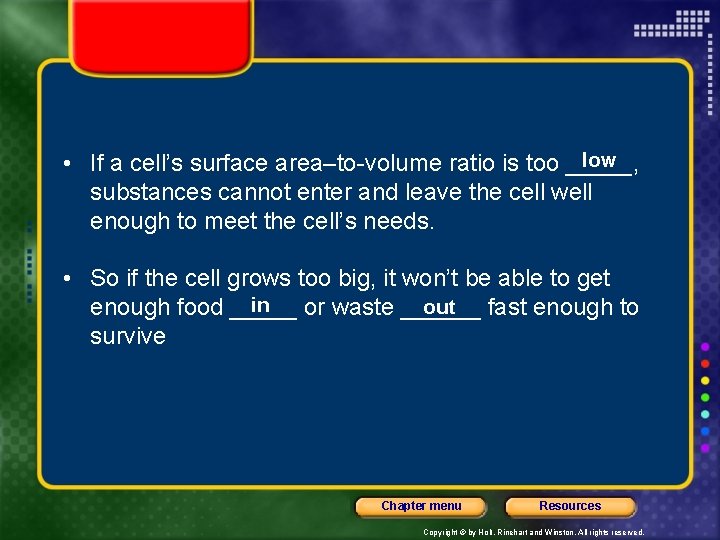
low • If a cell’s surface area–to-volume ratio is too _____, substances cannot enter and leave the cell well enough to meet the cell’s needs. • So if the cell grows too big, it won’t be able to get in out enough food _____ or waste ______ fast enough to survive Chapter menu Resources Copyright © by Holt, Rinehart and Winston. All rights reserved.
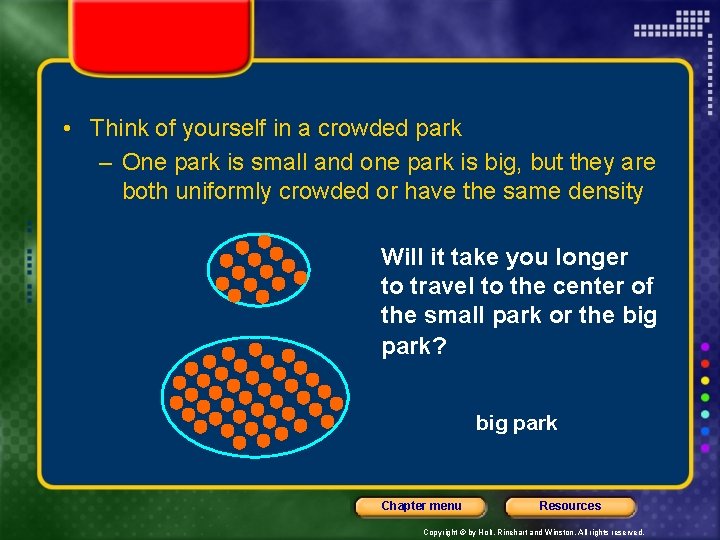
• Think of yourself in a crowded park – One park is small and one park is big, but they are both uniformly crowded or have the same density Will it take you longer to travel to the center of the small park or the big park? big park Chapter menu Resources Copyright © by Holt, Rinehart and Winston. All rights reserved.
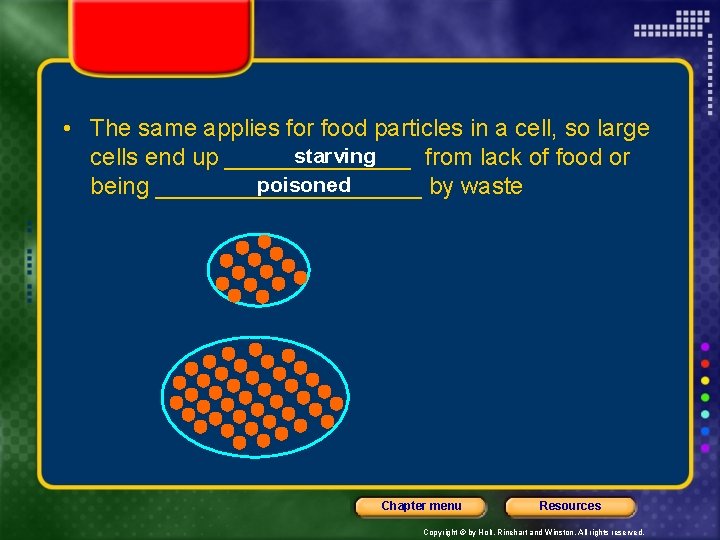
• The same applies for food particles in a cell, so large starving cells end up _______ from lack of food or poisoned being __________ by waste Chapter menu Resources Copyright © by Holt, Rinehart and Winston. All rights reserved.
Question 1 • Who studied plants…Schleiden or Schwann? Schleiden Chapter menu Resources Copyright © by Holt, Rinehart and Winston. All rights reserved.
Question 2 • What are three parts of the cell theory? All living things are made of one or more cells. Cells are the basic unit of structure and function in organisms. Cells come from preexisting cell. Chapter menu Resources Copyright © by Holt, Rinehart and Winston. All rights reserved.
Question 3 • Why must cells be relatively small? Because volume increases faster than surface area, and if it gets too big, it will starve or be poisoned Chapter menu Resources Copyright © by Holt, Rinehart and Winston. All rights reserved.
- Slides: 17