
Chapter 3 Scientific Measurement The ability to make
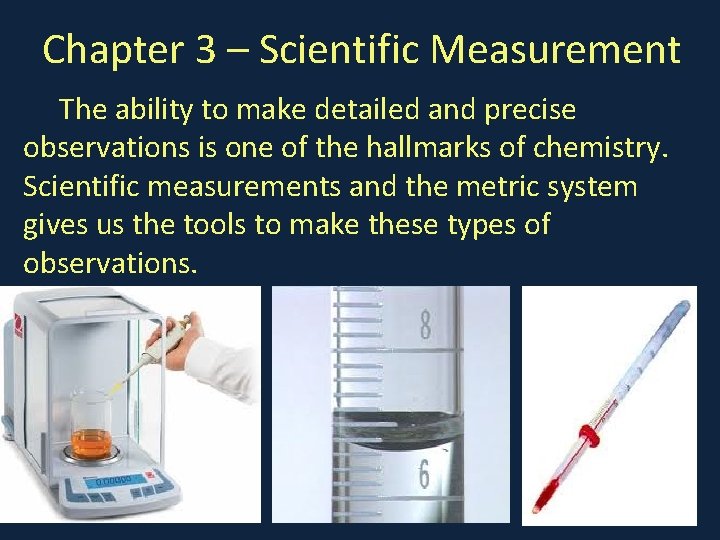
Chapter 3 – Scientific Measurement The ability to make detailed and precise observations is one of the hallmarks of chemistry. Scientific measurements and the metric system gives us the tools to make these types of observations.
Scientific Measurement • Scientific Notation • Many measurements in chemistry will be either very small or very large. • Scientific notation is a way of recording measurements more efficiently. • For example; 12. 01 grams of carbon will contain 602, 000, 000, 000 atoms
Scientific Measurement • Scientific Notation 12. 01 grams of carbon will contain 602, 000, 000, 000 atoms We can express this number in a more convenient way; 6. 02 x 1023 carbon atoms
Scientific Measurement • Scientific Notation • Rules for expressing numbers in scientific notation; 1. ) The first number (the coefficient) must be between the numbers 1 and 10, but not equal to 10. 2. ) The coefficient is multiplied by the number 10 3. ) The number 10 is raised to a power to indicate the magnitude of the measurement. Example 1: Express the number 0. 02 in scientific notation.
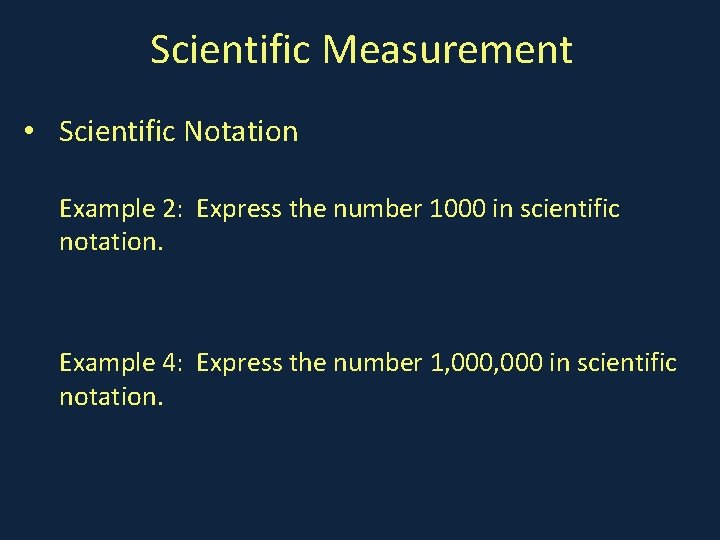
Scientific Measurement • Scientific Notation Example 2: Express the number 1000 in scientific notation. Example 4: Express the number 1, 000 in scientific notation.
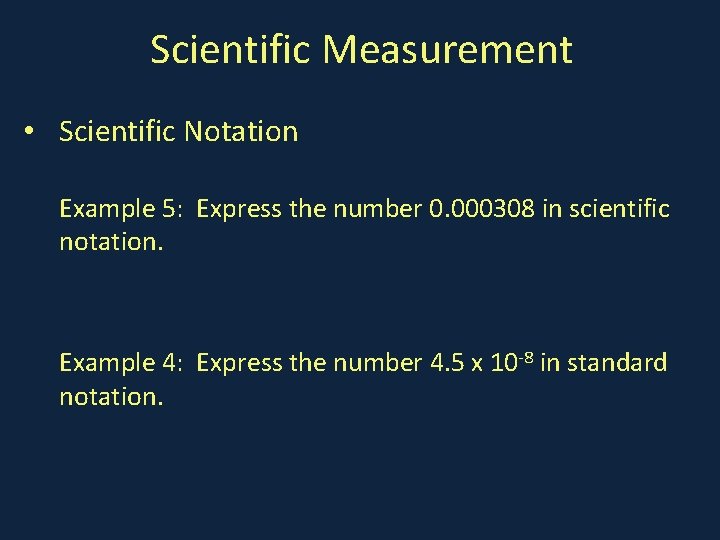
Scientific Measurement • Scientific Notation Example 5: Express the number 0. 000308 in scientific notation. Example 4: Express the number 4. 5 x 10 -8 in standard notation.
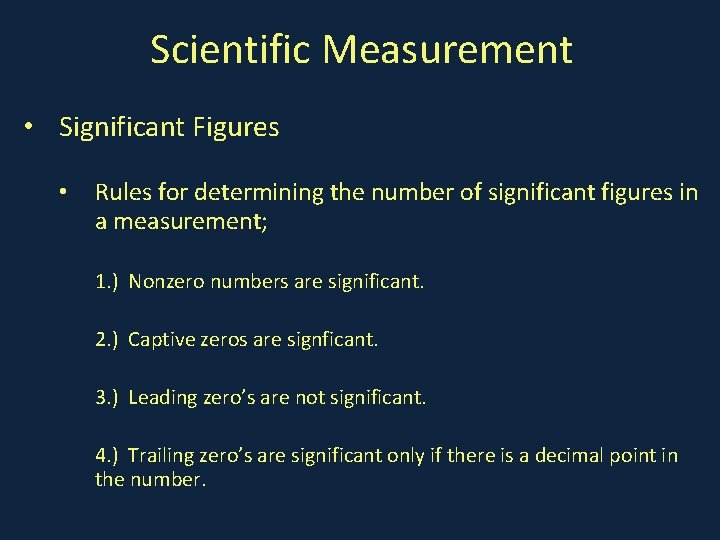
Scientific Measurement • Significant Figures • Rules for determining the number of significant figures in a measurement; 1. ) Nonzero numbers are significant. 2. ) Captive zeros are signficant. 3. ) Leading zero’s are not significant. 4. ) Trailing zero’s are significant only if there is a decimal point in the number.
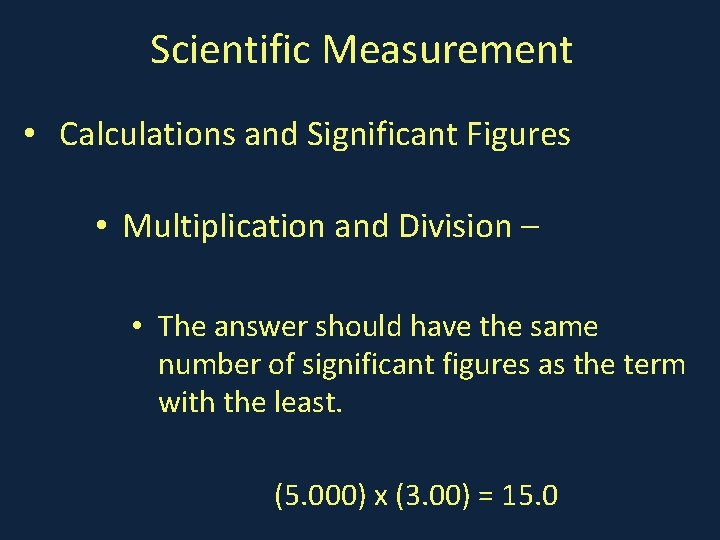
Scientific Measurement • Calculations and Significant Figures • Multiplication and Division – • The answer should have the same number of significant figures as the term with the least. (5. 000) x (3. 00) = 15. 0
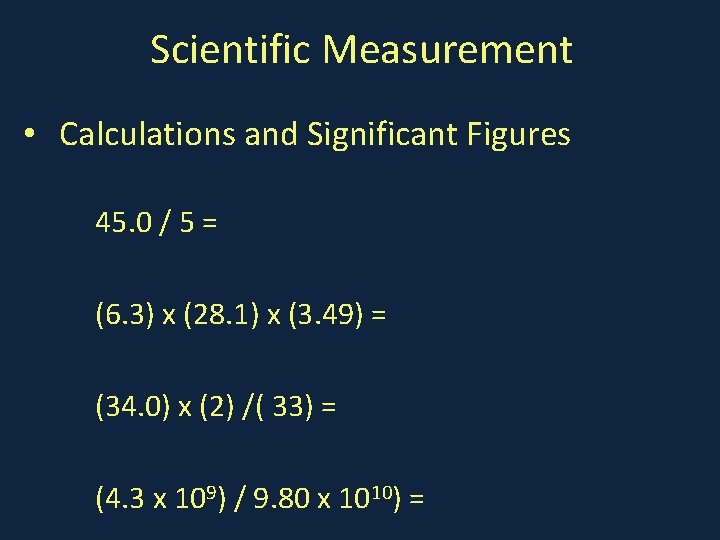
Scientific Measurement • Calculations and Significant Figures 45. 0 / 5 = (6. 3) x (28. 1) x (3. 49) = (34. 0) x (2) /( 33) = (4. 3 x 10⁹) / 9. 80 x 1010) =
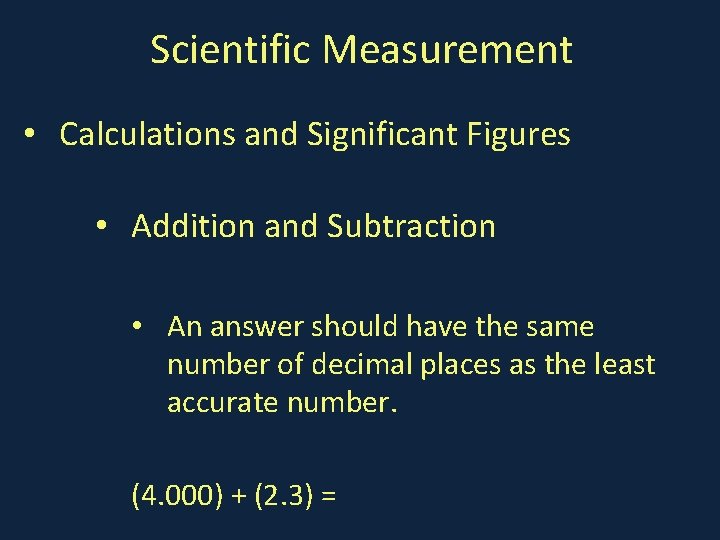
Scientific Measurement • Calculations and Significant Figures • Addition and Subtraction • An answer should have the same number of decimal places as the least accurate number. (4. 000) + (2. 3) =
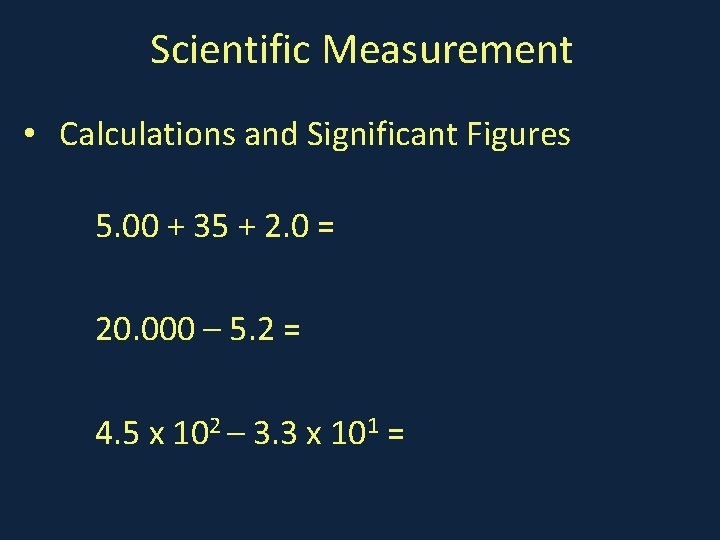
Scientific Measurement • Calculations and Significant Figures 5. 00 + 35 + 2. 0 = 20. 000 – 5. 2 = 4. 5 x 10² – 3. 3 x 101 =
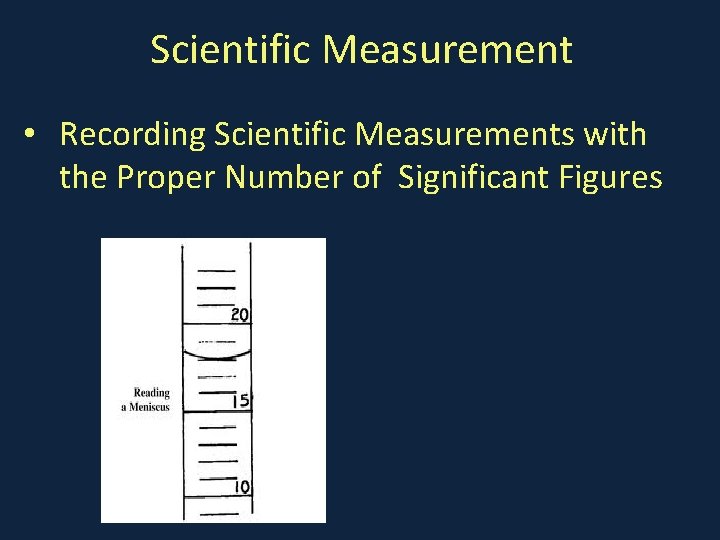
Scientific Measurement • Recording Scientific Measurements with the Proper Number of Significant Figures
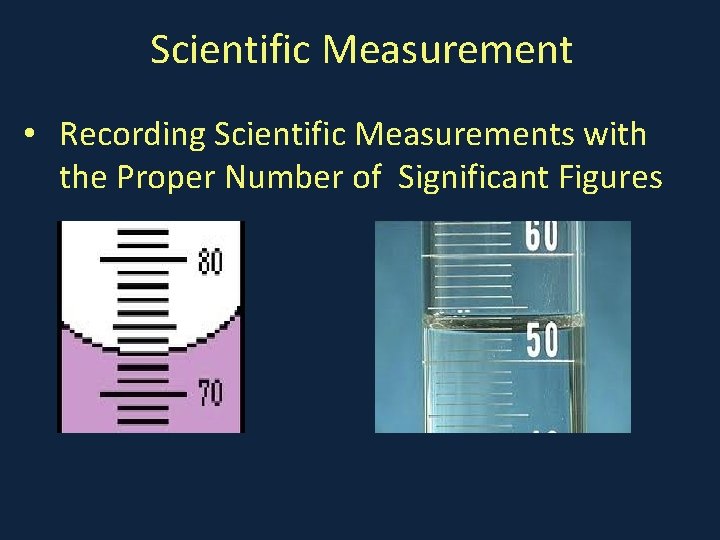
Scientific Measurement • Recording Scientific Measurements with the Proper Number of Significant Figures
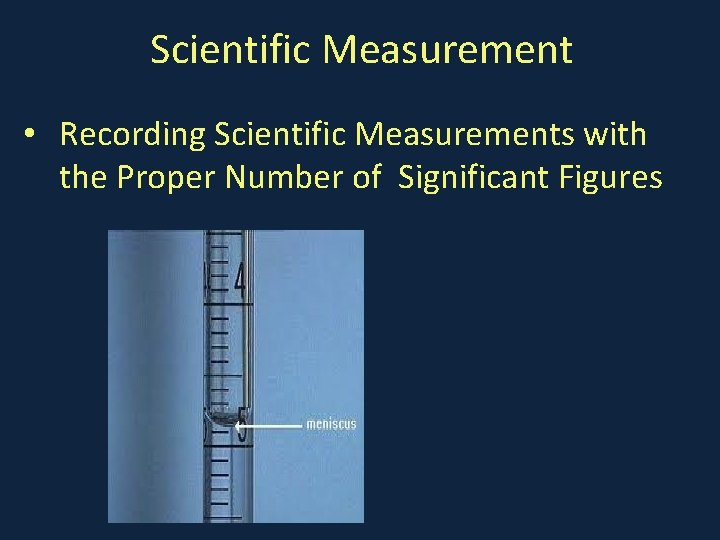
Scientific Measurement • Recording Scientific Measurements with the Proper Number of Significant Figures
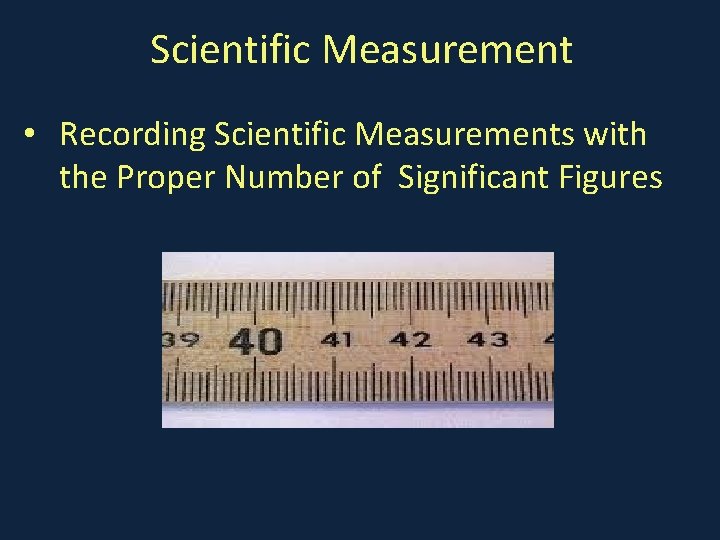
Scientific Measurement • Recording Scientific Measurements with the Proper Number of Significant Figures
Scientific Measurement • Accuracy Versus Precision • Accuracy – • Precision -
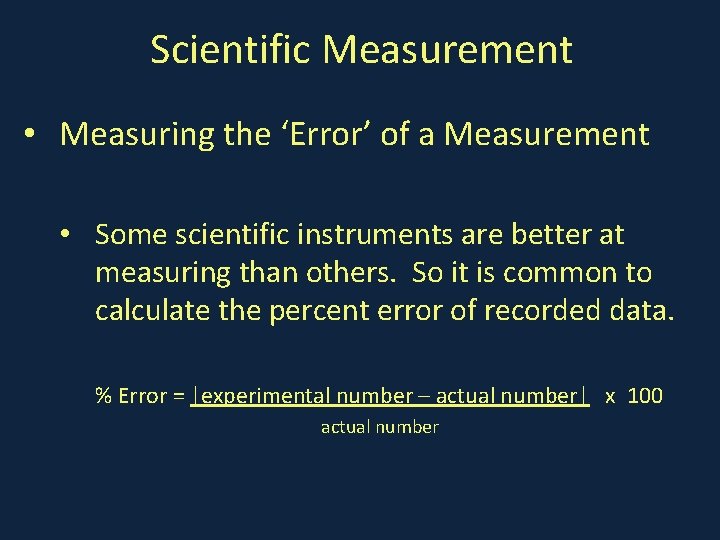
Scientific Measurement • Measuring the ‘Error’ of a Measurement • Some scientific instruments are better at measuring than others. So it is common to calculate the percent error of recorded data. % Error = |experimental number – actual number| x 100 actual number
Scientific Measurement • Calculating Percent Error Lets pretend you are performing an experiment where you were trying to isolate a substance from a chemical reaction. You were supposed to produce 20. 0 grams of the substance from the chemical reaction. But you were only able to isolate 17. 9 grams from your experiment. What is the percent error of your experiment?
Scientific Measurement • The Metric System • Developed in the late 1700’s as an attempt to develop a universal system for recording and scientific measurements. • The metric system has its orgins in France. • In the early years, France attempted to enact laws governing the use of the metric system. Thomas Jefferson was asked to help in created the legislation. But the attempt initially failed.
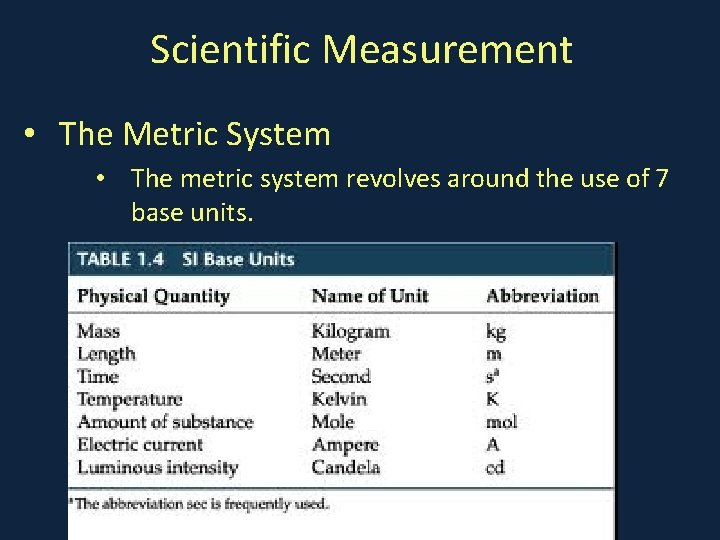
Scientific Measurement • The Metric System • The metric system revolves around the use of 7 base units.
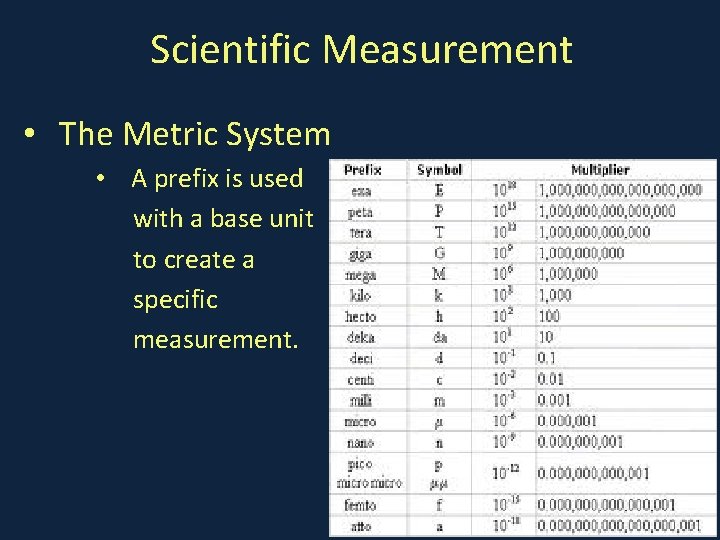
Scientific Measurement • The Metric System • A prefix is used with a base unit to create a specific measurement.
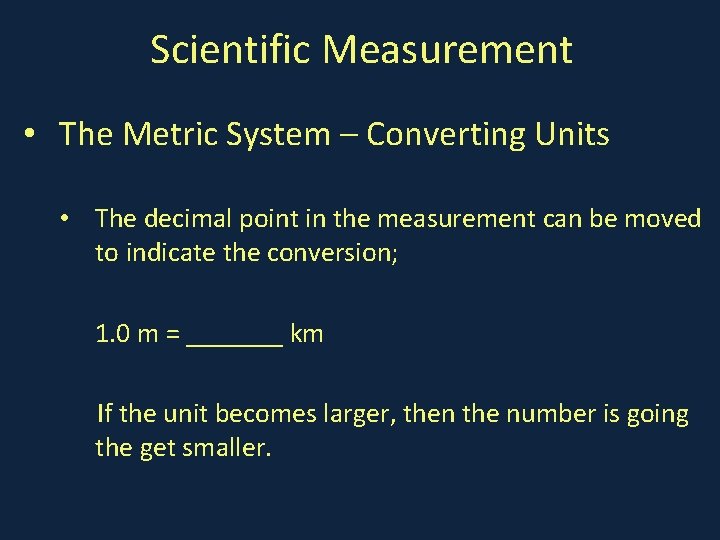
Scientific Measurement • The Metric System – Converting Units • The decimal point in the measurement can be moved to indicate the conversion; 1. 0 m = _______ km If the unit becomes larger, then the number is going the get smaller.
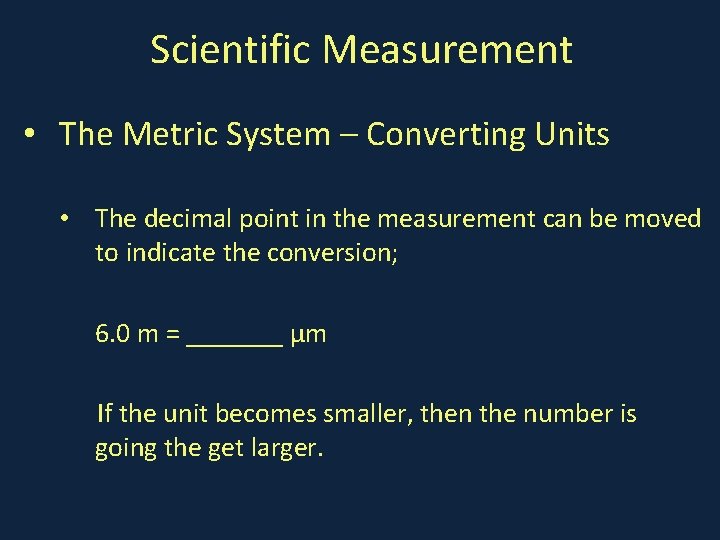
Scientific Measurement • The Metric System – Converting Units • The decimal point in the measurement can be moved to indicate the conversion; 6. 0 m = _______ μm If the unit becomes smaller, then the number is going the get larger.
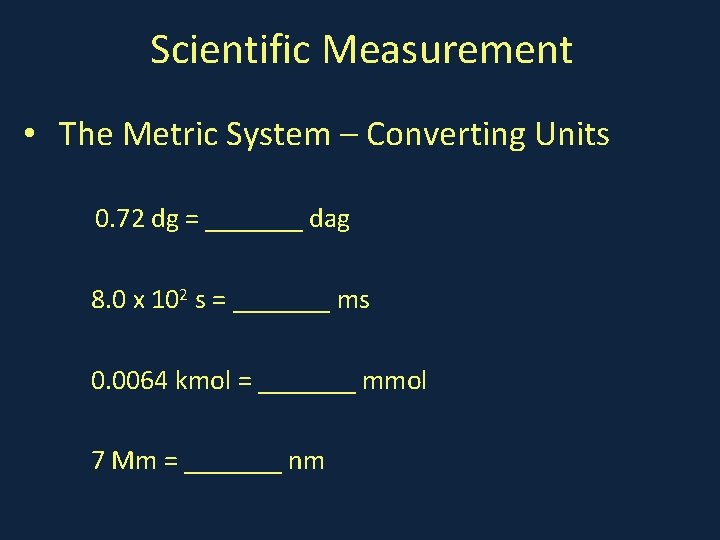
Scientific Measurement • The Metric System – Converting Units 0. 72 dg = _______ dag 8. 0 x 102 s = _______ ms 0. 0064 kmol = _______ mmol 7 Mm = _______ nm
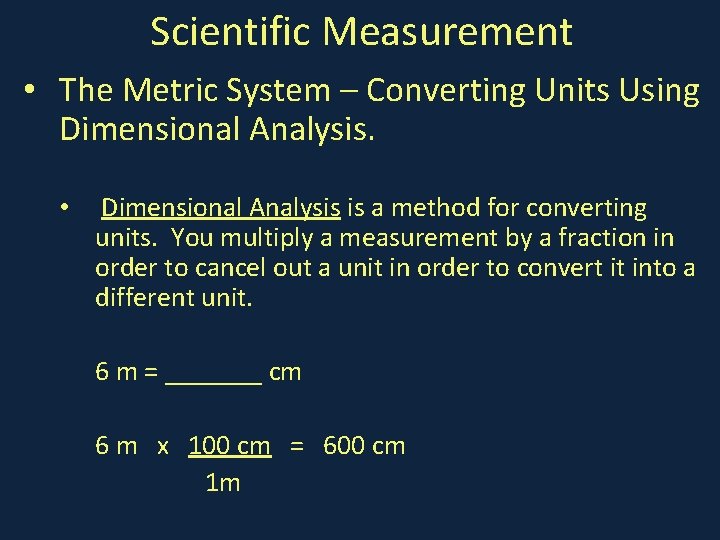
Scientific Measurement • The Metric System – Converting Units Using Dimensional Analysis. • Dimensional Analysis is a method for converting units. You multiply a measurement by a fraction in order to cancel out a unit in order to convert it into a different unit. 6 m = _______ cm 6 m x 100 cm = 600 cm 1 m
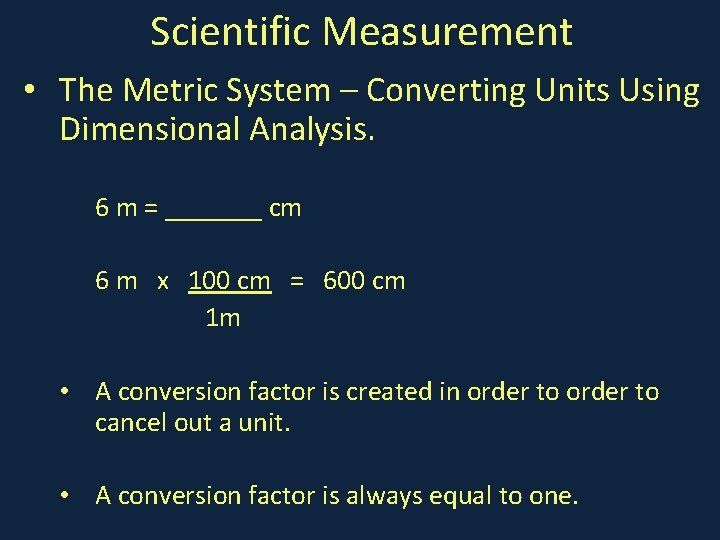
Scientific Measurement • The Metric System – Converting Units Using Dimensional Analysis. 6 m = _______ cm 6 m x 100 cm = 600 cm 1 m • A conversion factor is created in order to cancel out a unit. • A conversion factor is always equal to one.
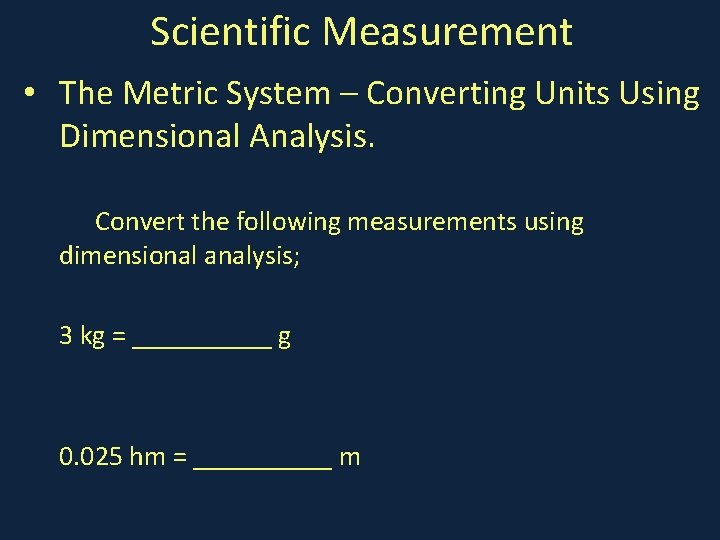
Scientific Measurement • The Metric System – Converting Units Using Dimensional Analysis. Convert the following measurements using dimensional analysis; 3 kg = _____ g 0. 025 hm = _____ m
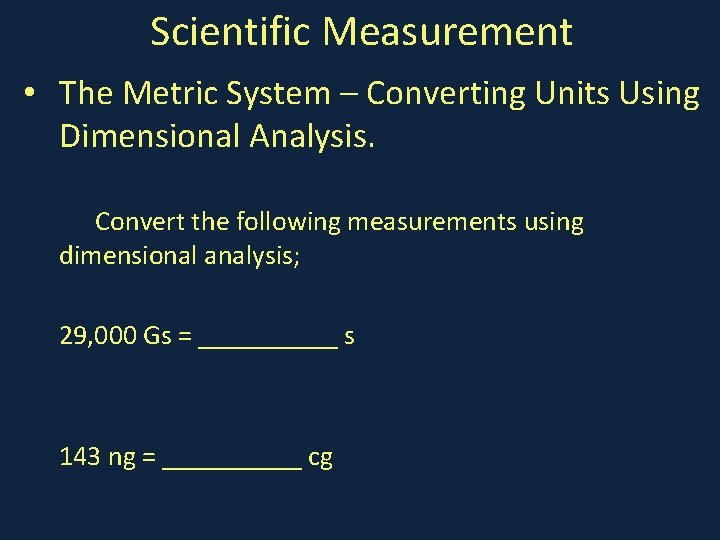
Scientific Measurement • The Metric System – Converting Units Using Dimensional Analysis. Convert the following measurements using dimensional analysis; 29, 000 Gs = _____ s 143 ng = _____ cg
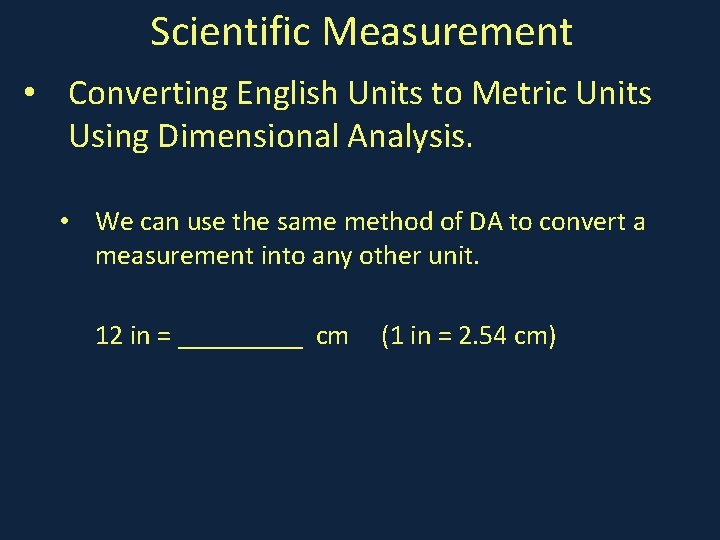
Scientific Measurement • Converting English Units to Metric Units Using Dimensional Analysis. • We can use the same method of DA to convert a measurement into any other unit. 12 in = _____ cm (1 in = 2. 54 cm)
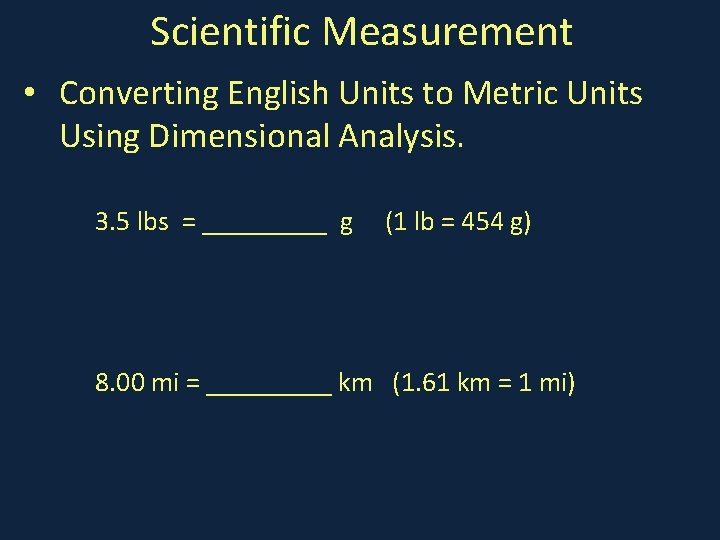
Scientific Measurement • Converting English Units to Metric Units Using Dimensional Analysis. 3. 5 lbs = _____ g (1 lb = 454 g) 8. 00 mi = _____ km (1. 61 km = 1 mi)
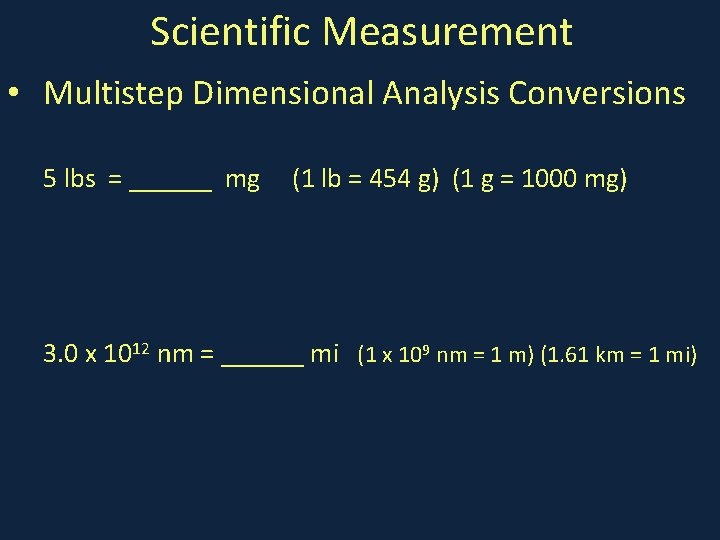
Scientific Measurement • Multistep Dimensional Analysis Conversions 5 lbs = ______ mg (1 lb = 454 g) (1 g = 1000 mg) 3. 0 x 1012 nm = ______ mi (1 x 10⁹ nm = 1 m) (1. 61 km = 1 mi)
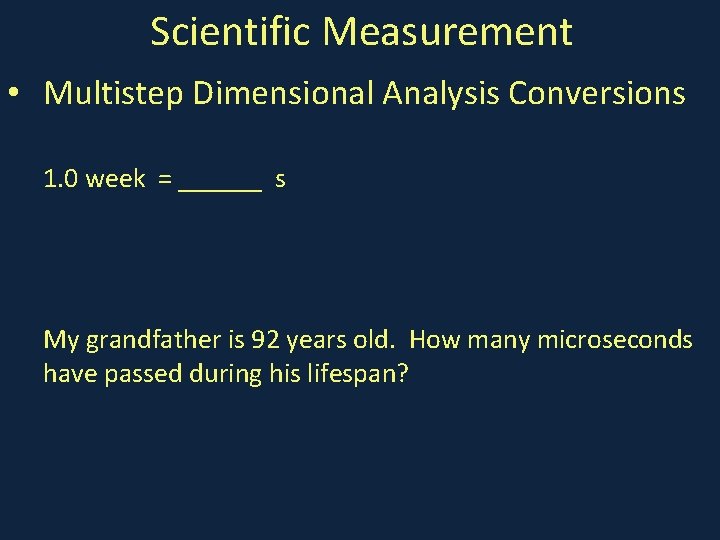
Scientific Measurement • Multistep Dimensional Analysis Conversions 1. 0 week = ______ s My grandfather is 92 years old. How many microseconds have passed during his lifespan?
Scientific Measurement • Multistep Dimensional Analysis Conversions Orbital velocity is 18, 000 mi/h. Convert this speed into m/s. The density of water is 1. 00 g/m. L. Convert this measurement into units of lbs / gallon.
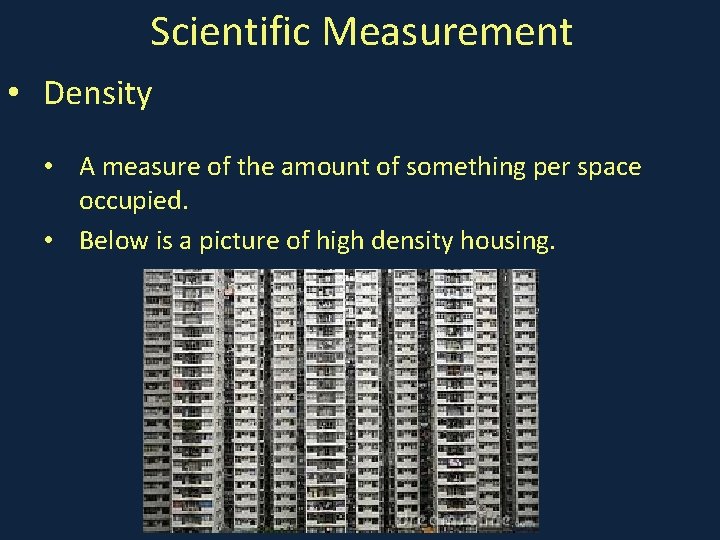
Scientific Measurement • Density • A measure of the amount of something per space occupied. • Below is a picture of high density housing.
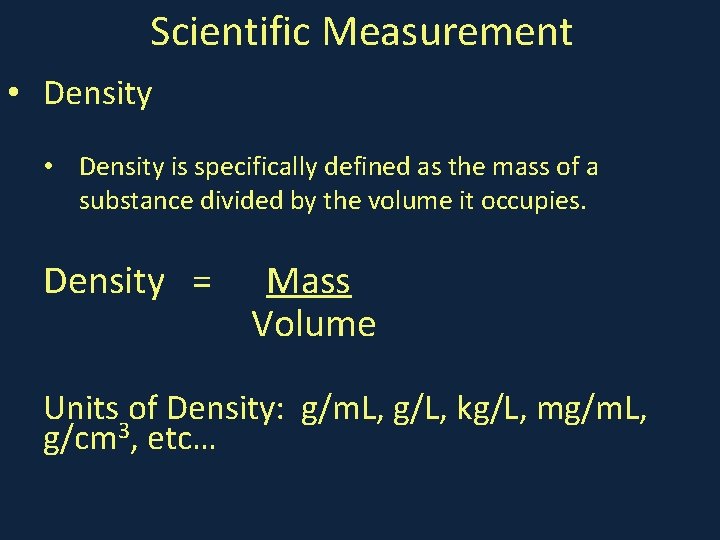
Scientific Measurement • Density is specifically defined as the mass of a substance divided by the volume it occupies. Density = Mass Volume Units of Density: g/m. L, g/L, kg/L, mg/m. L, g/cm 3, etc…
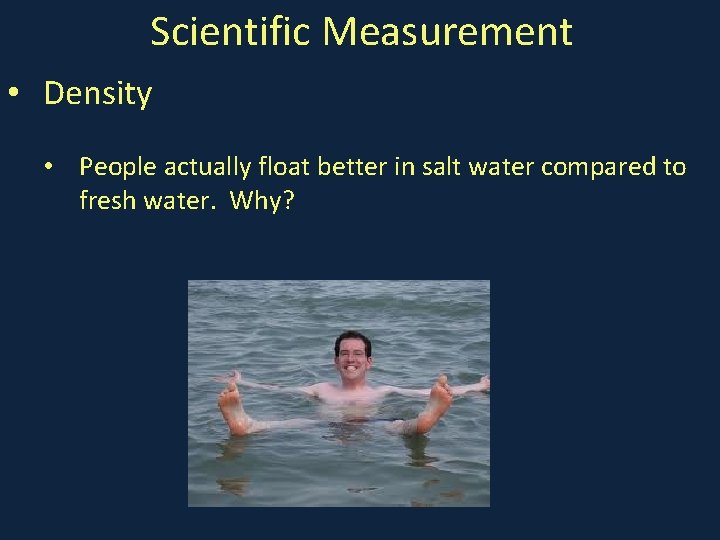
Scientific Measurement • Density • People actually float better in salt water compared to fresh water. Why?
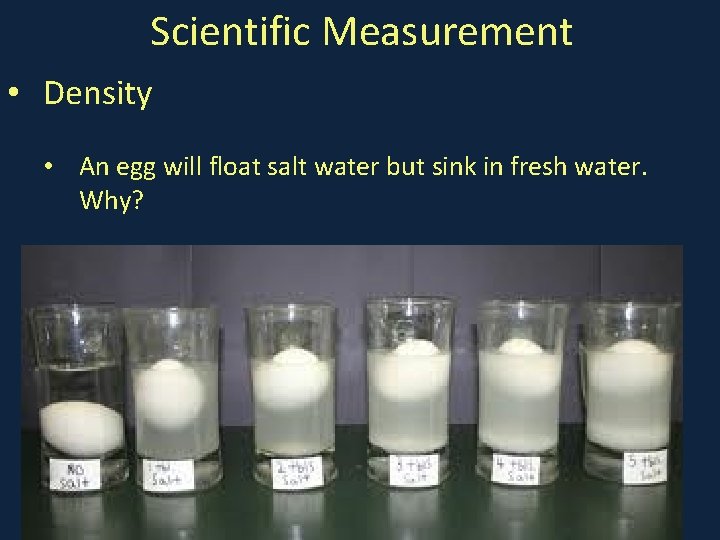
Scientific Measurement • Density • An egg will float salt water but sink in fresh water. Why?
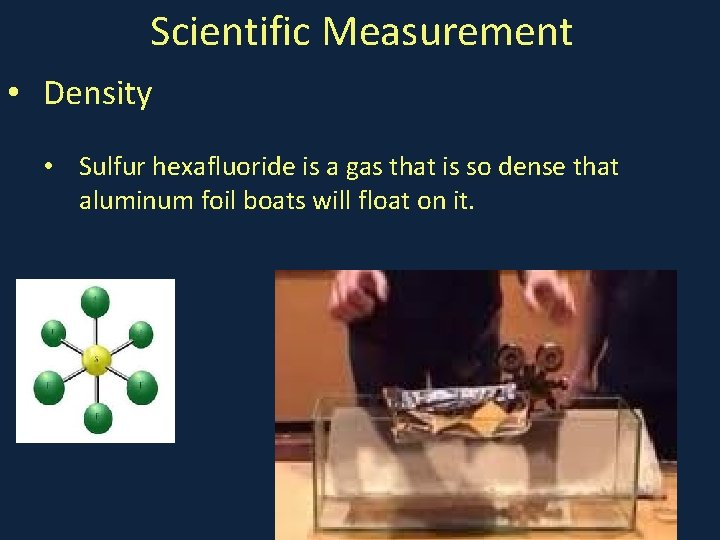
Scientific Measurement • Density • Sulfur hexafluoride is a gas that is so dense that aluminum foil boats will float on it.
Scientific Measurement • Density • Calculate the density of metallic object that has a mass of 35. 0 grams and a volume of 4. 0 m. L.
Scientific Measurement • Density • Calculate the mass a piece of aluminum that has a volume of 150. 0 m. L. The density of aluminum is 2. 70 g/m. L.
Scientific Measurement • Density • Calculate the mass of a brick of gold that has dimensions of 30. 0 cm x 20. 0 cm x 5. 0 cm. The density of gold is 19. 3 g/cm 3.
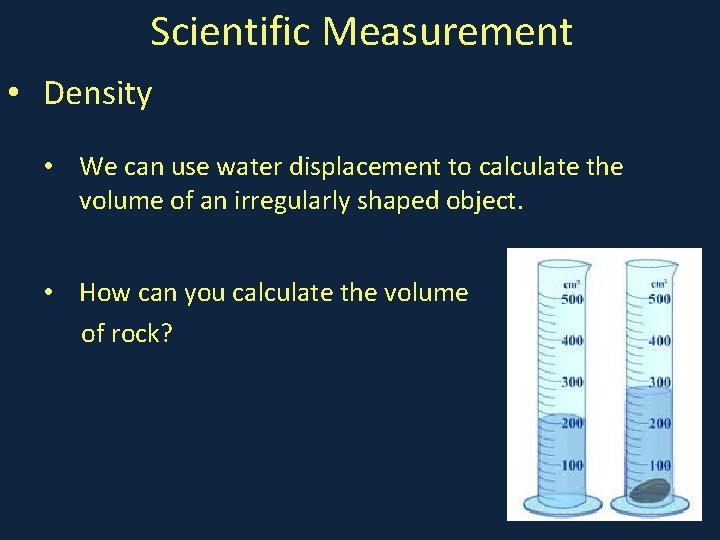
Scientific Measurement • Density • We can use water displacement to calculate the volume of an irregularly shaped object. • How can you calculate the volume of rock?
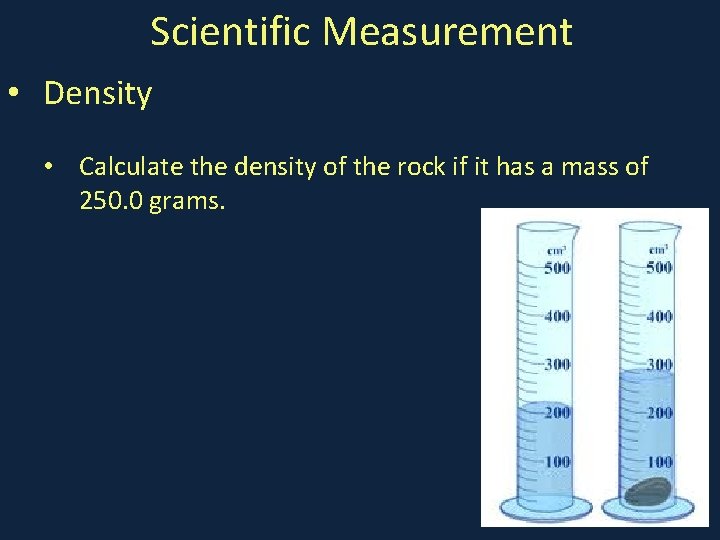
Scientific Measurement • Density • Calculate the density of the rock if it has a mass of 250. 0 grams.
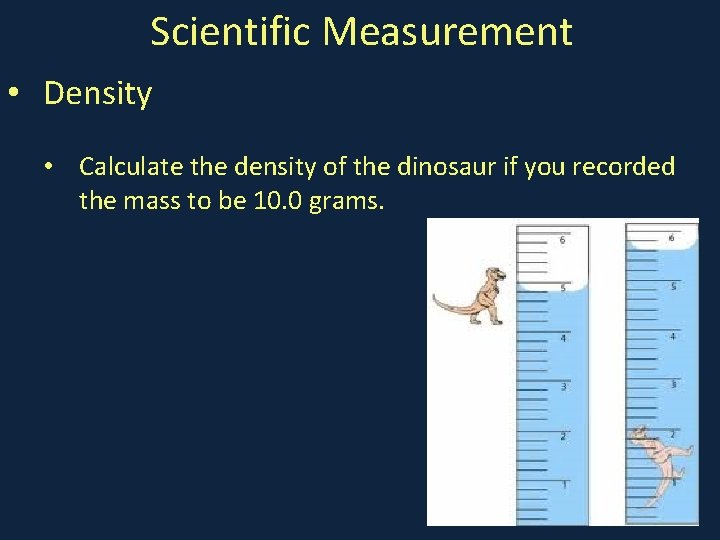
Scientific Measurement • Density • Calculate the density of the dinosaur if you recorded the mass to be 10. 0 grams.
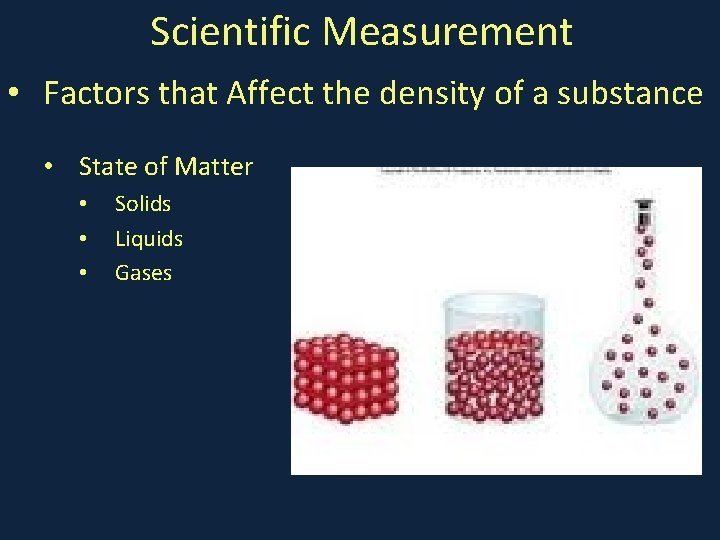
Scientific Measurement • Factors that Affect the density of a substance • State of Matter • • • Solids Liquids Gases
Scientific Measurement • Factors that Affect the density of a substance • Temperature • Generally, the density of most substances decreases as the temperature increases. • The energy of motion increases among the particles and increase the spacing between them.
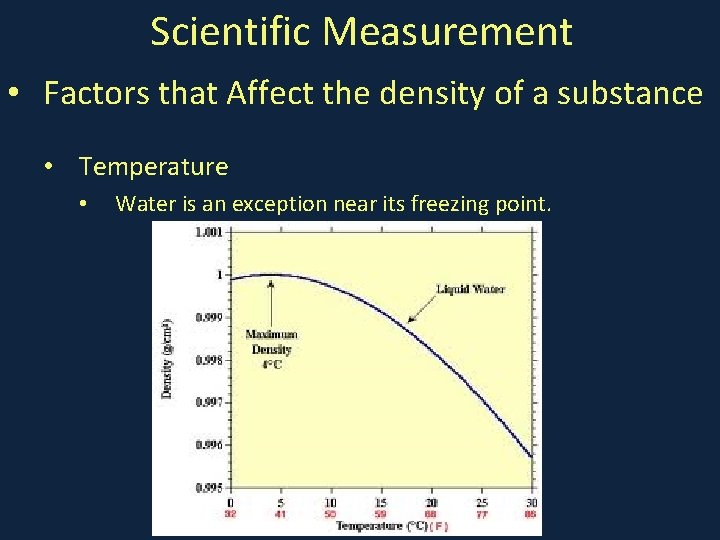
Scientific Measurement • Factors that Affect the density of a substance • Temperature • Water is an exception near its freezing point.
- Slides: 47