
Chapter 3 Scientific measurement 1 Types of observations
Chapter 3 Scientific measurement 1
Types of observations Qualitative- descriptive, but not true measurements – Hot – Large l Quantitative- describe with numbers and units – 100 C – 15 meters l 2

Types of observations Scientists prefer l Quantitative – More precise – No bias – testable l 3
How good are the measurements? Scientists use two word to describe how good the measurements arel Accuracy- how close the measurement is to the actual value. l Precision- how well can the measurement be repeated. l 4
Differences Accuracy can be true of an individual measurement or the average of several. l Precision requires several measurements before anything can be said about it. l examples l 5
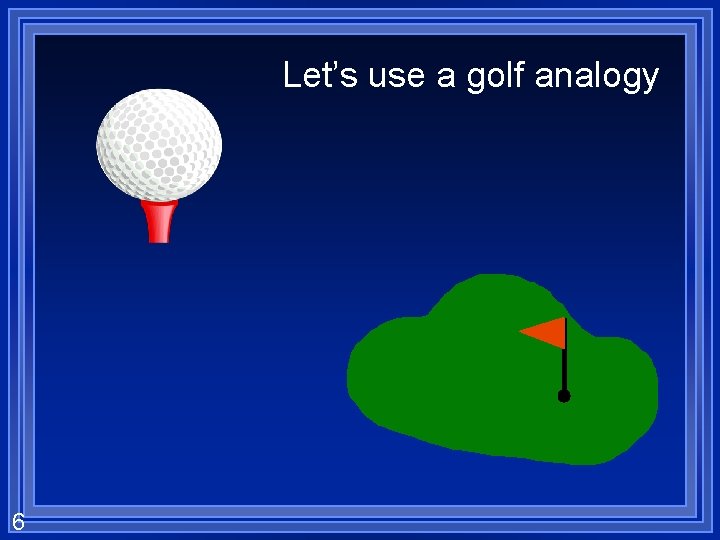
Let’s use a golf analogy 6
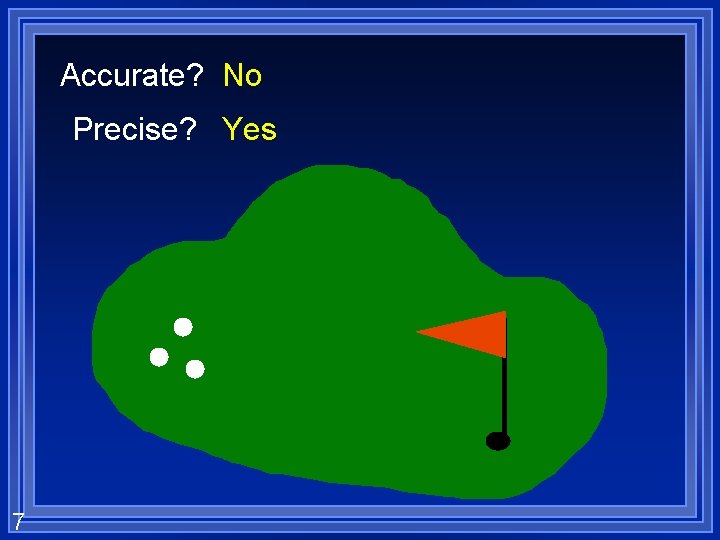
Accurate? No Precise? Yes 7
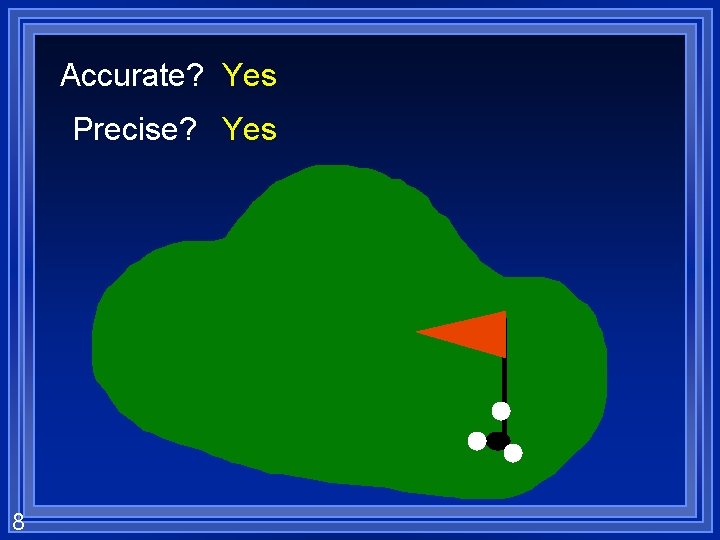
Accurate? Yes Precise? Yes 8
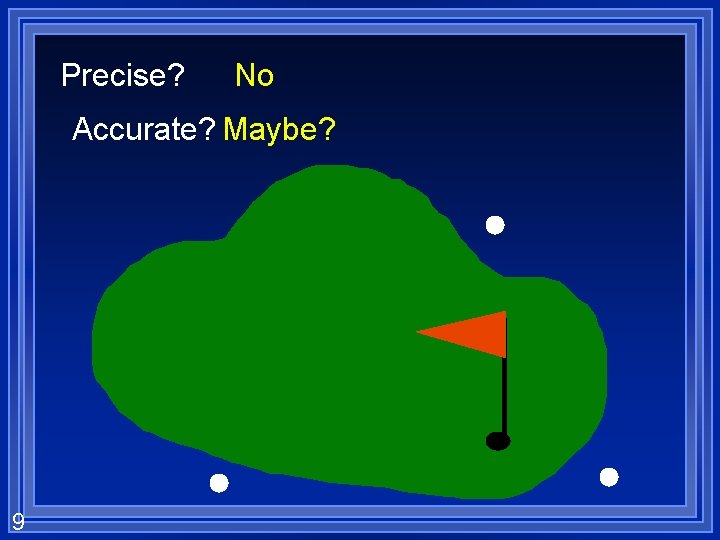
Precise? No Accurate? Maybe? 9
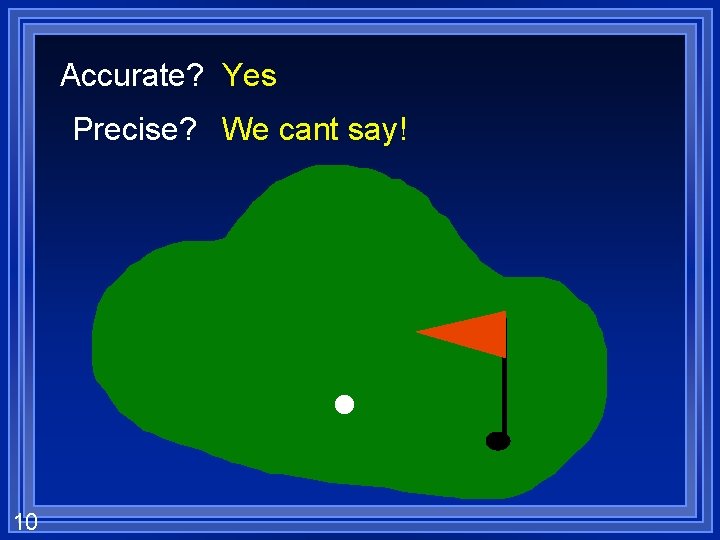
Accurate? Yes Precise? We cant say! 10
In terms of measurement Three students measure the room to be 10. 2 m, 10. 3 m and 10. 4 m across. l Were they precise? l Were they accurate? l 11
Error Accepted value – The right answer – Based on reliable references l Experimental Value- what you get in lab l Error = experimental value – accepted value l Can be negative l 12
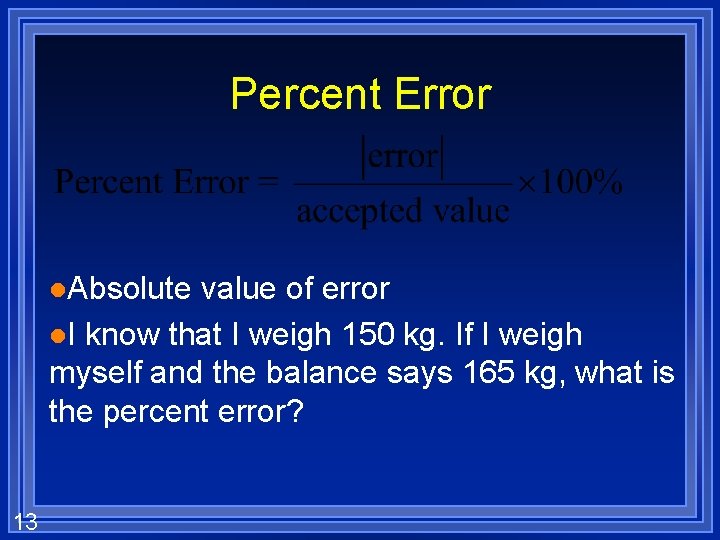
Percent Error l. Absolute value of error l. I know that I weigh 150 kg. If I weigh myself and the balance says 165 kg, what is the percent error? 13
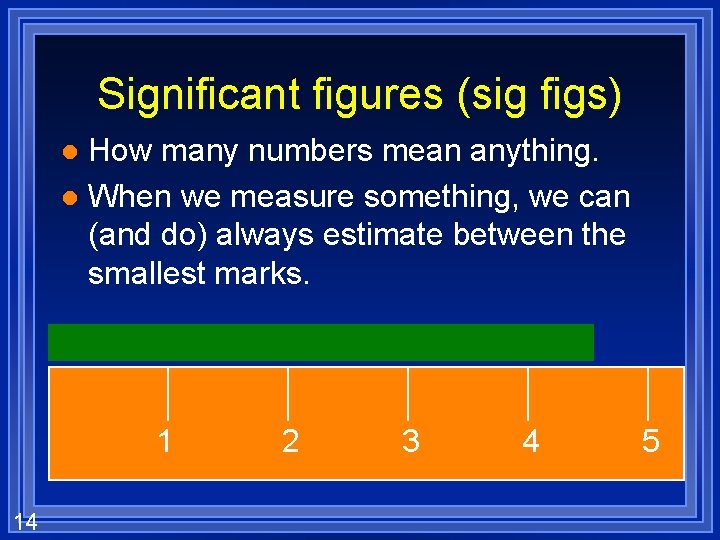
Significant figures (sig figs) How many numbers mean anything. l When we measure something, we can (and do) always estimate between the smallest marks. l 1 14 2 3 4 5
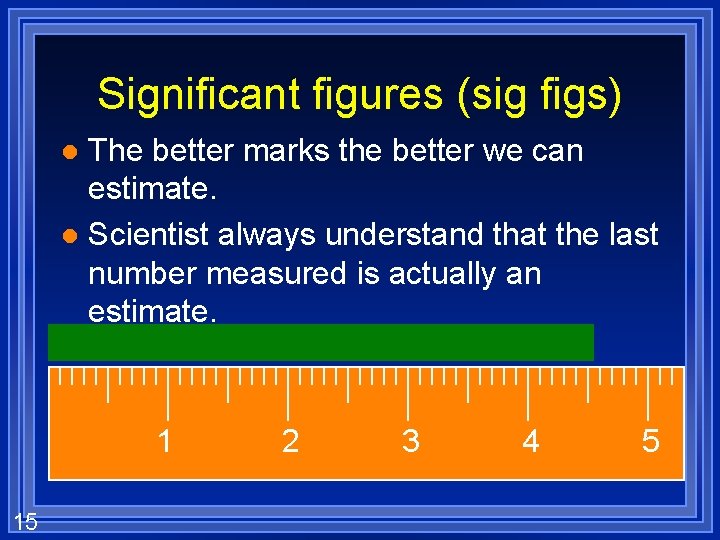
Significant figures (sig figs) The better marks the better we can estimate. l Scientist always understand that the last number measured is actually an estimate. l 1 15 2 3 4 5
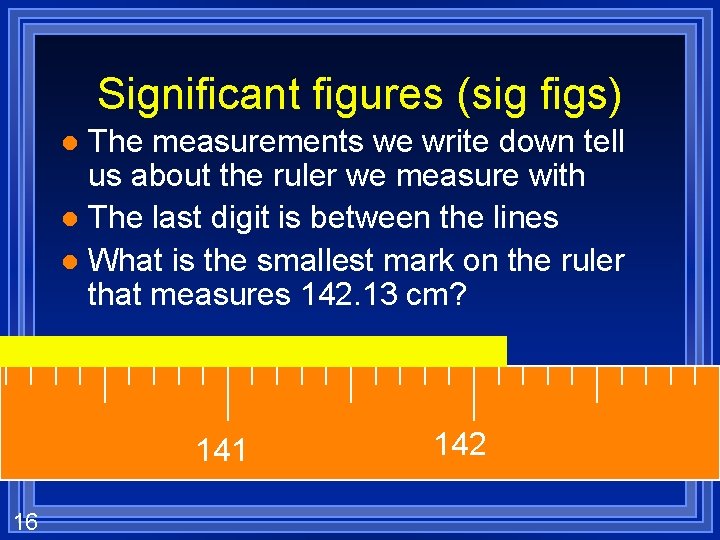
Significant figures (sig figs) The measurements we write down tell us about the ruler we measure with l The last digit is between the lines l What is the smallest mark on the ruler that measures 142. 13 cm? l 141 16 142
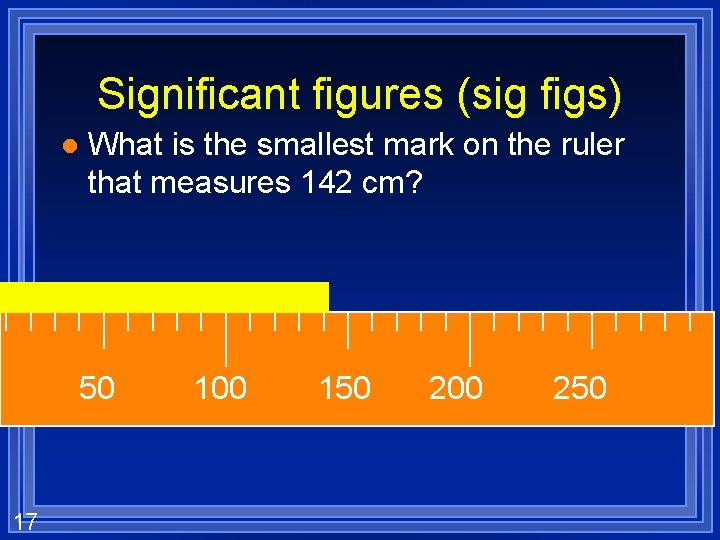
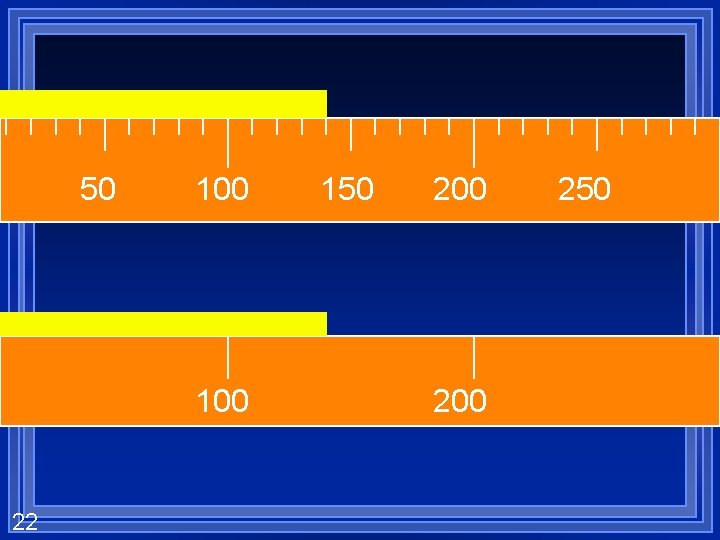
Significant figures (sig figs) l What is the smallest mark on the ruler that measures 142 cm? 50 17 100 150 200 250
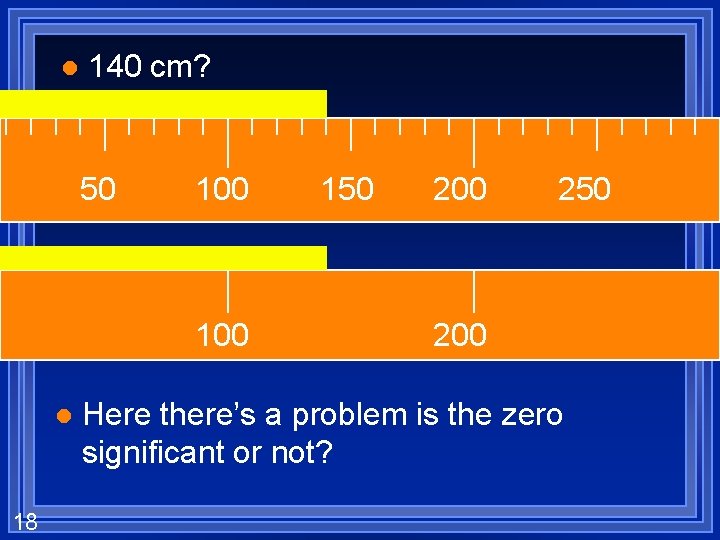
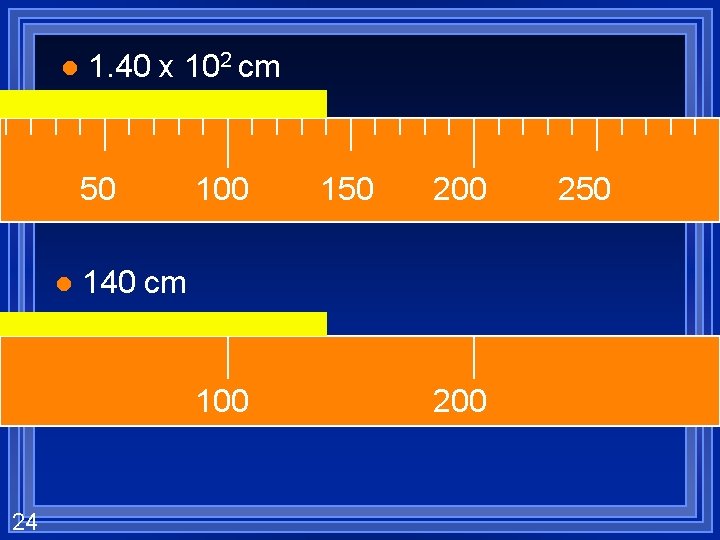
l 140 cm? 50 100 l 18 150 200 250 200 Here there’s a problem is the zero significant or not?
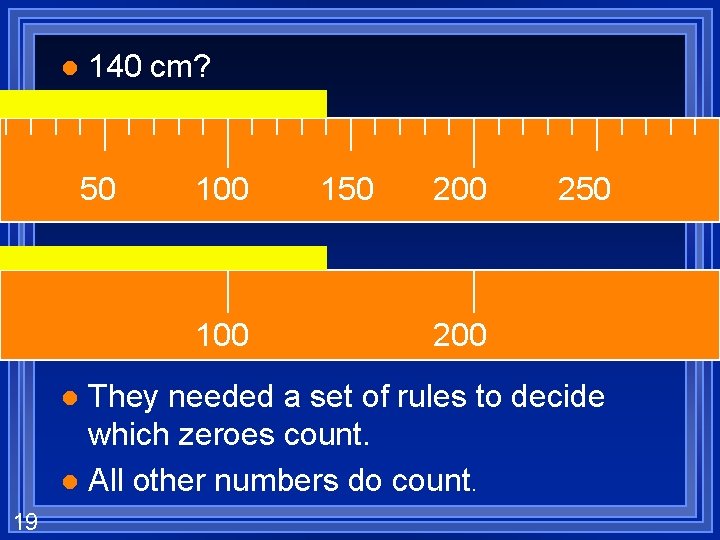
l 140 cm? 50 100 150 200 250 200 They needed a set of rules to decide which zeroes count. l All other numbers do count. l 19
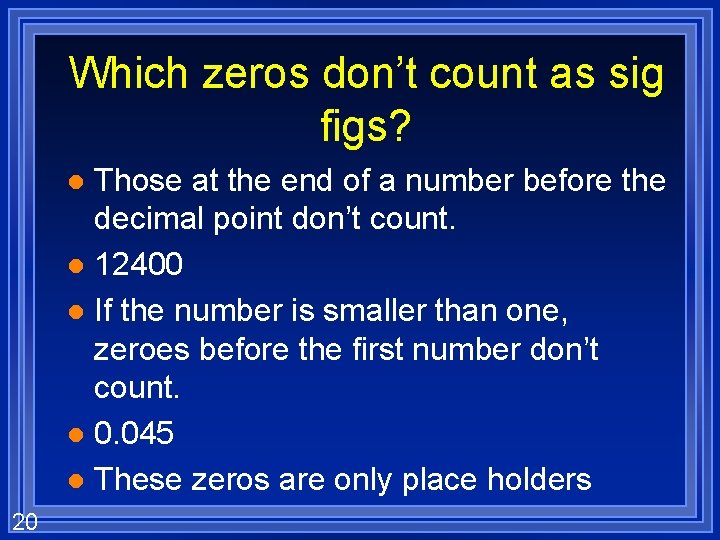
Which zeros don’t count as sig figs? Those at the end of a number before the decimal point don’t count. l 12400 l If the number is smaller than one, zeroes before the first number don’t count. l 0. 045 l These zeros are only place holders l 20
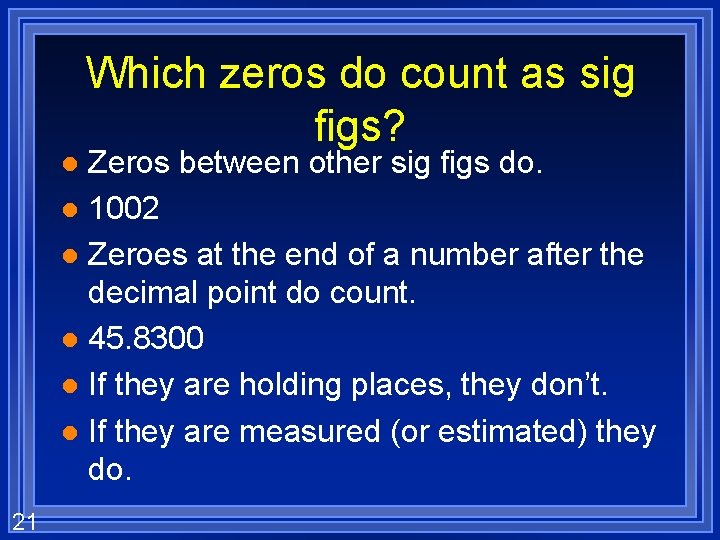
Which zeros do count as sig figs? Zeros between other sig figs do. l 1002 l Zeroes at the end of a number after the decimal point do count. l 45. 8300 l If they are holding places, they don’t. l If they are measured (or estimated) they do. l 21
50 100 22 150 200 250
Problem 50 is only 1 significant figure. l if it really has two, how can I write it? l A zero at the end only counts after the decimal place. l Scientific notation. l 5. 0 x 101 l now the zero counts. l 23
l 1. 40 x 102 cm 50 l 100 200 140 cm 100 24 150 200 250
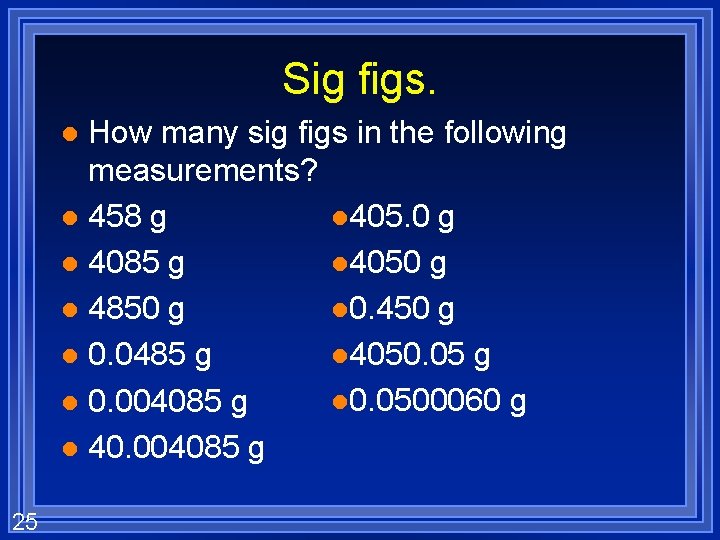
Sig figs. How many sig figs in the following measurements? l 405. 0 g l 458 g l 4050 g l 4085 g l 0. 450 g l 4850 g l 4050. 05 g l 0. 0485 g l 0. 0500060 g l 0. 004085 g l 40. 004085 g l 25
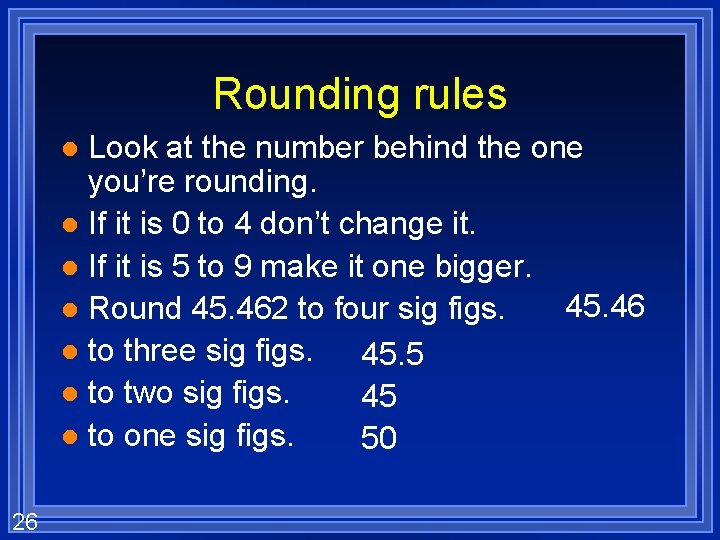
Rounding rules Look at the number behind the one you’re rounding. l If it is 0 to 4 don’t change it. l If it is 5 to 9 make it one bigger. 45. 46 l Round 45. 462 to four sig figs. l to three sig figs. 45. 5 l to two sig figs. 45 l to one sig figs. 50 l 26
Numbers without sig figs Counted numbers – 12 eggs in a dozen – 32 students in a class l Definitions – 1 m = 100 cm – 16 ounces is 1 pound l No estimated numbers l Unlimited significant figures l 27
Scientific notation All non-zero digits in scientific notation are significant figures. l Any ending zero will be after the decimal point to be significant l 1. 20 x 103 l Sometimes you must write in scientific notation to use the correct sig figs. l 28
Watch the Sig Figs When rounding, you don’t change the size of the number. l You should end up with a number about the same size. l Use place holders- they’re not significant. – Round 15253 to 3 sig figs 15300 – Round 0. 028965 to 3 sig figs 0. 0290 l 29
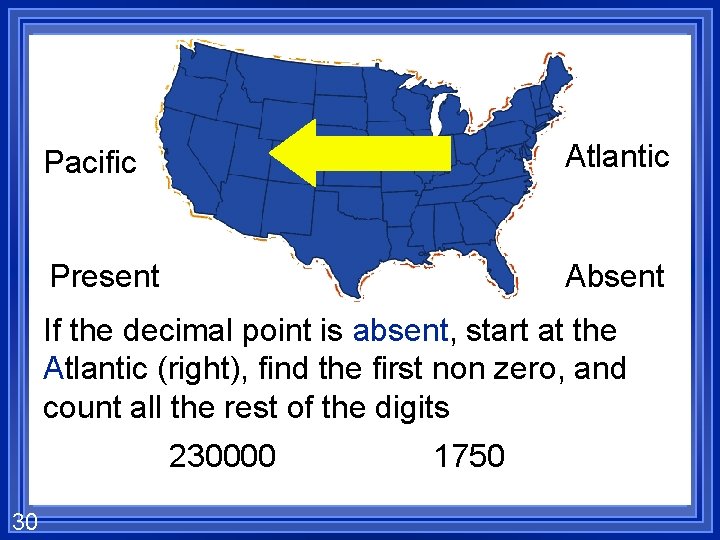
Pacific Atlantic Present Absent If the decimal point is absent, start at the Atlantic (right), find the first non zero, and count all the rest of the digits 230000 30 1750
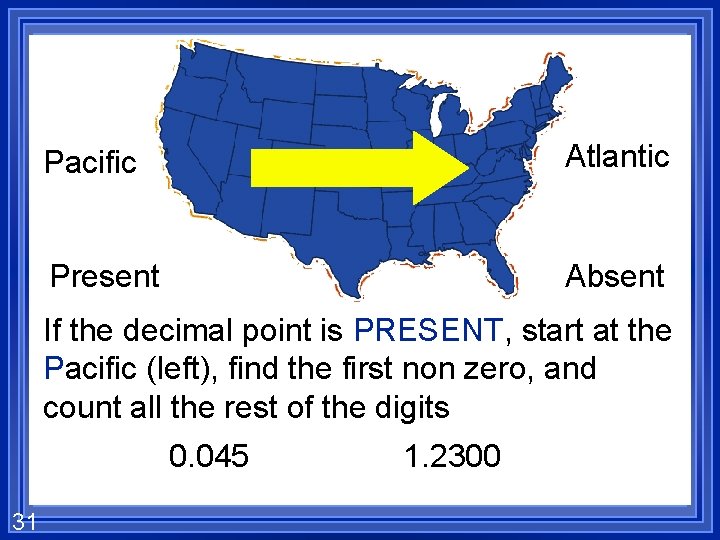
Pacific Atlantic Present Absent If the decimal point is PRESENT, start at the Pacific (left), find the first non zero, and count all the rest of the digits 0. 045 31 1. 2300
Using your calculator with scientific notation EE and EXP button stand for x 10 to the l 4. 5 x 10 -4 l push 4. 5 l push either EXP or EE l push 4 +/- or -4 l see what your display says. l 32
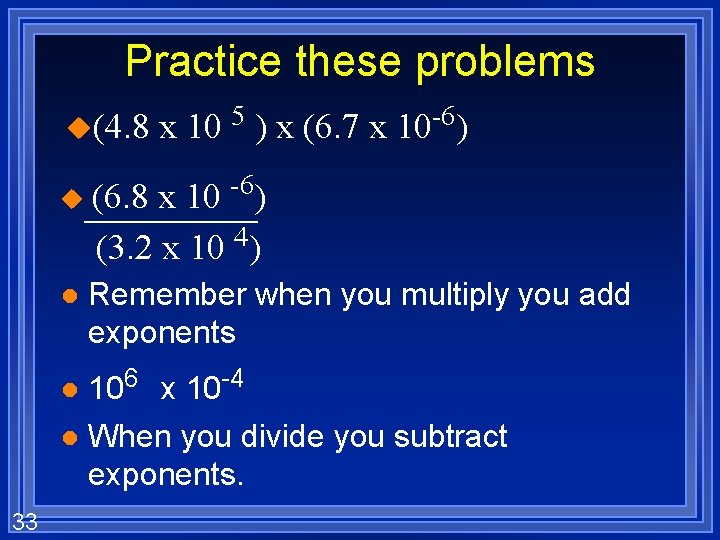
Practice these problems u(4. 8 u l x 10 5 ) x (6. 7 x 10 -6) (6. 8 x 10 -6) (3. 2 x 10 4) Remember when you multiply you add exponents 106 x 10 -4 l When you divide you subtract exponents. l 33
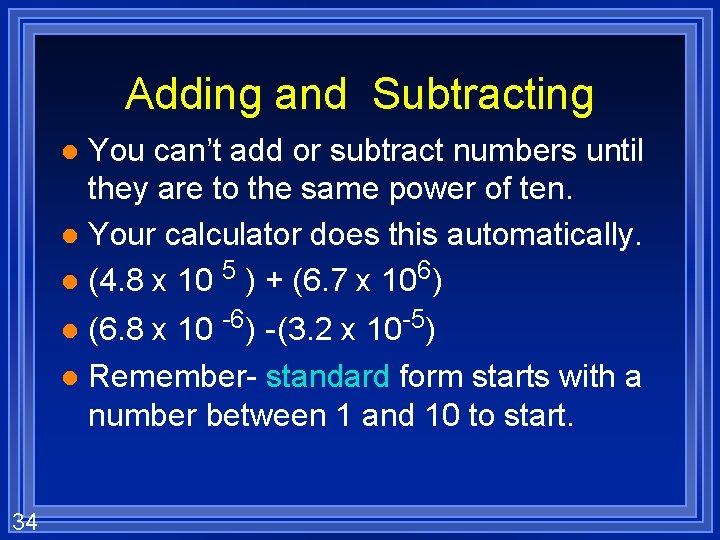
Adding and Subtracting You can’t add or subtract numbers until they are to the same power of ten. l Your calculator does this automatically. l (4. 8 x 10 5 ) + (6. 7 x 10⁶) l (6. 8 x 10 -6) -(3. 2 x 10 -5) l Remember- standard form starts with a number between 1 and 10 to start. l 34
Adding and subtracting with sig figs The last sig fig in a measurement is an estimate. l Your answer when you add or subtract can not be better than your worst estimate. l have to round it to the least place of the measurement in the problem. l 35
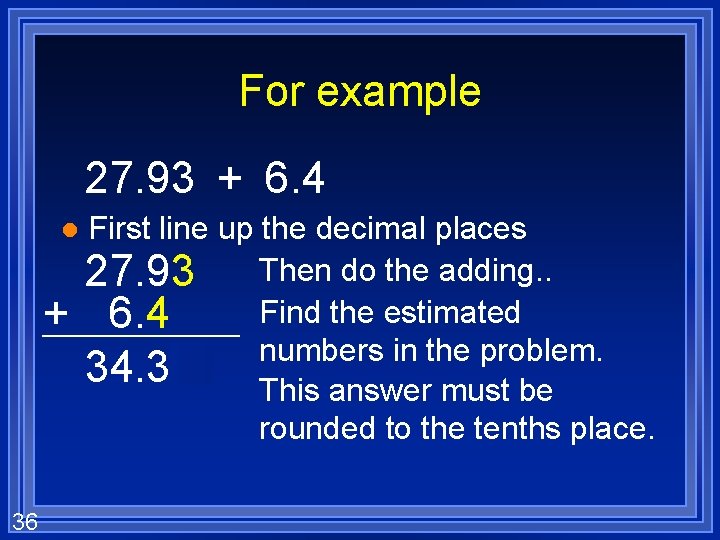
For example 27. 93 + 6. 4 l + 36 First line up the decimal places 27. 93 Then do the adding. . Find the estimated 6. 4 numbers in the problem. 34. 33 This answer must be rounded to the tenths place.
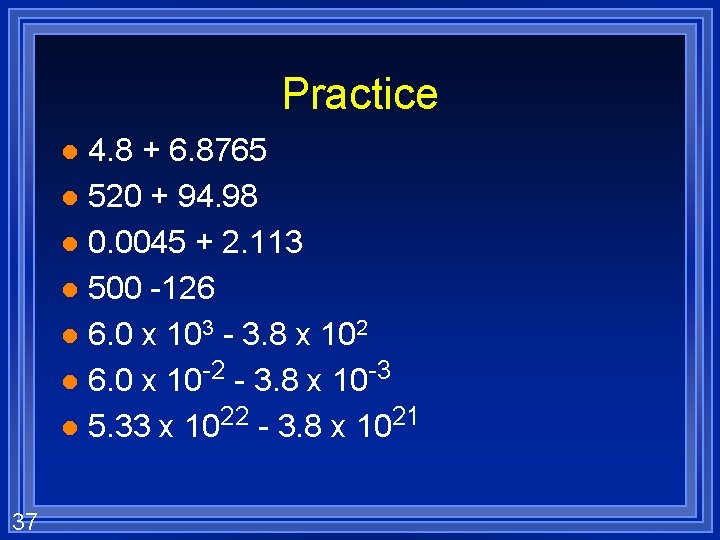
Practice 4. 8 + 6. 8765 l 520 + 94. 98 l 0. 0045 + 2. 113 l 500 -126 l 6. 0 x 103 - 3. 8 x 10² l 6. 0 x 10 -2 - 3. 8 x 10 -3 l 5. 33 x 1022 - 3. 8 x 10²¹ l 37
Multiplication and Division Rule is simpler l Same number of sig figs in the answer as the least in the question l 3. 6 x 653 l 2350. 8 l 3. 6 has 2 s. f. 653 has 3 s. f. l answer can only have 2 s. f. l 2400 l 38
Multiplication and Division Same rules for division. l practice l 4. 5 / 6. 245 l 4. 5 x 6. 245 l 9. 8764 x. 043 l 3. 876 / 1980 l 16547 / 710 l 39
The Metric System 40
Measuring The numbers are only half of a measurement. l It is 10 long. l 10 what? l Numbers without units are meaningless. l How many feet in a yard? l A mile? l A rod? l 41
The Metric System Easier to use because it is a decimal system. l Every conversion is by some power of 10. l A metric unit has two parts. l A prefix and a base unit. l prefix tells you how many times to divide or multiply by 10. l 42
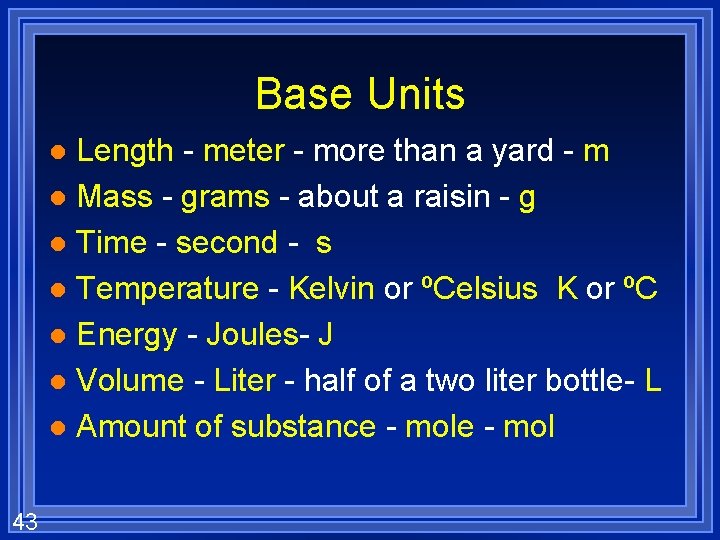
Base Units Length - meter - more than a yard - m l Mass - grams - about a raisin - g l Time - second - s l Temperature - Kelvin or ºCelsius K or ºC l Energy - Joules- J l Volume - Liter - half of a two liter bottle- L l Amount of substance - mol l 43
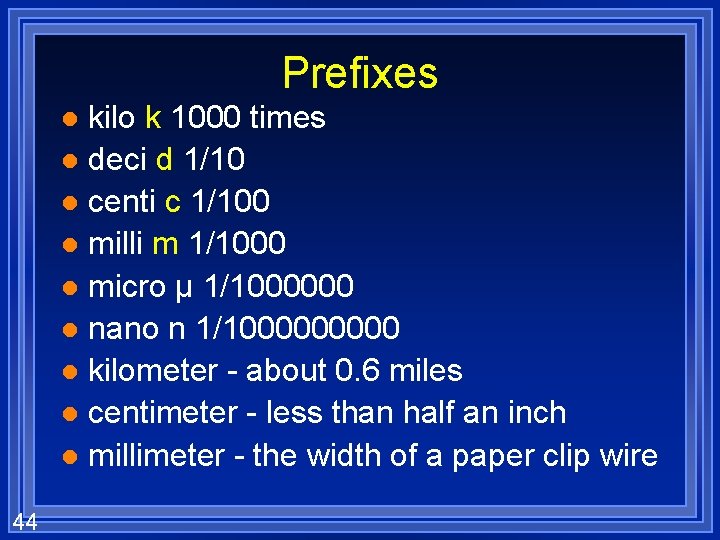
Prefixes kilo k 1000 times l deci d 1/10 l centi c 1/100 l milli m 1/1000 l micro μ 1/1000000 l nano n 1/100000 l kilometer - about 0. 6 miles l centimeter - less than half an inch l millimeter - the width of a paper clip wire l 44
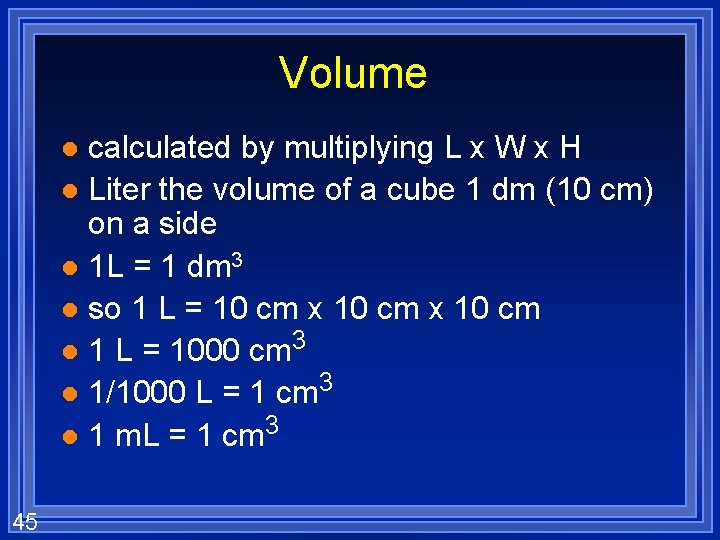
Volume calculated by multiplying L x W x H l Liter the volume of a cube 1 dm (10 cm) on a side l 1 L = 1 dm 3 l so 1 L = 10 cm x 10 cm l 1 L = 1000 cm 3 l 1/1000 L = 1 cm 3 l 1 m. L = 1 cm 3 l 45
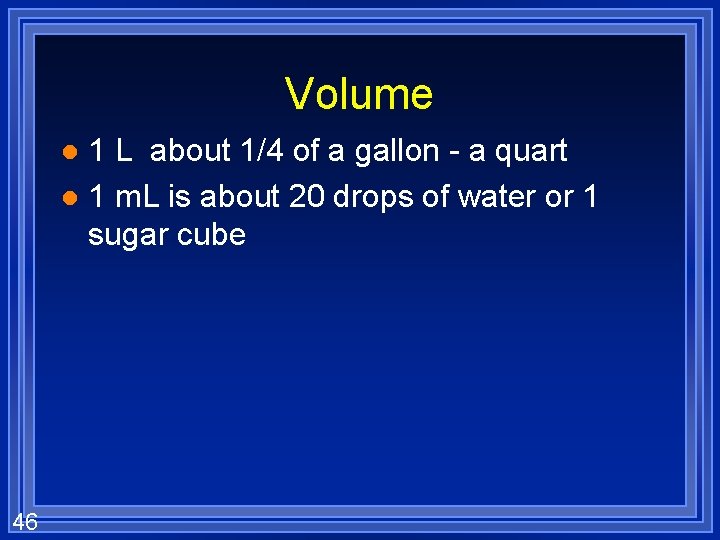
Volume 1 L about 1/4 of a gallon - a quart l 1 m. L is about 20 drops of water or 1 sugar cube l 46
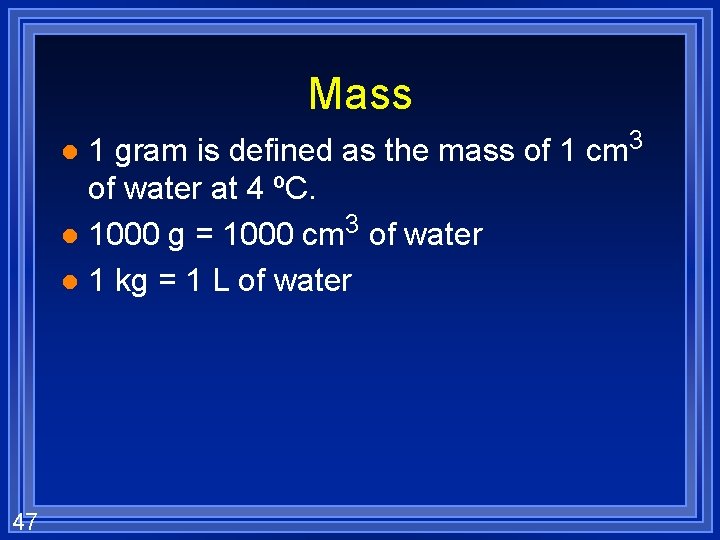
Mass 1 gram is defined as the mass of 1 cm 3 of water at 4 ºC. l 1000 g = 1000 cm 3 of water l 1 kg = 1 L of water l 47
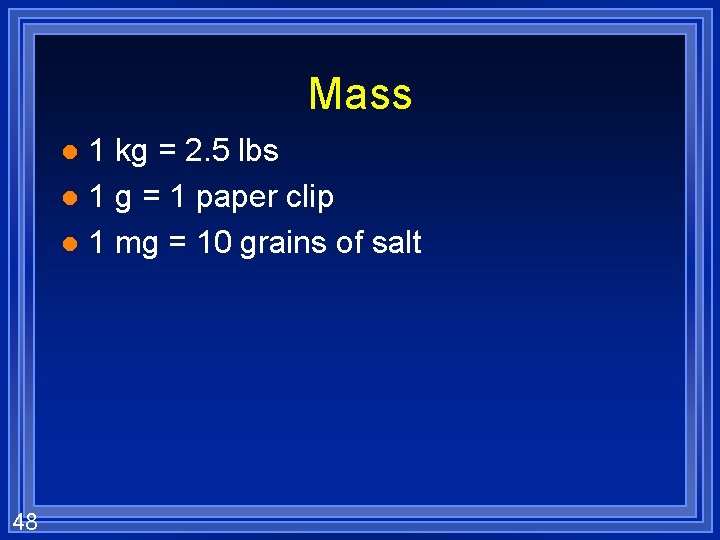
Mass 1 kg = 2. 5 lbs l 1 g = 1 paper clip l 1 mg = 10 grains of salt l 48
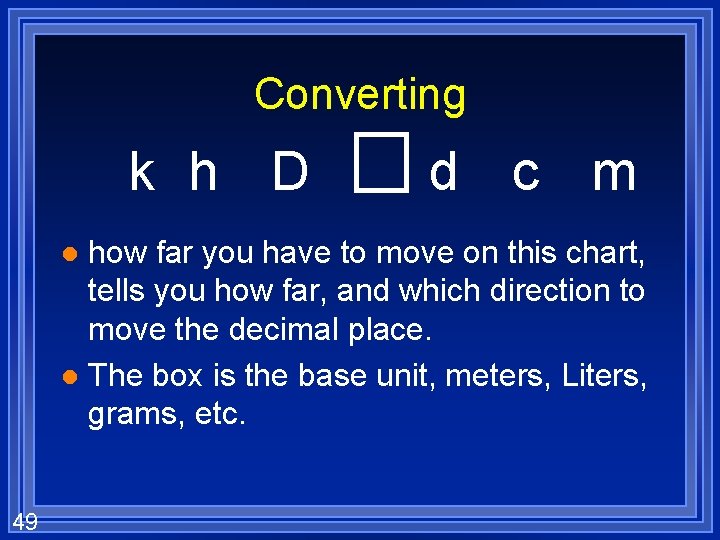
Converting k h D d c m how far you have to move on this chart, tells you how far, and which direction to move the decimal place. l The box is the base unit, meters, Liters, grams, etc. l 49
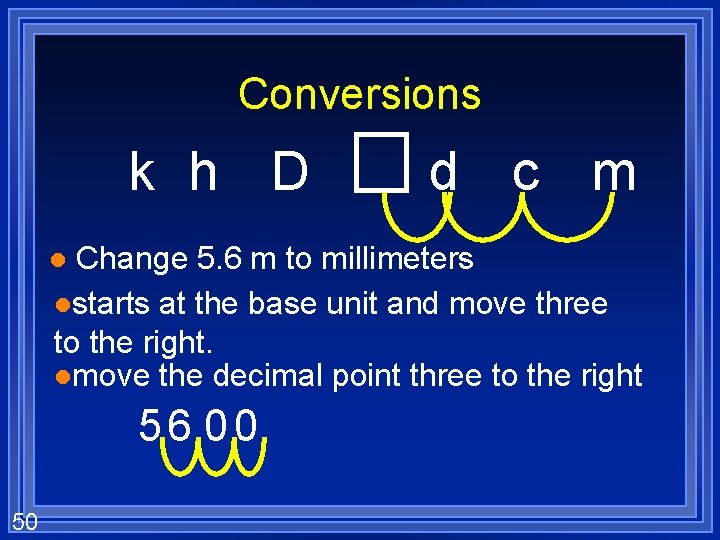
Conversions k h D d c m Change 5. 6 m to millimeters lstarts at the base unit and move three to the right. lmove the decimal point three to the right l 56 00 50
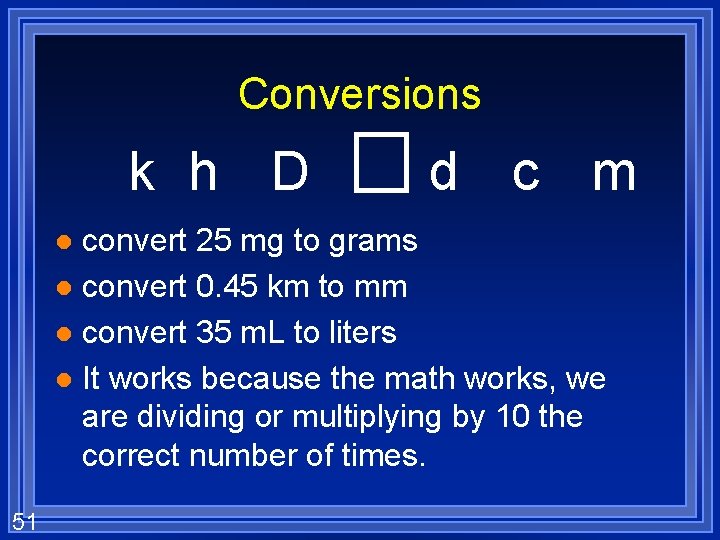
Conversions k h D d c m convert 25 mg to grams l convert 0. 45 km to mm l convert 35 m. L to liters l It works because the math works, we are dividing or multiplying by 10 the correct number of times. l 51
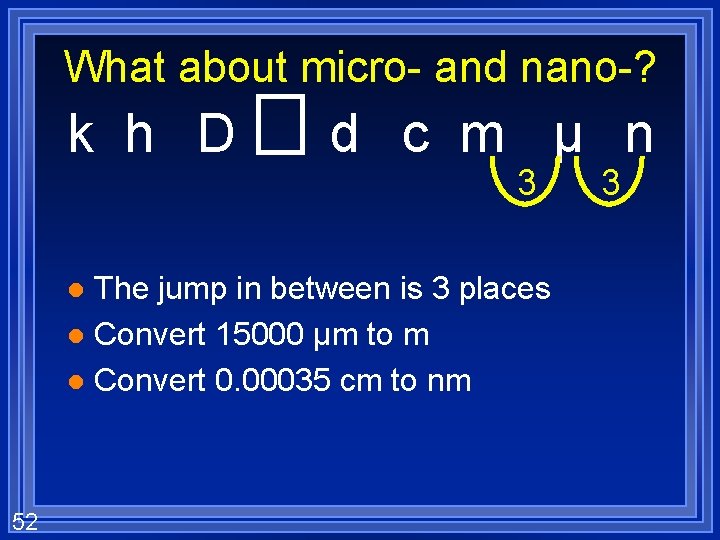
What about micro- and nano-? k h D d c m μ n 3 The jump in between is 3 places l Convert 15000 μm to m l Convert 0. 00035 cm to nm l 52 3
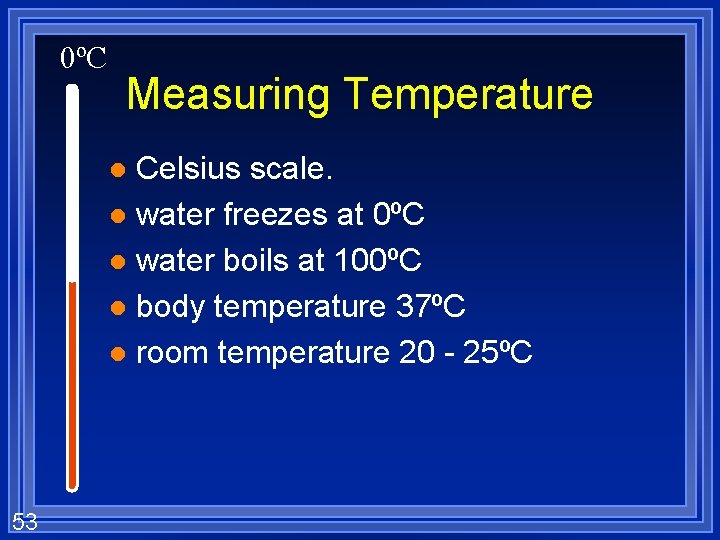
0ºC Measuring Temperature Celsius scale. l water freezes at 0ºC l water boils at 100ºC l body temperature 37ºC l room temperature 20 - 25ºC l 53
273 K Measuring Temperature Kelvin starts at absolute zero (-273 º C) l degrees are the same size l C = K -273 l K = C + 273 l Kelvin is always bigger. l Kelvin can never be negative. l 54
Temperature is different from heat. l Temperature is which way heat will flow. (from hot to cold) l Heat is energy, ability to do work. l A drop of boiling water hurts, l kilogram of boiling water kills. l 55
Units of energy are calories or Joules l 1 calorie is the amount of heat needed to raise the temperature of 1 gram of water by 1ºC. l A food Calorie is really a kilocalorie. l 1 calorie = 4. 18 J l 56
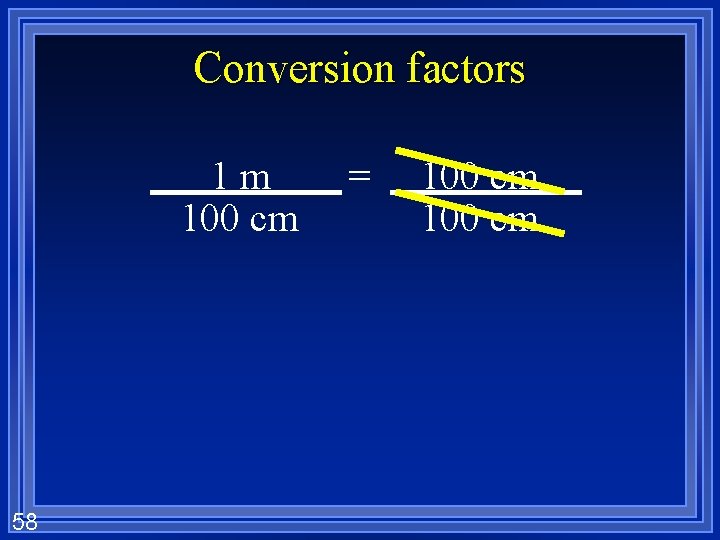
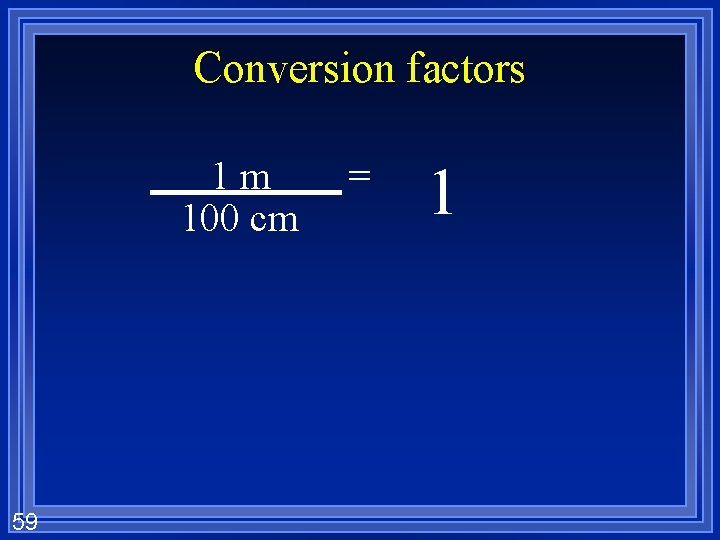
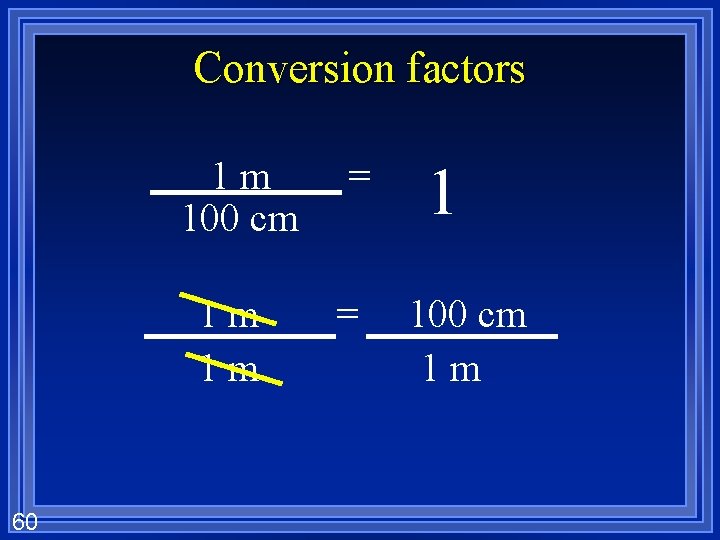
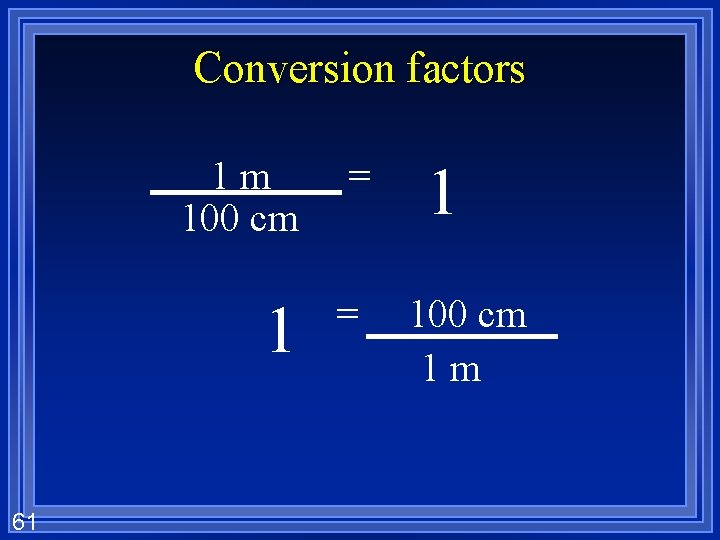
Conversion factors “A ratio of equivalent measurements. ” l Start with two things that are the same. 1 m = 100 cm l Can divide by each side to come up with two ways of writing the number 1. l 57
Conversion factors 1 m 100 cm 58 = 100 cm
Conversion factors 1 m 100 cm 59 = 1
Conversion factors 60 1 m 100 cm = 1 m 1 m = 1 100 cm 1 m
Conversion factors 61 1 m 100 cm = 1 100 cm 1 m
Conversion factors A unique way of writing the number 1. l In the same system they are defined quantities so they have unlimited significant figures. l Equivalence statements always have this relationship. l big # small unit = small # big unit l 1000 mm = 1 m l 62
Write the conversion factors for the following kilograms to grams l feet to inches l 1. 096 qt. = 1. 00 L l 63
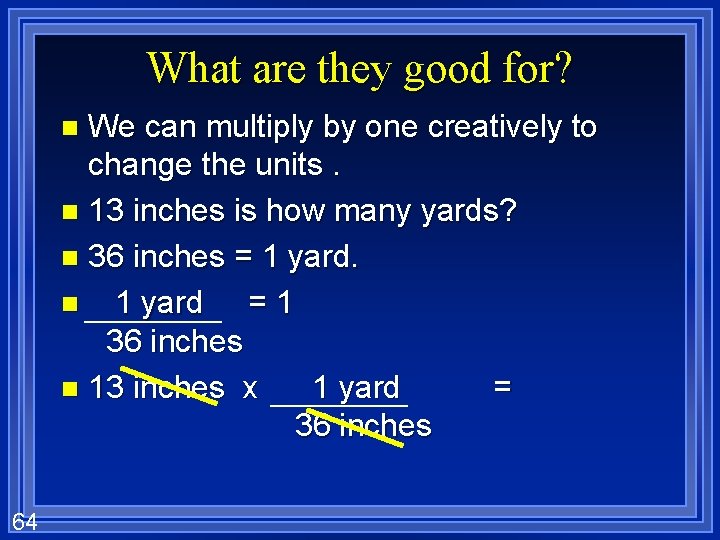
What are they good for? We can multiply by one creatively to change the units. n 13 inches is how many yards? n 36 inches = 1 yard. n 1 yard =1 36 inches n 13 inches x 1 yard = 36 inches n 64
Conversion factors Called conversion factors because they allow us to convert units. l Really just multiplying by one, in a creative way. l Choose the conversion factor that gets rid of the unit you don’t want. l 65
Dimensional Analysis Dimension = unit l Analyze = solve l Using the units to solve the problems. l If the units of your answer are right, chances are you did the math right. l 66
Dimensional Analysis Using with metric units l Need to know equivalence statements l If it has a prefix, get rid of it with one conversion factor l To add a prefix use a conversion factor l 67
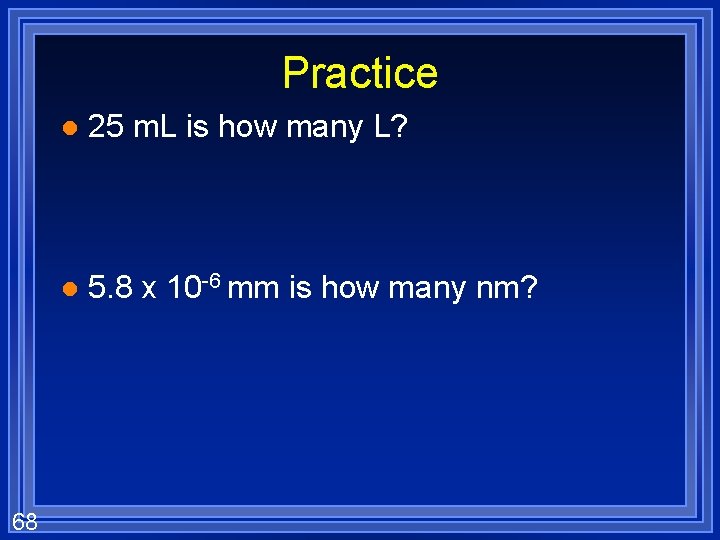
Practice 68 l 25 m. L is how many L? l 5. 8 x 10 -6 mm is how many nm?
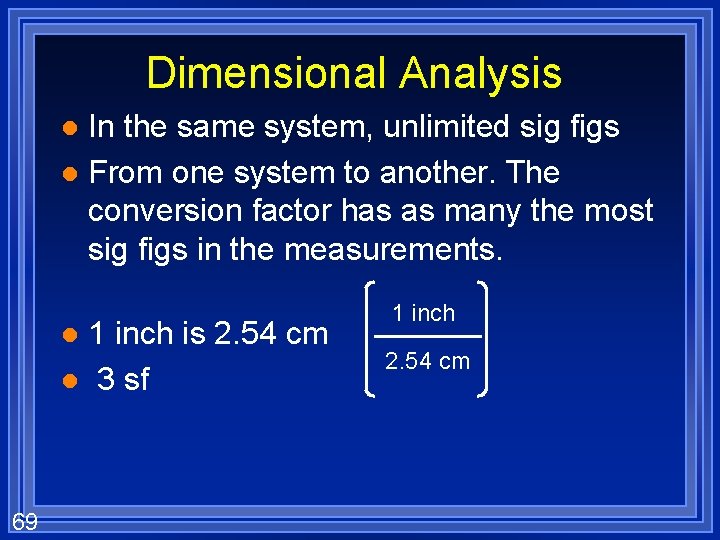
Dimensional Analysis In the same system, unlimited sig figs l From one system to another. The conversion factor has as many the most sig figs in the measurements. l 1 inch is 2. 54 cm l 3 sf l 69 1 inch 2. 54 cm
Dimensional Analysis l 70 A race is 10. 0 km long. How far is this in miles? – 1 mile = 1760 yds – 1 meter = 1. 094 yds
Dimensional Analysis l 71 Pikes peak is 14, 110 ft above sea level. What is this in meters? – 1 mile = 1760 yds – 1 meter = 1. 094 yds
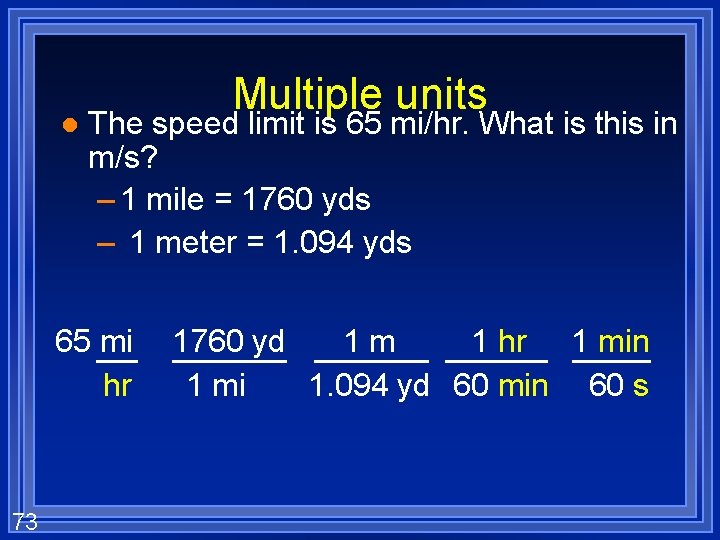
l The speed limit is 65 mi/hr. What is this in m/s? – 1 mile = 1760 yds – 1 meter = 1. 094 yds 65 mi hr 73 Multiple units 1760 yd 1 m 1 hr 1 min 1 mi 1. 094 yd 60 min 60 s
Multiple units l 74 Lead has a density of 11. 4 g/m. L. What is this in pounds per quart? – 454 g = 1 lb – 1 L = 1. 06 qt
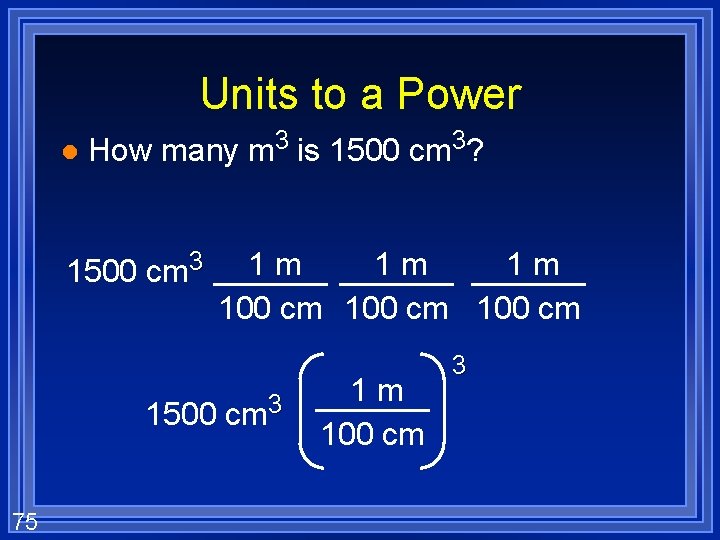
Units to a Power l How many m 3 is 1500 cm 3? 1500 cm 3 1500 75 1 m 1 m 1 m 100 cm cm 3 1 m 100 cm 3
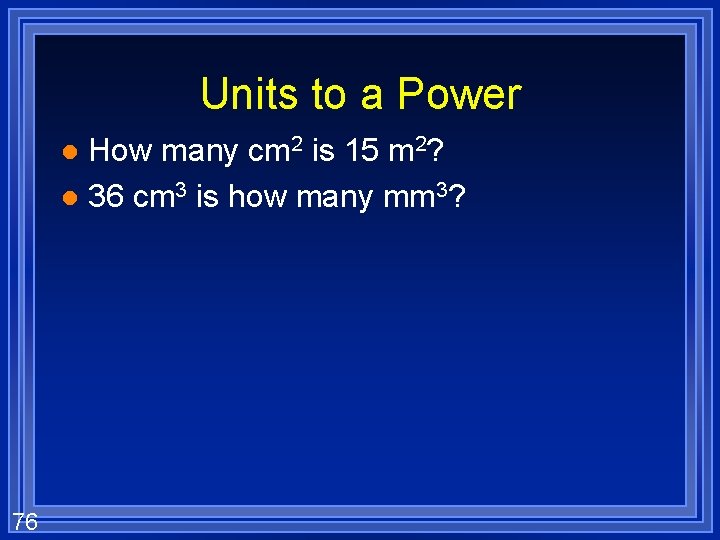
Units to a Power How many cm 2 is 15 m 2? l 36 cm 3 is how many mm 3? l 76
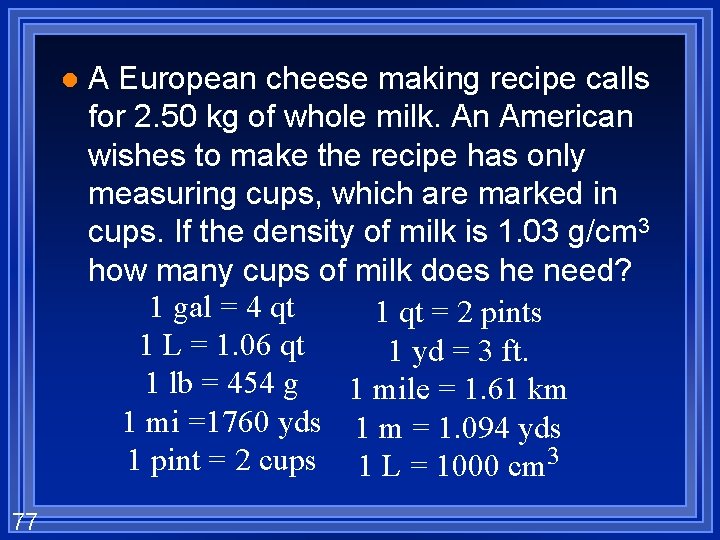
l 77 A European cheese making recipe calls for 2. 50 kg of whole milk. An American wishes to make the recipe has only measuring cups, which are marked in cups. If the density of milk is 1. 03 g/cm 3 how many cups of milk does he need? 1 gal = 4 qt 1 qt = 2 pints 1 L = 1. 06 qt 1 yd = 3 ft. 1 lb = 454 g 1 mile = 1. 61 km 1 mi =1760 yds 1 m = 1. 094 yds 1 pint = 2 cups 1 L = 1000 cm 3
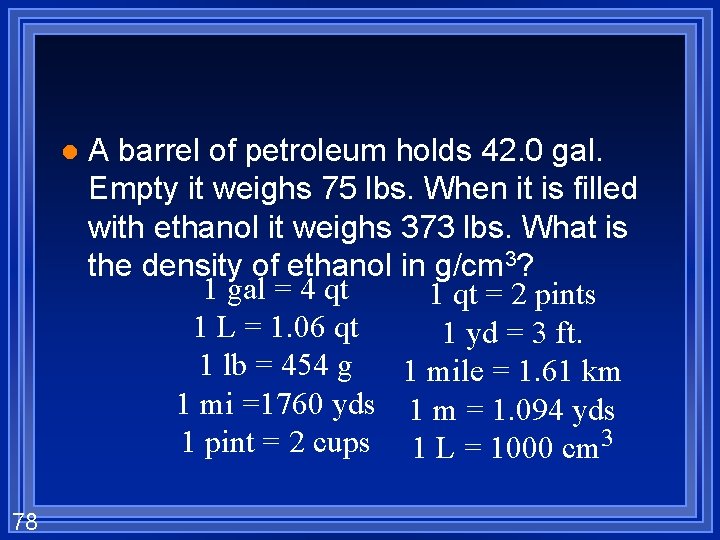
l 78 A barrel of petroleum holds 42. 0 gal. Empty it weighs 75 lbs. When it is filled with ethanol it weighs 373 lbs. What is the density of ethanol in g/cm 3? 1 gal = 4 qt 1 qt = 2 pints 1 L = 1. 06 qt 1 yd = 3 ft. 1 lb = 454 g 1 mile = 1. 61 km 1 mi =1760 yds 1 m = 1. 094 yds 1 pint = 2 cups 1 L = 1000 cm 3
Which is heavier? it depends 79
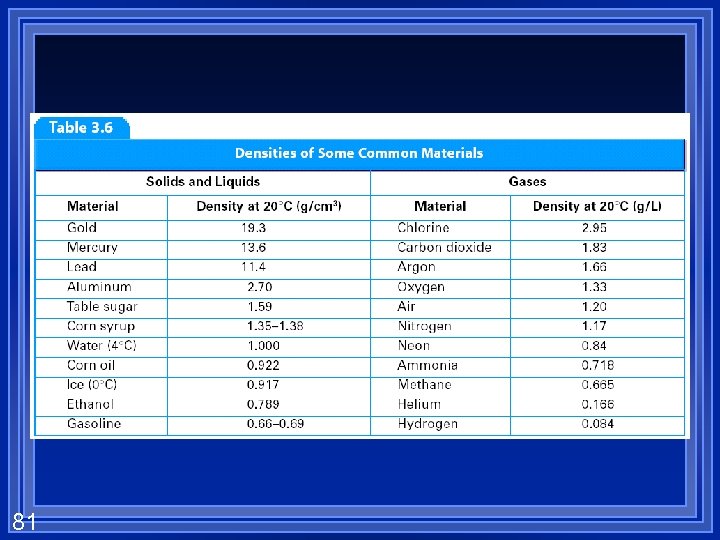
Density How heavy something is for its size. l The ratio of mass to volume for a substance. l. D=M/V l Independent of how much of it you have l gold - high density l air low density. l Table 3. 6 pg 90 l 80
81
Calculating The formula tells you how. l Units will be g/m. L or g/cm 3 l A piece of wood has a mass of 11. 2 g and a volume of 23 m. L what is the density? l A piece of wood has a density of 0. 93 g/m. L and a volume of 23 m. L what is the mass? l 82
Calculating A piece of wood has a density of 0. 93 g/m. L and a mass of 23 g what is the volume? l The units must always work out. l Algebra 1 l Get the thing you want on the top, l Then get it by itself. l What ever you do to one side, do to the other. l 83
Floating Lower density floats on higher density. l Ice is less dense than water. l Most wood is less dense than water. l Helium is less dense than air. l A ship is less dense than water. l 84
Density of water 1 g of water is 1 m. L of water. l density of water is 1 g/m. L l at 4ºC l otherwise it is less l 85
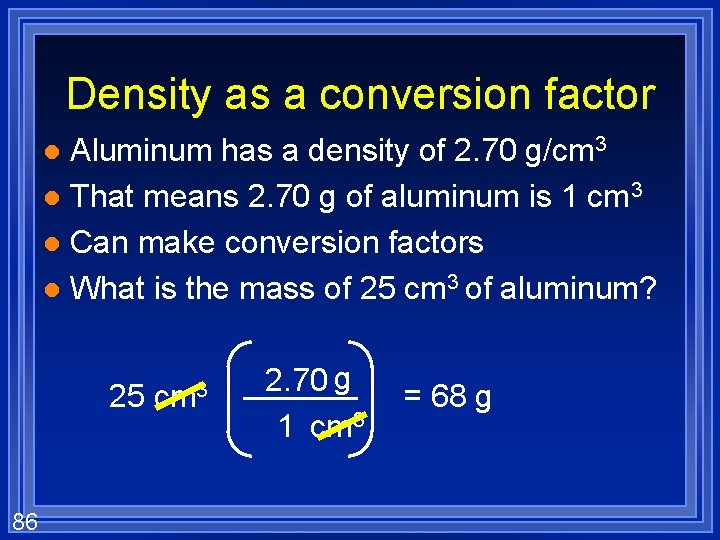
Density as a conversion factor Aluminum has a density of 2. 70 g/cm 3 l That means 2. 70 g of aluminum is 1 cm 3 l Can make conversion factors l What is the mass of 25 cm 3 of aluminum? l 25 86 cm 3 2. 70 g 1 cm 3 = 68 g
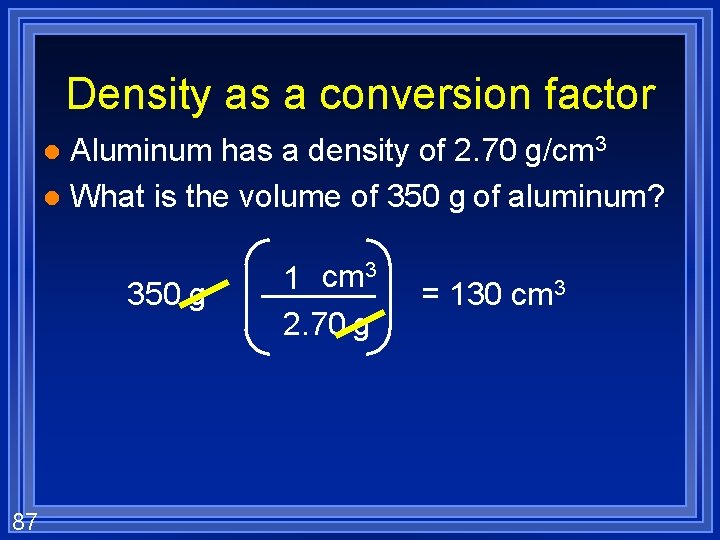
Density as a conversion factor Aluminum has a density of 2. 70 g/cm 3 l What is the volume of 350 g of aluminum? l 350 g 87 1 cm 3 2. 70 g = 130 cm 3
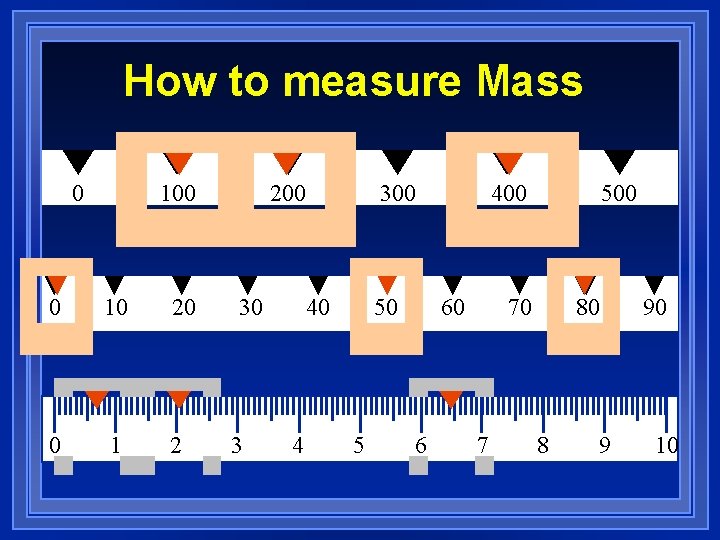
How to measure Mass 0 100 0 10 20 0 1 2 200 30 3 300 40 4 50 5 400 60 6 500 70 7 80 8 9 90 10
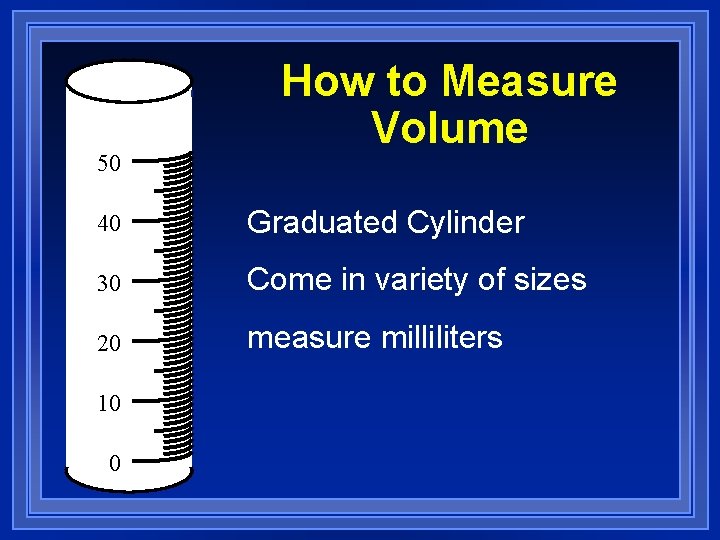
50 How to Measure Volume 40 Graduated Cylinder 30 Come in variety of sizes 20 measure milliliters 10 0
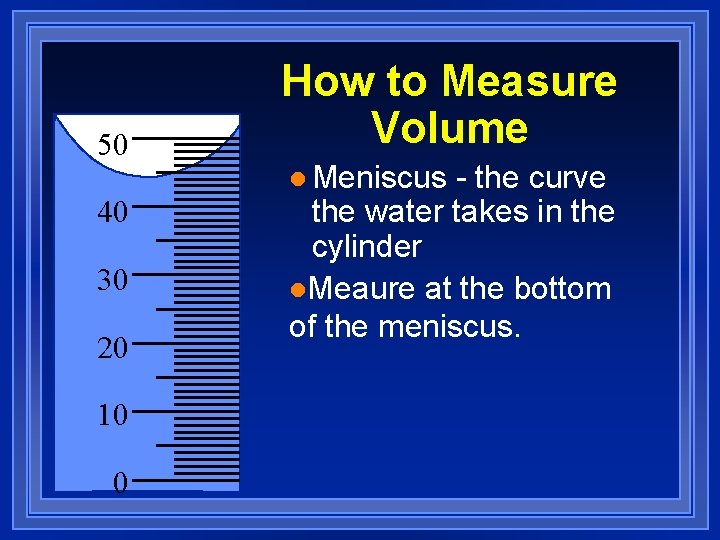
50 40 30 20 10 0 How to Measure Volume l Meniscus - the curve the water takes in the cylinder l. Meaure at the bottom of the meniscus.
Heat a form of energy 91
Some things heat up easily Some take a great deal of energy to change their temperature. l The Specific Heat Capacity amount of heat to change the temperature of 1 g of a substance by 1ºC. l specific heat- SH l l 92 S. H. = heat (cal) mass(g) x change in temp(ºC)
Specific Heat table page 42 l Water has a high specific heat l 1 cal/gºC l units will always be cal/gºC l or J/gºC l the amount of heat it takes to heat something is the same as the amount of heat it gives off when it cools because. . . l 93
Problems It takes 24. 3 calories to heat 15. 4 g of a metal from 22 ºC to 33ºC. What is the specific heat of the metal? l Iron has a specific heat of 0. 11 cal/gºC. How much heat will it take to change the temperature of 48. 3 g of iron by 32. 4ºC? l 94

95
- Slides: 94