
Chapter 3 Scanning Theory and Practice 1 Overview
![The regular expression for “identifier” is: letter → [a-z A-Z] digit → [0 -9]](https://slidetodoc.com/presentation_image/5313d70d111aabe9a0e582656d7b65c2/image-13.jpg "The regular expression for “identifier” is: letter → [a-z A-Z] digit → [0 -9]")
- Slides: 49
Chapter 3 Scanning – Theory and Practice 1
Overview of scanner • A scanner transforms a character stream of source file into a token stream. • It is also called a lexical analyzer. • Formal definitions allow a language designer to anticipate design flaws such as: – Virtually all languages specify certain kinds of rational constants. Such constants are often specified using decimal numerals such as 0. 1 and 10. 01. – Can. 1 or 10. be allowed? C, C++, Java say YES But, Pascal and Ada say NO Why? 1. . 10 (range 1 to 10) would have been recognized as 1. and. 10 two contants. 2
Regular expression • Regular expression is a convenient way to specify various sets of strings and it can specify the structure of the tokens used in a programming language. • A set of strings defined by a regular expression is called a regular set. 3
Regular expression (Cont. ) • The definition of regular expression starts with a finite character set, or vocabulary (denoted Σ) • An empty (null) string is allowed (denoted λ). It represents an empty buffer in which no characters have yet been matched. 4
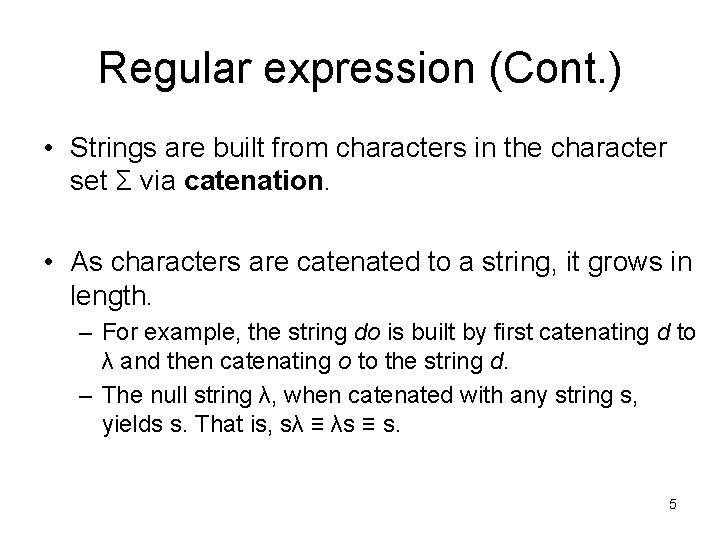
Regular expression (Cont. ) • Strings are built from characters in the character set Σ via catenation. • As characters are catenated to a string, it grows in length. – For example, the string do is built by first catenating d to λ and then catenating o to the string d. – The null string λ, when catenated with any string s, yields s. That is, sλ ≡ λs ≡ s. 5
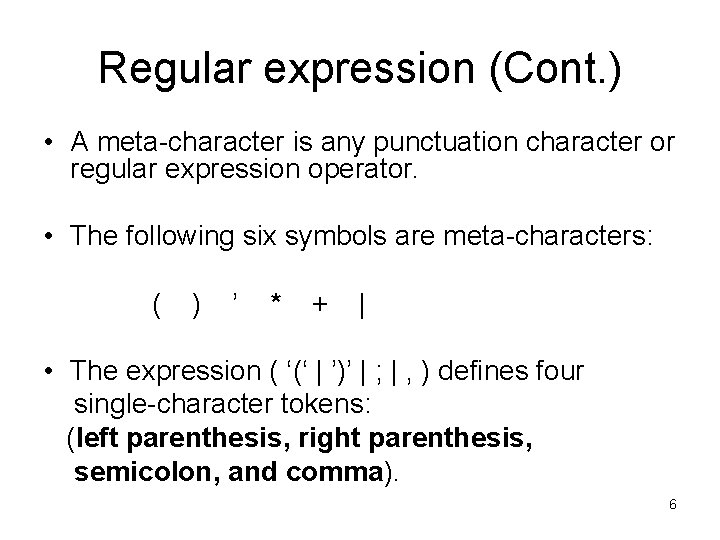
Regular expression (Cont. ) • A meta-character is any punctuation character or regular expression operator. • The following six symbols are meta-characters: ( ) ’ * + | • The expression ( ‘(‘ | ’)’ | ; | , ) defines four single-character tokens: (left parenthesis, right parenthesis, semicolon, and comma). 6
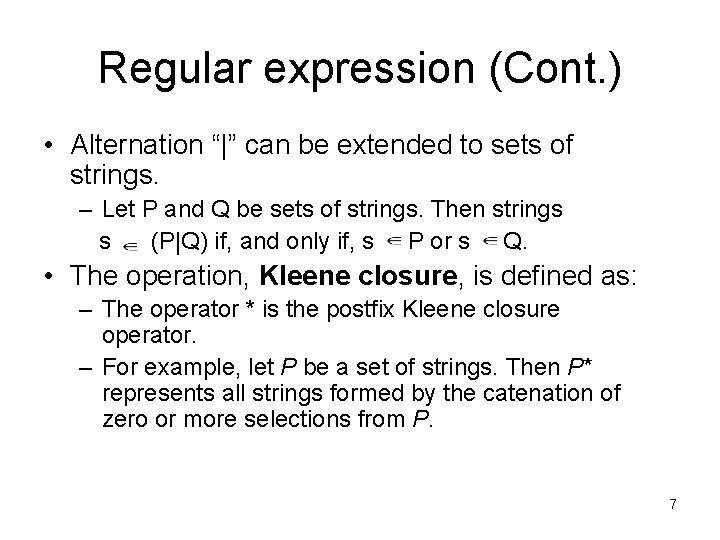
Regular expression (Cont. ) • Alternation “|” can be extended to sets of strings. – Let P and Q be sets of strings. Then strings s (P|Q) if, and only if, s P or s Q. • The operation, Kleene closure, is defined as: – The operator * is the postfix Kleene closure operator. – For example, let P be a set of strings. Then P* represents all strings formed by the catenation of zero or more selections from P. 7
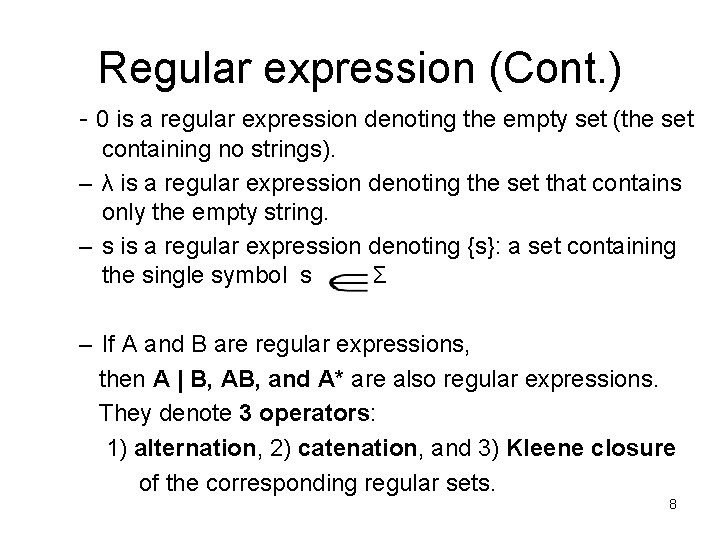
Regular expression (Cont. ) - 0 is a regular expression denoting the empty set (the set containing no strings). – λ is a regular expression denoting the set that contains only the empty string. – s is a regular expression denoting {s}: a set containing the single symbol s Σ – If A and B are regular expressions, then A | B, AB, and A* are also regular expressions. They denote 3 operators: 1) alternation, 2) catenation, and 3) Kleene closure of the corresponding regular sets. 8
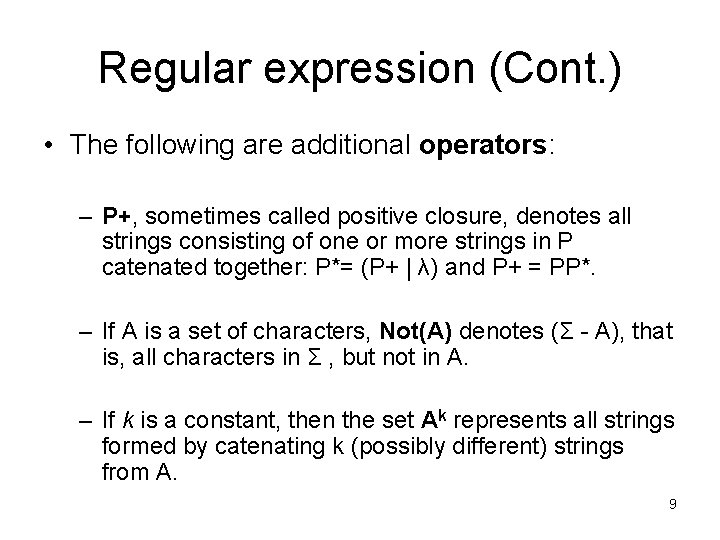
Regular expression (Cont. ) • The following are additional operators: – P+, sometimes called positive closure, denotes all strings consisting of one or more strings in P catenated together: P*= (P+ | λ) and P+ = PP*. – If A is a set of characters, Not(A) denotes (Σ - A), that is, all characters in Σ , but not in A. – If k is a constant, then the set Ak represents all strings formed by catenating k (possibly different) strings from A. 9
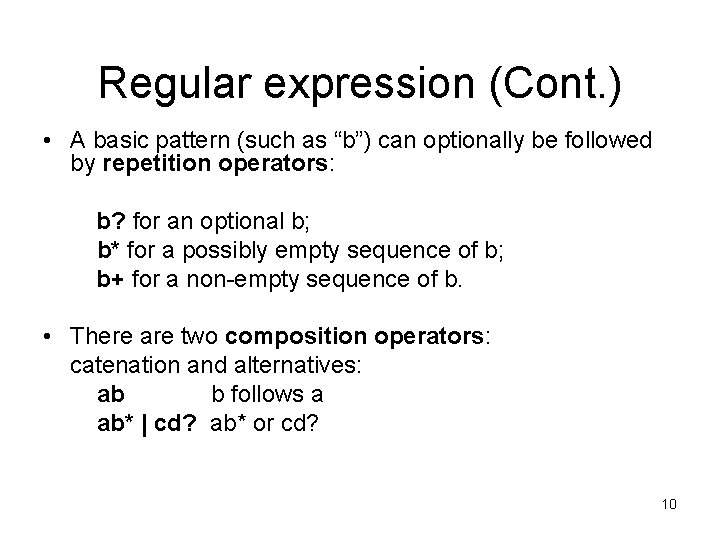
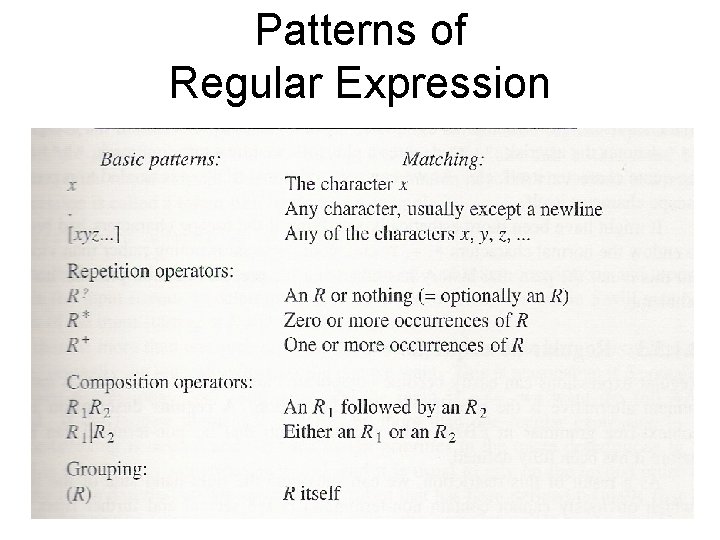
Regular expression (Cont. ) • A basic pattern (such as “b”) can optionally be followed by repetition operators: b? for an optional b; b* for a possibly empty sequence of b; b+ for a non-empty sequence of b. • There are two composition operators: catenation and alternatives: ab b follows a ab* | cd? ab* or cd? 10
Patterns of Regular Expression 11
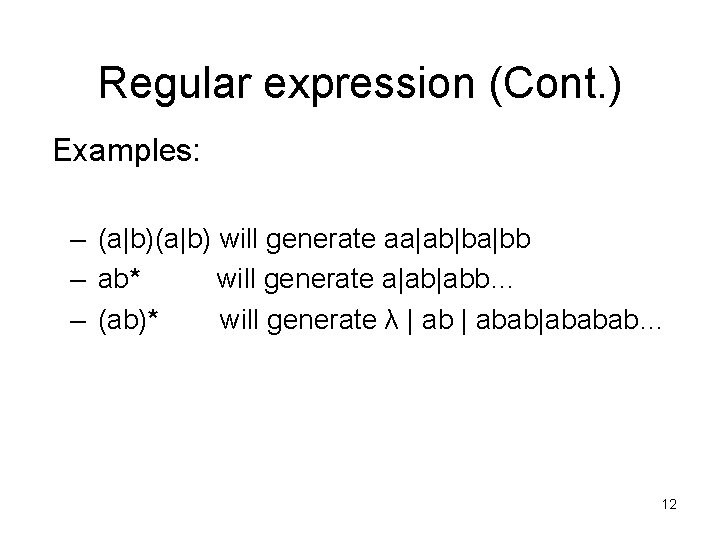
Regular expression (Cont. ) Examples: – (a|b) will generate aa|ab|ba|bb – ab* will generate a|ab|abb… – (ab)* will generate λ | abab|ababab… 12
The regular expression for “identifier” is: letter → [a-z A-Z] digit → [0 -9] underscore → _ letter_or_digit → letter | digit underscored_tail → underscore letter_or_digit+ identifier → letter_or_digit* underscored_tail* 13
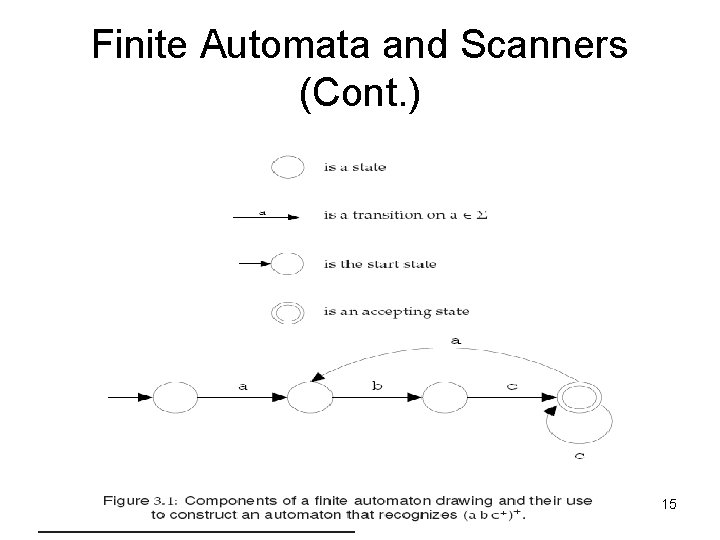
Finite Automata and Scanners • A finite automation (FA) can be used to recognize the tokens specified by a regular expression. • An FA consists of: – A finite set of states – A finite vocabulary, denoted Σ – A set of transitions (or moves) from one state to another, labeled with characters in Σ – A special state called the start state – A subset of the states called the accepting, or final, states. • An FA can also be represented graphically using a transition diagram, composed of the components shown in Fig. 3. 1. 14
Finite Automata and Scanners (Cont. ) 15
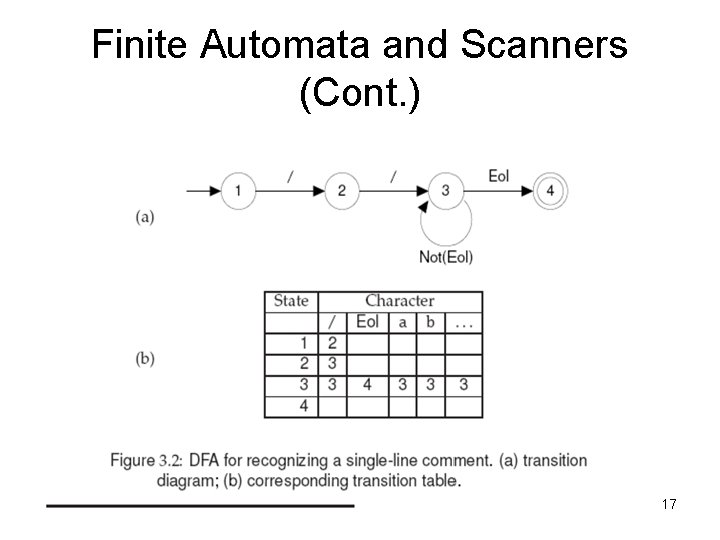
Finite Automata and Scanners (Cont. ) Deterministic Finite Automata (DFA): An FA that always allows a unique transition for a given state and character. – DFAs are simple to program and are often used to drive a scanner. – A DFA is conveniently represented in a computer by a transition table. • For example, the regular expression // (Not (eol) )* eol which defines a Java or C++ single-line comment, might be recognized by the DFA shown in Fig. 3. 2 16
Finite Automata and Scanners (Cont. ) 17
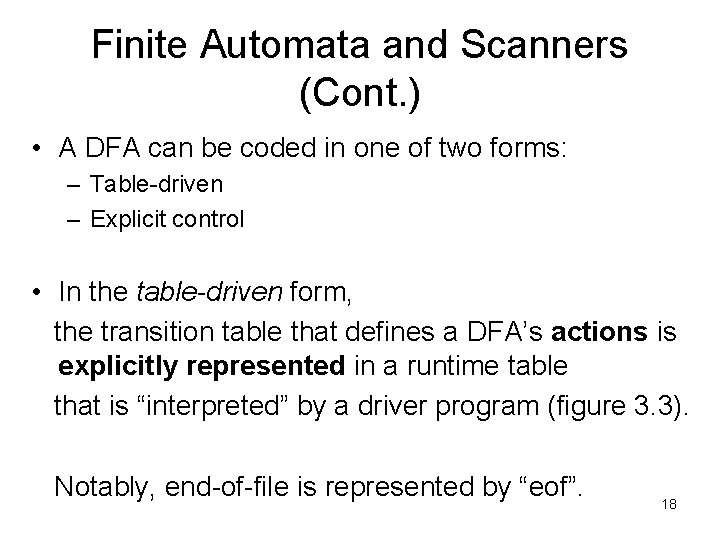
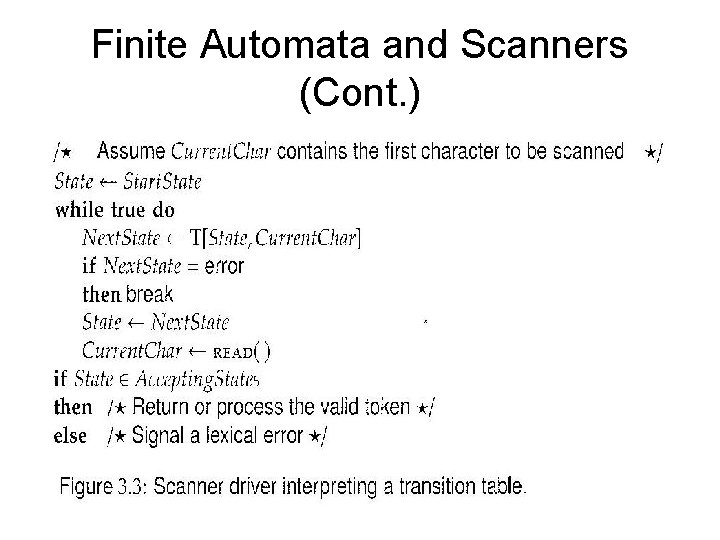
Finite Automata and Scanners (Cont. ) • A DFA can be coded in one of two forms: – Table-driven – Explicit control • In the table-driven form, the transition table that defines a DFA’s actions is explicitly represented in a runtime table that is “interpreted” by a driver program (figure 3. 3). Notably, end-of-file is represented by “eof”. 18
Finite Automata and Scanners (Cont. ) 19
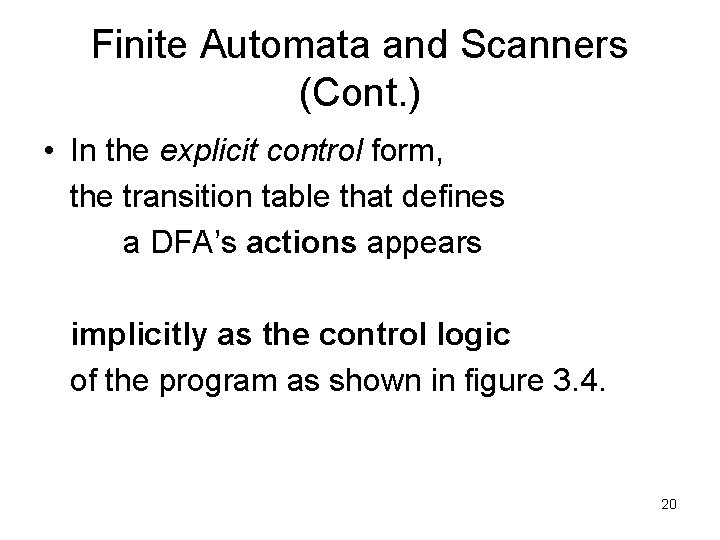
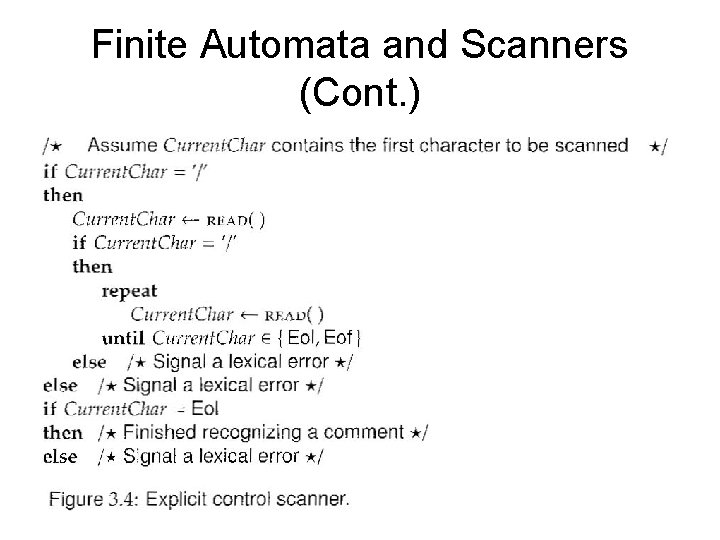
Finite Automata and Scanners (Cont. ) • In the explicit control form, the transition table that defines a DFA’s actions appears implicitly as the control logic of the program as shown in figure 3. 4. 20
Finite Automata and Scanners (Cont. ) 21
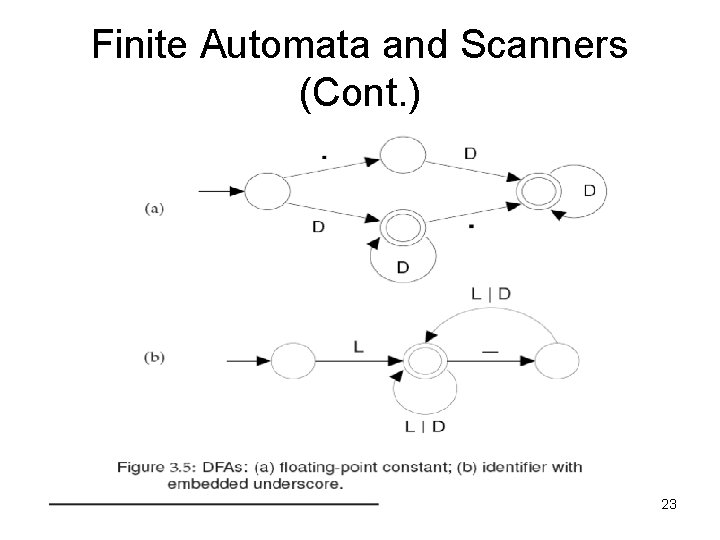
Finite Automata and Scanners (Cont. ) • An FA that analyzes or transforms its input beyond simply accepting tokens is called transducer. • The FAs shown in Fig. 3. 5 recognize a particular kind of constant and identifier. • A transducer that recognizes constants might be responsible for developing the appropriate bit pattern to represent the constant. • A transducer that processes identifiers may only have to retain the name of the identifier. 22
Finite Automata and Scanners (Cont. ) 23
Regular Expressions and Finite Automata • Regular expressions are equivalent to FAs. • The main job of scanner is to transform a regular expression into an equivalent FA. • First, transforming the regular expression into a nondeterministic finite automaton (NFA). 24
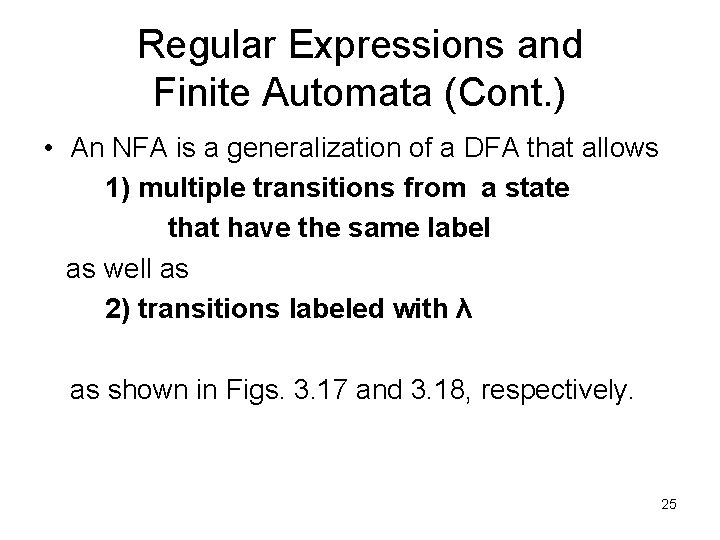
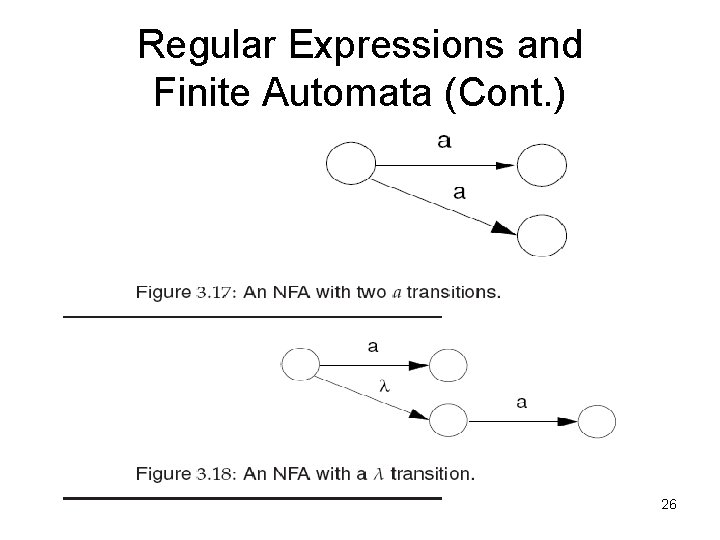
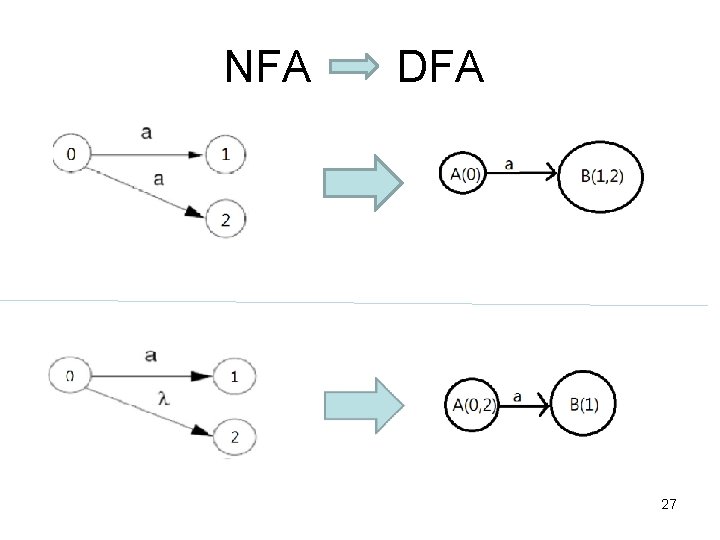
Regular Expressions and Finite Automata (Cont. ) • An NFA is a generalization of a DFA that allows 1) multiple transitions from a state that have the same label as well as 2) transitions labeled with λ as shown in Figs. 3. 17 and 3. 18, respectively. 25
Regular Expressions and Finite Automata (Cont. ) 26
NFA DFA 27
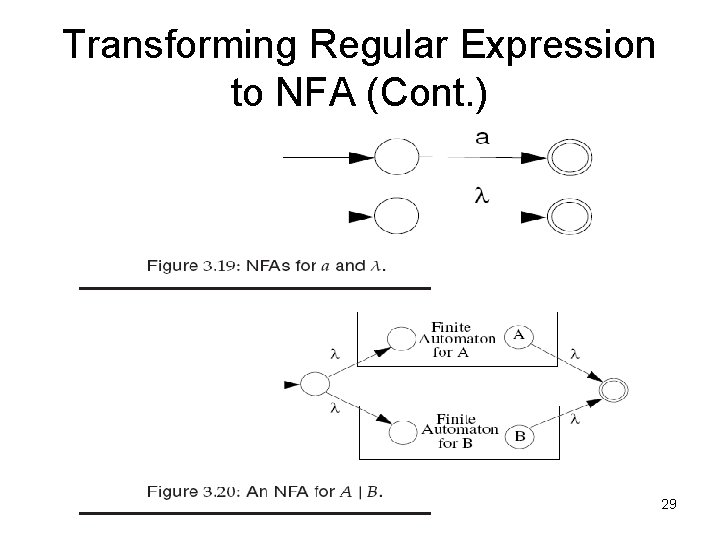
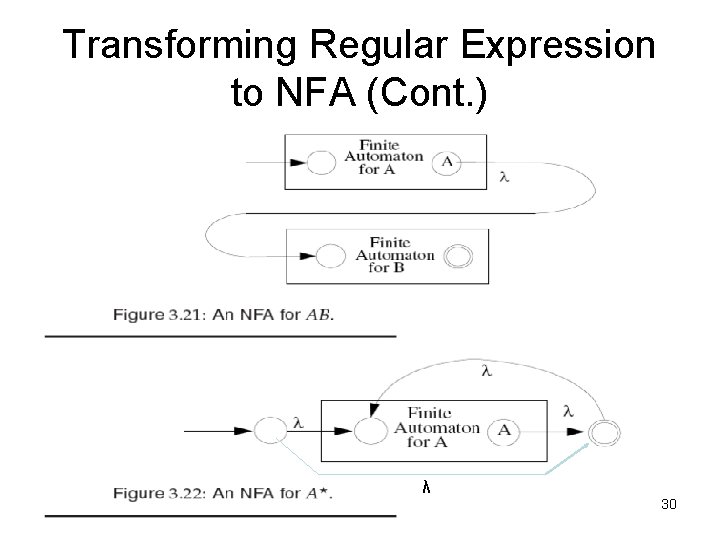
Transforming Regular Expression to NFA A regular expression is built of: the atomic regular expressions: a (a character in Σ) and λ (see Fig. 3. 19) using the three operations: AB, A|B, and A* (see Figs. 3. 20, 3. 21, 3. 22) 28
Transforming Regular Expression to NFA (Cont. ) 29
Transforming Regular Expression to NFA (Cont. ) λ 30
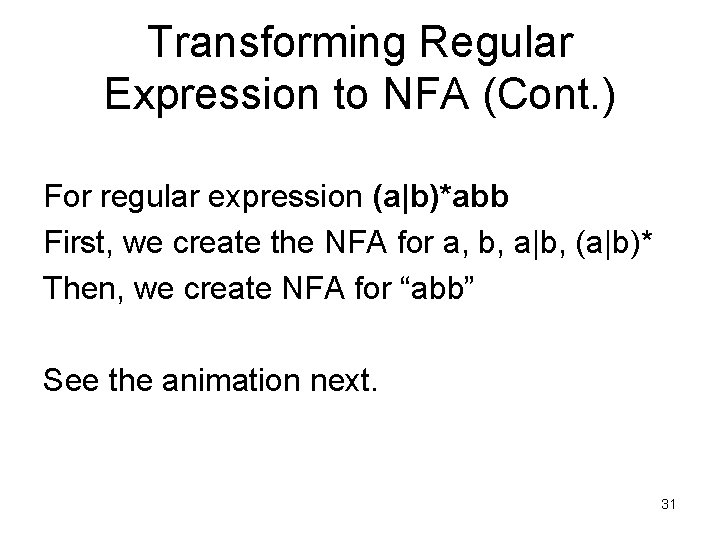
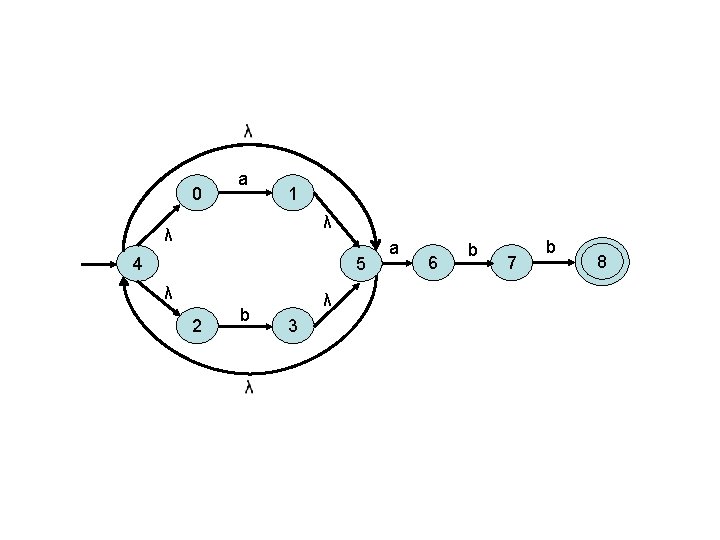
Transforming Regular Expression to NFA (Cont. ) For regular expression (a|b)*abb First, we create the NFA for a, b, a|b, (a|b)* Then, we create NFA for “abb” See the animation next. 31
0 a 1 λ λ 4 5 λ 2 b λ 3 a 6 b 7 b 8
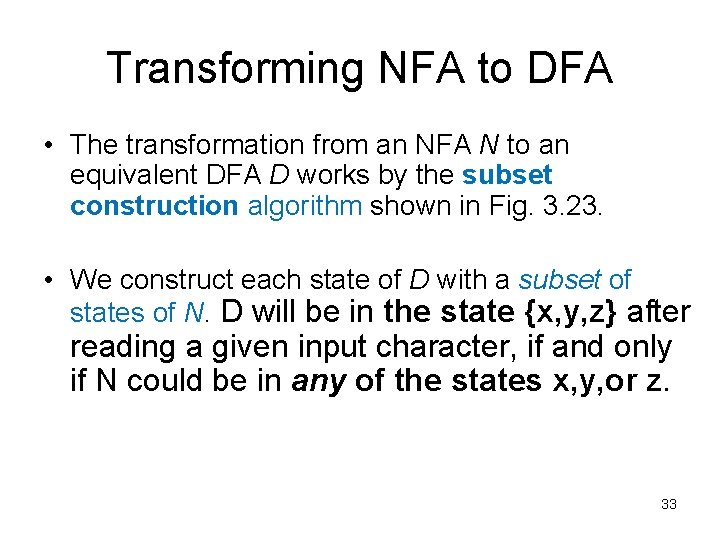
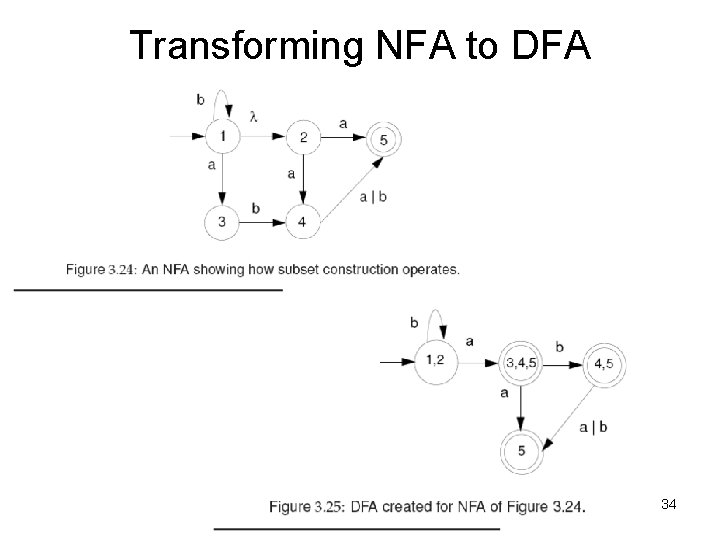
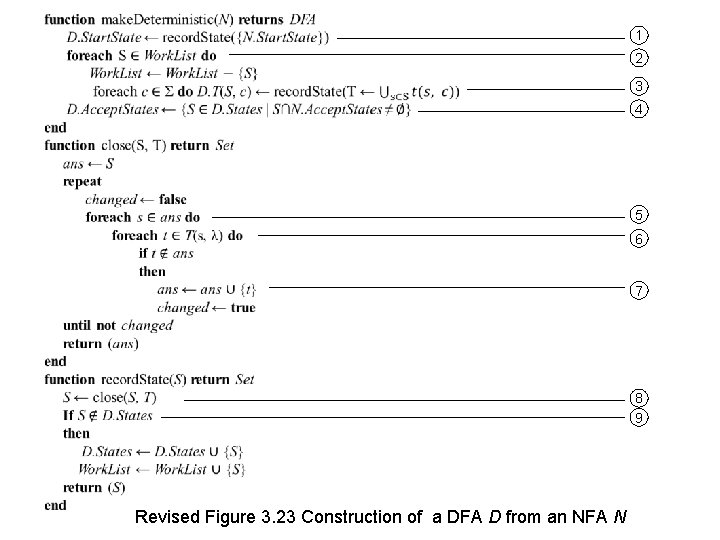
Transforming NFA to DFA • The transformation from an NFA N to an equivalent DFA D works by the subset construction algorithm shown in Fig. 3. 23. • We construct each state of D with a subset of states of N. D will be in the state {x, y, z} after reading a given input character, if and only if N could be in any of the states x, y, or z. 33
Transforming NFA to DFA 34
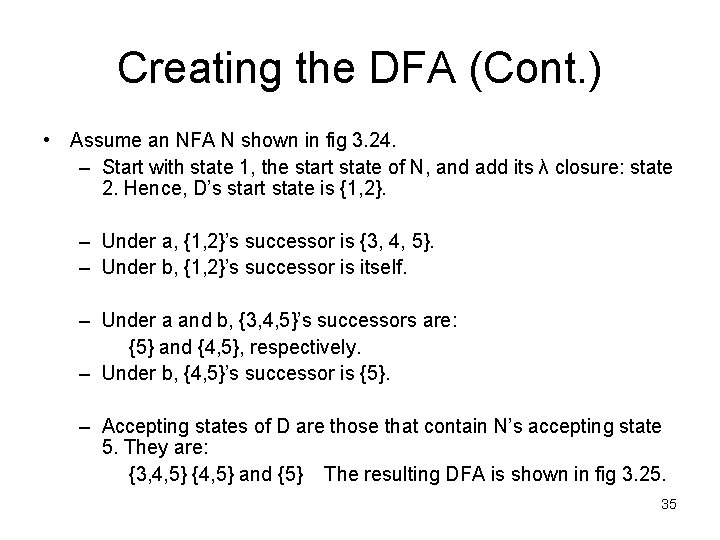
Creating the DFA (Cont. ) • Assume an NFA N shown in fig 3. 24. – Start with state 1, the start state of N, and add its λ closure: state 2. Hence, D’s start state is {1, 2}. – Under a, {1, 2}’s successor is {3, 4, 5}. – Under b, {1, 2}’s successor is itself. – Under a and b, {3, 4, 5}’s successors are: {5} and {4, 5}, respectively. – Under b, {4, 5}’s successor is {5}. – Accepting states of D are those that contain N’s accepting state 5. They are: {3, 4, 5} {4, 5} and {5} The resulting DFA is shown in fig 3. 25. 35
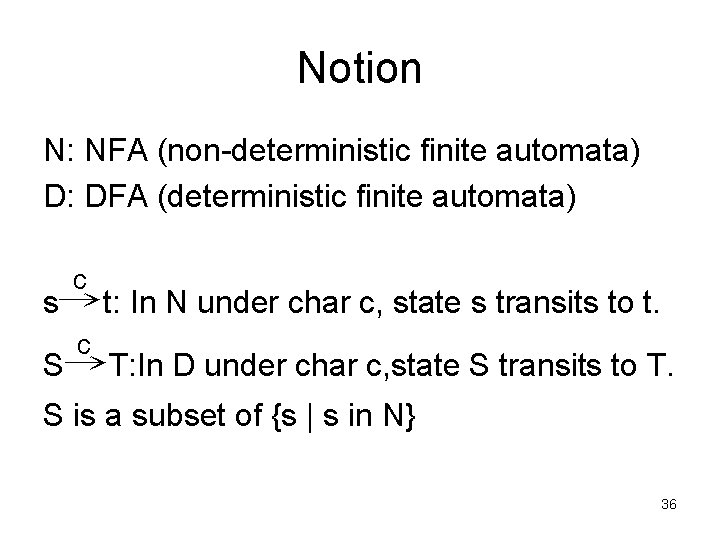
Notion N: NFA (non-deterministic finite automata) D: DFA (deterministic finite automata) c s→t: In N under char c, state s transits to t. c S→T: In D under char c, state S transits to T. S is a subset of {s | s in N} 36
• 1 2 3 4 5 6 7 8 9 Revised Figure 3. 23 Construction of a DFA D from an NFA N
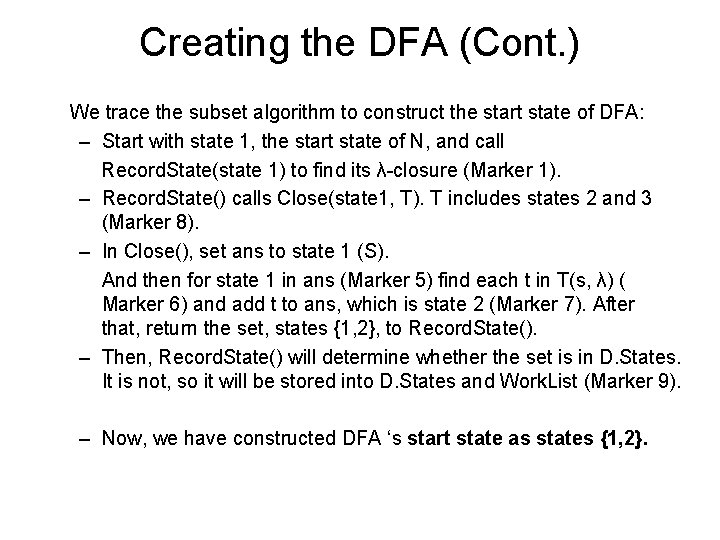
Creating the DFA (Cont. ) We trace the subset algorithm to construct the start state of DFA: – Start with state 1, the start state of N, and call Record. State(state 1) to find its λ-closure (Marker 1). – Record. State() calls Close(state 1, T). T includes states 2 and 3 (Marker 8). – In Close(), set ans to state 1 (S). And then for state 1 in ans (Marker 5) find each t in T(s, λ) ( Marker 6) and add t to ans, which is state 2 (Marker 7). After that, return the set, states {1, 2}, to Record. State(). – Then, Record. State() will determine whether the set is in D. States. It is not, so it will be stored into D. States and Work. List (Marker 9). – Now, we have constructed DFA ‘s start state as states {1, 2}.
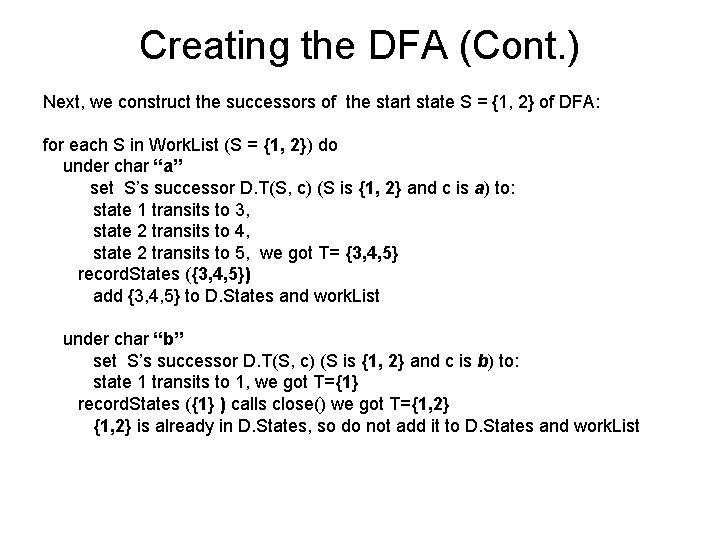
Creating the DFA (Cont. ) Next, we construct the successors of the start state S = {1, 2} of DFA: for each S in Work. List (S = {1, 2}) do under char “a” set S’s successor D. T(S, c) (S is {1, 2} and c is a) to: state 1 transits to 3, state 2 transits to 4, state 2 transits to 5, we got T= {3, 4, 5} record. States ({3, 4, 5}) add {3, 4, 5} to D. States and work. List under char “b” set S’s successor D. T(S, c) (S is {1, 2} and c is b) to: state 1 transits to 1, we got T={1} record. States ({1} ) calls close() we got T={1, 2} {1, 2} is already in D. States, so do not add it to D. States and work. List
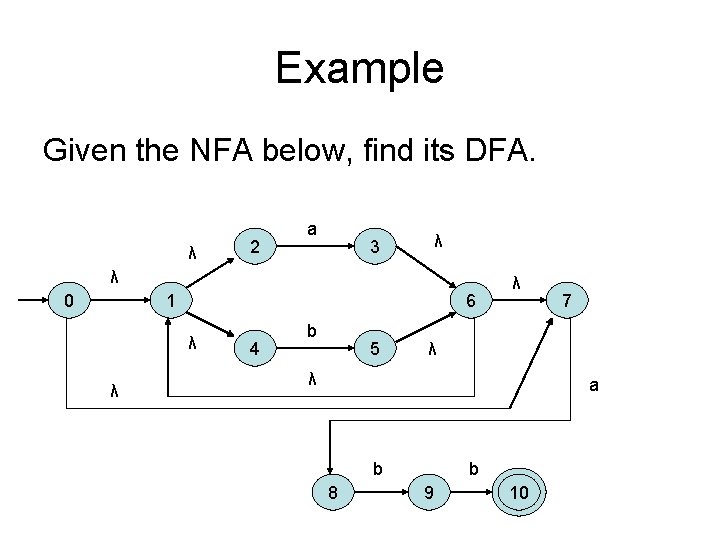
Example Given the NFA below, find its DFA. λ 2 a 3 λ λ 0 1 6 λ λ 4 b 5 λ 7 λ λ a b 8 b 9 10
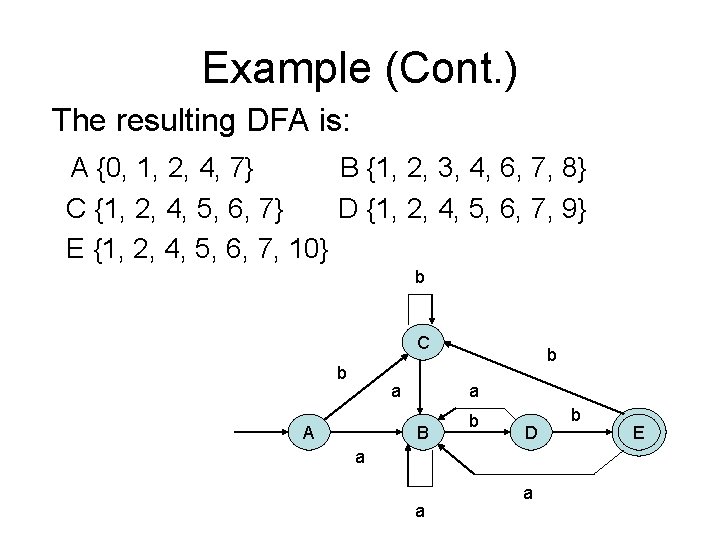
Example (Cont. ) The resulting DFA is: A {0, 1, 2, 4, 7} B {1, 2, 3, 4, 6, 7, 8} C {1, 2, 4, 5, 6, 7} D {1, 2, 4, 5, 6, 7, 9} E {1, 2, 4, 5, 6, 7, 10} b C b a A b a B b D a a a b E
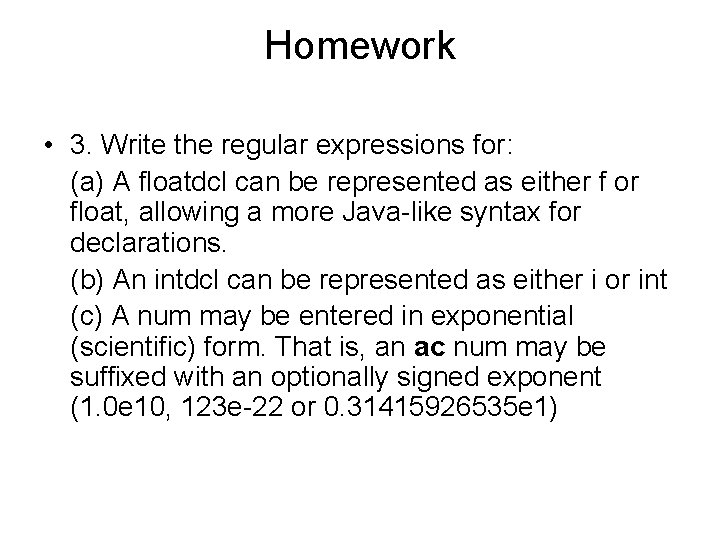
Homework • 3. Write the regular expressions for: (a) A floatdcl can be represented as either f or float, allowing a more Java-like syntax for declarations. (b) An intdcl can be represented as either i or int (c) A num may be entered in exponential (scientific) form. That is, an ac num may be suffixed with an optionally signed exponent (1. 0 e 10, 123 e-22 or 0. 31415926535 e 1)
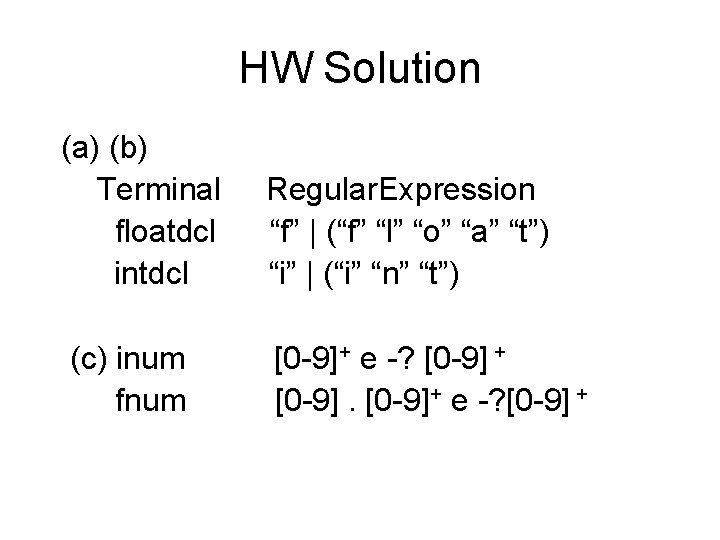
HW Solution (a) (b) Terminal Regular. Expression floatdcl “f” | (“f” “l” “o” “a” “t”) intdcl “i” | (“i” “n” “t”) (c) inum [0 -9]+ e -? [0 -9] + fnum [0 -9]+ e -? [0 -9] +
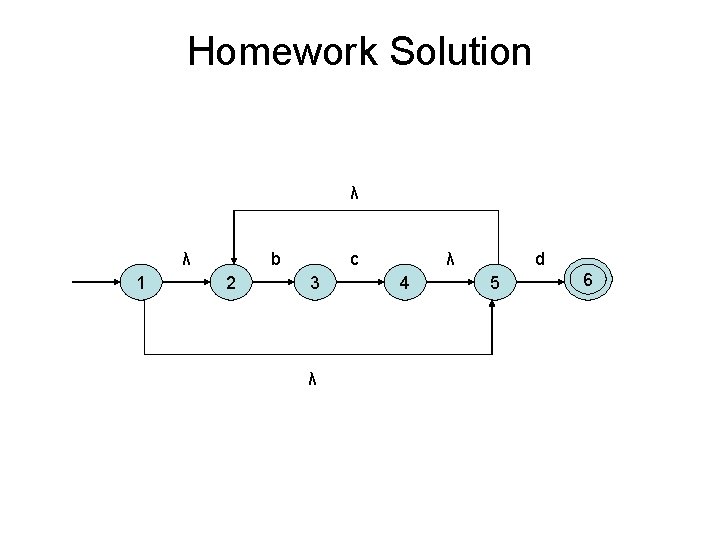
Homework 5(d) Write NFA, and then DFA that recognizes the tokens defined by the following regular expression: (bc)*d 44
Homework Solution λ λ 1 b 2 c 3 λ λ 4 d 5 6
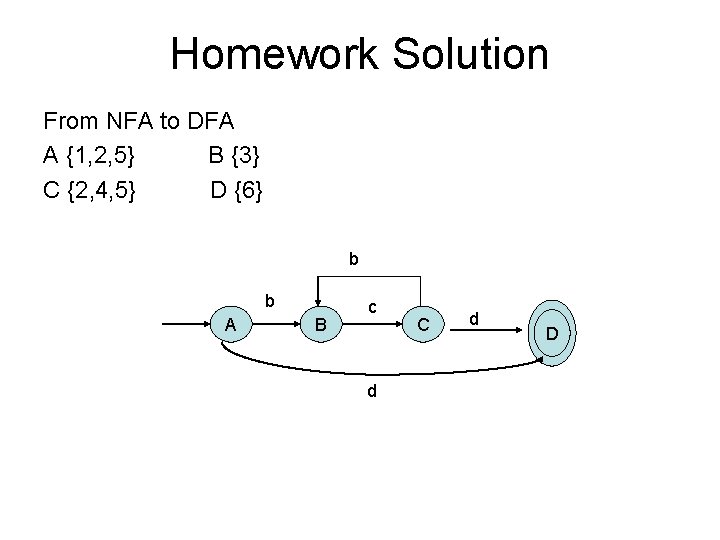
Homework Solution From NFA to DFA A {1, 2, 5} B {3} C {2, 4, 5} D {6} b b A B c d C d D
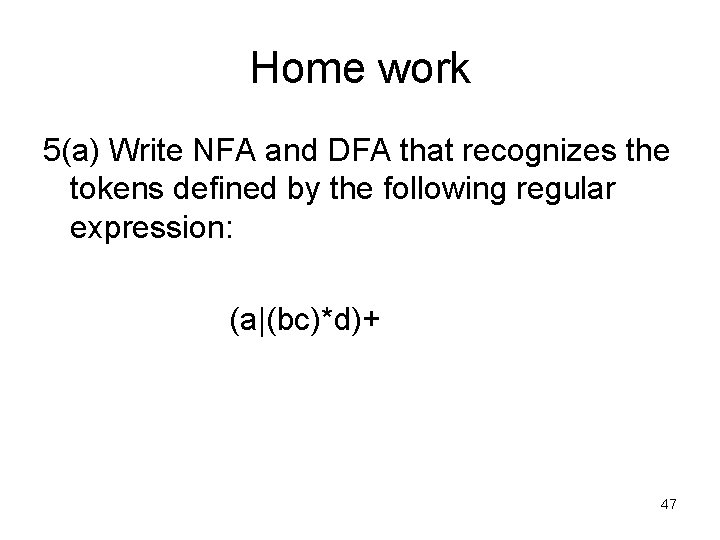
Home work 5(a) Write NFA and DFA that recognizes the tokens defined by the following regular expression: (a|(bc)*d)+ 47
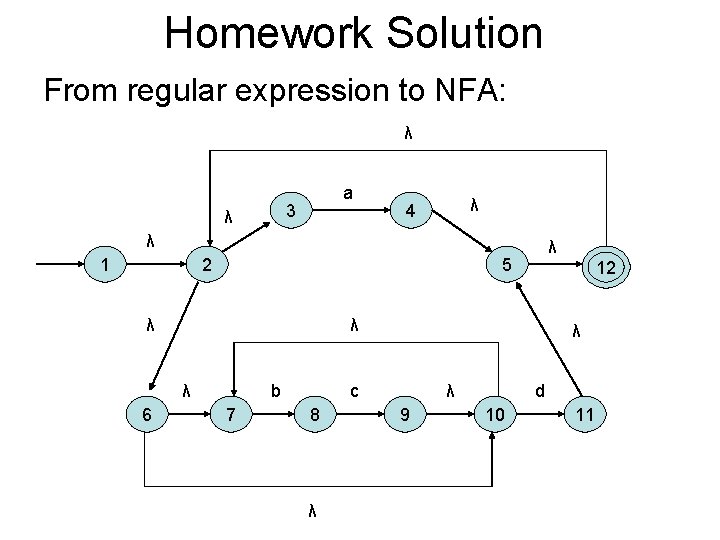
Homework Solution From regular expression to NFA: λ a 3 λ λ 4 λ 1 2 5 λ 12 λ λ 6 λ b 7 λ c 8 λ λ 9 d 10 11
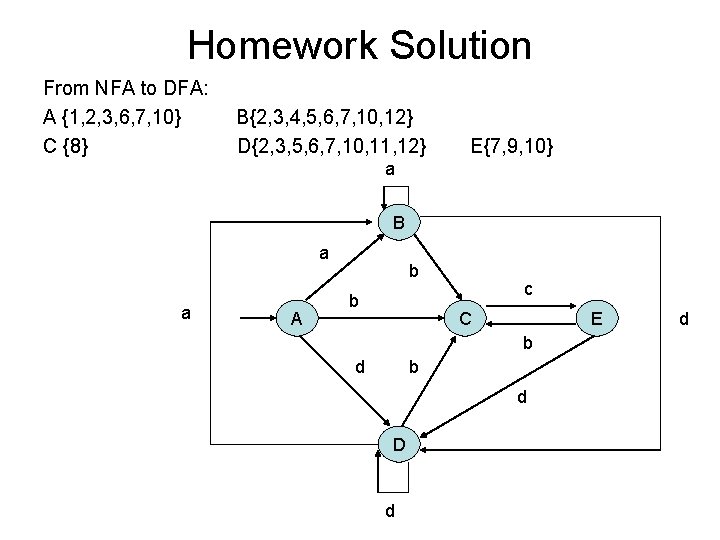
Homework Solution From NFA to DFA: A {1, 2, 3, 6, 7, 10} B{2, 3, 4, 5, 6, 7, 10, 12} C {8} D{2, 3, 5, 6, 7, 10, 11, 12} E{7, 9, 10} a B a a A b b c C E b d D d d