
Chapter 3 Resistance Introductory Circuit Analysis 12e Boylestad
Chapter 3 Resistance Introductory Circuit Analysis, 12/e Boylestad Copyright © 2011 by Pearson Education, Inc. publishing as Pearson [imprint]
INTRODUCTION • The opposition to the flow of charge through an electrical circuit, called resistance, has the units of ohms and uses the Greek letter omega (Ω) as its symbol. • The graphic symbol for resistance, which resembles the cutting edge of a saw. Introductory Circuit Analysis, 12/e Boylestad Copyright © 2011 by Pearson Education, Inc. publishing as Pearson [imprint]

INTRODUCTION FIG. 3. 1 Resistance symbol and notation. Introductory Circuit Analysis, 12/e Boylestad Copyright © 2011 by Pearson Education, Inc. publishing as Pearson [imprint]
INTRODUCTION • This opposition, due primarily to collisions and friction between the free electrons and other electrons, ions, and atoms in the path of motion, converts the supplied electrical energy into heat that raises the temperature of the electrical component and surrounding medium. • The heat you feel from an electrical heater is simply due to current passing through a high-resistance material. Introductory Circuit Analysis, 12/e Boylestad Copyright © 2011 by Pearson Education, Inc. publishing as Pearson [imprint]
RESISTANCE • The resistance of any material is due primarily to four factors: – Material – Length – Cross-sectional area – Temperature of the material Introductory Circuit Analysis, 12/e Boylestad Copyright © 2011 by Pearson Education, Inc. publishing as Pearson [imprint]

RESISTANCE • The first three elements are related by the following basic equation for resistance: Introductory Circuit Analysis, 12/e Boylestad Copyright © 2011 by Pearson Education, Inc. publishing as Pearson [imprint]

RESISTANCE FIG. 3. 2 Factors affecting the resistance of a conductor. Introductory Circuit Analysis, 12/e Boylestad Copyright © 2011 by Pearson Education, Inc. publishing as Pearson [imprint]
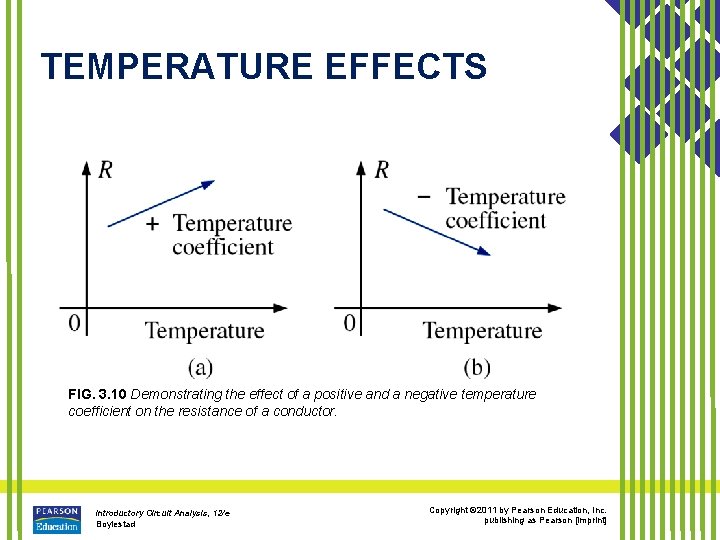
TEMPERATURE EFFECTS FIG. 3. 10 Demonstrating the effect of a positive and a negative temperature coefficient on the resistance of a conductor. Introductory Circuit Analysis, 12/e Boylestad Copyright © 2011 by Pearson Education, Inc. publishing as Pearson [imprint]

TYPES OF RESISTORS Fixed Resistors • Resistors are made in many forms, but all belong in either of two groups: fixed or variable. • The most common of the low-wattage, fixed type resistors is the film resistor. Introductory Circuit Analysis, 12/e Boylestad Copyright © 2011 by Pearson Education, Inc. publishing as Pearson [imprint]

TYPES OF RESISTORS Fixed Resistors FIG. 3. 12 Film resistors: (a) construction; (b) types. Introductory Circuit Analysis, 12/e Boylestad Copyright © 2011 by Pearson Education, Inc. publishing as Pearson [imprint]

TYPES OF RESISTORS Fixed Resistors FIG. 3. 13 Fixed-composition resistors: (a) construction; (b) appearance. Introductory Circuit Analysis, 12/e Boylestad Copyright © 2011 by Pearson Education, Inc. publishing as Pearson [imprint]
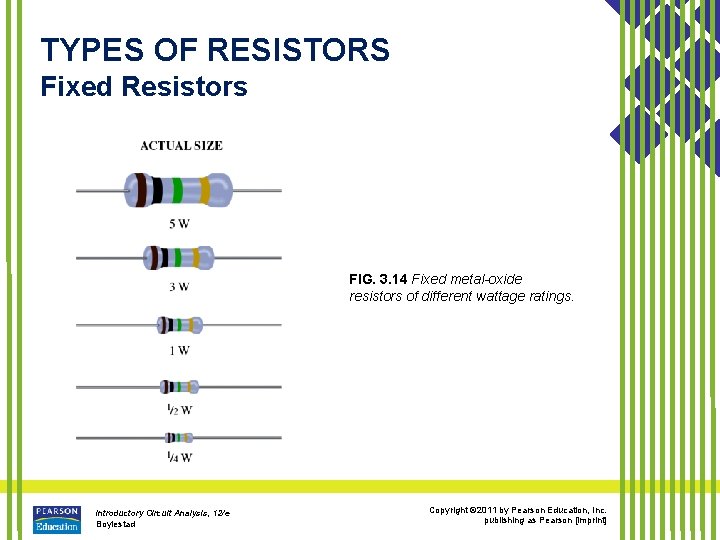
TYPES OF RESISTORS Fixed Resistors FIG. 3. 14 Fixed metal-oxide resistors of different wattage ratings. Introductory Circuit Analysis, 12/e Boylestad Copyright © 2011 by Pearson Education, Inc. publishing as Pearson [imprint]

TYPES OF RESISTORS Fixed Resistors FIG. 3. 15 Various types of fixed resistors. Introductory Circuit Analysis, 12/e Boylestad Copyright © 2011 by Pearson Education, Inc. publishing as Pearson [imprint]
TYPES OF RESISTORS Variable Resistors • Variable resistors, as the name implies, have a terminal resistance that can be varied by turning a dial, knob, screw, or whatever seems appropriate for the application. • They can have two or three terminals, but most have three terminals. If the two- or three-terminal device is used as a variable resistor, it is usually referred to as a rheostat. Introductory Circuit Analysis, 12/e Boylestad Copyright © 2011 by Pearson Education, Inc. publishing as Pearson [imprint]

TYPES OF RESISTORS Variable Resistors FIG. 3. 16 Potentiometer: (a) symbol; (b) and (c) rheostat connections; (d) rheostat symbol. Introductory Circuit Analysis, 12/e Boylestad Copyright © 2011 by Pearson Education, Inc. publishing as Pearson [imprint]
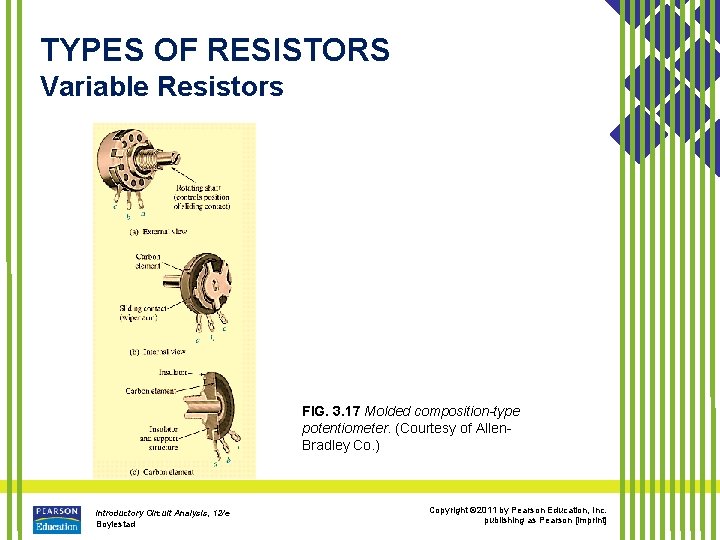
TYPES OF RESISTORS Variable Resistors FIG. 3. 17 Molded composition-type potentiometer. (Courtesy of Allen. Bradley Co. ) Introductory Circuit Analysis, 12/e Boylestad Copyright © 2011 by Pearson Education, Inc. publishing as Pearson [imprint]
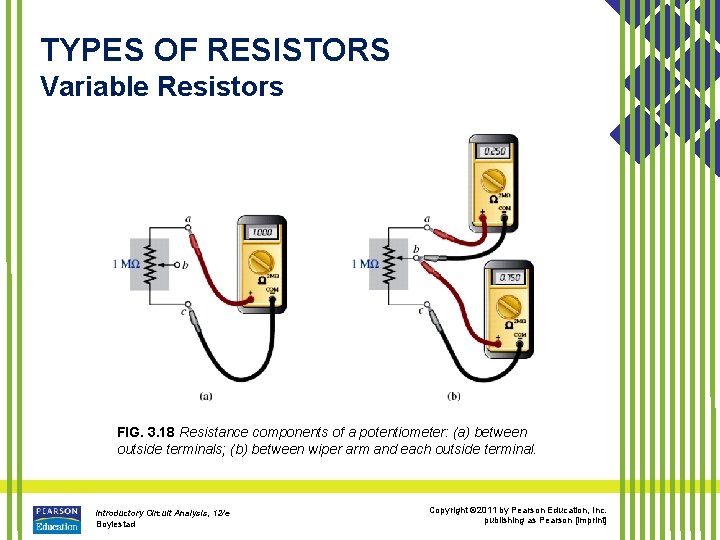
TYPES OF RESISTORS Variable Resistors FIG. 3. 18 Resistance components of a potentiometer: (a) between outside terminals; (b) between wiper arm and each outside terminal. Introductory Circuit Analysis, 12/e Boylestad Copyright © 2011 by Pearson Education, Inc. publishing as Pearson [imprint]
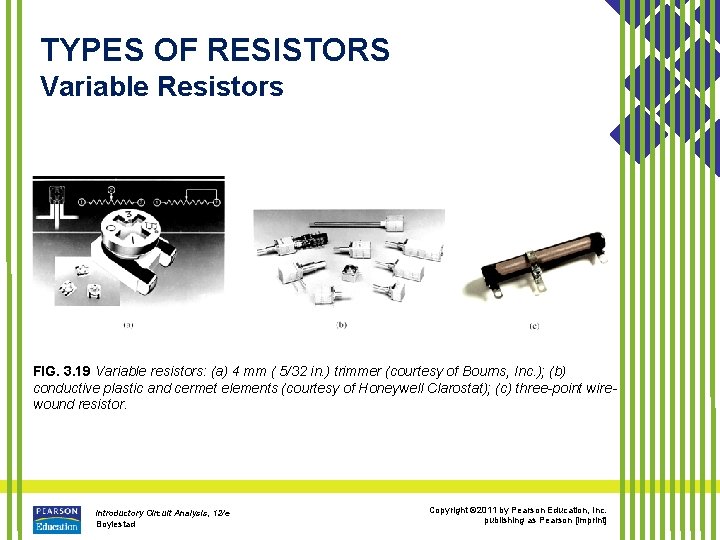
TYPES OF RESISTORS Variable Resistors FIG. 3. 19 Variable resistors: (a) 4 mm ( 5/32 in. ) trimmer (courtesy of Bourns, Inc. ); (b) conductive plastic and cermet elements (courtesy of Honeywell Clarostat); (c) three-point wirewound resistor. Introductory Circuit Analysis, 12/e Boylestad Copyright © 2011 by Pearson Education, Inc. publishing as Pearson [imprint]
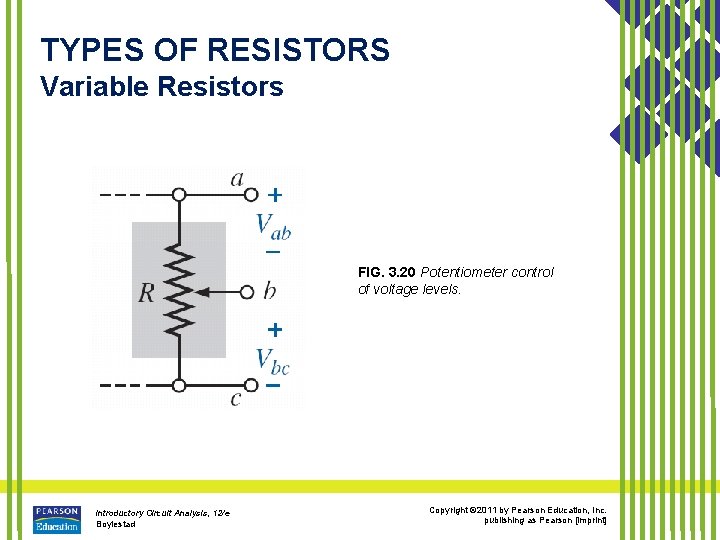
TYPES OF RESISTORS Variable Resistors FIG. 3. 20 Potentiometer control of voltage levels. Introductory Circuit Analysis, 12/e Boylestad Copyright © 2011 by Pearson Education, Inc. publishing as Pearson [imprint]
COLOR CODING AND STANDARD RESISTOR VALUES • A wide variety of resistors, fixed or variable, are large enough to have their resistance in ohms printed on the casing. • Some, however, are too small to have numbers printed on them, so a system of color coding is used. • For the thin-film resistor, four, five, or six bands may be used. • The four-band scheme is described. • Later in this section the purpose of the fifth and sixth bands will be described. Introductory Circuit Analysis, 12/e Boylestad Copyright © 2011 by Pearson Education, Inc. publishing as Pearson [imprint]
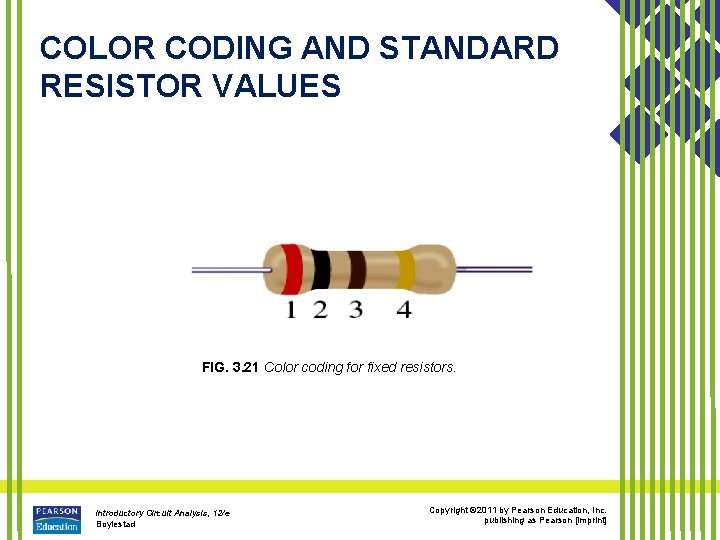
COLOR CODING AND STANDARD RESISTOR VALUES FIG. 3. 21 Color coding for fixed resistors. Introductory Circuit Analysis, 12/e Boylestad Copyright © 2011 by Pearson Education, Inc. publishing as Pearson [imprint]
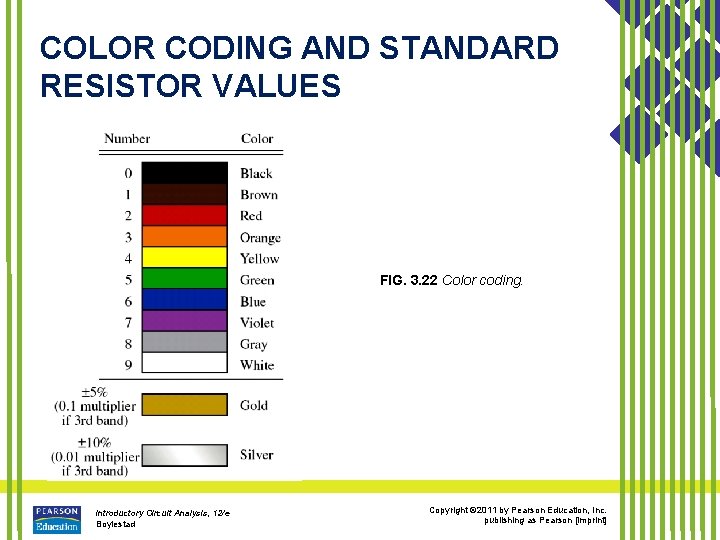
COLOR CODING AND STANDARD RESISTOR VALUES FIG. 3. 22 Color coding. Introductory Circuit Analysis, 12/e Boylestad Copyright © 2011 by Pearson Education, Inc. publishing as Pearson [imprint]
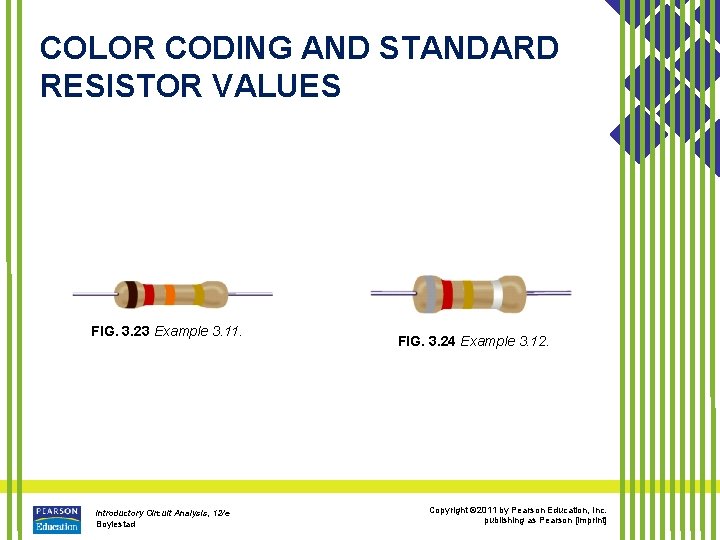
COLOR CODING AND STANDARD RESISTOR VALUES FIG. 3. 23 Example 3. 11. Introductory Circuit Analysis, 12/e Boylestad FIG. 3. 24 Example 3. 12. Copyright © 2011 by Pearson Education, Inc. publishing as Pearson [imprint]
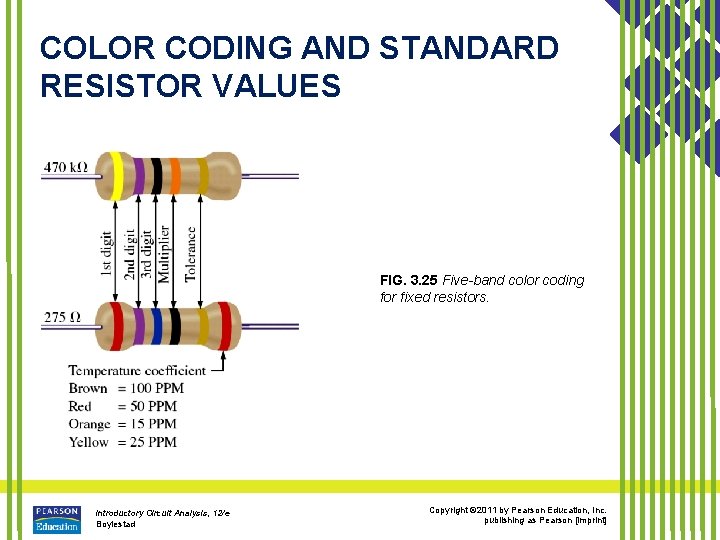
COLOR CODING AND STANDARD RESISTOR VALUES FIG. 3. 25 Five-band color coding for fixed resistors. Introductory Circuit Analysis, 12/e Boylestad Copyright © 2011 by Pearson Education, Inc. publishing as Pearson [imprint]
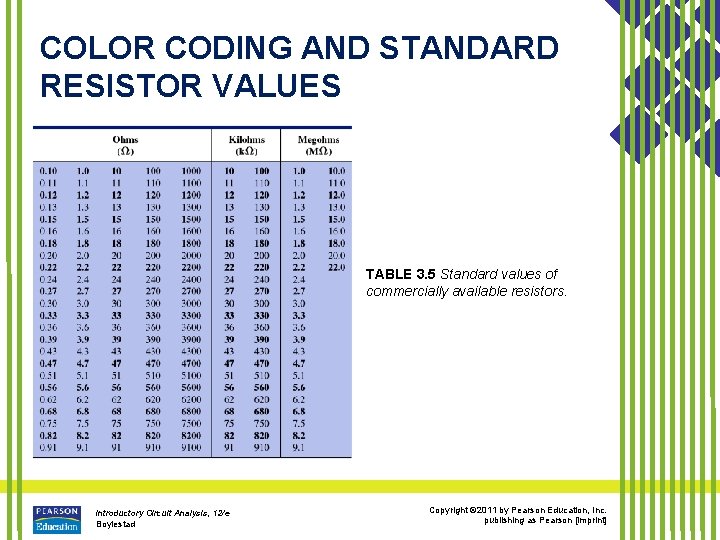
COLOR CODING AND STANDARD RESISTOR VALUES TABLE 3. 5 Standard values of commercially available resistors. Introductory Circuit Analysis, 12/e Boylestad Copyright © 2011 by Pearson Education, Inc. publishing as Pearson [imprint]
COLOR CODING AND STANDARD RESISTOR VALUES Surface Mount Resistors • In general, surface mount resistors are marked in three ways: color coding, three symbols, and two symbols. – The color coding is the same as just described earlier in this section for through-hole resistors. – The three-symbol approach uses three digits. The first two define the first two digits of the value; the last digit defines the power of the power-of-ten multiplier. Introductory Circuit Analysis, 12/e Boylestad Copyright © 2011 by Pearson Education, Inc. publishing as Pearson [imprint]
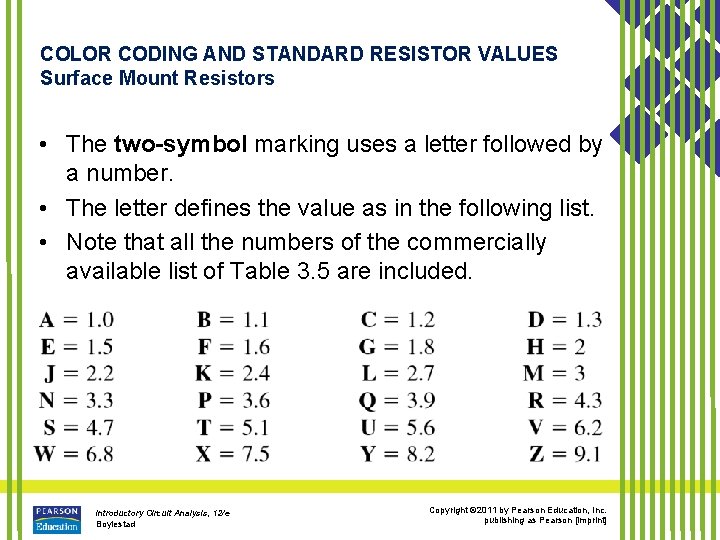
COLOR CODING AND STANDARD RESISTOR VALUES Surface Mount Resistors • The two-symbol marking uses a letter followed by a number. • The letter defines the value as in the following list. • Note that all the numbers of the commercially available list of Table 3. 5 are included. Introductory Circuit Analysis, 12/e Boylestad Copyright © 2011 by Pearson Education, Inc. publishing as Pearson [imprint]
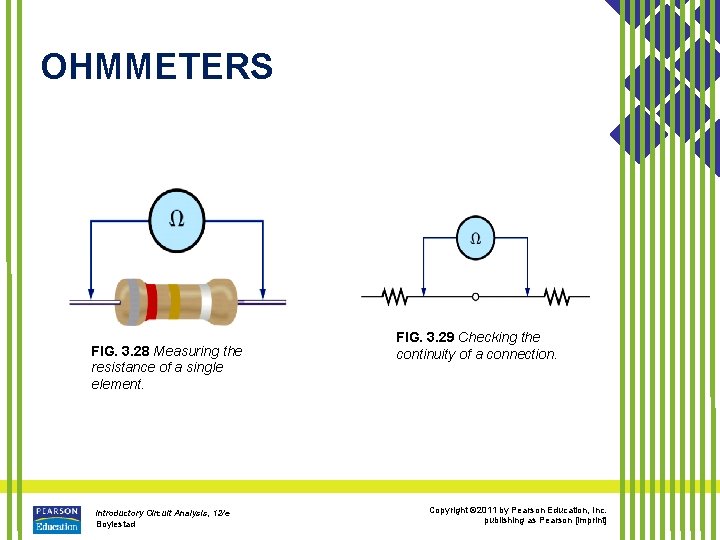
OHMMETERS FIG. 3. 28 Measuring the resistance of a single element. Introductory Circuit Analysis, 12/e Boylestad FIG. 3. 29 Checking the continuity of a connection. Copyright © 2011 by Pearson Education, Inc. publishing as Pearson [imprint]
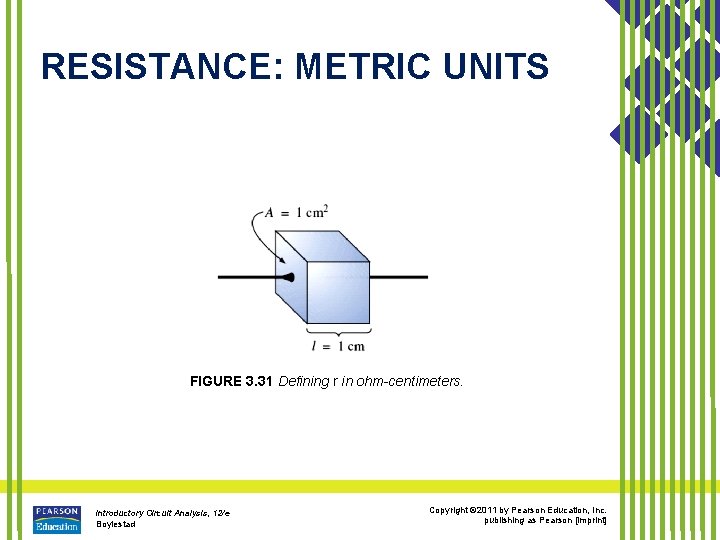
RESISTANCE: METRIC UNITS FIGURE 3. 31 Defining r in ohm-centimeters. Introductory Circuit Analysis, 12/e Boylestad Copyright © 2011 by Pearson Education, Inc. publishing as Pearson [imprint]
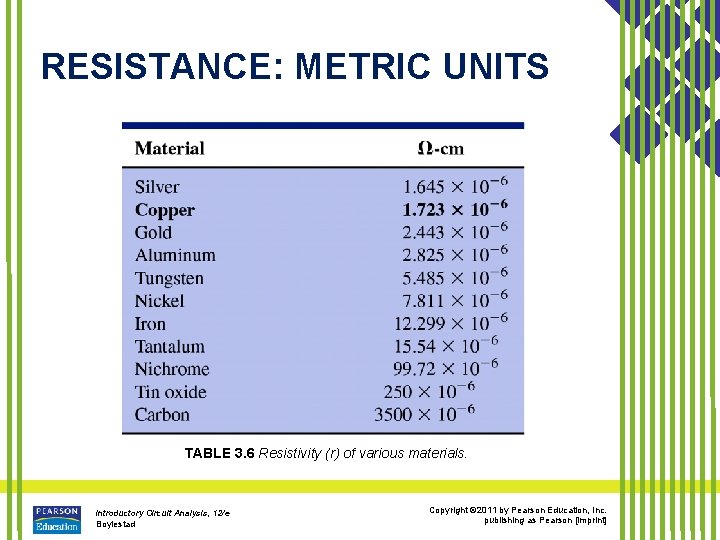
RESISTANCE: METRIC UNITS TABLE 3. 6 Resistivity (r) of various materials. Introductory Circuit Analysis, 12/e Boylestad Copyright © 2011 by Pearson Education, Inc. publishing as Pearson [imprint]
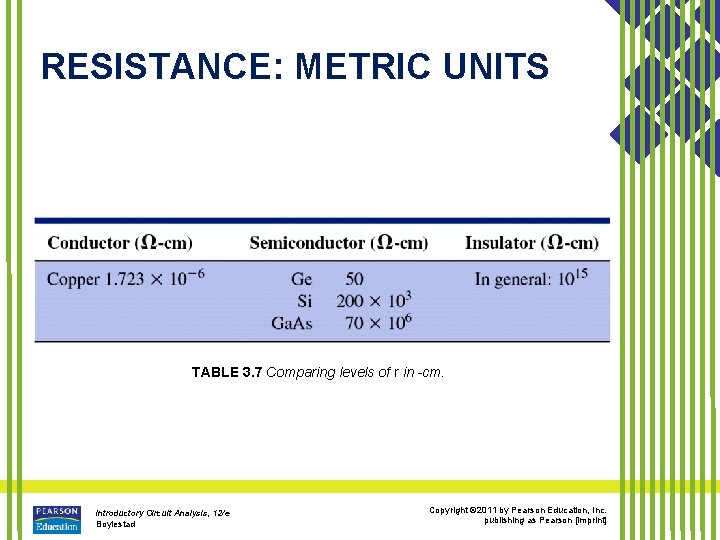
RESISTANCE: METRIC UNITS TABLE 3. 7 Comparing levels of r in -cm. Introductory Circuit Analysis, 12/e Boylestad Copyright © 2011 by Pearson Education, Inc. publishing as Pearson [imprint]
APPLICATIONS Electric Baseboard Heating Element • One of the most common applications of resistance is in household fixtures such as toasters and baseboard heating where the heat generated by current passing through a resistive element is employed to perform a useful function. Introductory Circuit Analysis, 12/e Boylestad Copyright © 2011 by Pearson Education, Inc. publishing as Pearson [imprint]
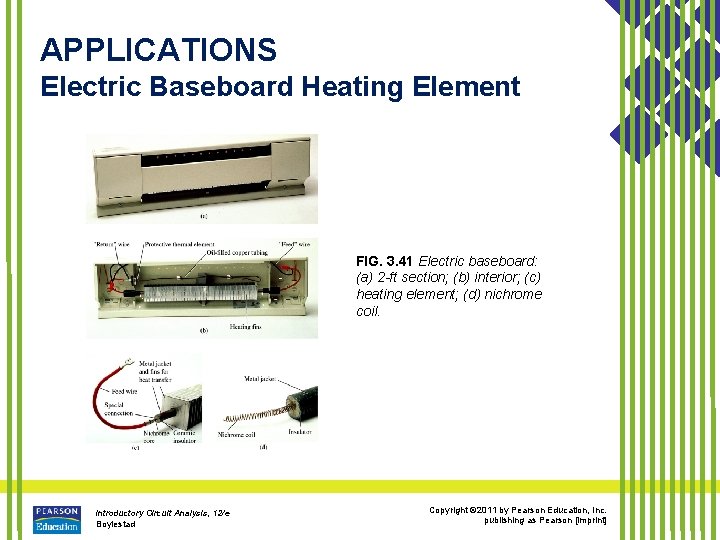
APPLICATIONS Electric Baseboard Heating Element FIG. 3. 41 Electric baseboard: (a) 2 -ft section; (b) interior; (c) heating element; (d) nichrome coil. Introductory Circuit Analysis, 12/e Boylestad Copyright © 2011 by Pearson Education, Inc. publishing as Pearson [imprint]
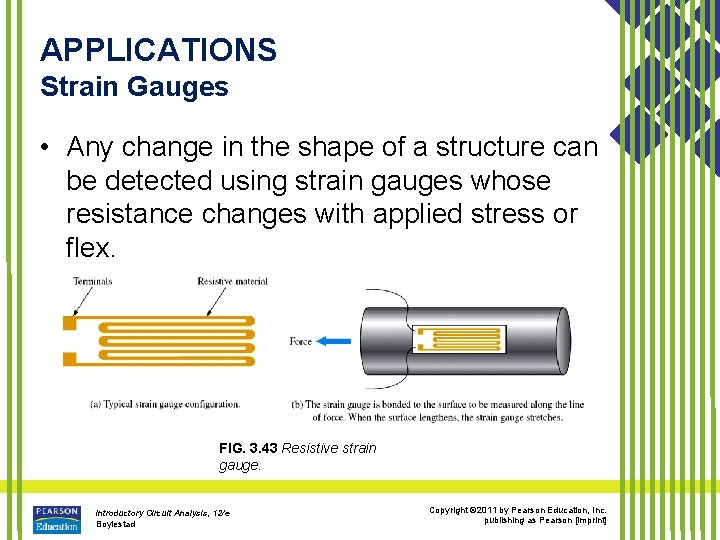
APPLICATIONS Strain Gauges • Any change in the shape of a structure can be detected using strain gauges whose resistance changes with applied stress or flex. FIG. 3. 43 Resistive strain gauge. Introductory Circuit Analysis, 12/e Boylestad Copyright © 2011 by Pearson Education, Inc. publishing as Pearson [imprint]
- Slides: 34