
Chapter 3 RealTime Scheduling and Schedulability Analysis Albert
Chapter 3: Real-Time Scheduling and Schedulability Analysis Albert M. K. Cheng
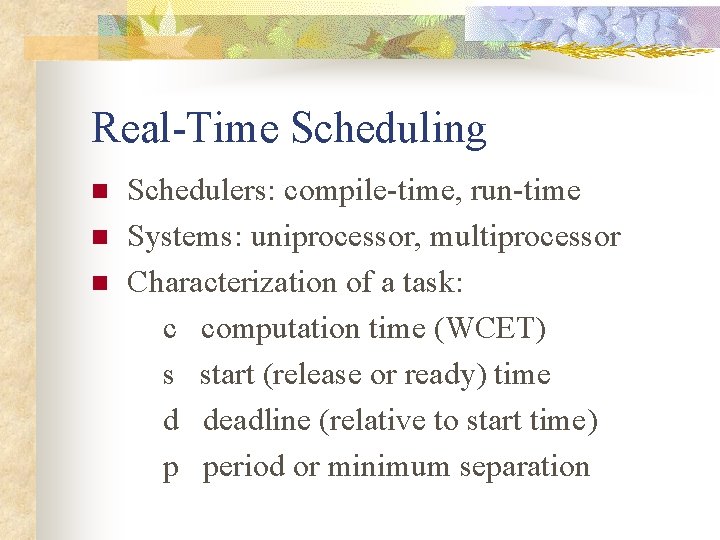
Real-Time Scheduling n n n Schedulers: compile-time, run-time Systems: uniprocessor, multiprocessor Characterization of a task: c computation time (WCET) s start (release or ready) time d deadline (relative to start time) p period or minimum separation
Optimal Scheduler n n One which may fail to meet the deadline of task only if no other scheduler can Examples include uniprocessor earliestdeadline-first (EDF) and least-laxity-first (LLF) schedulers for independent tasks with no synchronization constraints and no resource requirements
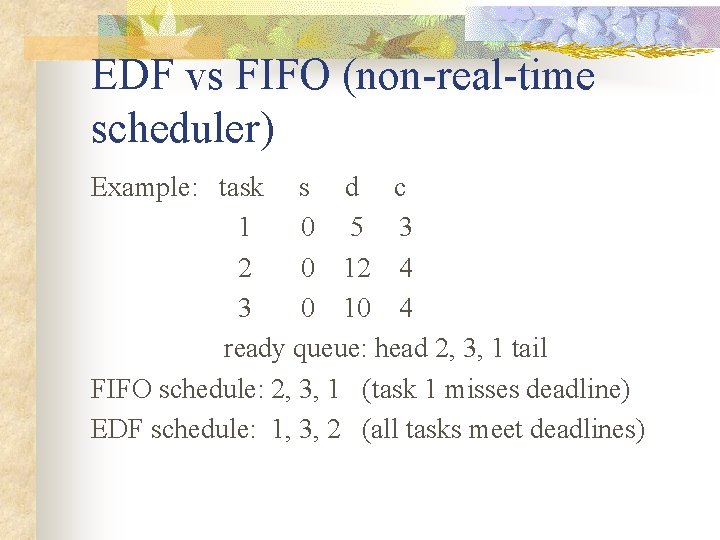
EDF vs FIFO (non-real-time scheduler) Example: task s d c 1 0 5 3 2 0 12 4 3 0 10 4 ready queue: head 2, 3, 1 tail FIFO schedule: 2, 3, 1 (task 1 misses deadline) EDF schedule: 1, 3, 2 (all tasks meet deadlines)
Rate-Monotonic (RM) Scheduler: Basic Assumptions n n n Compile-time/static Preemptive tasks No precedence constraints Negligible context-switching time Periodic tasks

Schedulability Test for RM n Liu and Layland’s sufficient condition: Utilization U = sum c_I / p_I Number of tasks n A task set is schedulable if U <= n(2^(1/n) – 1) Necessary and sufficient condition requires checking inequalities or plot of W vs t
Sporadic Tasks n n n Can be modeled by periodic tasks with periods equal to the minimum separation Deferred server (DS) is less wasteful Tasks with critical sections (nonpreemptive) must be handled differently
Scheduling Tasks with Constraints n n n Deterministic Rendezvous Model: tasks with rendezvous (as in Ada) Kernelized Monitor Model: tasks with critical sections Dataflow Model: tasks with precedence and data flow constraints
Multiprocessor Scheduling n n Scheduling game board representation: shows a tasks’ statuses dynamically Non-optimality of uniprocessor-optimal schedulers Need to consider special cases to improve scheduling efficiency Need to avoid conflict-free task sets
- Slides: 9