
Chapter 3 Questions and Their Uses Mc GrawHillIrwin
- Slides: 13
Chapter 3 Questions and Their Uses Mc. Graw-Hill/Irwin Copyright © 2011 by The Mc. Graw-Hill Companies, Inc. All rights reserved.
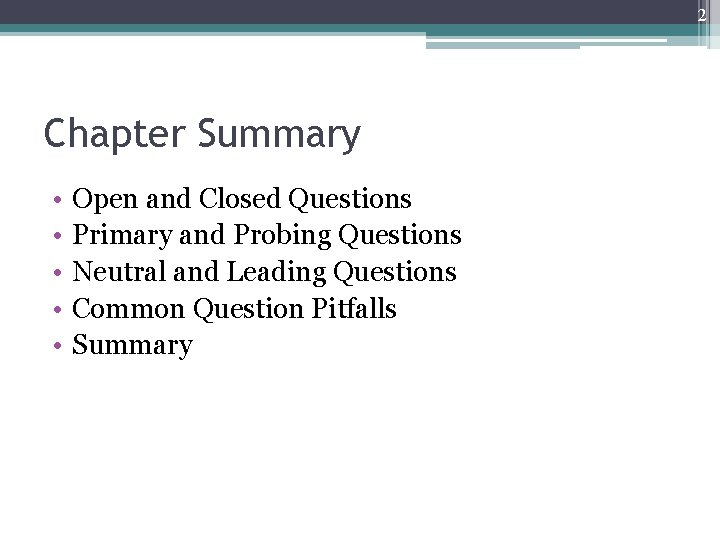
2 Chapter Summary • • • Open and Closed Questions Primary and Probing Questions Neutral and Leading Questions Common Question Pitfalls Summary
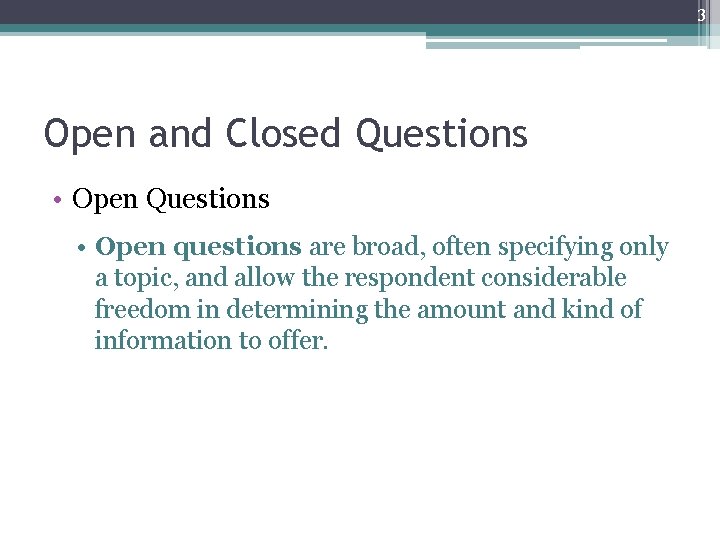
3 Open and Closed Questions • Open questions are broad, often specifying only a topic, and allow the respondent considerable freedom in determining the amount and kind of information to offer.
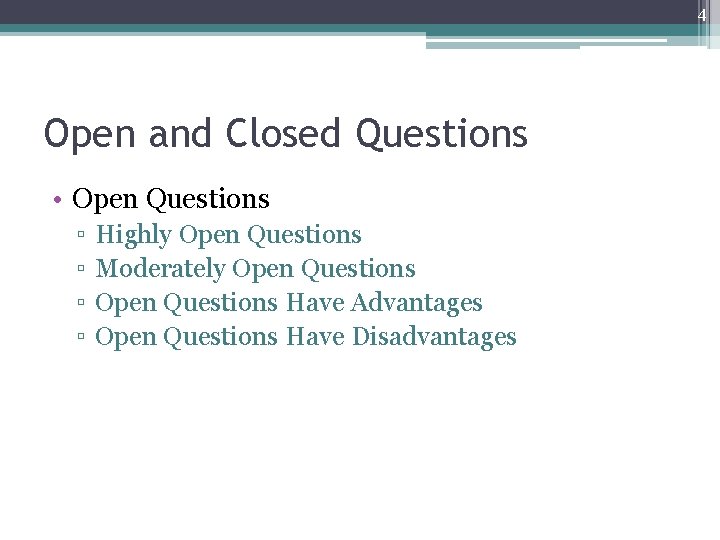
4 Open and Closed Questions • Open Questions ▫ ▫ Highly Open Questions Moderately Open Questions Have Advantages Open Questions Have Disadvantages
5 Open and Closed Questions • Closed Questions ▫ Closed questions are narrow in focus and restrict the interviewee’s freedom to determine the amount and kind of information to offer.
6 Open and Closed Questions • Closed Questions ▫ ▫ ▫ Moderately Closed Questions Highly Closed Questions Bipolar Questions Closed Questions Have Advantages Closed Questions Have Disadvantages
7 Primary and Probing Questions • Primary questions introduce topics or new areas within a topic and can stand alone even when taken out of context. • Probing questions attempt to discover additional information following a primary or secondary question.
8 Primary and Probing Questions • Types of Probing Questions ▫ ▫ ▫ ▫ Silent Probes Nudging Probes Clearinghouse Probes Informational Probes Restatement Probes Reflective Probes Mirror Probes
9 Primary and Probing Questions • Skillful Interviewing with Probing Questions ▫ Skillful probing leads to insightful answers. ▫ Be patient and be persistent.
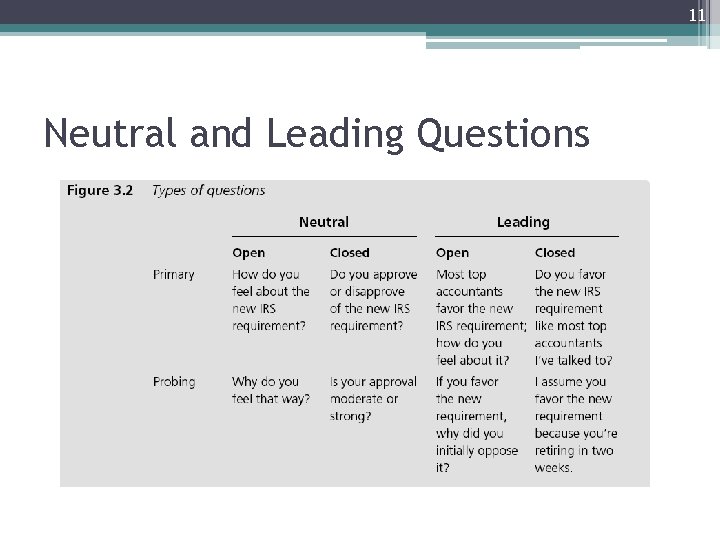
10 Neutral and Leading Questions • Neutral questions encourage honest answers. • Leading questions direct interviewees to specific answers. • Interviewer bias leads to dictated responses. • Loaded questions dictate answers through language or entrapment.
11 Neutral and Leading Questions
12 Common Question Pitfalls • • • The Bipolar Trap The Tell Me Everything The Open-to-Closed Switch The Double-Barreled Inquisition The Leading Push The Guessing Game The Yes (No) Response The Curious Probe The Quiz Show Complexity vs. Simplicity The Don’t Ask, Don’t Tell
13 Summary • Questions are the tools of the trade for both interviewers and interviewees. • Knowing question types, unique uses, and advantages and disadvantages, allows one to develop considerable interviewing skill.