
CHAPTER 3 PUTTING DOWN ROOTS OPPORTUNITY AND OPPRESSION
- Slides: 12
CHAPTER 3 PUTTING DOWN ROOTS: OPPORTUNITY AND OPPRESSION IN COLONIAL SOCIETY. Michaella Kanarek Period 7 APUSH
FAMILY LIFE IN THE 17 TH CENTURY. � Godly family; ruled by patriarch=father to his children, husband to his wife, source of authority and unquestioned obedience. � Life cycle of the 17 th century New England family began with MARRIAGE. � Men brought farmland to the marriage, brides had to provide an offering worth about ½ of what the groom offered. � Congregational churches were built in a family foundation
WOMEN’S LIVES IN PURITAN NEW ENGLAND � English custom treated women as inferior to men. � Women worked on family farms as well as separate tasks -cooking, washing, clothes making, dairying and gardening. � According to English common law, a wife exercised no control over property.
THE STRUCTURE OF PLANTER SOCIETY � Tobacco=$$$, it generated inequality. Some planters amassed large fortunes, other barely managed to maintain. � Wealthy planters relied on white laborers who were not free, as well as slaves. � Indentured servants: individuals who agreed to serve a master for a set number of years in exchange for the cost of boat transportation to America.
SLAVERY � Between the 16 th-19 th century, slave traders carried almost 11 million blacks to the Americas. � The decision to bring African slaves to the colonies was based primarily on economic considerations. � By the end of the 17 th century, the legal status of Virginia’s black people was no longer in doubt. They were slaves for life, and so were their children after them. � Stono Rebellion: September 1739, 150 S. Carolina blacks rose up and murdered several white planters
MAJOR EVENTS � Slave Trade � Stono Rebellion � Navigation Acts (1660) � Bacon’s Rebellion � Glorious Revolution
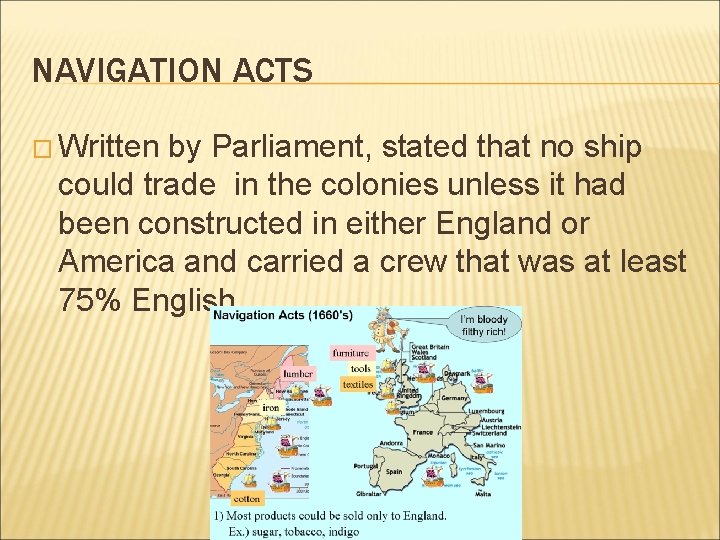
NAVIGATION ACTS � Written by Parliament, stated that no ship could trade in the colonies unless it had been constructed in either England or America and carried a crew that was at least 75% English.
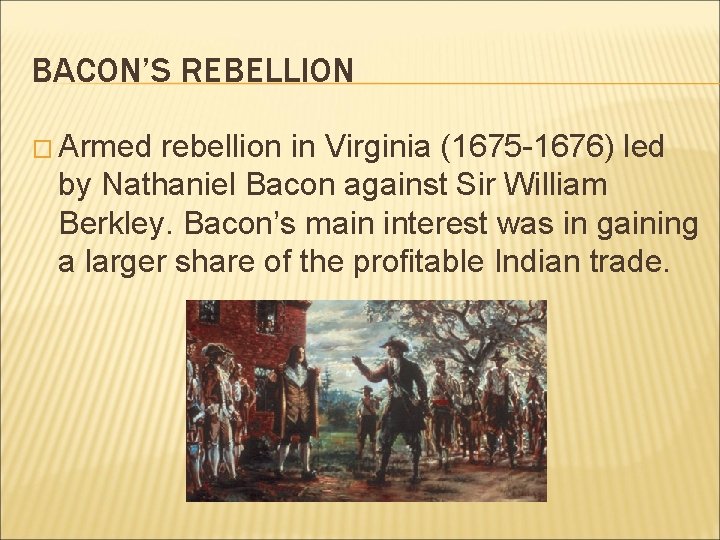
BACON’S REBELLION � Armed rebellion in Virginia (1675 -1676) led by Nathaniel Bacon against Sir William Berkley. Bacon’s main interest was in gaining a larger share of the profitable Indian trade.
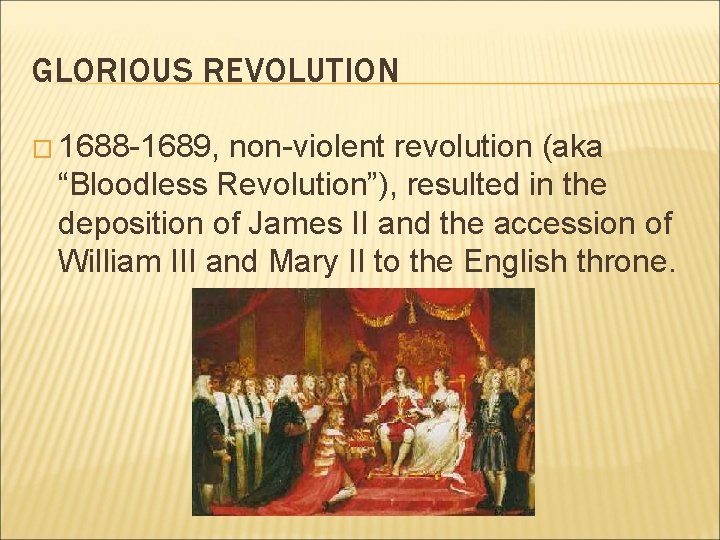
GLORIOUS REVOLUTION � 1688 -1689, non-violent revolution (aka “Bloodless Revolution”), resulted in the deposition of James II and the accession of William III and Mary II to the English throne.
IMPORTANT DOCUMENTS � The Passage of Indentured Servants (1750) -Gottlieb Mittelberger � The Stono Rebellion (1739) -James Oglethorpe (Governor of Georgia) � Bacon’s Declaration in the name of the people (1676)
IMPORTANT LEGISLATION � Half-Way Covenant (1662) � Prenuptial Agreement (1653) � Navigation Act (1653) � Bill of Rights (1689)
REFERENCES � � � � America Past and Present AP Edition http: //www. u-s-history. com/pages/h 547. html http: //www 2. iath. virginia. edu/saxonsalem/servlet/Saxon. Servlet? source=salem/texts/names. x ml&style=salem/xsl/dynaxml. xsl&group. num=all&mbio. nu m=mb 16&clear-stylesheet-cache=yes https: //files. nyu. edu/dwv 1/public/bio. html http: //wps. ablongman. com/wps/media/objects/28/29338/p rimarysources 1_2_1. html http: //wps. prenhall. com/wps/media/objects/170/174992/0 4_stono. HTM http: //historymatters. gmu. edu/d/5800