
Chapter 3 PublicKey Cryptography and Key Management J
Chapter 3 Public-Key Cryptography and Key Management J. Wang and Z. Kissel. Introduction to Network Security: Theory and Practice. Wiley and HEP, 2015

Why Public-Key Cryptography? l To use data encryption algorithms in network communications, all parities must first agree on using the same secret keys ¨ ¨ ¨ l Rely on couriers Set up a meeting to determine a secret key Use postal service, email service, phone service … However, these conventional methods are inflexible for network communication applications Public-key cryptography (PKC) ¨ ¨ ¨ Invented in the 1970’s Without the need of sharing prior secrets to distribute secret keys securely Can also be used for authentication J. Wang and Z. Kissel. Introduction to Network Security: Theory and Practice. Wiley and HEP, 2015
Chapter 3 Outline l l l 3. 1 Concepts of Public-Key Cryptography 3. 2 Elementary Concepts and Theorems in Number Theory 3. 3 Diffie-Hellman Key Exchange 3. 4 RSA Cryptosystem 3. 5 Elliptic-Curve Cryptography 3. 6 Key Distributions and Management J. Wang and Z. Kissel. Introduction to Network Security: Theory and Practice. Wiley and HEP, 2015
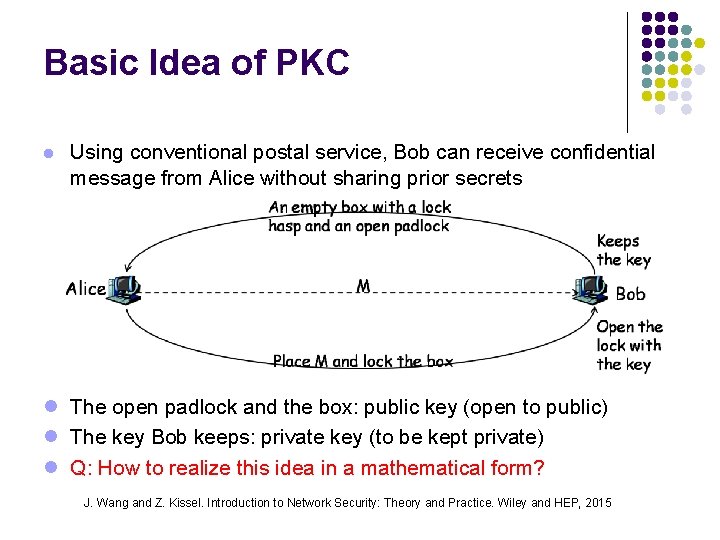
Basic Idea of PKC l Using conventional postal service, Bob can receive confidential message from Alice without sharing prior secrets l The open padlock and the box: public key (open to public) l The key Bob keeps: private key (to be kept private) l Q: How to realize this idea in a mathematical form? J. Wang and Z. Kissel. Introduction to Network Security: Theory and Practice. Wiley and HEP, 2015
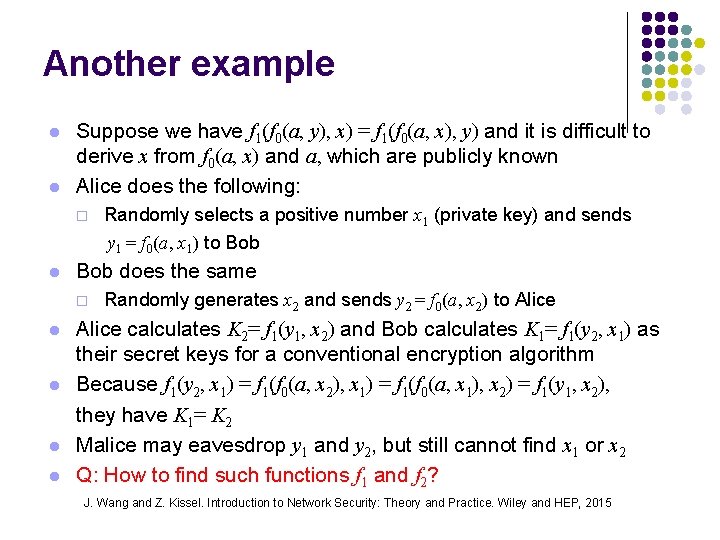
Another example l l Suppose we have f 1(f 0(a, y), x) = f 1(f 0(a, x), y) and it is difficult to derive x from f 0(a, x) and a, which are publicly known Alice does the following: ¨ l Bob does the same ¨ l l Randomly selects a positive number x 1 (private key) and sends y 1 = f 0(a, x 1) to Bob Randomly generates x 2 and sends y 2 = f 0(a, x 2) to Alice calculates K 2= f 1(y 1, x 2) and Bob calculates K 1= f 1(y 2, x 1) as their secret keys for a conventional encryption algorithm Because f 1(y 2, x 1) = f 1(f 0(a, x 2), x 1) = f 1(f 0(a, x 1), x 2) = f 1(y 1, x 2), they have K 1= K 2 Malice may eavesdrop y 1 and y 2, but still cannot find x 1 or x 2 Q: How to find such functions f 1 and f 2? J. Wang and Z. Kissel. Introduction to Network Security: Theory and Practice. Wiley and HEP, 2015
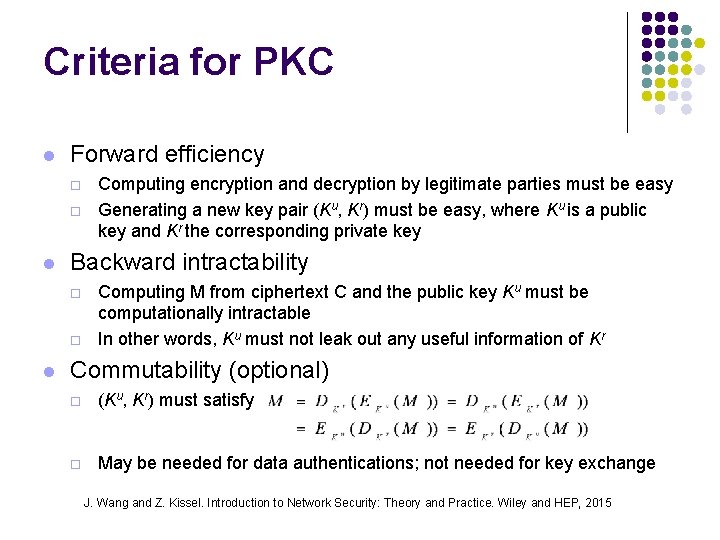
Criteria for PKC l Forward efficiency ¨ ¨ l Backward intractability ¨ ¨ l Computing encryption and decryption by legitimate parties must be easy Generating a new key pair (Ku, Kr) must be easy, where Ku is a public key and Kr the corresponding private key Computing M from ciphertext C and the public key Ku must be computationally intractable In other words, Ku must not leak out any useful information of Kr Commutability (optional) ¨ (Ku, Kr) must satisfy ¨ May be needed for data authentications; not needed for key exchange J. Wang and Z. Kissel. Introduction to Network Security: Theory and Practice. Wiley and HEP, 2015
Chapter 3 Outline l l l 3. 1 Concepts of Public-Key Cryptography 3. 2 Elementary Concepts and Theorems in Number Theory 3. 3 Diffie-Hellman Key Exchange 3. 4 RSA Cryptosystem 3. 5 Elliptic-Curve Cryptography 3. 6 Key Distributions and Management J. Wang and Z. Kissel. Introduction to Network Security: Theory and Practice. Wiley and HEP, 2015
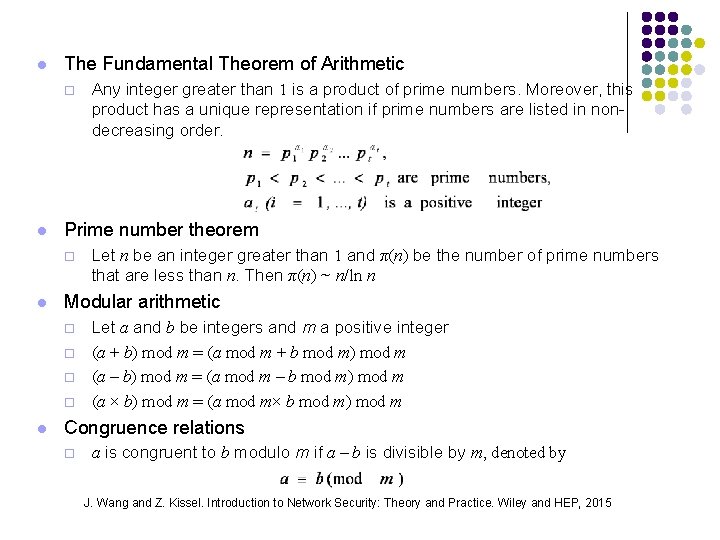
l The Fundamental Theorem of Arithmetic ¨ l Prime number theorem ¨ l Let n be an integer greater than 1 and π(n) be the number of prime numbers that are less than n. Then π(n) ~ n/ln n Modular arithmetic ¨ ¨ l Any integer greater than 1 is a product of prime numbers. Moreover, this product has a unique representation if prime numbers are listed in nondecreasing order. Let a and b be integers and m a positive integer (a + b) mod m = (a mod m + b mod m) mod m (a – b) mod m = (a mod m – b mod m) mod m (a × b) mod m = (a mod m× b mod m) mod m Congruence relations ¨ a is congruent to b modulo m if a – b is divisible by m, denoted by J. Wang and Z. Kissel. Introduction to Network Security: Theory and Practice. Wiley and HEP, 2015
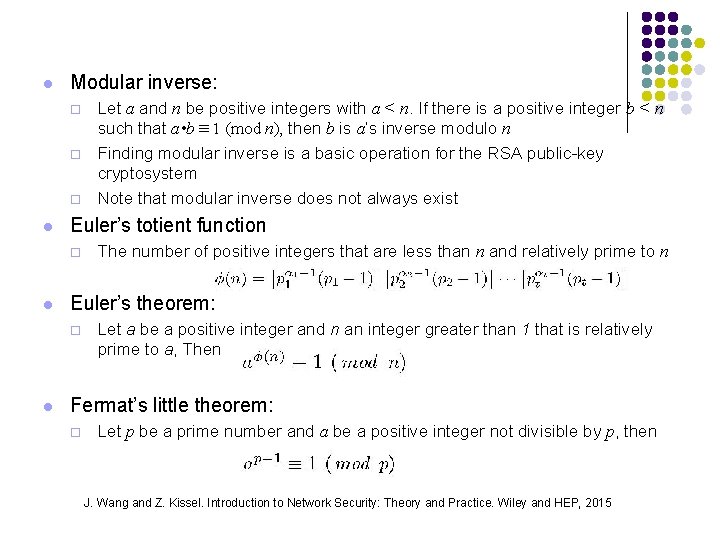
l Modular inverse: ¨ ¨ ¨ l Euler’s totient function ¨ l The number of positive integers that are less than n and relatively prime to n Euler’s theorem: ¨ l Let a and n be positive integers with a < n. If there is a positive integer b < n such that a • b ≡ 1 (mod n), then b is a’s inverse modulo n Finding modular inverse is a basic operation for the RSA public-key cryptosystem Note that modular inverse does not always exist Let a be a positive integer and n an integer greater than 1 that is relatively prime to a, Then Fermat’s little theorem: ¨ Let p be a prime number and a be a positive integer not divisible by p, then J. Wang and Z. Kissel. Introduction to Network Security: Theory and Practice. Wiley and HEP, 2015

l Primitive roots: ¨ If for any positive integer m < φ(n), then a is called a primitive root modulo n ¨ l Not every integer n has a primitive root Fast modular exponentiation: ¨ ¨ ¨ ax mod n is a common operation in PKC Naïve method to calculate ax mod n: First calculate ax, then calculate modulo n. It incurs high time complexity!!! x is a positive integer. Let then J. Wang and Z. Kissel. Introduction to Network Security: Theory and Practice. Wiley and HEP, 2015
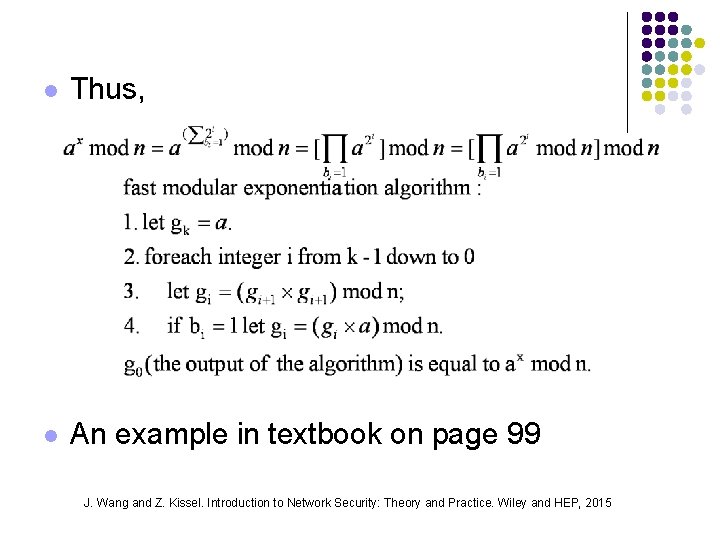
l Thus, l An example in textbook on page 99 J. Wang and Z. Kissel. Introduction to Network Security: Theory and Practice. Wiley and HEP, 2015
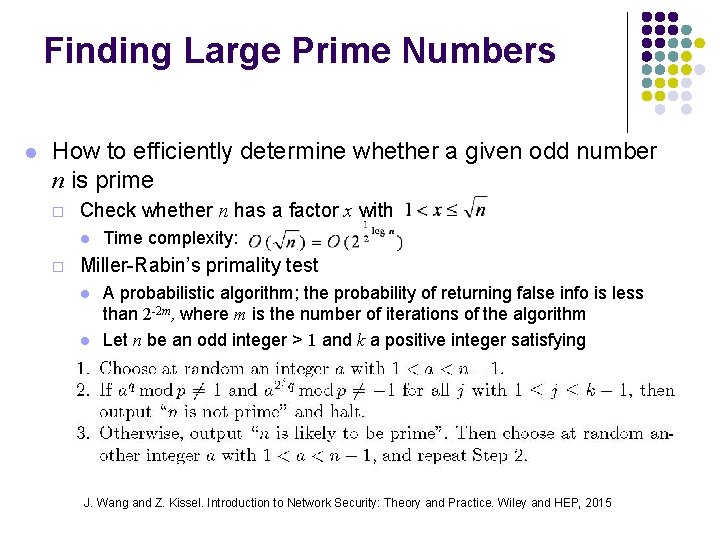
Finding Large Prime Numbers l How to efficiently determine whether a given odd number n is prime ¨ Check whether n has a factor x with l ¨ Time complexity: Miller-Rabin’s primality test l l A probabilistic algorithm; the probability of returning false info is less than 2 -2 m, where m is the number of iterations of the algorithm Let n be an odd integer > 1 and k a positive integer satisfying n – 1 = 2 kq, where q is an odd integer J. Wang and Z. Kissel. Introduction to Network Security: Theory and Practice. Wiley and HEP, 2015
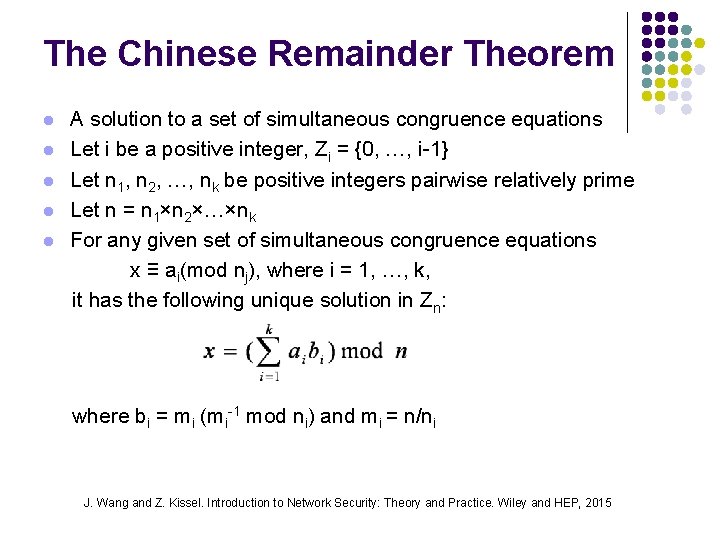
The Chinese Remainder Theorem l l l A solution to a set of simultaneous congruence equations Let i be a positive integer, Zi = {0, …, i-1} Let n 1, n 2, …, nk be positive integers pairwise relatively prime Let n = n 1×n 2×…×nk For any given set of simultaneous congruence equations x ≡ ai(mod nj), where i = 1, …, k, it has the following unique solution in Zn: where bi = mi (mi-1 mod ni) and mi = n/ni J. Wang and Z. Kissel. Introduction to Network Security: Theory and Practice. Wiley and HEP, 2015
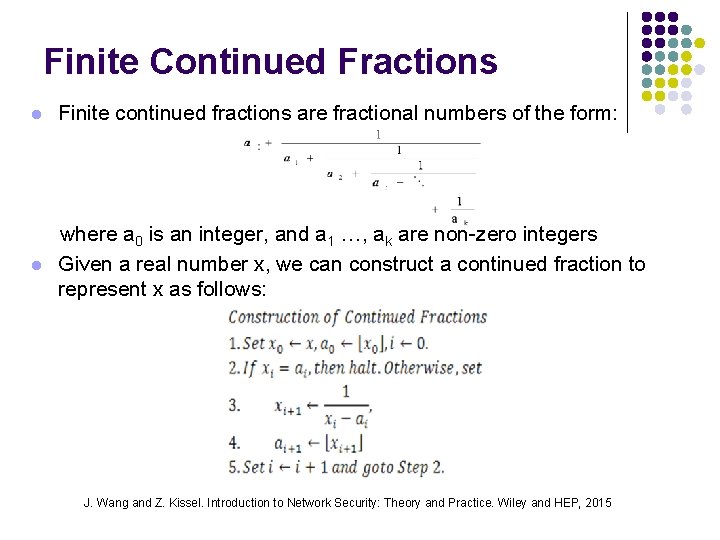
Finite Continued Fractions l Finite continued fractions are fractional numbers of the form: l where a 0 is an integer, and a 1 …, ak are non-zero integers Given a real number x, we can construct a continued fraction to represent x as follows: J. Wang and Z. Kissel. Introduction to Network Security: Theory and Practice. Wiley and HEP, 2015
Chapter 3 Outline l l l 3. 1 Concepts of Public-Key Cryptography 3. 2 Elementary Concepts and Theorems in Number Theory 3. 3 Diffie-Hellman Key Exchange 3. 4 RSA Cryptosystems 3. 5 Elliptic-Curve Cryptography 3. 6 Key Distributions and Management J. Wang and Z. Kissel. Introduction to Network Security: Theory and Practice. Wiley and HEP, 2015
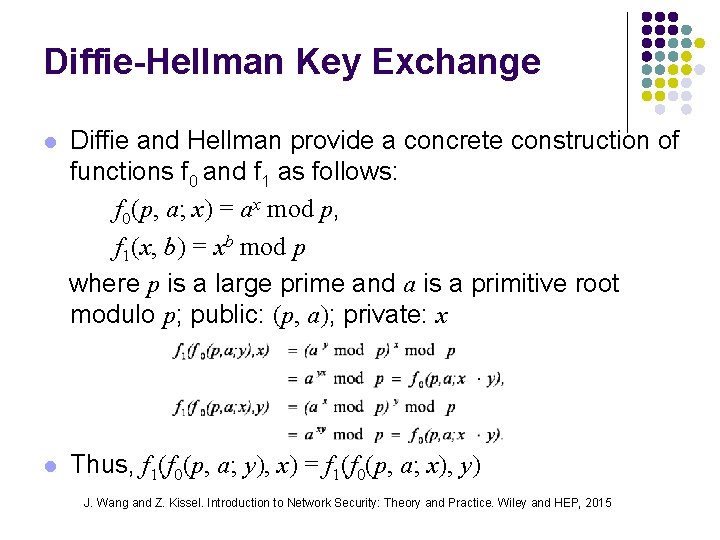
Diffie-Hellman Key Exchange l Diffie and Hellman provide a concrete construction of functions f 0 and f 1 as follows: f 0(p, a; x) = ax mod p, f 1(x, b) = xb mod p where p is a large prime and a is a primitive root modulo p; public: (p, a); private: x l Thus, f 1(f 0(p, a; y), x) = f 1(f 0(p, a; x), y) J. Wang and Z. Kissel. Introduction to Network Security: Theory and Practice. Wiley and HEP, 2015
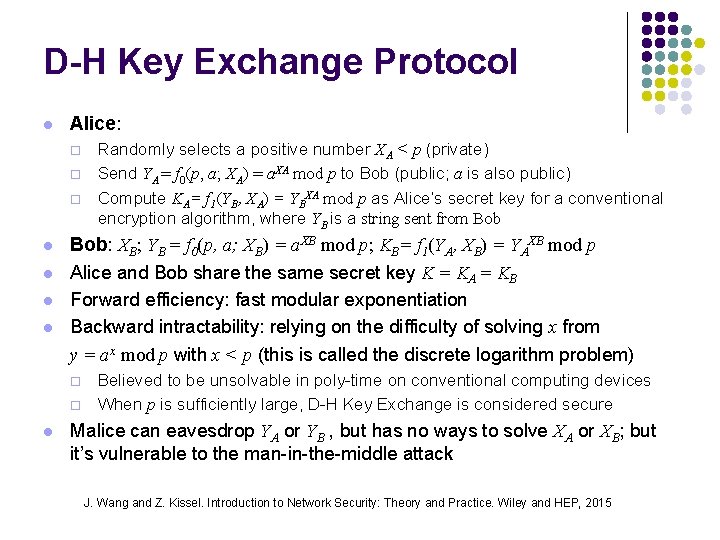
D-H Key Exchange Protocol l Alice: ¨ ¨ ¨ l l Bob: XB; YB = f 0(p, a; XB) = a. XB mod p; KB= f 1(YA, XB) = YAXB mod p Alice and Bob share the same secret key K = KA = KB Forward efficiency: fast modular exponentiation Backward intractability: relying on the difficulty of solving x from y = ax mod p with x < p (this is called the discrete logarithm problem) ¨ ¨ l Randomly selects a positive number XA < p (private) Send YA = f 0(p, a; XA) = a. XA mod p to Bob (public; a is also public) Compute KA= f 1(YB, XA) = YBXA mod p as Alice’s secret key for a conventional encryption algorithm, where YB is a string sent from Bob Believed to be unsolvable in poly-time on conventional computing devices When p is sufficiently large, D-H Key Exchange is considered secure Malice can eavesdrop YA or YB , but has no ways to solve XA or XB; but it’s vulnerable to the man-in-the-middle attack J. Wang and Z. Kissel. Introduction to Network Security: Theory and Practice. Wiley and HEP, 2015
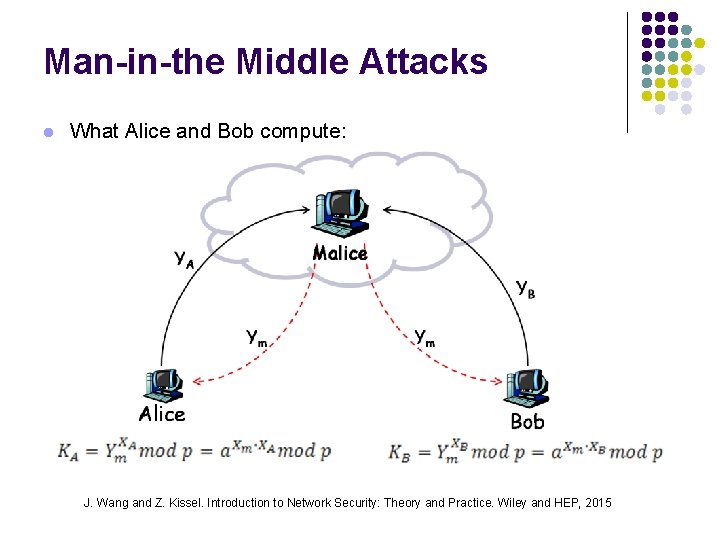
Man-in-the Middle Attacks l What Alice and Bob compute: J. Wang and Z. Kissel. Introduction to Network Security: Theory and Practice. Wiley and HEP, 2015
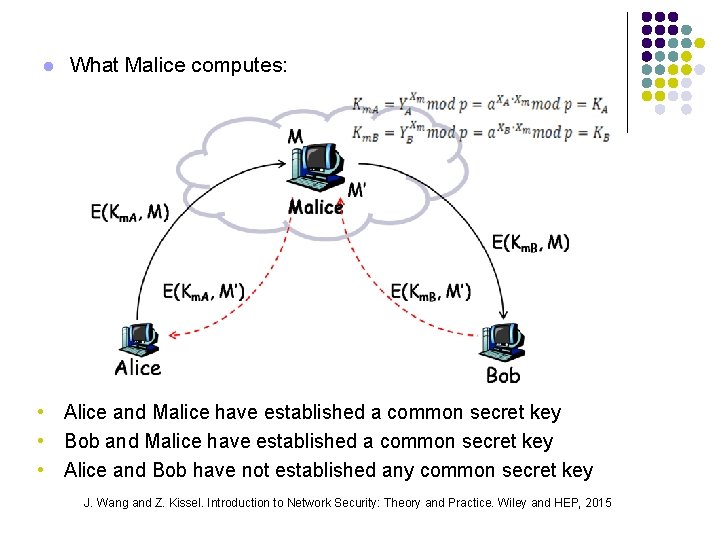
l What Malice computes: • Alice and Malice have established a common secret key • Bob and Malice have established a common secret key • Alice and Bob have not established any common secret key J. Wang and Z. Kissel. Introduction to Network Security: Theory and Practice. Wiley and HEP, 2015
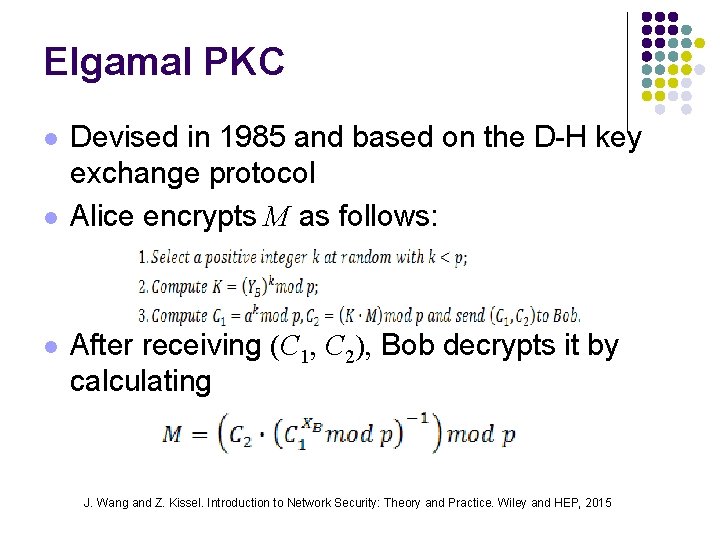
Elgamal PKC l l l Devised in 1985 and based on the D-H key exchange protocol Alice encrypts M as follows: After receiving (C 1, C 2), Bob decrypts it by calculating J. Wang and Z. Kissel. Introduction to Network Security: Theory and Practice. Wiley and HEP, 2015
Chapter 3 Outline l l l 3. 1 Concepts of Public-Key Cryptography 3. 2 Elementary Concepts and Theorems in Number Theory 3. 3 Diffie-Hellman Key Exchange 3. 4 RSA Cryptosystem 3. 5 Elliptic-Curve Cryptography 3. 6 Key Distributions and Management J. Wang and Z. Kissel. Introduction to Network Security: Theory and Practice. Wiley and HEP, 2015
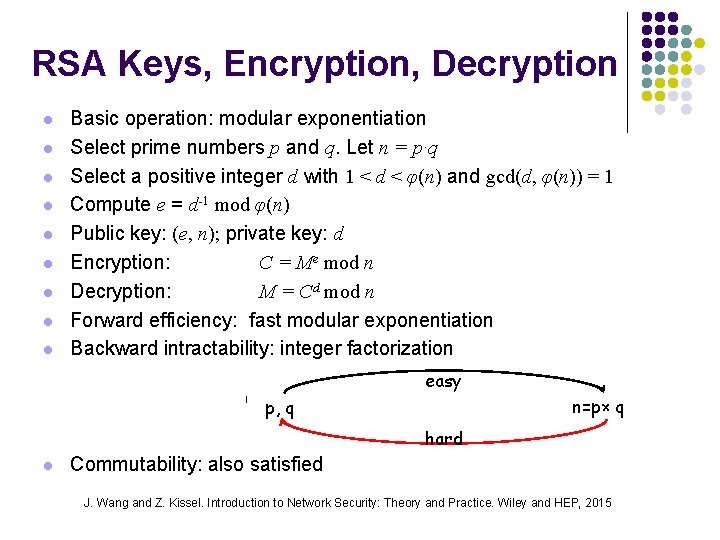
RSA Keys, Encryption, Decryption l l l l l Basic operation: modular exponentiation Select prime numbers p and q. Let n = p·q Select a positive integer d with 1 < d < φ(n) and gcd(d, φ(n)) = 1 Compute e = d-1 mod φ(n) Public key: (e, n); private key: d Encryption: C = Me mod n Decryption: M = Cd mod n Forward efficiency: fast modular exponentiation Backward intractability: integer factorization easy n=p× q p, q hard l Commutability: also satisfied J. Wang and Z. Kissel. Introduction to Network Security: Theory and Practice. Wiley and HEP, 2015
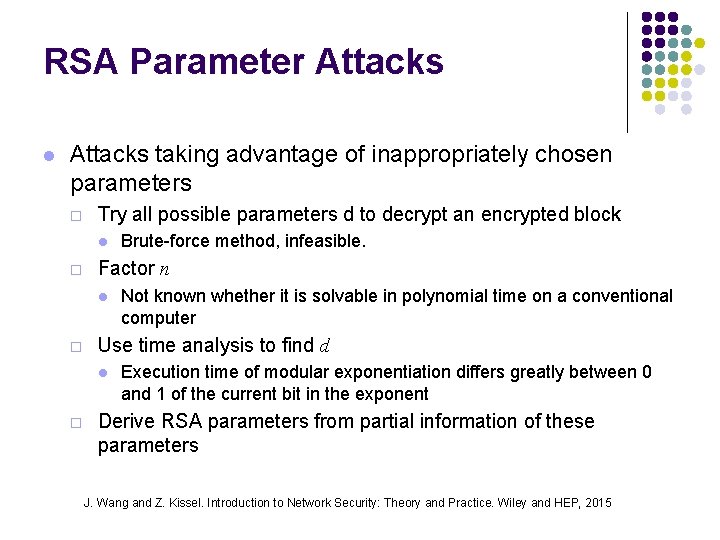
RSA Parameter Attacks l Attacks taking advantage of inappropriately chosen parameters ¨ Try all possible parameters d to decrypt an encrypted block l ¨ Factor n l ¨ Not known whether it is solvable in polynomial time on a conventional computer Use time analysis to find d l ¨ Brute-force method, infeasible. Execution time of modular exponentiation differs greatly between 0 and 1 of the current bit in the exponent Derive RSA parameters from partial information of these parameters J. Wang and Z. Kissel. Introduction to Network Security: Theory and Practice. Wiley and HEP, 2015
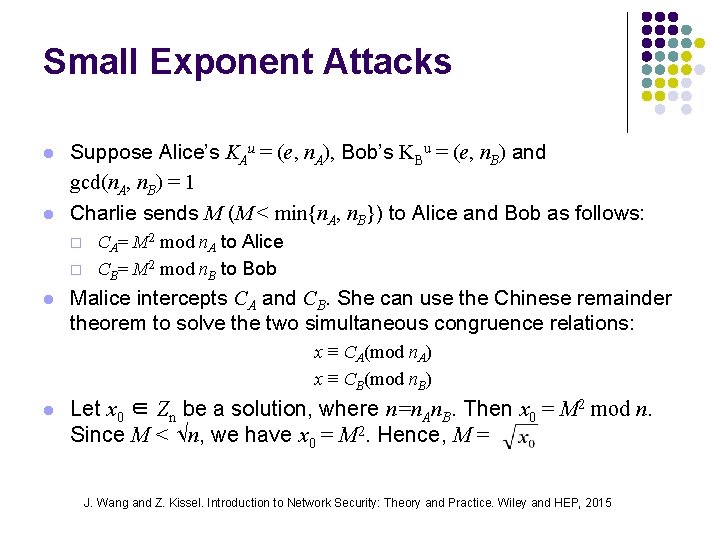
Small Exponent Attacks l l Suppose Alice’s KAu = (e, n. A), Bob’s KBu = (e, n. B) and gcd(n. A, n. B) = 1 Charlie sends M (M < min{n. A, n. B}) to Alice and Bob as follows: ¨ ¨ l CA= M 2 mod n. A to Alice CB= M 2 mod n. B to Bob Malice intercepts CA and CB. She can use the Chinese remainder theorem to solve the two simultaneous congruence relations: x ≡ CA(mod n. A) x ≡ CB(mod n. B) l Let x 0 ∈ Zn be a solution, where n=n. An. B. Then x 0 = M 2 mod n. Since M < √n, we have x 0 = M 2. Hence, M = J. Wang and Z. Kissel. Introduction to Network Security: Theory and Practice. Wiley and HEP, 2015
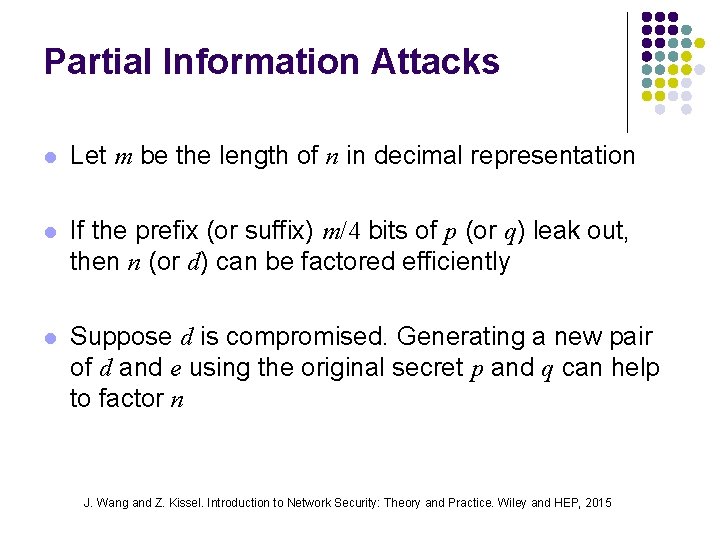
Partial Information Attacks l Let m be the length of n in decimal representation l If the prefix (or suffix) m/4 bits of p (or q) leak out, then n (or d) can be factored efficiently l Suppose d is compromised. Generating a new pair of d and e using the original secret p and q can help to factor n J. Wang and Z. Kissel. Introduction to Network Security: Theory and Practice. Wiley and HEP, 2015
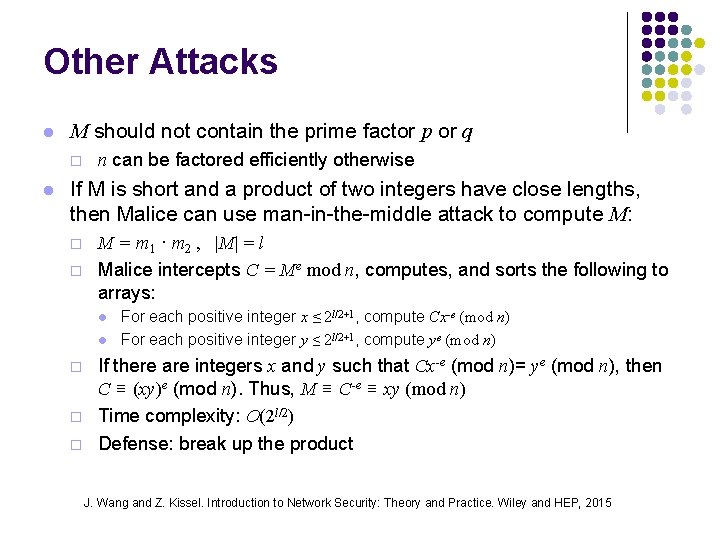
Other Attacks l M should not contain the prime factor p or q ¨ l n can be factored efficiently otherwise If M is short and a product of two integers have close lengths, then Malice can use man-in-the-middle attack to compute M: ¨ ¨ M = m 1 · m 2 , |M| = l Malice intercepts C = Me mod n, computes, and sorts the following to arrays: l l ¨ ¨ ¨ For each positive integer x ≤ 2 l/2+1, compute Cx-e (mod n) For each positive integer y ≤ 2 l/2+1, compute ye (mod n) If there are integers x and y such that Cx-e (mod n)= ye (mod n), then C ≡ (xy)e (mod n). Thus, M ≡ C-e ≡ xy (mod n) Time complexity: O(2 l/2) Defense: break up the product J. Wang and Z. Kissel. Introduction to Network Security: Theory and Practice. Wiley and HEP, 2015
Chapter 3 Outline l l l 3. 1 Concepts of Public-Key Cryptography 3. 2 Elementary Concepts and Theorems in Number Theory 3. 3 Diffie-Hellman Key Exchange 3. 4 RSA Cryptosystem 3. 5 Elliptic-Curve Cryptography 3. 6 Key Distributions and Management J. Wang and Z. Kissel. Introduction to Network Security: Theory and Practice. Wiley and HEP, 2015
Key Distribution and Management l PKC takes more time to encrypt data than conventional encryption algorithms ¨ l PKC is not suitable for encrypting long data PKC is often used to encrypt secret keys for conventional encryption algorithms and other short messages for authentication J. Wang and Z. Kissel. Introduction to Network Security: Theory and Practice. Wiley and HEP, 2015
Master Keys and Session Keys l Master keys (Km): a secret key used to encrypt other secret keys during a certain period of time ¨ l Reduce exposure of the master key Session keys (Ks): a secret key for each new communication session and encrypted by the master key ¨ ¨ Encrypt a message or a packet in TCP Shorter lifetime than that of a master key J. Wang and Z. Kissel. Introduction to Network Security: Theory and Practice. Wiley and HEP, 2015
Public-Key Certificates l To use PKC, users must get the other users’ public keys ¨ ¨ l Published in a special Website or by emails Cannot ensure true ownership of a public key Public-key certificates to authenticate public keys ¨ ¨ Issued by trusted organizations, certificate authorities (CAs) A CA uses PKC to authenticate certificates l l Publishes its public key on its Website Issues a certificate for each user Encrypts the certificate by CA’s private key for authentication When Alice wants to use Bob’s public key: ¨ ¨ ¨ Asks Bob to send her his certificate Uses CA’s public key to verify it Gets Bob’s public key from his certificate J. Wang and Z. Kissel. Introduction to Network Security: Theory and Practice. Wiley and HEP, 2015
CA Networks l A CA needs to keep track of which certificates are out of date and which have been canceled l CA(KXu): a certificate issued by CA to user X whose public key is KXu l Alice and Bob possess certificates from two different CAs. How to verify each other’s certificate? ¨ CAs should be able to authenticate each other’s public keys J. Wang and Z. Kissel. Introduction to Network Security: Theory and Practice. Wiley and HEP, 2015
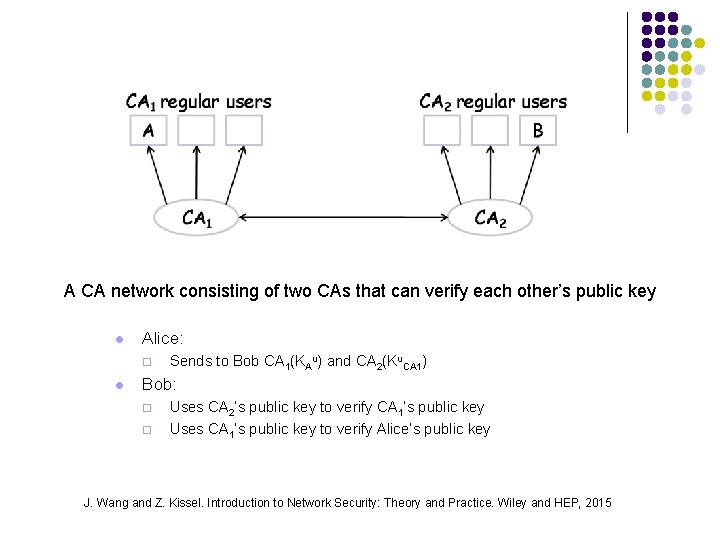
A CA network consisting of two CAs that can verify each other’s public key l Alice: ¨ l Sends to Bob CA 1(KAu) and CA 2(Ku. CA 1) Bob: ¨ ¨ Uses CA 2‘s public key to verify CA 1‘s public key Uses CA 1‘s public key to verify Alice’s public key J. Wang and Z. Kissel. Introduction to Network Security: Theory and Practice. Wiley and HEP, 2015
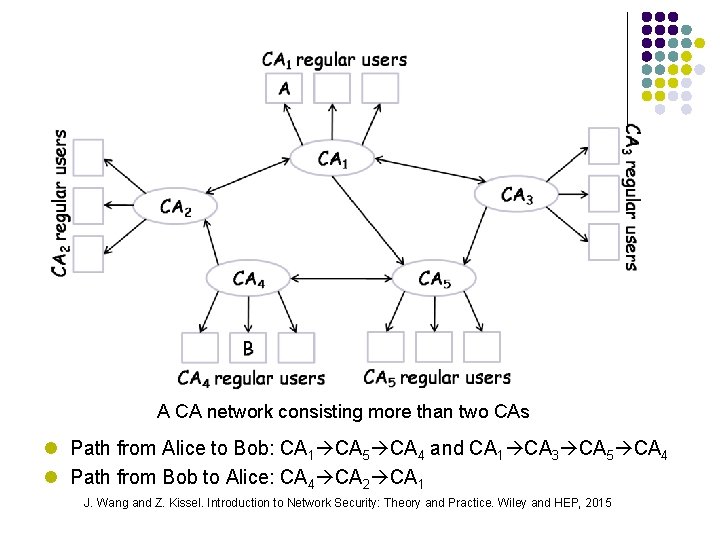
A CA network consisting more than two CAs l Path from Alice to Bob: CA 1 CA 5 CA 4 and CA 1 CA 3 CA 5 CA 4 l Path from Bob to Alice: CA 4 CA 2 CA 1 J. Wang and Z. Kissel. Introduction to Network Security: Theory and Practice. Wiley and HEP, 2015
Key Rings l A system may have many different users l How to store and manage these public and private keys? l Private-key rings ¨ l A table in which each row represents a record of a particular user: key ID, owner’s name, public key, encrypted private key, time stamp… Public-key rings ¨ A table in which each row represents a record of a particular user: key ID, owner’s name, public key, CA name, CA trust, time stamp… J. Wang and Z. Kissel. Introduction to Network Security: Theory and Practice. Wiley and HEP, 2015
- Slides: 34