
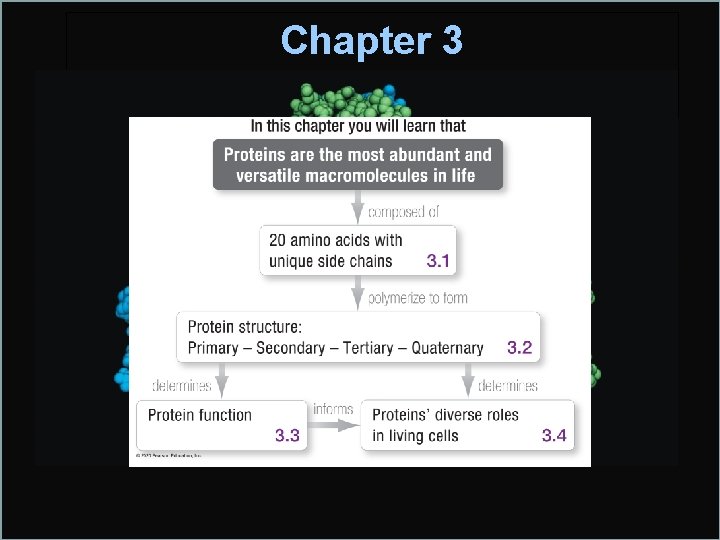
Chapter 3 Protein Structure and Function 3 1
- Slides: 19
Chapter 3 Protein Structure and Function
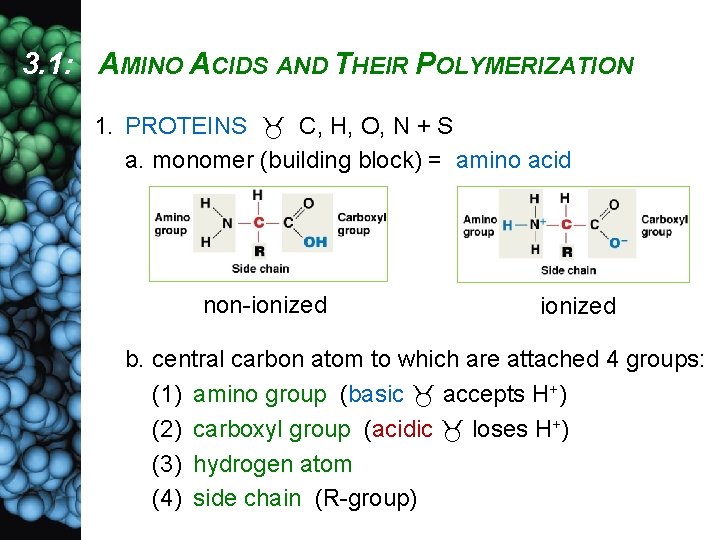
3. 1: AMINO ACIDS AND THEIR POLYMERIZATION 1. PROTEINS C, H, O, N + S a. monomer (building block) = amino acid non-ionized b. central carbon atom to which are attached 4 groups: (1) amino group (basic accepts H+) (2) carboxyl group (acidic loses H+) (3) hydrogen atom (4) side chain (R-group)
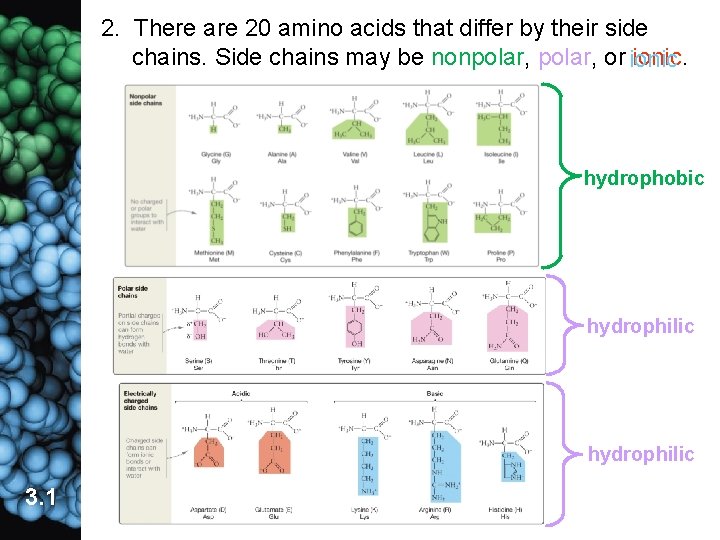
2. There are 20 amino acids that differ by their side chains. Side chains may be nonpolar, or ionic. hydrophobic hydrophilic 3. 1
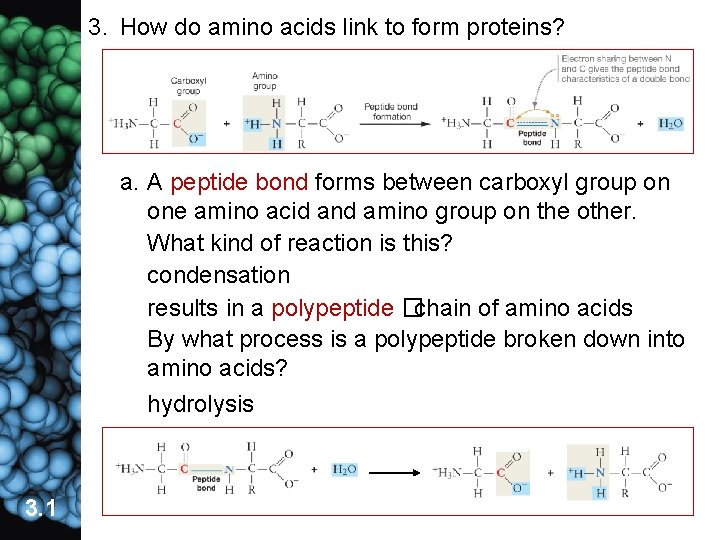
3. How do amino acids link to form proteins? a. A peptide bond forms between carboxyl group on one amino acid and amino group on the other. What kind of reaction is this? condensation results in a polypeptide �chain of amino acids By what process is a polypeptide broken down into amino acids? lts hydrolysis 3. 1
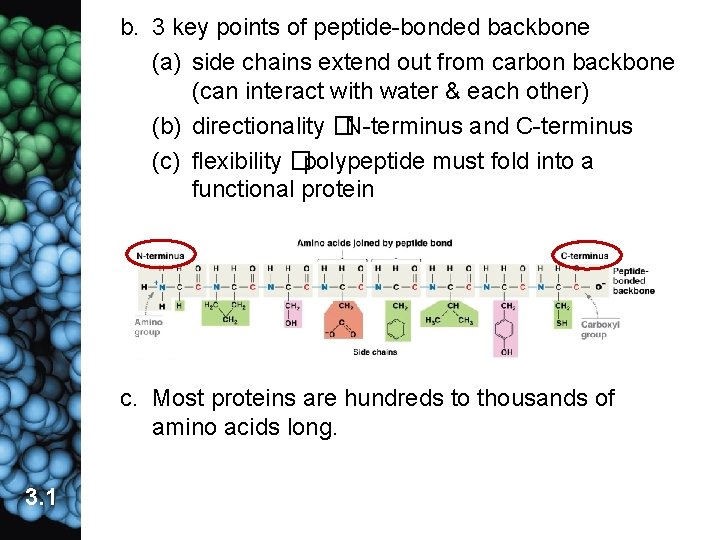
b. 3 key points of peptide-bonded backbone (a) side chains extend out from carbon backbone (can interact with water & each other) (b) directionality �N-terminus and C-terminus (c) flexibility �polypeptide must fold into a functional protein c. Most proteins are hundreds to thousands of amino acids long. 3. 1
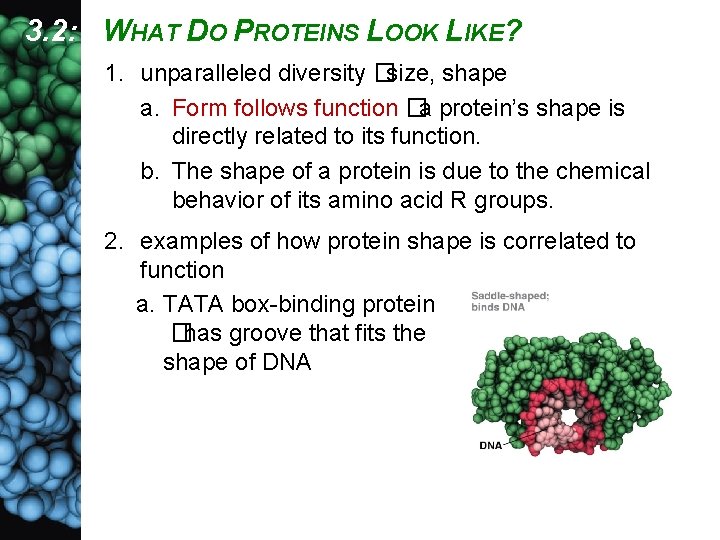
3. 2: WHAT DO PROTEINS LOOK LIKE? 1. unparalleled diversity �size, shape a. Form follows function �a protein’s shape is directly related to its function. b. The shape of a protein is due to the chemical behavior of its amino acid R groups. 2. examples of how protein shape is correlated to function a. TATA box-binding protein �has groove that fits the shape of DNA
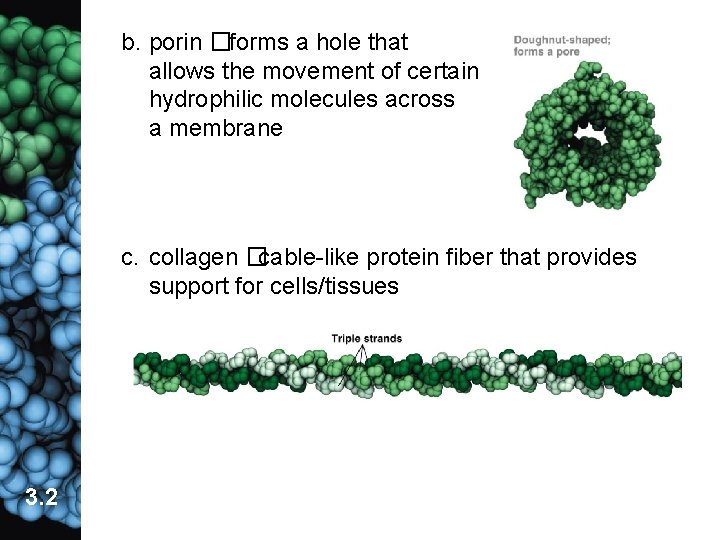
b. porin �forms a hole that allows the movement of certain hydrophilic molecules across a membrane c. collagen �cable-like protein fiber that provides support for cells/tissues 3. 2
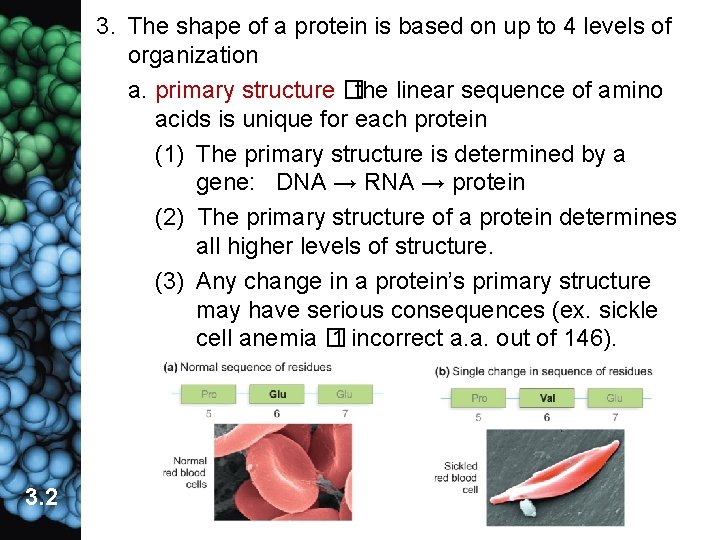
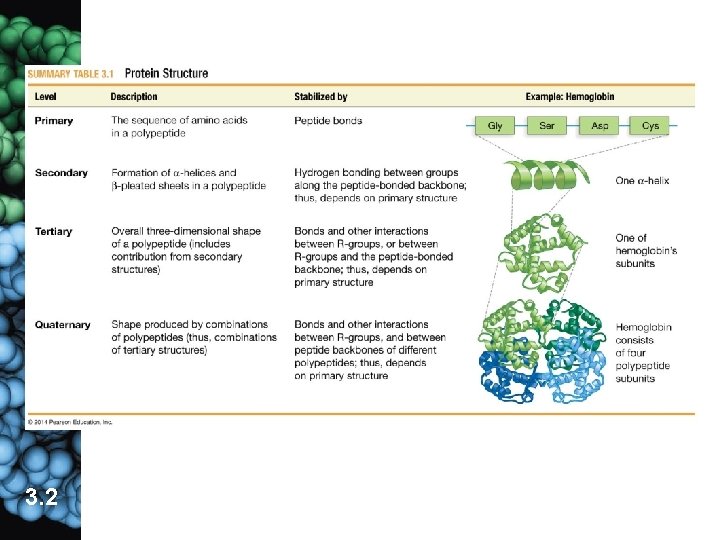
3. The shape of a protein is based on up to 4 levels of organization a. primary structure �the linear sequence of amino acids is unique for each protein (1) The primary structure is determined by a gene: DNA → RNA → protein (2) The primary structure of a protein determines all higher levels of structure. (3) Any change in a protein’s primary structure may have serious consequences (ex. sickle cell anemia � 1 incorrect a. a. out of 146). 3. 2
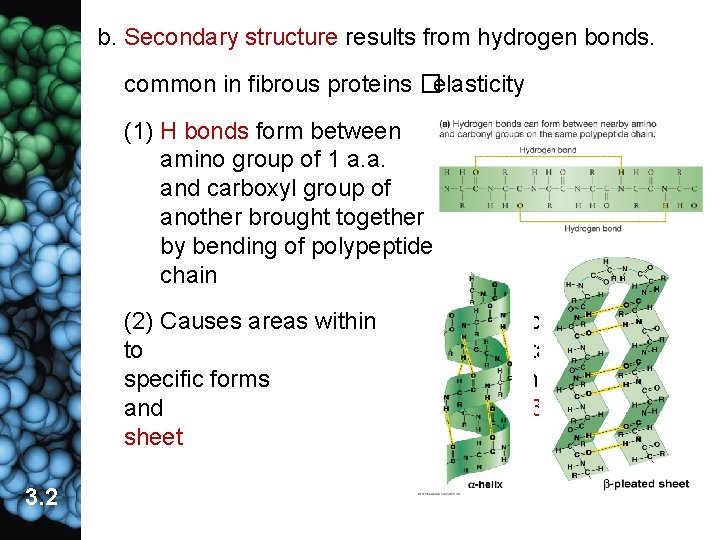
b. Secondary structure results from hydrogen bonds. common in fibrous proteins �elasticity (1) H bonds form between amino group of 1 a. a. and carboxyl group of another brought together by bending of polypeptide chain (2) Causes areas within to specific forms and sheet 3. 2 developing protein take on including α-helix β-pleated
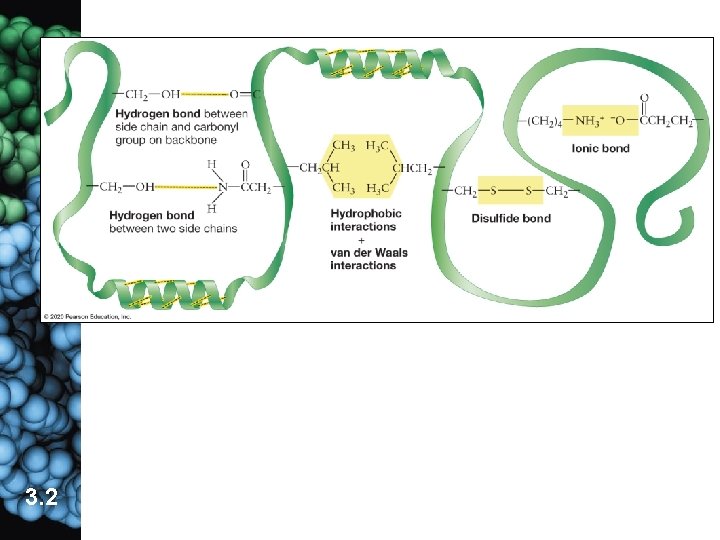
c. Tertiary structure is the 3 -D shape of the polypeptide resulting from interactions among side groups. common in globular proteins (1) covalent bonds (disulfide bridges) (2) van der Waals interactions are weak attractions among nonpolar side groups �clustering of hydrophobic regions (3) ionic bonds between oppositely charged ionic side groups (4) hydrogen bonds between polar side groups 3. 2
3. 2
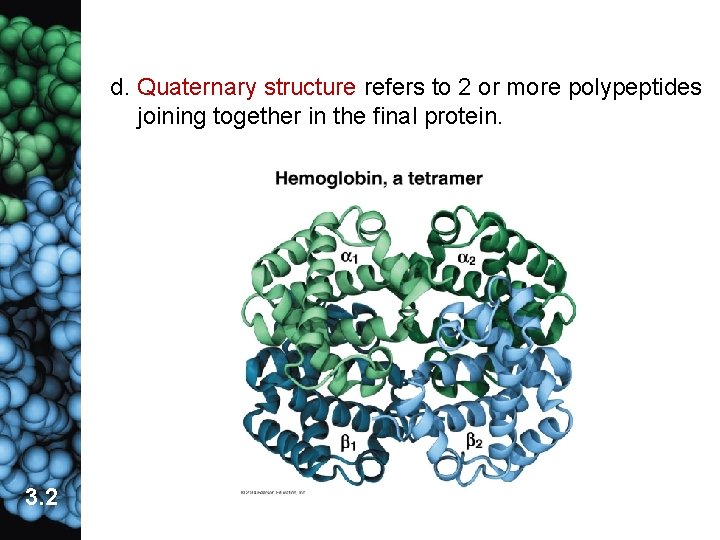
d. Quaternary structure refers to 2 or more polypeptides joining together in the final protein. 3. 2
3. 2
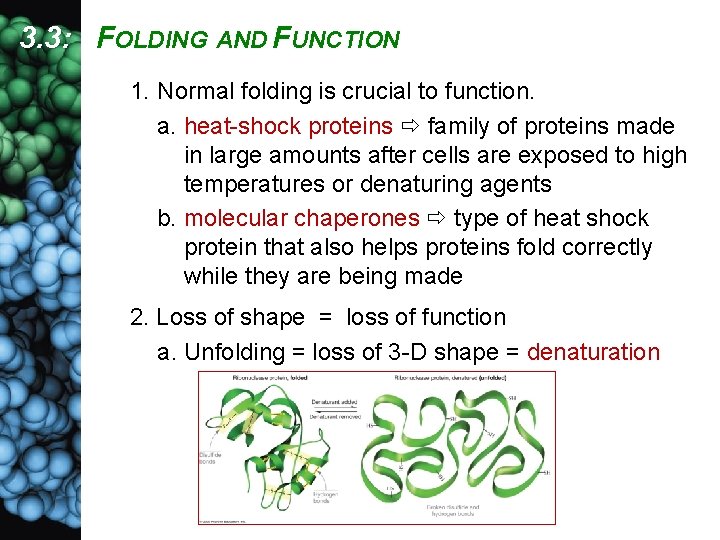
3. 3: FOLDING AND FUNCTION 1. Normal folding is crucial to function. a. heat-shock proteins family of proteins made in large amounts after cells are exposed to high temperatures or denaturing agents b. molecular chaperones type of heat shock protein that also helps proteins fold correctly while they are being made 2. Loss of shape = loss of function a. Unfolding = loss of 3 -D shape = denaturation
b. Denaturation is caused by anything that disrupts R-group interactions and H bonds. (1) temperature change (2) p. H change (3) electric current (4) addition of a salt (5) organic solvents 3. 3
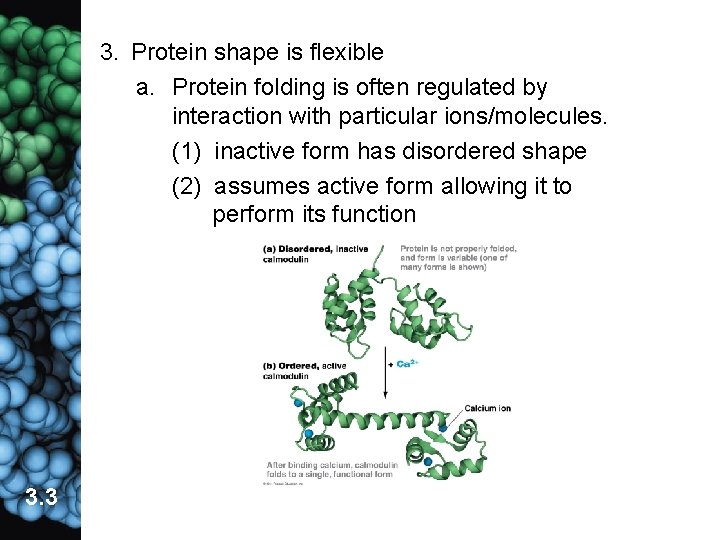
3. Protein shape is flexible a. Protein folding is often regulated by interaction with particular ions/molecules. (1) inactive form has disordered shape (2) assumes active form allowing it to perform its function 3. 3
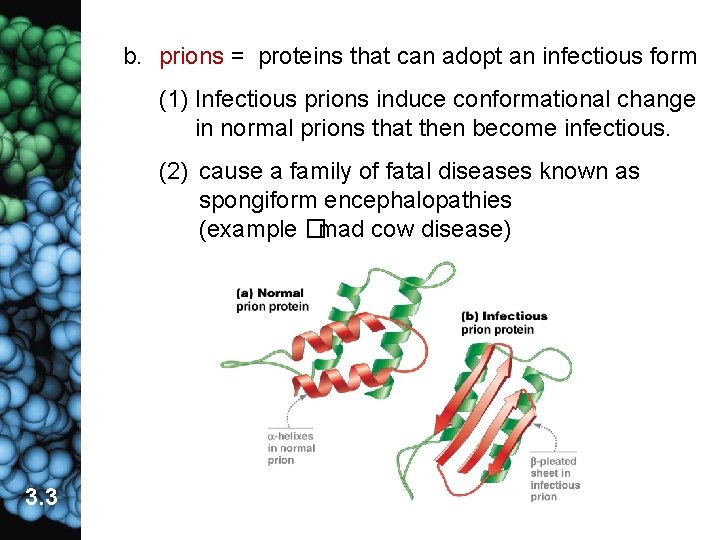
b. prions = proteins that can adopt an infectious form (1) Infectious prions induce conformational change in normal prions that then become infectious. (2) cause a family of fatal diseases known as spongiform encephalopathies (example �mad cow disease) 3. 3
3. 4: PROTEIN FUNCTIONS ARE AS DIVERSE AS PROTEIN STRUCTURES 1. Proteins perform more functions than any other type of molecule *a. catalysis – enzymes b. structure – keratin (hair, nails, scales, feathers) c. movement – contractile proteins d. signaling – hormones and cell receptors e. transport – hemoglobin f. defense – antibodies * Most important protein FUNCTION because: (1) life consists of chemical reactions (2) catalysts speed up chemical reactions
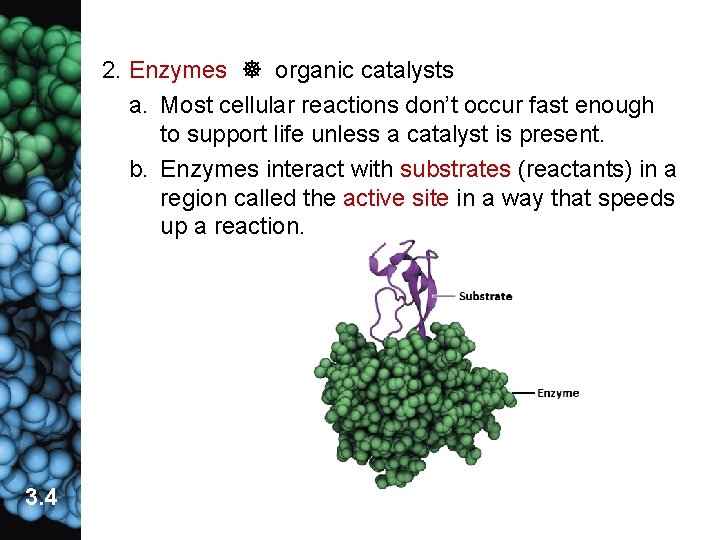
2. Enzymes organic catalysts a. Most cellular reactions don’t occur fast enough to support life unless a catalyst is present. b. Enzymes interact with substrates (reactants) in a region called the active site in a way that speeds up a reaction. 3. 4