
Chapter 3 Processes Chapter 3 Processes Process Concept

- Slides: 39
Chapter 3 Processes
Chapter 3: Processes • Process Concept • Process Scheduling • Operations on Processes • Interprocess Communication • Examples of IPC Systems • Communication in Client-Server Systems
Objectives • To introduce the notion of a process -- a program in execution, which forms the basis of all computation • To describe the various features of processes, including scheduling, creation and termination, and communication • To explore interprocess communication using shared memory and message passing • To describe communication in client-server systems
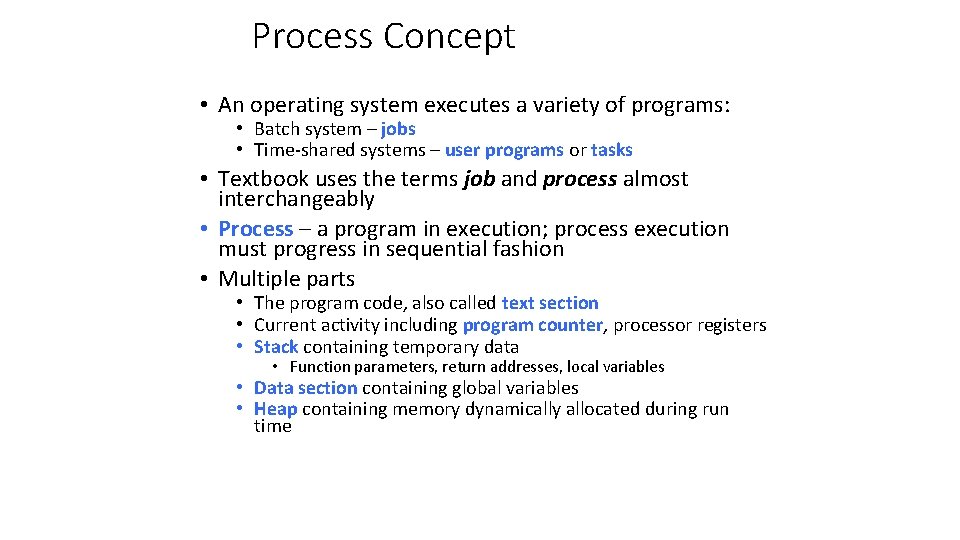
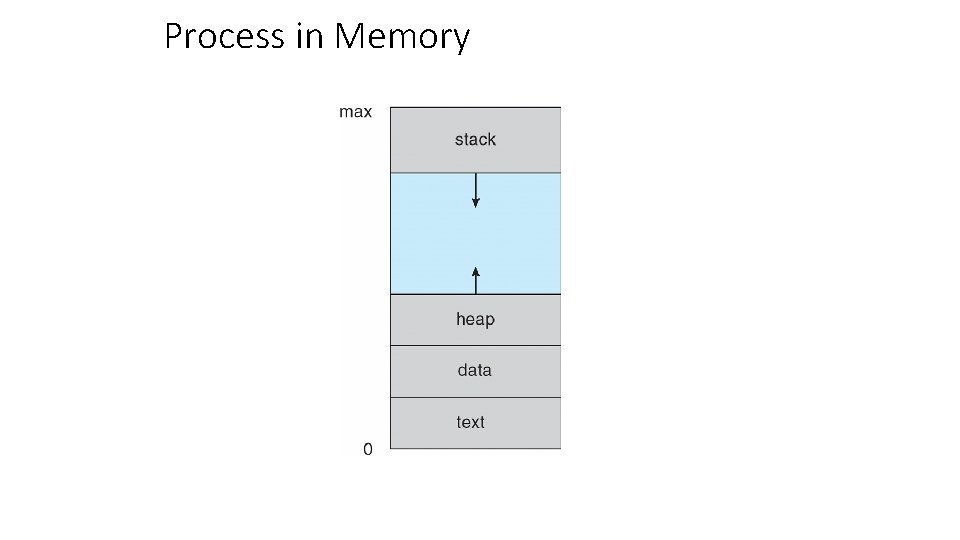
Process Concept • An operating system executes a variety of programs: • Batch system – jobs • Time-shared systems – user programs or tasks • Textbook uses the terms job and process almost interchangeably • Process – a program in execution; process execution must progress in sequential fashion • Multiple parts • The program code, also called text section • Current activity including program counter, processor registers • Stack containing temporary data • Function parameters, return addresses, local variables • Data section containing global variables • Heap containing memory dynamically allocated during run time
Process Concept (Cont. ) • Program is passive entity stored on disk (executable file), process is active • Program becomes process when executable file loaded into memory • Execution of program started via GUI mouse clicks, command line entry of its name, etc • One program can be several processes • Consider multiple users executing the same program
Process in Memory
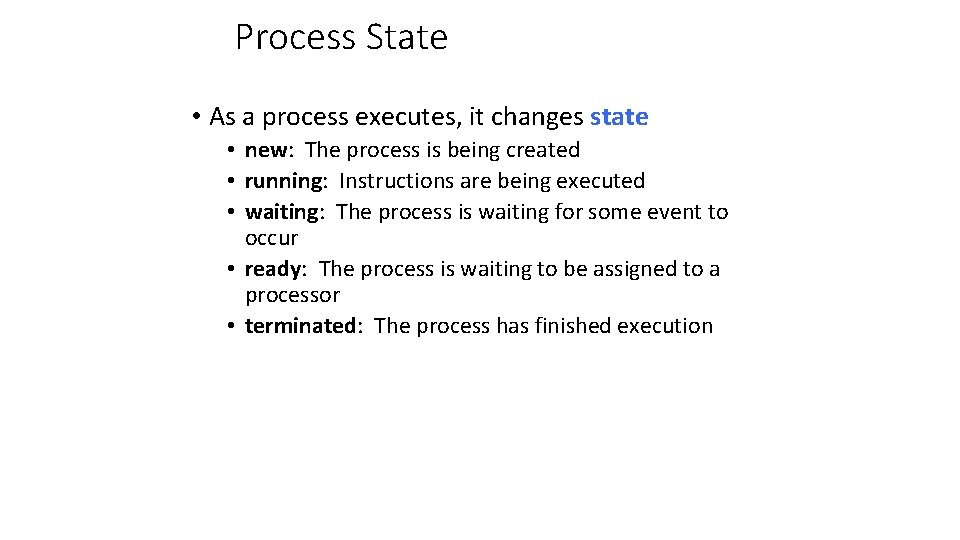
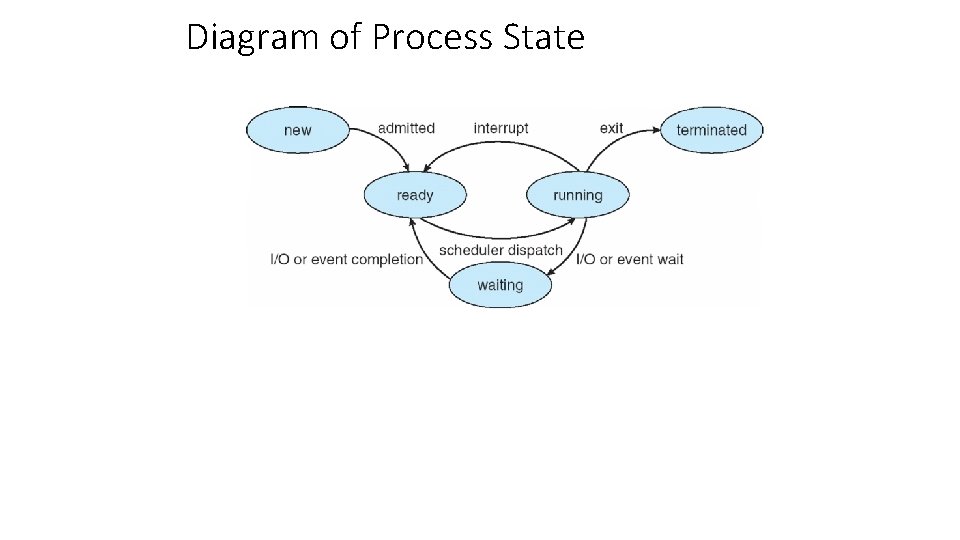
Process State • As a process executes, it changes state • new: The process is being created • running: Instructions are being executed • waiting: The process is waiting for some event to occur • ready: The process is waiting to be assigned to a processor • terminated: The process has finished execution
Diagram of Process State
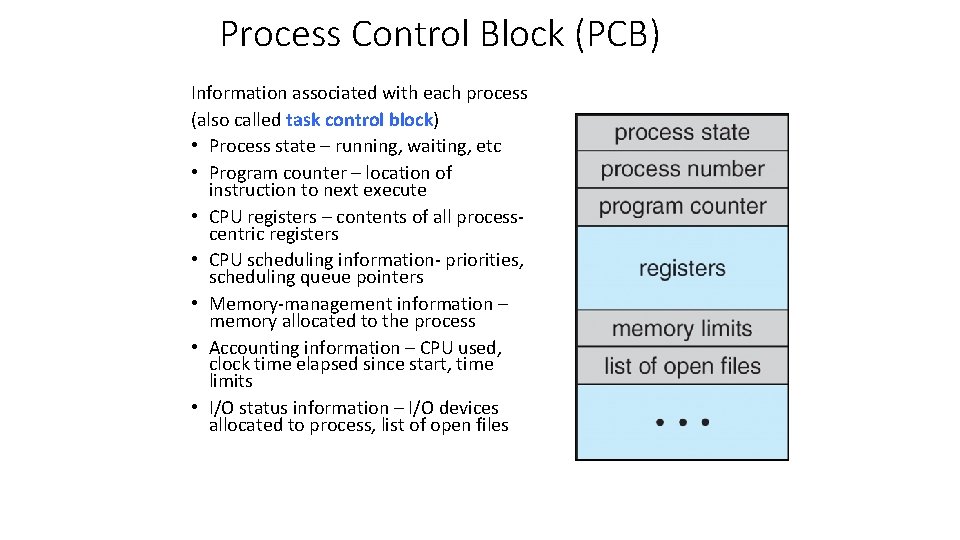
Process Control Block (PCB) Information associated with each process (also called task control block) • Process state – running, waiting, etc • Program counter – location of instruction to next execute • CPU registers – contents of all processcentric registers • CPU scheduling information- priorities, scheduling queue pointers • Memory-management information – memory allocated to the process • Accounting information – CPU used, clock time elapsed since start, time limits • I/O status information – I/O devices allocated to process, list of open files
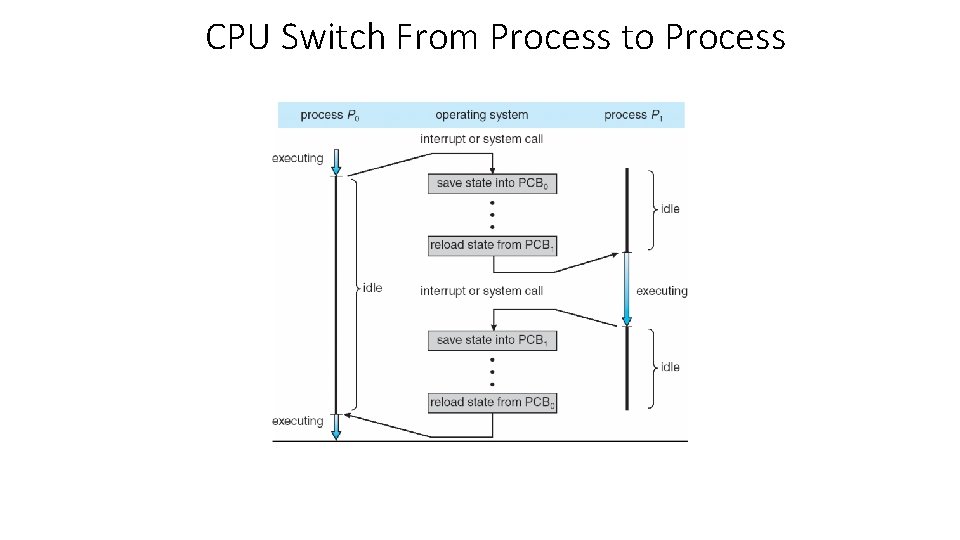
CPU Switch From Process to Process
Threads • So far, process has a single thread of execution • Consider having multiple program counters per process • Multiple locations can execute at once • Multiple threads of control -> threads • Must then have storage for thread details, multiple program counters in PCB • See next chapter
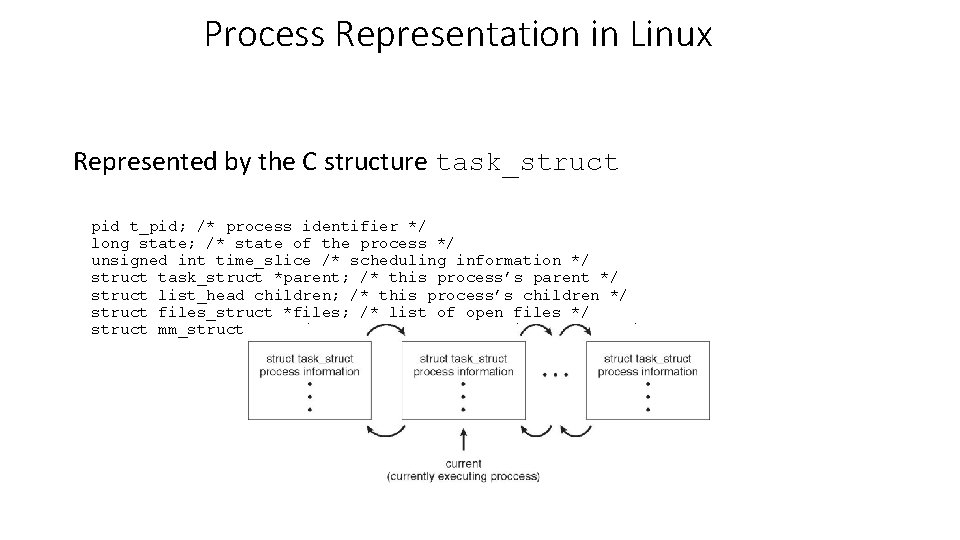
Process Representation in Linux Represented by the C structure task_struct pid t_pid; /* process identifier */ long state; /* state of the process */ unsigned int time_slice /* scheduling information */ struct task_struct *parent; /* this process’s parent */ struct list_head children; /* this process’s children */ struct files_struct *files; /* list of open files */ struct mm_struct *mm; /* address space of this process */
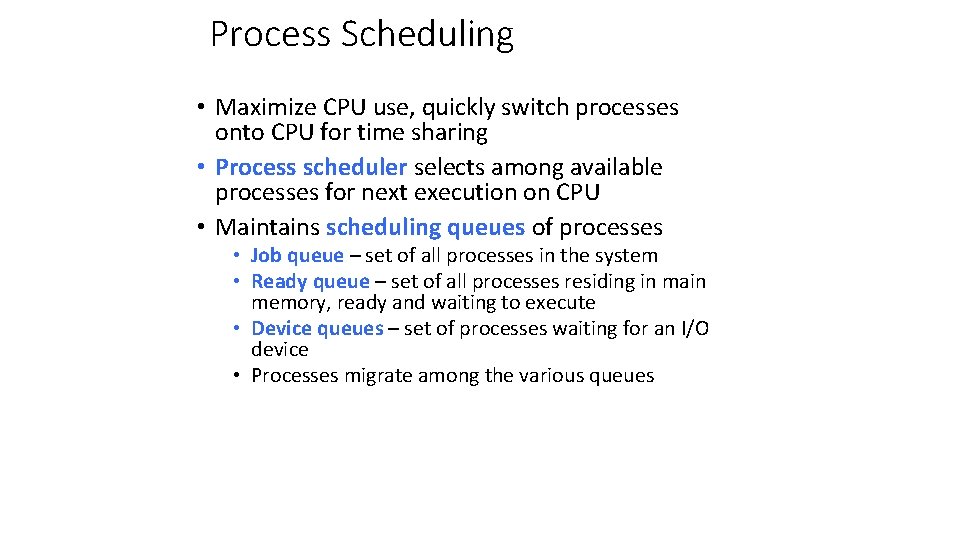
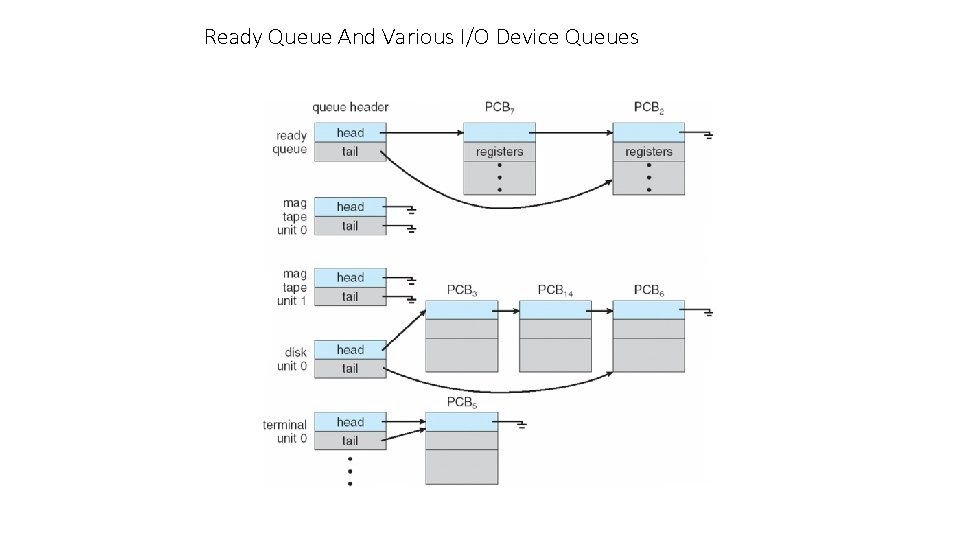
Process Scheduling • Maximize CPU use, quickly switch processes onto CPU for time sharing • Process scheduler selects among available processes for next execution on CPU • Maintains scheduling queues of processes • Job queue – set of all processes in the system • Ready queue – set of all processes residing in main memory, ready and waiting to execute • Device queues – set of processes waiting for an I/O device • Processes migrate among the various queues
Ready Queue And Various I/O Device Queues
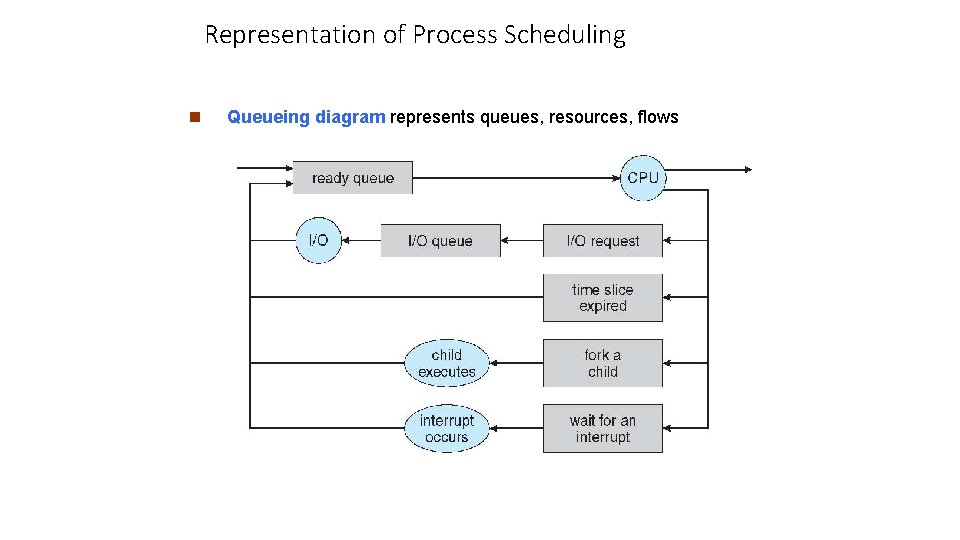
Representation of Process Scheduling n Queueing diagram represents queues, resources, flows
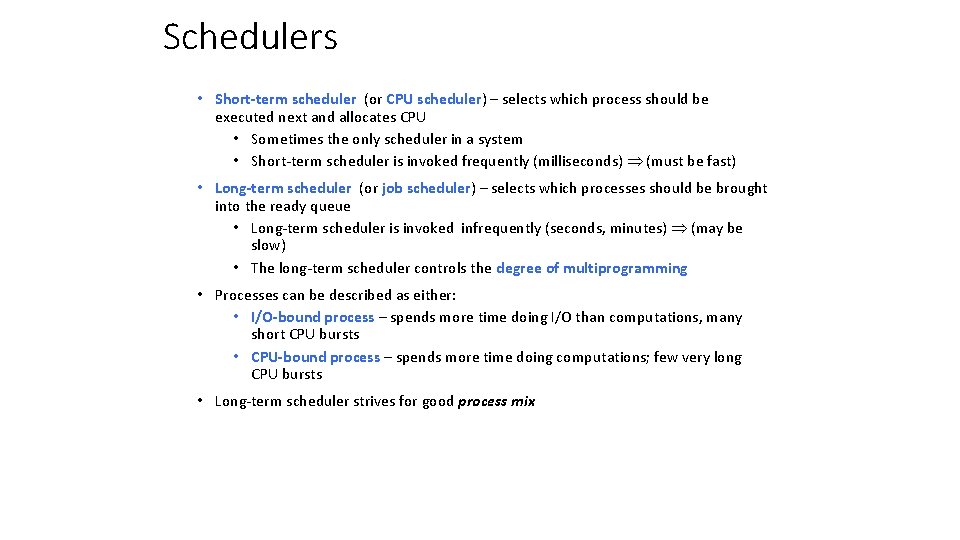
Schedulers • Short-term scheduler (or CPU scheduler) – selects which process should be executed next and allocates CPU • Sometimes the only scheduler in a system • Short-term scheduler is invoked frequently (milliseconds) (must be fast) • Long-term scheduler (or job scheduler) – selects which processes should be brought into the ready queue • Long-term scheduler is invoked infrequently (seconds, minutes) (may be slow) • The long-term scheduler controls the degree of multiprogramming • Processes can be described as either: • I/O-bound process – spends more time doing I/O than computations, many short CPU bursts • CPU-bound process – spends more time doing computations; few very long CPU bursts • Long-term scheduler strives for good process mix
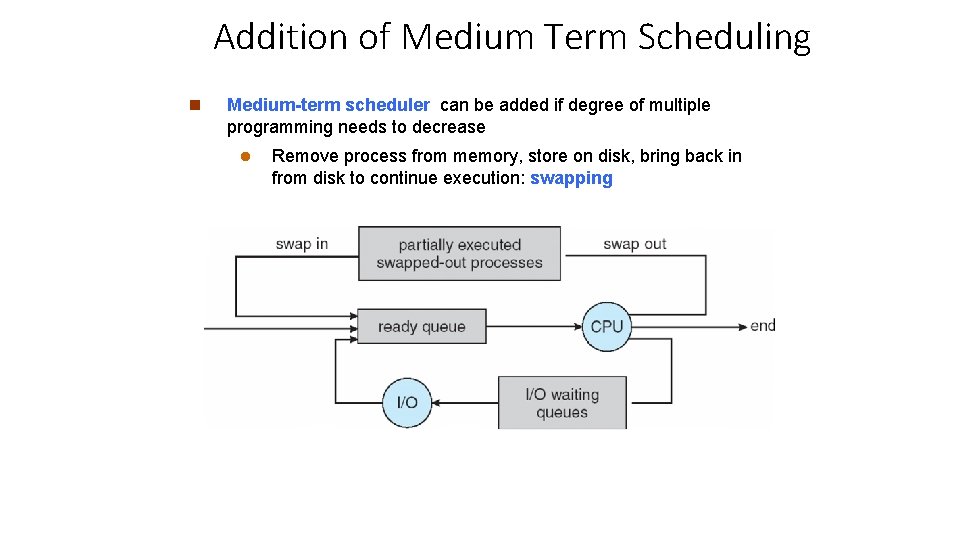
Addition of Medium Term Scheduling n Medium-term scheduler can be added if degree of multiple programming needs to decrease l Remove process from memory, store on disk, bring back in from disk to continue execution: swapping
Multitasking in Mobile Systems • Some mobile systems (e. g. , early version of i. OS) allow only one process to run, others suspended • Due to screen real estate, user interface limits i. OS provides for a • Single foreground process- controlled via user interface • Multiple background processes– in memory, running, but not on the display, and with limits • Limits include single, short task, receiving notification of events, specific long-running tasks like audio playback • Android runs foreground and background, with fewer limits • Background process uses a service to perform tasks • Service can keep running even if background process is suspended • Service has no user interface, small memory use
Context Switch • When CPU switches to another process, the system must save the state of the old process and load the saved state for the new process via a context switch • Context of a process represented in the PCB • Context-switch time is overhead; the system does no useful work while switching • The more complex the OS and the PCB the longer the context switch • Time dependent on hardware support • Some hardware provides multiple sets of registers per CPU multiple contexts loaded at once
Operations on Processes • System must provide mechanisms for: • process creation, • process termination, • and so on as detailed next
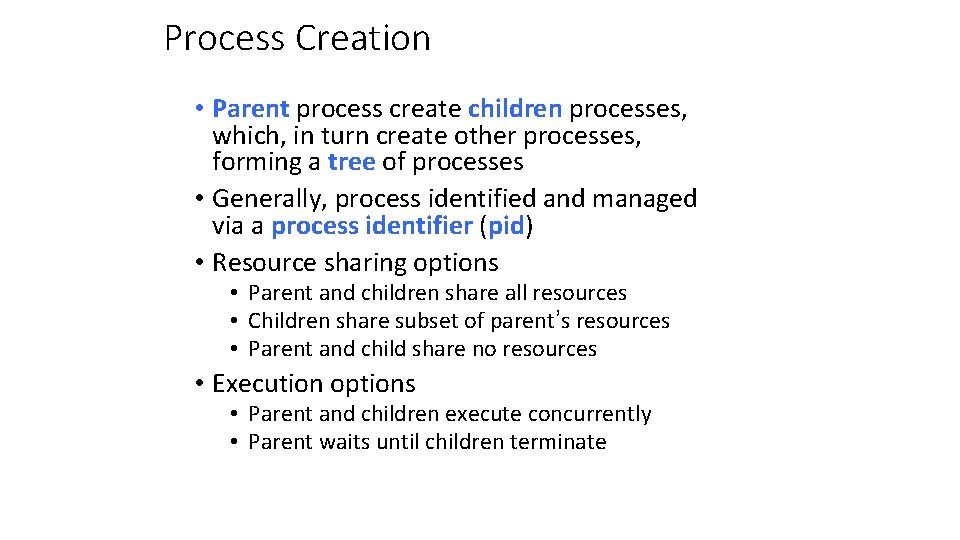
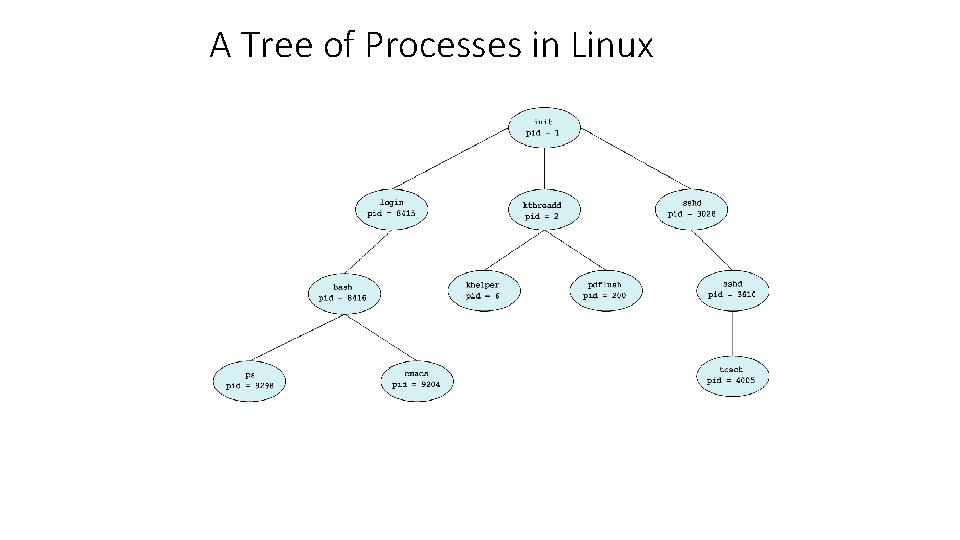
Process Creation • Parent process create children processes, which, in turn create other processes, forming a tree of processes • Generally, process identified and managed via a process identifier (pid) • Resource sharing options • Parent and children share all resources • Children share subset of parent’s resources • Parent and child share no resources • Execution options • Parent and children execute concurrently • Parent waits until children terminate
A Tree of Processes in Linux
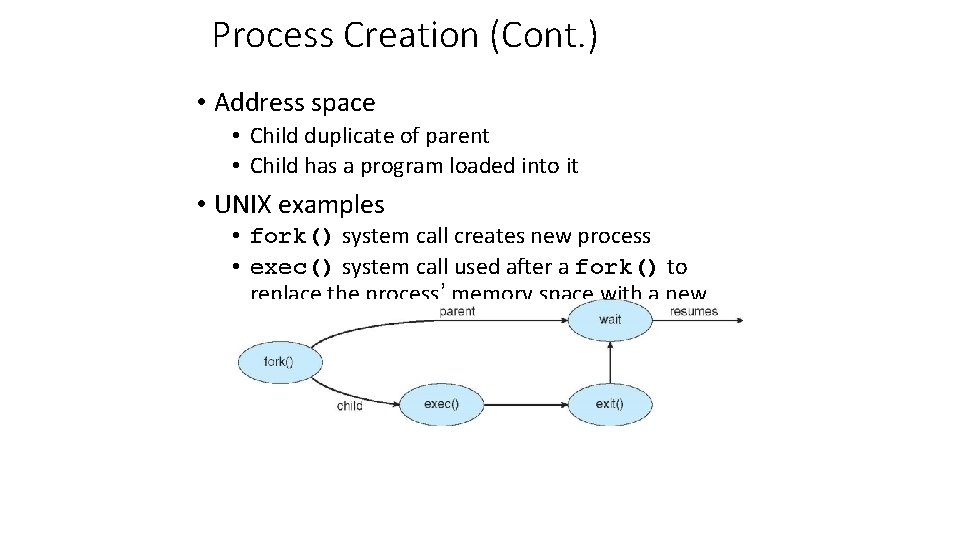
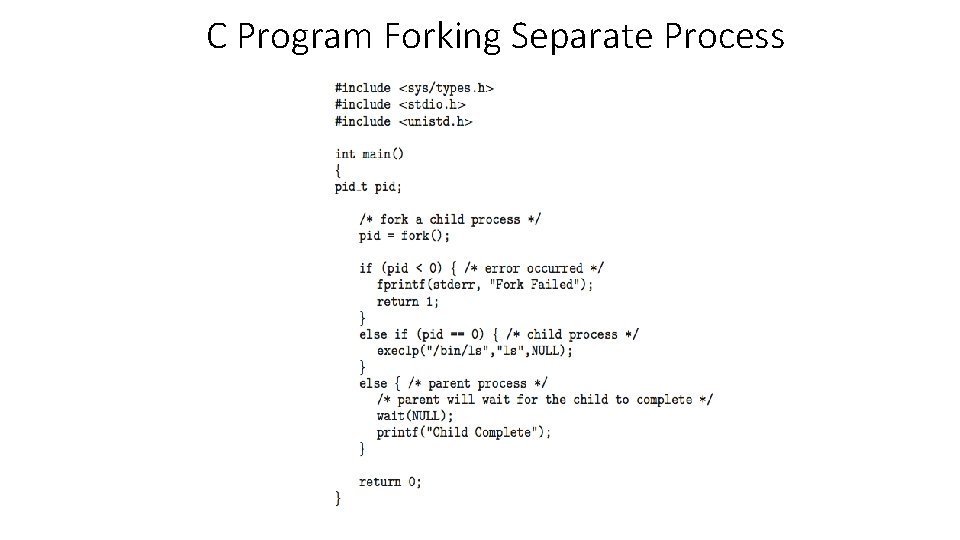
Process Creation (Cont. ) • Address space • Child duplicate of parent • Child has a program loaded into it • UNIX examples • fork() system call creates new process • exec() system call used after a fork() to replace the process’ memory space with a new program
C Program Forking Separate Process
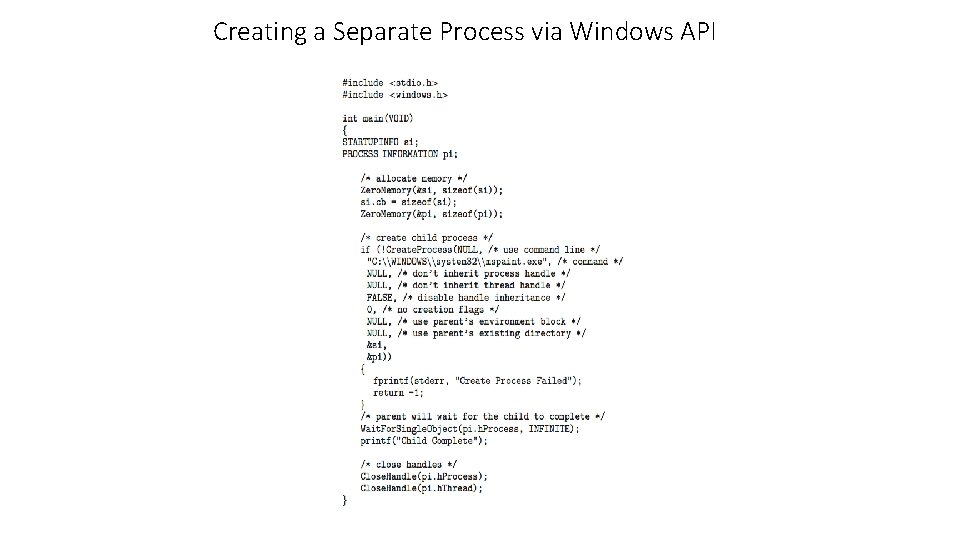
Creating a Separate Process via Windows API
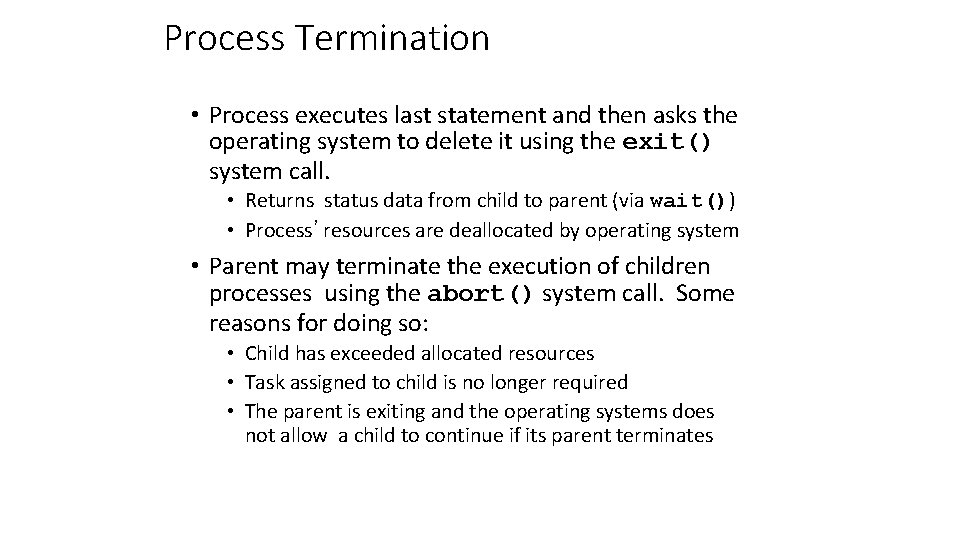
Process Termination • Process executes last statement and then asks the operating system to delete it using the exit() system call. • Returns status data from child to parent (via wait()) • Process’ resources are deallocated by operating system • Parent may terminate the execution of children processes using the abort() system call. Some reasons for doing so: • Child has exceeded allocated resources • Task assigned to child is no longer required • The parent is exiting and the operating systems does not allow a child to continue if its parent terminates
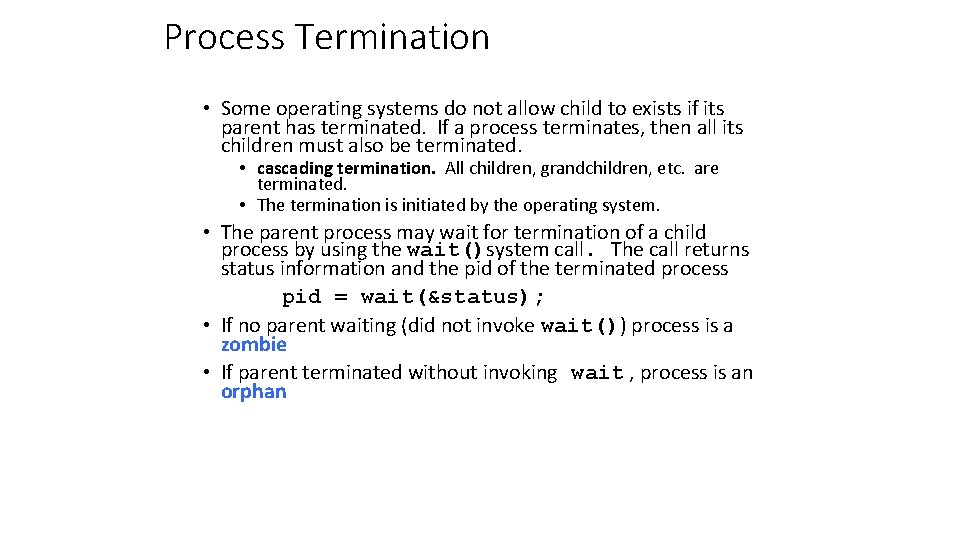
Process Termination • Some operating systems do not allow child to exists if its parent has terminated. If a process terminates, then all its children must also be terminated. • cascading termination. All children, grandchildren, etc. are terminated. • The termination is initiated by the operating system. • The parent process may wait for termination of a child process by using the wait()system call. The call returns status information and the pid of the terminated process pid = wait(&status); • If no parent waiting (did not invoke wait()) process is a zombie • If parent terminated without invoking wait , process is an orphan
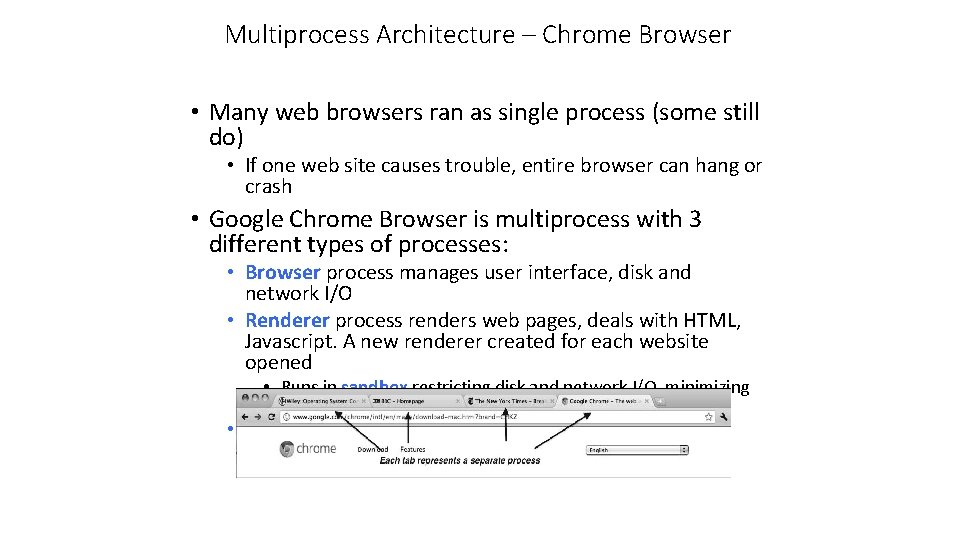
Multiprocess Architecture – Chrome Browser • Many web browsers ran as single process (some still do) • If one web site causes trouble, entire browser can hang or crash • Google Chrome Browser is multiprocess with 3 different types of processes: • Browser process manages user interface, disk and network I/O • Renderer process renders web pages, deals with HTML, Javascript. A new renderer created for each website opened • Runs in sandbox restricting disk and network I/O, minimizing effect of security exploits • Plug-in process for each type of plug-in
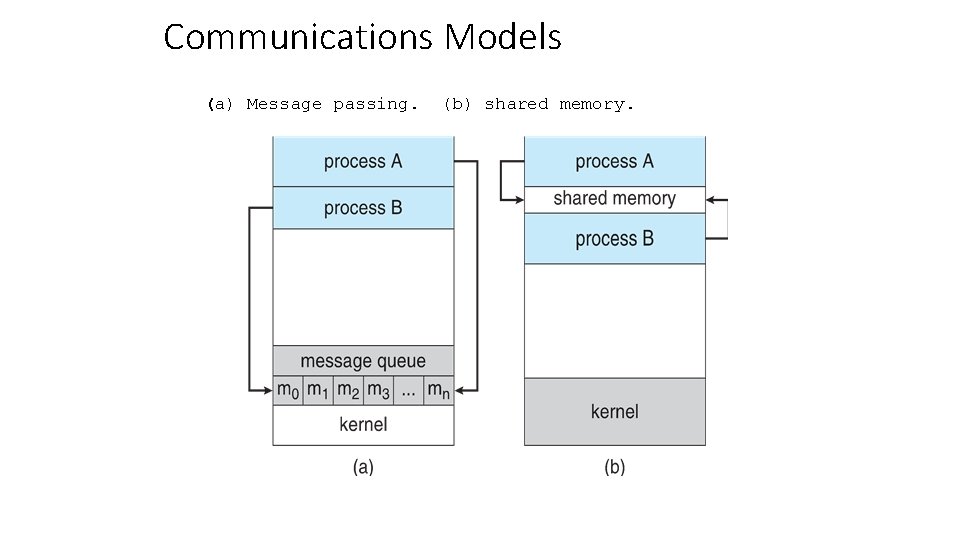
Interprocess Communication • Processes within a system may be independent or cooperating • Cooperating process can affect or be affected by other processes, including sharing data • Reasons for cooperating processes: • • Information sharing Computation speedup Modularity Convenience • Cooperating processes need interprocess communication (IPC) • Two models of IPC • Shared memory • Message passing
Communications Models (a) Message passing. (b) shared memory.
Cooperating Processes • Independent process cannot affect or be affected by the execution of another process • Cooperating process can affect or be affected by the execution of another process • Advantages of process cooperation • • Information sharing Computation speed-up Modularity Convenience
Producer-Consumer Problem • Paradigm for cooperating processes, producer process produces information that is consumed by a consumer process • unbounded-buffer places no practical limit on the size of the buffer • bounded-buffer assumes that there is a fixed buffer size
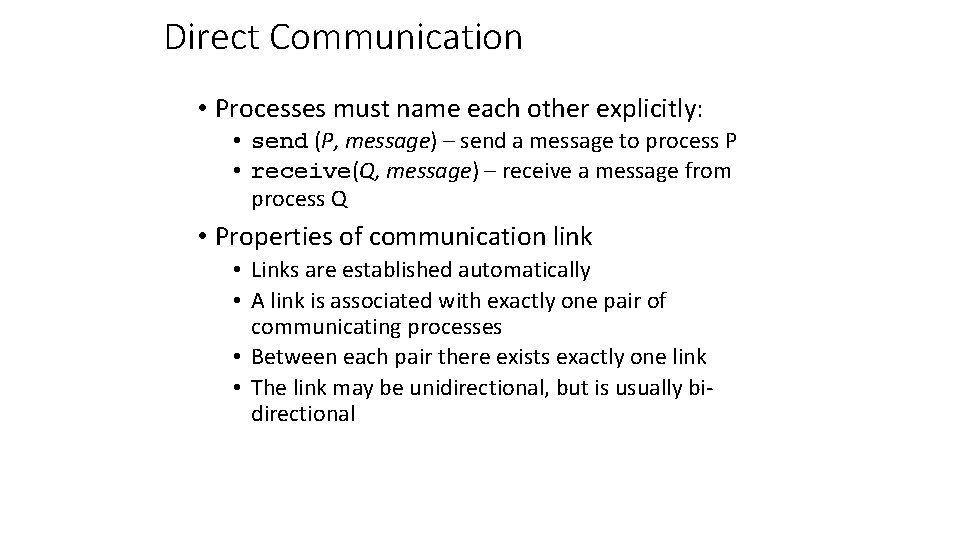
Direct Communication • Processes must name each other explicitly: • send (P, message) – send a message to process P • receive(Q, message) – receive a message from process Q • Properties of communication link • Links are established automatically • A link is associated with exactly one pair of communicating processes • Between each pair there exists exactly one link • The link may be unidirectional, but is usually bidirectional
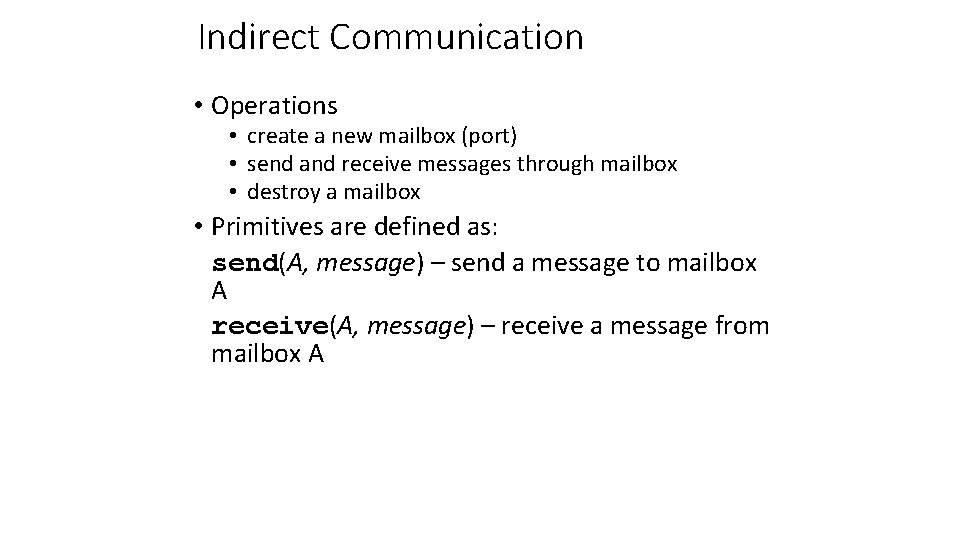
Indirect Communication • Messages are directed and received from mailboxes (also referred to as ports) • Each mailbox has a unique id • Processes can communicate only if they share a mailbox • Properties of communication link • Link established only if processes share a common mailbox • A link may be associated with many processes • Each pair of processes may share several communication links • Link may be unidirectional or bi-directional
Indirect Communication • Operations • create a new mailbox (port) • send and receive messages through mailbox • destroy a mailbox • Primitives are defined as: send(A, message) – send a message to mailbox A receive(A, message) – receive a message from mailbox A
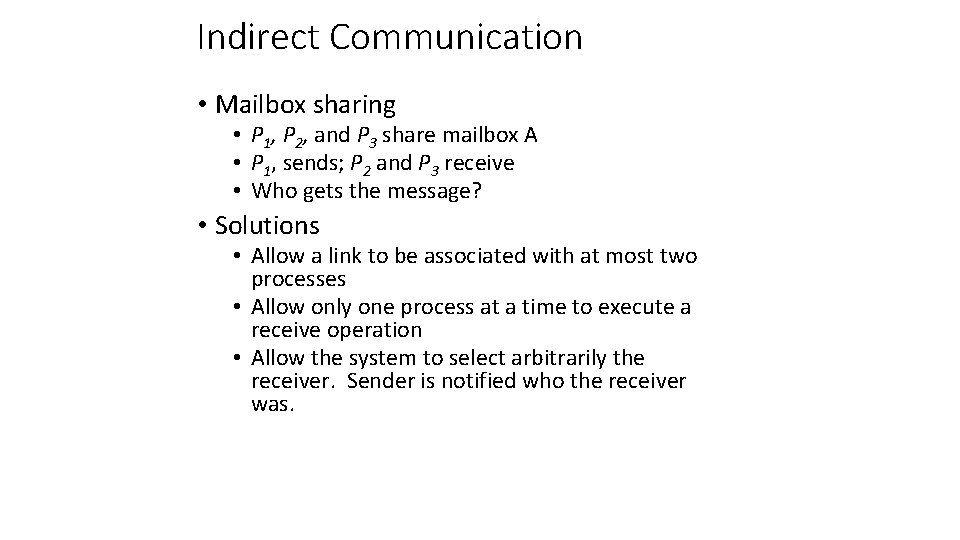
Indirect Communication • Mailbox sharing • P 1, P 2, and P 3 share mailbox A • P 1, sends; P 2 and P 3 receive • Who gets the message? • Solutions • Allow a link to be associated with at most two processes • Allow only one process at a time to execute a receive operation • Allow the system to select arbitrarily the receiver. Sender is notified who the receiver was.
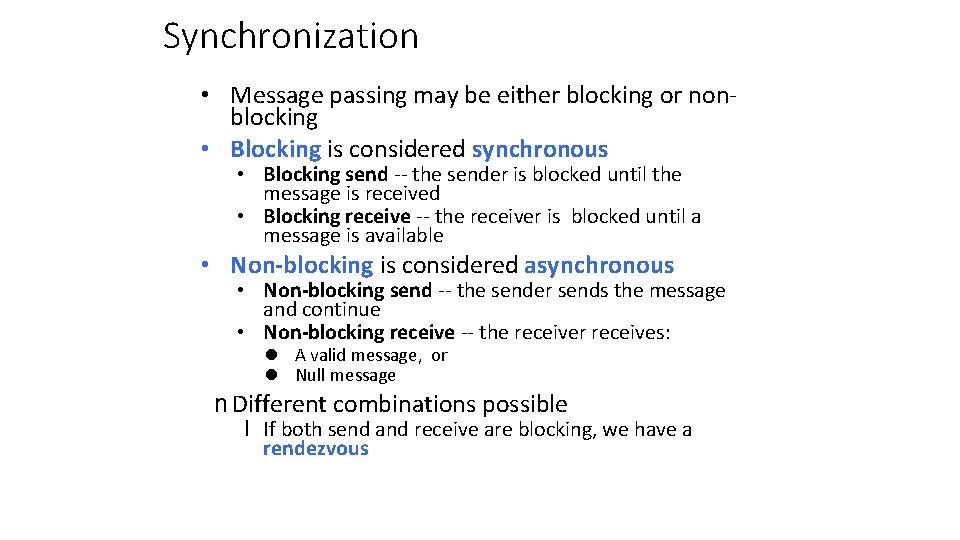
Synchronization • Message passing may be either blocking or nonblocking • Blocking is considered synchronous • Blocking send -- the sender is blocked until the message is received • Blocking receive -- the receiver is blocked until a message is available • Non-blocking is considered asynchronous • Non-blocking send -- the sender sends the message and continue • Non-blocking receive -- the receiver receives: l A valid message, or l Null message n Different combinations possible l If both send and receive are blocking, we have a rendezvous
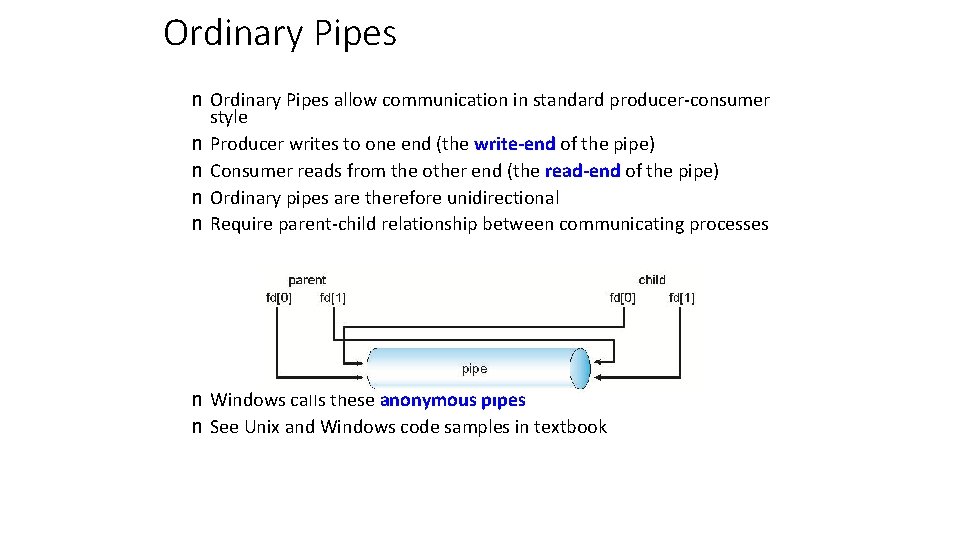
Ordinary Pipes n Ordinary Pipes allow communication in standard producer-consumer style n Producer writes to one end (the write-end of the pipe) n Consumer reads from the other end (the read-end of the pipe) n Ordinary pipes are therefore unidirectional n Require parent-child relationship between communicating processes n Windows calls these anonymous pipes n See Unix and Windows code samples in textbook
Named Pipes • Named Pipes are more powerful than ordinary pipes • Communication is bidirectional • No parent-child relationship is necessary between the communicating processes • Several processes can use the named pipe for communication • Provided on both UNIX and Windows systems