
Chapter 3 Process Choice and Layout Decisions in





- Slides: 29
Chapter 3 Process Choice and Layout Decisions in Manufacturing and Services
Chapter Objectives 3 Be able to: § Describe the characteristics of the five classic types of manufacturing processes, and explain how different manufacturing process choices support different market requirements. § Describe the critical role of customization in manufacturing, including the degree and point of customization. § Discuss the three dimensions that differentiate services from one another - the service package, customization, and customer contact - and explain the different managerial challenges driven by these dimensions. § Develop a product-based layout using line balancing, and develop a functional layout based on total distance traveled. Copyright © 2016 Pearson Education, Inc. 3 -2
Introduction 3 § Manufacturing and Service processes are very important to firms because: § They tend to be expensive and far reaching § Process decisions deserve extra attention because different processes have different strengths and weaknesses. § Some processes are particularly good at supporting a wide variety of goods or services, while others are better at providing standardized products or services at the lowest possible cost. § Managers must make sure that the process they choose best supports their overall business strategy and the needs of their targeted customers. Copyright © 2016 Pearson Education, Inc. 3 -3
Manufacturing Processes 3 § Questions to ask when selecting a manufacturing process: § What are the physical requirements of the company’s product? § How similar to one another are the products the company makes? § What are the company’s production volumes? § Where in the value chain does customization take place (if at all)? Copyright © 2016 Pearson Education, Inc. 3 -4
Manufacturing Processes 3 § Product-based layout § A type of layout where resources are arranged sequentially, according to the steps required to make a product. § Functional layout § A type of layout where resources are physically grouped by function. Copyright © 2016 Pearson Education, Inc. 3 -5
Manufacturing Processes 3 § Continuous Flow Processes § Production Line § Batch Manufacturing § Job Shop § Fixed Position Layout Copyright © 2016 Pearson Education, Inc. 3 -6
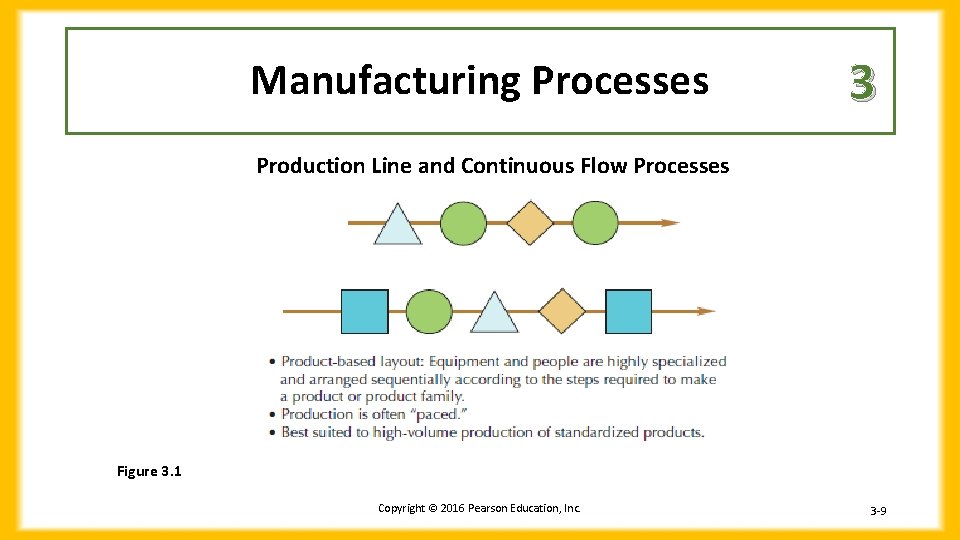
Manufacturing Processes 3 § Production Line – A type of manufacturing process used to produce a narrow range of standard items with identical or highly similar designs. § Follows a product-based layout § Steps are usually linked by some system that moves the items from one step to the next. § Suitable for high-volume production of product(s) characterized by similar design attributes. § Need high volumes to justify the required investment in specialized equipment and labor. § Are inflexible with regard to items that do not fit the design characteristics of the production line. Copyright © 2016 Pearson Education, Inc. 3 -7
Manufacturing Processes 3 § Continuous Flow Processes - A type of manufacturing process that produces highly standardized products using a tightly linked, paced sequence of steps. § Closely resembles the production line process § Form of product usually cannot be broken into discrete units. § Examples include yarns and fabric, food products, and chemical products such as oil and gas Copyright © 2016 Pearson Education, Inc. 3 -8
Manufacturing Processes 3 Production Line and Continuous Flow Processes Figure 3. 1 Copyright © 2016 Pearson Education, Inc. 3 -9
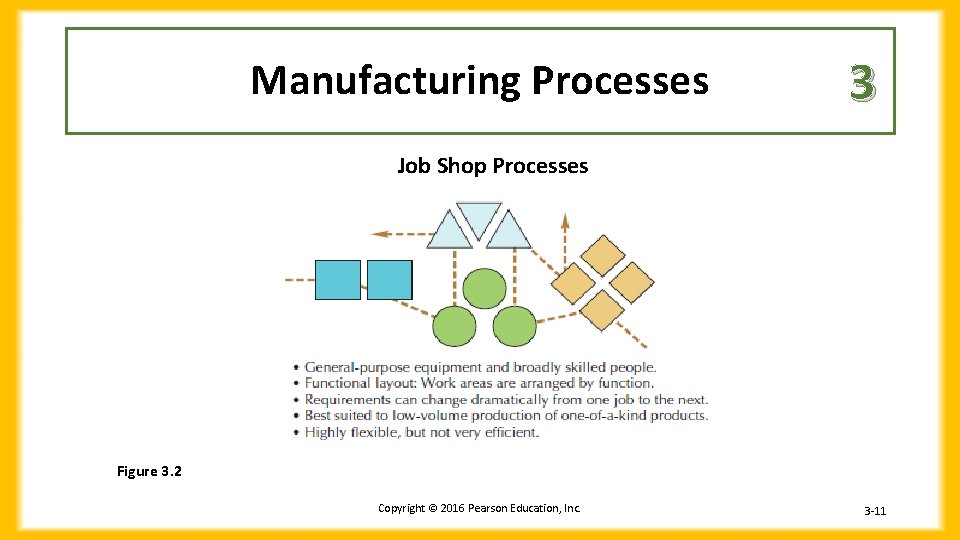
Manufacturing Processes 3 § Job Shops – A type of manufacturing process used to make a wide variety of highly customized products in quantities as small as one. § Characterized by general-purpose equipment and broadly skilled workers. § Main emphasis is meeting a customer’s unique requirements. § Product design is not standardized. § Typically follow a functional layout. § Examples include custom furniture, specialized machine tools used by manufacturers, and restoration and refurbishing work. Copyright © 2016 Pearson Education, Inc. 3 -10
Manufacturing Processes 3 Job Shop Processes Figure 3. 2 Copyright © 2016 Pearson Education, Inc. 3 -11
Manufacturing Processes 3 § Batch Manufacturing – A type of manufacturing process where items are moved through the different manufacturing steps in groups or batches. § Fits between job shops and lines in terms of production volumes and flexibility and strikes a balance between the flexibility of a job shop and the efficiency of a line. § Are the most common type of manufacturing process. § The sequence of steps is not as tightly linked as a production line. § Flexible Manufacturing Systems – Highly automated batch processes that can reduce the cost of making groups of similar products. Copyright © 2016 Pearson Education, Inc. 3 -12
Manufacturing Processes 3 § Fixed-Position Layout – A type of manufacturing process in which the position of the product is fixed. § Materials, equipment, and workers are transported to and from the product. § Used in industries where the products are very bulky, massive, or heavy and movement is problematic. § Examples include shipbuilding, construction projects, and traditional home building. Copyright © 2016 Pearson Education, Inc. 3 -13
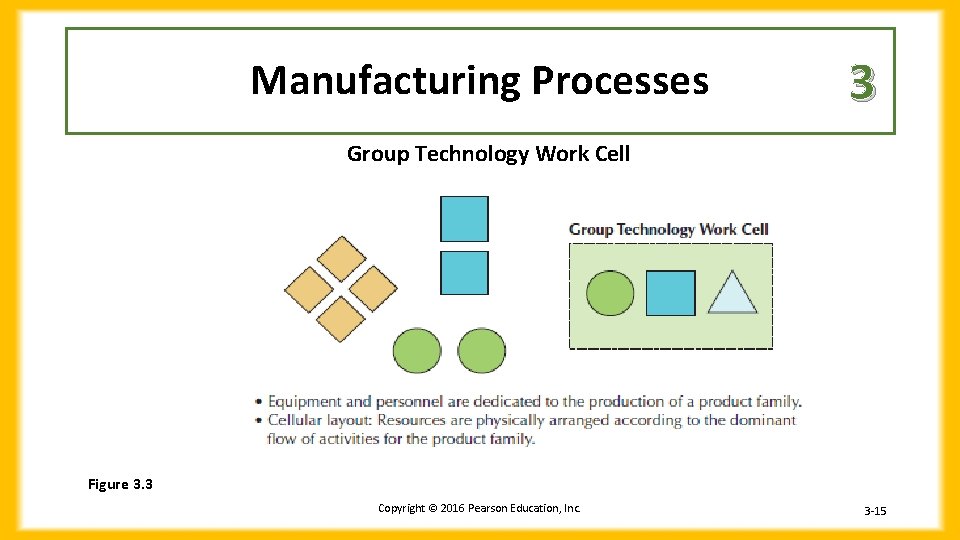
Manufacturing Processes 3 § Hybrid Manufacturing Process – A term referring to a manufacturing process that seeks to combine the characteristics, and hence advantages, of more than one of the classic processes. § Machining centers § Group technology § Flexible manufacturing systems Copyright © 2016 Pearson Education, Inc. 3 -14
Manufacturing Processes 3 Group Technology Work Cell Figure 3. 3 Copyright © 2016 Pearson Education, Inc. 3 -15
Product Customization Within the Supply Chain 3 § Four Levels of Customization § Make-to-stock (MTS) – Products that require no customization. § Assemble-to-order (ATO) – Products that are customized only at the very end of the manufacturing process. § Make-to-order (MTO) – Products that use standard components but the final configuration of those components is customer specific. § Engineer-to-order (ETO) – Products are designed and produced from the start to meet unusual customer needs or requirements. Copyright © 2016 Pearson Education, Inc. 3 -16
Product Customization Within the Supply Chain 3 § When customization occurs early in the supply chain: § Flexibility in response to unique customer needs will be greater. § Lead times to the customer will tend to be longer. § Products will tend to be more costly. § When customization occurs late in the supply chain: § Flexibility in response to unique customer needs will be limited. § Lead times to the customer will tend to be shorter. § Products will tend to be less costly. Copyright © 2016 Pearson Education, Inc. 3 -17
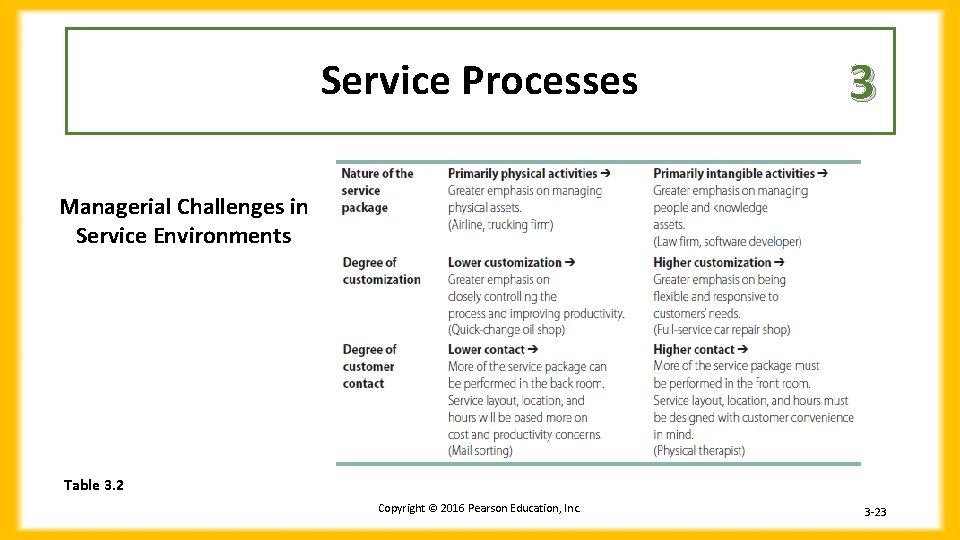
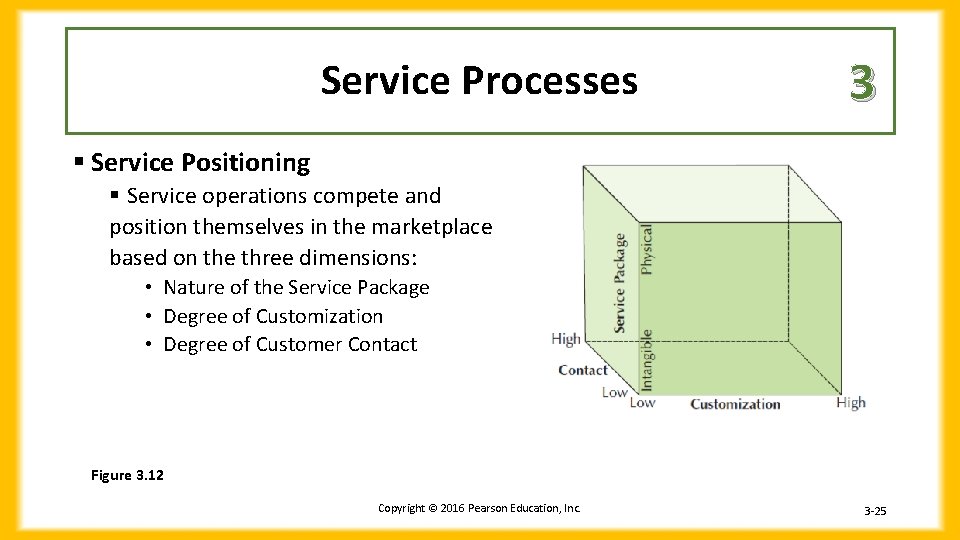
Service Processes 3 § Three dimensions on which services can differ: § The nature of the service package § The degree of customization § The level of customer contact Copyright © 2016 Pearson Education, Inc. 3 -18
Service Processes 3 § Service Package – A package that includes all the value-added physical and intangible activities that a service organization provides to the customer. § The greater the emphasis on physical activities, the more the management’s attention will be directed to capital expenditures (buildings, planes, and trucks), material costs, and other tangible assets. § The greater the emphasis on intangible activities, the more critical are the training and retention of skilled employees and the development of the firm’s knowledge assets. Copyright © 2016 Pearson Education, Inc. 3 -19
Service Processes 3 § Service Customization - Ranges from highly customized to standardized. § As the degree of customization decreases, the service package becomes more standardized. § As the degree of customization increases, the service package becomes less predictable and more variable. Copyright © 2016 Pearson Education, Inc. 3 -20
Service Processes 3 § Customer Contact – The degree of customer contact determines the relative importance of front room and back room operations in a service process § Front Room – The physical or virtual point where the customer interfaces directly with the service organization. § Examples: Sales floor in a retail store, Help desk for a software provider, Web page for a company. § Back Room – The part of a service operation that is completed without direct customer contact. § Examples: Package sorting at Fed. Ex or UPS, Testing medical samples Copyright © 2016 Pearson Education, Inc. 3 -21
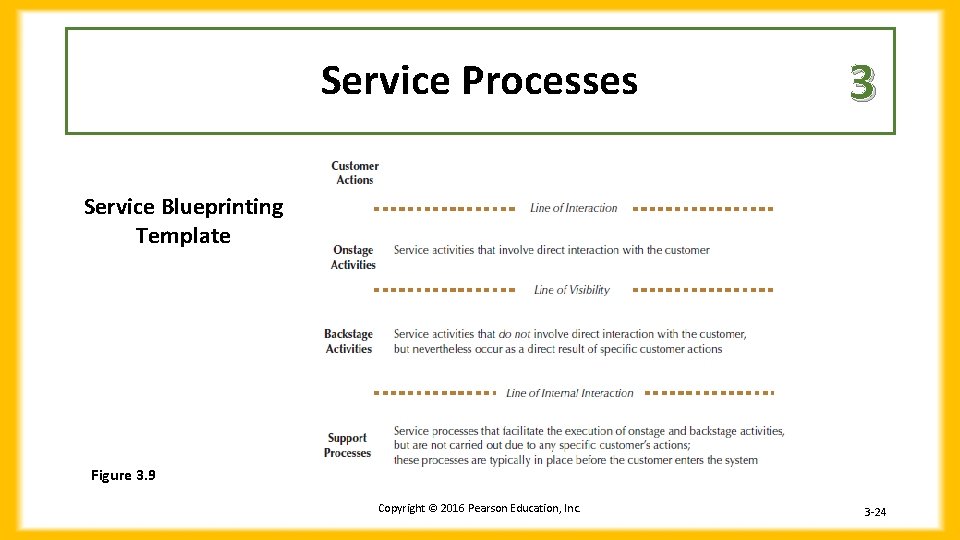
Service Processes 3 § Service Blueprinting - A specialized form of business process mapping that lays out the service process from the viewpoint of the customer and parses out the organization’s service actions based on: § The extent to which an action involves direct interaction with the customer. § Whether an action takes place as a direct response to a customer’s needs. Copyright © 2016 Pearson Education, Inc. 3 -22
Service Processes 3 Managerial Challenges in Service Environments Table 3. 2 Copyright © 2016 Pearson Education, Inc. 3 -23
Service Processes 3 Service Blueprinting Template Figure 3. 9 Copyright © 2016 Pearson Education, Inc. 3 -24
Service Processes 3 § Service Positioning § Service operations compete and position themselves in the marketplace based on the three dimensions: • Nature of the Service Package • Degree of Customization • Degree of Customer Contact Figure 3. 12 Copyright © 2016 Pearson Education, Inc. 3 -25
Layout Decision Models 3 § Fixed position layout – Productive resources have to be moved to where the product is being made or the service is being provided. § Product-based layout – Arranges resources sequentially, according to the steps required to make a product or provide a service. § Functional layout – Physically groups resources by function. § Cellular layout – Production resources are dedicated to a subset of products with similar requirements known as a product family. Copyright © 2016 Pearson Education, Inc. 3 -26
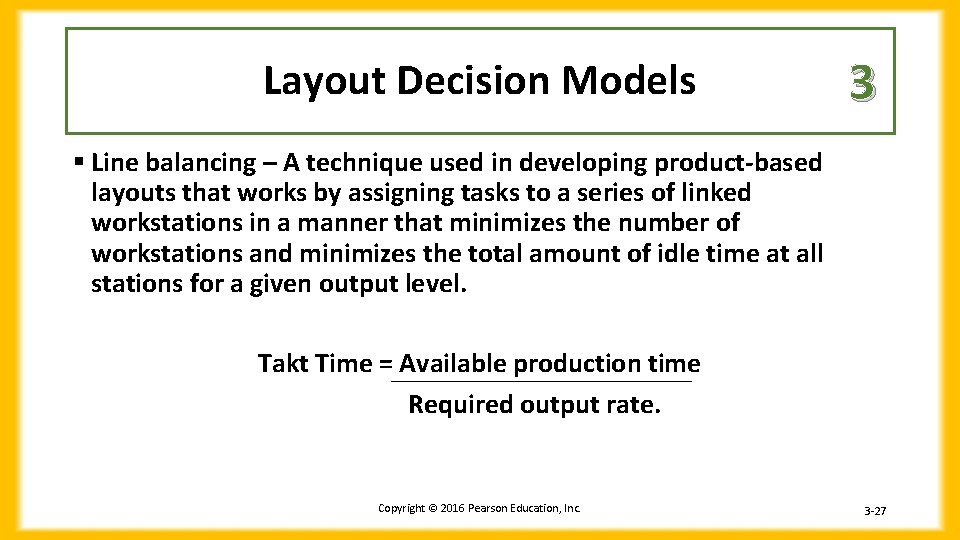
Layout Decision Models 3 § Line balancing – A technique used in developing product-based layouts that works by assigning tasks to a series of linked workstations in a manner that minimizes the number of workstations and minimizes the total amount of idle time at all stations for a given output level. Takt Time = Available production time Required output rate. Copyright © 2016 Pearson Education, Inc. 3 -27
Layout Decision Models 3 § The six basic steps of line balancing: 1. Identify all the process steps required, their times, immediate predecessors and the total time for all tasks. 2. Draw a precedence diagram. 3. Determine takt time for the line. 4. Compute theoretical minimum number of workstations needed 5. Use a decision rule to assign tasks to workstations. 6. Evaluate the performance of the proposed line by calculating some basic performance measures. Copyright © 2016 Pearson Education, Inc. 3 -28
Layout Decision Models 3 § Assigning Department Locations in Functional Layouts § Arrange the different functional areas or departments in such a way that departments that should be close to one another are, while departments that don’t need to be or shouldn’t be near one another aren’t. § Minimize the total distance traveled Copyright © 2016 Pearson Education, Inc. 3 -29