
Chapter 3 Probability Distribution Chapter 3 Part A
Chapter 3 Probability Distribution
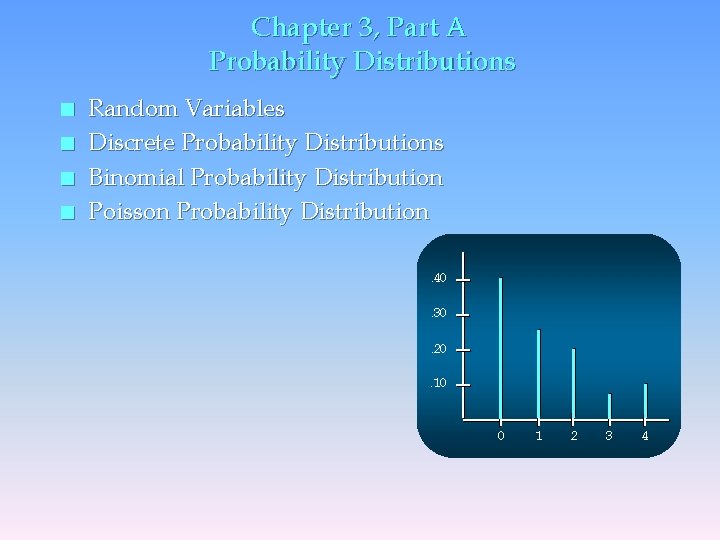
Chapter 3, Part A Probability Distributions n n Random Variables Discrete Probability Distributions Binomial Probability Distribution Poisson Probability Distribution. 40. 30. 20. 10 0 1 2 3 4
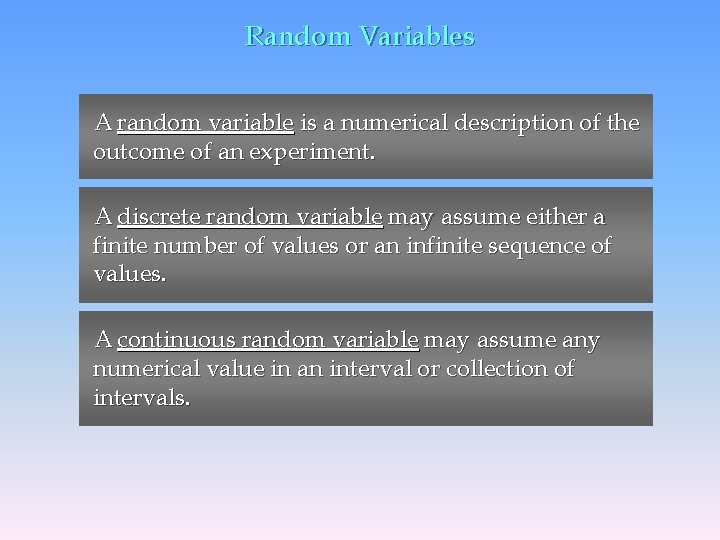
Random Variables A random variable is a numerical description of the outcome of an experiment. A discrete random variable may assume either a finite number of values or an infinite sequence of values. A continuous random variable may assume any numerical value in an interval or collection of intervals.
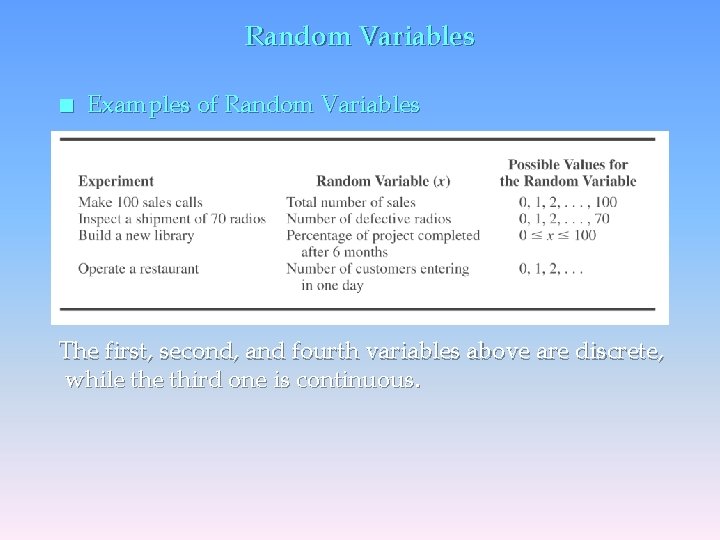
Random Variables n Examples of Random Variables The first, second, and fourth variables above are discrete, while third one is continuous.
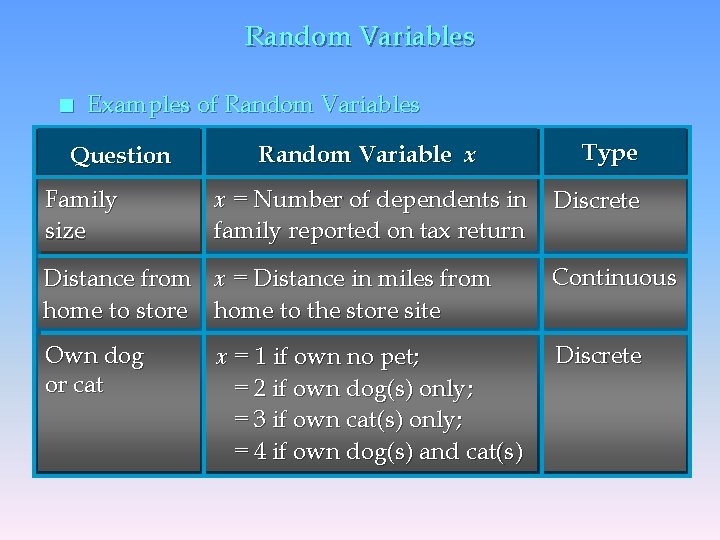
Random Variables n Examples of Random Variables Question Family size Random Variable x x = Number of dependents in family reported on tax return Type Discrete Distance from x = Distance in miles from home to store home to the store site Continuous Own dog or cat Discrete x = 1 if own no pet; = 2 if own dog(s) only; = 3 if own cat(s) only; = 4 if own dog(s) and cat(s)
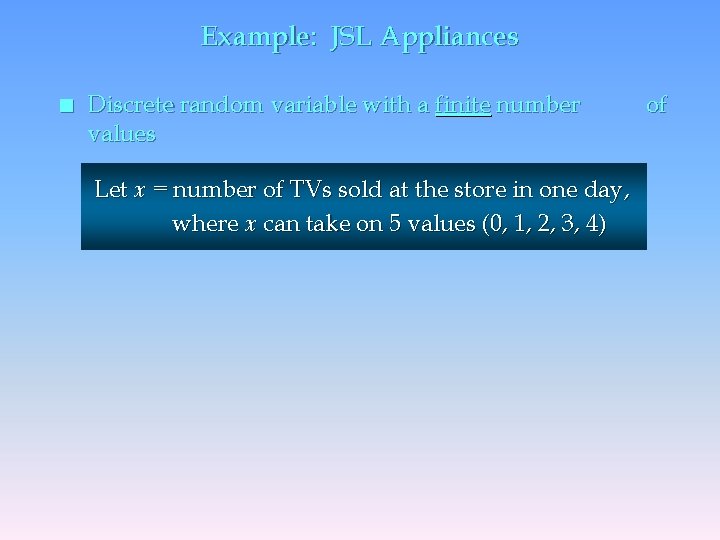
Example: JSL Appliances n Discrete random variable with a finite number values Let x = number of TVs sold at the store in one day, where x can take on 5 values (0, 1, 2, 3, 4) of
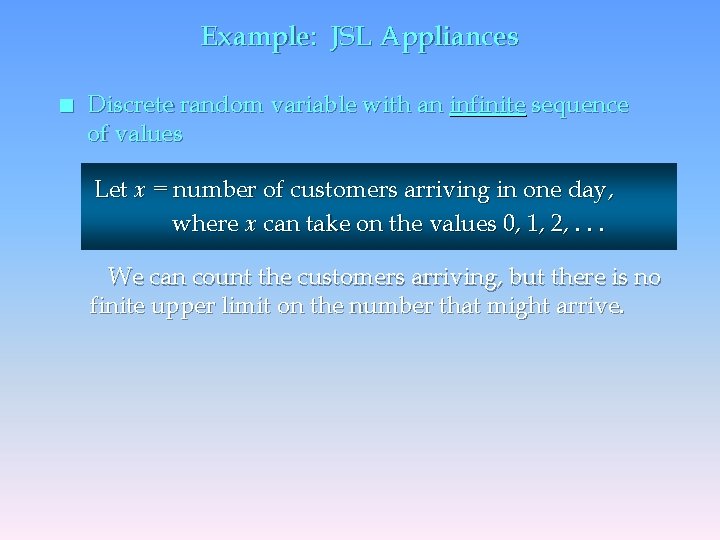
Example: JSL Appliances n Discrete random variable with an infinite sequence of values Let x = number of customers arriving in one day, where x can take on the values 0, 1, 2, . . . We can count the customers arriving, but there is no finite upper limit on the number that might arrive.
Discrete Probability Distributions The probability distribution for a random variable describes how probabilities are distributed over the values of the random variable. We can describe a discrete probability distribution with a table, graph, or equation.
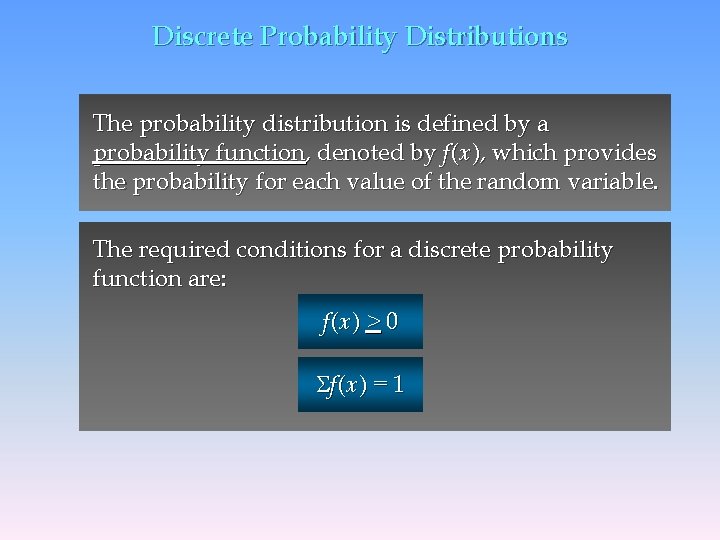
Discrete Probability Distributions The probability distribution is defined by a probability function, denoted by f (x), which provides the probability for each value of the random variable. The required conditions for a discrete probability function are: f (x ) > 0 f (x ) = 1
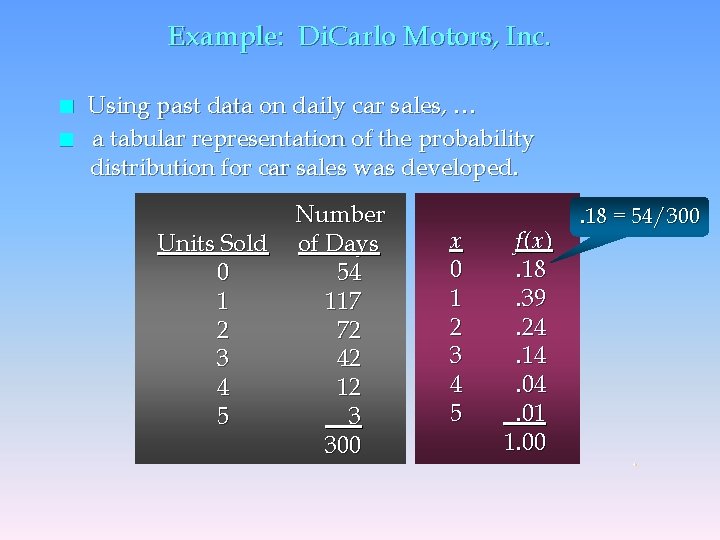
Example: Di. Carlo Motors, Inc. n n Using past data on daily car sales, … a tabular representation of the probability distribution for car sales was developed. Units Sold 0 1 2 3 4 5 Number of Days 54 117 72 42 12 3 300 x 0 1 2 3 4 5 f (x ). 18. 39. 24. 14. 01 1. 00 . 18 = 54/300
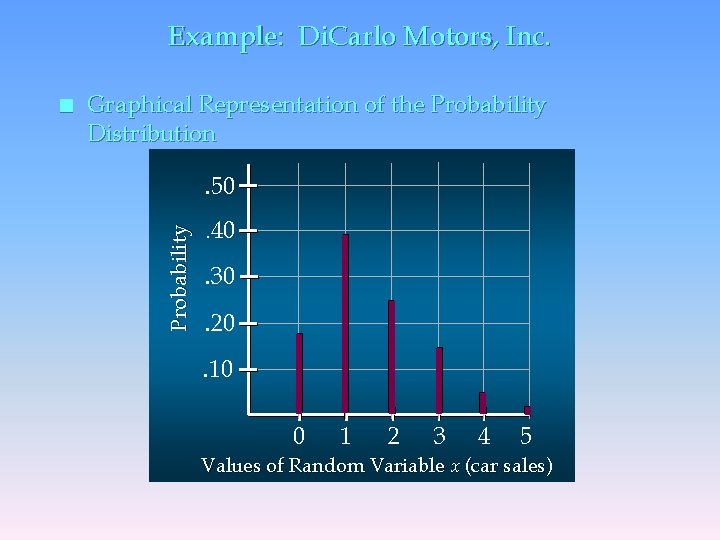
Example: Di. Carlo Motors, Inc. Graphical Representation of the Probability Distribution. 50 Probability n . 40 . 30. 20. 10 0 1 2 3 4 5 Values of Random Variable x (car sales)
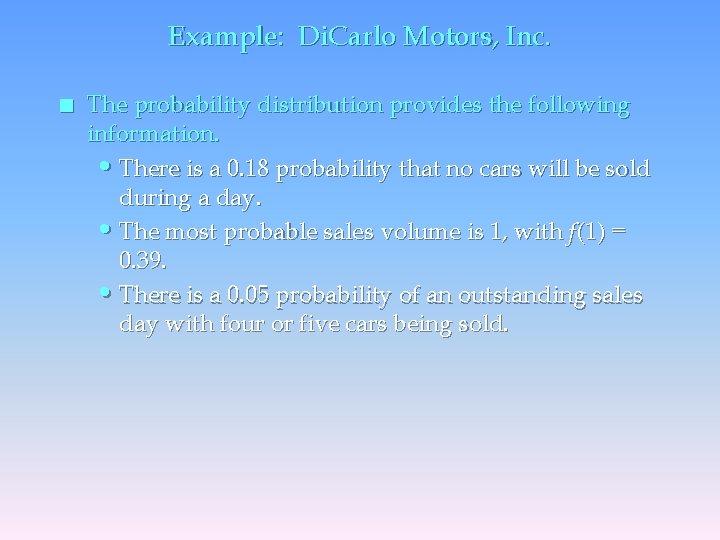
Example: Di. Carlo Motors, Inc. n The probability distribution provides the following information. • There is a 0. 18 probability that no cars will be sold during a day. • The most probable sales volume is 1, with f (1) = 0. 39. • There is a 0. 05 probability of an outstanding sales day with four or five cars being sold.
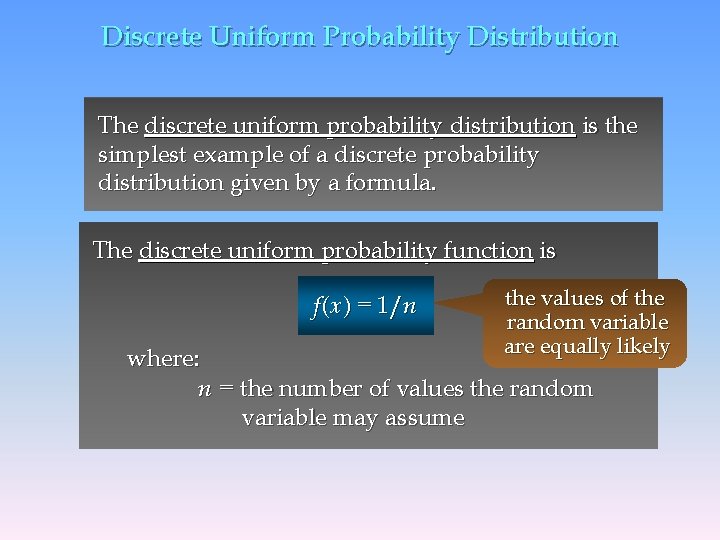
Discrete Uniform Probability Distribution The discrete uniform probability distribution is the simplest example of a discrete probability distribution given by a formula. The discrete uniform probability function is f (x) = 1/n the values of the random variable are equally likely where: n = the number of values the random variable may assume
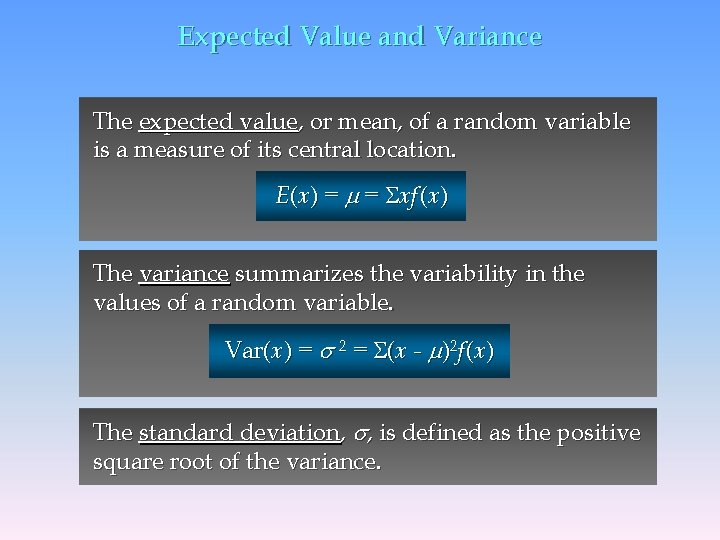
Expected Value and Variance The expected value, or mean, of a random variable is a measure of its central location. E(x) = = xf (x) The variance summarizes the variability in the values of a random variable. Var(x) = 2 = (x - )2 f (x) The standard deviation, , is defined as the positive square root of the variance.
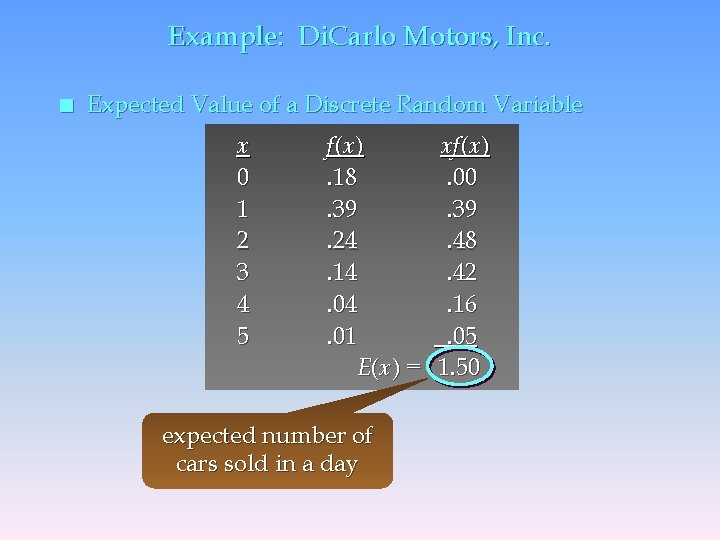
Example: Di. Carlo Motors, Inc. n Expected Value of a Discrete Random Variable x 0 1 2 3 4 5 f (x ) xf (x). 18. 00. 39. 24. 48. 14. 42. 04. 16. 01. 05 E(x) = 1. 50 expected number of cars sold in a day
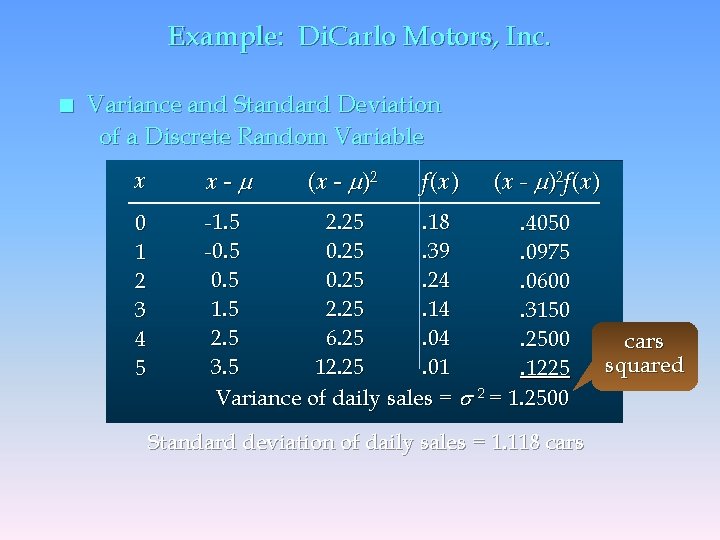
Example: Di. Carlo Motors, Inc. n Variance and Standard Deviation of a Discrete Random Variable x x- (x - )2 0 1 2 3 4 5 . 18 -1. 5 2. 25. 4050. 39 -0. 5 0. 25. 0975. 24 0. 5 0. 25. 0600. 14 1. 5 2. 25. 3150. 04 2. 5 6. 2500. 01 3. 5 12. 25. 1225 Variance of daily sales = 2 = 1. 2500 f (x ) (x - )2 f (x) Standard deviation of daily sales = 1. 118 cars squared
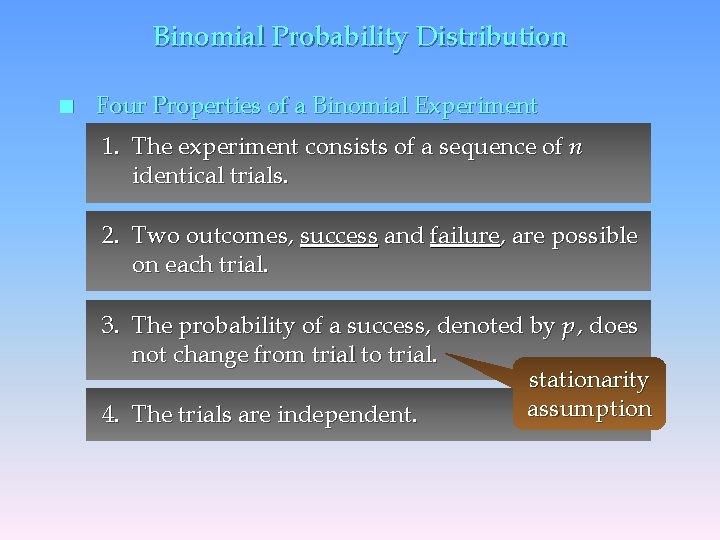
Binomial Probability Distribution n Four Properties of a Binomial Experiment 1. The experiment consists of a sequence of n identical trials. 2. Two outcomes, success and failure, are possible on each trial. 3. The probability of a success, denoted by p , does not change from trial to trial. stationarity assumption 4. The trials are independent.
Binomial Probability Distribution Our interest is in the number of successes occurring in the n trials. We let x denote the number of successes occurring in the n trials.
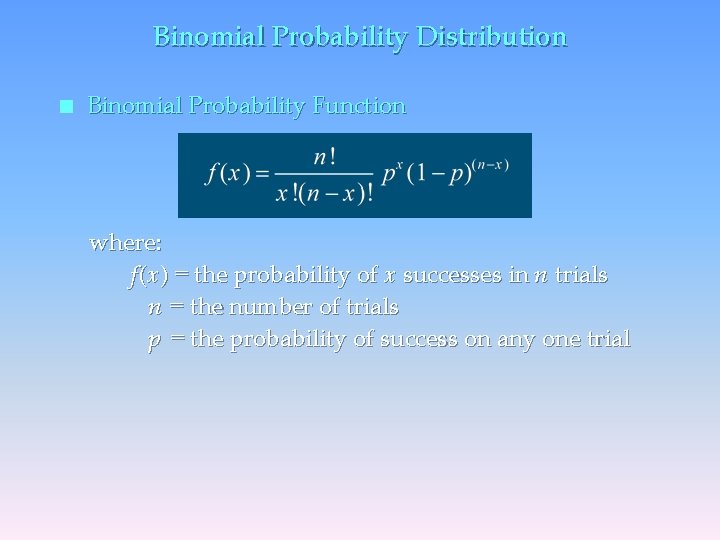
Binomial Probability Distribution n Binomial Probability Function where: f (x) = the probability of x successes in n trials n = the number of trials p = the probability of success on any one trial
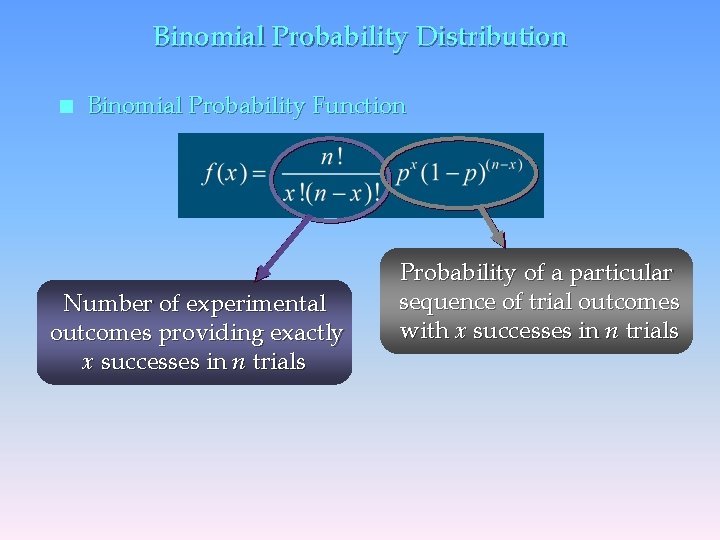
Binomial Probability Distribution n Binomial Probability Function Number of experimental outcomes providing exactly x successes in n trials Probability of a particular sequence of trial outcomes with x successes in n trials
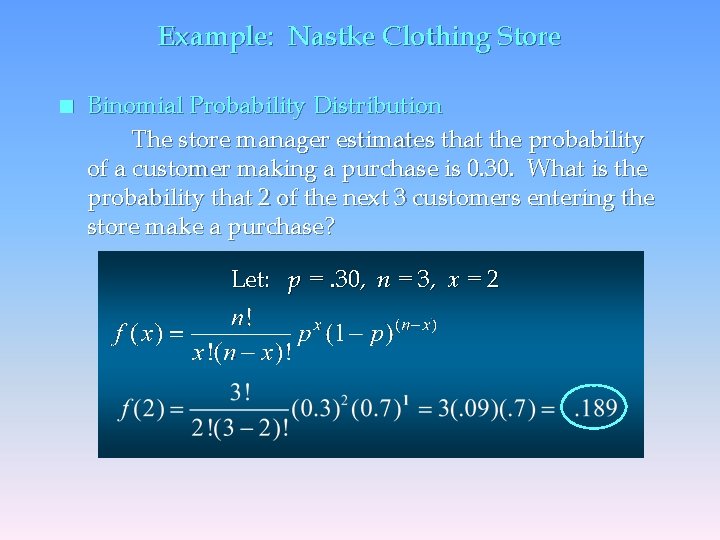
Example: Nastke Clothing Store n Binomial Probability Distribution The store manager estimates that the probability of a customer making a purchase is 0. 30. What is the probability that 2 of the next 3 customers entering the store make a purchase? Let: p =. 30, n = 3, x = 2
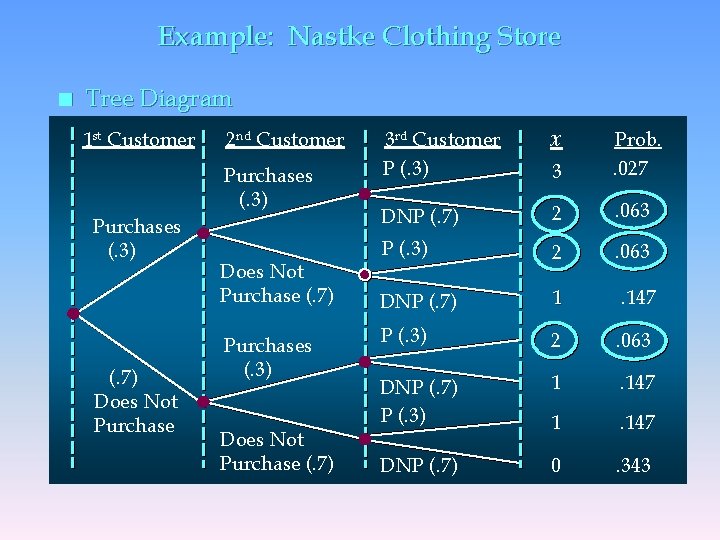
Example: Nastke Clothing Store n Tree Diagram 1 st Customer 2 nd Customer Purchases (. 3) (. 7) Does Not Purchase (. 7) Purchases (. 3) Does Not Purchase (. 7) 3 rd Customer P (. 3) x 3 Prob. . 027 DNP (. 7) 2 . 063 P (. 3) 2 . 063 DNP (. 7) 1 . 147 P (. 3) 2 . 063 DNP (. 7) P (. 3) 1 . 147 DNP (. 7) 0 . 343
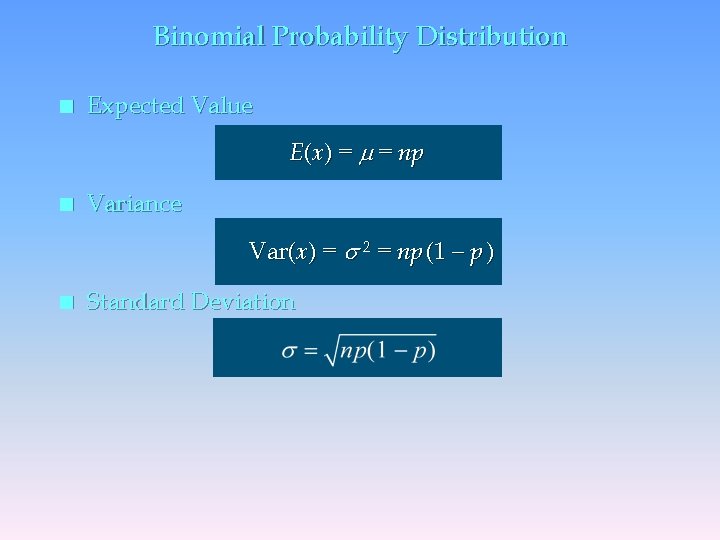
Binomial Probability Distribution n Expected Value E(x) = = np n Variance Var(x) = 2 = np (1 - p ) n Standard Deviation
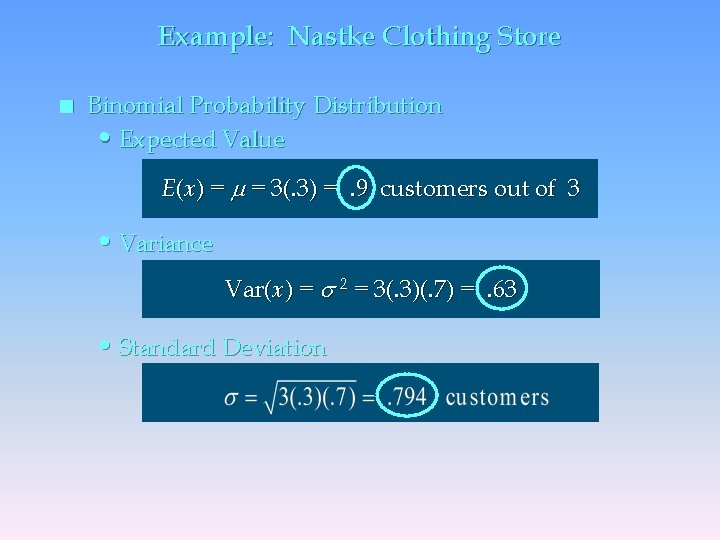
Example: Nastke Clothing Store n Binomial Probability Distribution • Expected Value E(x) = = 3(. 3) =. 9 customers out of 3 • Variance Var(x) = 2 = 3(. 3)(. 7) =. 63 • Standard Deviation
Poisson Probability Distribution A Poisson distributed random variable is often useful in estimating the number of occurrences over a specified interval of time or space It is a discrete random variable that may assume an infinite sequence of values (x = 0, 1, 2, . . . ).
Poisson Probability Distribution Examples of a Poisson distributed random variable: the number of knotholes in 24 linear feet of pine board the number of vehicles arriving at a toll booth in one hour
Poisson Probability Distribution n Two Properties of a Poisson Experiment 1. The probability of an occurrence is the same for any two intervals of equal length. 2. The occurrence or nonoccurrence in any interval is independent of the occurrence or nonoccurrence in any other interval.
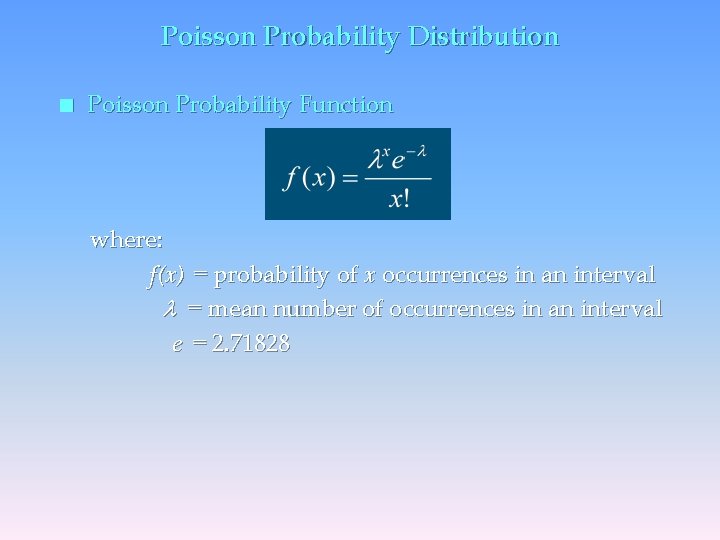
Poisson Probability Distribution n Poisson Probability Function where: f(x) = probability of x occurrences in an interval l = mean number of occurrences in an interval e = 2. 71828
Example: Drive-up Teller Window n Poisson Probability Function: Time Interval Suppose that we are interested in the number of arrivals at the drive-up teller window of a bank during a 15 -minute period on weekday mornings. If we assume that the probability of a car arriving is the same for any two time periods of equal length and that the arrival or non-arrival of a car in any time period is independent of the arrival or non-arrival in any other time period, the Poisson probability function is applicable. Then if we assume that an analysis of historical data shows that the average number of cars arriving during a 15 -minute interval of time is 10, the Poisson probability function with = 10 applies.
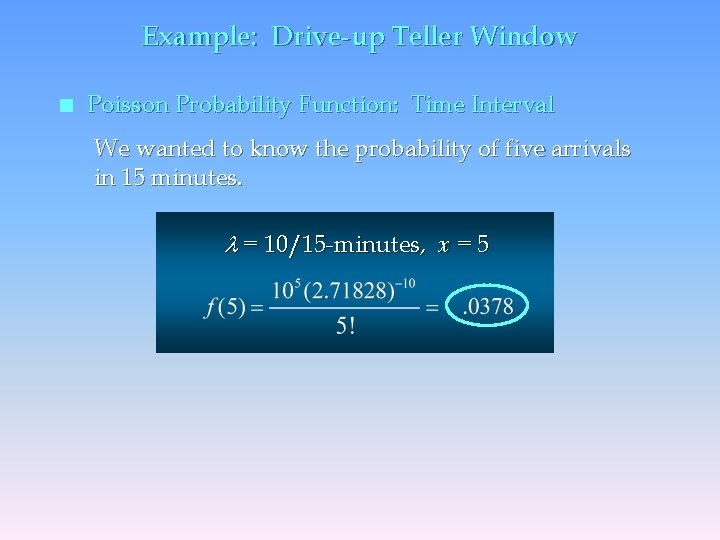
Example: Drive-up Teller Window n Poisson Probability Function: Time Interval We wanted to know the probability of five arrivals in 15 minutes. l = 10/15 -minutes, x = 5
Example: Department of Transportation n Poisson Probability Function: Distance Interval Suppose that we are concerned with the occurrence of major defects in a section of highway one month after resurfacing. We assume that the probability of a defect is the same for any two intervals of equal length and that the occurrence or nonoccurrence of a defect in any one interval is independent of the occurrence or nonoccurrence in any other interval. Thus, the Poisson probability distribution applies. Suppose that major defects occur at the average rate of two per mile.
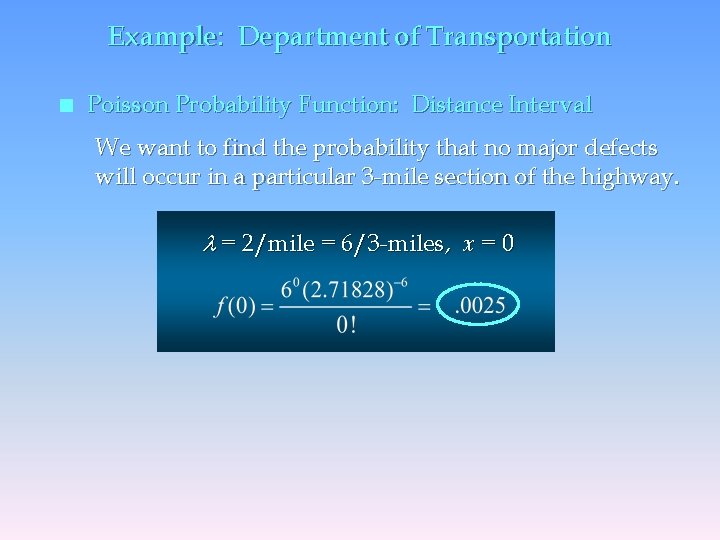
Example: Department of Transportation n Poisson Probability Function: Distance Interval We want to find the probability that no major defects will occur in a particular 3 -mile section of the highway. l = 2/mile = 6/3 -miles, x = 0
- Slides: 32