
Chapter 3 PROBABILITY 1 Chapter Outline 3 1
Chapter 3 PROBABILITY 1
Chapter Outline 3. 1 Basic Concepts of Probability 3. 2 Conditional Probability and the Multiplication Rule 3. 3 The Addition Rule 3. 4 Additional Topics in Probability and Counting 2
Section 3. 1 BASIC CONCEPTS OF PROBABILITY 3
Section 3. 1 Objectives ØIdentify the sample space of a probability experiment ØIdentify simple events ØUse the Fundamental Counting Principle ØDistinguish among classical probability, empirical probability, and subjective probability ØDetermine the probability of the complement of an event ØUse a tree diagram and the Fundamental Counting Principle to find probabilities 4
Probability Experiments Probability experiment An action, or trial, through which specific results (counts, measurements, or responses) are obtained. Outcome The result of a single trial in a probability experiment. Sample Space The set of all possible outcomes of a probability experiment. Event Consists of one or more outcomes and is a subset of the sample space. 5
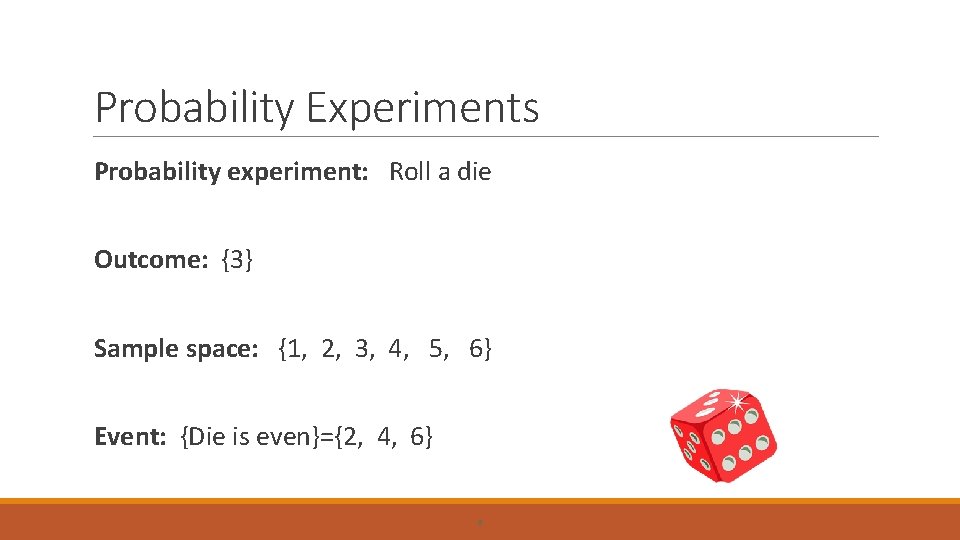
Probability Experiments Probability experiment: Roll a die Outcome: {3} Sample space: {1, 2, 3, 4, 5, 6} Event: {Die is even}={2, 4, 6} 6
Example: Identifying the Sample Space A probability experiment consists of tossing a coin and then rolling a six-sided die. Describe the sample space. Solution: There are two possible outcomes when tossing a coin: a head (H) or a tail (T). For each of these, there are six possible outcomes when rolling a die: 1, 2, 3, 4, 5, or 6. One way to list outcomes for actions occurring in a sequence is to use a tree diagram. 7
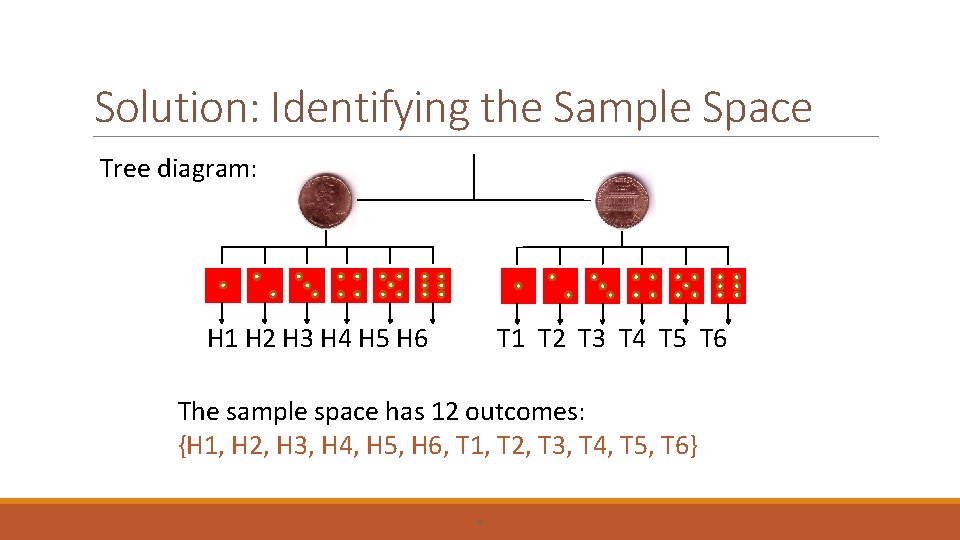
Solution: Identifying the Sample Space Tree diagram: H 1 H 2 H 3 H 4 H 5 H 6 T 1 T 2 T 3 T 4 T 5 T 6 The sample space has 12 outcomes: {H 1, H 2, H 3, H 4, H 5, H 6, T 1, T 2, T 3, T 4, T 5, T 6} 8
Simple Events Simple event An event that consists of a single outcome. ◦ e. g. “Tossing heads and rolling a 3” {H 3} An event that consists of more than one outcome is not a simple event. ◦ e. g. “Tossing heads and rolling an even number” {H 2, H 4, H 6} 9
Example: Identifying Simple Events Determine whether the event is simple or not. For quality control, you randomly select a machine part from a batch that has been manufactured that day. Event A is selecting a specific defective machine part. Solution: Simple (event A has one outcome: Choosing the specific defective machine part) 10
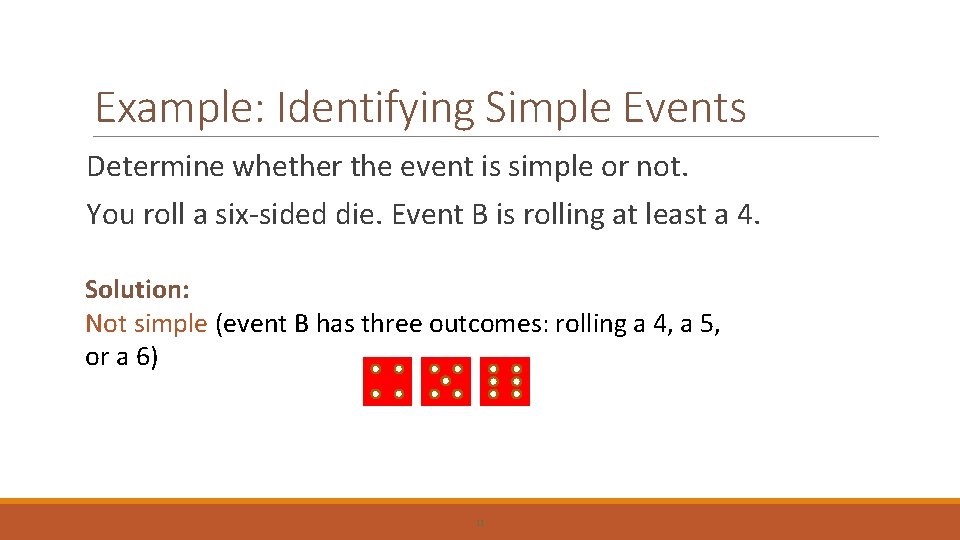
Example: Identifying Simple Events Determine whether the event is simple or not. You roll a six-sided die. Event B is rolling at least a 4. Solution: Not simple (event B has three outcomes: rolling a 4, a 5, or a 6) 11
Fundamental Counting Principle • If one event can occur in m ways and a second event can occur in n ways, the number of ways the two events can occur in sequence is m*n. • Can be extended for any number of events occurring in sequence. 12
Example: Fundamental Counting Principle You are purchasing a new car. The possible manufacturers, car sizes, and colors are listed. Manufacturer: Ford, GM, Honda Car size: compact, midsize Color: white (W), red (R), black (B), green (G) How many different ways can you select one manufacturer, one car size, and one color? Use a tree diagram to check your result. 13
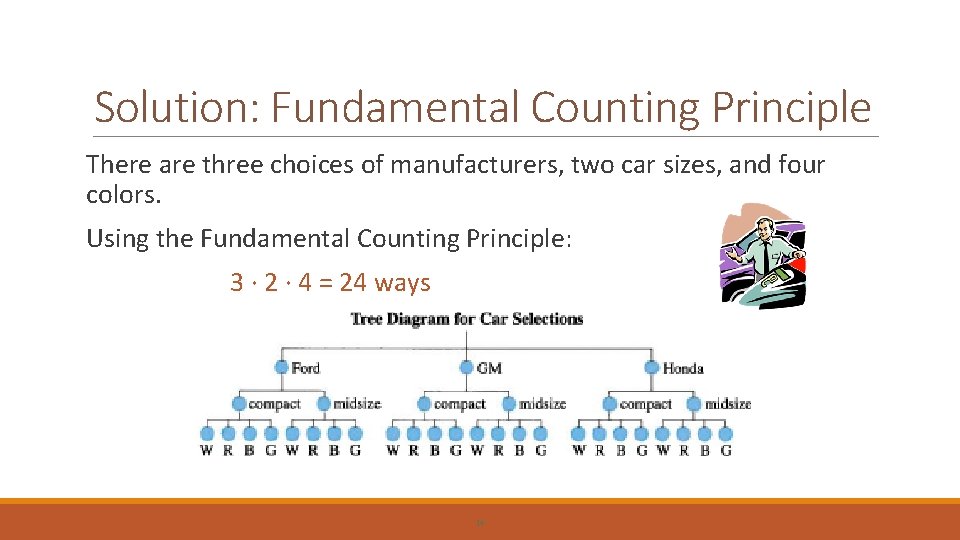
Solution: Fundamental Counting Principle There are three choices of manufacturers, two car sizes, and four colors. Using the Fundamental Counting Principle: 3 ∙ 2 ∙ 4 = 24 ways 14
Example: Fundamental Counting Principle The access code for a car’s security system consists of four digits. Each digit can be 0 through 9. How many access codes are possible if 1. Each digit can be used only once and not repeated? 2. Each digit can be repeated? 3. Each digit can be repeated but the first digit cannot be 0 or 1? 15
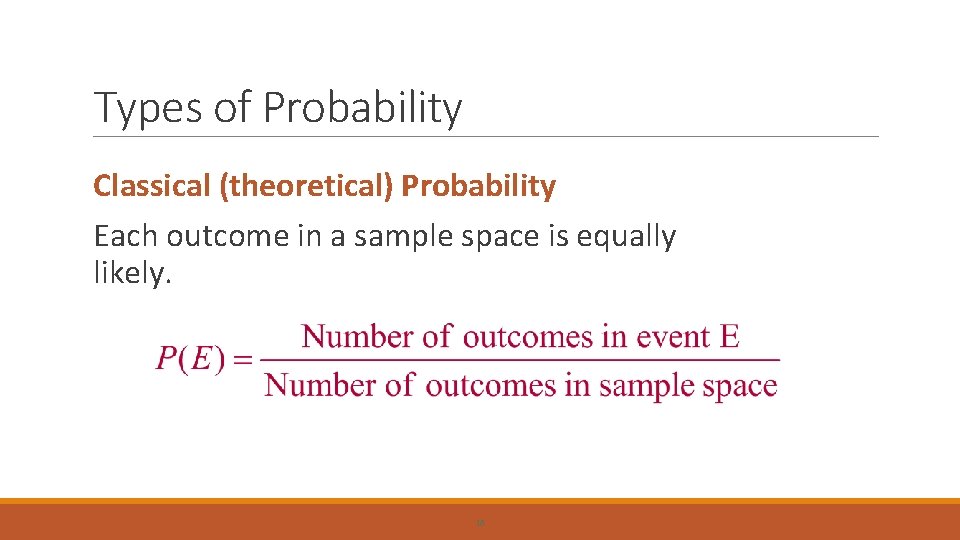
Types of Probability Classical (theoretical) Probability Each outcome in a sample space is equally likely. 16
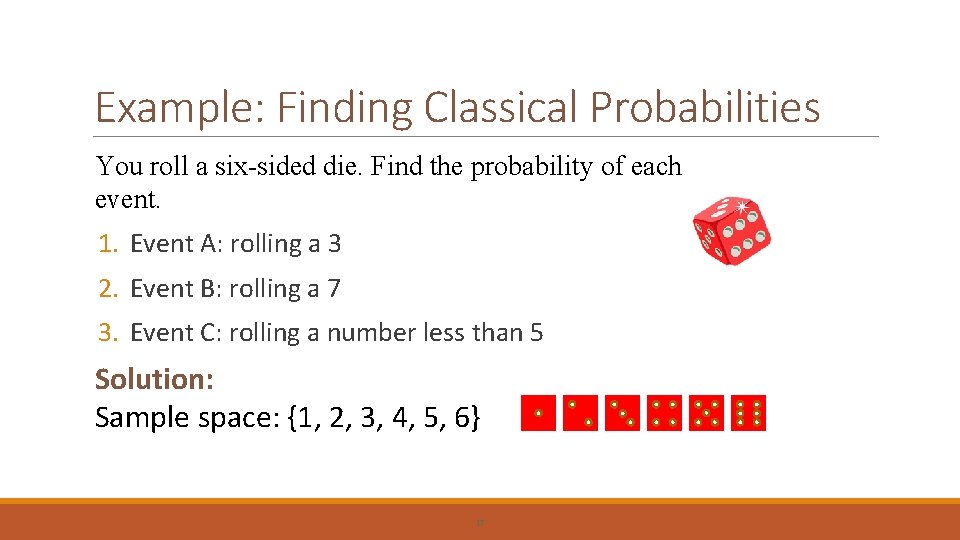
Example: Finding Classical Probabilities You roll a six-sided die. Find the probability of each event. 1. Event A: rolling a 3 2. Event B: rolling a 7 3. Event C: rolling a number less than 5 Solution: Sample space: {1, 2, 3, 4, 5, 6} 17
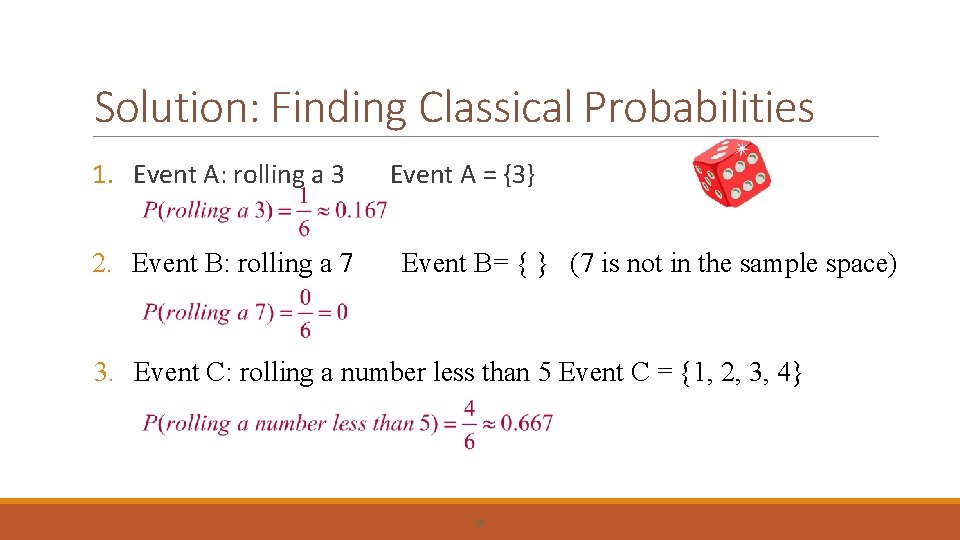
Solution: Finding Classical Probabilities 1. Event A: rolling a 3 2. Event B: rolling a 7 Event A = {3} Event B= { } (7 is not in the sample space) 3. Event C: rolling a number less than 5 Event C = {1, 2, 3, 4} 18
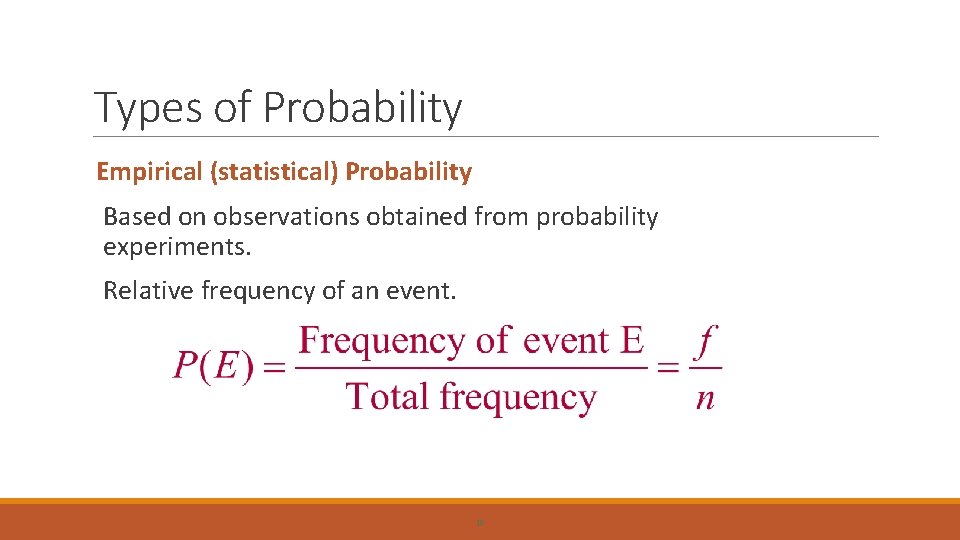
Types of Probability Empirical (statistical) Probability Based on observations obtained from probability experiments. Relative frequency of an event. 19
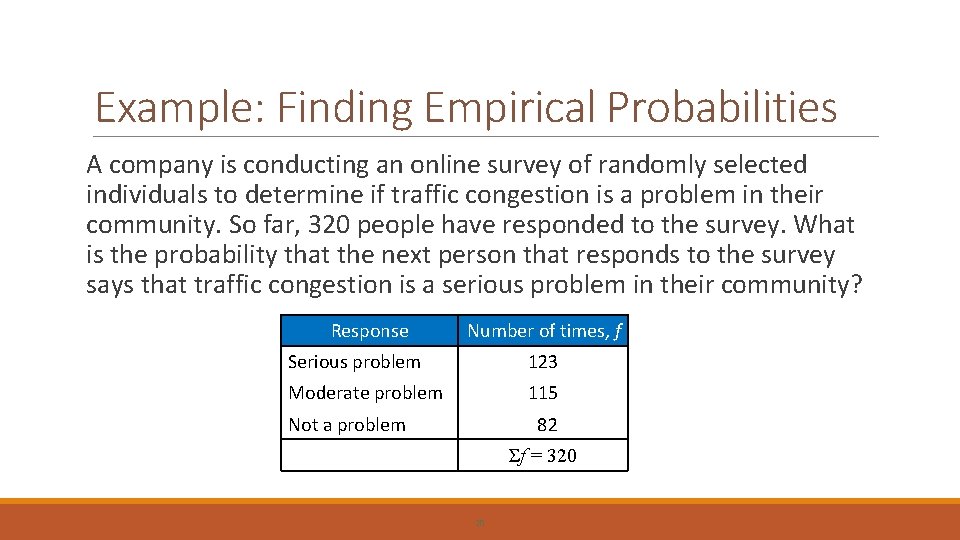
Example: Finding Empirical Probabilities A company is conducting an online survey of randomly selected individuals to determine if traffic congestion is a problem in their community. So far, 320 people have responded to the survey. What is the probability that the next person that responds to the survey says that traffic congestion is a serious problem in their community? Response Number of times, f Serious problem 123 Moderate problem 115 Not a problem 82 Σf = 320 20
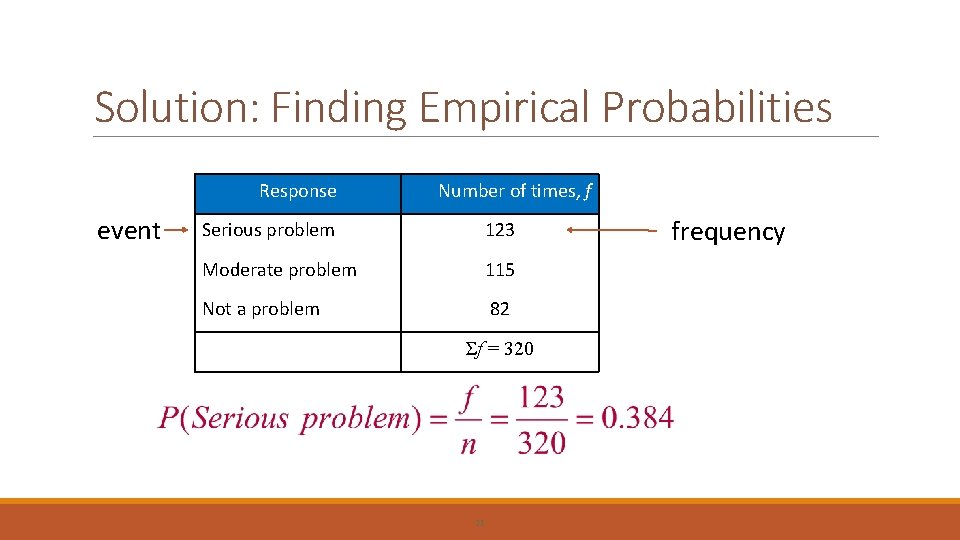
Solution: Finding Empirical Probabilities Response event Number of times, f Serious problem 123 Moderate problem 115 Not a problem 82 Σf = 320 21 frequency
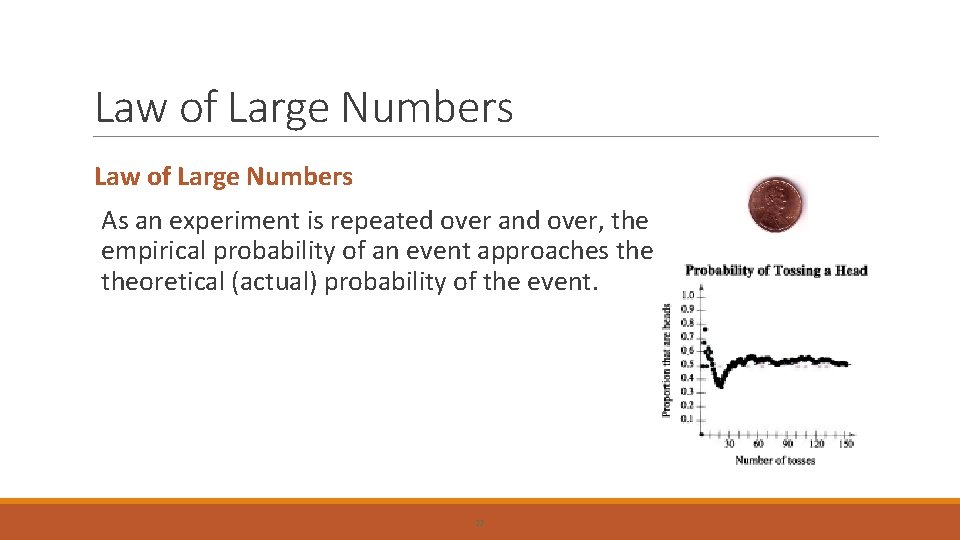
Law of Large Numbers As an experiment is repeated over and over, the empirical probability of an event approaches theoretical (actual) probability of the event. 22
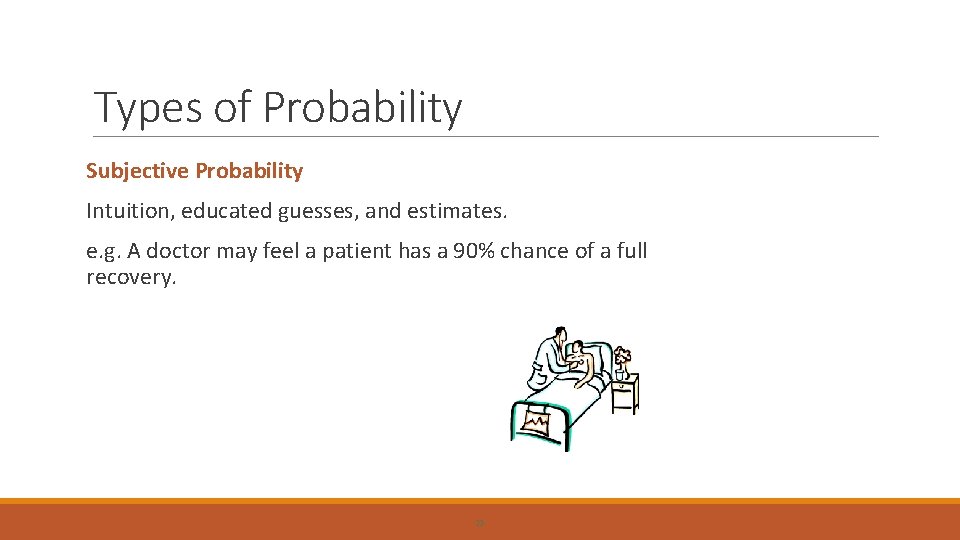
Types of Probability Subjective Probability Intuition, educated guesses, and estimates. e. g. A doctor may feel a patient has a 90% chance of a full recovery. 23
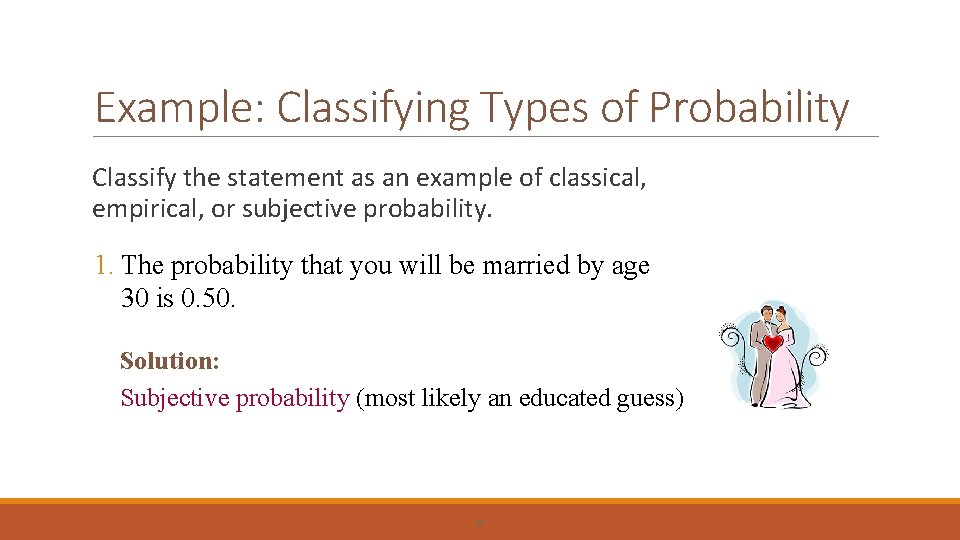
Example: Classifying Types of Probability Classify the statement as an example of classical, empirical, or subjective probability. 1. The probability that you will be married by age 30 is 0. 50. Solution: Subjective probability (most likely an educated guess) 24
Example: Classifying Types of Probability Classify the statement as an example of classical, empirical, or subjective probability. 2. The probability that a voter chosen at random will vote Republican is 0. 45. Solution: Empirical probability (most likely based on a survey) 25
Example: Classifying Types of Probability Classify the statement as an example of classical, empirical, or subjective probability. 3. The probability of winning a 1000 -ticket raffle with one ticket is. Solution: Classical probability (equally likely outcomes) 26
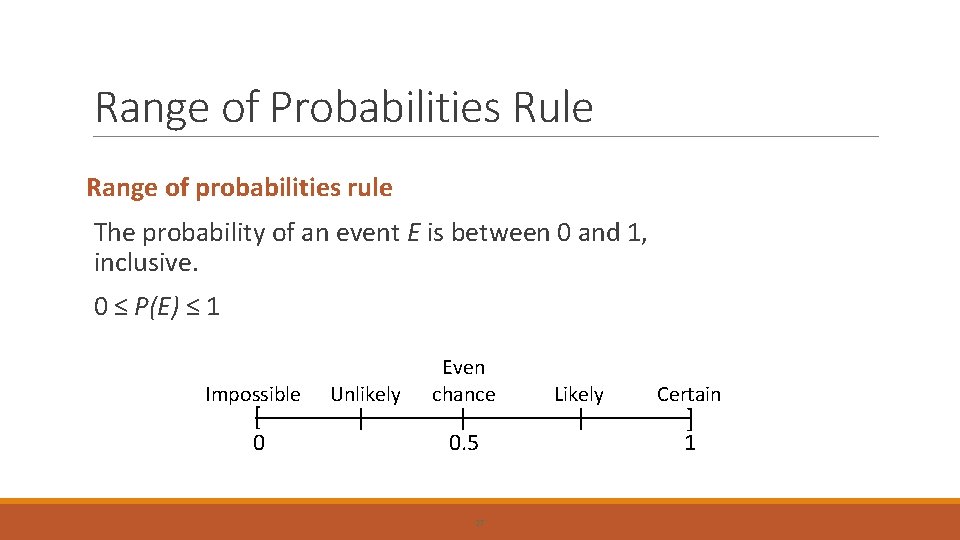
Range of Probabilities Rule Range of probabilities rule The probability of an event E is between 0 and 1, inclusive. 0 ≤ P(E) ≤ 1 Impossible [ 0 Unlikely Even chance 0. 5 27 Likely Certain ] 1
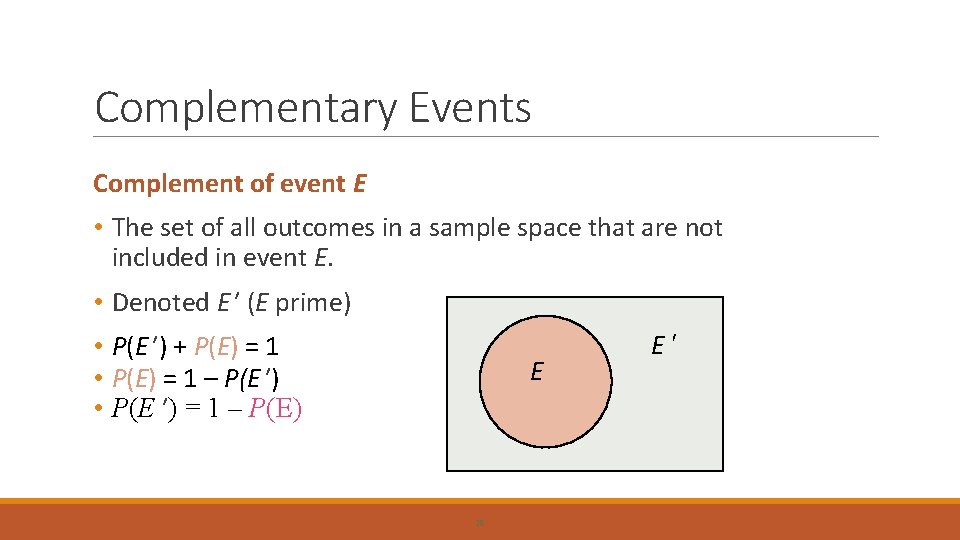
Complementary Events Complement of event E • The set of all outcomes in a sample space that are not included in event E. • Denoted E ′ (E prime) • P(E ′) + P(E) = 1 • P(E) = 1 – P(E ′) • P(E ′) = 1 – P(E) E 28 E′
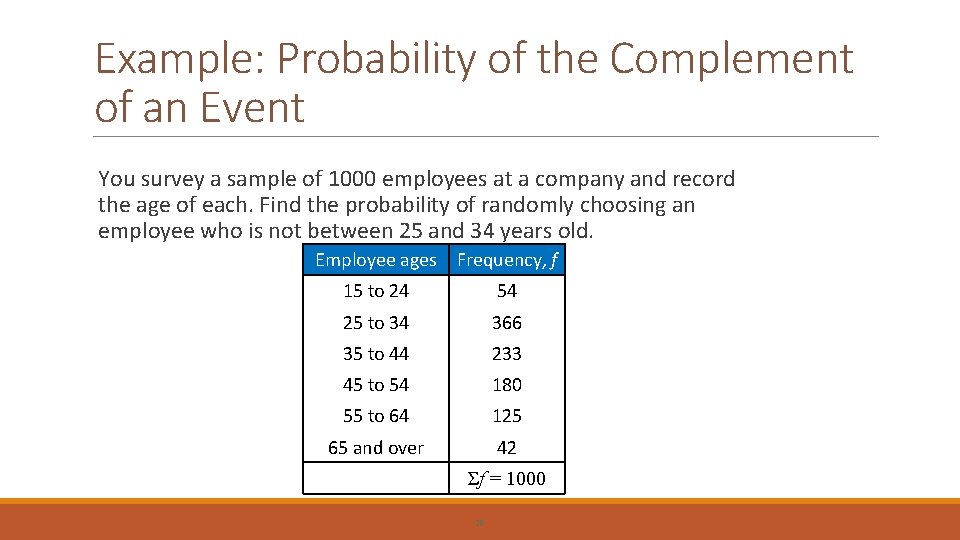
Example: Probability of the Complement of an Event You survey a sample of 1000 employees at a company and record the age of each. Find the probability of randomly choosing an employee who is not between 25 and 34 years old. Employee ages Frequency, f 15 to 24 54 25 to 34 366 35 to 44 233 45 to 54 180 55 to 64 125 65 and over 42 Σf = 1000 29
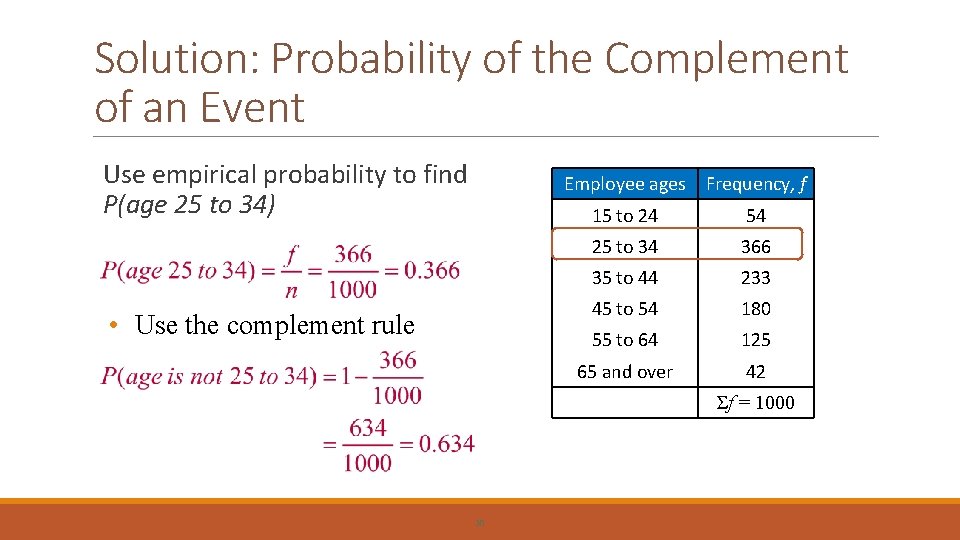
Solution: Probability of the Complement of an Event Use empirical probability to find P(age 25 to 34) Employee ages Frequency, f • Use the complement rule 15 to 24 54 25 to 34 366 35 to 44 233 45 to 54 180 55 to 64 125 65 and over 42 Σf = 1000 30
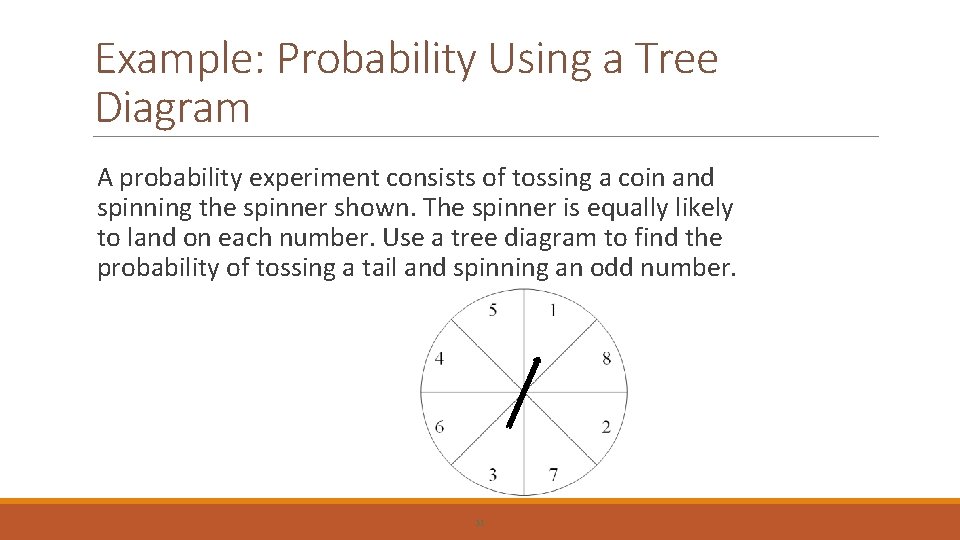
Example: Probability Using a Tree Diagram A probability experiment consists of tossing a coin and spinning the spinner shown. The spinner is equally likely to land on each number. Use a tree diagram to find the probability of tossing a tail and spinning an odd number. 31
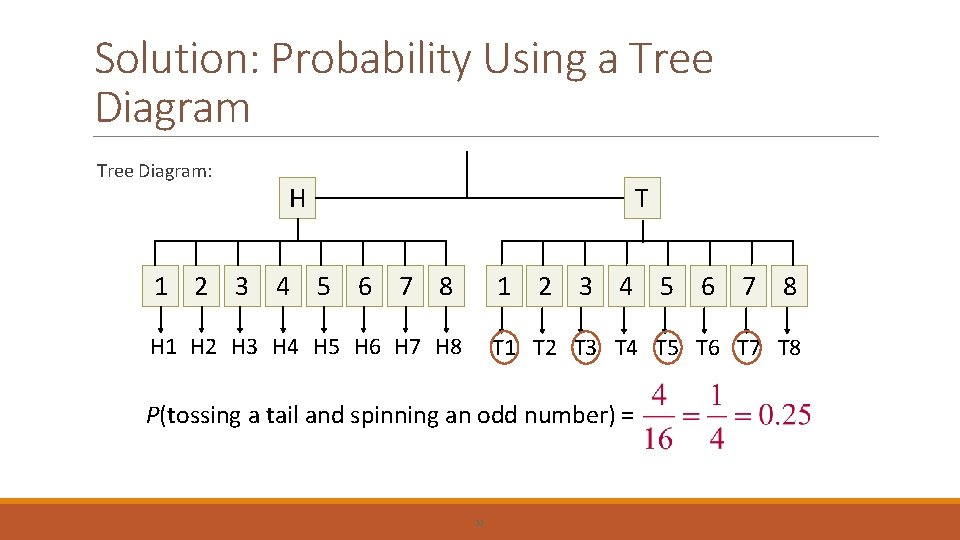
Solution: Probability Using a Tree Diagram: H T 1 2 3 4 5 6 7 8 H 1 H 2 H 3 H 4 H 5 H 6 H 7 H 8 T 1 T 2 T 3 T 4 T 5 T 6 T 7 T 8 P(tossing a tail and spinning an odd number) = 32

Example: Probability Using the Fundamental Counting Principle Your college identification number consists of 8 digits. Each digit can be 0 through 9 and each digit can be repeated. What is the probability of getting your college identification number when randomly generating eight digits? 33
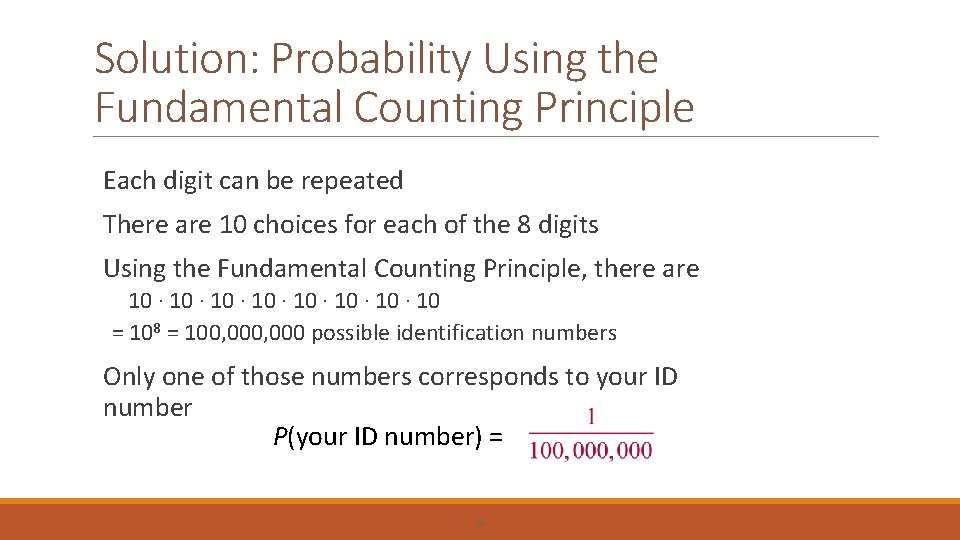
Solution: Probability Using the Fundamental Counting Principle Each digit can be repeated There are 10 choices for each of the 8 digits Using the Fundamental Counting Principle, there are 10 ∙ 10 ∙ 10 = 108 = 100, 000 possible identification numbers Only one of those numbers corresponds to your ID number P(your ID number) = 34
Section 3. 2 CONDITIONAL PROBABILITY AND THE MULTIPLICATION RULE 35
Section 3. 2 Objectives ØDetermine conditional probabilities ØDistinguish between independent and dependent events ØUse the Multiplication Rule to find the probability of events occurring in sequence ØUse the Multiplication Rule to find conditional probabilities 36
Conditional Probability The probability of an event occurring, given that another event has already occurred Denoted P(B | A) (read “probability of B, given A”) 37
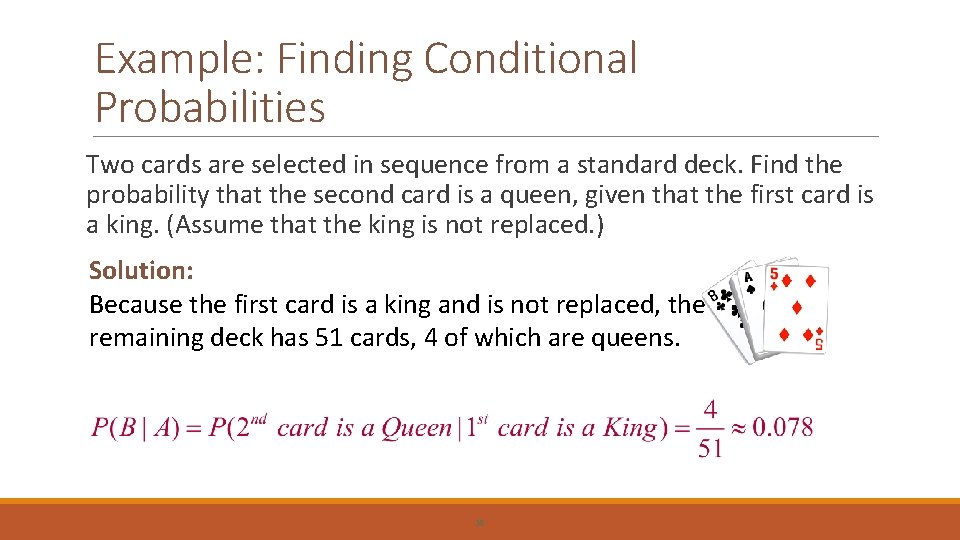
Example: Finding Conditional Probabilities Two cards are selected in sequence from a standard deck. Find the probability that the second card is a queen, given that the first card is a king. (Assume that the king is not replaced. ) Solution: Because the first card is a king and is not replaced, the remaining deck has 51 cards, 4 of which are queens. 38
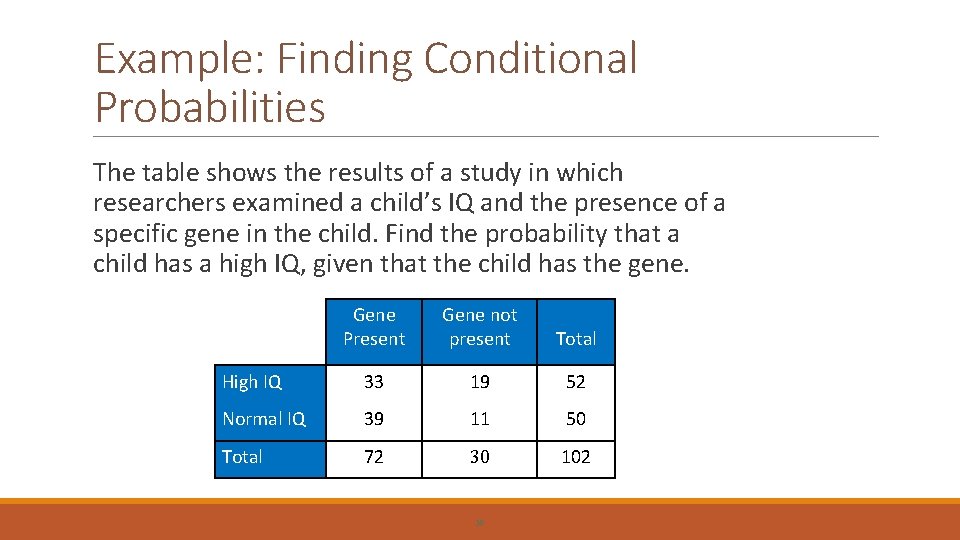
Example: Finding Conditional Probabilities The table shows the results of a study in which researchers examined a child’s IQ and the presence of a specific gene in the child. Find the probability that a child has a high IQ, given that the child has the gene. Gene Present Gene not present Total High IQ 33 19 52 Normal IQ 39 11 50 Total 72 30 102 39
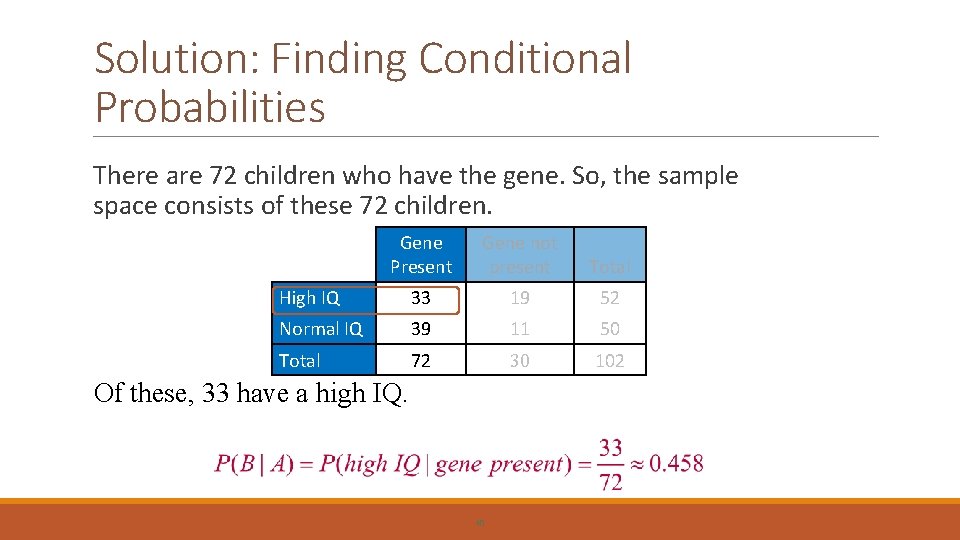
Solution: Finding Conditional Probabilities There are 72 children who have the gene. So, the sample space consists of these 72 children. Gene Present Gene not present Total High IQ 33 19 52 Normal IQ 39 11 50 Total 72 30 102 Of these, 33 have a high IQ. 40
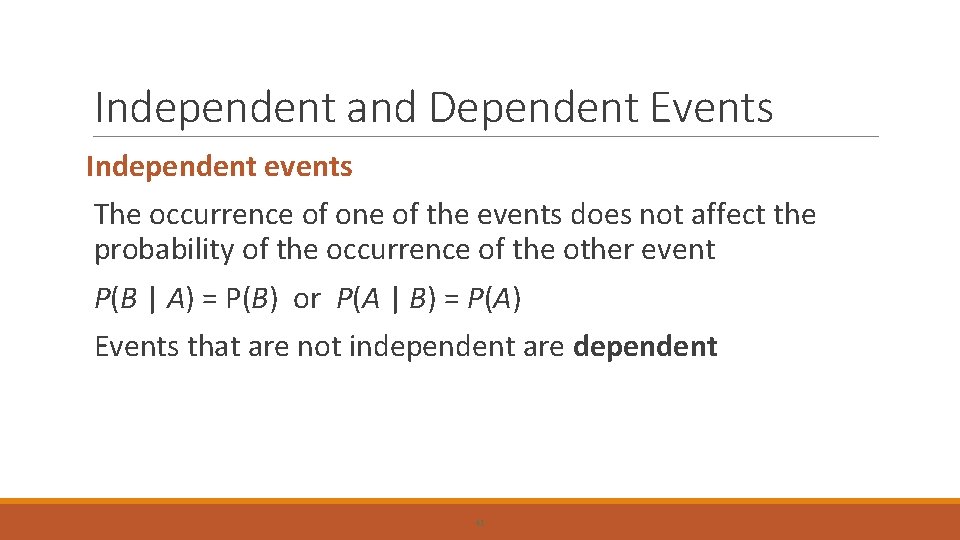
Independent and Dependent Events Independent events The occurrence of one of the events does not affect the probability of the occurrence of the other event P(B | A) = P(B) or P(A | B) = P(A) Events that are not independent are dependent 41
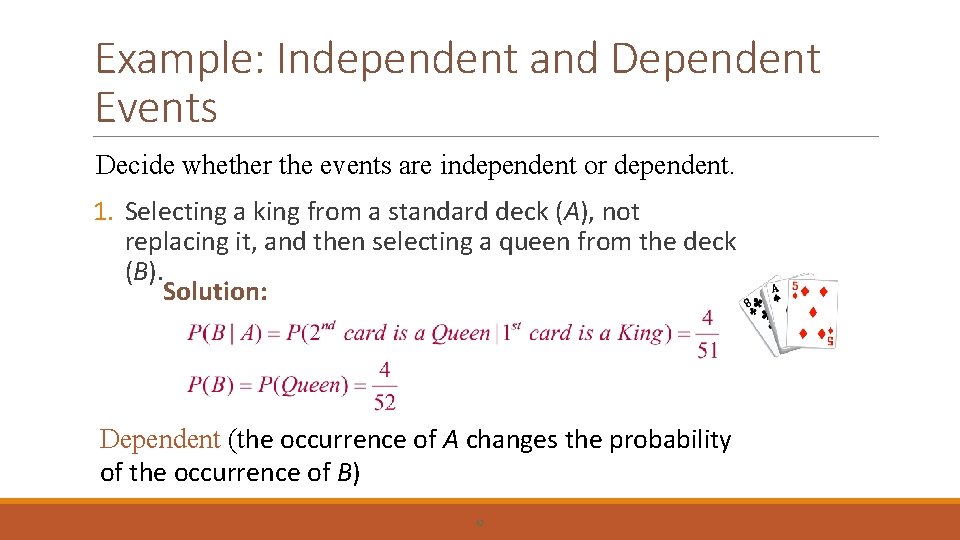
Example: Independent and Dependent Events Decide whether the events are independent or dependent. 1. Selecting a king from a standard deck (A), not replacing it, and then selecting a queen from the deck (B). Solution: Dependent (the occurrence of A changes the probability of the occurrence of B) 42
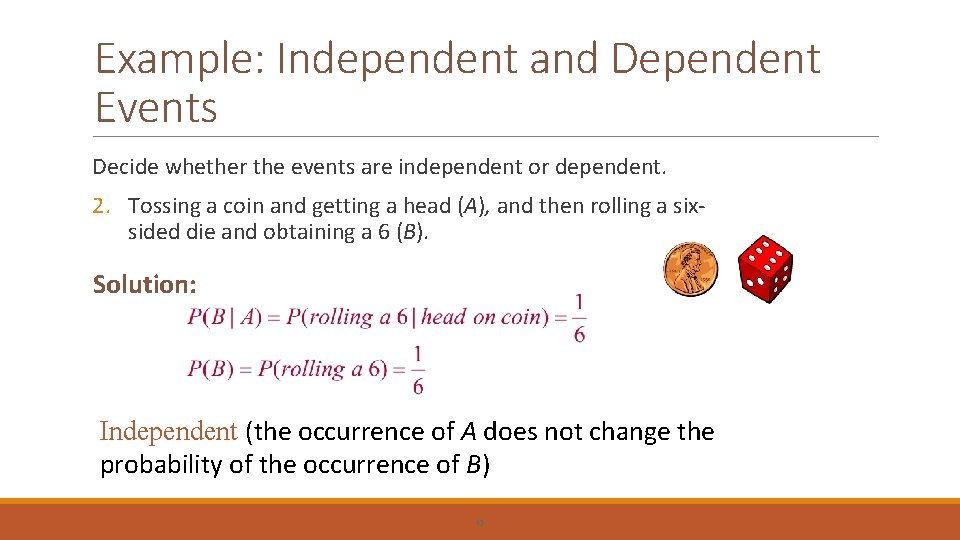
Example: Independent and Dependent Events Decide whether the events are independent or dependent. 2. Tossing a coin and getting a head (A), and then rolling a sixsided die and obtaining a 6 (B). Solution: Independent (the occurrence of A does not change the probability of the occurrence of B) 43
The Multiplication Rule Multiplication rule for the probability of A and B The probability that two events A and B will occur in sequence is ◦ P(A and B) = P(A) ∙ P(B | A) For independent events the rule can be simplified to ◦ P(A and B) = P(A) ∙ P(B) ◦ Can be extended for any number of independent events 44
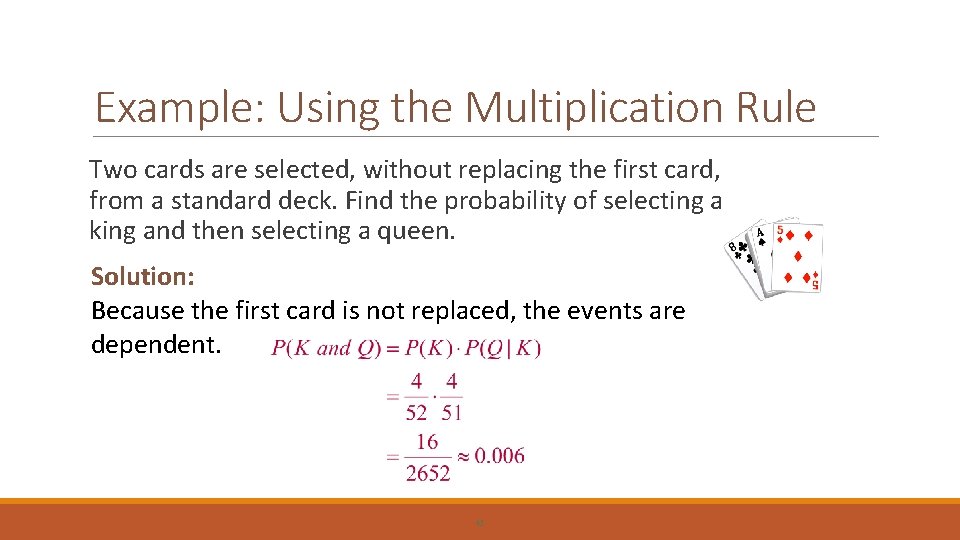
Example: Using the Multiplication Rule Two cards are selected, without replacing the first card, from a standard deck. Find the probability of selecting a king and then selecting a queen. Solution: Because the first card is not replaced, the events are dependent. 45
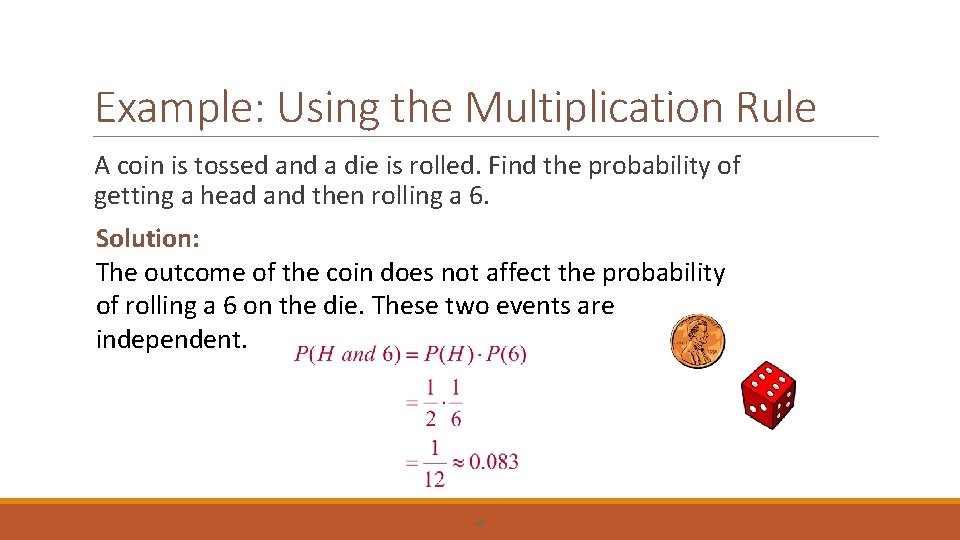
Example: Using the Multiplication Rule A coin is tossed and a die is rolled. Find the probability of getting a head and then rolling a 6. Solution: The outcome of the coin does not affect the probability of rolling a 6 on the die. These two events are independent. 46
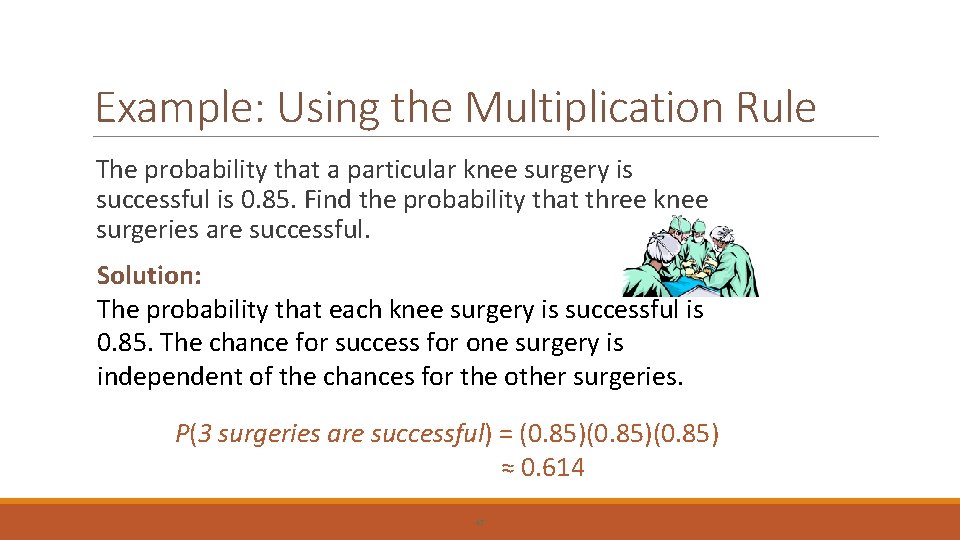
Example: Using the Multiplication Rule The probability that a particular knee surgery is successful is 0. 85. Find the probability that three knee surgeries are successful. Solution: The probability that each knee surgery is successful is 0. 85. The chance for success for one surgery is independent of the chances for the other surgeries. P(3 surgeries are successful) = (0. 85)(0. 85) ≈ 0. 614 47
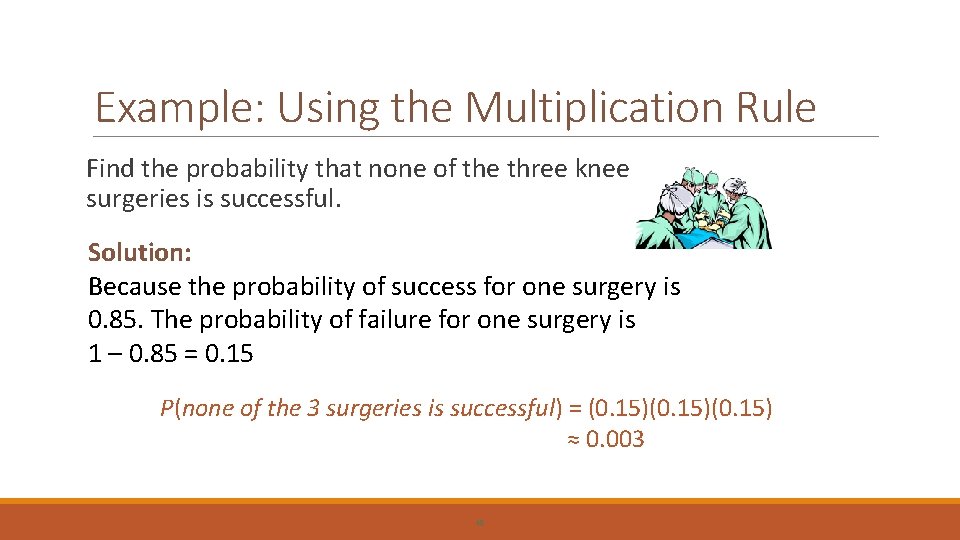
Example: Using the Multiplication Rule Find the probability that none of the three knee surgeries is successful. Solution: Because the probability of success for one surgery is 0. 85. The probability of failure for one surgery is 1 – 0. 85 = 0. 15 P(none of the 3 surgeries is successful) = (0. 15)(0. 15) ≈ 0. 003 48
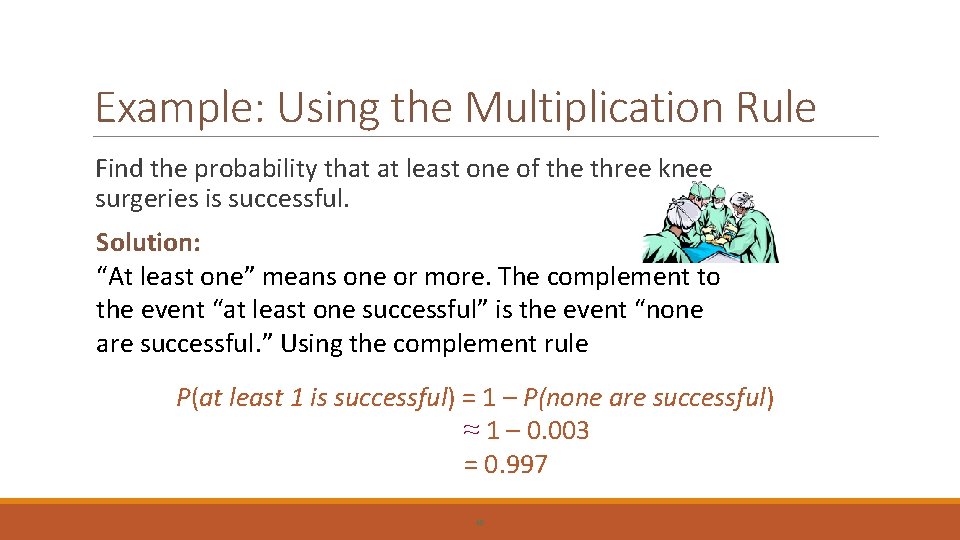
Example: Using the Multiplication Rule Find the probability that at least one of the three knee surgeries is successful. Solution: “At least one” means one or more. The complement to the event “at least one successful” is the event “none are successful. ” Using the complement rule P(at least 1 is successful) = 1 – P(none are successful) ≈ 1 – 0. 003 = 0. 997 49
Example: Using the Multiplication Rule to Find Probabilities More than 15, 000 U. S. medical school seniors applied to residency programs in 2007. Of those, 93% were matched to a residency position. Seventy-four percent of the seniors matched to a residency position were matched to one of their top two choices. Medical students electronically rank the residency programs in their order of preference and program directors across the United States do the same. The term “match” refers to the process where a student’s preference list and a program director’s preference list overlap, resulting in the placement of the student for a residency position. (Source: National Resident Matching Program) 50
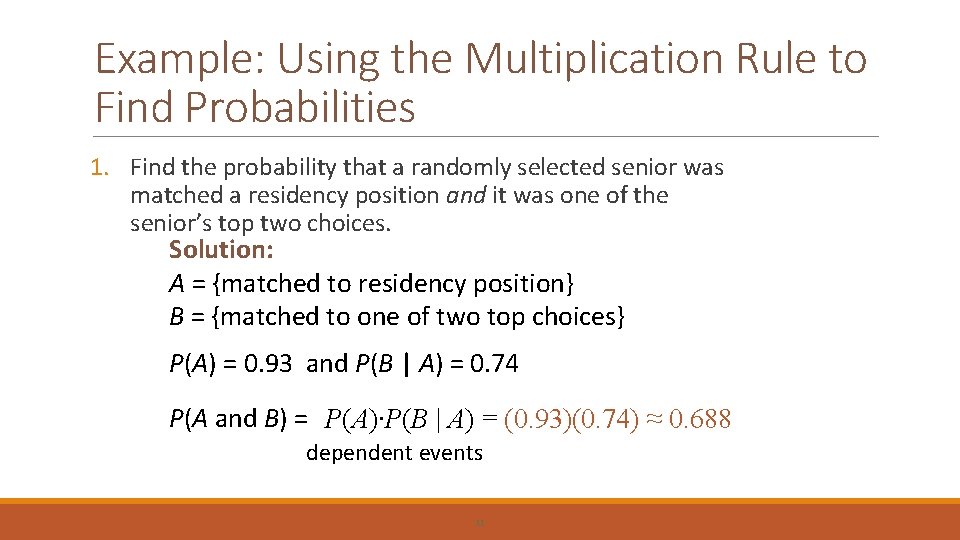
Example: Using the Multiplication Rule to Find Probabilities 1. Find the probability that a randomly selected senior was matched a residency position and it was one of the senior’s top two choices. Solution: A = {matched to residency position} B = {matched to one of two top choices} P(A) = 0. 93 and P(B | A) = 0. 74 P(A and B) = P(A)∙P(B | A) = (0. 93)(0. 74) ≈ 0. 688 dependent events 51
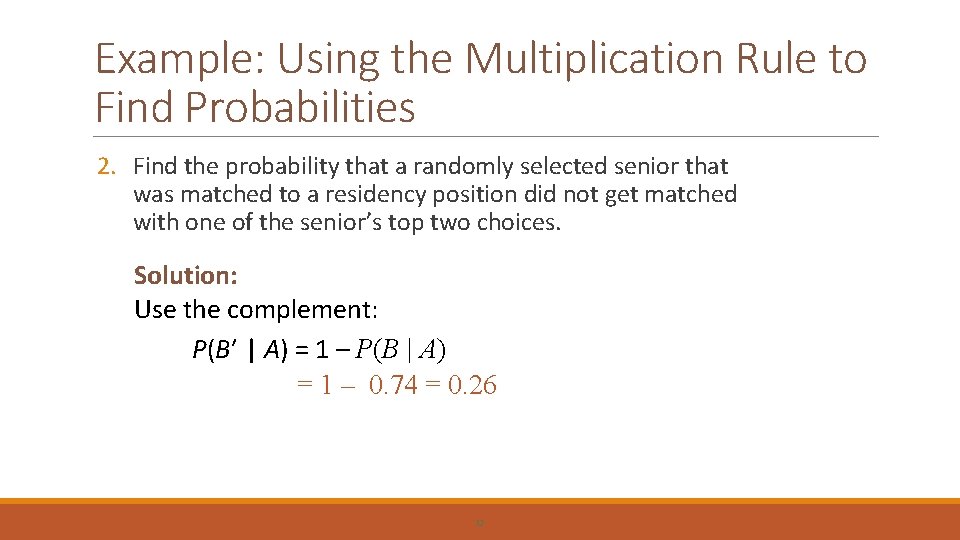
Example: Using the Multiplication Rule to Find Probabilities 2. Find the probability that a randomly selected senior that was matched to a residency position did not get matched with one of the senior’s top two choices. Solution: Use the complement: P(B′ | A) = 1 – P(B | A) = 1 – 0. 74 = 0. 26 52

Section 3. 3 ADDITION RULE 53
Section 3. 3 Objectives ØDetermine if two events are mutually exclusive ØUse the Addition Rule to find the probability of two events 54
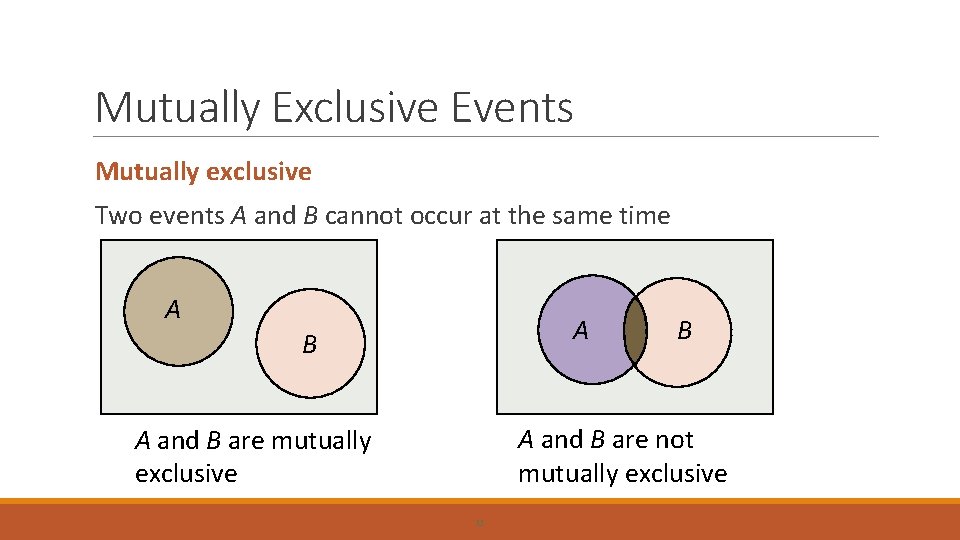
Mutually Exclusive Events Mutually exclusive Two events A and B cannot occur at the same time A A B B A and B are not mutually exclusive A and B are mutually exclusive 55
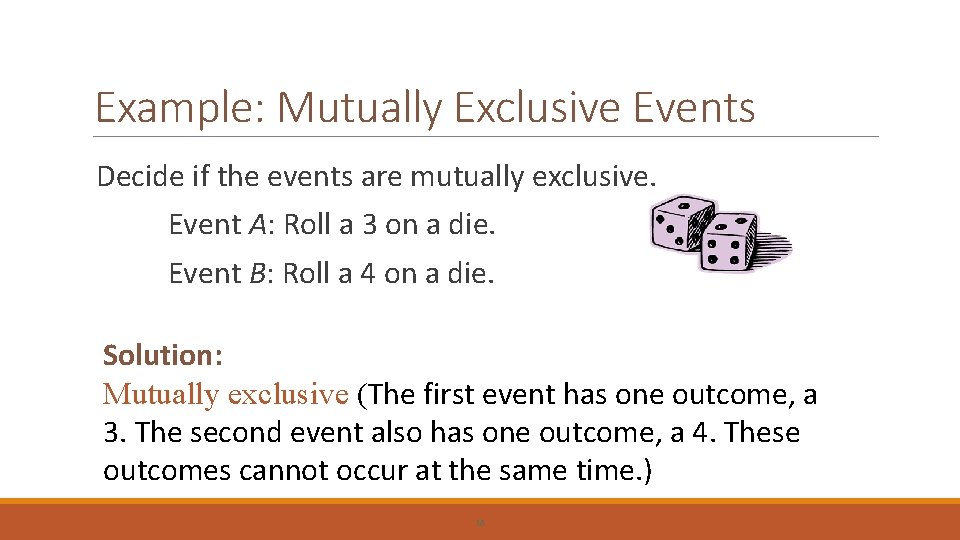
Example: Mutually Exclusive Events Decide if the events are mutually exclusive. Event A: Roll a 3 on a die. Event B: Roll a 4 on a die. Solution: Mutually exclusive (The first event has one outcome, a 3. The second event also has one outcome, a 4. These outcomes cannot occur at the same time. ) 56
Example: Mutually Exclusive Events Decide if the events are mutually exclusive. Event A: Randomly select a male student. Event B: Randomly select a nursing major. Solution: Not mutually exclusive (The student can be a male nursing major. ) 57
Example: Mutually Exclusive Events Decide if the events are mutually exclusive. Event A: Randomly select a blood donor with type O blood. Event B: Randomly select a female blood donor. Solution: Not mutually exclusive (The donor can be female with type O blood. ) 58
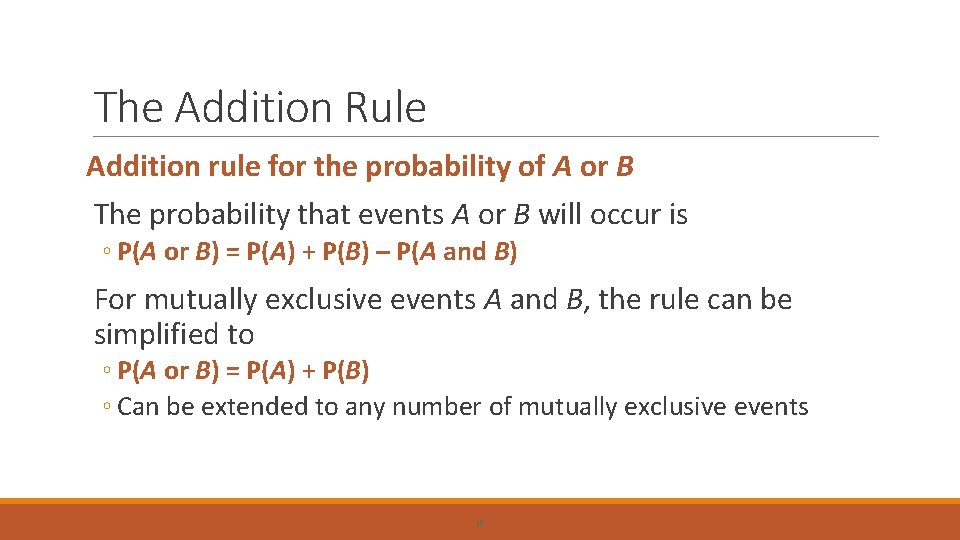
The Addition Rule Addition rule for the probability of A or B The probability that events A or B will occur is ◦ P(A or B) = P(A) + P(B) – P(A and B) For mutually exclusive events A and B, the rule can be simplified to ◦ P(A or B) = P(A) + P(B) ◦ Can be extended to any number of mutually exclusive events 59
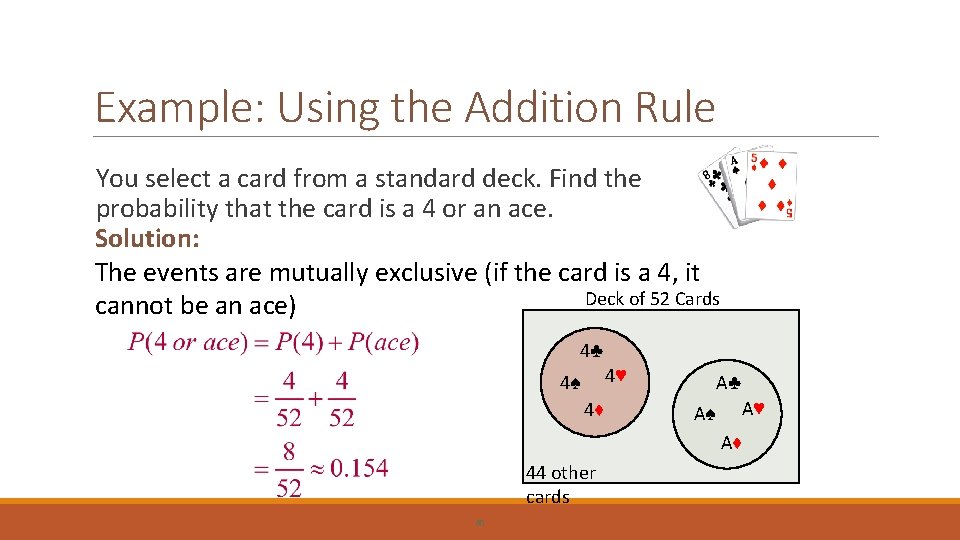
Example: Using the Addition Rule You select a card from a standard deck. Find the probability that the card is a 4 or an ace. Solution: The events are mutually exclusive (if the card is a 4, it Deck of 52 Cards cannot be an ace) 4♣ 4♥ 4♠ 4♦ A♣ A♠ A♥ A♦ 44 other cards 60
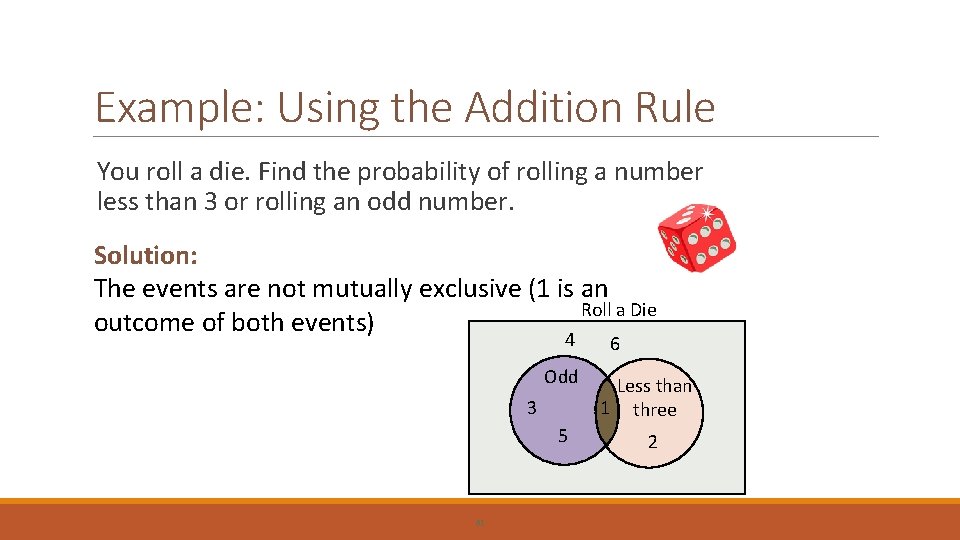
Example: Using the Addition Rule You roll a die. Find the probability of rolling a number less than 3 or rolling an odd number. Solution: The events are not mutually exclusive (1 is an Roll a Die outcome of both events) 4 Odd 3 5 61 6 Less than 1 three 2
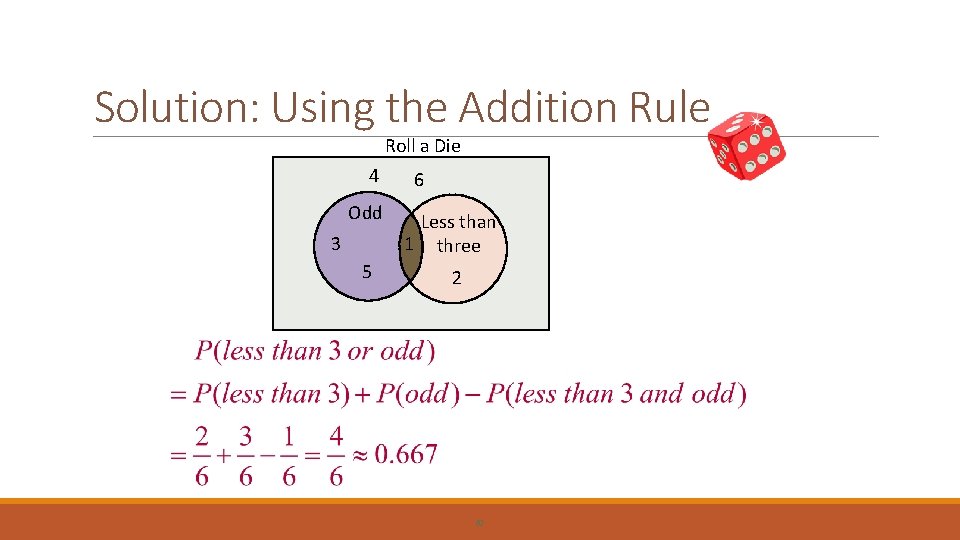
Solution: Using the Addition Rule Roll a Die 4 Odd 3 5 6 Less than 1 three 2 62
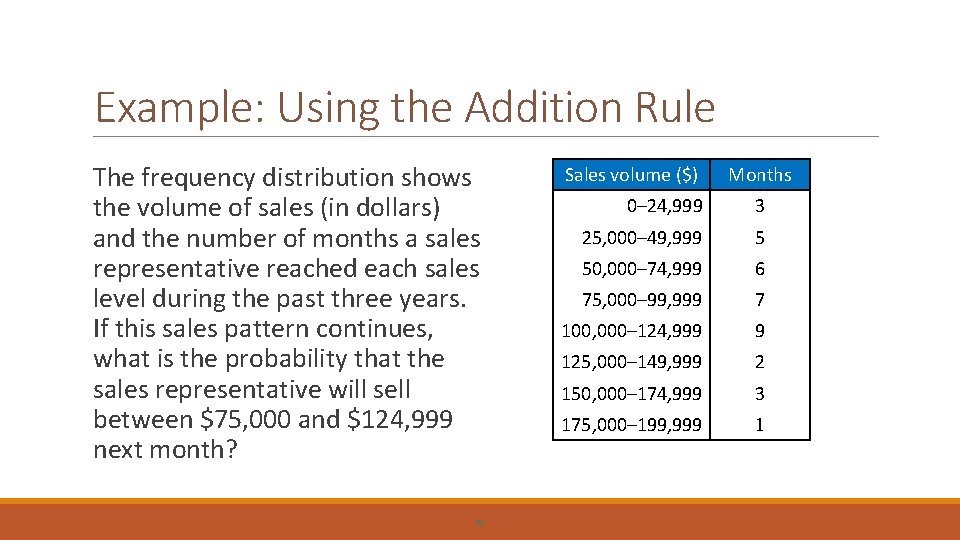
Example: Using the Addition Rule The frequency distribution shows the volume of sales (in dollars) and the number of months a sales representative reached each sales level during the past three years. If this sales pattern continues, what is the probability that the sales representative will sell between $75, 000 and $124, 999 next month? 63 Sales volume ($) Months 0– 24, 999 3 25, 000– 49, 999 5 50, 000– 74, 999 6 75, 000– 99, 999 7 100, 000– 124, 999 9 125, 000– 149, 999 2 150, 000– 174, 999 3 175, 000– 199, 999 1
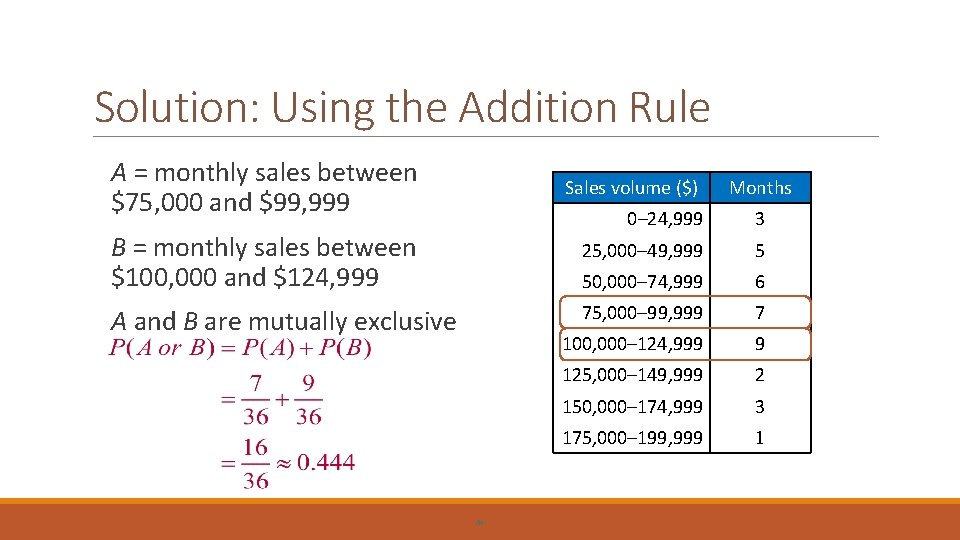
Solution: Using the Addition Rule A = monthly sales between $75, 000 and $99, 999 Sales volume ($) Months B = monthly sales between $100, 000 and $124, 999 0– 24, 999 3 25, 000– 49, 999 5 50, 000– 74, 999 6 A and B are mutually exclusive 75, 000– 99, 999 7 100, 000– 124, 999 9 125, 000– 149, 999 2 150, 000– 174, 999 3 175, 000– 199, 999 1 64
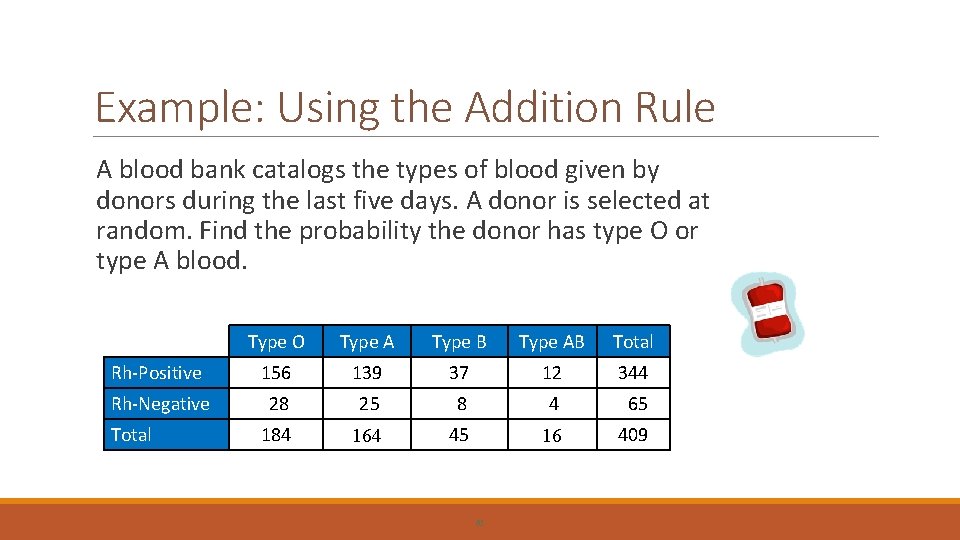
Example: Using the Addition Rule A blood bank catalogs the types of blood given by donors during the last five days. A donor is selected at random. Find the probability the donor has type O or type A blood. Type O Type A Type B Type AB Total Rh-Positive 156 139 37 12 344 Rh-Negative 28 25 8 4 65 184 164 45 16 409 Total 65
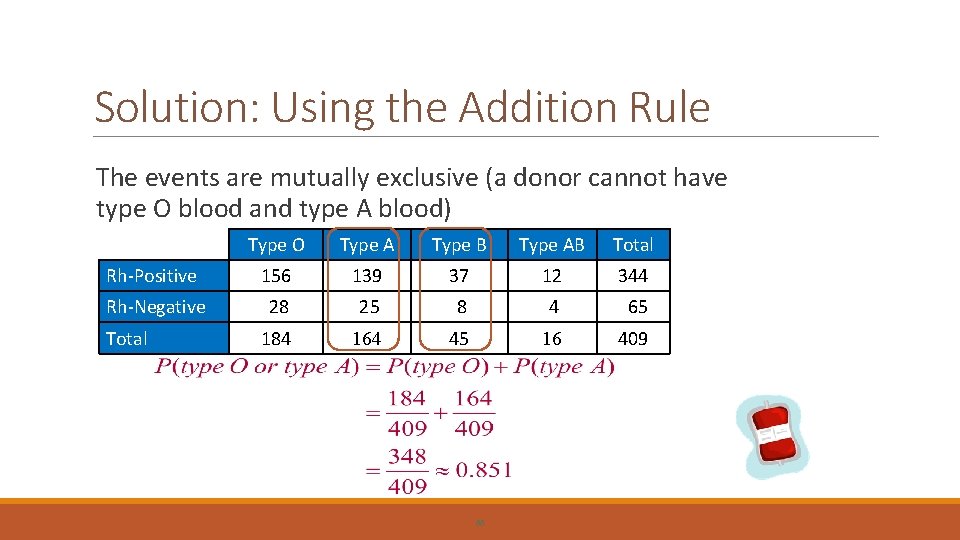
Solution: Using the Addition Rule The events are mutually exclusive (a donor cannot have type O blood and type A blood) Type O Type A Type B Type AB Total Rh-Positive 156 139 37 12 344 Rh-Negative 28 25 8 4 65 184 164 45 16 409 Total 66
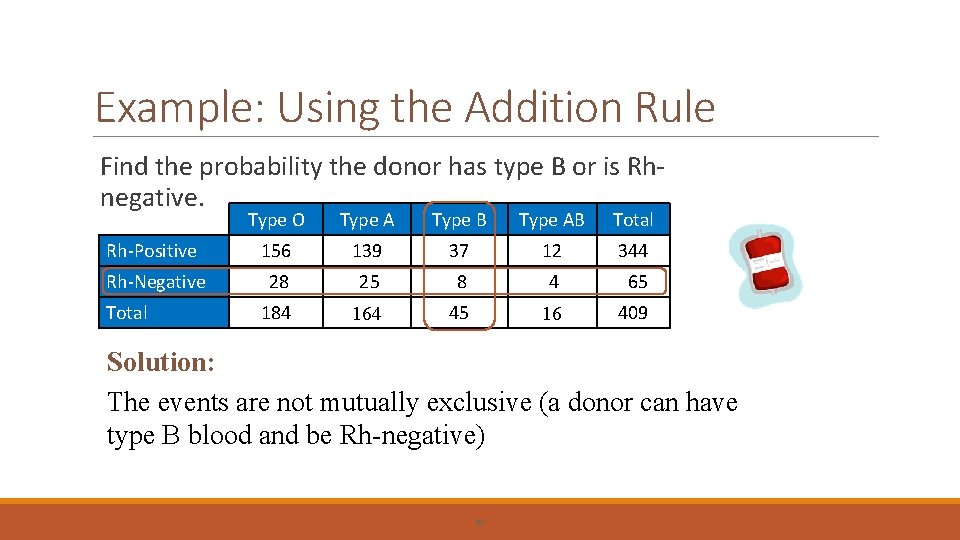
Example: Using the Addition Rule Find the probability the donor has type B or is Rhnegative. Type O Type A Type B Type AB Total Rh-Positive 156 139 37 12 344 Rh-Negative 28 25 8 4 65 184 164 45 16 409 Total Solution: The events are not mutually exclusive (a donor can have type B blood and be Rh-negative) 67
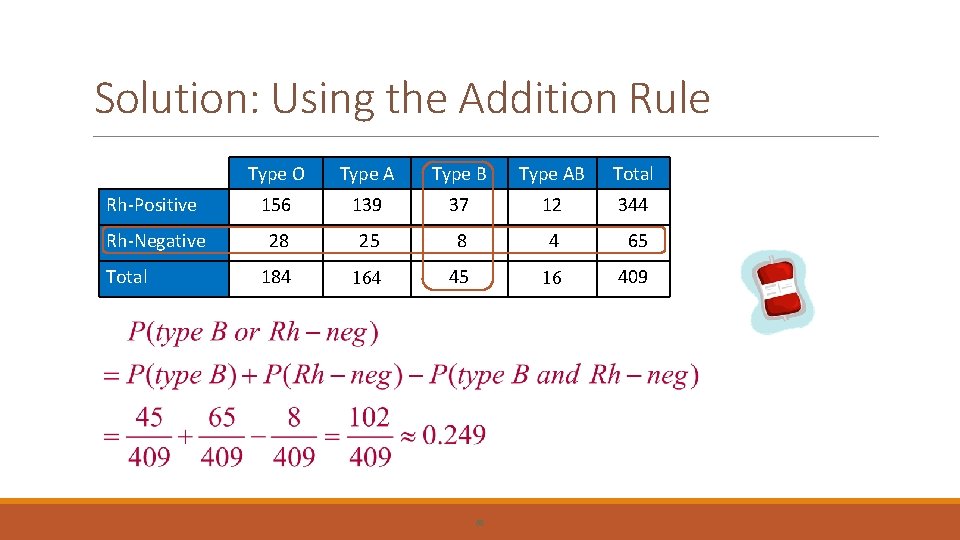
Solution: Using the Addition Rule Type O Type A Type B Type AB Total Rh-Positive 156 139 37 12 344 Rh-Negative 28 25 8 4 65 184 164 45 16 409 Total 68
Section 3. 4 ADDITIONAL TOPICS IN PROBABILITY AND COUNTING 69
Section 3. 4 Objectives ØDetermine the number of ways a group of objects can be arranged in order ØDetermine the number of ways to choose several objects from a group without regard to order ØUse the counting principles to find probabilities 70
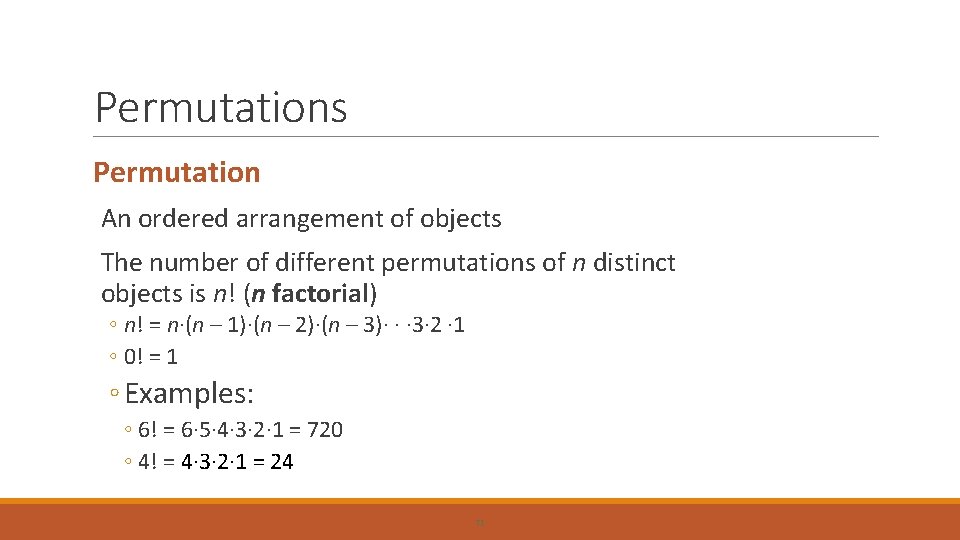
Permutations Permutation An ordered arrangement of objects The number of different permutations of n distinct objects is n! (n factorial) ◦ n! = n∙(n – 1)∙(n – 2)∙(n – 3)∙ ∙ ∙ 3∙ 2 ∙ 1 ◦ 0! = 1 ◦ Examples: ◦ 6! = 6∙ 5∙ 4∙ 3∙ 2∙ 1 = 720 ◦ 4! = 4∙ 3∙ 2∙ 1 = 24 71
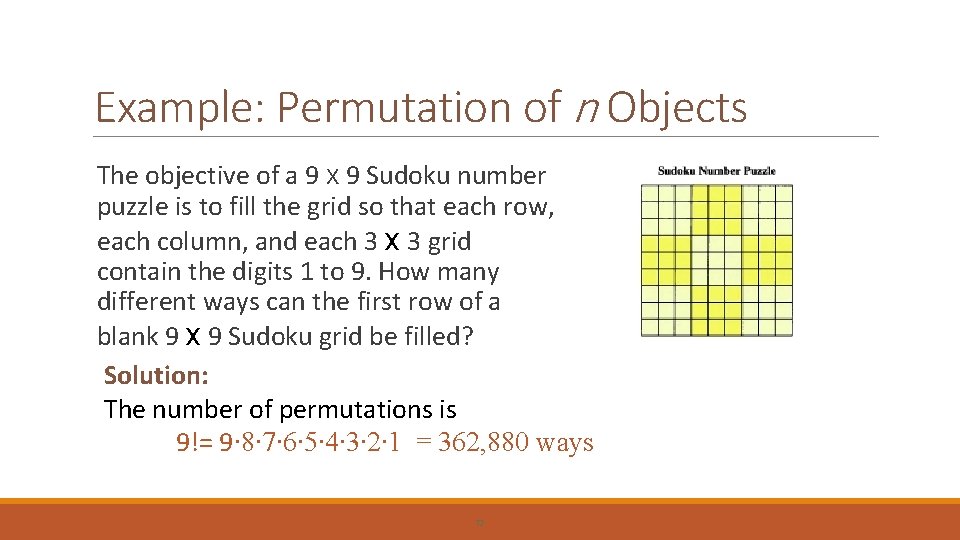
Example: Permutation of n Objects The objective of a 9 x 9 Sudoku number puzzle is to fill the grid so that each row, each column, and each 3 x 3 grid contain the digits 1 to 9. How many different ways can the first row of a blank 9 x 9 Sudoku grid be filled? Solution: The number of permutations is 9!= 9∙ 8∙ 7∙ 6∙ 5∙ 4∙ 3∙ 2∙ 1 = 362, 880 ways 72
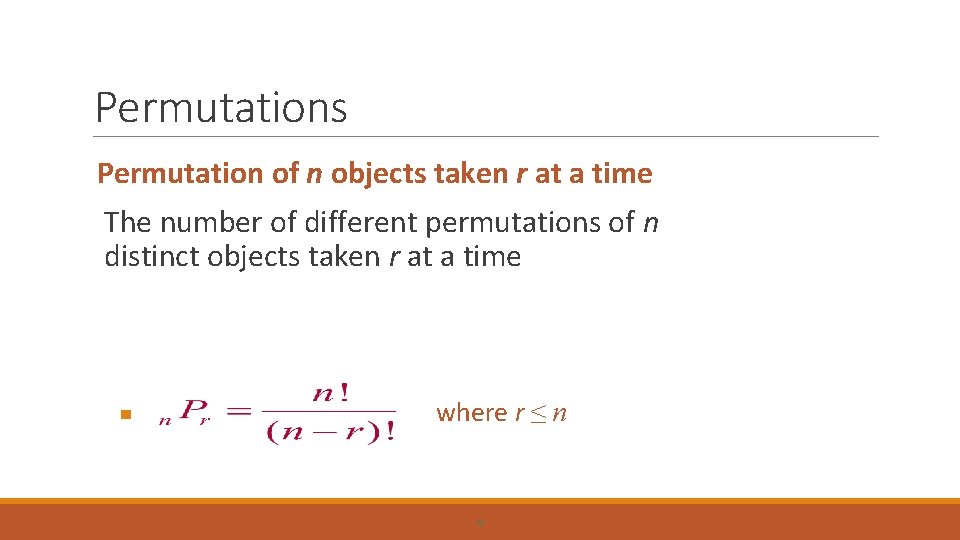
Permutations Permutation of n objects taken r at a time The number of different permutations of n distinct objects taken r at a time ■ where r ≤ n 73
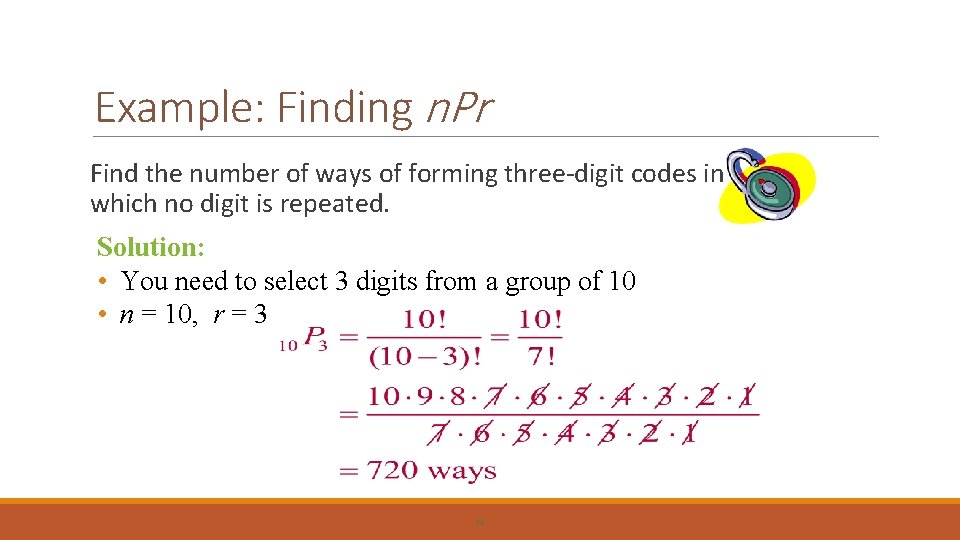
Example: Finding n. Pr Find the number of ways of forming three-digit codes in which no digit is repeated. Solution: • You need to select 3 digits from a group of 10 • n = 10, r = 3 74
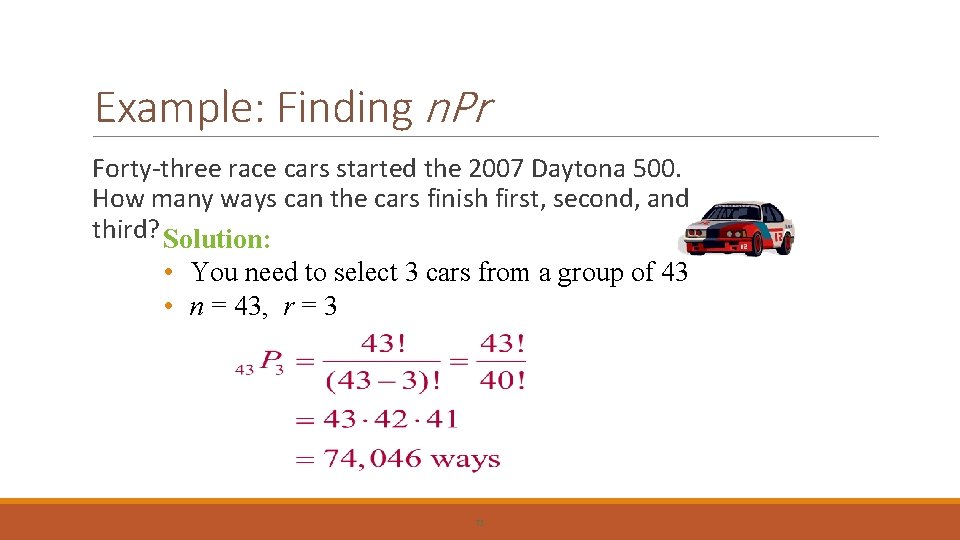
Example: Finding n. Pr Forty-three race cars started the 2007 Daytona 500. How many ways can the cars finish first, second, and third? Solution: • You need to select 3 cars from a group of 43 • n = 43, r = 3 75
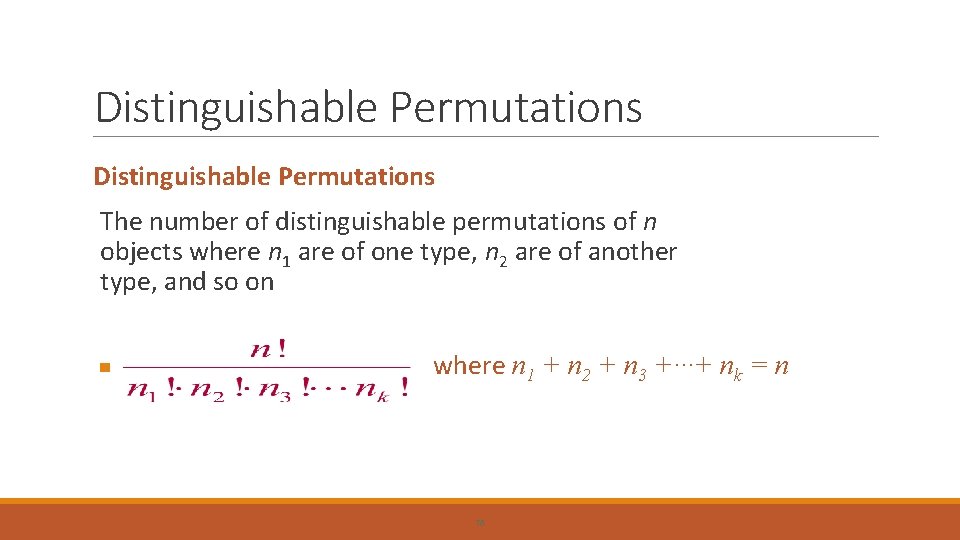
Distinguishable Permutations The number of distinguishable permutations of n objects where n 1 are of one type, n 2 are of another type, and so on ■ where n 1 + n 2 + n 3 +∙∙∙+ nk = n 76
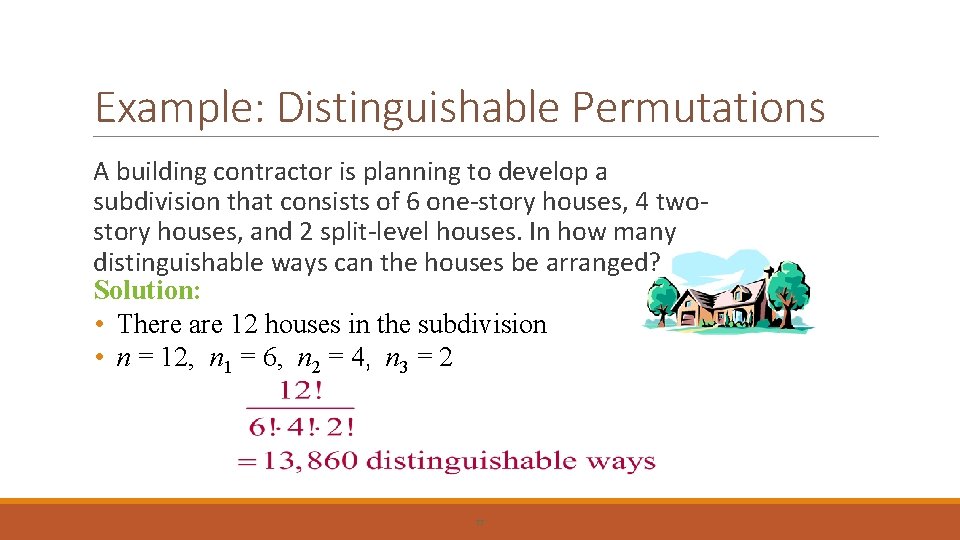
Example: Distinguishable Permutations A building contractor is planning to develop a subdivision that consists of 6 one-story houses, 4 twostory houses, and 2 split-level houses. In how many distinguishable ways can the houses be arranged? Solution: • There are 12 houses in the subdivision • n = 12, n 1 = 6, n 2 = 4, n 3 = 2 77
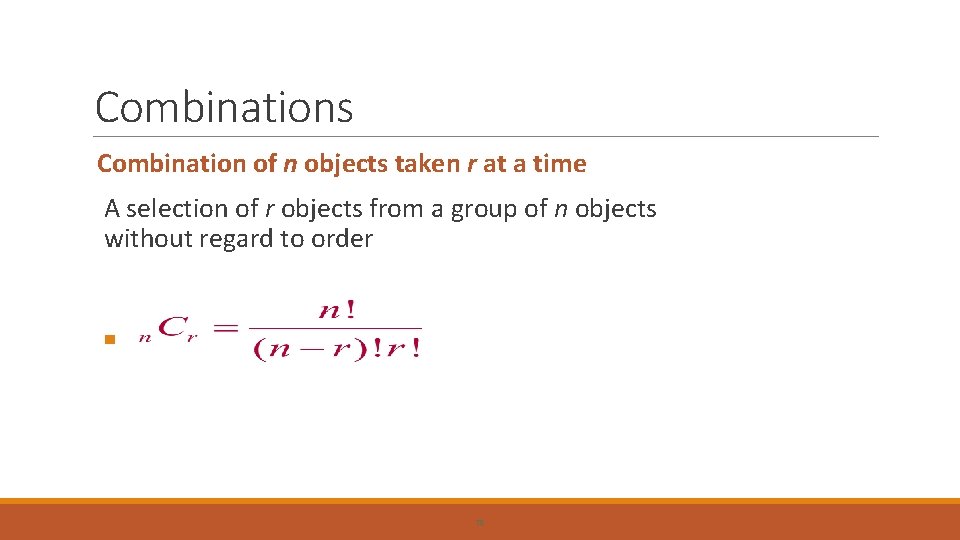
Combinations Combination of n objects taken r at a time A selection of r objects from a group of n objects without regard to order ■ 78
Example: Combinations A state’s department of transportation plans to develop a new section of interstate highway and receives 16 bids for the project. The state plans to hire four of the bidding companies. How many different combinations of four companies can be selected from the 16 bidding companies? Solution: • You need to select 4 companies from a group of 16 • n = 16, r = 4 • Order is not important 79
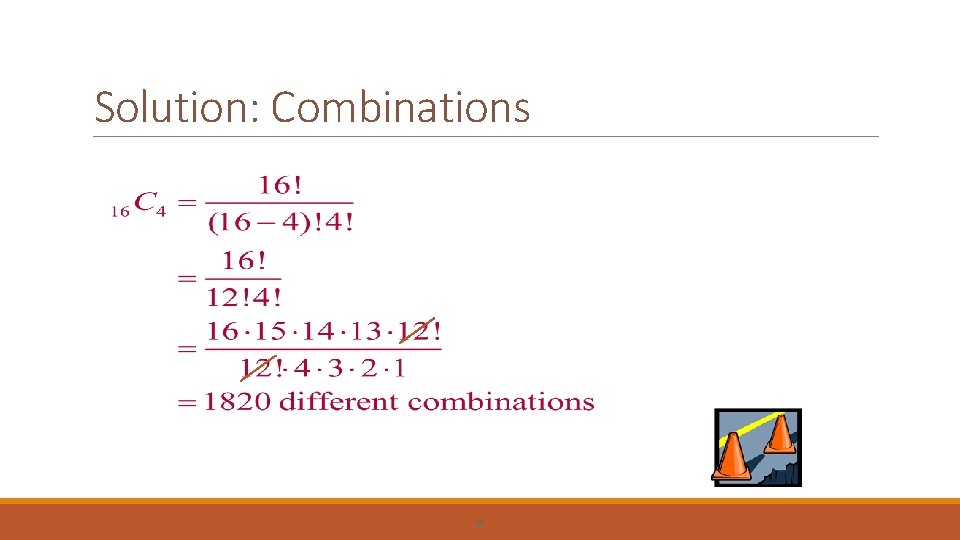
Solution: Combinations 80
Example: Finding Probabilities A student advisory board consists of 17 members. Three members serve as the board’s chair, secretary, and webmaster. Each member is equally likely to serve any of the positions. What is the probability of selecting at random the three members that hold each position? 81
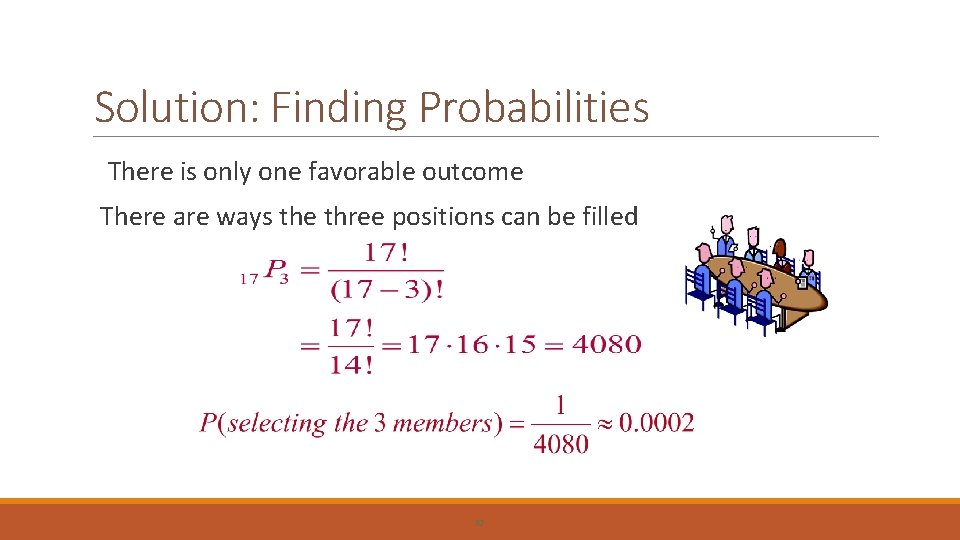
Solution: Finding Probabilities There is only one favorable outcome There are ways the three positions can be filled 82
Example: Finding Probabilities You have 11 letters consisting of one M, four Is, four Ss, and two Ps. If the letters are randomly arranged in order, what is the probability that the arrangement spells the word Mississippi? 83
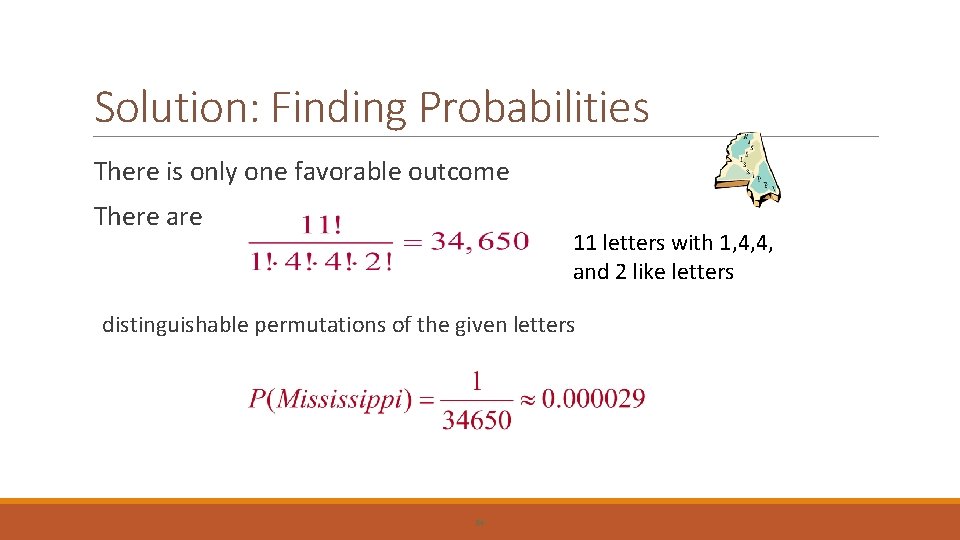
Solution: Finding Probabilities There is only one favorable outcome There are 11 letters with 1, 4, 4, and 2 like letters distinguishable permutations of the given letters 84
Example: Finding Probabilities A food manufacturer is analyzing a sample of 400 corn kernels for the presence of a toxin. In this sample, three kernels have dangerously high levels of the toxin. If four kernels are randomly selected from the sample, what is the probability that exactly one kernel contains a dangerously high level of the toxin? 85
Solution: Finding Probabilities The possible number of ways of choosing one toxic kernel out of three toxic kernels is 3 C 1 =3 The possible number of ways of choosing three nontoxic kernels from 397 nontoxic kernels is 397 C 3 = 10, 349, 790 Using the Multiplication Rule, the number of ways of choosing one toxic kernel and three nontoxic kernels is 3 C 1 ∙ 397 C 3 = 3 ∙ 10, 349, 790 3 = 31, 049, 370 86
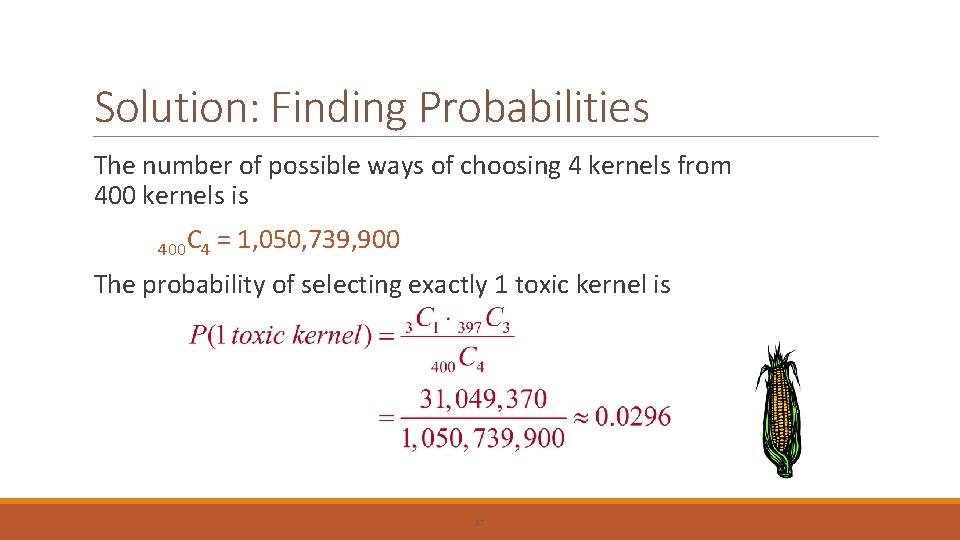
Solution: Finding Probabilities The number of possible ways of choosing 4 kernels from 400 kernels is 400 C 4 = 1, 050, 739, 900 The probability of selecting exactly 1 toxic kernel is 87
- Slides: 87