
Chapter 3 Principles of Baking On Baking Labensky
Chapter 3 Principles of Baking On Baking Labensky et al. © 2005 Pearson Education, Inc. Upper Saddle River, New Jersey 07458

Principles of Baking • This brief chapter introduces the student to the scientific basis for what takes place in the bakeshop. • Concepts and vocabulary presented here are used and expanded upon throughout the text. • Understanding the science of mixing fat, flour and water to make a finished product makes for a wellrounded professional. 2 On Baking Labensky et al. © 2005 Pearson Education, Inc. Upper Saddle River, New Jersey 07458
Mixing • Once ingredients are measured all baked goods must be mixed. • Mixing distributes ingredients evenly and helps form gluten and aerates the dough. • Doughs have low water content. • Batters generally contain more liquids, fat and sugar than doughs. 3 On Baking Labensky et al. © 2005 Pearson Education, Inc. Upper Saddle River, New Jersey 07458
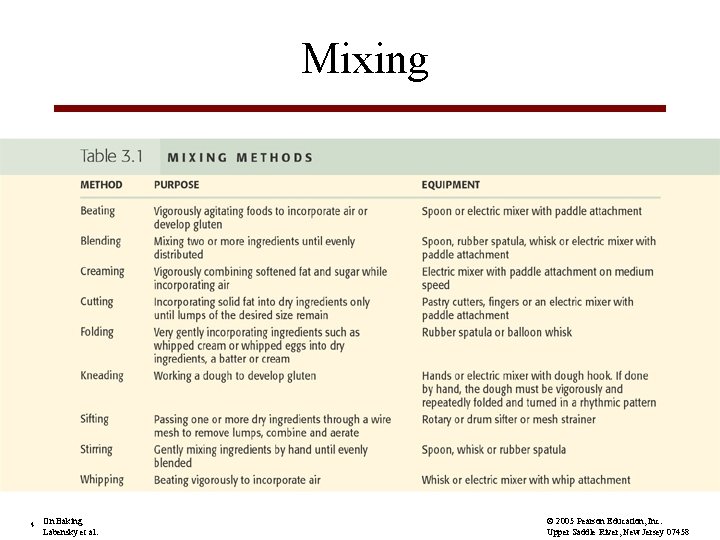
Mixing 4 On Baking Labensky et al. © 2005 Pearson Education, Inc. Upper Saddle River, New Jersey 07458
Cooking Methods • Dry-heat cooking uses air or fat and is the principal method to cook: – batter – dough • Moist heat uses water or steam for cooking: – fruits – tenderizing foods – reducing liquids 5 On Baking Labensky et al. © 2005 Pearson Education, Inc. Upper Saddle River, New Jersey 07458
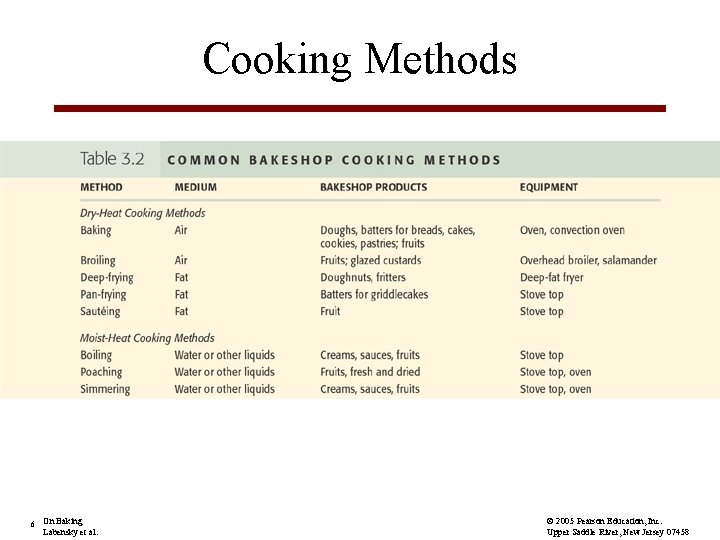
Cooking Methods 6 On Baking Labensky et al. © 2005 Pearson Education, Inc. Upper Saddle River, New Jersey 07458
The Baking Process • Batters and dough pass through 9 stages during the baking process: – – – – – 7 On Baking Labensky et al. Gasses form Gasses are trapped Starches gelatinize Proteins coagulate Fats melt Water evaporates Sugars caramelize Carryover baking Staling © 2005 Pearson Education, Inc. Upper Saddle River, New Jersey 07458
NSF Rating • National Sanitation Foundation, or NSF, sets standards for tools, cookware and equipment, requiring: – Easily cleanable equipment – Food contact surfaces nontoxic, nonabsorbent, corrosion resistant, nonreactive and smooth – Internal corners rounded and smooth; external corners smooth and sealed – Coating nontoxic, easily cleaned, resist chipping – Waste and waste liquids must be easily removed 8 On Baking Labensky et al. © 2005 Pearson Education, Inc. Upper Saddle River, New Jersey 07458
Tools and Equipment • Hand tools aid in cutting, moving or combining foods • They have few, if any, moving parts – Spatulas – Dough scrapers – Whisks – Tongs – Cutters 9 On Baking Labensky et al. © 2005 Pearson Education, Inc. Upper Saddle River, New Jersey 07458
Tools and Equipment • Other equipment used in the bakeshop: – Graters – Pastry brushes – Rolling pins 10 On Baking Labensky et al. © 2005 Pearson Education, Inc. Upper Saddle River, New Jersey 07458
Tools and Equipment • Knives should be easily sharpened, well constructed, comfortable and balanced. • Metals used for knives are: – Carbon steel – Stainless steel – High-carbon stainless steel – Ceramic 11 On Baking Labensky et al. © 2005 Pearson Education, Inc. Upper Saddle River, New Jersey 07458
Tools and Equipment • Shapes are: – French, or chef’s – Utility – Paring – Bread/cake – Lame or bread slasher 12 On Baking Labensky et al. © 2005 Pearson Education, Inc. Upper Saddle River, New Jersey 07458
Measuring and Pouring Devices • Precise measuring is critical in the bakeshop. • Measurement may be based upon weight or volume. Tools are: – – – 13 On Baking Labensky et al. Scales Cups and spoons Ladles Portion scoops Thermometers Timers © 2005 Pearson Education, Inc. Upper Saddle River, New Jersey 07458
Cookware and Bakeware • The most versatile materials are copper, aluminum and stainless steel. Cookware: – Pots – Pans • Bakeware shapes or holds batters: – – – 14 On Baking Labensky et al. Sheet pans Hotel pans Tart pans Cake pans Molds © 2005 Pearson Education, Inc. Upper Saddle River, New Jersey 07458
Strainers and Sieves • Aerate dry ingredients or drain cooked foods – – China cap Skimmer and spider Cheesecloth Food mill and flour sifter • Decorating and finishing tools decorate cakes and pastries – Pastry bags – Dispensing tips for the pastry bags – Cake combs 15 On Baking Labensky et al. © 2005 Pearson Education, Inc. Upper Saddle River, New Jersey 07458
Processing Equipment • Electrical and nonelectrical devices to chop, puree, slice, grind or mix – Slicers – Mandoline – Food processor – Blender – Immersion blender – Mixer – Juicer 16 On Baking Labensky et al. © 2005 Pearson Education, Inc. Upper Saddle River, New Jersey 07458
Heavy Equipment • Ovens are enclosed spaces where food is cooked by hot air – Wood burning – Microwave – Cook stoves – Broiler, salamander and blowtorch are used for top browning – Deep-fat fryers are for doughnuts – Proof boxes store dough before baking 17 On Baking Labensky et al. © 2005 Pearson Education, Inc. Upper Saddle River, New Jersey 07458
Heavy Equipment • Refrigerators and freezers store foods at low temperatures. • Sheeters roll dough • Dishwashers clean bakeware and cookware. • Work surfaces are usually stainless steel; storage takes place in high-density plastic. 18 On Baking Labensky et al. © 2005 Pearson Education, Inc. Upper Saddle River, New Jersey 07458
Safety Equipment • Should consist of: – Fire extinguishers – Ventilation systems – First-aid kits 19 On Baking Labensky et al. © 2005 Pearson Education, Inc. Upper Saddle River, New Jersey 07458
Professional Bakeshop • The task of baking is divided into four stages: – Measuring and mixing of ingredients – Makeup of the product before baking – Baking – Final assembly 20 On Baking Labensky et al. © 2005 Pearson Education, Inc. Upper Saddle River, New Jersey 07458
- Slides: 20