
Chapter 3 Preschool Years Verb forms Tense Regularization
Chapter 3 Preschool Years
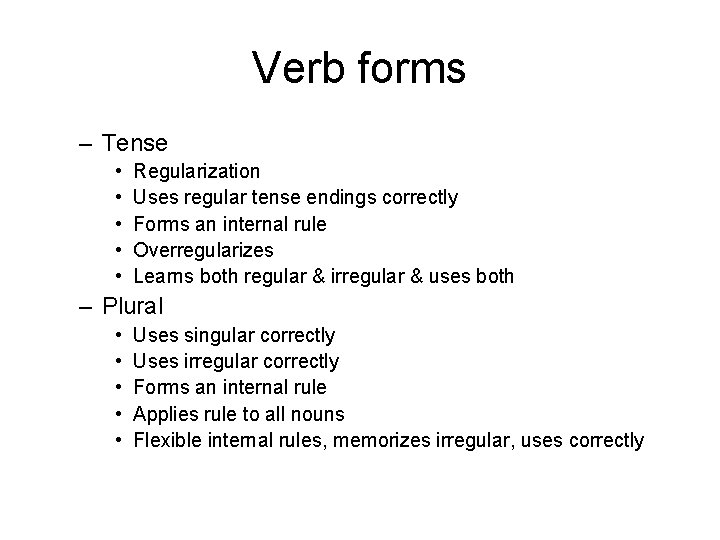
Verb forms – Tense • • • Regularization Uses regular tense endings correctly Forms an internal rule Overregularizes Learns both regular & irregular & uses both – Plural • • • Uses singular correctly Uses irregular correctly Forms an internal rule Applies rule to all nouns Flexible internal rules, memorizes irregular, uses correctly
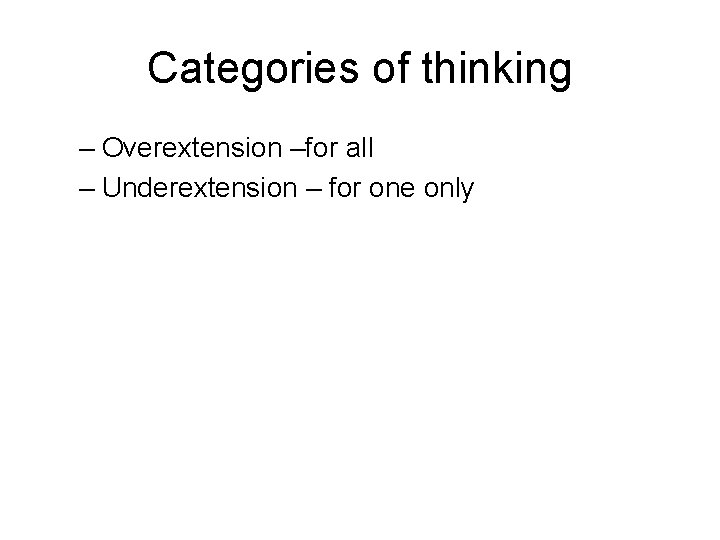
Categories of thinking – Overextension –for all – Underextension – for one only
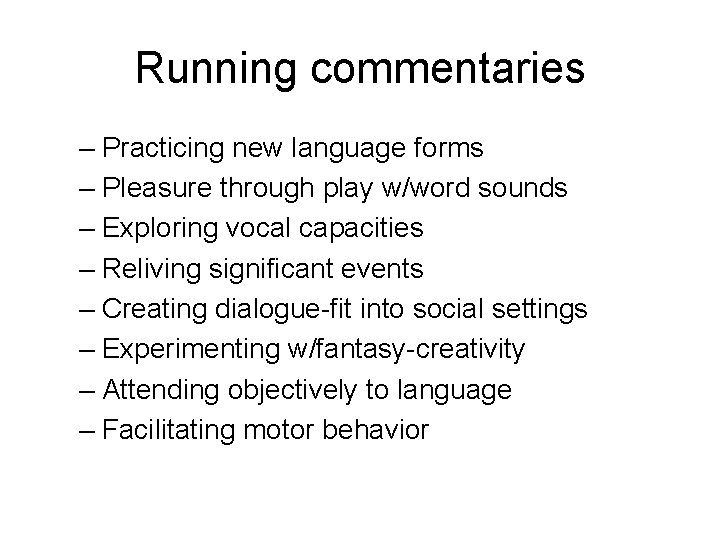
Running commentaries – Practicing new language forms – Pleasure through play w/word sounds – Exploring vocal capacities – Reliving significant events – Creating dialogue-fit into social settings – Experimenting w/fantasy-creativity – Attending objectively to language – Facilitating motor behavior
Older Preschoolers (4 -5) • Social conversation – Gaining attention-eye contact, touching, using catch phrases – Pausing & listening – Correcting himself – Maintaining attention by not pausing – Taking turns in conversation • Friendships
• Group play – Verbally suggest play theme – Engage in verbal negotiation – Compromise – Argue – Become leader by using right words • Inner speech (unspoken) • Conventions of conversation
• Relational words – Space, size, time, number • Speech & behavior – – – Volume Tone Mimic “bad guy” Echoing, baby talk Silence Friends, meet needs • Impact words – Name-calling, etc. (pragmatics)
• • Sound words Created words Word meaning Reality & nonsense – Language play (humor=incongruity) • Speech & intelligence
• Common speech patterns – – – – Rhyme Self-chatter Errors Longer, more complex sentences Articulation - omissions & substitutions Transform questions Stutter • Metalinguistic awareness – Nature as language as an object – Puns, metaphors, irony
• Brain – 4 -12 3 rd critical restructuring – keep or eliminate connections
- Slides: 10