
Chapter 3 Population Dynamics In the past two
- Slides: 44
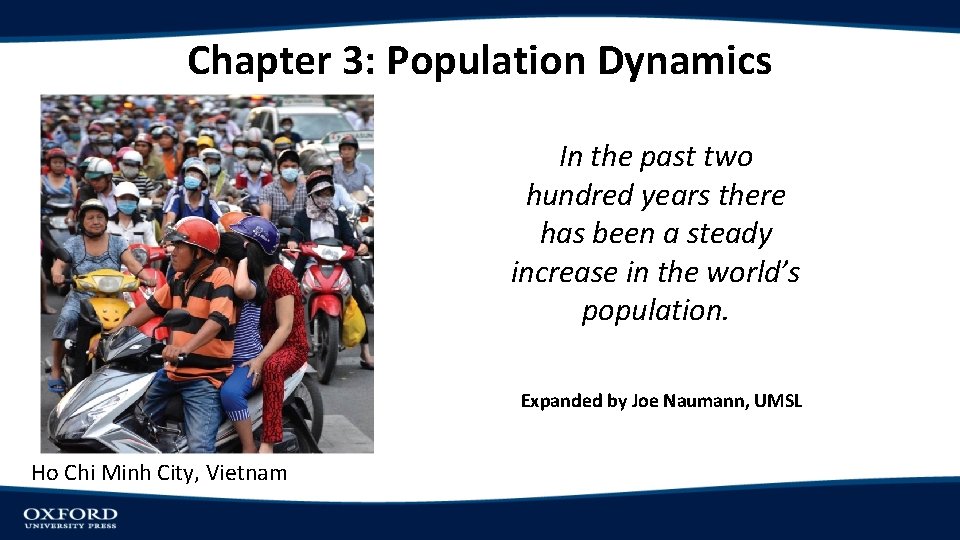
Chapter 3: Population Dynamics In the past two hundred years there has been a steady increase in the world’s population. Expanded by Joe Naumann, UMSL Ho Chi Minh City, Vietnam
Chapter Learning Objectives • Describe the historical factors that trigger major population changes. • Describe the main trends of world population change with associated economic and cultural impacts. • Identify the four phases of the demographic transition. • Explain the social and economic concerns that accompany each stage of the demographic transition. • Relate current global cultural and political occurrences to contemporary population geographies.
3 • Definition of Demography – Statistical analysis of human population • Spatial Density – Humans are quite unevenly distributed over the Earth’s surface – Population densities range from zero to over 2, 000 people per square mile • What is studied? – Fertility – Gender – Health – Age – Nutrition – Mortality – Migration
4 Density and Distribution • Population distribution and density – Uneven population distribution by continent – Density divided into categories also uneven within a country – Density does not indicate standard of living, overpopulation, or under population – Physiological density difficult to measure • More useful than the arithmetic density • Agricultural Density better for comparing countries – Shifting population densities • Migrations
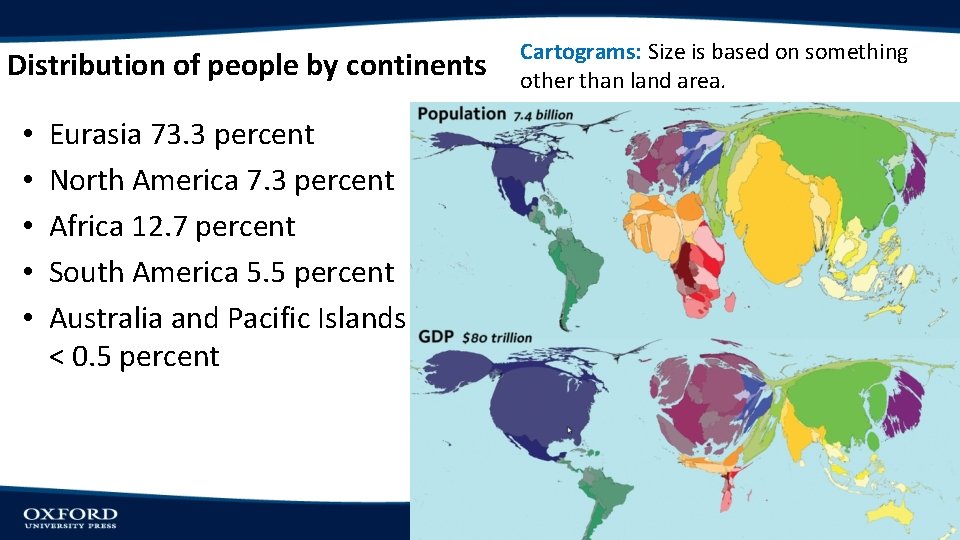
Distribution of people by continents • • • Eurasia 73. 3 percent North America 7. 3 percent Africa 12. 7 percent South America 5. 5 percent Australia and Pacific Islands < 0. 5 percent Cartograms: Size is based on something other than land area.
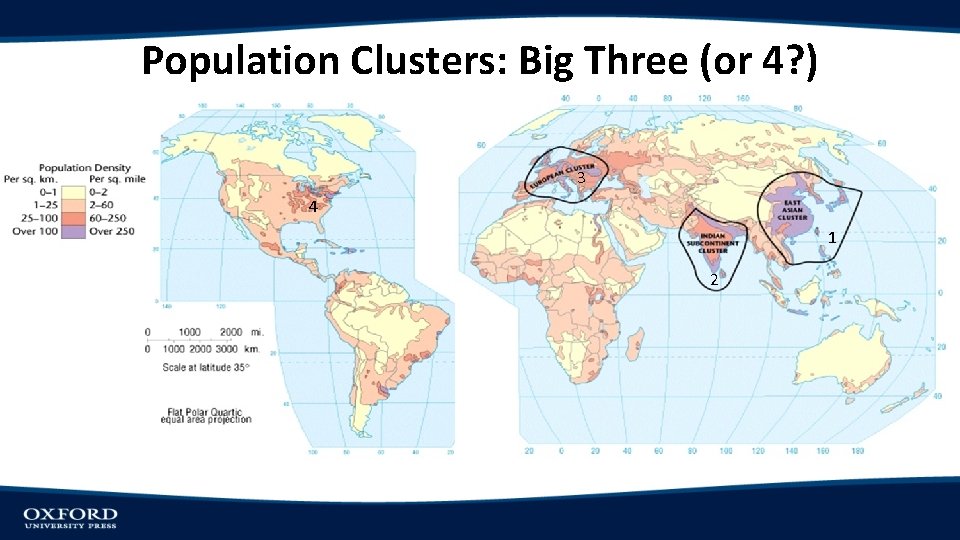
Population Clusters: Big Three (or 4? ) 3 4 1 2
7 Also study the spatial variation of other demographic qualities • • Birthrate differences Death rates Overpopulation Sex ratios Age groups Crime Quality of life Human mobility
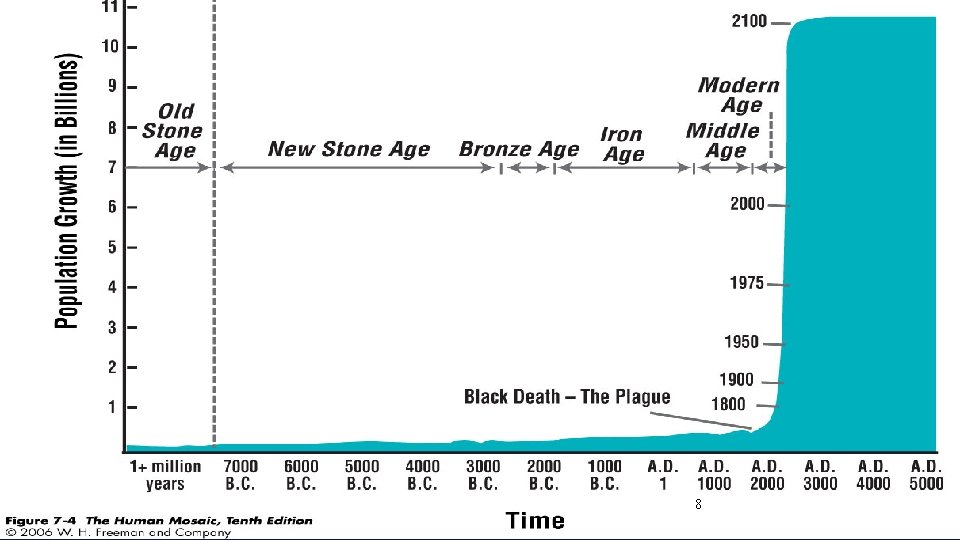
8
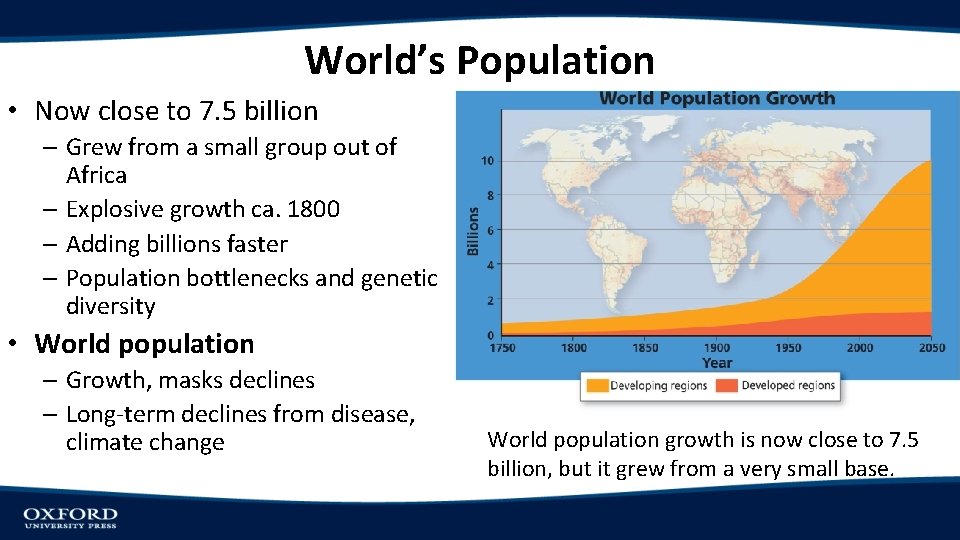
World’s Population • Now close to 7. 5 billion – Grew from a small group out of Africa – Explosive growth ca. 1800 – Adding billions faster – Population bottlenecks and genetic diversity • World population – Growth, masks declines – Long-term declines from disease, climate change World population growth is now close to 7. 5 billion, but it grew from a very small base.
Population Declines DISEASE • Pandemic occurs on a wide geographic scale – 3 major past pandemics • Bubonic plague hit as waves across the world in 6 -8 th centuries – Spread along trade routes – Mass death created social confusion
Population Declines DISEASE • “Black Death” in Asia, North Africa, Europe in 14 th century – Rapid population loss – Switch from arable agriculture to pastoral farming – Peasants’ Revolt • Columbian Encounter of Europeans in the Americas (Columbian Exchange) – Devastation to indigenous populations from disease – “Pristine Myth” of North America’s wilderness
Population Declines CLIMATE CHANGE • Agricultural productivity – Humans more reliant, so declines in output, decrease population • Little Ice Age of 17 th century – Food shortages and population decrease URBANIZATION/INDUSTRIALIZATION (developed countries) • Two working parents & desire for much higher material lifestyle – Children seen as a financial liability – Total Fertility Rate of most developed countries is below 2. 1 (needed to keep a population stable (neither shrinking nor growing)
The Reproductive Revolution • Patriarchy (agriculture based)and reproductive efficiency – High infant mortality rates and low life expectancy – Role of women – subservient – Children, particularly males, seen as helpful laborers • Demographic transition – Increased efficiency of reproduction and birth control – Calls into question the basis of patriarchy – Urbanization/Industrialization • Educated, working women • Children are a financial liability rather than an economic asset (helpful laborers)
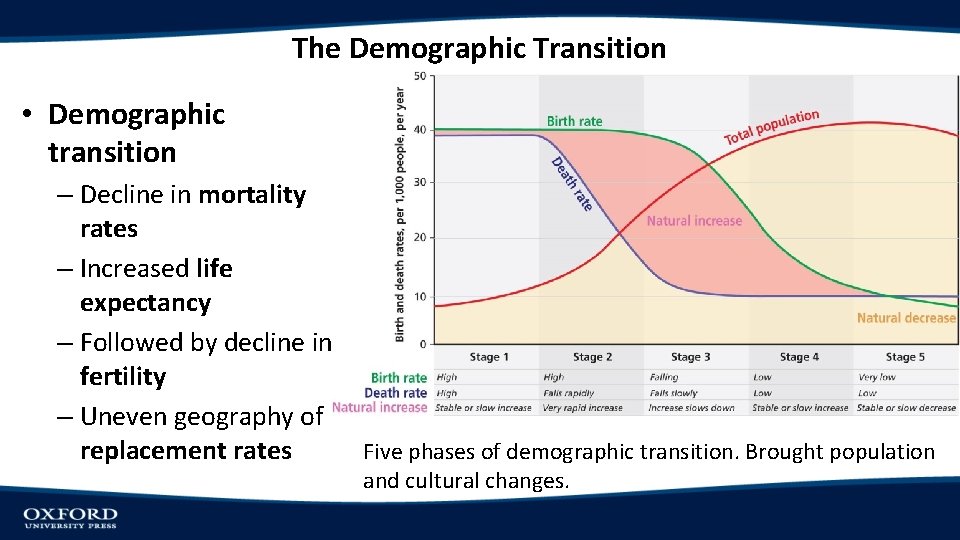
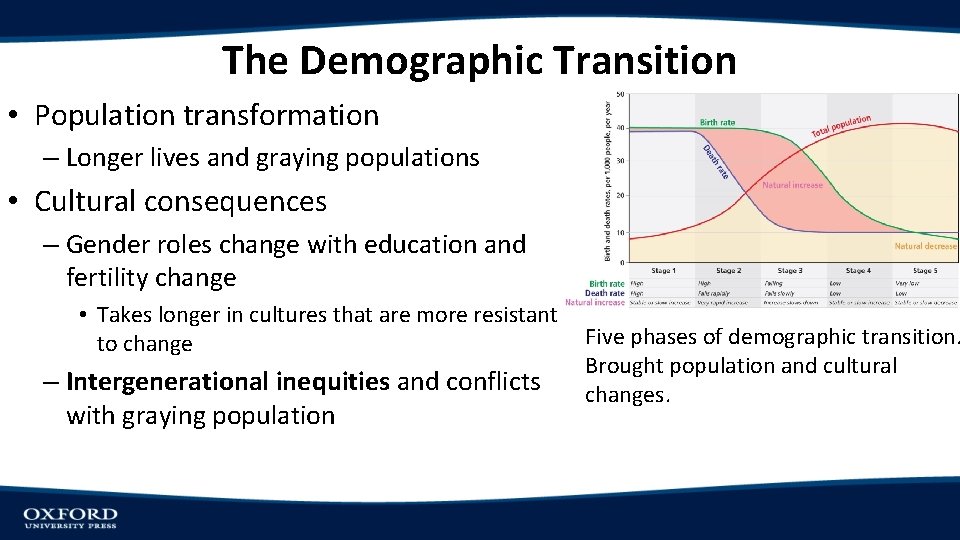
The Demographic Transition • Demographic transition – Decline in mortality rates – Increased life expectancy – Followed by decline in fertility – Uneven geography of replacement rates Five phases of demographic transition. Brought population and cultural changes.
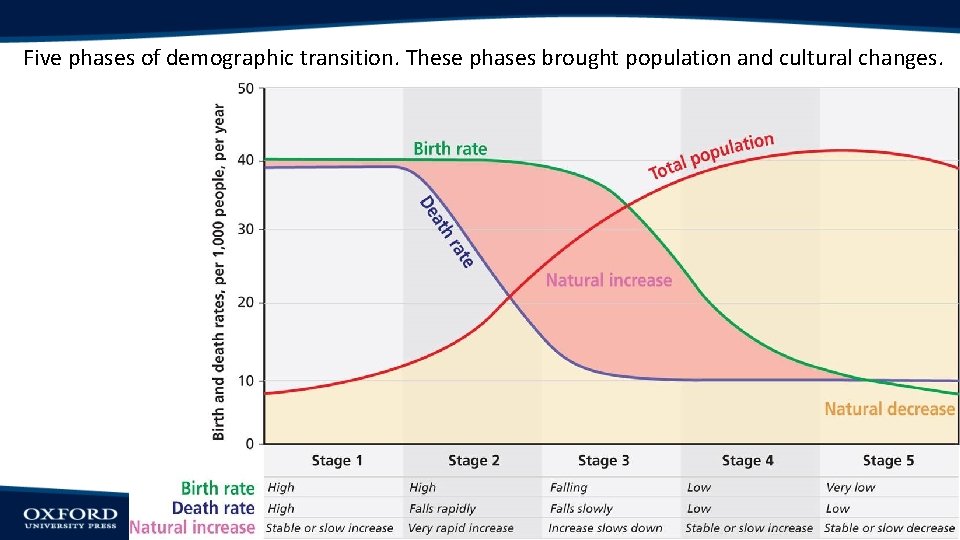
Five phases of demographic transition. These phases brought population and cultural changes.
Demographic Base of the Celtic Tiger • Demography of Ireland – Steady increases until peak in 1840 – Population plummets from Great Famine, emigration, low births – Availability of contraception – Demographic dividend – Economic growth but hit hard by recession
The Demographic Transition • Population transformation – Longer lives and graying populations • Cultural consequences – Gender roles change with education and fertility change • Takes longer in cultures that are more resistant to change – Intergenerational inequities and conflicts with graying population Five phases of demographic transition. Brought population and cultural changes.
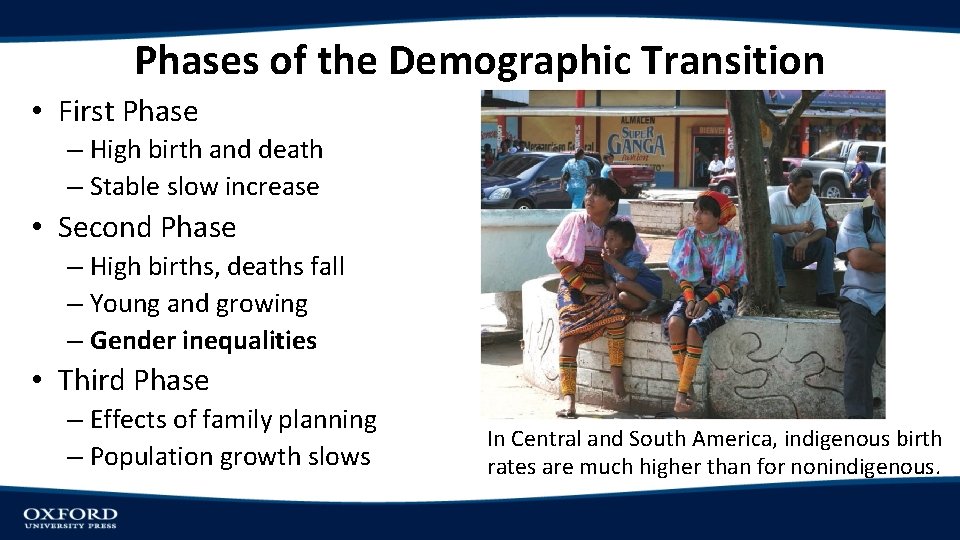
Phases of the Demographic Transition • First Phase – High birth and death – Stable slow increase • Second Phase – High births, deaths fall – Young and growing – Gender inequalities • Third Phase – Effects of family planning – Population growth slows In Central and South America, indigenous birth rates are much higher than for nonindigenous.
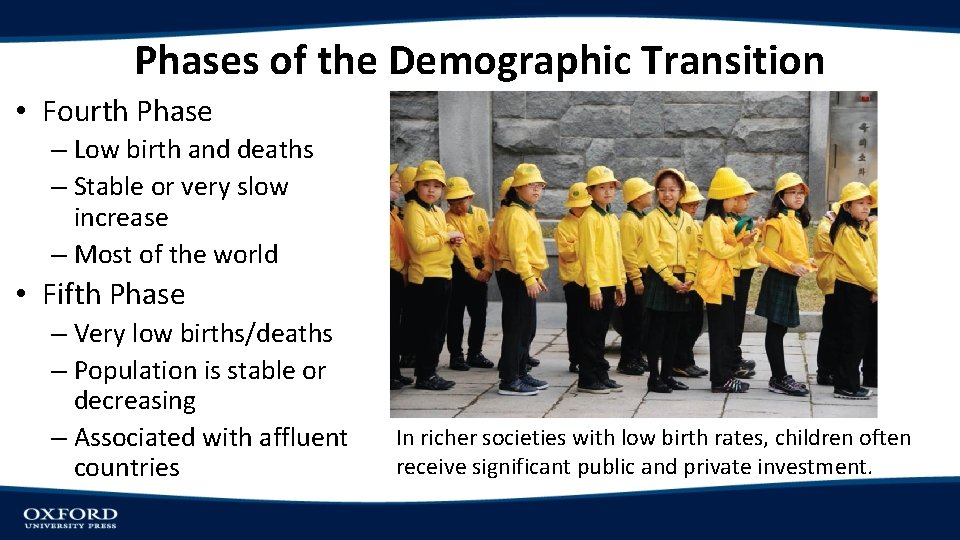
Phases of the Demographic Transition • Fourth Phase – Low birth and deaths – Stable or very slow increase – Most of the world • Fifth Phase – Very low births/deaths – Population is stable or decreasing – Associated with affluent countries In richer societies with low birth rates, children often receive significant public and private investment.
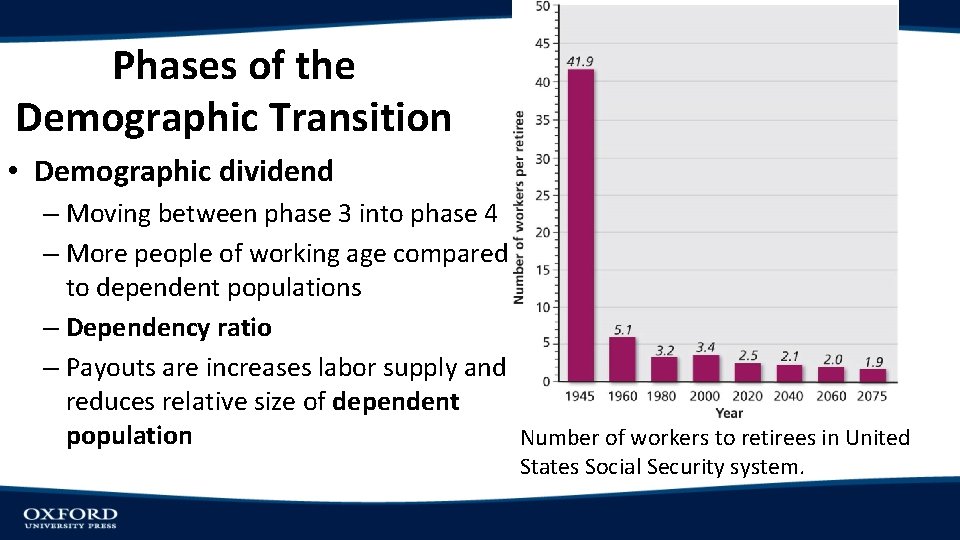
Phases of the Demographic Transition • Demographic dividend – Moving between phase 3 into phase 4 – More people of working age compared to dependent populations – Dependency ratio – Payouts are increases labor supply and reduces relative size of dependent population Number of workers to retirees in United States Social Security system.
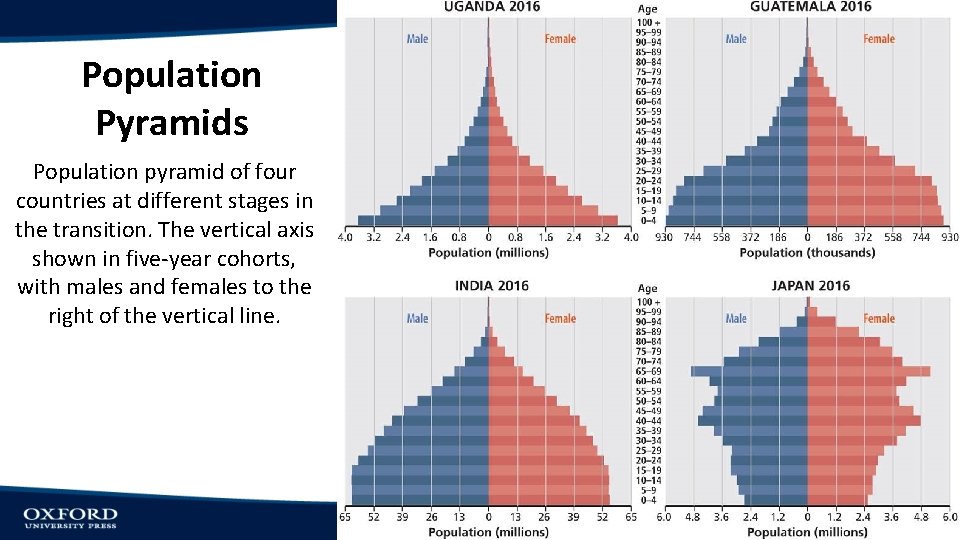
Population Pyramids Population pyramid of four countries at different stages in the transition. The vertical axis shown in five-year cohorts, with males and females to the right of the vertical line.
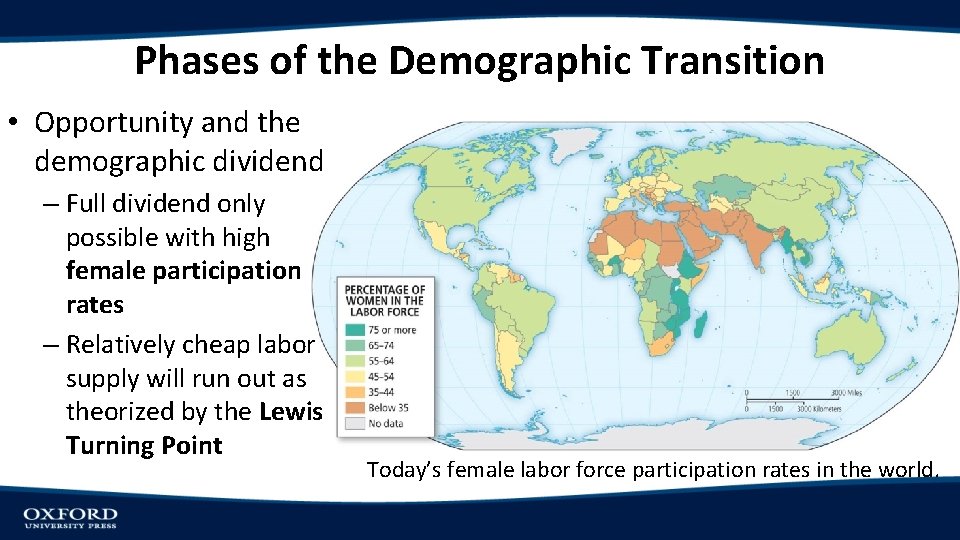
Phases of the Demographic Transition • Opportunity and the demographic dividend – Full dividend only possible with high female participation rates – Relatively cheap labor supply will run out as theorized by the Lewis Turning Point Today’s female labor force participation rates in the world.
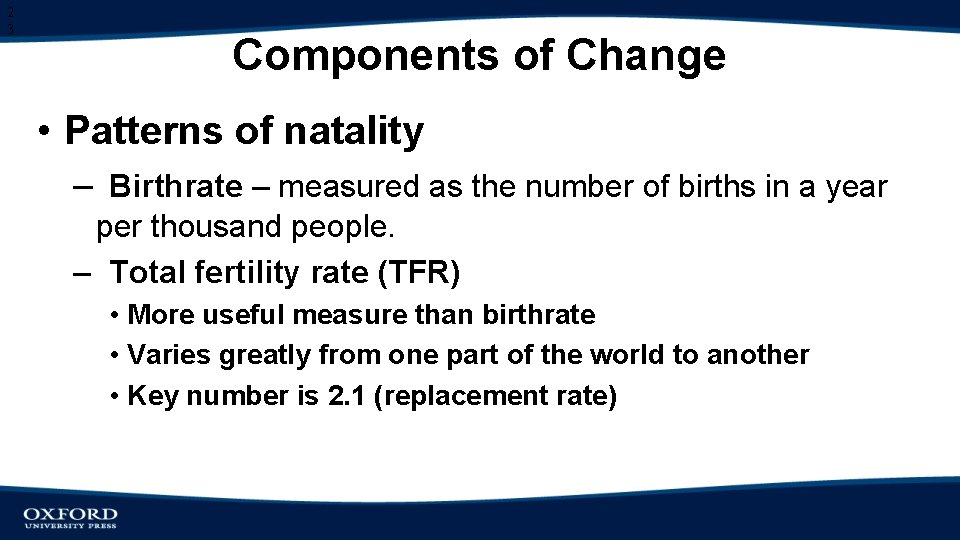
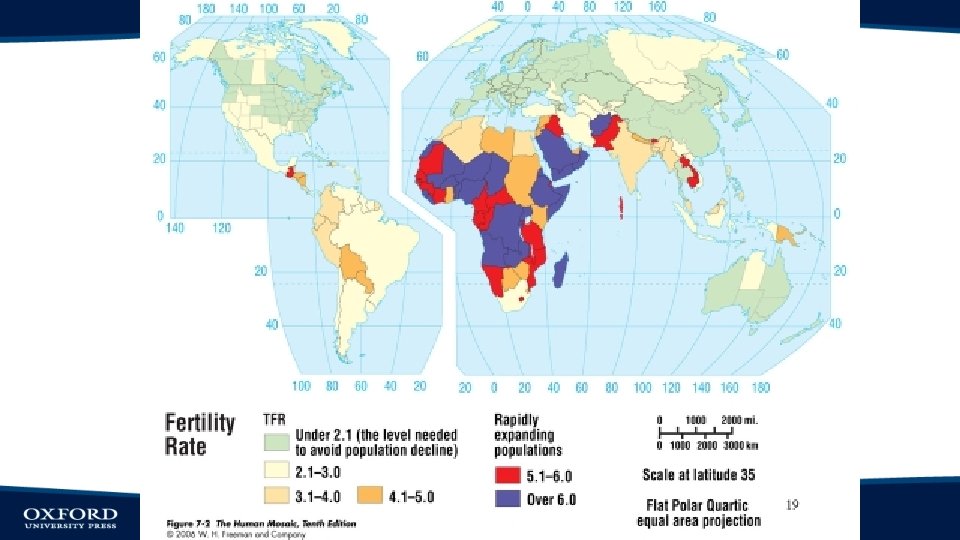
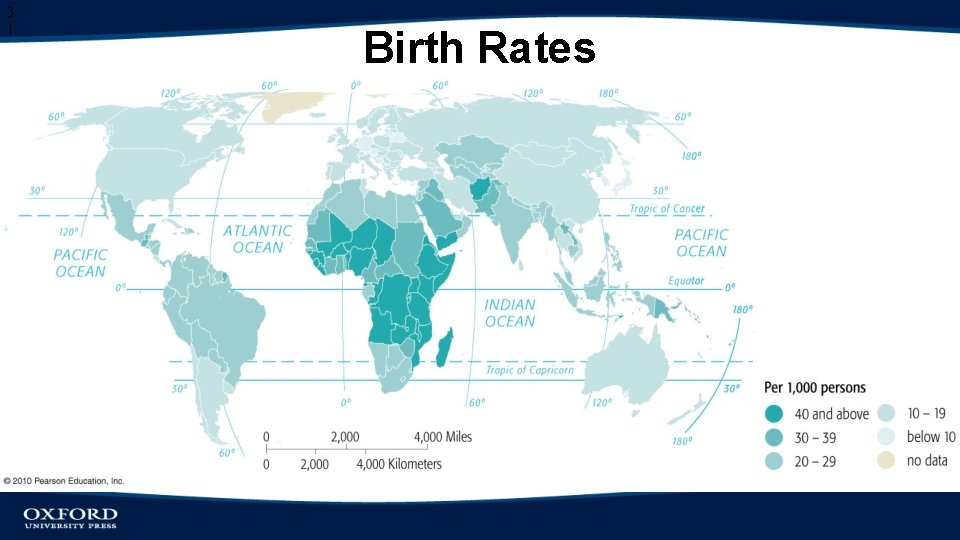
2 3 Components of Change • Patterns of natality – Birthrate – measured as the number of births in a year per thousand people. – Total fertility rate (TFR) • More useful measure than birthrate • Varies greatly from one part of the world to another • Key number is 2. 1 (replacement rate)
Brazil and the Demographic Dividend • Brazil’s growth – 1872: 10 million – 2016: 209 million • Demographic transition – Birth decline with more family planning with urbanization and secularization • Demographic dividend since 1970 – Increased democratization and social welfare programs – Ageing just starting
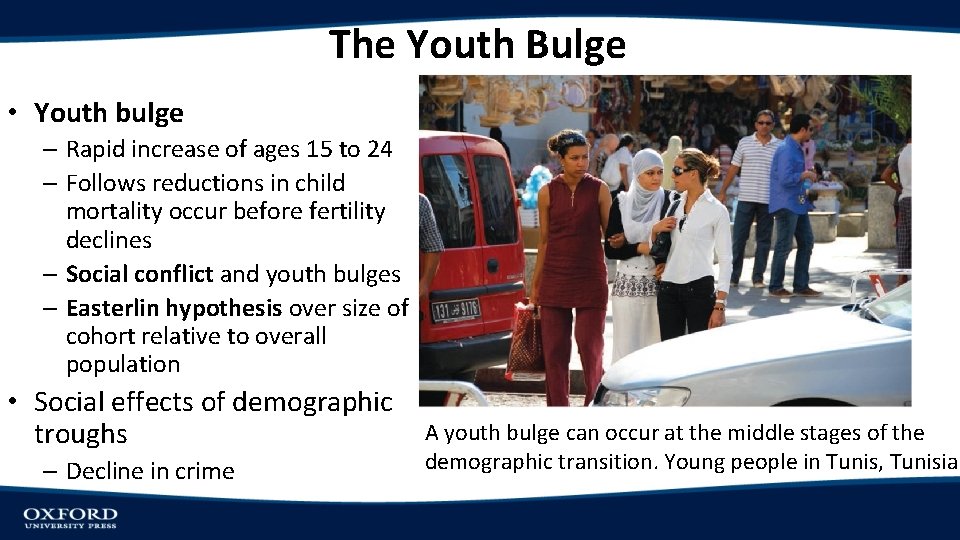
The Youth Bulge • Youth bulge – Rapid increase of ages 15 to 24 – Follows reductions in child mortality occur before fertility declines – Social conflict and youth bulges – Easterlin hypothesis over size of cohort relative to overall population • Social effects of demographic troughs – Decline in crime A youth bulge can occur at the middle stages of the demographic transition. Young people in Tunis, Tunisia.
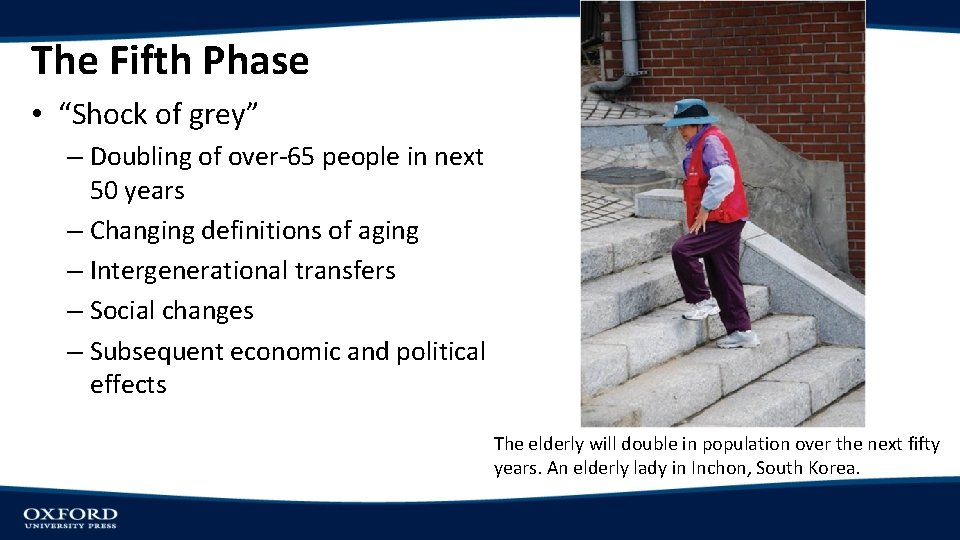
The Fifth Phase • “Shock of grey” – Doubling of over-65 people in next 50 years – Changing definitions of aging – Intergenerational transfers – Social changes – Subsequent economic and political effects The elderly will double in population over the next fifty years. An elderly lady in Inchon, South Korea.
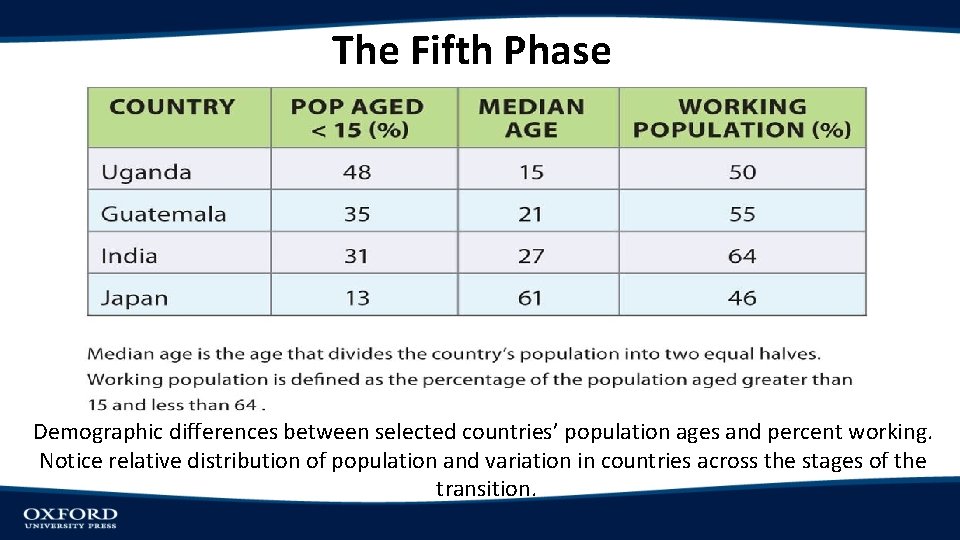
The Fifth Phase Demographic differences between selected countries’ population ages and percent working. Notice relative distribution of population and variation in countries across the stages of the transition.
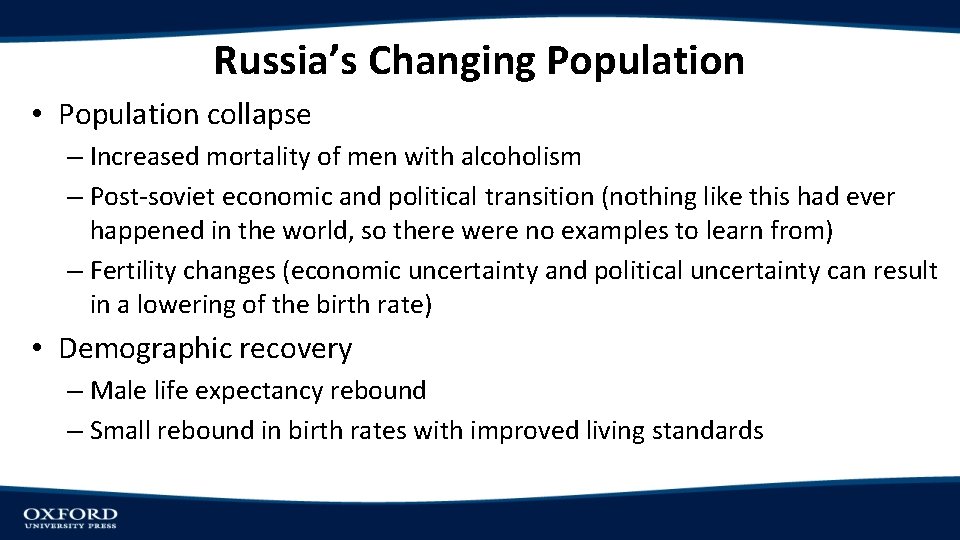
Russia’s Changing Population • Population collapse – Increased mortality of men with alcoholism – Post-soviet economic and political transition (nothing like this had ever happened in the world, so there were no examples to learn from) – Fertility changes (economic uncertainty and political uncertainty can result in a lowering of the birth rate) • Demographic recovery – Male life expectancy rebound – Small rebound in birth rates with improved living standards
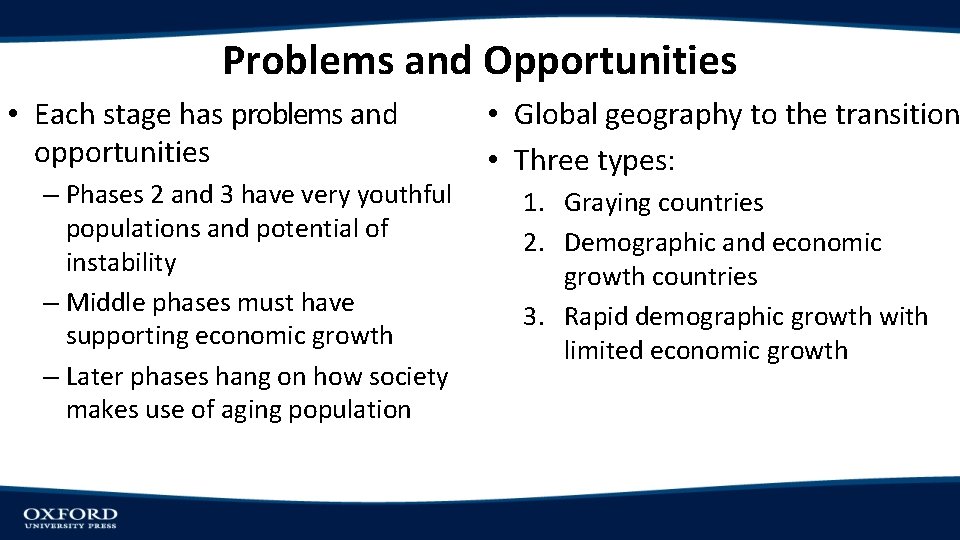
Problems and Opportunities • Each stage has problems and opportunities – Phases 2 and 3 have very youthful populations and potential of instability – Middle phases must have supporting economic growth – Later phases hang on how society makes use of aging population • Global geography to the transition • Three types: 1. Graying countries 2. Demographic and economic growth countries 3. Rapid demographic growth with limited economic growth
3 1 Birth Rates
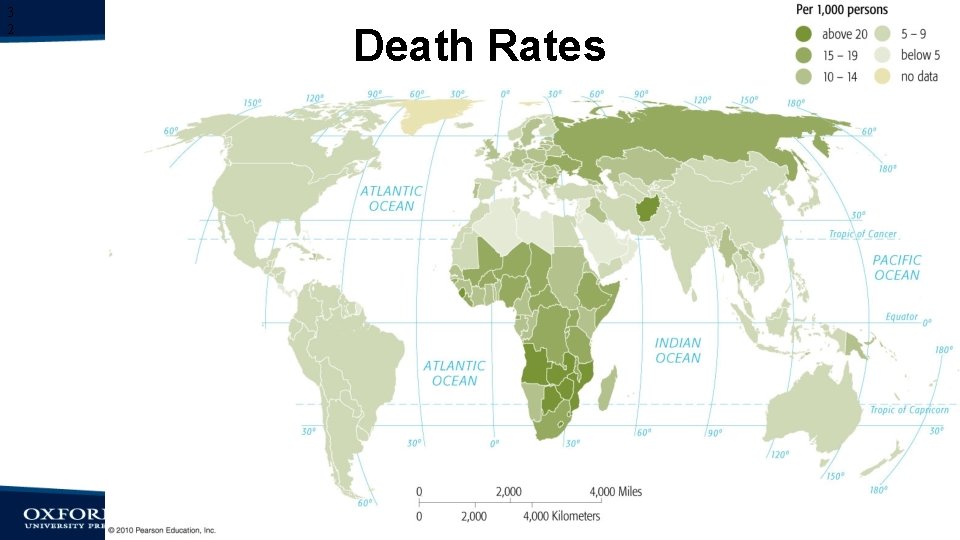
3 2 Death Rates
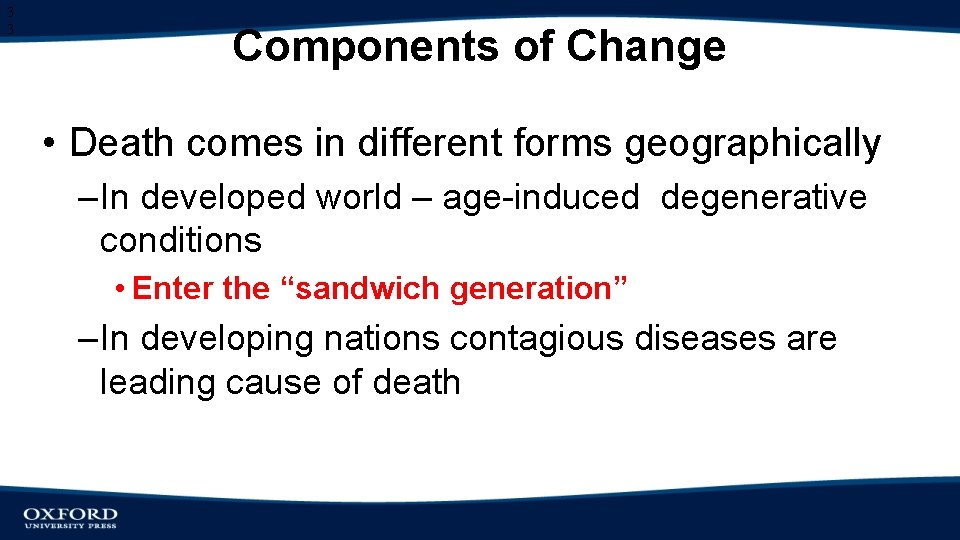
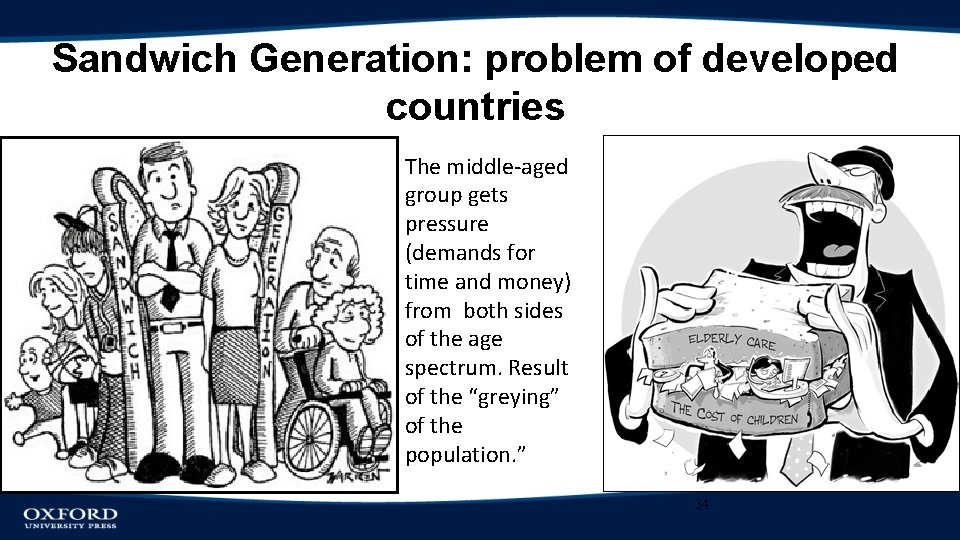
3 3 Components of Change • Death comes in different forms geographically – In developed world – age-induced degenerative conditions • Enter the “sandwich generation” – In developing nations contagious diseases are leading cause of death
Sandwich Generation: problem of developed countries The middle-aged group gets pressure (demands for time and money) from both sides of the age spectrum. Result of the “greying” of the population. ” 34
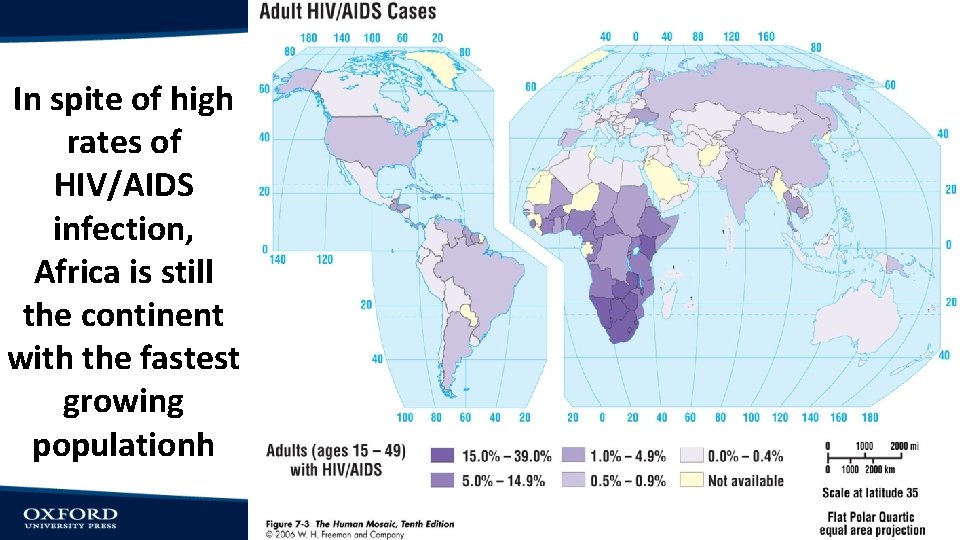
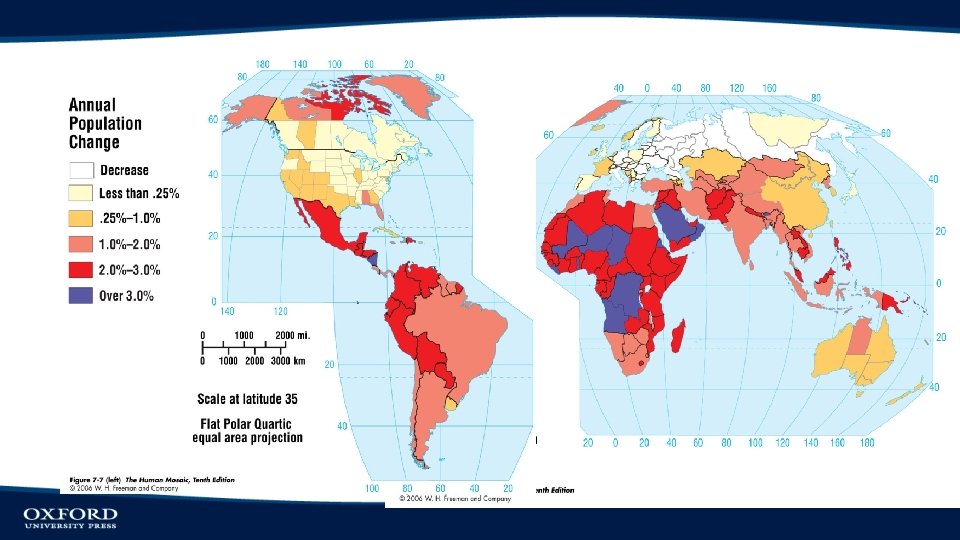
In spite of high rates of HIV/AIDS infection, Africa is still the continent with the fastest growing populationh
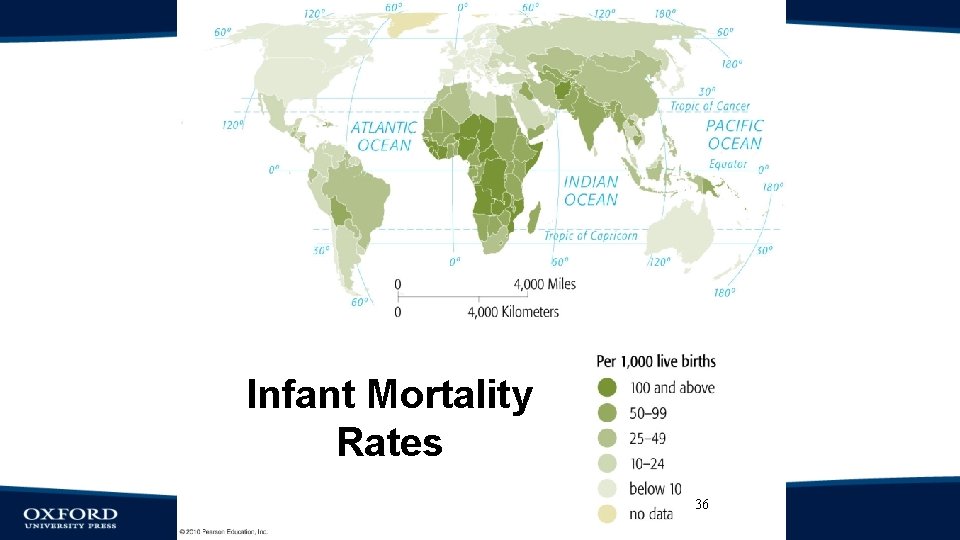
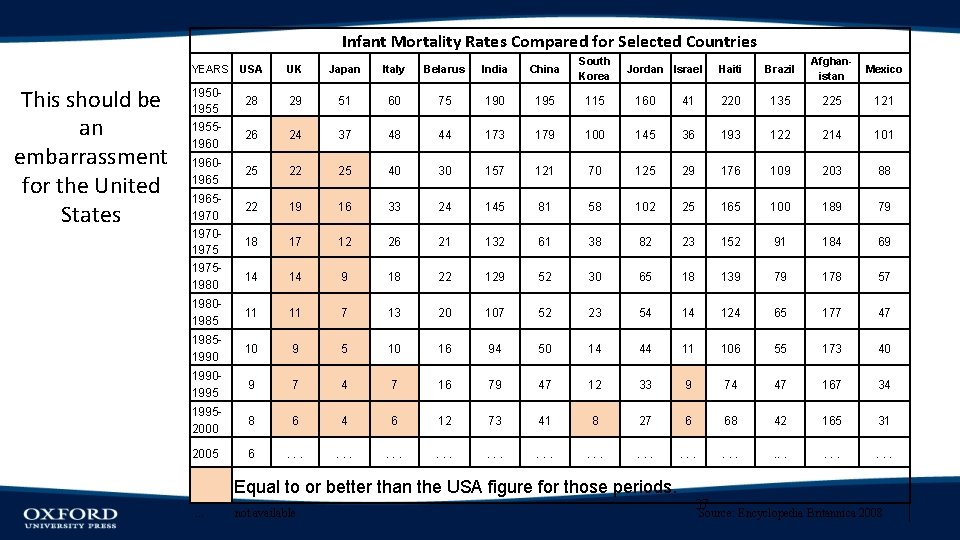
Infant Mortality Rates 36
Infant Mortality Rates Compared for Selected Countries This should be an embarrassment for the United States YEARS USA UK Japan Italy Belarus India China South Korea Haiti Brazil Afghanistan Mexico 19501955 28 29 51 60 75 190 195 115 160 41 220 135 225 121 19551960 26 24 37 48 44 173 179 100 145 36 193 122 214 101 19601965 25 22 25 40 30 157 121 70 125 29 176 109 203 88 19651970 22 19 16 33 24 145 81 58 102 25 165 100 189 79 19701975 18 17 12 26 21 132 61 38 82 23 152 91 184 69 19751980 14 14 9 18 22 129 52 30 65 18 139 79 178 57 19801985 11 11 7 13 20 107 52 23 54 14 124 65 177 47 19851990 10 9 5 10 16 94 50 14 44 11 106 55 173 40 19901995 9 7 4 7 16 79 47 12 33 9 74 47 167 34 19952000 8 6 4 6 12 73 41 8 27 6 68 42 165 31 2005 6 . . Jordan Israel Equal to or better than the USA figure for those periods. . not available 37 Source: Encyclopedia Britannica 2008
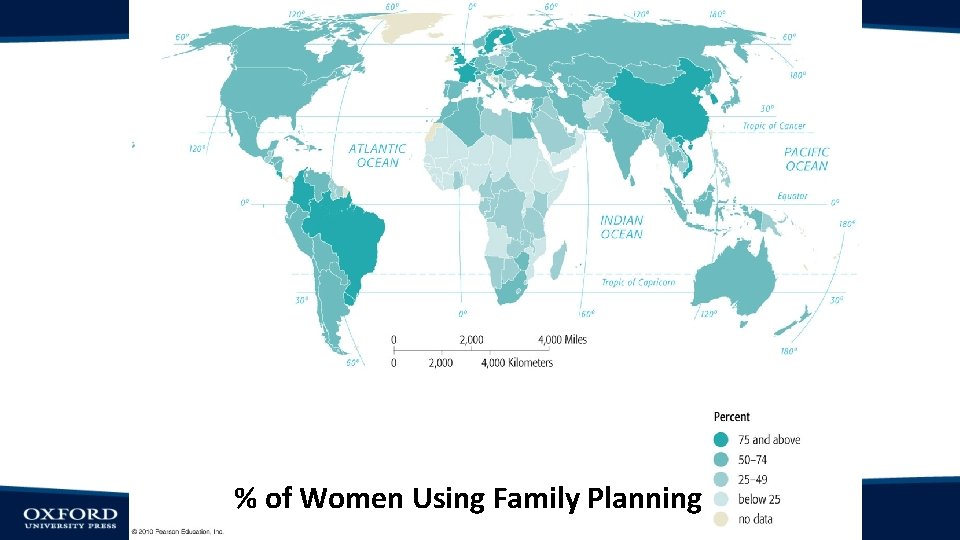
% of Women Using Family Planning
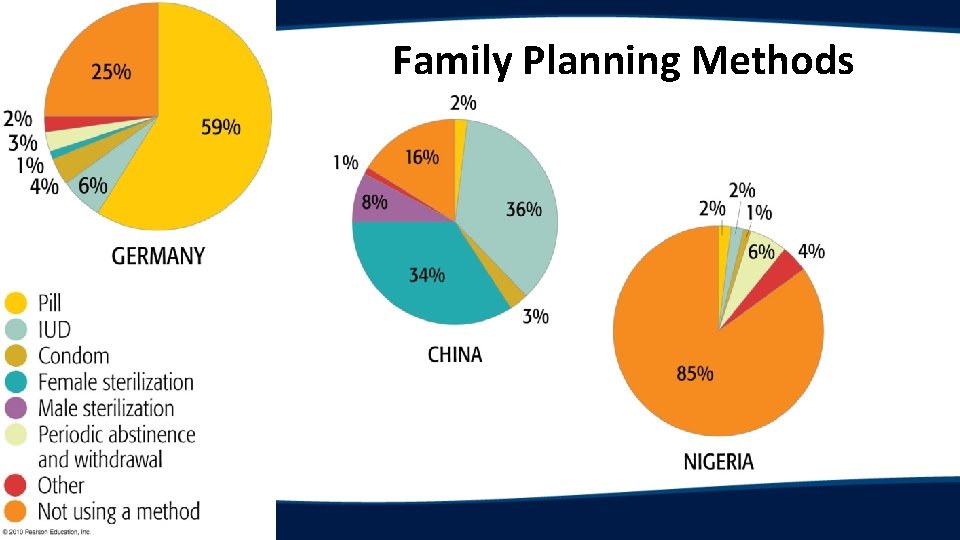
Family Planning Methods
Chapter Summary • Earth began with relatively small human population that left Africa to populate the world, population explosion occurred in 19 -20 th century. • Three major pandemics had social effects: bubonic plague impeded growth yet led to technological advances; the “Black Death” swept over most of the world and killed up to half population; and Columbian Encounter reduced indigenous populations in the Americas up to 90 percent. • Population levels influenced by long-term climate changes, particularly as humans are more dependent on agricultural productivity. • Demographic transition resulted in declining mortality rates, improved health, increased life expectancies and economic productivity.
Chapter Summary • More reliable birth control methods led to lower birth rates; changes household economies so that children were seen as dependents, not workers. • Major demographic shift toward older populations, especially in richer countries. With aging population, intergenerational inequities and conflicts can become more pronounced. • During the transition, richer countries have increased life expectancies and lower births, poorer countries increase life expectancy but with slower declines in birth rates. Results in complex patterns of demographic regimes across the world. • Four distinct phases of demographic transition: 1) high births and fluctuating deaths; 2) declining death and birth rates; 3) birth rates declining; 4) low births and high life expectancy.
Chapter Summary • Demographic dividend with more younger and productive workers increases labor supply relative to those who are dependent, allowing for more investments. Supported strong economic performance and growth of several countries in last 20 years. Full dividend only possible if female participation rates are high. • In early and middle stages of transition, youth bulge can appear and may bring social conflict. • Later stages may bring another demographic dividend from older populations, greater reliance on immigration, and disconnects between marriage and children. • Each stage creates problems and opportunities: demographic ratio; demographic dividends; high dependency; need for increased immigration; cultural and political debates.
Chapter Summary • A distinct global geography is created by the demographic transition, resulting in three types of countries: aging countries, demographic and economic growth countries, and demographic growth countries with limited economic growth opportunities. • Demographic changes are at the heart of some of the most profound cultural transformations and intense political debates occurring around the world.