
Chapter 3 Plate Tectonics a Unifying Theory Discovering
- Slides: 48
Chapter 3 Plate Tectonics — a Unifying Theory
Discovering Plate Boundaries • Classified boundaries based on OBSERVATIONS of PATTERNS: – Topographic expression – Seismicity - distribution and depth of earthquakes – Volcanology - distribution of volcanoes – Age of the sea floor • terra. rice. edu/plateboundary/
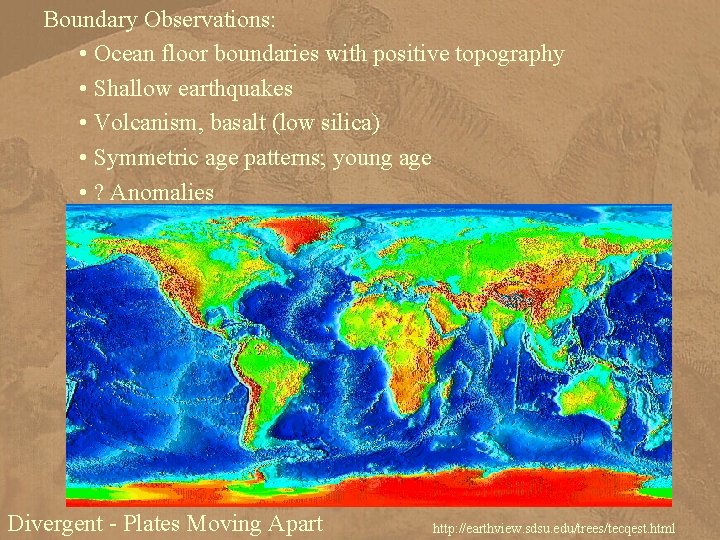
Boundary Observations: • Ocean floor boundaries with positive topography • Shallow earthquakes • Volcanism, basalt (low silica) • Symmetric age patterns; young age • ? Anomalies Divergent - Plates Moving Apart http: //earthview. sdsu. edu/trees/tecqest. html
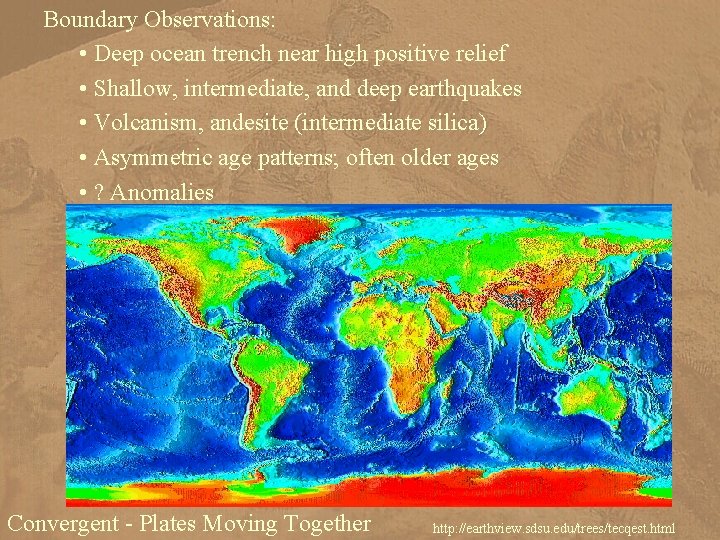
Boundary Observations: • Deep ocean trench near high positive relief • Shallow, intermediate, and deep earthquakes • Volcanism, andesite (intermediate silica) • Asymmetric age patterns; often older ages • ? Anomalies Convergent - Plates Moving Together http: //earthview. sdsu. edu/trees/tecqest. html
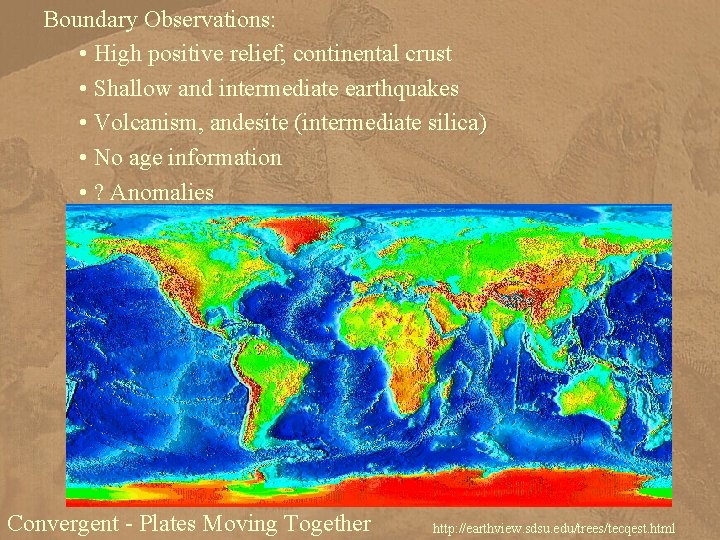
Boundary Observations: • High positive relief; continental crust • Shallow and intermediate earthquakes • Volcanism, andesite (intermediate silica) • No age information • ? Anomalies Convergent - Plates Moving Together http: //earthview. sdsu. edu/trees/tecqest. html
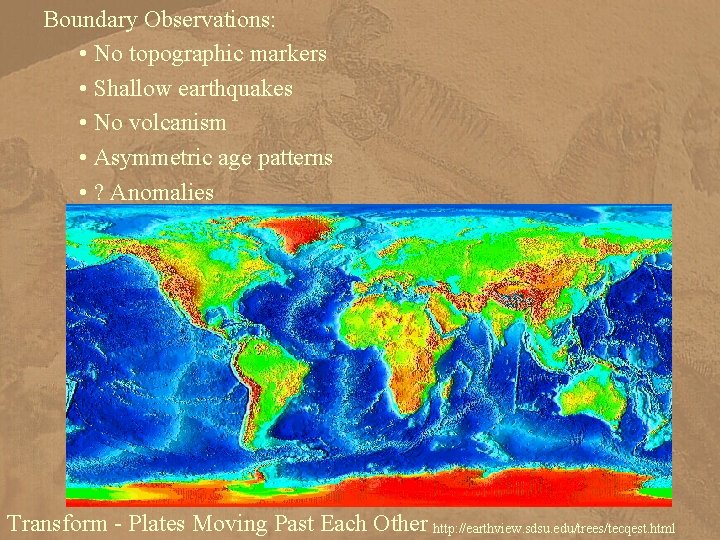
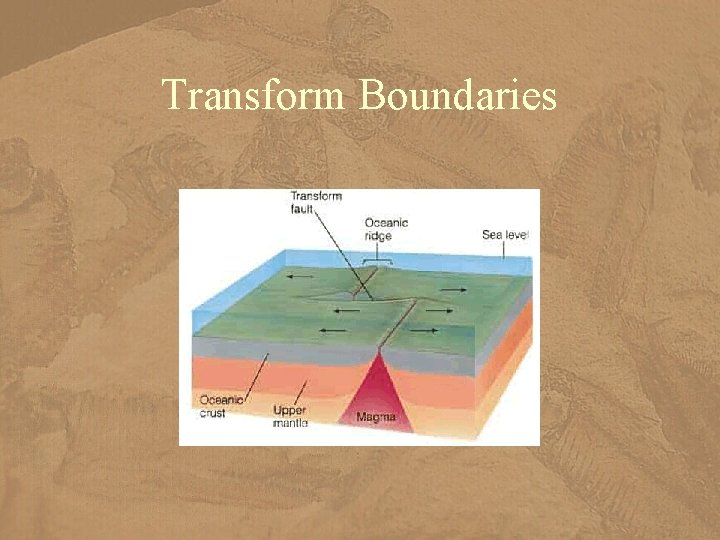
Boundary Observations: • No topographic markers • Shallow earthquakes • No volcanism • Asymmetric age patterns • ? Anomalies Transform - Plates Moving Past Each Other http: //earthview. sdsu. edu/trees/tecqest. html
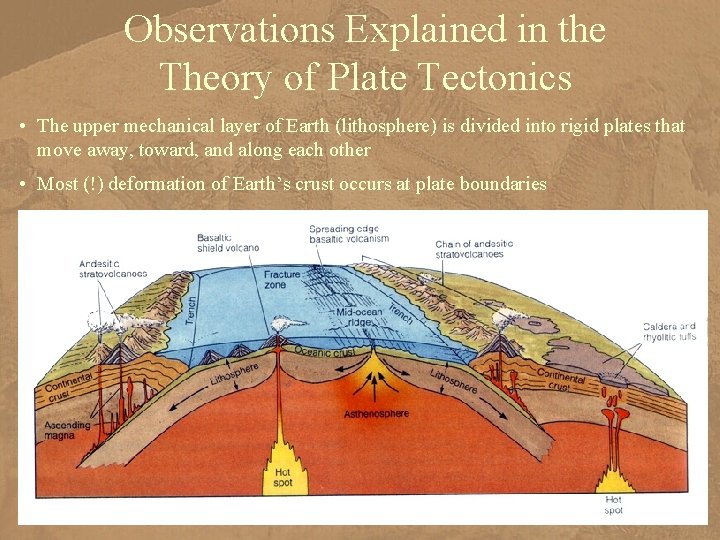
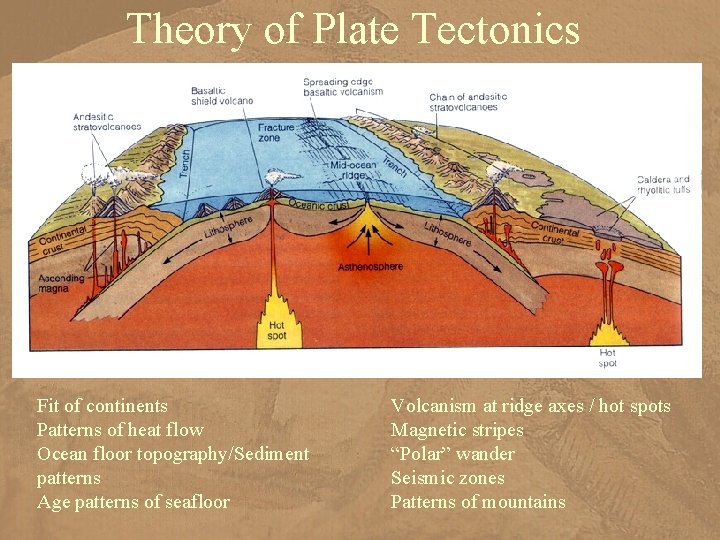
Observations Explained in the Theory of Plate Tectonics • The upper mechanical layer of Earth (lithosphere) is divided into rigid plates that move away, toward, and along each other • Most (!) deformation of Earth’s crust occurs at plate boundaries
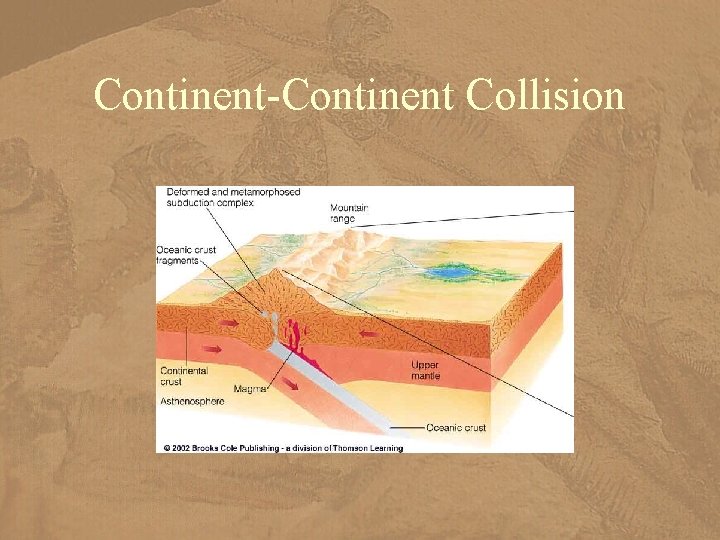
Continent-Continent Collision
Transform Boundaries
3 Main Boundary Types • Convergent – – Ocean-continent Ocean-ocean Continent-continent Oceanic crust subducts – cold, dense • Divergent – New oceanic crust created • Transform – Often difficult to recognize
Plate Tectonics. . . • Recent • Unifying theme of • solid earth sciences • Framework on which we hang (test!) observations about Earth’s geology and geophysics • Is a THEORY What makes the plates?
Earth: three main layers defined by composition: • Crust - Outer • Mantle - Middle • Core - Center
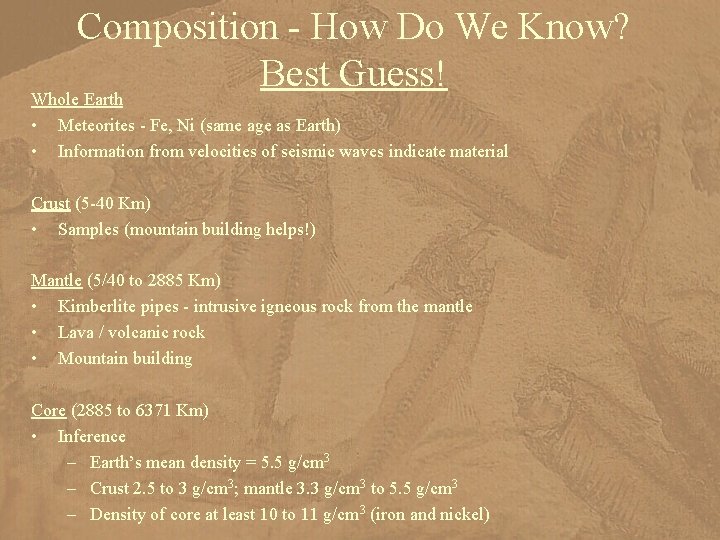
Composition - How Do We Know? Best Guess! Whole Earth • • Meteorites - Fe, Ni (same age as Earth) Information from velocities of seismic waves indicate material Crust (5 -40 Km) • Samples (mountain building helps!) Mantle (5/40 to 2885 Km) • Kimberlite pipes - intrusive igneous rock from the mantle • Lava / volcanic rock • Mountain building Core (2885 to 6371 Km) • Inference – Earth’s mean density = 5. 5 g/cm 3 – Crust 2. 5 to 3 g/cm 3; mantle 3. 3 g/cm 3 to 5. 5 g/cm 3 – Density of core at least 10 to 11 g/cm 3 (iron and nickel)
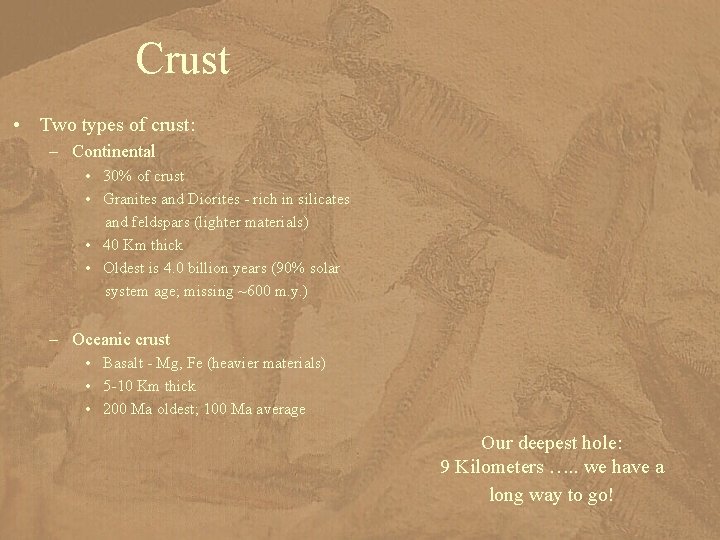
Crust • Two types of crust: – Continental • 30% of crust • Granites and Diorites - rich in silicates and feldspars (lighter materials) • 40 Km thick • Oldest is 4. 0 billion years (90% solar system age; missing ~600 m. y. ) – Oceanic crust • Basalt - Mg, Fe (heavier materials) • 5 -10 Km thick • 200 Ma oldest; 100 Ma average Our deepest hole: 9 Kilometers …. . we have a long way to go!
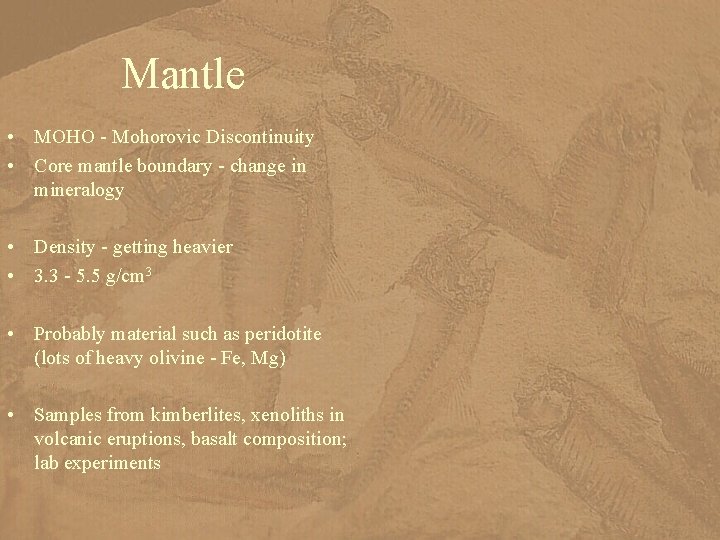
Mantle • MOHO - Mohorovic Discontinuity • Core mantle boundary - change in mineralogy • Density - getting heavier • 3. 3 - 5. 5 g/cm 3 • Probably material such as peridotite (lots of heavy olivine - Fe, Mg) • Samples from kimberlites, xenoliths in volcanic eruptions, basalt composition; lab experiments
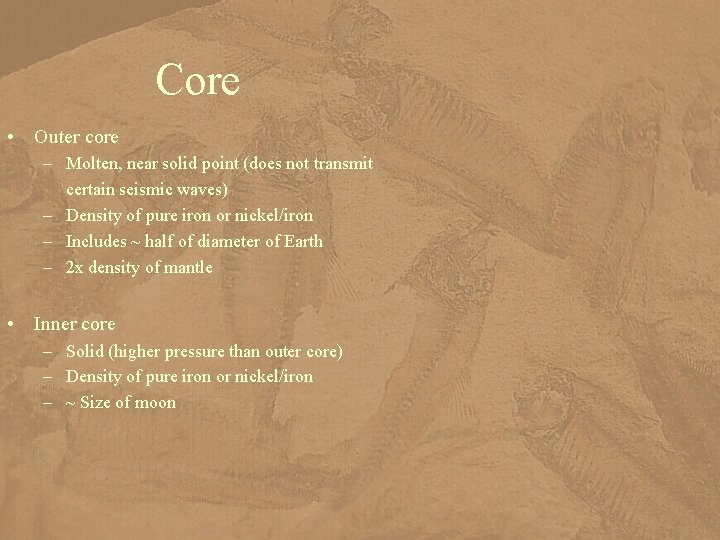
Core • Outer core – Molten, near solid point (does not transmit certain seismic waves) – Density of pure iron or nickel/iron – Includes ~ half of diameter of Earth – 2 x density of mantle • Inner core – Solid (higher pressure than outer core) – Density of pure iron or nickel/iron – ~ Size of moon
Crust Mantle Core (Composition) Earth: three main layers defined by mechanical properties - strength: • Lithosphere • Asthenosphere • Mesosphere
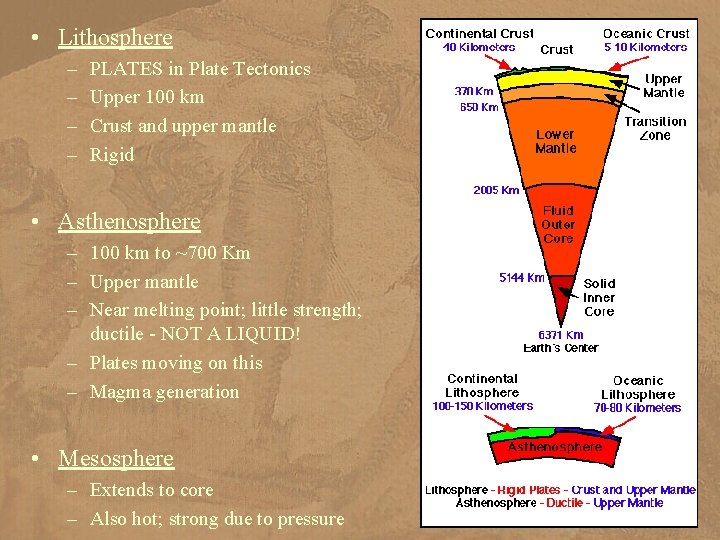
• Lithosphere – – PLATES in Plate Tectonics Upper 100 km Crust and upper mantle Rigid • Asthenosphere – 100 km to ~700 Km – Upper mantle – Near melting point; little strength; ductile - NOT A LIQUID! – Plates moving on this – Magma generation • Mesosphere – Extends to core – Also hot; strong due to pressure
Why Do the Plates Move?
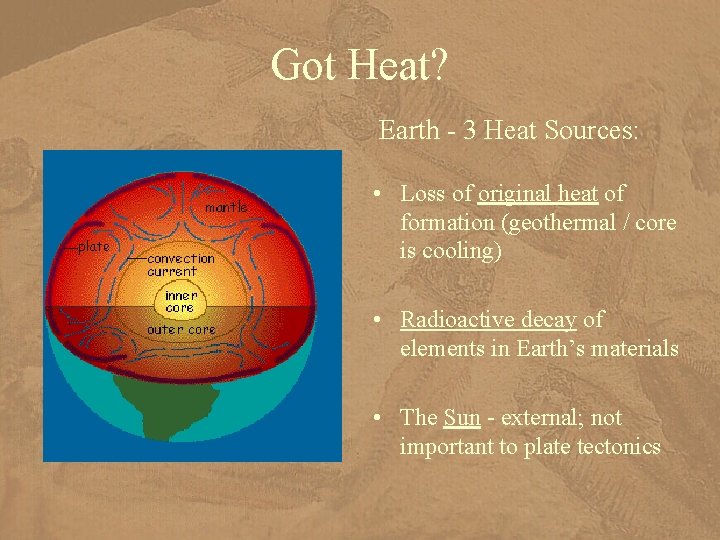
Got Heat? Earth - 3 Heat Sources: • Loss of original heat of formation (geothermal / core is cooling) • Radioactive decay of elements in Earth’s materials • The Sun - external; not important to plate tectonics
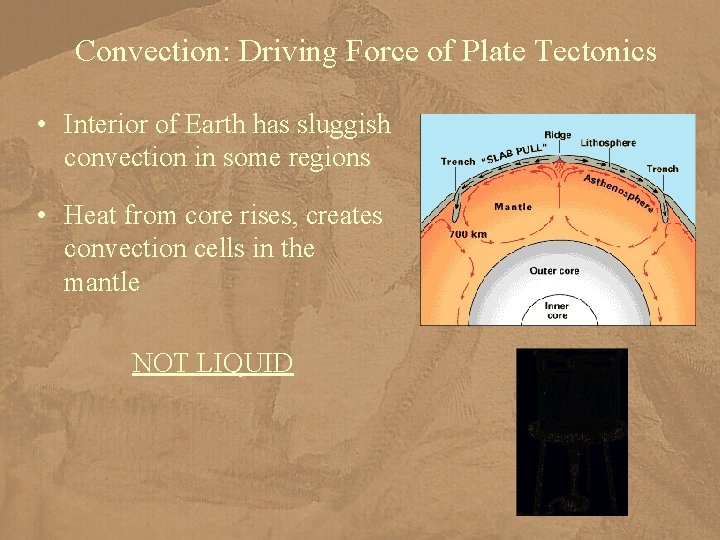
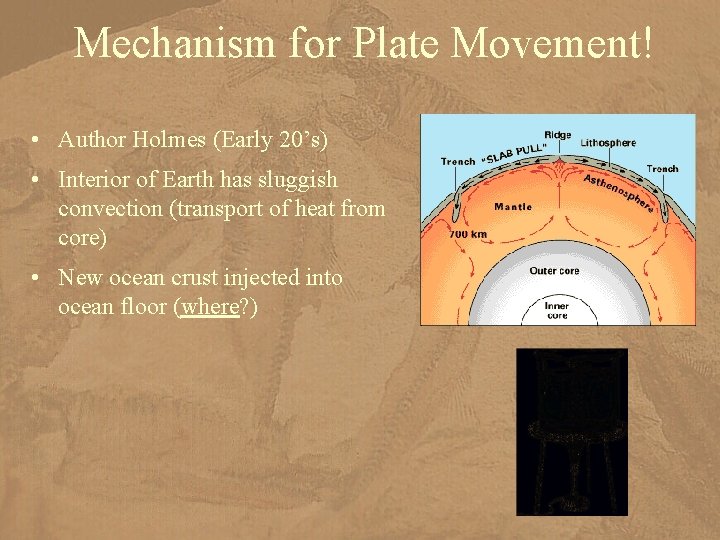
Convection: Driving Force of Plate Tectonics • Interior of Earth has sluggish convection in some regions • Heat from core rises, creates convection cells in the mantle NOT LIQUID
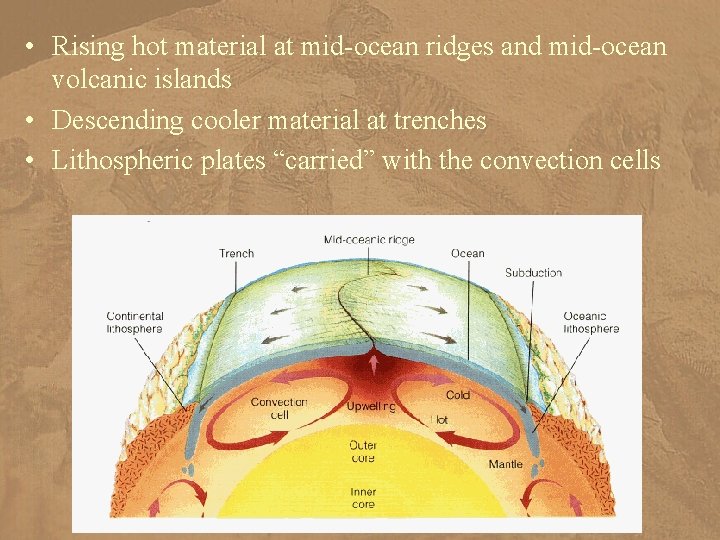
• Rising hot material at mid-ocean ridges and mid-ocean volcanic islands • Descending cooler material at trenches • Lithospheric plates “carried” with the convection cells
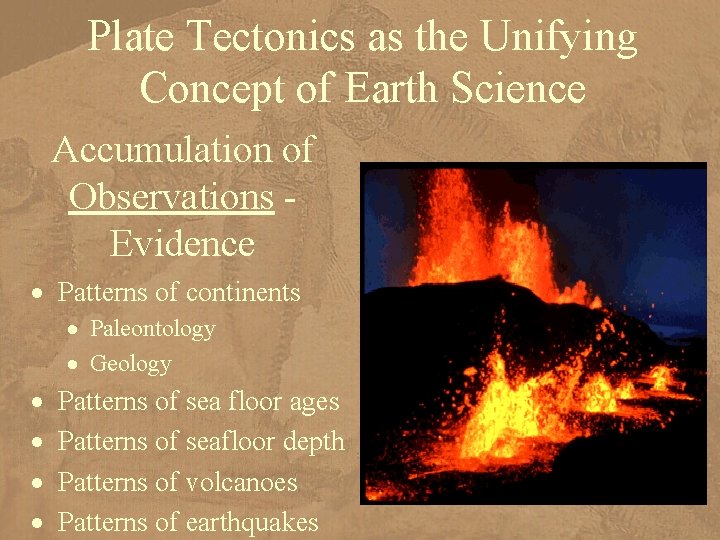
Plate Tectonics as the Unifying Concept of Earth Science Accumulation of Observations Evidence · Patterns of continents · Paleontology · Geology · · Patterns of sea floor ages Patterns of seafloor depth Patterns of volcanoes Patterns of earthquakes
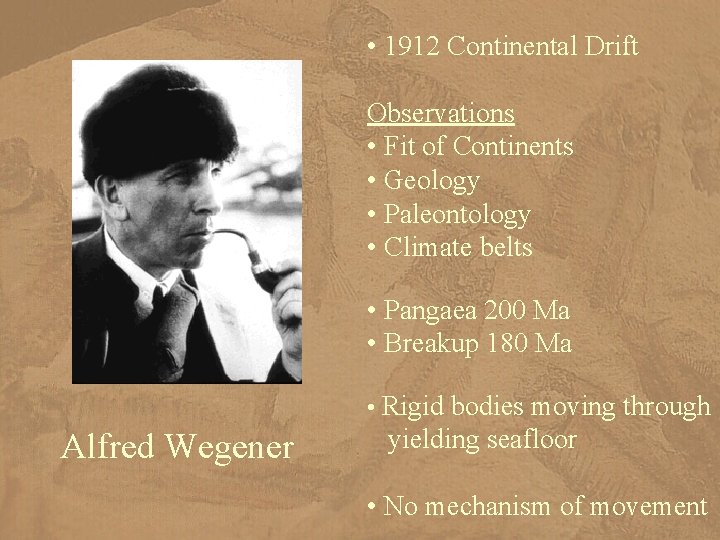
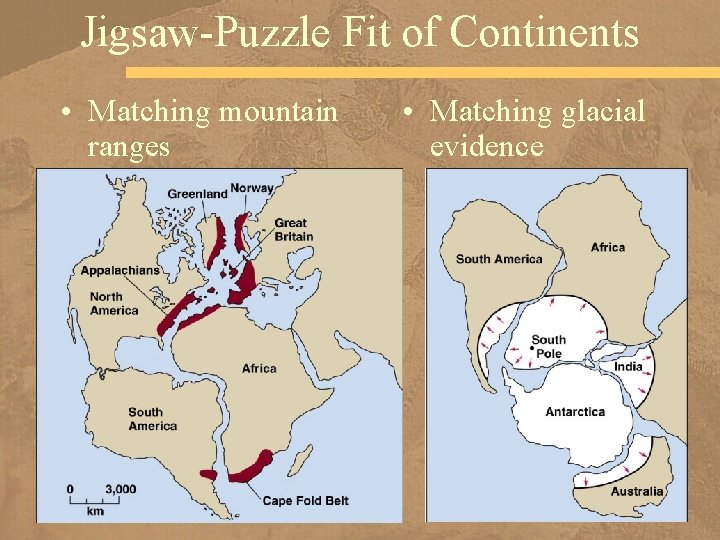
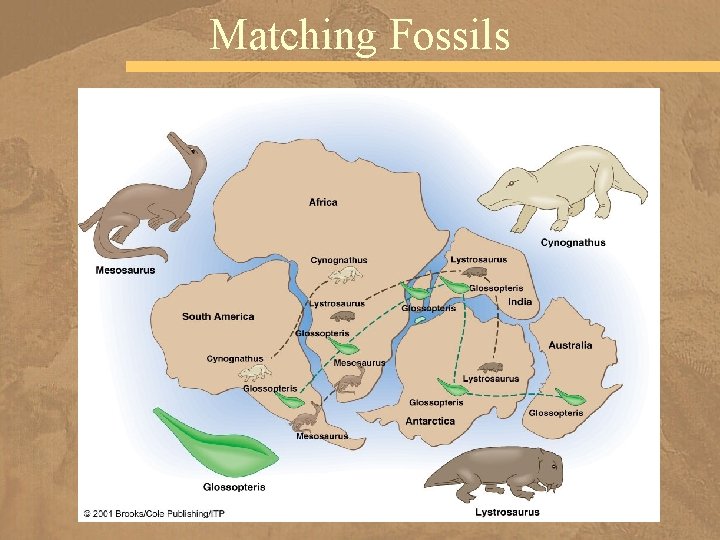
• 1912 Continental Drift Observations • Fit of Continents • Geology • Paleontology • Climate belts • Pangaea 200 Ma • Breakup 180 Ma • Rigid bodies moving through Alfred Wegener yielding seafloor • No mechanism of movement
Jigsaw-Puzzle Fit of Continents • Matching mountain ranges • Matching glacial evidence
Matching Fossils
Mechanism for Plate Movement! • Author Holmes (Early 20’s) • Interior of Earth has sluggish convection (transport of heat from core) • New ocean crust injected into ocean floor (where? )
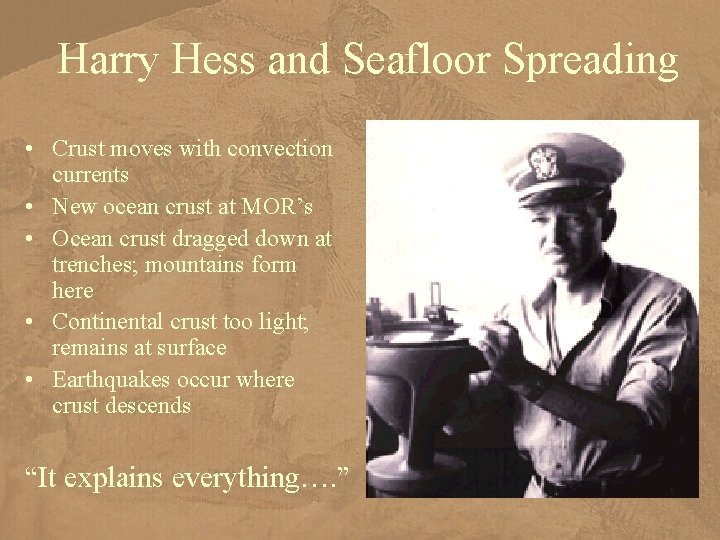
Harry Hess and Seafloor Spreading • Crust moves with convection currents • New ocean crust at MOR’s • Ocean crust dragged down at trenches; mountains form here • Continental crust too light; remains at surface • Earthquakes occur where crust descends “It explains everything…. ”
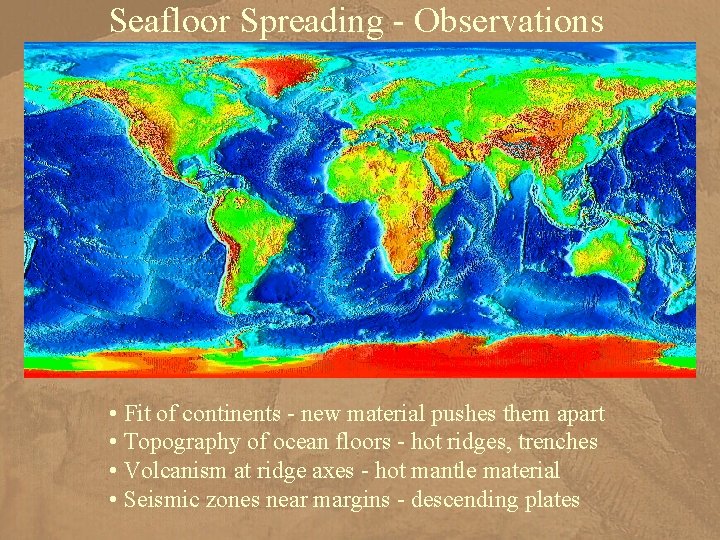
Seafloor Spreading - Observations • Fit of continents - new material pushes them apart • Topography of ocean floors - hot ridges, trenches • Volcanism at ridge axes - hot mantle material • Seismic zones near margins - descending plates
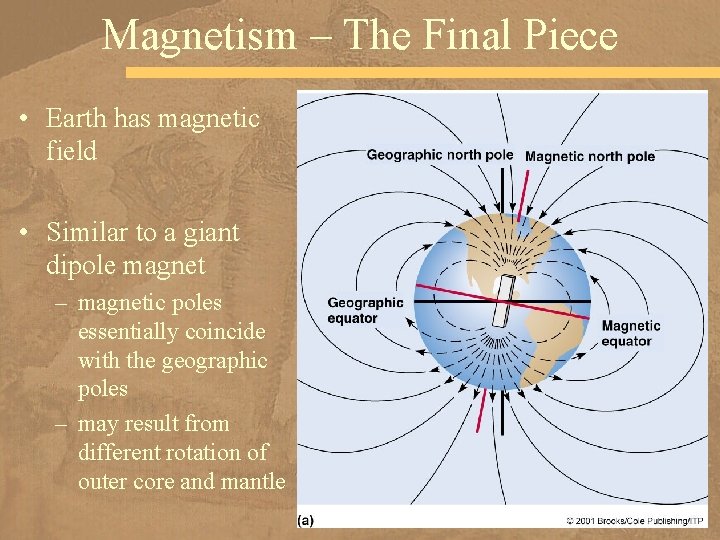
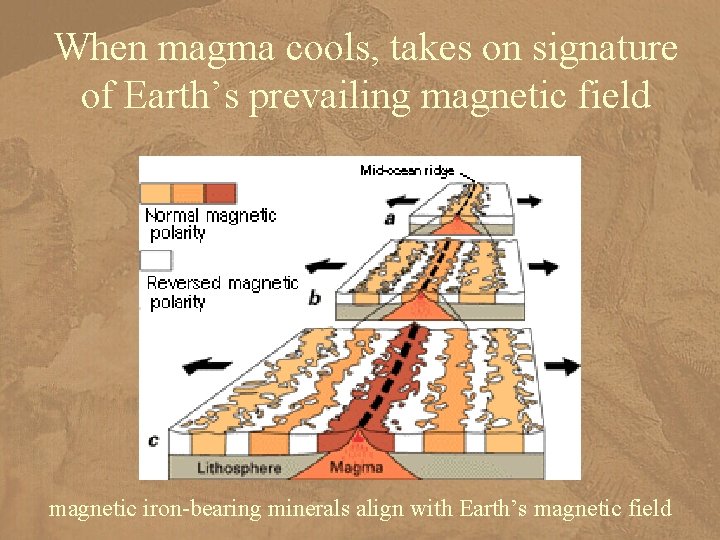
Magnetism – The Final Piece • Earth has magnetic field • Similar to a giant dipole magnet – magnetic poles essentially coincide with the geographic poles – may result from different rotation of outer core and mantle
Magnetic Reversals • Earth’s present magnetic field is called normal – magnetic north near the north geographic pole – magnetic south near the south geographic pole • At various times in the past, Earth’s magnetic field has completely reversed – magnetic south near the north geographic pole – magnetic north near the south geographic pole
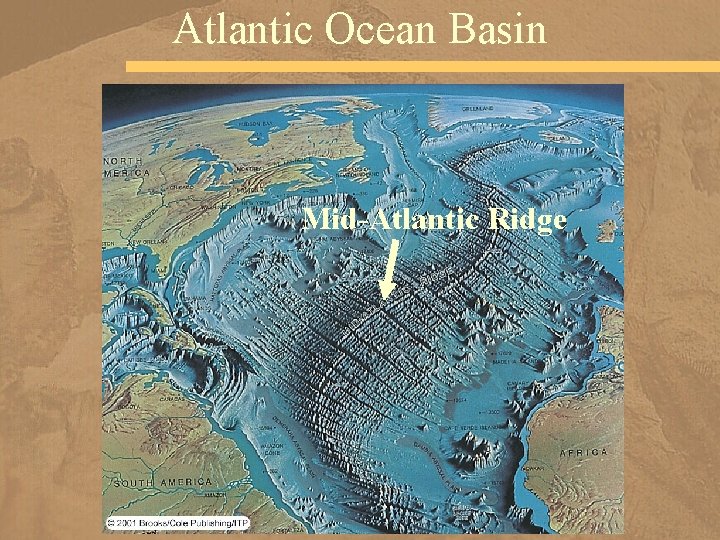
Mapping Ocean Basins • Ocean mapping revealed – a ridge system 65, 000 km long – the most extensive mountain range in the world • The Mid-Atlantic Ridge – is the best known – divides Atlantic Ocean basin in two nearly equal parts
Atlantic Ocean Basin Mid-Atlantic Ridge
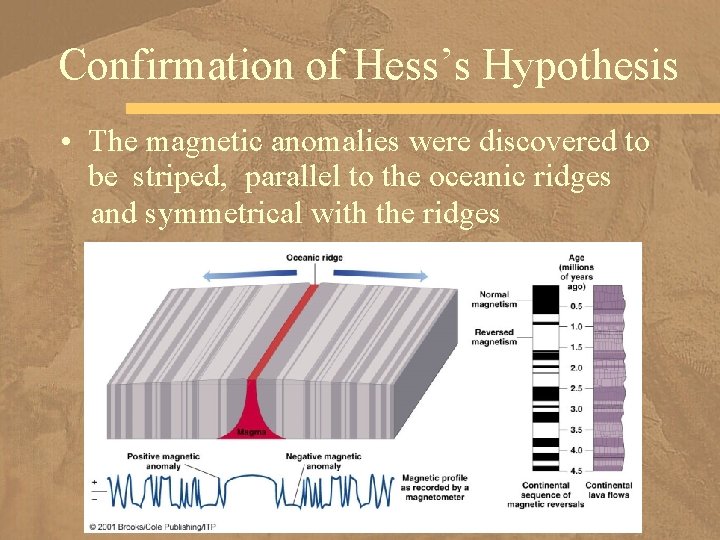
When magma cools, takes on signature of Earth’s prevailing magnetic field magnetic iron-bearing minerals align with Earth’s magnetic field
How would you test this?
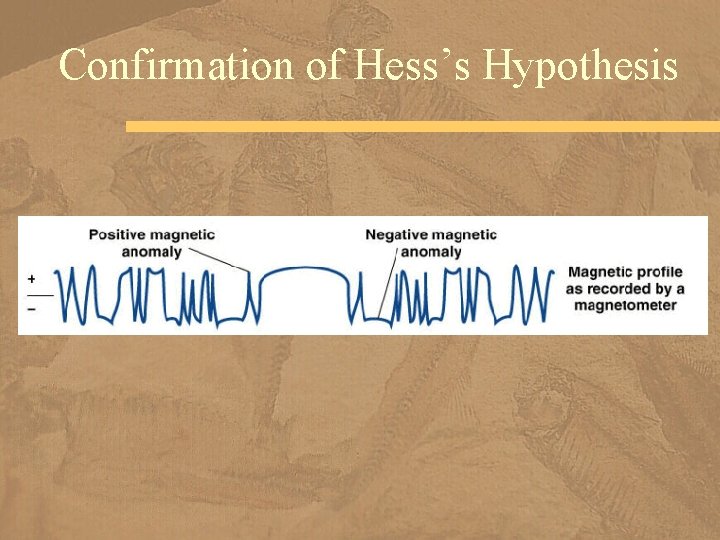
Confirmation of Hess’s Hypothesis
Confirmation of Hess’s Hypothesis • The magnetic anomalies were discovered to be striped, parallel to the oceanic ridges and symmetrical with the ridges
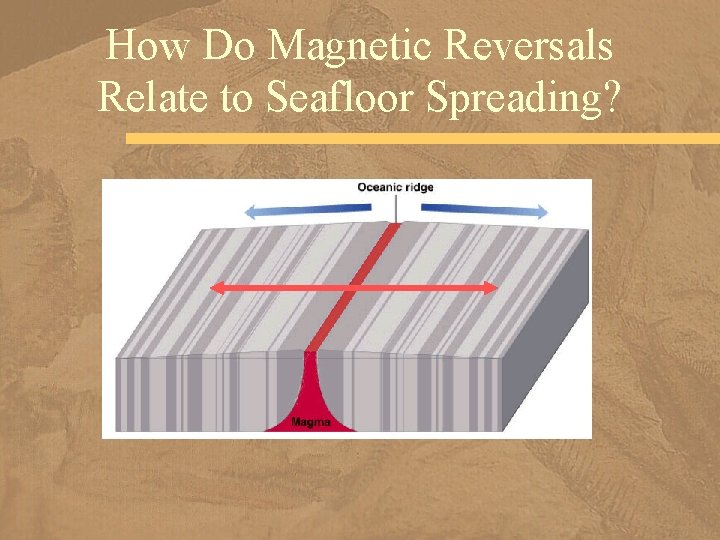
How Do Magnetic Reversals Relate to Seafloor Spreading?
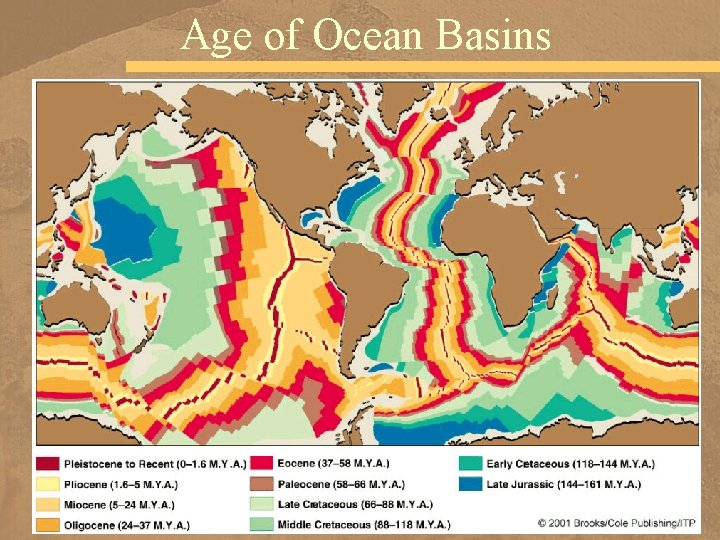
Oceanic Crust Is Young • Seafloor spreading theory indicates that – oceanic crust is geologically young – forms during spreading – destroyed during subduction • Radiometric dating confirms young age – youngest oceanic crust occurs at mid-ocean ridges – and the oldest oceanic crust is less than 180 million years old – oldest continental crust is 3. 96 billion yeas old
Age of Ocean Basins
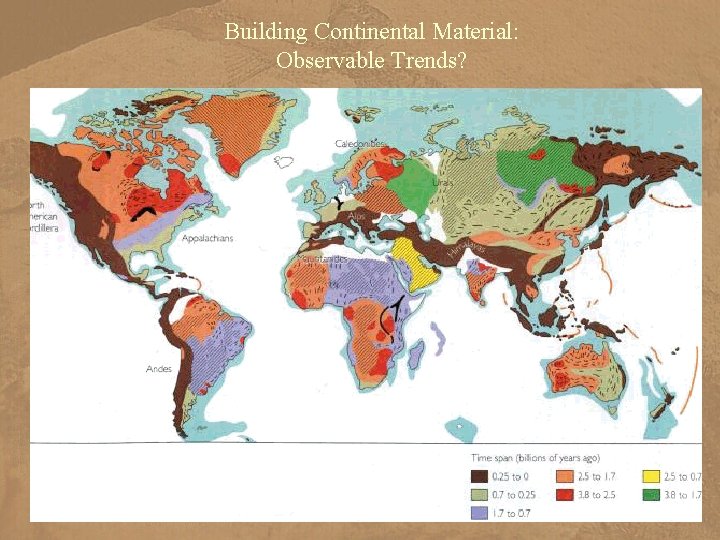
Building Continental Material: Observable Trends?
How Fast Do Plates Move? What Absolute Direction? How Do We Know?
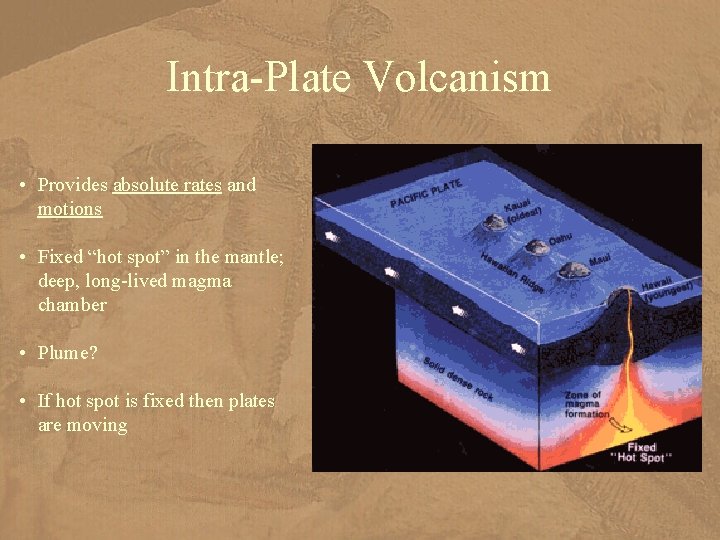
Intra-Plate Volcanism • Provides absolute rates and motions • Fixed “hot spot” in the mantle; deep, long-lived magma chamber • Plume? • If hot spot is fixed then plates are moving
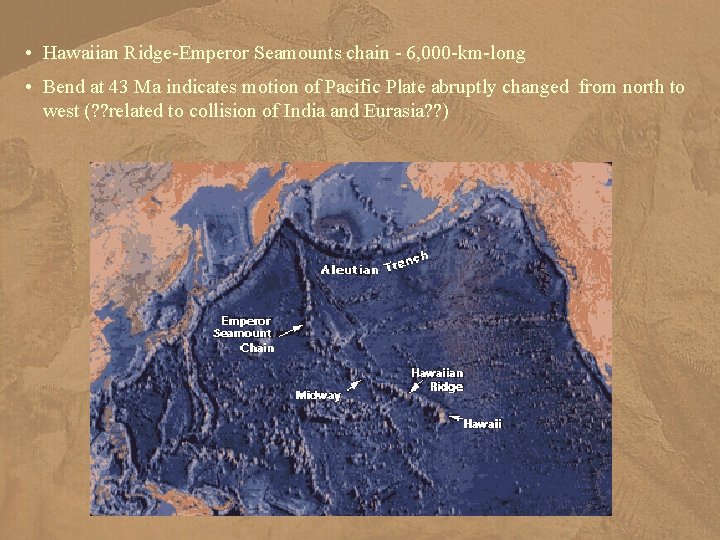
• Hawaiian Ridge-Emperor Seamounts chain - 6, 000 -km-long • Bend at 43 Ma indicates motion of Pacific Plate abruptly changed from north to west (? ? related to collision of India and Eurasia? ? )
Theory of Plate Tectonics Fit of continents Patterns of heat flow Ocean floor topography/Sediment patterns Age patterns of seafloor Volcanism at ridge axes / hot spots Magnetic stripes “Polar” wander Seismic zones Patterns of mountains
How Does Plate Tectonics Affect the Distribution of Life? • Present distribution of plants and animals – climate – geographic barriers • Barriers create biotic provinces – distinctive assemblage of plants and animals • Plate movements largely control barriers – when continents break up, new provinces form – when continents come together, fewer provinces result – as continents move north or south they move across temperature barriers
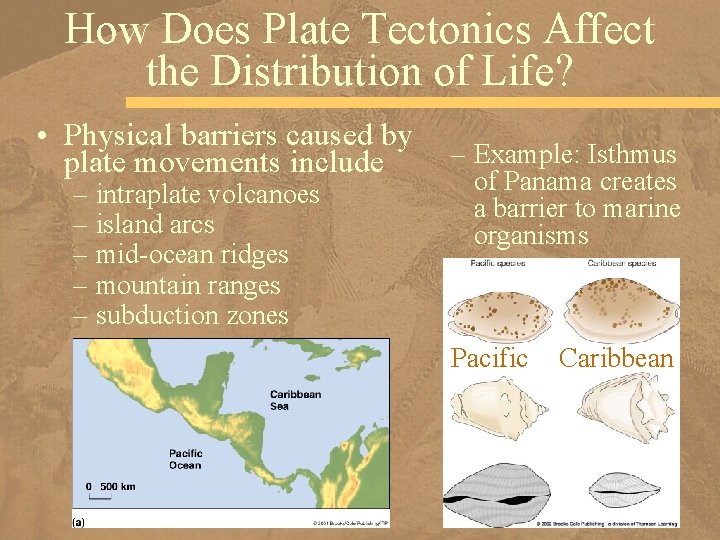
How Does Plate Tectonics Affect the Distribution of Life? • Physical barriers caused by plate movements include – intraplate volcanoes – island arcs – mid-ocean ridges – mountain ranges – subduction zones – Example: Isthmus of Panama creates a barrier to marine organisms Pacific Caribbean
Summary • Plate tectonic theory – widely accepted by the 1970 s – overwhelming evidence supporting it • It helps explain – volcanism – earthquake activity – mountain building – global climate changes – distribution of biota and resources