
Chapter 3 Physical Properties of Soil Soil Texture
- Slides: 49
Chapter 3 Physical Properties of Soil
Soil Texture What is Soil Texture? It is the proportion of three sizes of soil particles. Which are: Sand (Large) Silt (Medium) Clay (Small)
Soil Texture Effects of Particle Size? Soil particle size affects two important soil features: They are internal surface area The numbers and size of the pore spaces
Soil Texture What is the internal surface area ? It is the area of soil that the total surface are of the particles in the soil. So the smaller the soil particles the greater the internal surface area will be.
Soil Texture Pore size and number: this depends on the particle size. So there are more pores that are found between the larger particles. See page 34 for example.
Soil Texture What is a Soil Separates? They are categories that scientist have divided up into three groups The three groups are: Sand Silt Clay
Soil Texture What is Sand? It is the largest and is further divided into four subcategories. They are: Very coarse sand Coarse sand Medium sand Fine Sand
Soil Texture Sand it is the larges soil separate and is composed mainly of weathered grains of quartz. Sand is also gritty to the touch. Sand grains will not stick to each other.
Soil Texture Sand What will sand do to the soil? It will improve the soil by improving the water infiltration and aeration
Soil Texture Silt is the medium sized soil separated. Silt particles are silky or powdery to the touch Silt grains will not stick to one another just like sand grains. Silt is the best soil as it has the ability to hold large amounts of water in a form plants can use.
Soil Texture Clay is the smallest size soil separate. It is composed of tiny crystals Clay is formed by chemical reactions between weathered minerals to form tiny particle of new minerals. Clay will hold more plant nutrients than any other separate. Clay grains will stick to one another.
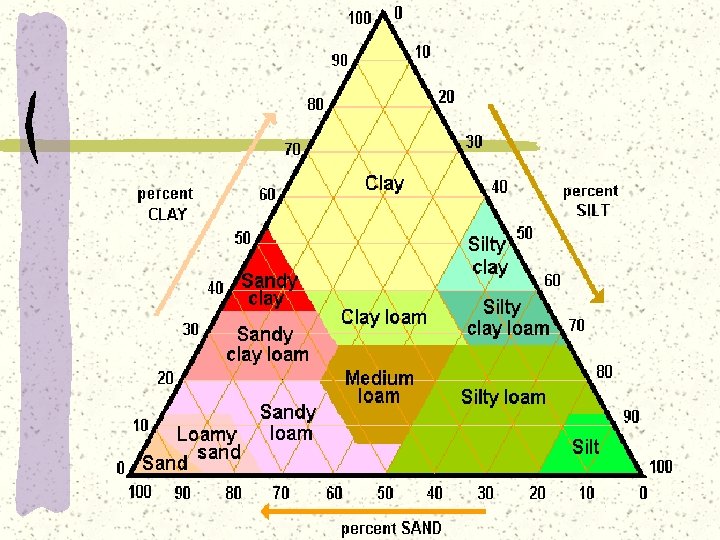
Soil Texture There are 12 textural classes which can be seen in the next slide.
Soil Texture Pass out picture of triangle and lets see if we can classify some soils.
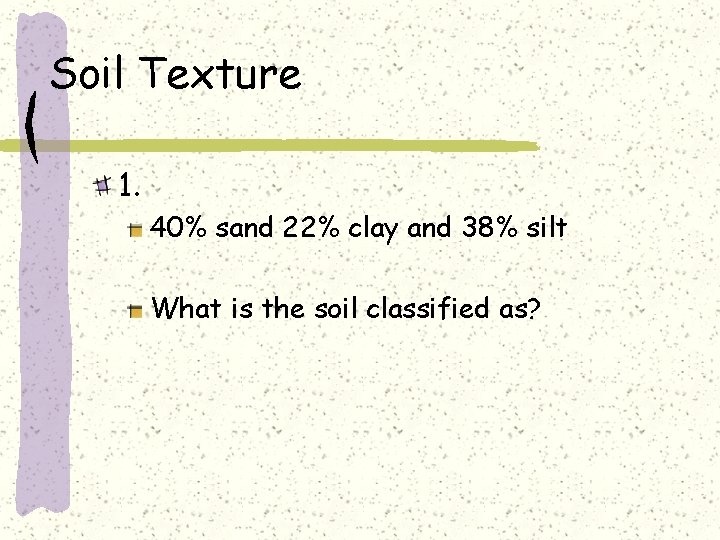
Soil Texture 1. 40% sand 22% clay and 38% silt What is the soil classified as?
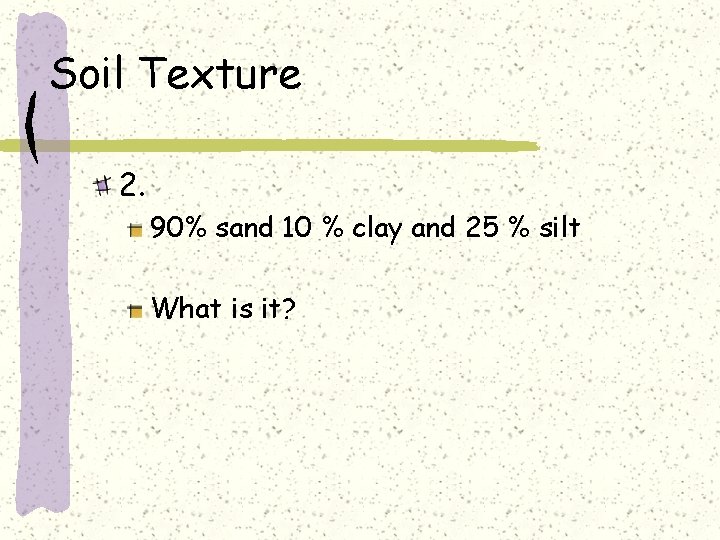
Soil Texture 2. 90% sand 10 % clay and 25 % silt What is it?
Soil Texture 3. 30% sand 50 % clay and 15% silt What is it?
Soil Texture 4. 10 % sand 80% clay and 30% silt. What is it?
Soil Texture Lets go and texture some of the kits that we have. See if you can make a ribbon and with which one? Which one feels grittiest? Which one feel powdery?
Soil Density and Permeability What is Particle Density? it is the density of solid particles only.
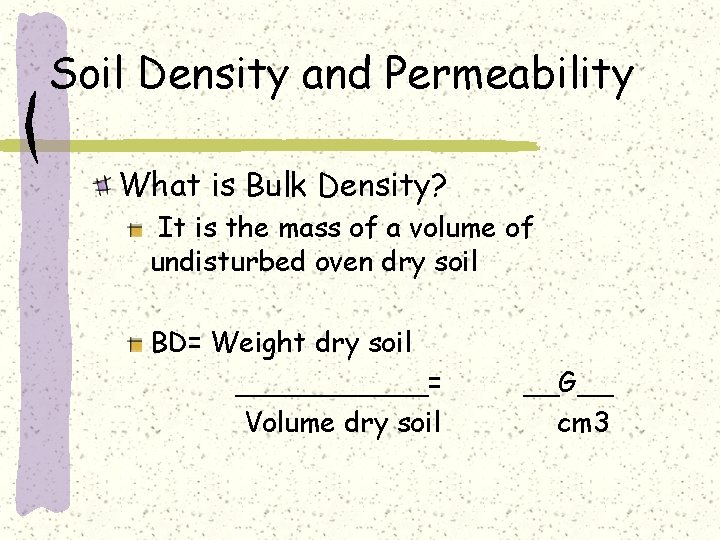
Soil Density and Permeability What is Bulk Density? It is the mass of a volume of undisturbed oven dry soil BD= Weight dry soil ______= Volume dry soil __G__ cm 3
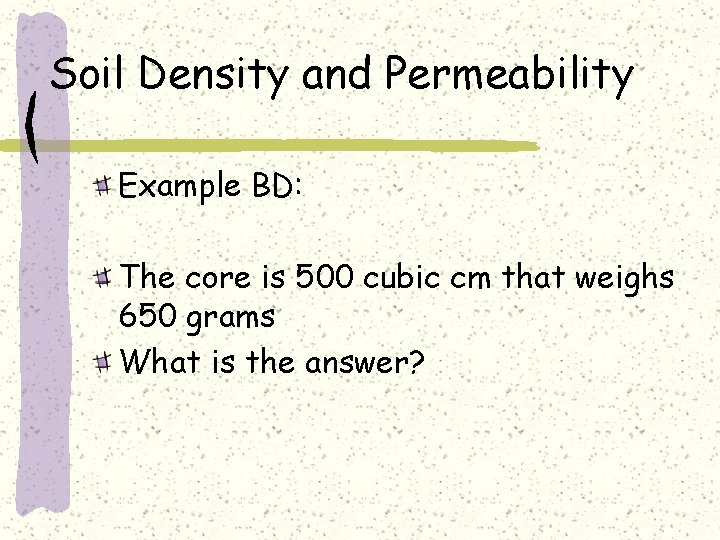
Soil Density and Permeability Example BD: The core is 500 cubic cm that weighs 650 grams What is the answer?
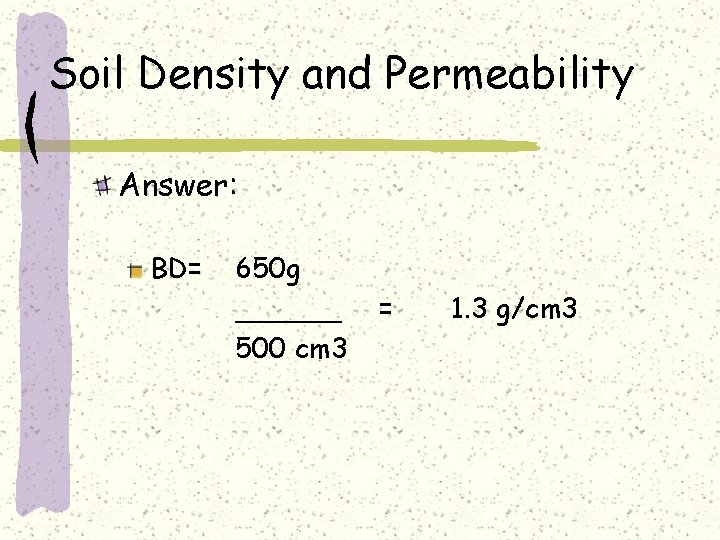
Soil Density and Permeability Answer: BD= 650 g ______ 500 cm 3 = 1. 3 g/cm 3
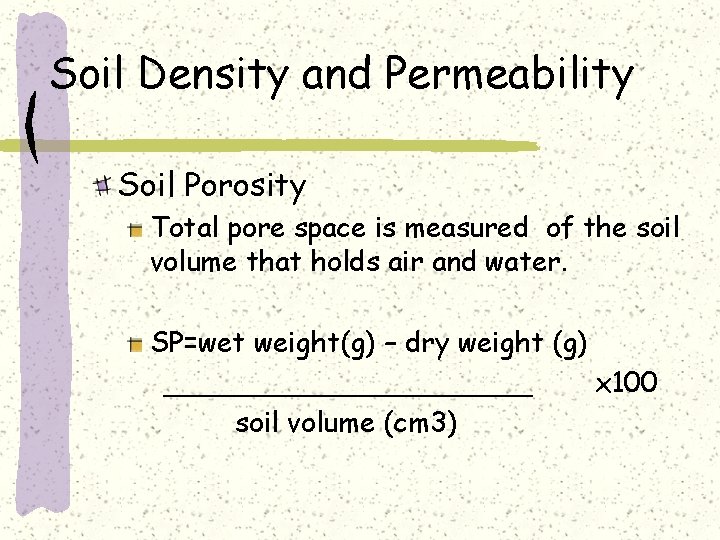
Soil Density and Permeability Soil Porosity Total pore space is measured of the soil volume that holds air and water. SP=wet weight(g) – dry weight (g) ___________ x 100 soil volume (cm 3)
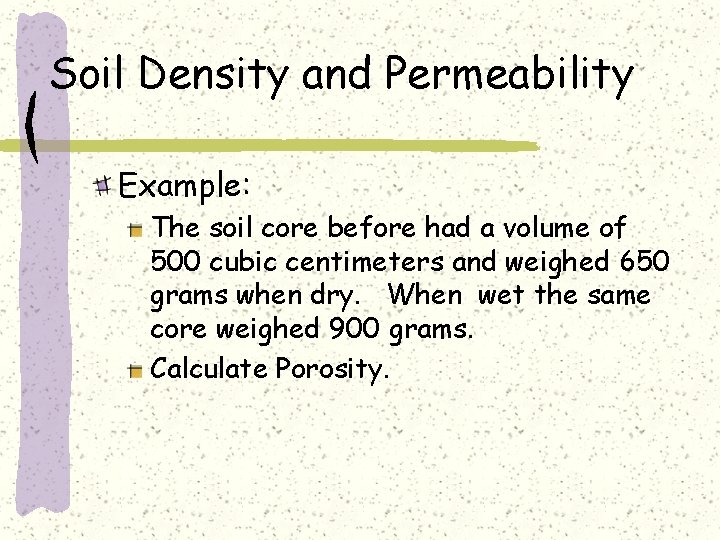
Soil Density and Permeability Example: The soil core before had a volume of 500 cubic centimeters and weighed 650 grams when dry. When wet the same core weighed 900 grams. Calculate Porosity.
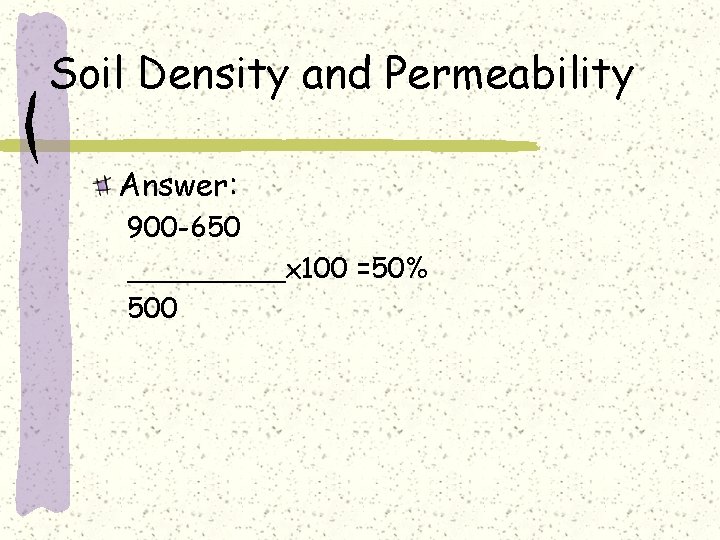
Soil Density and Permeability Answer: 900 -650 _____x 100 =50% 500
Soil Density and Permeability What is Permeability? is the ease of which air, water, and roots move through the soil
Soil Density and Permeability What is Hydraulic Conductivity? Is the measure of the rate of water movement through the soil
Soil Structures What is Soil Aggregates? It is aggregates that occur naturally in the soil are called peds. While clumps of soil caused by tillage are called clods
Types of Soil Structures Before we discuss these turn to pg 43. There are four types of soil structures. They are: Granular structure Platy structure Blocky structure Prismatic structure
Types of Soil Structures What is Granular structure? It is commonly found in A horizons Peds are small usually between 1 to 10 millimeters
Types of Soil Structures What is Platy Structures? Usually found in E horizons Peds are large but tin, platelike and arranged in overlapping horizontal layers.
Types of Soil Structures What is Blocky Structures? This is the typical of my B horizons Peds are large about 5 to 50 millimeters
Types of Soil Structures What is Prismatic structure? found in Horizon B Peds are large range from 10 - 100 millimeters in size
Soil Tilth What is Soil Tilth? is a general term for the physical conditions of a tilled soil.
Soil Tilth What is compaction? It is the result when pressure is applied to the soil surface.
Soil Tilth Now you will read pages 45 -50 and will take notes over these pages
Soil Pans What is a pan? It is any layer of hardened soil. There are four types of pans: Clay pan Fragipans Plinthite Caliche and duripans
Soil Pans Claypans: Has a very high clay content in the subsoil layer. This layer is very dense
Soil Pans Fragipans: results from clay accumulation Clay will bind soil particles into hard brittle layer
Soil Pans Plinthite Layers are cemented by a special type of clay common to the tropics These soils are very poor for Agriculture uses.
Soil Pans Caliche and Duripans Has chemicals cement soil particles together
Soil Colors Dark Brown to Black dark colors result from organic matter or dark parent material.
Soil Colors White to Light Gray color indicates that chemicals that color soil have leached out May also be a result of a large amount of lime in one place for the white appearance.
Soil Colors Light brown, Yellow to Red: These are the colors of oxidized iron minerals, chemically similar to rust Red indicates good drainage
Soil Colors Bluish Gray this is the color of less oxidized iron and indicates a lack of oxygen in the soil So this is an indication of poor drainage
Soil Colors Mottled Colors: Will show different colors often spots of rust, yellow, and gray.
Soil Colors Hue- is the color such as red and yellow Value- Is the lightness or darkness of the hue 0 -10 and 0 being the darkest and 10 the lightest Chroma- is the purity of the dominant color and is also number