
CHAPTER 3 PEOPLE OF THE ANCIENT MIDDLE EAST
- Slides: 32
CHAPTER 3: PEOPLE OF THE ANCIENT MIDDLE EAST 10, 000 B. C. – 600 A. D.
What is Civilization? Large, settled population Food production through agriculture Established government Developed religion Specialized crafts Long-distance trade System of Writing
Why the Middle East? Discussion: The Middle East was home to the world’s earliest civilizations. What factors could have led to this?
The Ancient Middle East Mesopotamia & the Fertile Crescent � Why did people come to this region?
Why The Middle East? How did the first settlers survive? � Irrigation Techniques developed to drain water during flood periods Move water to other fields far away � Food surpluses Cities import food from surrounding farming communities Food stored in temples
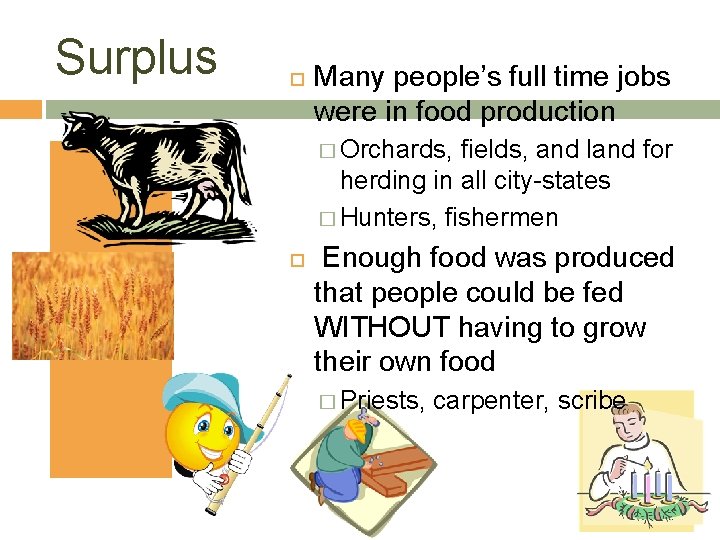
Surplus Many people’s full time jobs were in food production � Orchards, fields, and land for herding in all city-states � Hunters, fishermen Enough food was produced that people could be fed WITHOUT having to grow their own food � Priests, carpenter, scribe
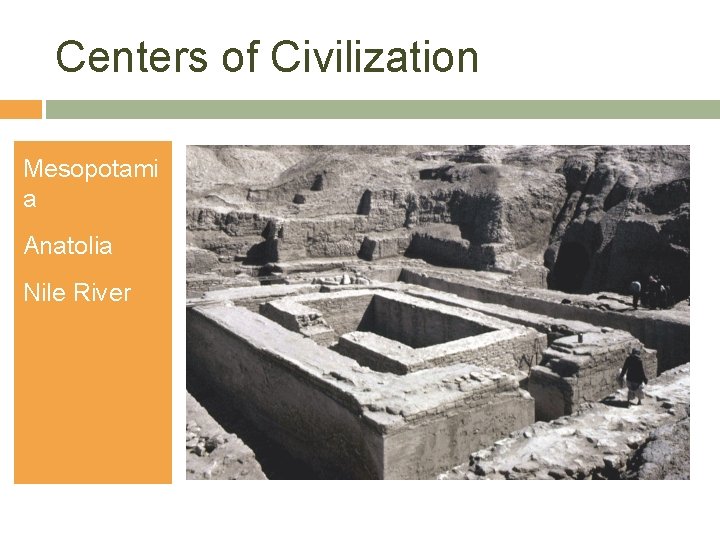
Centers of Civilization Mesopotami a Anatolia Nile River
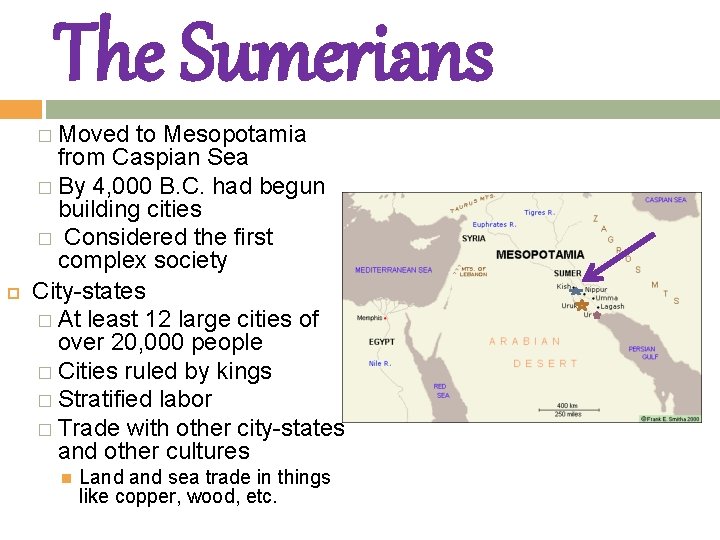
The Sumerians � Moved to Mesopotamia from Caspian Sea � By 4, 000 B. C. had begun building cities � Considered the first complex society City-states � At least 12 large cities of over 20, 000 people � Cities ruled by kings � Stratified labor � Trade with other city-states and other cultures Land sea trade in things like copper, wood, etc.
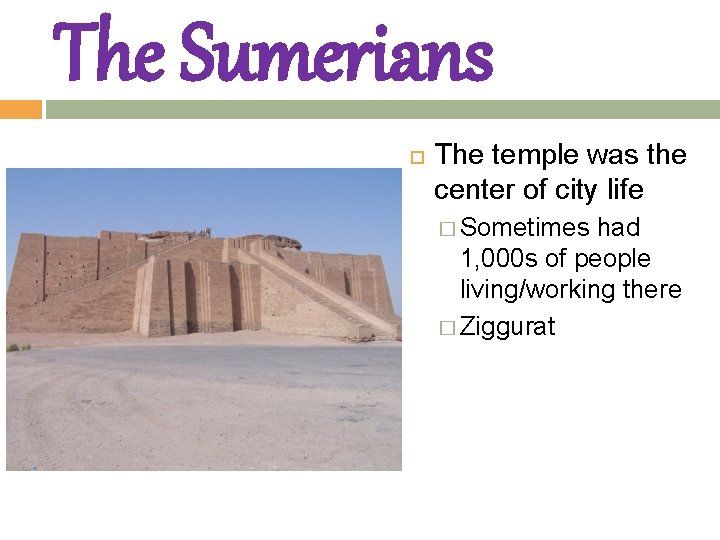
The Sumerians The temple was the center of city life � Sometimes had 1, 000 s of people living/working there � Ziggurat
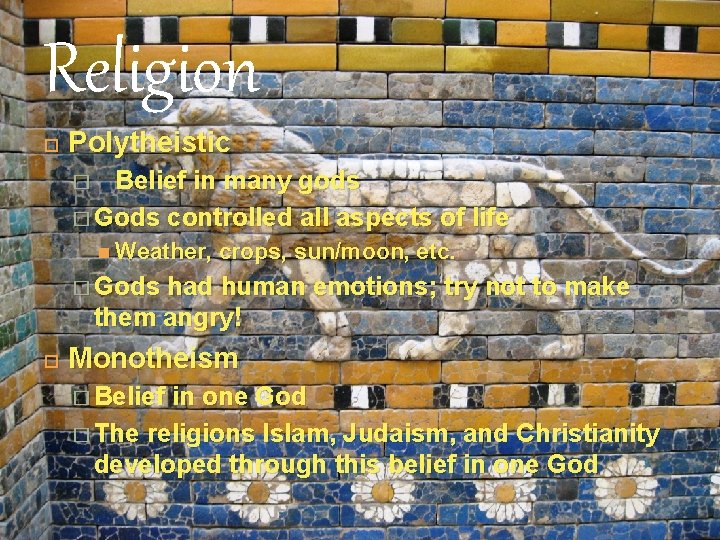
Religion Polytheistic Belief in many gods � Gods controlled all aspects of life � Weather, crops, sun/moon, etc. � Gods had human emotions; try not to make them angry! Monotheism � Belief in one God � The religions Islam, Judaism, and Christianity developed through this belief in one God
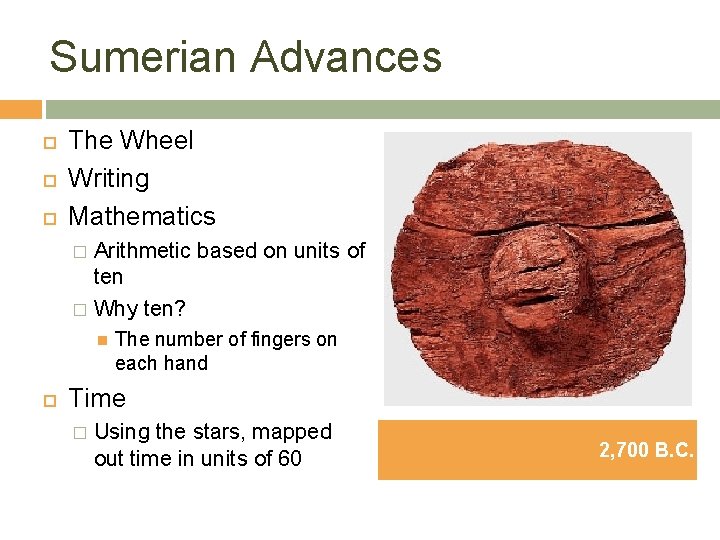
Sumerian Advances The Wheel Writing Mathematics Arithmetic based on units of ten � Why ten? � The number of fingers on each hand Time � Using the stars, mapped out time in units of 60 2, 700 B. C.
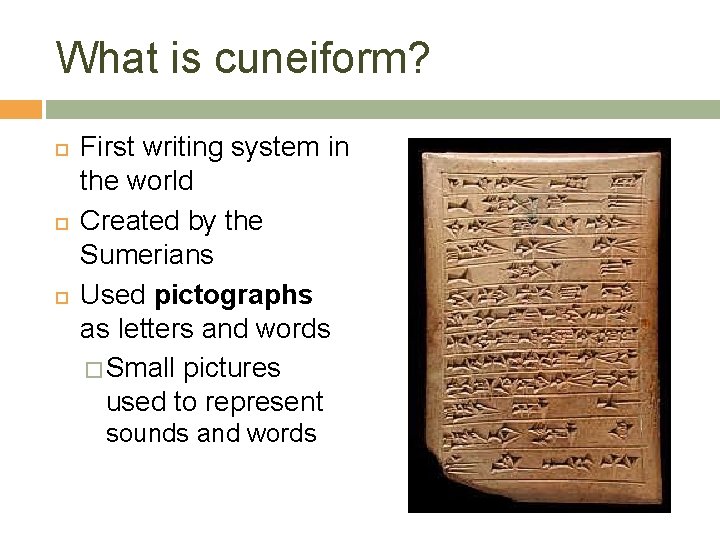
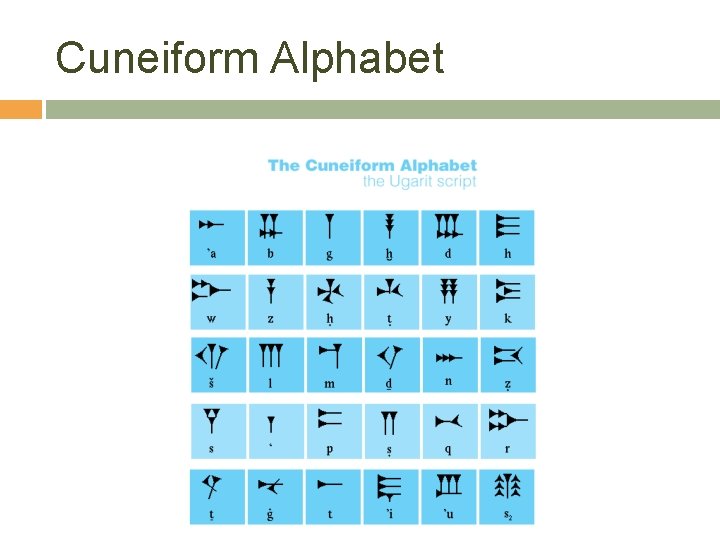
What is cuneiform? First writing system in the world Created by the Sumerians Used pictographs as letters and words � Small pictures used to represent sounds and words
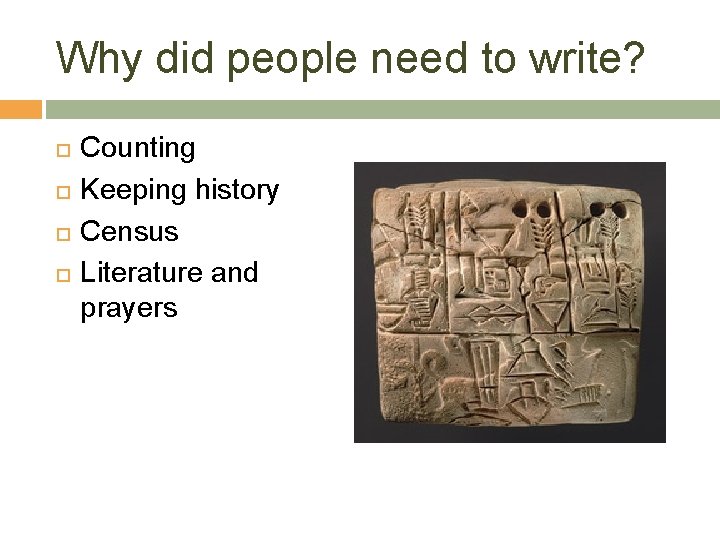
Why did people need to write? Counting Keeping history Census Literature and prayers
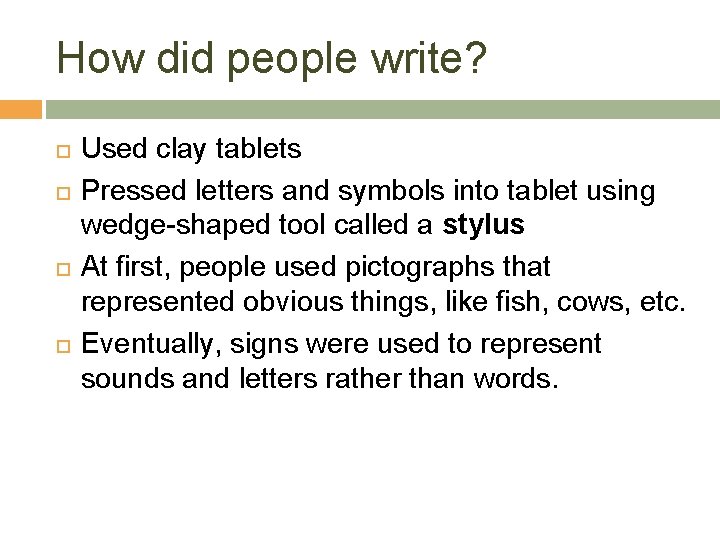
How did people write? Used clay tablets Pressed letters and symbols into tablet using wedge-shaped tool called a stylus At first, people used pictographs that represented obvious things, like fish, cows, etc. Eventually, signs were used to represent sounds and letters rather than words.
Cuneiform Alphabet
Assignment Create you own alphabet out of pictograms. Think of what kinds of symbols could represent sounds or words you associate with different letters. Then, using your alphabet, create a “tablet” on which you write your name and something about yourself.
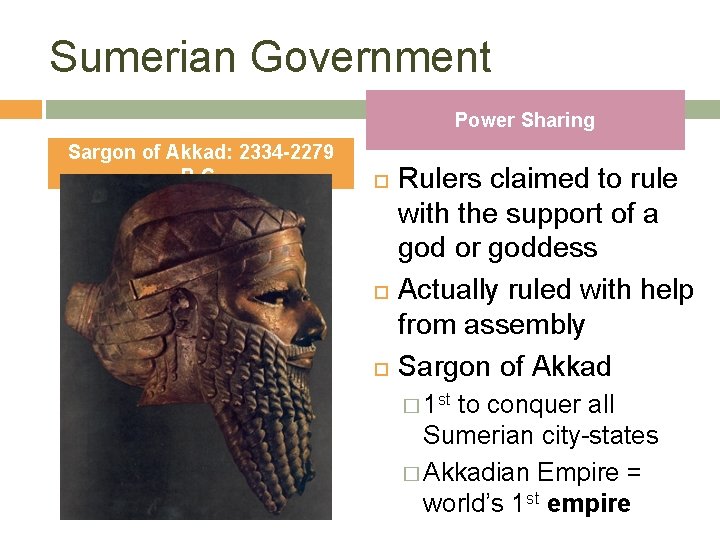
Sumerian Government Power Sharing Sargon of Akkad: 2334 -2279 B. C. Rulers claimed to rule with the support of a god or goddess Actually ruled with help from assembly Sargon of Akkad � 1 st to conquer all Sumerian city-states � Akkadian Empire = world’s 1 st empire
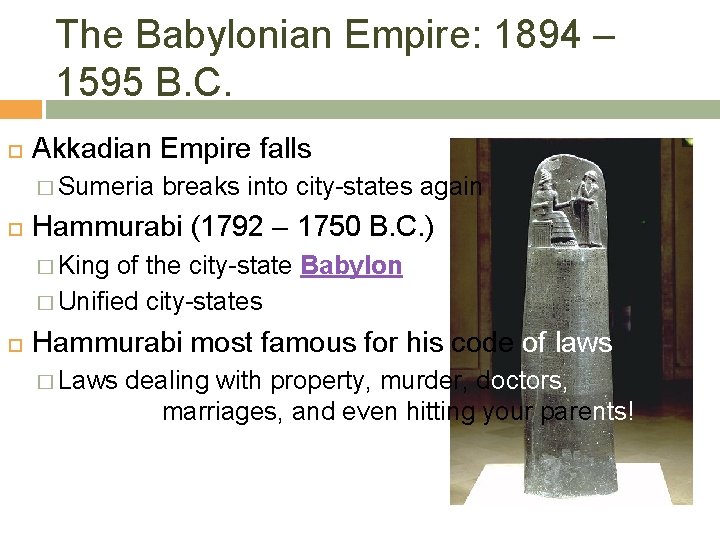
The Babylonian Empire: 1894 – 1595 B. C. Akkadian Empire falls � Sumeria breaks into city-states again Hammurabi (1792 – 1750 B. C. ) � King of the city-state Babylon � Unified city-states Hammurabi most famous for his code of laws � Laws dealing with property, murder, doctors, stealing, marriages, and even hitting your parents!
Hammurabi’s Code “If a Builder builds a house for someone, and does not construct it properly, and the house which he built falls in and kills its owner, then the builder shall be put to death. ” “If a son strike his father, his hands shall be hewn off. “ “If a man put out the eye of another man, his eye shall be put out. ” “If he put out the eye of a freed man, or break the bone of a freed man, he shall pay one gold mina. ” “If he put out the eye of a man's slave, or break the
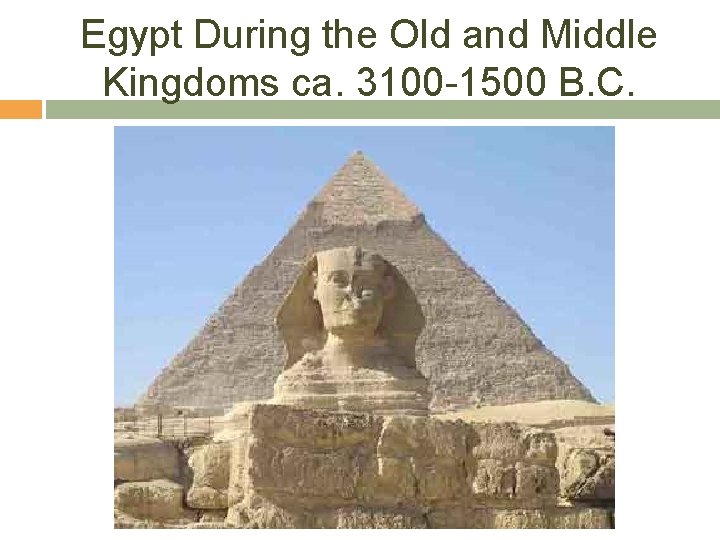
Egypt During the Old and Middle Kingdoms ca. 3100 -1500 B. C.
Ancient Egypt in Geography On your maps, please identify the following: http: //www. wadsworthmedia. com/historyn ow/western/product/wawc 1 m 01 c/content/wciv 1/modules/egypt. swf
Egypt vs. Mesopotamia Look at the timeline comparing the two http: //wadsworth. com/history_d/templates/stud ent_resources/0534627129_duiker/timeline/Fl ash. SWFfiles/DS_Timeline_Template. htm Observe similarities in the beginning of civilization for both
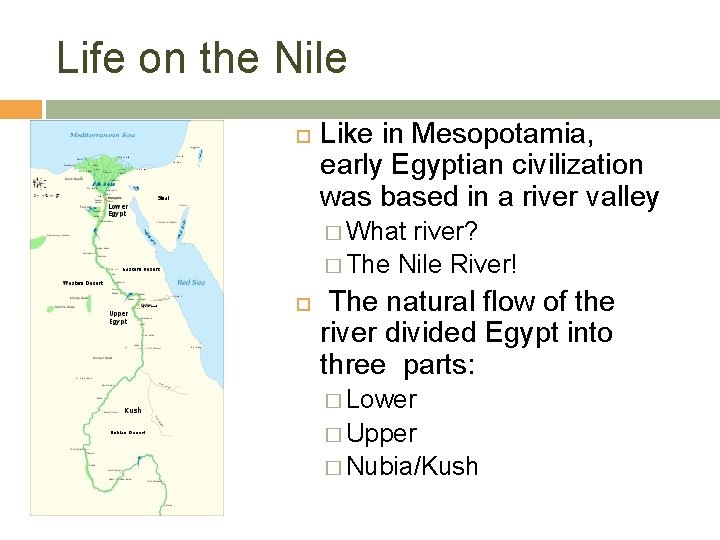
Life on the Nile Like in Mesopotamia, early Egyptian civilization was based in a river valley � What river? � The Nile River! The natural flow of the river divided Egypt into three parts: � Lower � Upper � Nubia/Kush
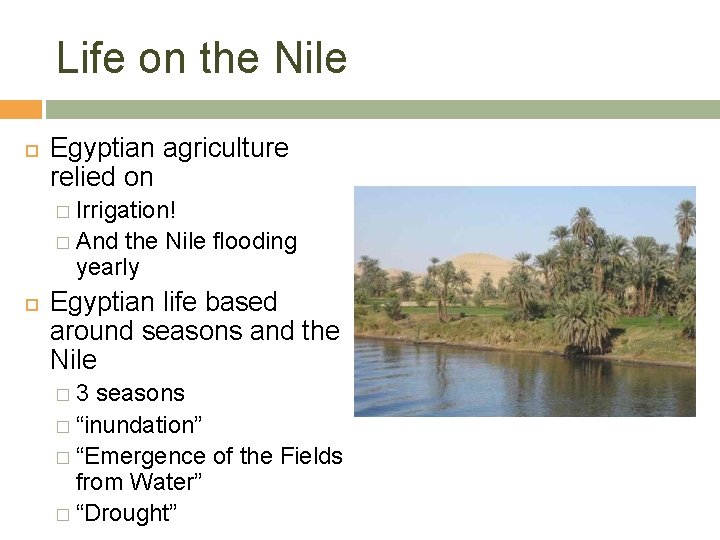
Life on the Nile Egyptian agriculture relied on � Irrigation! � And the Nile flooding yearly Egyptian life based around seasons and the Nile � 3 seasons � “inundation” � “Emergence of the Fields from Water” � “Drought”
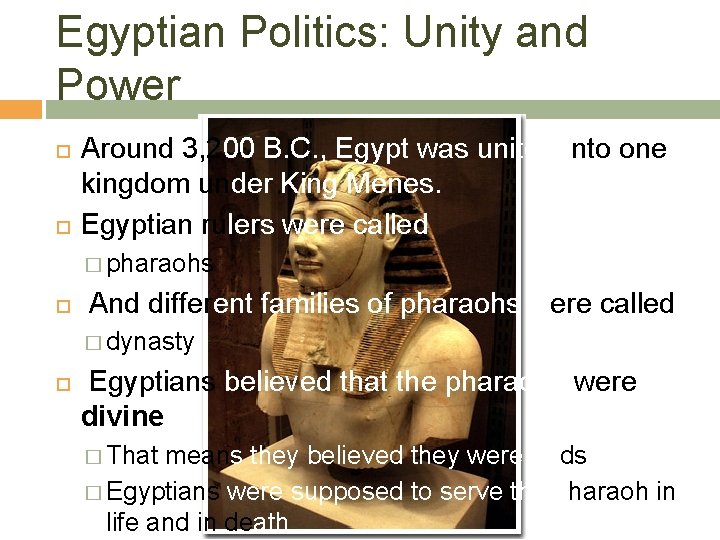
Egyptian Politics: Unity and Power Around 3, 200 B. C. , Egypt was united into one kingdom under King Menes. Egyptian rulers were called � pharaohs And different families of pharaohs were called � dynasty Egyptians believed that the pharaohs were divine � That means they believed they were gods � Egyptians were supposed to serve the pharaoh in life and in death
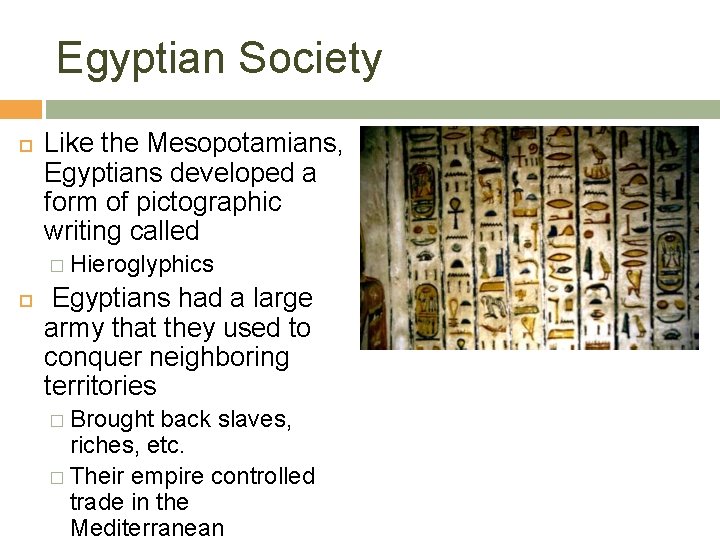
Egyptian Society Like the Mesopotamians, Egyptians developed a form of pictographic writing called � Hieroglyphics Egyptians had a large army that they used to conquer neighboring territories � Brought back slaves, riches, etc. � Their empire controlled trade in the Mediterranean
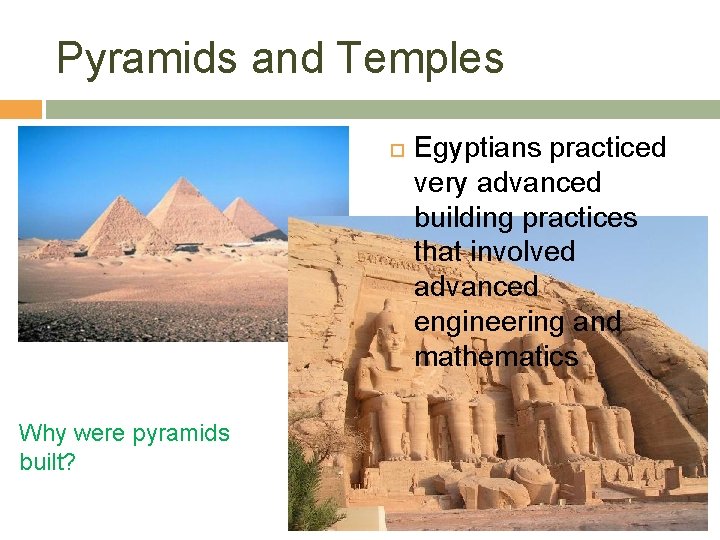
Pyramids and Temples Why were pyramids built? Egyptians practiced very advanced building practices that involved advanced engineering and mathematics
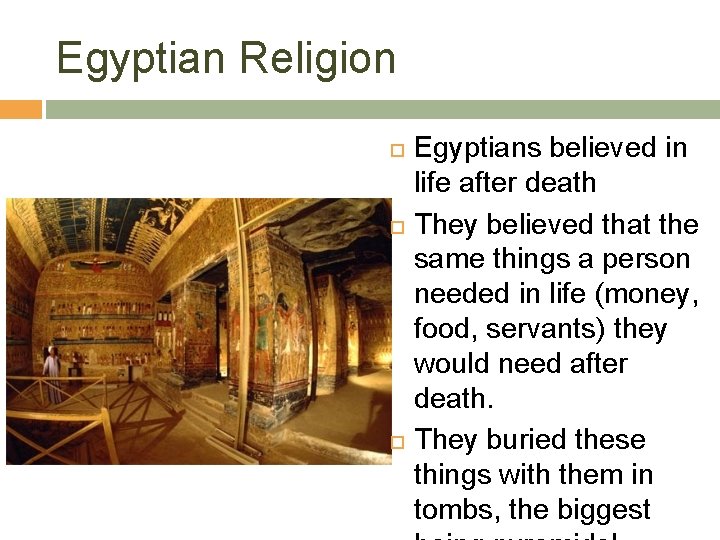
Egyptian Religion Egyptians believed in life after death They believed that the same things a person needed in life (money, food, servants) they would need after death. They buried these things with them in tombs, the biggest
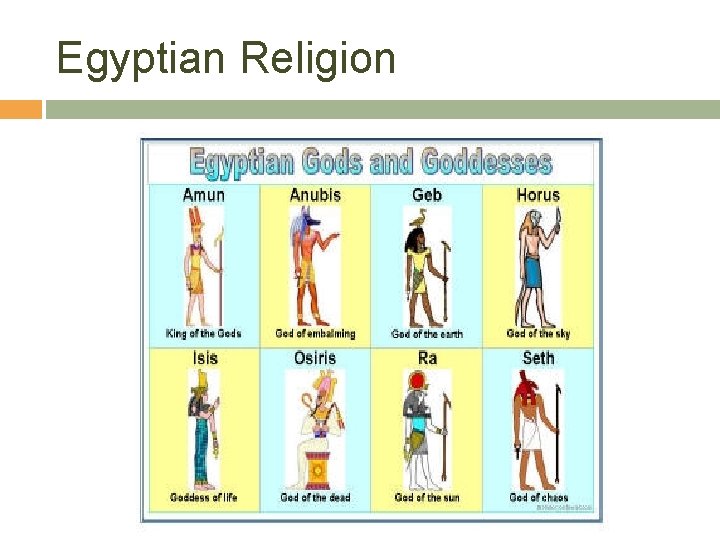
Egyptian Religion
Egyptian Religion Like Sumerians, Egyptians were polytheistic Many of their gods were anthropomorphic � Had both human and animal aspects What are some characteristics of Egyptian religion that you can see from the readings? How did Egyptian religion reflect their life, culture, geography, etc? What kinds of things were important to them based on their gods’ responsibilities?
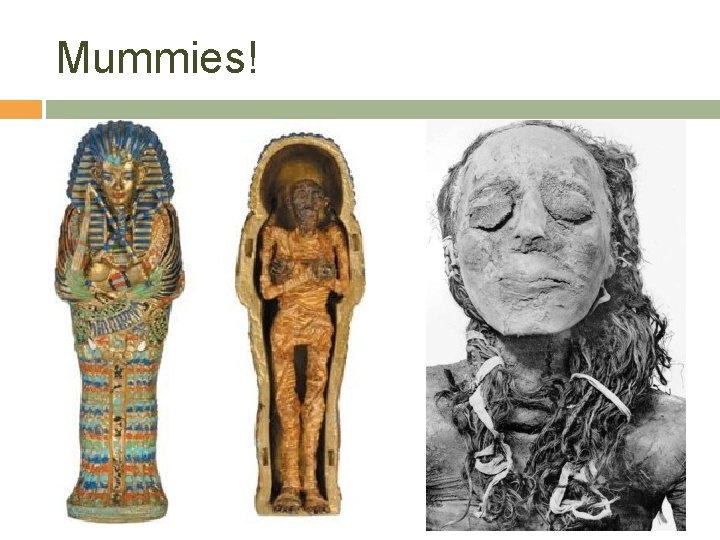
Mummification Egyptians believed that it was necessary to preserve the body for the person to live on in the afterlife Embalmers removed organs like the intestines, liver, heart, brain, and kidney from the body, packed it with chemicals, and wrapped it in preserving bandages. Thus, we have mummies!
Mummies!