
Chapter 3 Parallel and Perpendicular Lines Lesson 1
- Slides: 6
Chapter 3: Parallel and Perpendicular Lines Lesson 1: Parallel Lines and Transversals
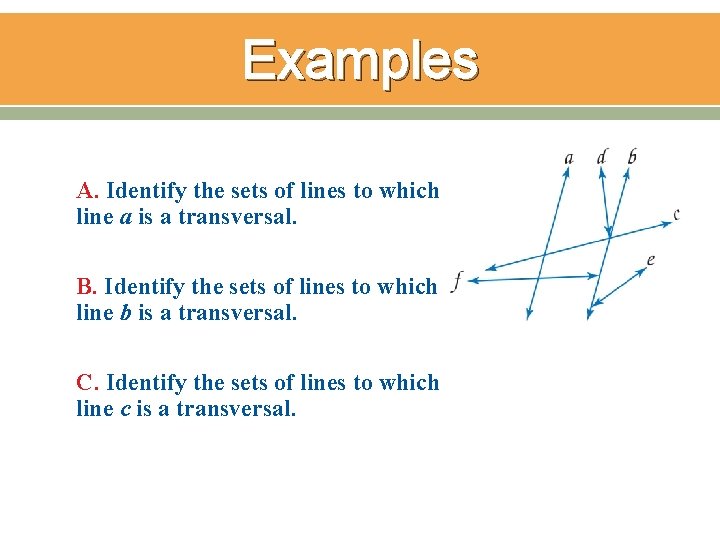
Definitions Parallel lines ( || )- coplanar lines that do not intersect (arrows on lines indicate which sets are parallel to each other) Parallel planes- two or more planes that do not intersect Skew lines- lines that do not intersect but are not parallel (are not coplanar) Transversal- a line that intersects two or more lines in a plane at different points
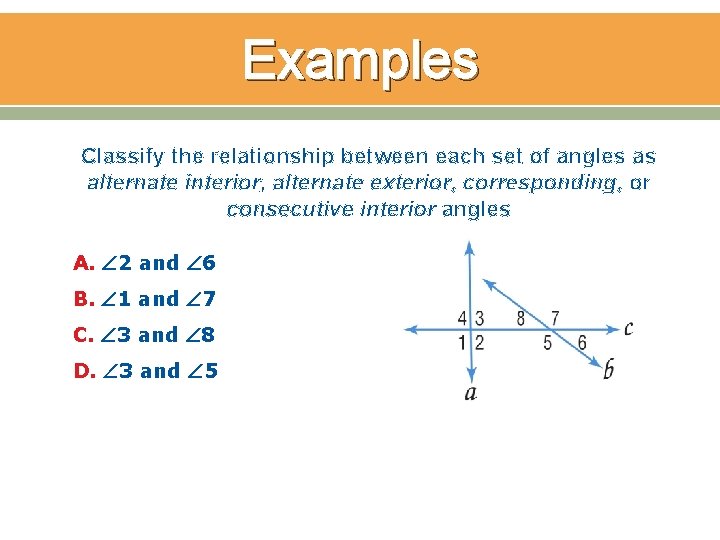
Pairs of angles formed by parallel lines and a transversal (see graphic organizer for examples) Exterior angles: outside the two parallel lines Interior angles: between the two parallel lines Consecutive Interior angles: between the two parallel lines, on the same side of the transversal Consecutive Exterior angles: outside the two parallel lines, on the same side of the transversal Alternate Exterior angles: outside the two parallel lines, on different sides of the transversal Alternate Interior angles: between the two parallel lines, on different sides of the transversal Corresponding angles: one outside the parallel lines, one inside the parallel lines and both on the same side of the transversal
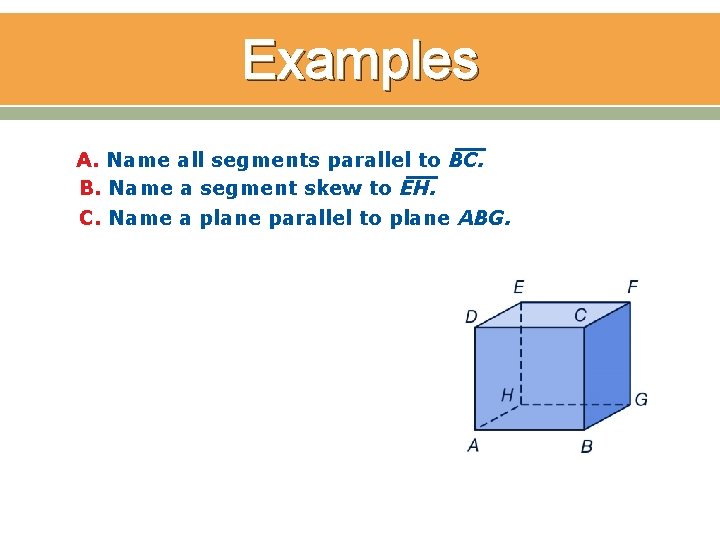
Examples A. Name all segments parallel to BC. B. Name a segment skew to EH. C. Name a plane parallel to plane ABG.
Examples Classify the relationship between each set of angles as alternate interior, alternate exterior, corresponding, or consecutive interior angles A. 2 and 6 B. 1 and 7 C. 3 and 8 D. 3 and 5
Examples A. Identify the sets of lines to which line a is a transversal. B. Identify the sets of lines to which line b is a transversal. C. Identify the sets of lines to which line c is a transversal.