
Chapter 3 ORGANIZATIONAL CULTURE AND ENVIRONMENT THE CONSTRAINTS
- Slides: 22
Chapter 3 ORGANIZATIONAL CULTURE AND ENVIRONMENT: THE CONSTRAINTS © 2003 Pearson Education Canada Inc. 3. 1
LEARNING OBJECTIVES • You should be able to: – Differentiate the symbolic from the omnipotent view of management – Define organizational culture – Identify the seven dimensions that make up an organization’s culture – Explain how cultures can be strong or weak – Describe the various ways that employees learn culture © 2003 Pearson Education Canada Inc. 3. 2
LEARNING OBJECTIVES (continued) • You should be able to: – Explain how culture constrains managers – Describe the various components in an organization’s specific and general environments – Contrast certain and uncertain environments – Identify the various stakeholders with whom managers have to deal – Clarify how managers manage relationships with external stakeholders © 2003 Pearson Education Canada Inc. 3. 3
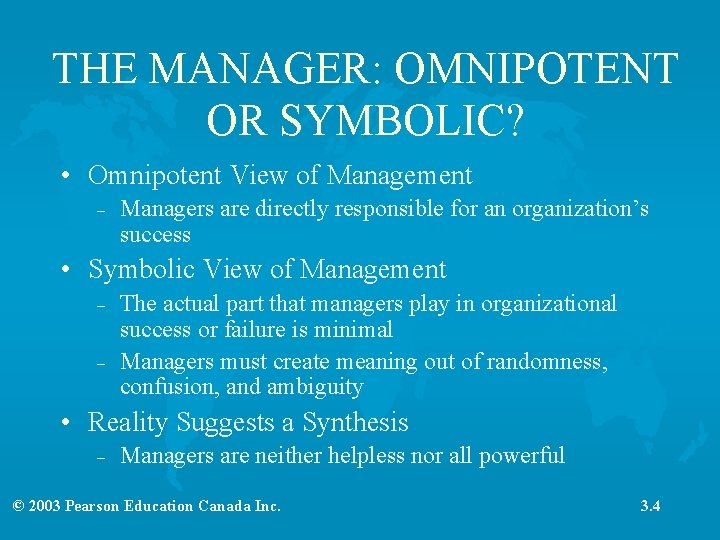
THE MANAGER: OMNIPOTENT OR SYMBOLIC? • Omnipotent View of Management – Managers are directly responsible for an organization’s success • Symbolic View of Management – – The actual part that managers play in organizational success or failure is minimal Managers must create meaning out of randomness, confusion, and ambiguity • Reality Suggests a Synthesis – Managers are neither helpless nor all powerful © 2003 Pearson Education Canada Inc. 3. 4
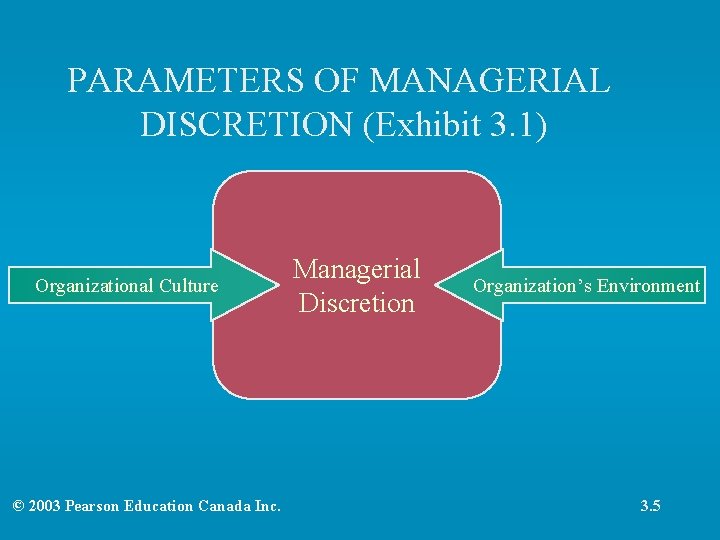
PARAMETERS OF MANAGERIAL DISCRETION (Exhibit 3. 1) Organizational Culture © 2003 Pearson Education Canada Inc. Managerial Discretion Organization’s Environment 3. 5
WHAT IS ORGANIZATIONAL CULTURE? • A system of shared meaning and beliefs held by organizational members that determines, in large degree, how they act • Composite picture of organizational culture may be derived from seven dimensions • Organization’s personality often shaped by one of these dimensions © 2003 Pearson Education Canada Inc. 3. 6
DIMENSIONS OF ORGANIZATIONAL CULTURE (Exhibit 3. 2) © 2003 Pearson Education Canada Inc. 3. 7
THE CULTURE OF AN ORGANIZATION • Strong Versus Weak Cultures – – – In strong cultures, key values are deeply held and widely shared Strong cultures have greater influence on employees than do weak cultures Employees more committed to organizations with strong cultures Strong cultures are associated with high organizational performance Most organizations have moderate to strong cultures © 2003 Pearson Education Canada Inc. 3. 8
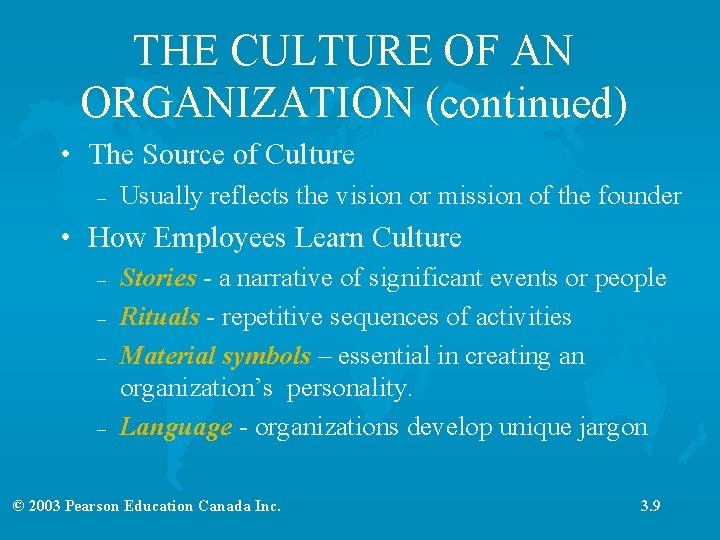
THE CULTURE OF AN ORGANIZATION (continued) • The Source of Culture – Usually reflects the vision or mission of the founder • How Employees Learn Culture – – Stories - a narrative of significant events or people Rituals - repetitive sequences of activities Material symbols – essential in creating an organization’s personality. Language - organizations develop unique jargon © 2003 Pearson Education Canada Inc. 3. 9
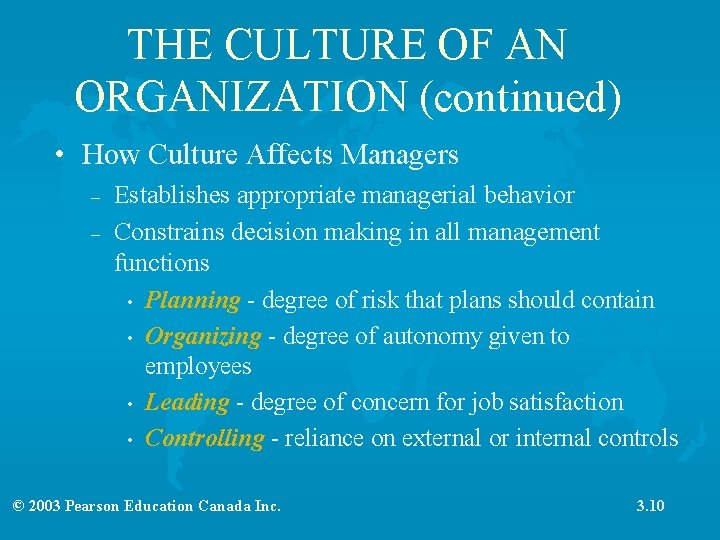
THE CULTURE OF AN ORGANIZATION (continued) • How Culture Affects Managers – – Establishes appropriate managerial behavior Constrains decision making in all management functions • Planning - degree of risk that plans should contain • Organizing - degree of autonomy given to employees • Leading - degree of concern for job satisfaction • Controlling - reliance on external or internal controls © 2003 Pearson Education Canada Inc. 3. 10
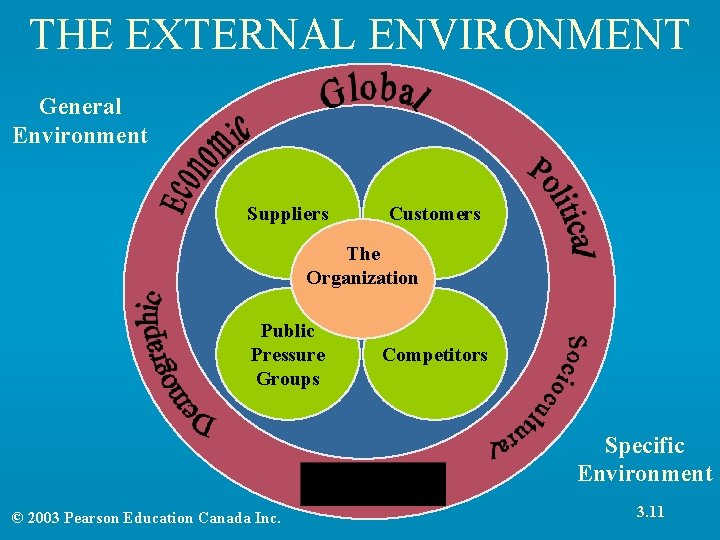
THE EXTERNAL ENVIRONMENT General Environment Suppliers Customers The Organization Public Pressure Groups Competitors Specific Environment © 2003 Pearson Education Canada Inc. 3. 11
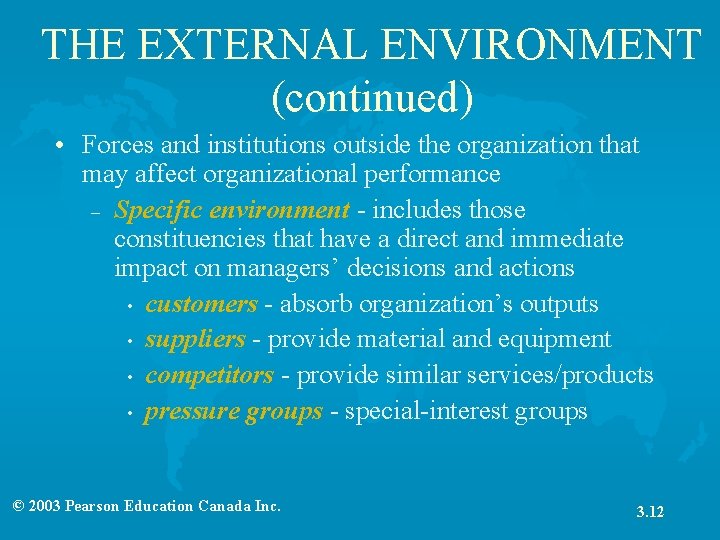
THE EXTERNAL ENVIRONMENT (continued) • Forces and institutions outside the organization that may affect organizational performance – Specific environment - includes those constituencies that have a direct and immediate impact on managers’ decisions and actions • customers - absorb organization’s outputs • suppliers - provide material and equipment • competitors - provide similar services/products • pressure groups - special-interest groups © 2003 Pearson Education Canada Inc. 3. 12
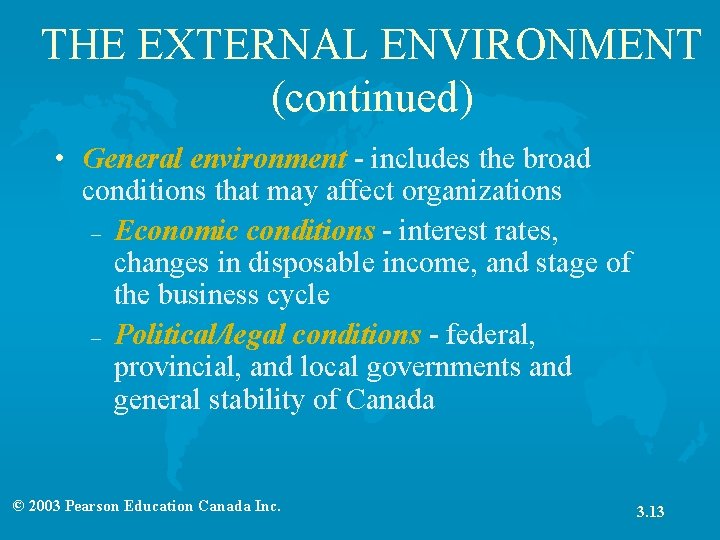
THE EXTERNAL ENVIRONMENT (continued) • General environment - includes the broad conditions that may affect organizations – Economic conditions - interest rates, changes in disposable income, and stage of the business cycle – Political/legal conditions - federal, provincial, and local governments and general stability of Canada © 2003 Pearson Education Canada Inc. 3. 13
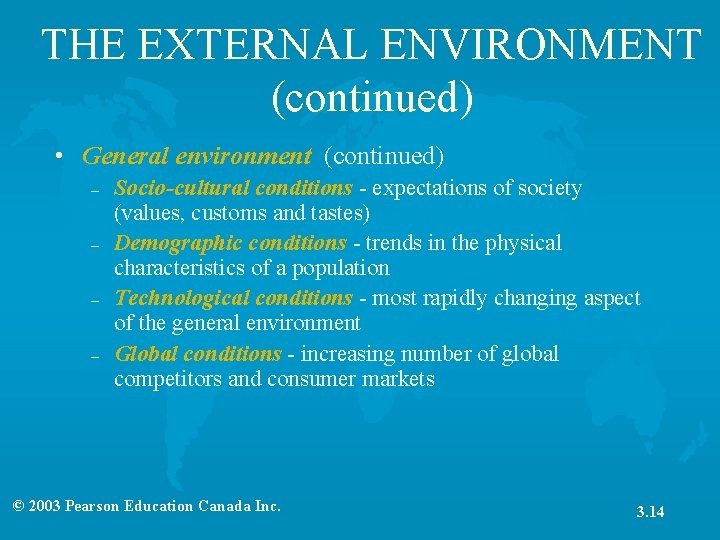
THE EXTERNAL ENVIRONMENT (continued) • General environment (continued) – – Socio-cultural conditions - expectations of society (values, customs and tastes) Demographic conditions - trends in the physical characteristics of a population Technological conditions - most rapidly changing aspect of the general environment Global conditions - increasing number of global competitors and consumer markets © 2003 Pearson Education Canada Inc. 3. 14
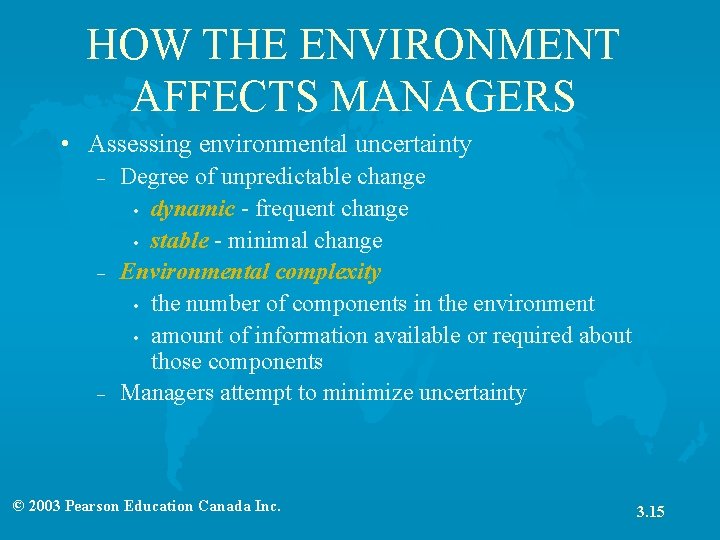
HOW THE ENVIRONMENT AFFECTS MANAGERS • Assessing environmental uncertainty – – – Degree of unpredictable change • dynamic - frequent change • stable - minimal change Environmental complexity • the number of components in the environment • amount of information available or required about those components Managers attempt to minimize uncertainty © 2003 Pearson Education Canada Inc. 3. 15
ENVIRONMENTAL UNCERTAINTY (Exhibit 3. 6) © 2003 Pearson Education Canada Inc. 3. 16
STAKEHOLDER RELATIONSHIP MANAGEMENT • Who are stakeholders? – Any constituencies that are affected by the organization’s decisions and actions • • include internal and external groups can influence the organization © 2003 Pearson Education Canada Inc. 3. 17
ORGANIZATIONAL STAKEHOLDERS (Exhibit 3. 7) © 2003 Pearson Education Canada Inc. 3. 18
STAKEHOLDER RELATIONSHIP MANAGEMENT (continued) • Why is stakeholder relationship management important? – – The more secure the relationship, the more influence managers will have over organizational outcomes It’s the “right” thing to do © 2003 Pearson Education Canada Inc. 3. 19
STAKEHOLDER RELATIONSHIP MANAGEMENT (continued) • How can these relationships be managed? – Four steps identify the stakeholders • determine real and potential concerns of each stakeholder group • determine whether stakeholder is critical • determine specific approach to manage the relationship Approach to a stakeholder group based on the importance of the group and the degree of environmental uncertainty • – © 2003 Pearson Education Canada Inc. 3. 20
MANAGING STAKEHOLDER RELATIONSHIPS (Exhibit 3. 8) © 2003 Pearson Education Canada Inc. 3. 21
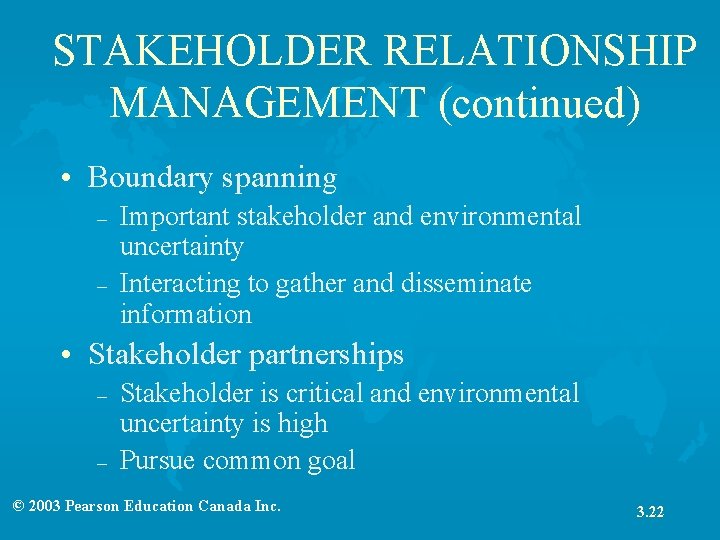
STAKEHOLDER RELATIONSHIP MANAGEMENT (continued) • Boundary spanning – – Important stakeholder and environmental uncertainty Interacting to gather and disseminate information • Stakeholder partnerships – – Stakeholder is critical and environmental uncertainty is high Pursue common goal © 2003 Pearson Education Canada Inc. 3. 22