
Chapter 3 Optical ComponentsDevices OPTICAL FIBER PASSIVE DEVICES
Chapter 3 Optical Components/Devices
OPTICAL FIBER PASSIVE DEVICES: COUPLERS, ISOLATORS, CIRCULATORS, BRAGG GRATINGS AND ATTENUATORS

Optical Passive Devices Passive Components i. Couplers ii. Isolators iii. Circulators iv. Fiber Bragg Gratings v. Attenuator
Introduction • In electrical circuits, passive components refer to resistors, capacitors, and inductors elements that overall consume power. On the other hand, active components deliver power to a system. • In fiber optic systems, passive components typically refer to those that are not involved in opto-electric conversion, i. e. , they neither generate nor detect light. Instead they are involved in guiding or manipulating the light without adding energy to it.
Splitters and Couplers • It becomes necessary to combine two or more optical signals into one stream or to divide a single optical signal into several branches for different purposes. • An obvious example of combining several signals is in the case of WDM systems, where several signals of different wavelengths need to be combined into one WDM signal which can then be transmitted on a single fiber. • An example of dividing a single signal into multiple signals is when the received signal at an optical receiver is split into two paths, one path goes to the receiver and the other path goes to an optical power meter to monitor the power level at the receiver. A coupler is a device that can achieve this function.

Coupler Figure 1: A 2× 2 coupler
Coupler • The coupler has four ports, numbered from 1 to 4 in the Figure 1. This device is usually made by twisting two pairs of fibers together and then pulling them while heating the twisted area. • As a result, the two claddings fuse and the thickness of cladding at the twisted area reduces, allowing modes to couple from one fiber to the other.
Coupler • When light propagates in one fiber, the evanescent fields in the cladding generate guided waves in the other fiber. • The energy oscillates back and forth between the two fibers as a function of the coupling distance and the radius of the fibers. Therefore by controlling these parameters the coupling ratio can be controlled. • In general, the power entering from one side splits between the two outputs on the other side.
Coupler • Refer to Figure 1: Let us assume a signal is applied to port 1 as the input. It will then split between the two outputs, ports 3 and 4. If the optical power associated with the input and outputs are PIN, POUT 1, and POUT 2, for an ideal lossless coupler, we have PIN =POUT 1+POUT 2
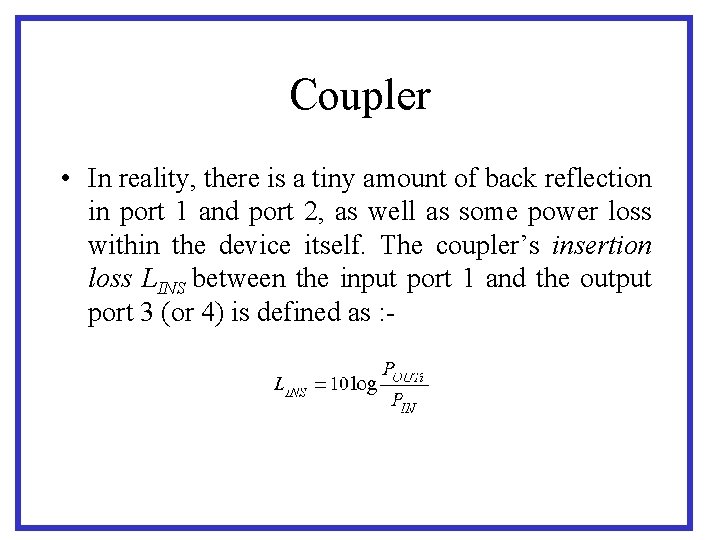
Coupler • In reality, there is a tiny amount of back reflection in port 1 and port 2, as well as some power loss within the device itself. The coupler’s insertion loss LINS between the input port 1 and the output port 3 (or 4) is defined as : -
Coupler • where i=1, 2. If the power is split equally between ports 3 and 4, the power for each of the outputs is half of the input power. In this case, the device is known as 50/50 splitter or a 3 d. B coupler. • Obviously the insertion loss for both outputs is 3 d. B in this case. On the other hand, a highly asymmetric splitting ratio can beused to tap off a small portion of the signal, for instance, for monitoring purposes.
Optical Couplers Losses: a. Excess loss (The Ratio of the input power to the total output power). The light energy has been scattered or absorbed within the coupler and is not available at the output. b. Crosstalk or directionality When we apply power to 1, we expect it to come out of port 2 and 3 but not out of port 4, the other input port. Because of backscatter within the coupler, some energy is reflected back and appear at port 4. This backscatter is very slightly and is called directionality loss or crosstalk.
Optical Couplers c. Insertion loss Refers to the loss for a particular port-to-port path. For example, for the path from input port i to output port j. This looks at a single output power compared with the input power. There are two possibilities, the power coming out of port 2 and compare it with the input power at port 1 or port 3 compared with input power port 1.
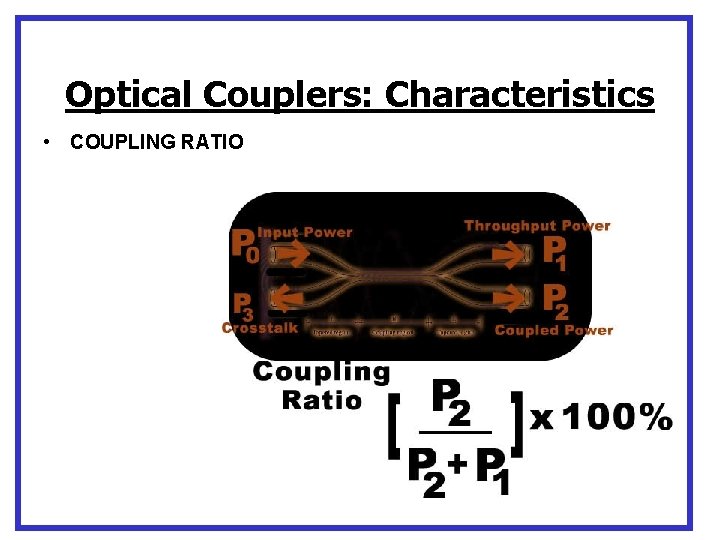
Optical Couplers: Characteristics • COUPLING RATIO
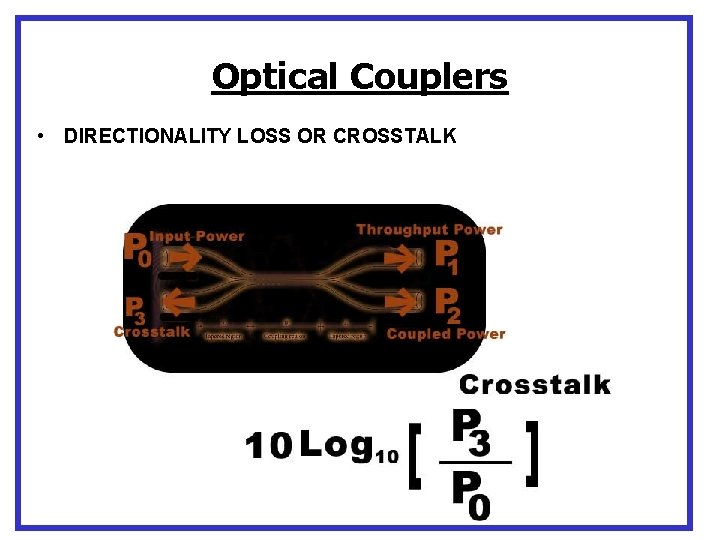
Optical Couplers • DIRECTIONALITY LOSS OR CROSSTALK
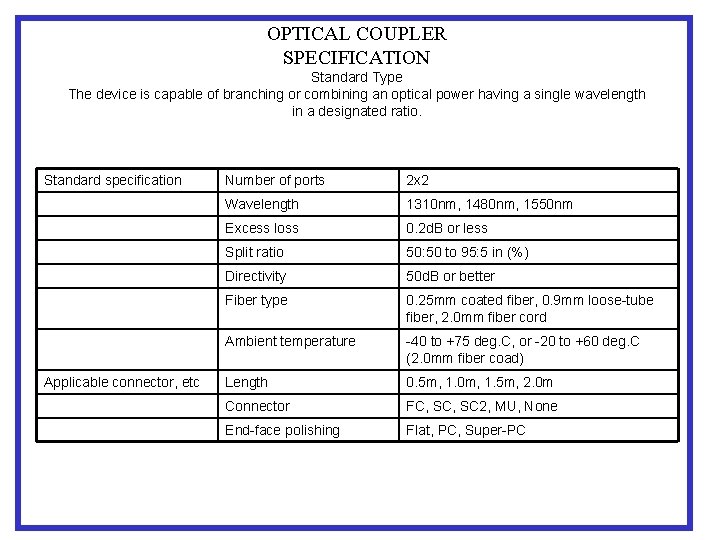
OPTICAL COUPLER SPECIFICATION Standard Type The device is capable of branching or combining an optical power having a single wavelength in a designated ratio. Standard specification Applicable connector, etc Number of ports 2 x 2 Wavelength 1310 nm, 1480 nm, 1550 nm Excess loss 0. 2 d. B or less Split ratio 50: 50 to 95: 5 in (%) Directivity 50 d. B or better Fiber type 0. 25 mm coated fiber, 0. 9 mm loose-tube fiber, 2. 0 mm fiber cord Ambient temperature -40 to +75 deg. C, or -20 to +60 deg. C (2. 0 mm fiber coad) Length 0. 5 m, 1. 0 m, 1. 5 m, 2. 0 m Connector FC, SC 2, MU, None End-face polishing Flat, PC, Super-PC
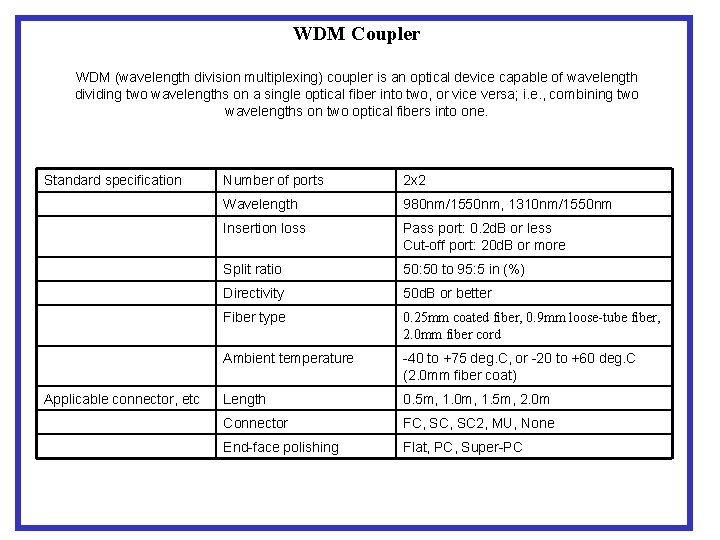
WDM Coupler WDM (wavelength division multiplexing) coupler is an optical device capable of wavelength dividing two wavelengths on a single optical fiber into two, or vice versa; i. e. , combining two wavelengths on two optical fibers into one. Standard specification Applicable connector, etc Number of ports 2 x 2 Wavelength 980 nm/1550 nm, 1310 nm/1550 nm Insertion loss Pass port: 0. 2 d. B or less Cut-off port: 20 d. B or more Split ratio 50: 50 to 95: 5 in (%) Directivity 50 d. B or better Fiber type 0. 25 mm coated fiber, 0. 9 mm loose-tube fiber, 2. 0 mm fiber cord Ambient temperature -40 to +75 deg. C, or -20 to +60 deg. C (2. 0 mm fiber coat) Length 0. 5 m, 1. 0 m, 1. 5 m, 2. 0 m Connector FC, SC 2, MU, None End-face polishing Flat, PC, Super-PC
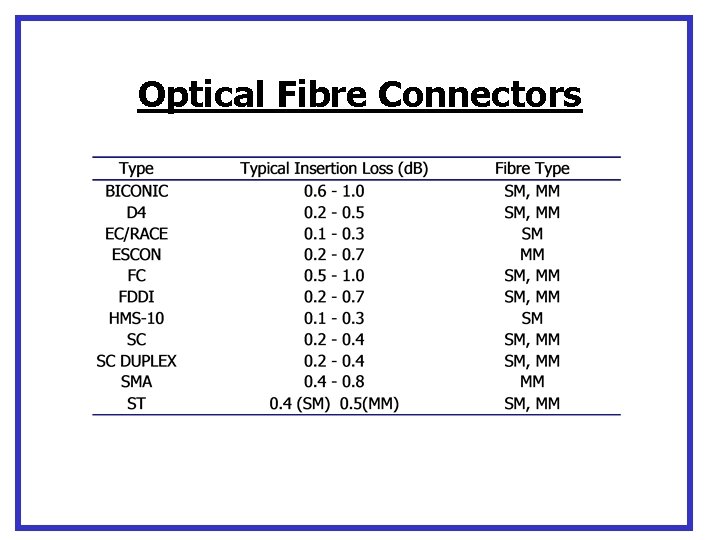
Optical Fibre Connectors
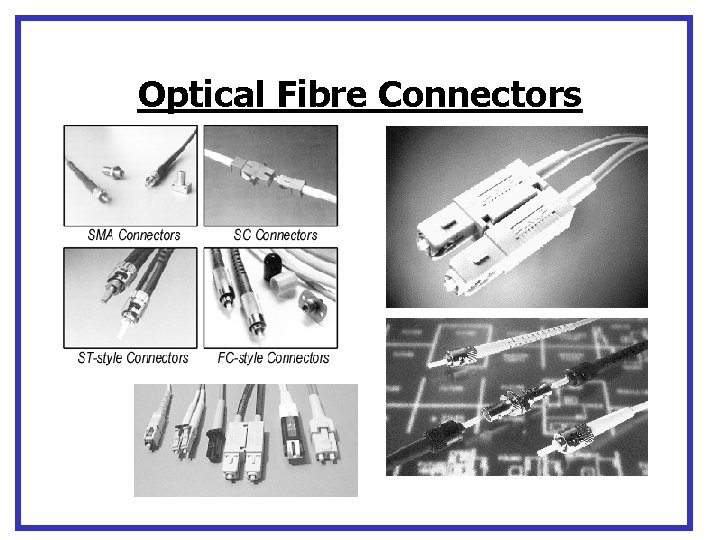
Optical Fibre Connectors
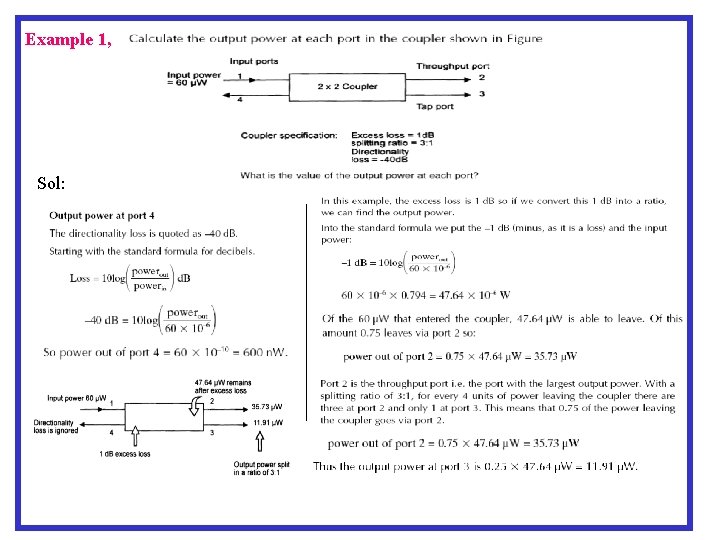
Example 1, Sol:
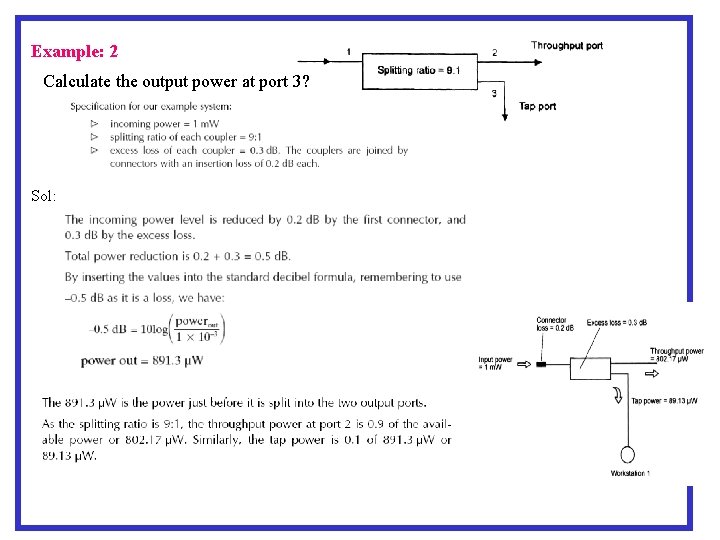
Example: 2 Calculate the output power at port 3? Sol:
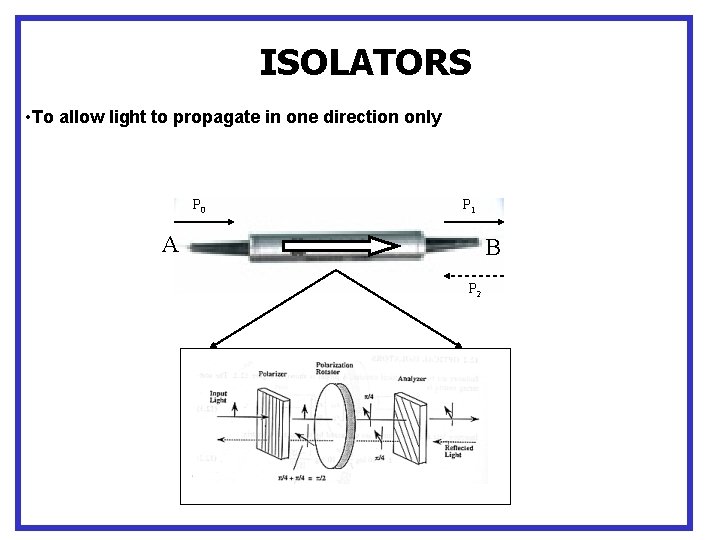
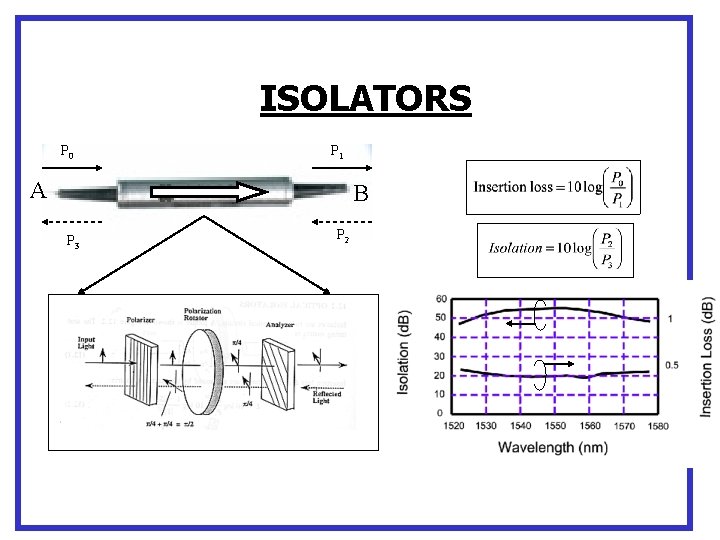
ISOLATORS • To allow light to propagate in one direction only P 0 P 1 A B P 2
ISOLATORS • As light travels along fibers and connectors, there are many opportunities for back reflection. These reflections usually happen when light passes through an interface perpendicular to the direction of light propagation. • An angled interface, such as in an APC connector, significantly reduces such reflections. However, in most cases one does not have control over all the link parameters, and it is necessary to reduce the effects of any potential reflection on sensitive devices such as DFB lasers. • In such cases, an isolator is used to reduce the amount of light reaching back to the laser.
ISOLATORS • Isolators normally work on the principle of rotation of the light polarization by a Faraday rotator. As Fig. 2 shows, the isolator consists of two polarizer plates that are at 45° angle with respect to each other with a Faraday rotator placed in between them.
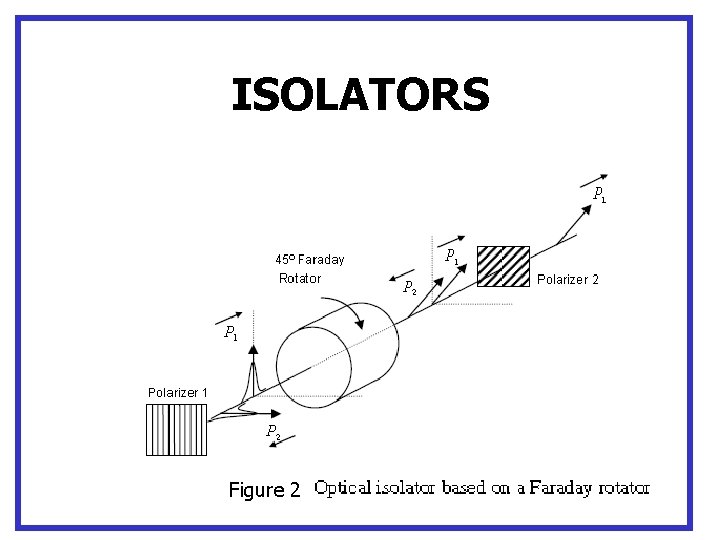
ISOLATORS Figure 2
ISOLATORS • Let us first consider a pulse of light, P 1, which is propagating from left to right. After passing through polarizer 1, the light is polarized in the vertical direction. • Then the light enters the Faraday rotator which is subject to an external magnetic field usually provided by a permanent magnet. The Faraday rotator rotates the polarization plane of the light in proportion to its length and the strength of the applied magnetic field. For this application, the length of the Faraday rotator is chosen such that the plane of polarization rotates by 45°.
ISOLATORS • Thus, once P 1 goes through the rotator its polarization plane has rotated by 45°. At the output plane, a second polarizer plate is inserted whose axis of polarization is also at 45° with respect to polarizer 1. As a result, P 1 can go through polarizer 2 with little attenuation. • It can be seen, therefore, that light can travel through the system from left to right with relatively little attenuation, except possibly for the attenuation due to the filtering of unpolarized light by the first polarizer (if the input light is unpolarized before it enters the isolator).
ISOLATORS • Now consider a pulse travelling from right to left. Once it passes through polarizer 2, it will be polarized at 45°, as represented by P 2 in Figure 2. Then it goes through the Faraday rotator, which rotates the polarization plane by another 45°. • Thus, once P 2 arrives at polarizer 1, its polarization plane is perpendicular to that of polarizer 1. Therefore, it is almost completely absorbed by polarizer 1, and very little of it gets through the system. This means any light propagating through the system from right to left experiences a large amount of attenuation. As a result, the isolator passes light in one direction and blocks it in the opposite direction.
ISOLATORS • Practical isolators can provide around 40 d. B of isolation, with an insertion loss of around 1 d. B. • As noted before, they are widely used on the output of DFB lasers to prevent any back reflected light from entering the laser cavity and causing instability in the laser output
ISOLATORS P 0 P 1 A B P 3 P 2
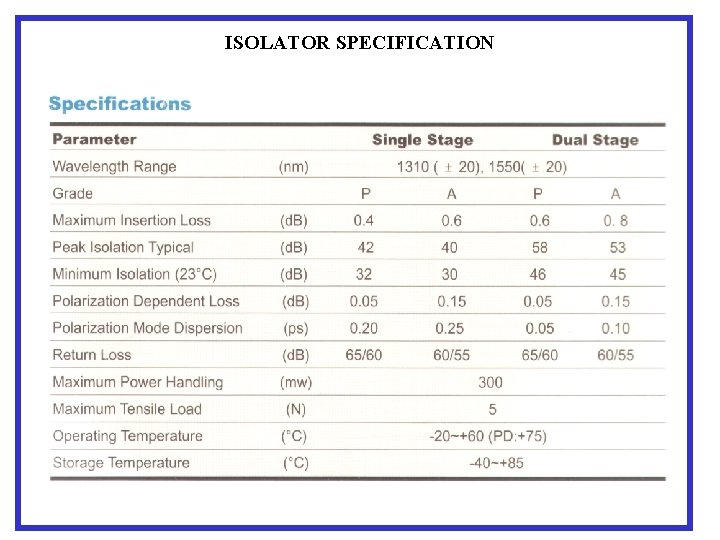
ISOLATOR SPECIFICATION
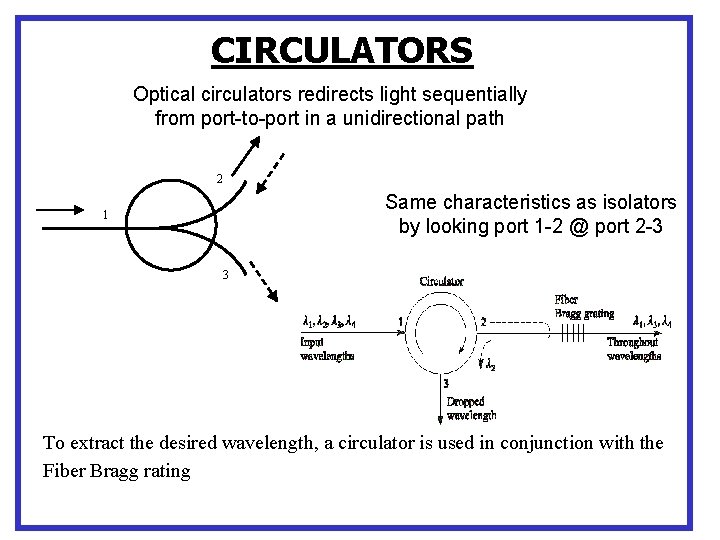
CIRCULATORS Optical circulators redirects light sequentially from port-to-port in a unidirectional path 2 Same characteristics as isolators by looking port 1 -2 @ port 2 -3 1 3 To extract the desired wavelength, a circulator is used in conjunction with the Fiber Bragg rating
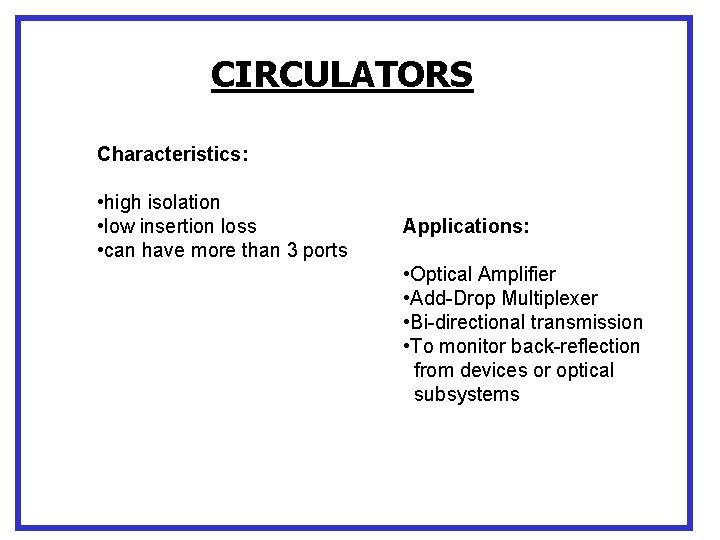
CIRCULATORS Characteristics: • high isolation • low insertion loss • can have more than 3 ports Applications: • Optical Amplifier • Add-Drop Multiplexer • Bi-directional transmission • To monitor back-reflection from devices or optical subsystems
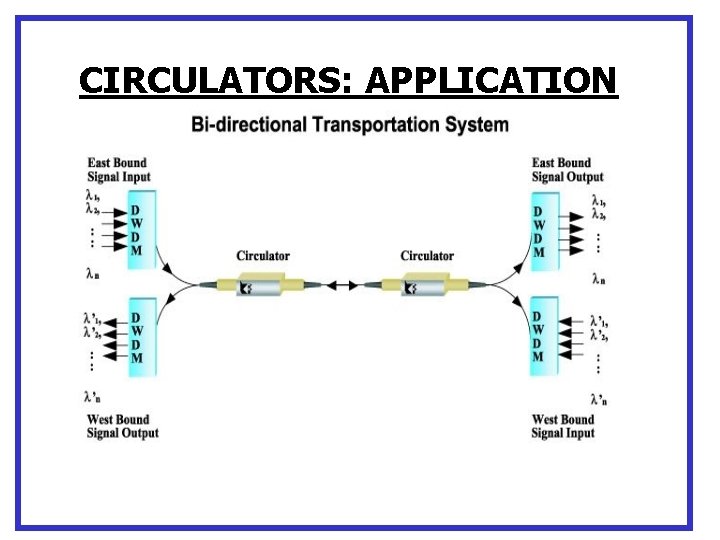
CIRCULATORS: APPLICATION
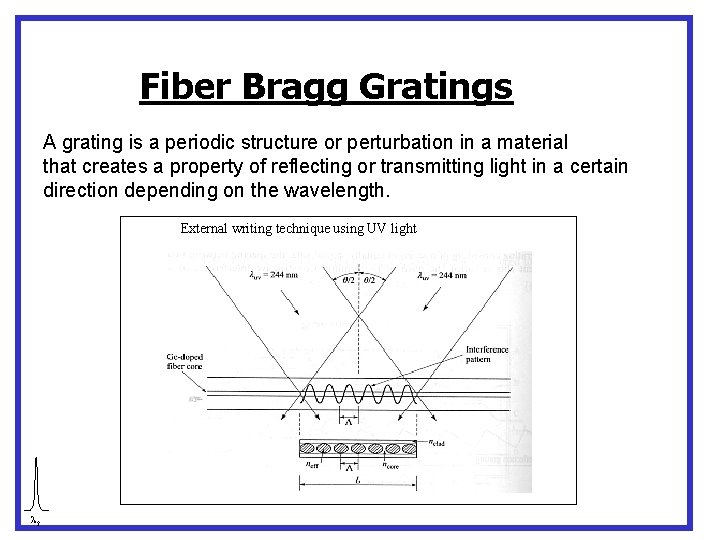
Fiber Bragg Gratings A grating is a periodic structure or perturbation in a material that creates a property of reflecting or transmitting light in a certain direction depending on the wavelength. External writing technique using UV light l 2
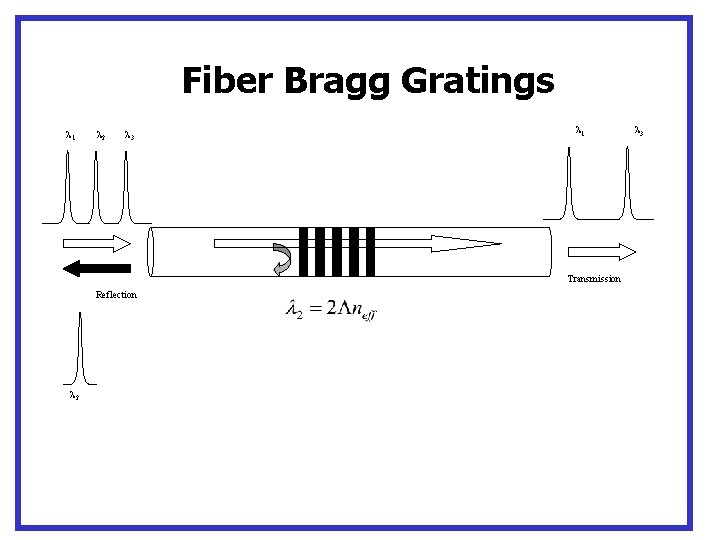
Fiber Bragg Gratings l 1 l 2 l 3 l 1 Transmission Reflection l 2 l 3
Fiber Bragg Gratings
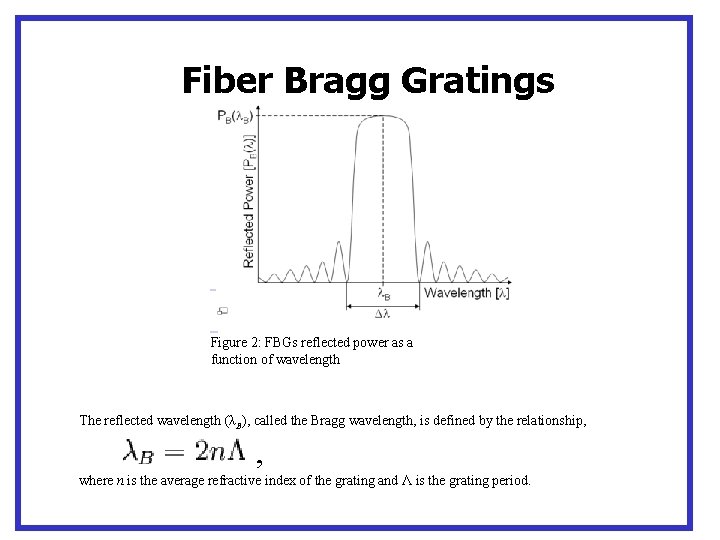
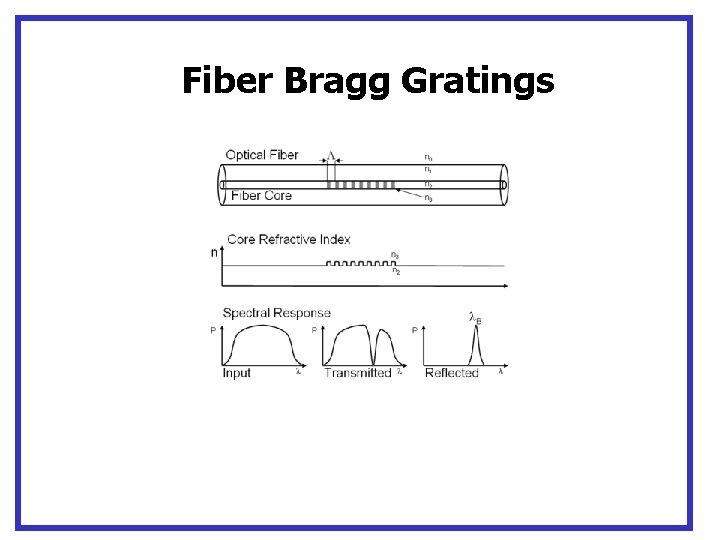
Fiber Bragg Gratings Figure 2: FBGs reflected power as a function of wavelength The reflected wavelength (λB), called the Bragg wavelength, is defined by the relationship, , where n is the average refractive index of the grating and Λ is the grating period.
Fiber Bragg Gratings Characteristics: • high reflectivity to be used as a filter • low insertion loss • low cost/simple packaging
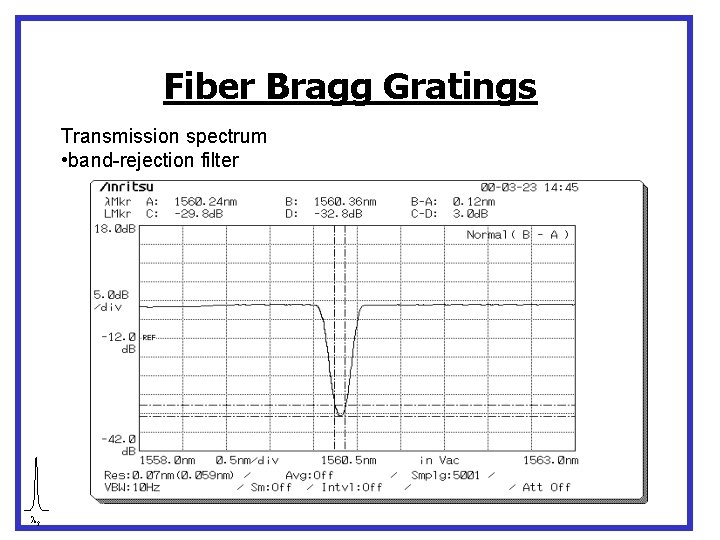
Fiber Bragg Gratings Transmission spectrum • band-rejection filter l 2
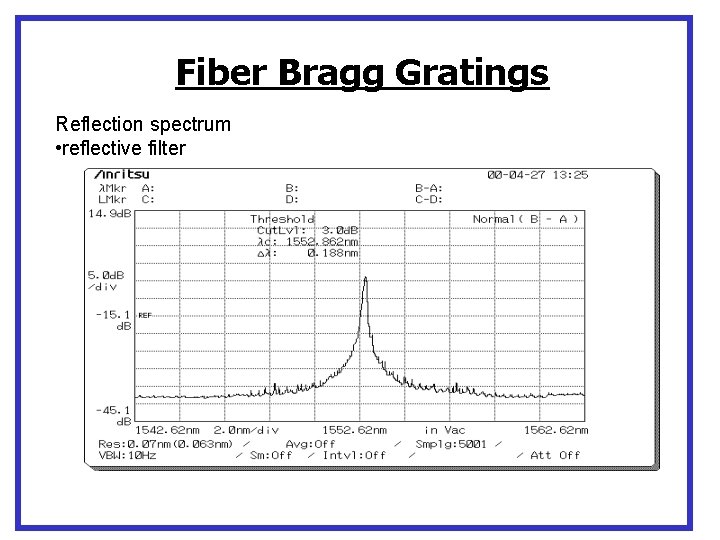
Fiber Bragg Gratings Reflection spectrum • reflective filter
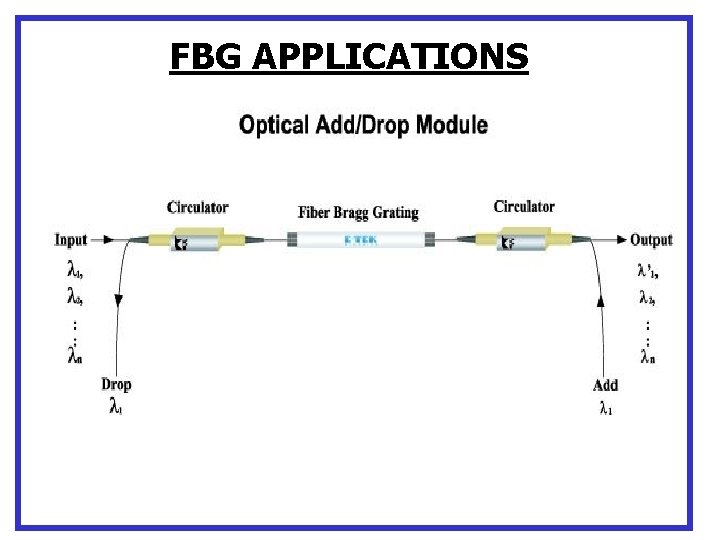
FBG APPLICATIONS
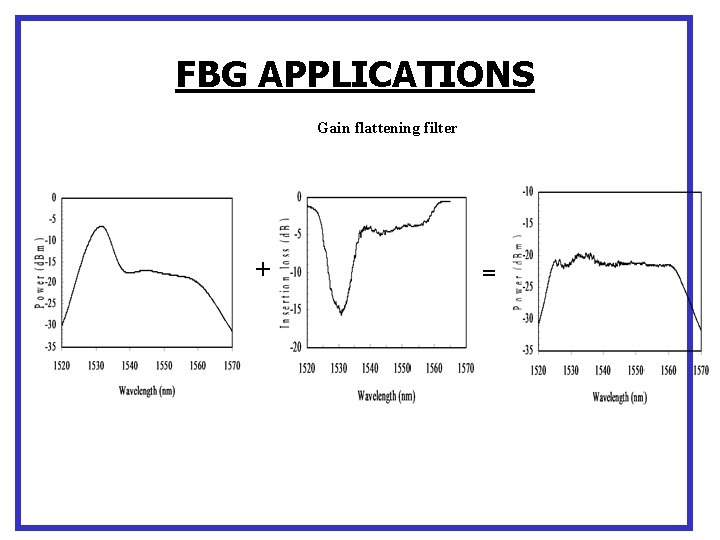
FBG APPLICATIONS Gain flattening filter + =
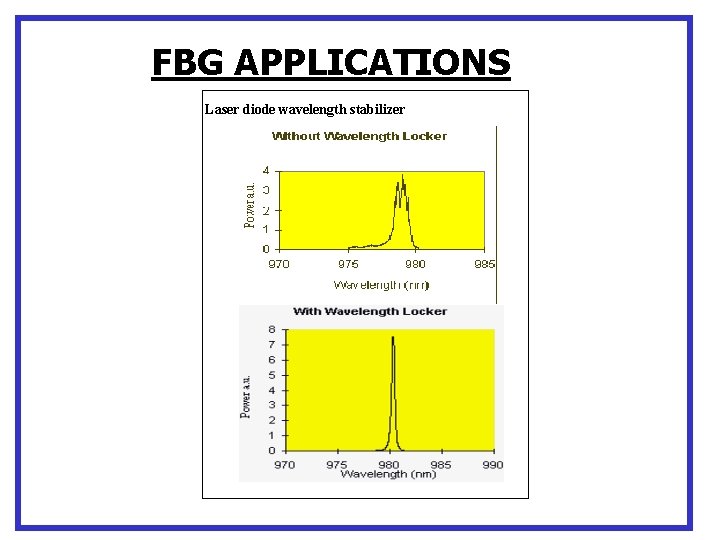
FBG APPLICATIONS Laser diode wavelength stabilizer
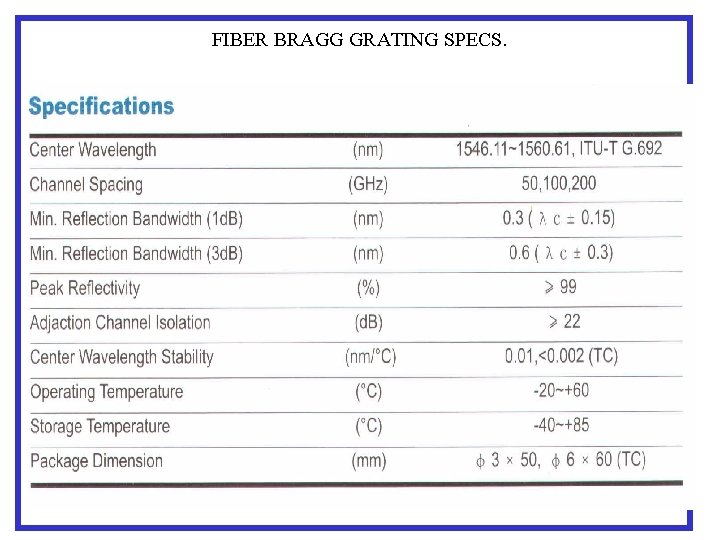
FIBER BRAGG GRATING SPECS.
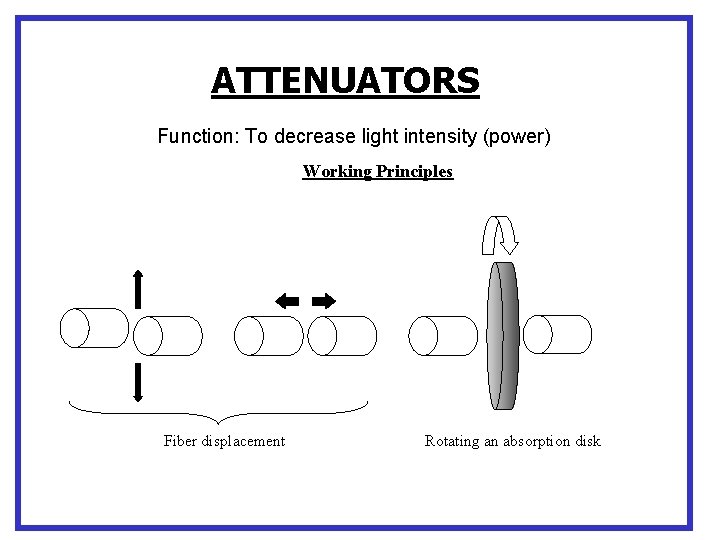
ATTENUATORS Function: To decrease light intensity (power) Working Principles Fiber displacement Rotating an absorption disk
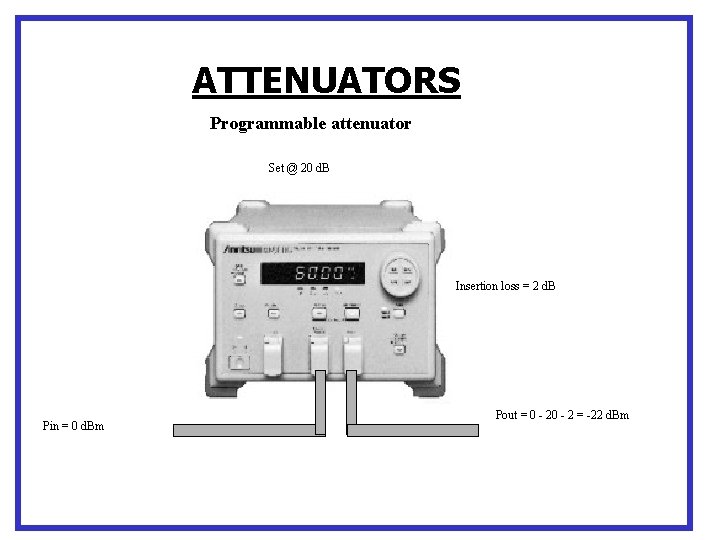
ATTENUATORS Programmable attenuator Set @ 20 d. B Insertion loss = 2 d. B Pin = 0 d. Bm Pout = 0 - 2 = -22 d. Bm
ATTENUATORS Characteristics: • low insertion loss • dynamic attenuation range • wide range of operating wavelength • high return loss Applications: • adjust optical power to the dynamic range of receivers • equalize power between different WDM signals • To avoid receiver saturation
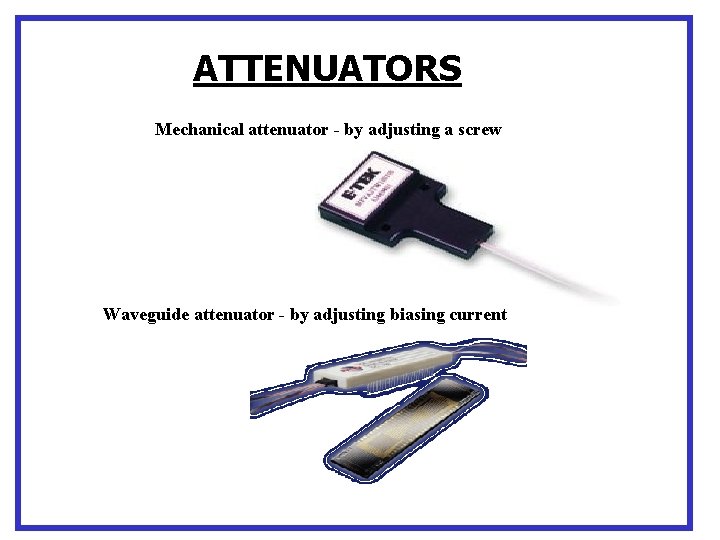
ATTENUATORS Mechanical attenuator - by adjusting a screw Waveguide attenuator - by adjusting biasing current
ATTENUATORS • Sometimes it becomes necessary to attenuate an optical signal by a known amount. For example, the power output from a transmitter may be more than what a receiver can handle. • Another common case is when an optical signal needs to be analyzed by a piece of equipment, but the power is beyond the optimum input range of the equipment. In such cases, an optical attenuator can be used to reduce the signal power
ATTENUATORS • Optical attenuators can be either fixed or variable. A fixed attenuator is used in cases where the required amount of attenuation is constant. • A fixed amount of attenuation can be achieved in a variety of ways. One way is to use a splitter. • There also devices specifically designed to work as an attenuator. These are typically coupling sleeves that incorporate a stop that ensures a predetermined air gap between the fiber ferrules. Alternatively, a metal-doped fiber with high absorption coefficient can be inserted in the path of the signal. As a result, the light experiences a fixed amount of attenuation as it passes through the device. • These attenuators are available for different kinds of connectors and in various attenuation values. Standard connector types are SC, FC, ST, and LC, and typical attenuation values are from 1 to 20 d. B.
ATTENUATORS • Variable attenuators are somewhat more sophisticated. We noted there are several factors can reduce the coupling between two fibers. In principle, by controlling any of those factors the attenuation can be varied. For instance, by changing the air gap between the two fibers, a variable attenuator can be achieved. However, because of the very high sensitivity of coupling loss to mechanical parameters (such as air gap or alignment), controlling and calibrating the attenuation is challenging. • As a result, mechanical variable attenuators tend to be rather bulky, expensive, and more like a piece of equipment rather than a simple device. • Microelectromechanical systems (MEMS) technology can also be used to build variable attenuators. MEMS devices are faster, smaller in size, and consume less supply power. As a result, these devices are becoming increasingly popular as MEMS technology matures.
- Slides: 52