
CHAPTER 3 Number Systems The Architecture of Computer
CHAPTER 3: Number Systems The Architecture of Computer Hardware and Systems Software & Networking: An Information Technology Approach 4 th Edition, Irv Englander John Wiley and Sons 2010 Power. Point slides authored by Wilson Wong, Bentley University Power. Point slides for the 3 rd edition were co-authored with Lynne Senne, Bentley University
Why Binary? § Early computer design was decimal § Mark I and ENIAC § John von Neumann proposed binary data processing (1945) § Simplified computer design § Used for both instructions and data § Natural relationship between on/off switches and calculation using Boolean logic Copyright 2010 John Wiley & Sons, Inc. On Off True False Yes No 1 0 3 -2
Counting and Arithmetic § Decimal or base 10 number system § Origin: counting on the fingers § “Digit” from the Latin word digitus meaning “finger” § Base: the number of different digits including zero in the number system § Example: Base 10 has 10 digits, 0 through 9 § § Binary or base 2 Bit (binary digit): 2 digits, 0 and 1 Octal or base 8: 8 digits, 0 through 7 Hexadecimal or base 16: 16 digits, 0 through F § Examples: 1010 = A 16; 1110 = B 16 Copyright 2010 John Wiley & Sons, Inc. 3 -3
Keeping Track of the Bits § Bits commonly stored and manipulated in groups § 8 bits = 1 byte § 4 bytes = 1 word (in many systems) § Number of bits used in calculations § Affects accuracy of results § Limits size of numbers manipulated by the computer Copyright 2010 John Wiley & Sons, Inc. 3 -4
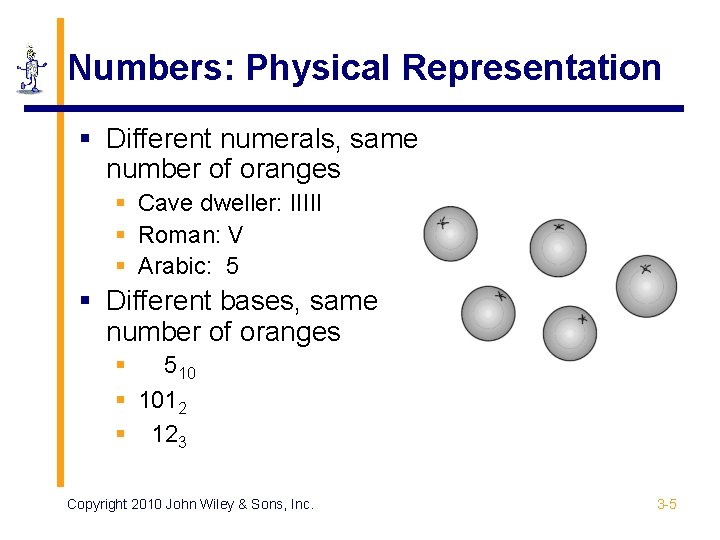
Numbers: Physical Representation § Different numerals, same number of oranges § Cave dweller: IIIII § Roman: V § Arabic: 5 § Different bases, same number of oranges § 510 § 1012 § 123 Copyright 2010 John Wiley & Sons, Inc. 3 -5
Number System § Roman: position independent § Modern: based on positional notation (place value) § Decimal system: system of positional notation based on powers of 10. § Binary system: system of positional notation based powers of 2 § Octal system: system of positional notation based on powers of 8 § Hexadecimal system: system of positional notation based powers of 16 Copyright 2010 John Wiley & Sons, Inc. 3 -6
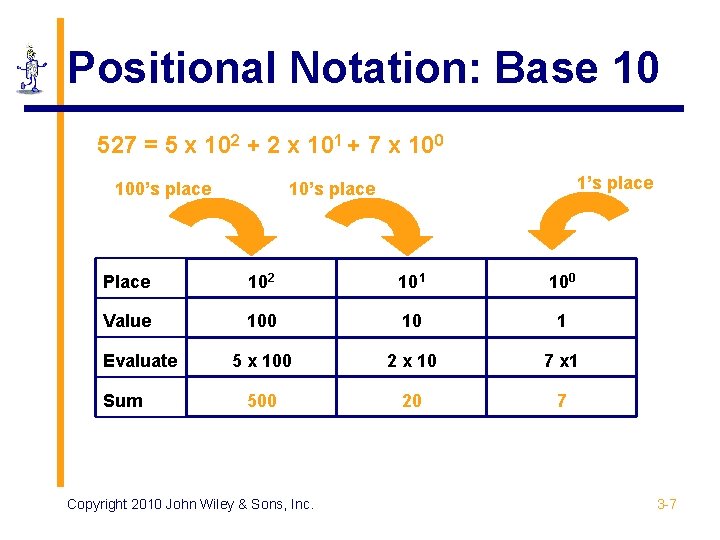
Positional Notation: Base 10 527 = 5 x 10² + 2 x 101 + 7 x 100’s place 10’s place Place 102 101 100 Value 100 10 1 5 x 100 2 x 10 7 x 1 500 20 7 Evaluate Sum Copyright 2010 John Wiley & Sons, Inc. 3 -7
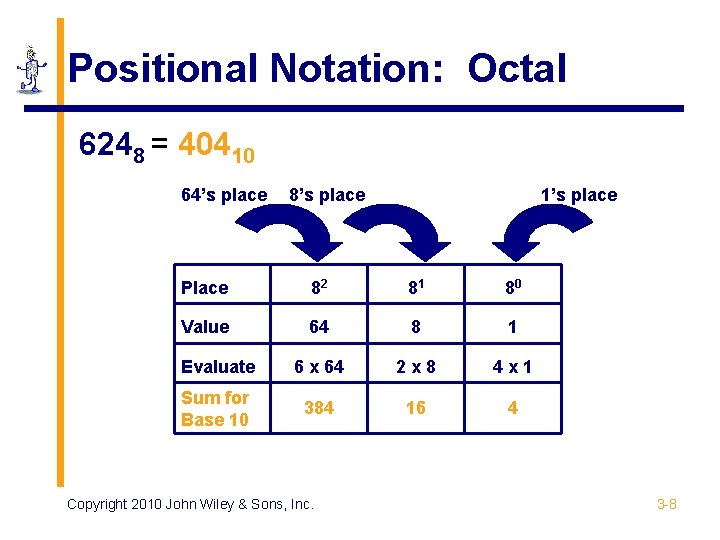
Positional Notation: Octal 6248 = 40410 64’s place 8’s place 1’s place Place 82 81 80 Value 64 8 1 Evaluate 6 x 64 2 x 8 4 x 1 Sum for Base 10 384 16 4 Copyright 2010 John Wiley & Sons, Inc. 3 -8
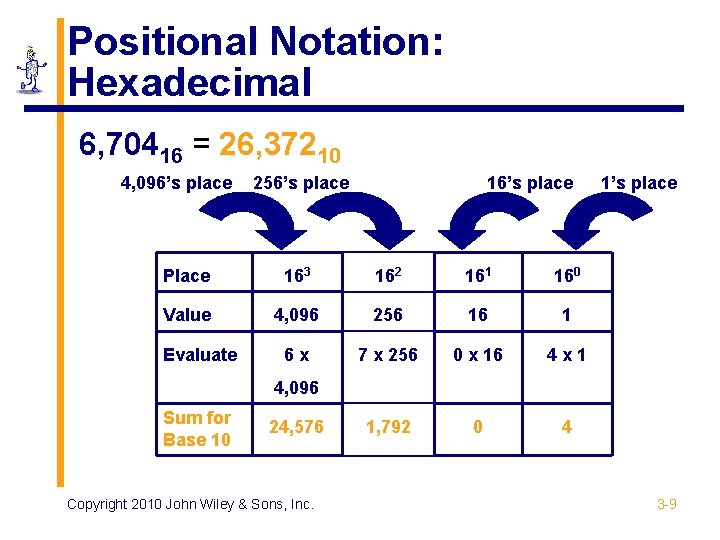
Positional Notation: Hexadecimal 6, 70416 = 26, 37210 4, 096’s place 256’s place 16’s place Place 163 162 161 160 Value 4, 096 256 16 1 6 x 7 x 256 0 x 16 4 x 1 1, 792 0 4 Evaluate 1’s place 4, 096 Sum for Base 10 24, 576 Copyright 2010 John Wiley & Sons, Inc. 3 -9
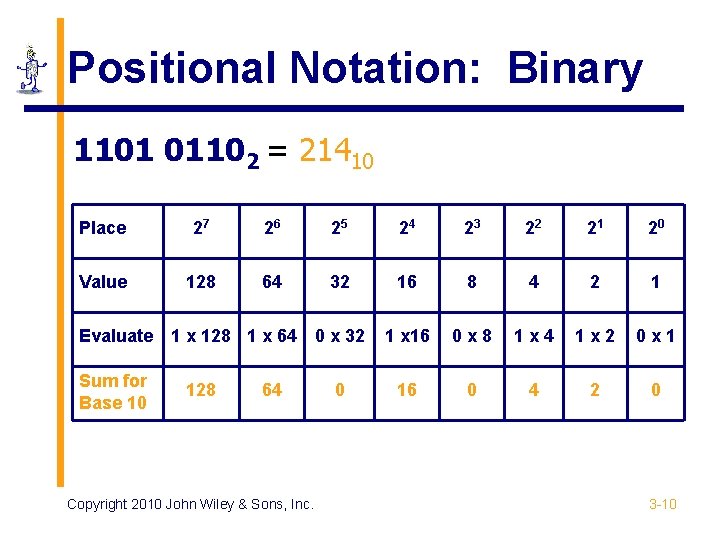
Positional Notation: Binary 1101 01102 = 21410 Place 27 26 25 24 23 22 21 20 Value 128 64 32 16 8 4 2 1 1 x 16 0 x 8 1 x 4 1 x 2 0 x 1 16 0 4 2 0 Evaluate Sum for Base 10 1 x 128 1 x 64 0 x 32 128 64 Copyright 2010 John Wiley & Sons, Inc. 0 3 -10
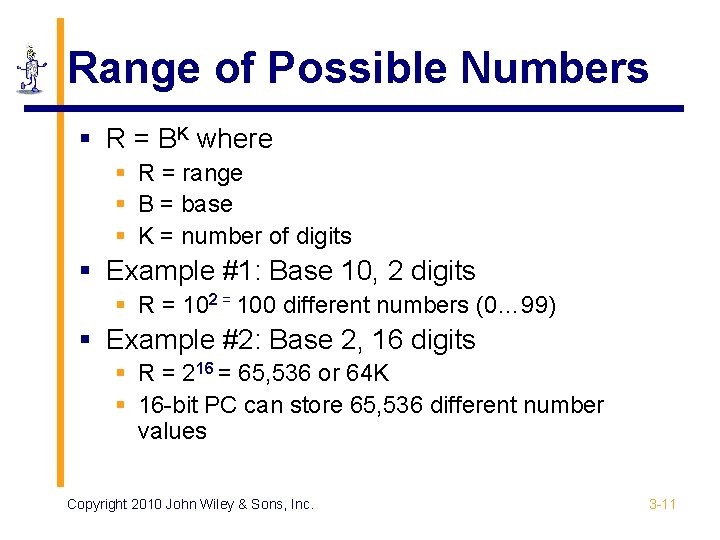
Range of Possible Numbers § R = BK where § R = range § B = base § K = number of digits § Example #1: Base 10, 2 digits § R = 102 = 100 different numbers (0… 99) § Example #2: Base 2, 16 digits § R = 216 = 65, 536 or 64 K § 16 -bit PC can store 65, 536 different number values Copyright 2010 John Wiley & Sons, Inc. 3 -11
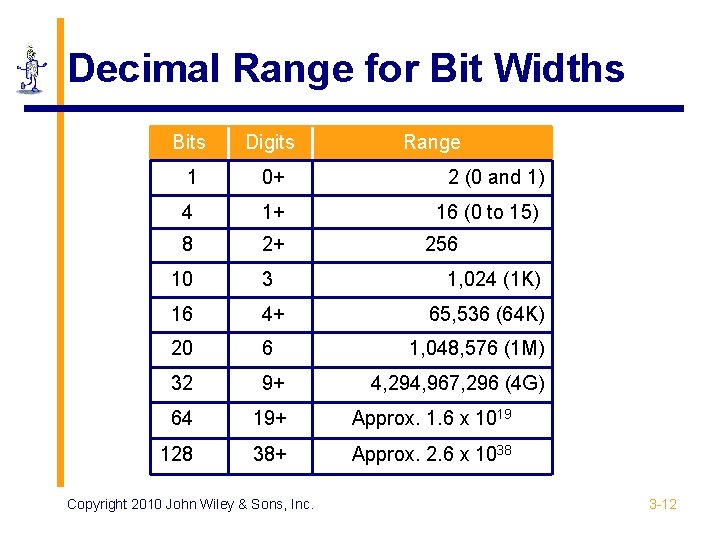
Decimal Range for Bit Widths Bits Digits 1 0+ 4 1+ 8 2+ 10 3 16 4+ 20 6 32 9+ 64 19+ Approx. 1. 6 x 10¹⁹ 128 38+ Approx. 2. 6 x 1038 Copyright 2010 John Wiley & Sons, Inc. Range 2 (0 and 1) 16 (0 to 15) 256 1, 024 (1 K) 65, 536 (64 K) 1, 048, 576 (1 M) 4, 294, 967, 296 (4 G) 3 -12
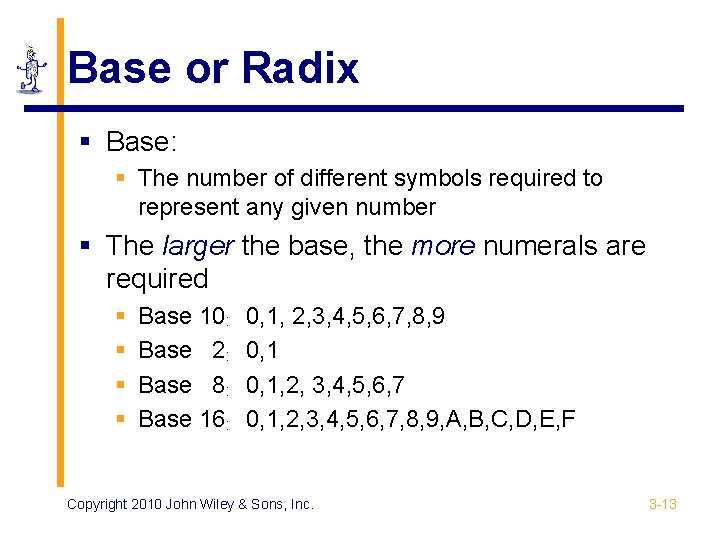
Base or Radix § Base: § The number of different symbols required to represent any given number § The larger the base, the more numerals are required § § Base 10: Base 2: Base 8: Base 16: 0, 1, 2, 3, 4, 5, 6, 7, 8, 9 0, 1, 2, 3, 4, 5, 6, 7, 8, 9, A, B, C, D, E, F Copyright 2010 John Wiley & Sons, Inc. 3 -13
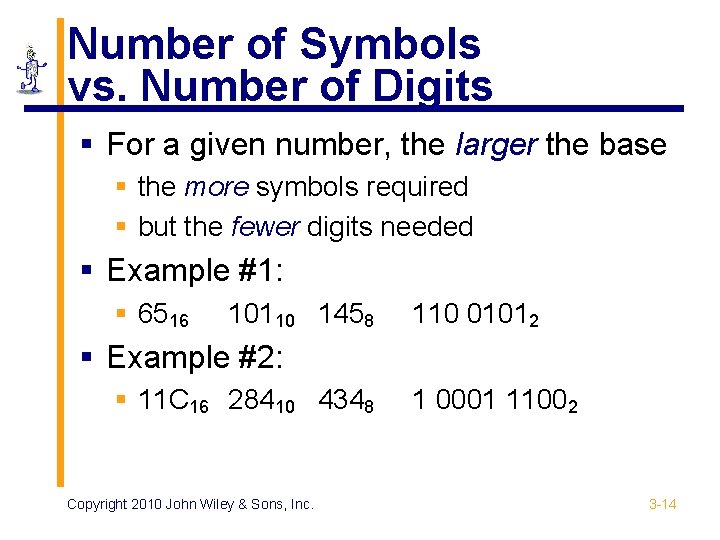
Number of Symbols vs. Number of Digits § For a given number, the larger the base § the more symbols required § but the fewer digits needed § Example #1: § 6516 10110 1458 110 01012 § Example #2: § 11 C 16 28410 4348 Copyright 2010 John Wiley & Sons, Inc. 1 0001 11002 3 -14
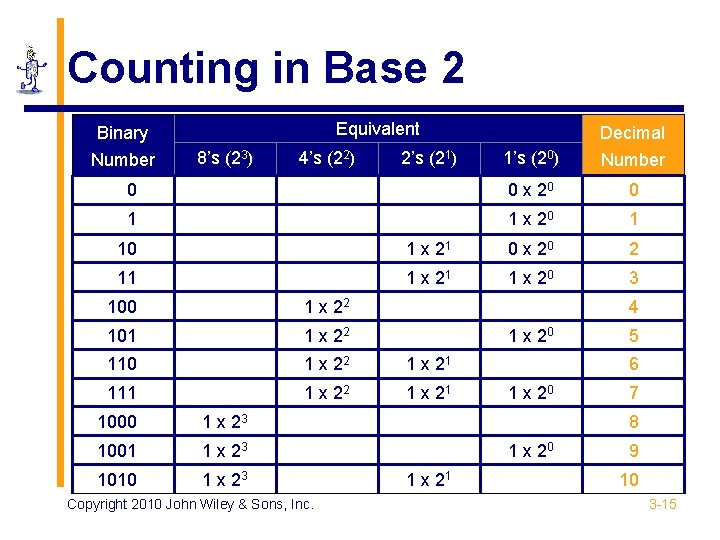
Counting in Base 2 Equivalent Binary 1’s (20) Number 0 0 x 20 0 1 1 x 20 1 Number 8’s (23) 4’s (22) 2’s (21) Decimal 10 1 x 21 0 x 20 2 11 1 x 20 3 100 1 x 22 101 1 x 22 110 1 x 22 1 x 21 111 1 x 22 1 x 21 1000 1 x 23 1001 1 x 23 1010 1 x 23 Copyright 2010 John Wiley & Sons, Inc. 4 1 x 20 5 6 1 x 20 7 8 1 x 20 1 x 21 9 10 3 -15
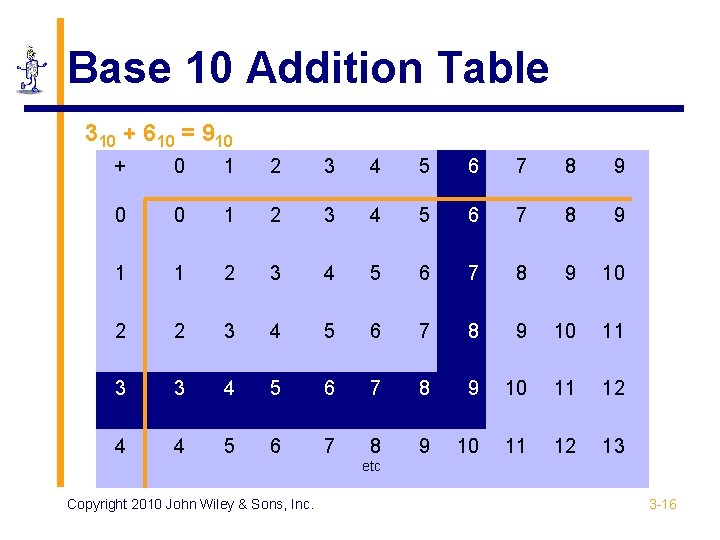
Base 10 Addition Table 310 + 610 = 910 + 0 1 2 3 4 5 6 7 8 9 0 0 1 2 3 4 5 6 7 8 9 10 2 2 3 4 5 6 7 8 9 10 11 3 3 4 5 6 7 8 9 10 11 12 4 4 5 6 7 8 9 10 11 12 13 etc Copyright 2010 John Wiley & Sons, Inc. 3 -16
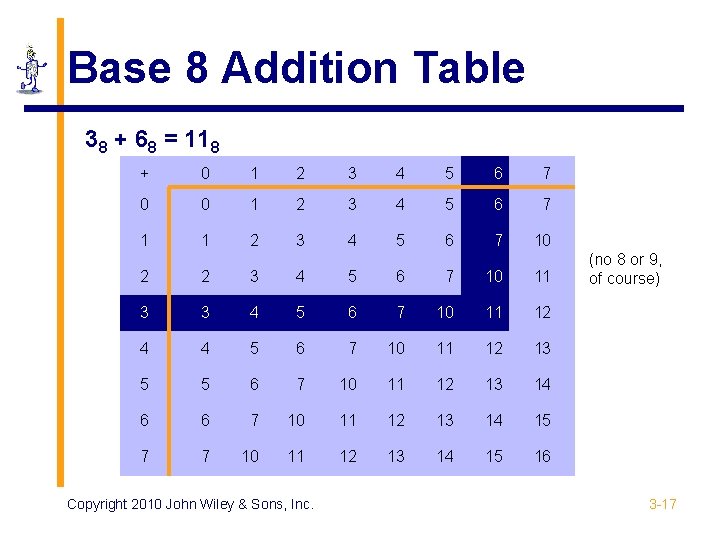
Base 8 Addition Table 38 + 68 = 118 + 0 1 2 3 4 5 6 7 0 0 1 2 3 4 5 6 7 10 2 2 3 4 5 6 7 10 11 3 3 4 5 6 7 10 11 12 4 4 5 6 7 10 11 12 13 5 5 6 7 10 11 12 13 14 6 6 7 10 11 12 13 14 15 7 7 10 11 12 13 14 15 16 Copyright 2010 John Wiley & Sons, Inc. (no 8 or 9, of course) 3 -17
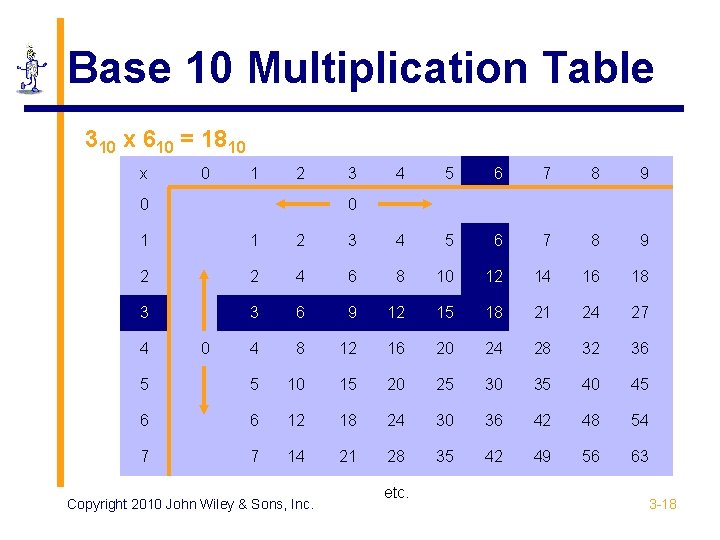
Base 10 Multiplication Table 310 x 610 = 1810 x 0 1 2 0 3 4 5 6 7 8 9 0 1 1 2 3 4 5 6 7 8 9 2 2 4 6 8 10 12 14 16 18 3 3 6 9 12 15 18 21 24 27 4 8 12 16 20 24 28 32 36 5 5 10 15 20 25 30 35 40 45 6 6 12 18 24 30 36 42 48 54 7 7 14 21 28 35 42 49 56 63 4 0 Copyright 2010 John Wiley & Sons, Inc. etc. 3 -18
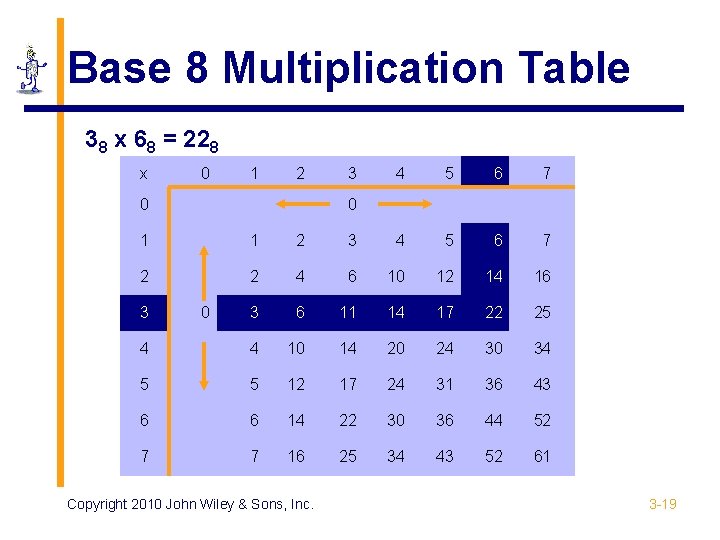
Base 8 Multiplication Table 38 x 68 = 228 x 0 1 2 0 3 4 5 6 7 0 1 1 2 3 4 5 6 7 2 2 4 6 10 12 14 16 3 6 11 14 17 22 25 4 4 10 14 20 24 30 34 5 5 12 17 24 31 36 43 6 6 14 22 30 36 44 52 7 7 16 25 34 43 52 61 3 0 Copyright 2010 John Wiley & Sons, Inc. 3 -19
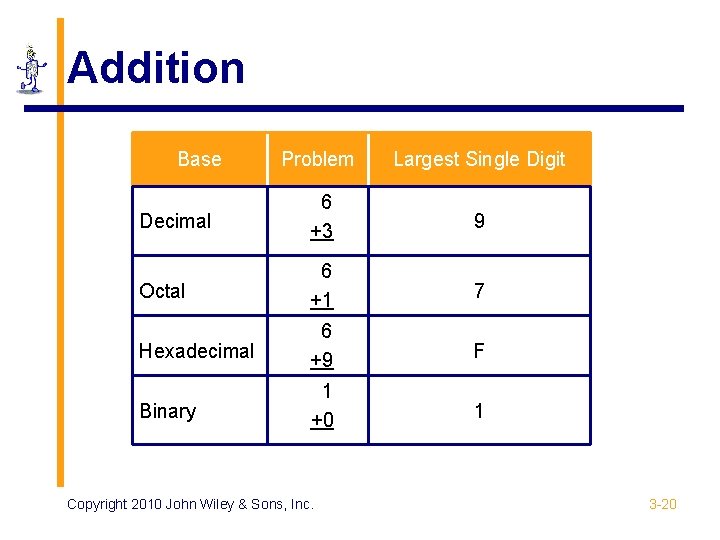
Addition Base Problem Largest Single Digit Decimal 6 +3 9 Octal 6 +1 7 Hexadecimal 6 +9 F Binary 1 +0 1 Copyright 2010 John Wiley & Sons, Inc. 3 -20
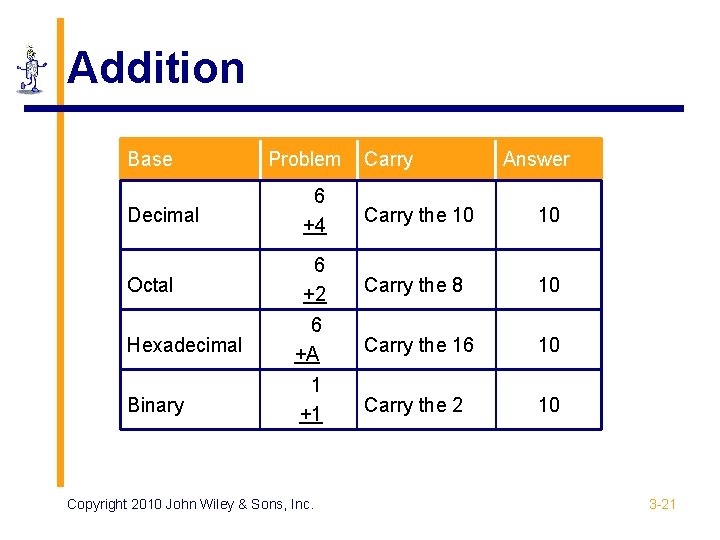
Addition Base Problem Carry Answer Decimal 6 +4 Carry the 10 10 Octal 6 +2 Carry the 8 10 Hexadecimal 6 +A Carry the 16 10 Binary 1 +1 Carry the 2 10 Copyright 2010 John Wiley & Sons, Inc. 3 -21
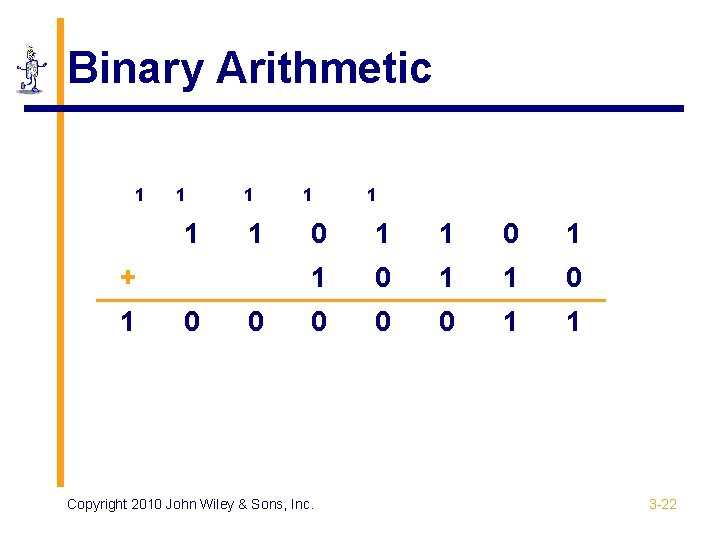
Binary Arithmetic 1 1 1 + 1 0 0 1 1 0 0 1 1 Copyright 2010 John Wiley & Sons, Inc. 3 -22
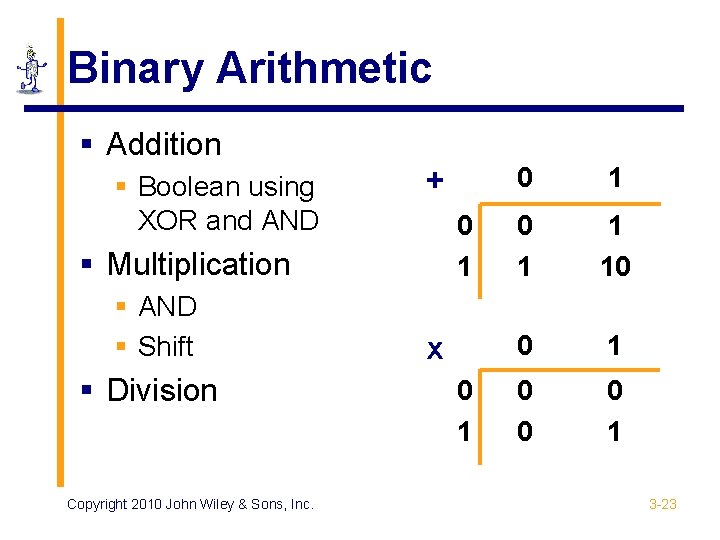
Binary Arithmetic § Addition § Boolean using XOR and AND + 0 1 § Multiplication § AND § Shift § Division Copyright 2010 John Wiley & Sons, Inc. x 0 1 0 1 1 10 0 1 0 0 0 1 3 -23
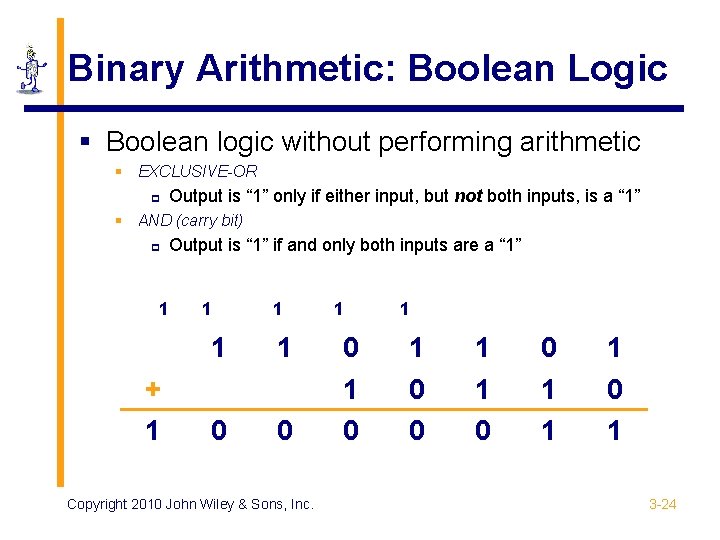
Binary Arithmetic: Boolean Logic § Boolean logic without performing arithmetic § EXCLUSIVE-OR p Output is “ 1” only if either input, but not both inputs, is a “ 1” § AND (carry bit) p 1 + 1 Output is “ 1” if and only both inputs are a “ 1” 1 1 0 0 Copyright 2010 John Wiley & Sons, Inc. 1 0 1 1 0 0 1 1 1 0 1 3 -24
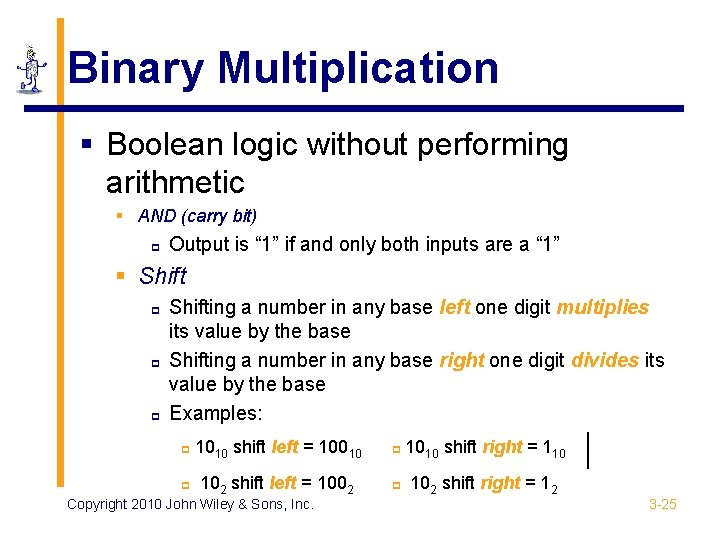
Binary Multiplication § Boolean logic without performing arithmetic § AND (carry bit) p Output is “ 1” if and only both inputs are a “ 1” § Shift p p p Shifting a number in any base left one digit multiplies its value by the base Shifting a number in any base right one digit divides its value by the base Examples: p 1010 shift left = 10010 p 1010 shift right = 110 p 102 shift left = 1002 p 102 shift right = 12 Copyright 2010 John Wiley & Sons, Inc. 3 -25
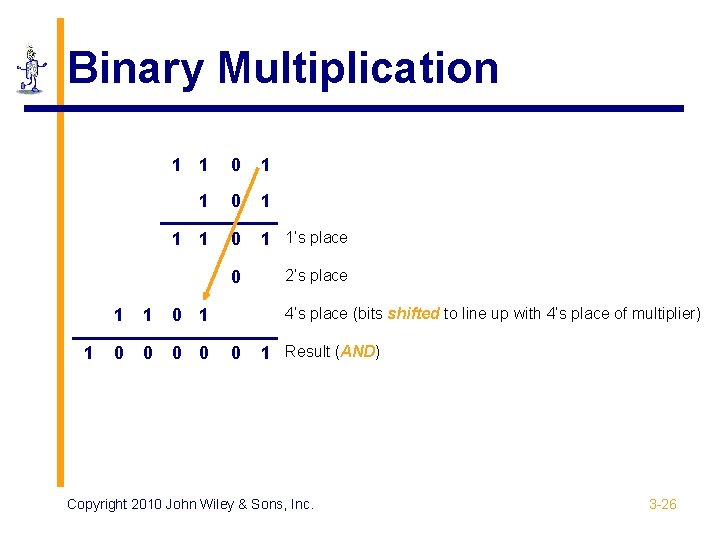
Binary Multiplication 1 1 1 0 1 1’s place 0 2’s place 1 1 0 0 0 0 4’s place (bits shifted to line up with 4’s place of multiplier) 0 1 Result (AND) Copyright 2010 John Wiley & Sons, Inc. 3 -26
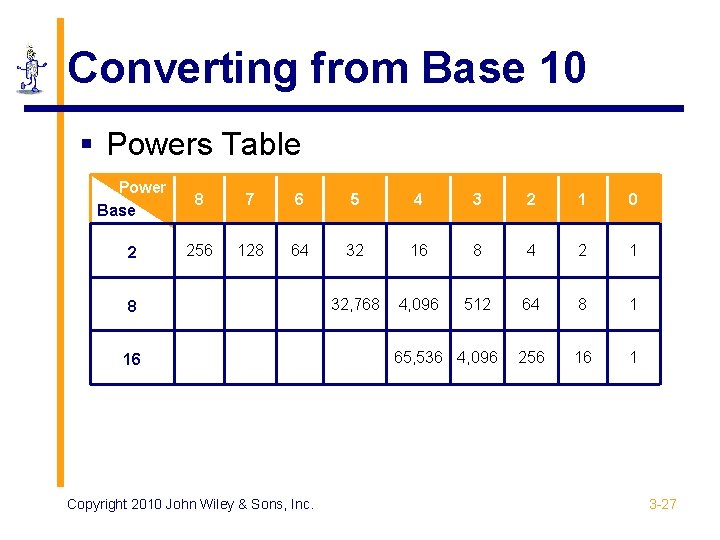
Converting from Base 10 § Powers Table Power Base 8 7 6 5 4 3 2 1 0 2 256 128 64 32 16 8 4 2 1 32, 768 4, 096 512 64 8 1 256 16 1 8 16 Copyright 2010 John Wiley & Sons, Inc. 65, 536 4, 096 3 -27
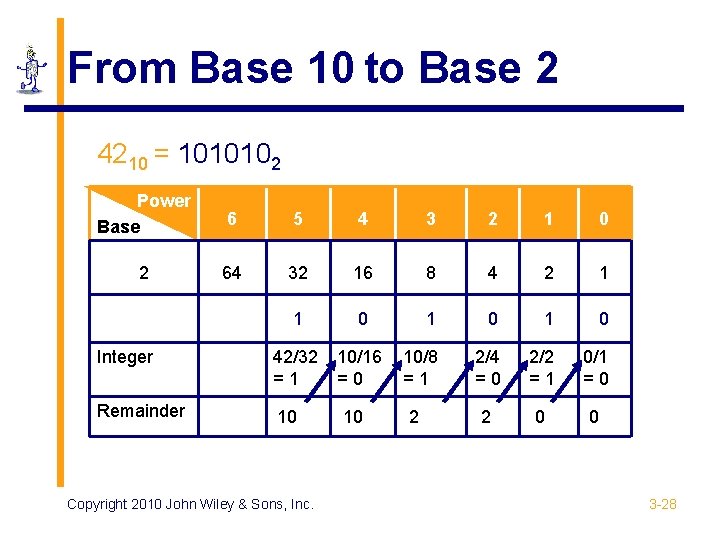
From Base 10 to Base 2 4210 = 1010102 Power Base 6 5 4 3 2 1 0 2 64 32 16 8 4 2 1 1 0 1 0 Integer 42/32 =1 10/16 =0 10/8 =1 2/4 =0 2/2 =1 0/1 =0 Remainder 10 2 0 0 Copyright 2010 John Wiley & Sons, Inc. 10 2 3 -28
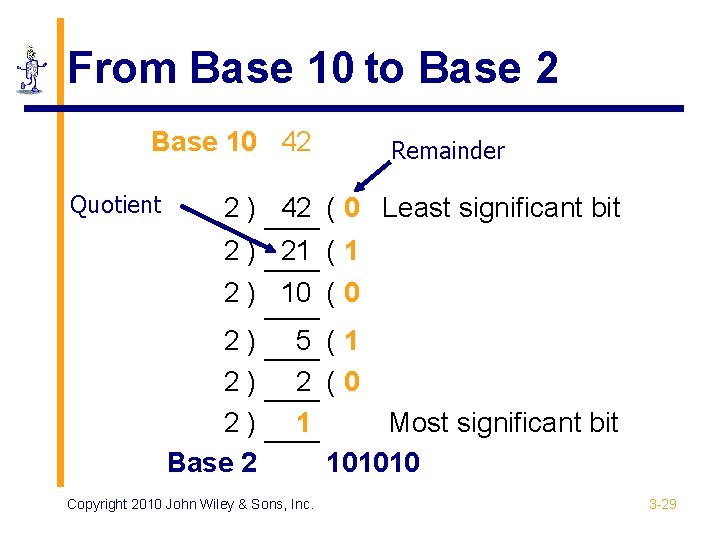
From Base 10 to Base 2 Base 10 42 Quotient Remainder 2 ) 42 ( 0 Least significant bit 2 ) 21 ( 1 2 ) 10 ( 0 2) 2) 2) Base 2 5 (1 2 (0 1 Most significant bit 101010 Copyright 2010 John Wiley & Sons, Inc. 3 -29
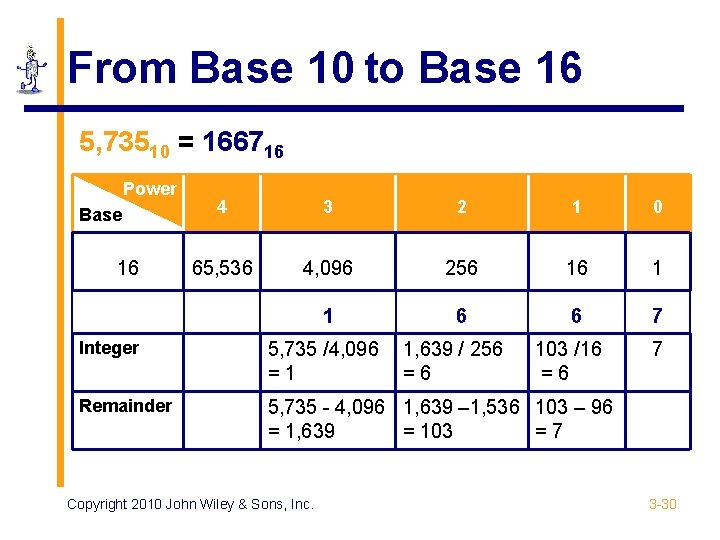
From Base 10 to Base 16 5, 73510 = 166716 Power Base 16 4 3 2 1 0 65, 536 4, 096 256 16 1 1 6 6 7 Integer 5, 735 /4, 096 =1 Remainder 5, 735 - 4, 096 1, 639 – 1, 536 103 – 96 = 1, 639 = 103 =7 Copyright 2010 John Wiley & Sons, Inc. 1, 639 / 256 =6 103 /16 =6 7 3 -30
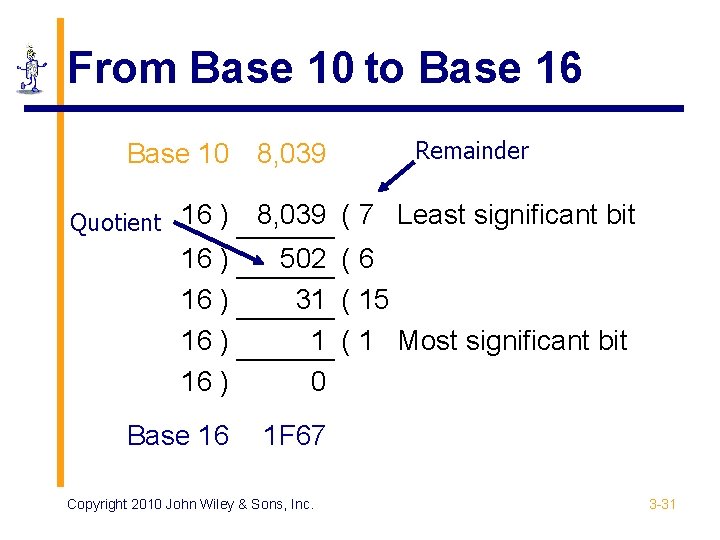
From Base 10 to Base 16 Base 10 8, 039 Quotient 16 ) 16 ) Base 16 Remainder 8, 039 ( 7 Least significant bit 502 ( 6 31 ( 15 1 ( 1 Most significant bit 0 1 F 67 Copyright 2010 John Wiley & Sons, Inc. 3 -31
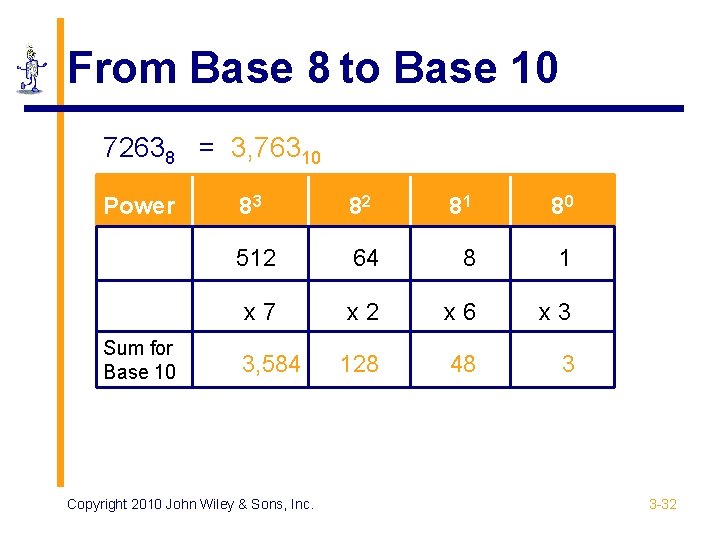
From Base 8 to Base 10 72638 = 3, 76310 Power Sum for Base 10 83 82 512 x 7 3, 584 Copyright 2010 John Wiley & Sons, Inc. 81 80 64 8 1 x 2 x 6 x 3 128 48 3 3 -32
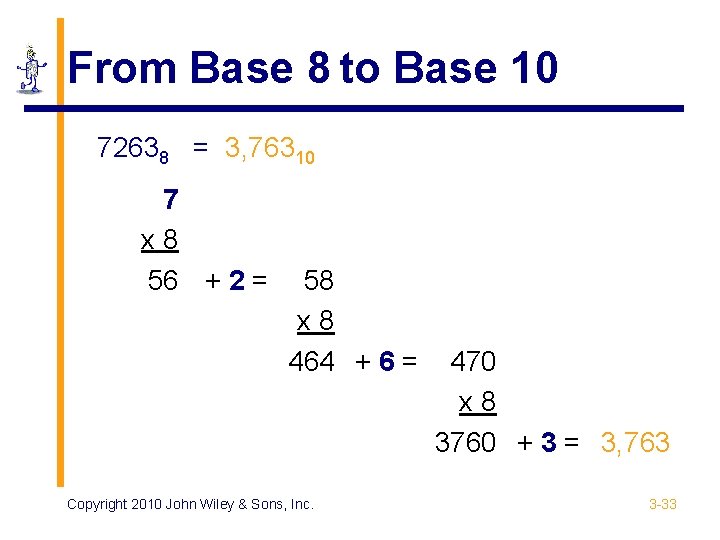
From Base 8 to Base 10 72638 = 3, 76310 7 x 8 56 + 2 = 58 x 8 464 + 6 = Copyright 2010 John Wiley & Sons, Inc. 470 x 8 3760 + 3 = 3, 763 3 -33
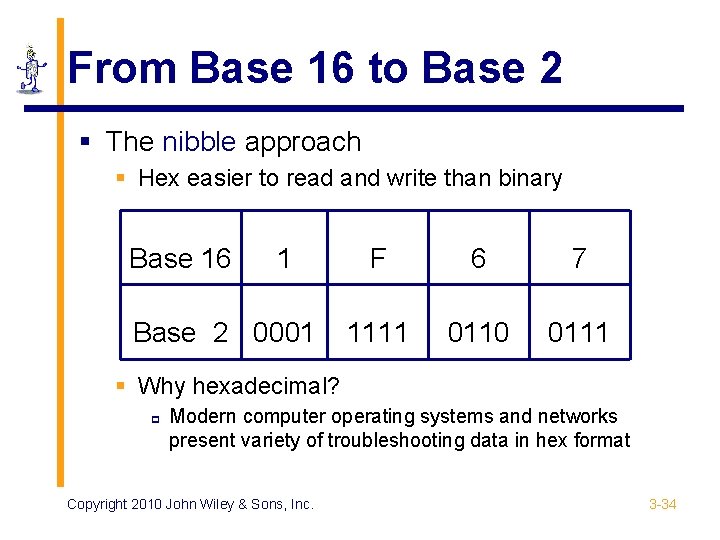
From Base 16 to Base 2 § The nibble approach § Hex easier to read and write than binary Base 16 1 Base 2 0001 F 6 7 1111 0110 0111 § Why hexadecimal? p Modern computer operating systems and networks present variety of troubleshooting data in hex format Copyright 2010 John Wiley & Sons, Inc. 3 -34
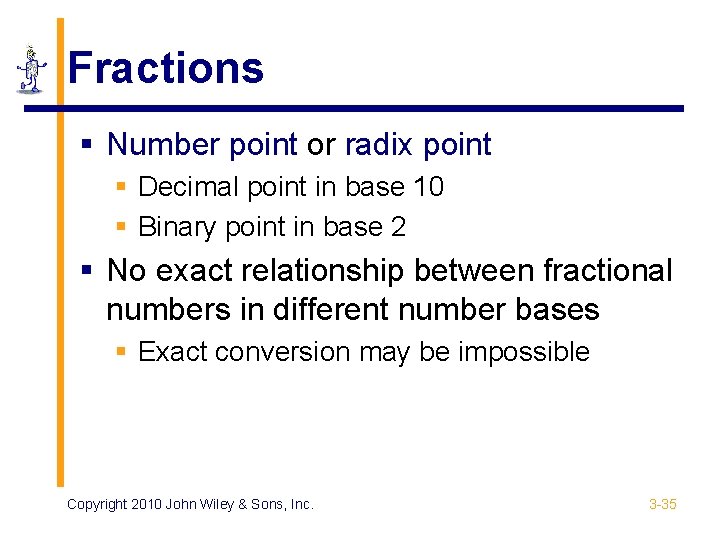
Fractions § Number point or radix point § Decimal point in base 10 § Binary point in base 2 § No exact relationship between fractional numbers in different number bases § Exact conversion may be impossible Copyright 2010 John Wiley & Sons, Inc. 3 -35
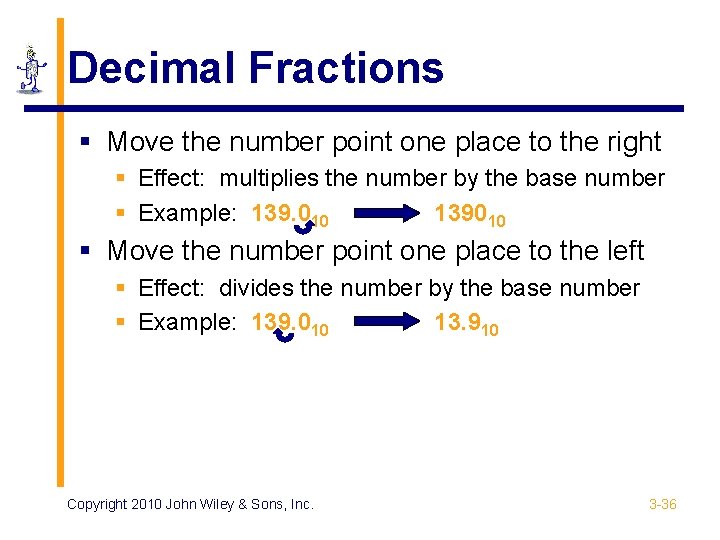
Decimal Fractions § Move the number point one place to the right § Effect: multiplies the number by the base number § Example: 139. 010 139010 § Move the number point one place to the left § Effect: divides the number by the base number § Example: 139. 010 13. 910 Copyright 2010 John Wiley & Sons, Inc. 3 -36
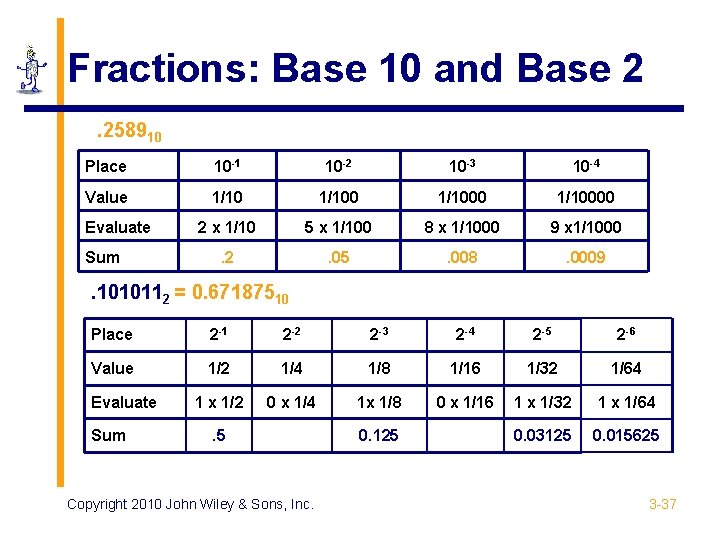
Fractions: Base 10 and Base 2. 258910 Place 10 -1 10 -2 10 -3 10 -4 Value 1/10000 2 x 1/10 5 x 1/100 8 x 1/1000 9 x 1/1000 . 2 . 05 . 008 . 0009 Evaluate Sum . 1010112 = 0. 67187510 Place 2 -1 2 -2 2 -3 2 -4 2 -5 2 -6 Value 1/2 1/4 1/8 1/16 1/32 1/64 1 x 1/2 0 x 1/4 1 x 1/8 0 x 1/16 1 x 1/32 1 x 1/64 0. 03125 0. 015625 Evaluate Sum . 5 Copyright 2010 John Wiley & Sons, Inc. 0. 125 3 -37
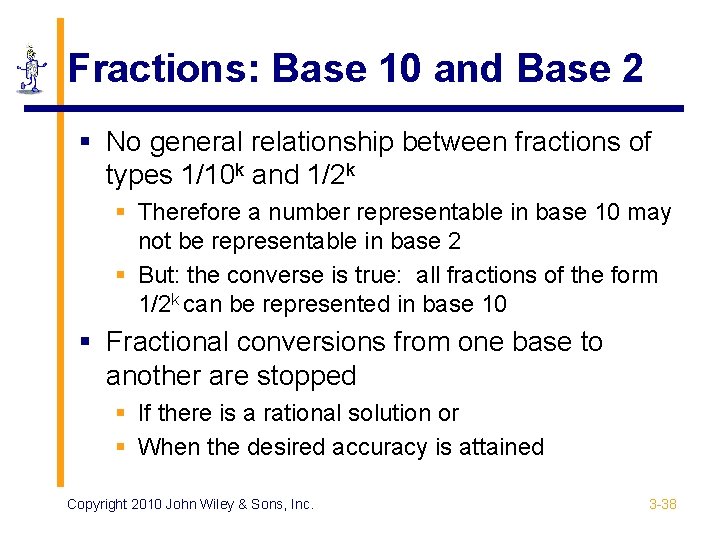
Fractions: Base 10 and Base 2 § No general relationship between fractions of types 1/10 k and 1/2 k § Therefore a number representable in base 10 may not be representable in base 2 § But: the converse is true: all fractions of the form 1/2 k can be represented in base 10 § Fractional conversions from one base to another are stopped § If there is a rational solution or § When the desired accuracy is attained Copyright 2010 John Wiley & Sons, Inc. 3 -38
- Slides: 38