
Chapter 3 Notes Constitutional Convention May 1787 Delegates
- Slides: 29
Chapter 3 Notes
Constitutional Convention • May 1787 - Delegates from each state (except Rhode Island) converged on Philadelphia for a convention to address the problems within the Articles of Confederation. • Focus: Addressed the structure of the National/Federal/Central Government. • 12 of 13 states sent delegates. Why not Rhode Island? • Who were these delegates? • Who led the convention? • Quickly realized that the Confederation had to be scrapped for a new form of government.
Operating Procedures • 1. Decisions made by majority of votes (Each state was given one vote) • 2. Agreed to keep discussions secret. Why? • Public’s Opinion (? ) • Perpetual Contract (? ) • Problem: No records were kept • How do we know what happened? • Diaries (journals): James Madison in particular
Conflict 1: Structure of Central Government • Why was there bound to be conflict between the states when it came to determining who had power? • What was the structure of the central government under the Articles of Confederation? • What are some of the problems with this basic structure?
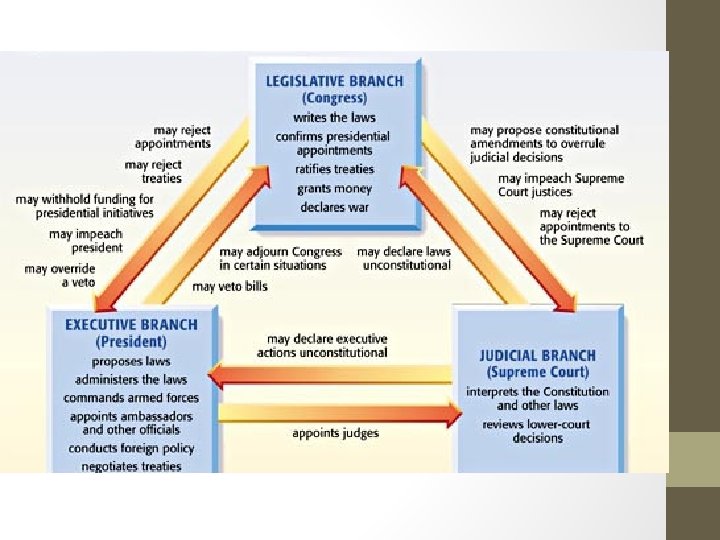
Best Structure: Separation of Powers • Baron Charles de Montesquieu (The Spirit of the Laws) • Montesquieu’s Tripartite System: power should be divided between a legislature, an executive, and a judiciary. • No one or one group should have complete power. • If power corrupts, how can one limit corruption? • If you limit specific powers (the power to tax, the power to declare war…. ), how can the government operate in order to meet its four primary functions? • The government must retain all necessary powers while also dividing power to avoid absolute power.
Virginia Plan • 1. Three Branches: Legislative (create laws), Executive Branch (enforce laws), and Judicial (interpret and apply laws). • 2. Legislature is divided into two parts (bicameral). Why? • 3. Representation was based on population (more population, more delegates in legislature) • Which is the most powerful branch? • Who would oppose this plan? Why?
New Jersey Plan • 1. Three Branches: Legislative, Executive, and Judicial • 2. Legislature is one house (unicameral) • 3. Each state gets one vote to represent them in legislature. • Who opposes this plan? Why?
The Great Compromise (Roger Sherman of Connecticut) • 1. Three Branches: Which branches? • 2. Legislature is bicameral: The House of Representatives (The House!) and the Senate • 3. Senate: Equal representation for each state = two reps per state • 4. House of Representatives: Based on population • How does this ensure more just/fair laws and policies? (consider the power of majority)
Conflict 2: Economics and Representation • What was the economy of the southern states? • What was the main source of labor in the southern economy? • In the House of Representatives, how is representation determined? • What is the problem for southern states?
3/5 th Compromise • Southern states wanted to count the slave population in order to help determine the total population. • Northern states argued that since slaves were treated as property, they should not be counted in the population. • Solution: Representation and direct taxes on slaves would be based on three/fifths of the slave population. • How is this a “compromise? ”
Conflict #3: Choosing the Executive • Options: • Popular Vote: • Gave too much power to the north (urban v. rural power). • Smaller states needs aren’t met. • Didn’t trust the population • Legislature: • “Fear of Intrigue”- The president being chosen by a small group of men who met regularly (pre-social networks). Closed door deals. • The President would be bound to the legislature and not the people. • Solution: Who chooses?
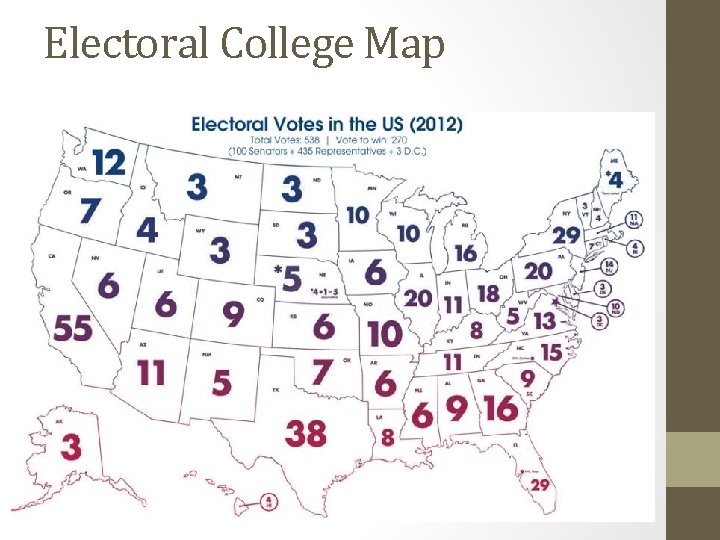
Electoral College • A college is an organized group with a particular aim or purpose. • Each state will be given a number of “electors” based off the number of their members of congress (two senators and all members of the House) • Each state legislature will choose how the electors are chosen. • Electors are pledged to a specific presidential/vice presidential candidate. The state popular vote determines which electors get to cast a vote. • Majority of electoral votes determines the executive.
Electoral College Map
Electoral College • There a total of 538 electoral votes (100 senators + 435 reps + 3 DC electors). • How many votes are required to win (majority rule)? • Madison (Federalist No. 39) Mixture of state-based and population-based government. • Problems: • Popular vote does not confirm winner (not democratic) • Swing states draw too much attention • Favors smaller states
Ratification - Federalists • Each state would create a ratifying convention to vote yes or no => 9 of 13 states required => if so, Constitution becomes the “Supreme Law of the Land. ” • Federalists: Supporters of the U. S. Constitution • Federalism= A form of government in which power is divided between the federal (national) government and the state governments. • The Federalists main arguments for a strong central government survive through a series of essays called The Federalist Papers written by James Madison, Alexander Hamilton, and John Jay. • Feared a strong central government, but feared a weak central government more.
Anti-Federalists • Anti-Federalists = Opposed the ratification of the U. S. Constitution • Too much power to the national government (indirect government) • Too little power to the states (direct government) • Assault on state sovereignty • Absence of a Bill of Rights = failed to provide the proper protection from the national government • Failed to provide “essential” civil liberties
Agreement • Federalists agreed to add a bill of rights after ratification. • Ratification • June 21, 1788, New Hampshire was the 9 th state to ratify the Constitution => thus, creating the government of the United States of America • The last state, Rhode Island, ratified the Constitution in 1790.
The Federalist Papers • The Federalist Papers were written as a series of articles supporting the ratification of the Constitution. • Written by Alexander Hamilton, John Jay, and James Madison under the pen name “Publius” (one of 4 to overthrow the Roman monarchy and establish the Republic). • They were written to the people of New York. Why? • Today, the Federalist Papers are used as one of the main sources to understand interpret the original intent of the U. S. Constitution.
Assignment: The Federalist No. 10 • Written by James Madison • Focus: how the new republic can best protect against factions (special interest groups) • Protection against the Tyrannical Majority
Structure of the U. S. Constitution • “It’s a plan, but not a straightjacket, flexible and short. ” – Harry S. Truman • ~4540 words • All legitimate authority (power) is derived from the U. S. Constitution. • Federal Government: The Branches • State Government => defines local power • Those governments cannot deviate outside of their powers defined in the U. S. Constitution • Since the U. S. Constitution retains and defines all powers, what is it?
Basic Structure of the U. S. Constitution • Structure: • Preamble- Goals and purpose of the document • The Articles- Powers distributed to the Branches • The Amendments- Changes made over time • The Preamble is….
The Articles • 7 Articles • Article 1: Legislative Branch • The power to create legislation (statutes/laws) • Traditionally, the most powerful branch • Article 2: Executive Branch • The power to enforce (carryout) the laws created by Congress • Article 3: Judicial Branch • The power to interpret and apply law
The Articles (continued) • Article 4: Relationship of the state governments to one another and to the Federal government. • Full Faith and Credit • How to make new states • States must follow the Republic form of government • Article 5: Amendment Process • 2/3 rds of both Houses (only successful process) • National Convention (called on by 2/3 rds of the states) • Ratification of the Amendment is required by 3/4 th of the states. • Article 6: Supremacy Clause- Government is bound to the Constitution, but in conflicts of Federal government and state law, the Federal government is Supreme. • Article 7: Ratification
Amending the Constitution • Essential to creating an enduring and eternal document/political institution. • Total of 27 Amendments (changes) to the Constitution. • First 10 Amendments are also known as the Bill of Rights. • The amendment process was made to be difficult and require overwhelming support of the Nation.
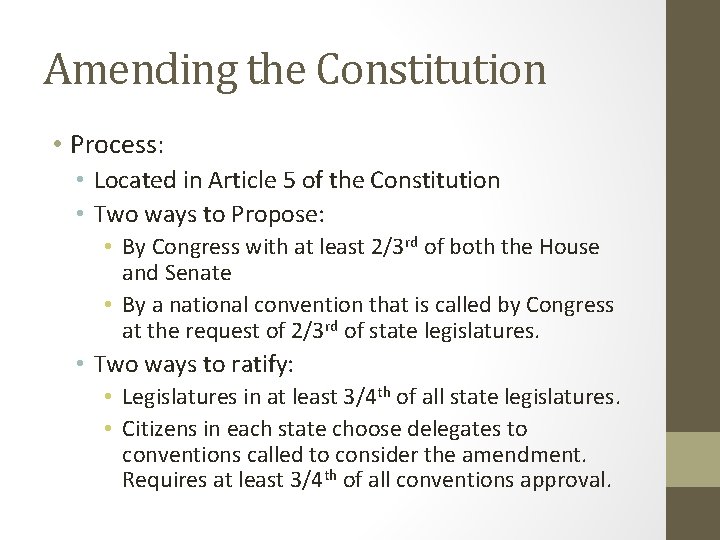
Amending the Constitution • Process: • Located in Article 5 of the Constitution • Two ways to Propose: • By Congress with at least 2/3 rd of both the House and Senate • By a national convention that is called by Congress at the request of 2/3 rd of state legislatures. • Two ways to ratify: • Legislatures in at least 3/4 th of all state legislatures. • Citizens in each state choose delegates to conventions called to consider the amendment. Requires at least 3/4 th of all conventions approval.
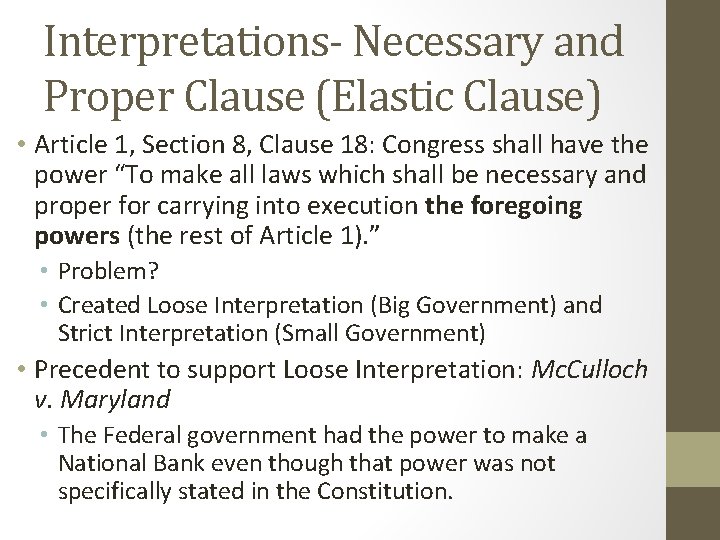
Interpretations- Necessary and Proper Clause (Elastic Clause) • Article 1, Section 8, Clause 18: Congress shall have the power “To make all laws which shall be necessary and proper for carrying into execution the foregoing powers (the rest of Article 1). ” • Problem? • Created Loose Interpretation (Big Government) and Strict Interpretation (Small Government) • Precedent to support Loose Interpretation: Mc. Culloch v. Maryland • The Federal government had the power to make a National Bank even though that power was not specifically stated in the Constitution.
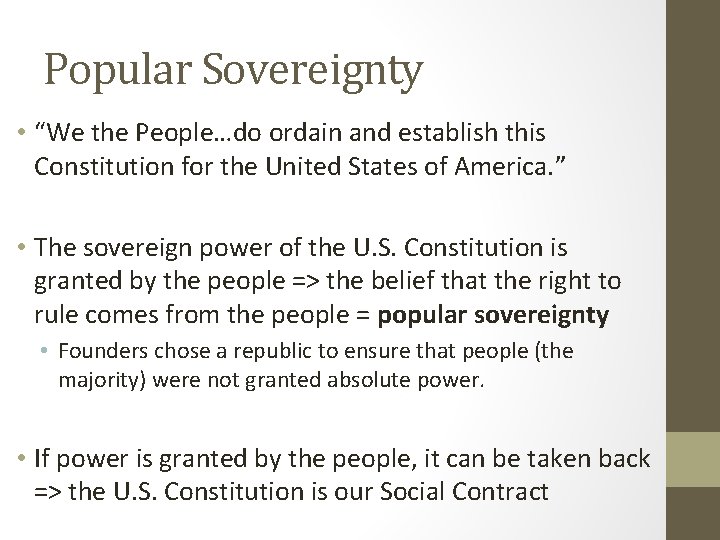
Popular Sovereignty • “We the People…do ordain and establish this Constitution for the United States of America. ” • The sovereign power of the U. S. Constitution is granted by the people => the belief that the right to rule comes from the people = popular sovereignty • Founders chose a republic to ensure that people (the majority) were not granted absolute power. • If power is granted by the people, it can be taken back => the U. S. Constitution is our Social Contract
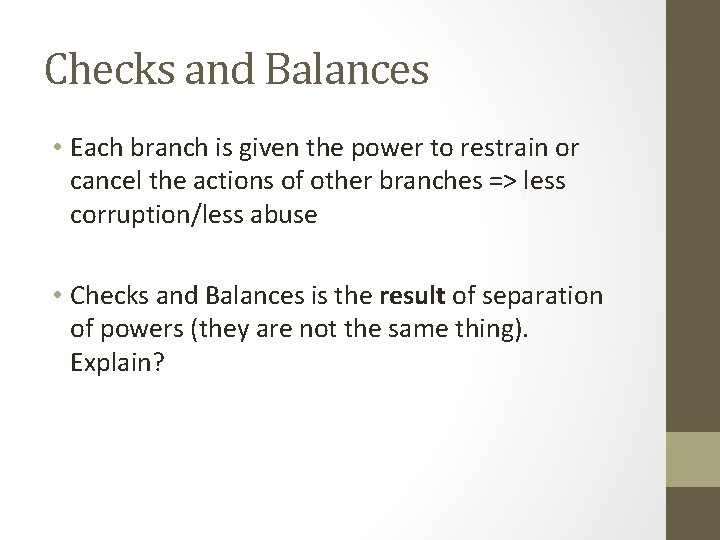
Checks and Balances • Each branch is given the power to restrain or cancel the actions of other branches => less corruption/less abuse • Checks and Balances is the result of separation of powers (they are not the same thing). Explain?