
Chapter 3 Notes Atoms The Building Blocks of
Chapter 3 Notes Atoms: The Building Blocks of Matter
What is a “Mole” in Chemistry? How do we count atoms and convert the number into moles or grams?
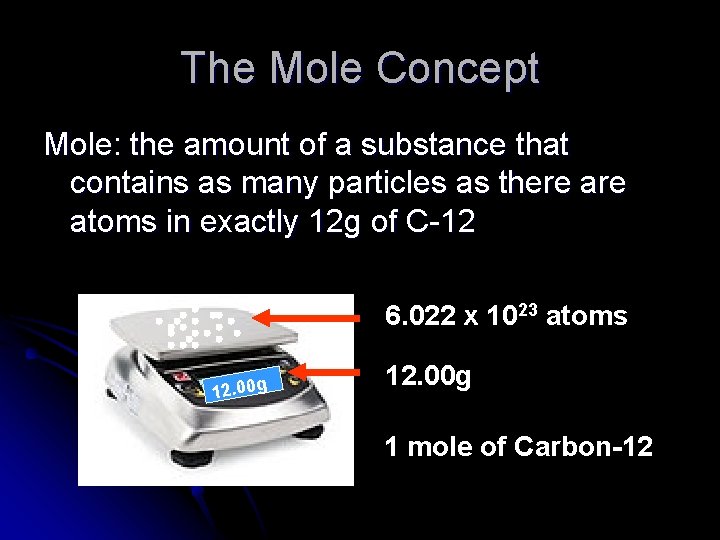
The Mole Concept Mole: the amount of a substance that contains as many particles as there atoms in exactly 12 g of C-12 6. 022 x 1023 atoms 12. 00 g 1 mole of Carbon-12
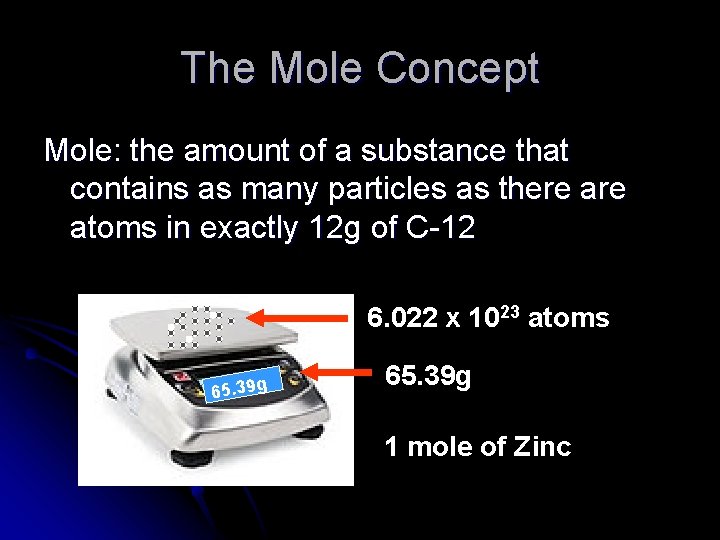
The Mole Concept Mole: the amount of a substance that contains as many particles as there atoms in exactly 12 g of C-12 6. 022 x 1023 atoms 65. 39 g 1 mole of Zinc
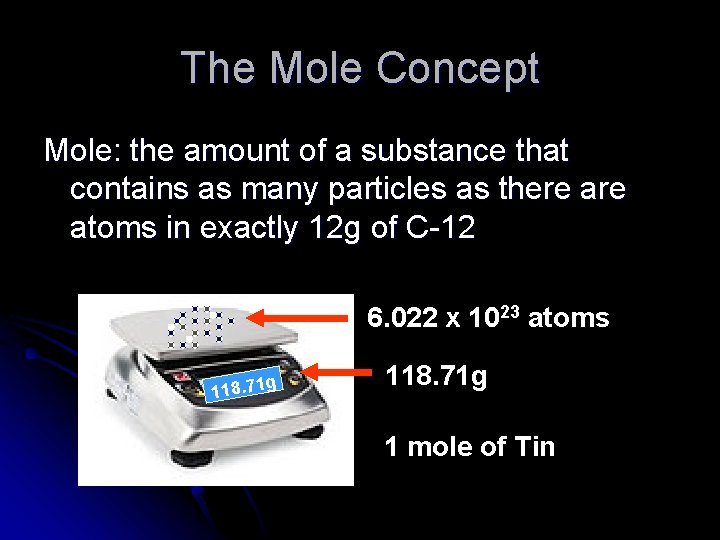
The Mole Concept Mole: the amount of a substance that contains as many particles as there atoms in exactly 12 g of C-12 6. 022 x 1023 atoms g 118. 71 g 1 mole of Tin
Comparing Moles Why do moles of zinc have more mass and volume than moles of carbon? Consider a dozen eggs and a dozen basketballs…
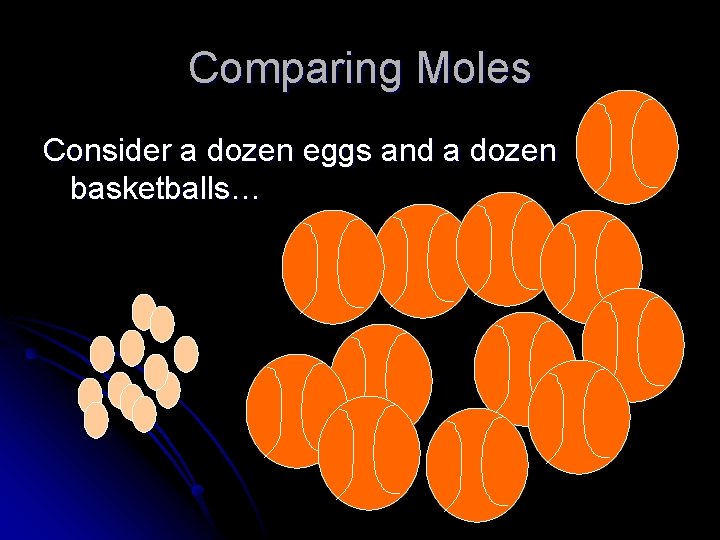
Comparing Moles Consider a dozen eggs and a dozen basketballs…
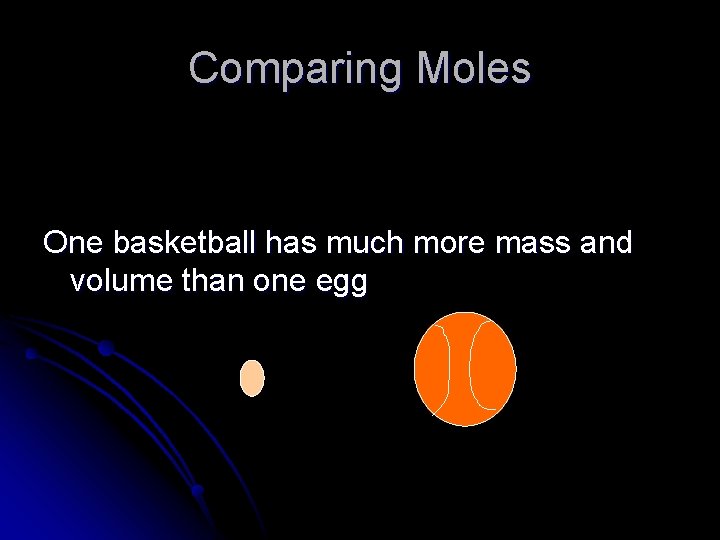
Comparing Moles One basketball has much more mass and volume than one egg
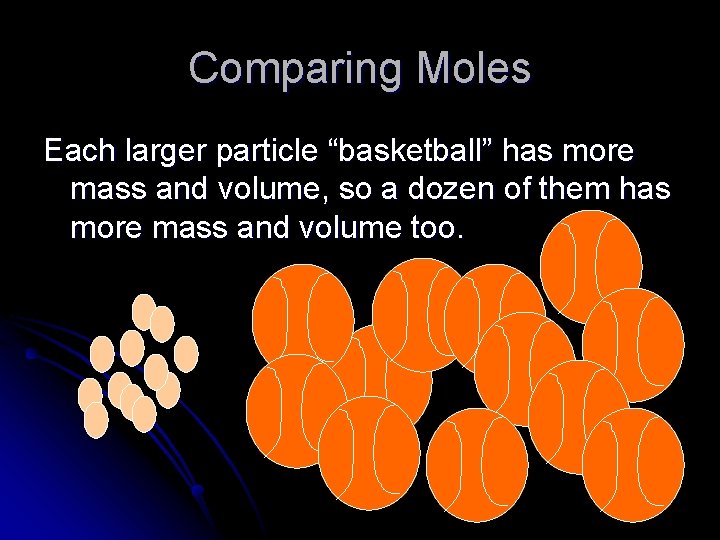
Comparing Moles Each larger particle “basketball” has more mass and volume, so a dozen of them has more mass and volume too.
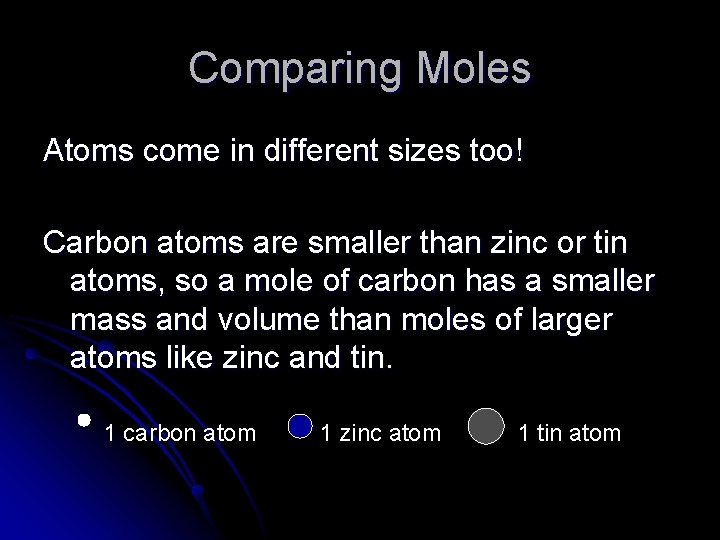
Comparing Moles Atoms come in different sizes too! Carbon atoms are smaller than zinc or tin atoms, so a mole of carbon has a smaller mass and volume than moles of larger atoms like zinc and tin. 1 carbon atom 1 zinc atom 1 tin atom
Comparing Moles How were all three moles of carbon, zinc, and tin alike? They all contain 6. 022 x 1023 atoms This amount is called Avogadro’s Constant Abbreviated as NA
Molar Mass The molar mass of a pure substance is the total mass of one mole of the substance. The molar mass of an element is equal to the average atomic mass in gram units. The elements’ atomic masses are found on the Periodic Table.
Mass – Mole Conversions Mole: the amount of a substance that contains as many particles as there atoms in exactly 12 g of C-12 l Avogadro’s number: 6. 022 x 1023 particles in one mole of any pure substance l Molar mass: the mass of one mole of any substance l
Mass – Mole Conversions Therefore… l 1 mole = 6. 022 x 1023 atoms (particle units) l 1 mole = element’s atomic mass in grams l 6. 022 x 1023 atoms = element’s atomic mass in grams
Mass – Mole Conversions Set up an equality l Make conversion factors based on the equality l Pick the conversion factor with the unit you want to be left with on top and the unit you want to cancel on the bottom l Set up and work the problem l
Foundations of Atomic Theory Primitive cultures believed that all matter was composed of only four elements l Earth l Wind l Fire l Water l
Democritus Greek Philosopher l Theorized that matter could be broken down to “atoms” and no further l The Greek word “atomos” means indivisible l Aristotle believed in the four elements theory and this caused great controversy for almost 2000 years l
Chemical Analysis in the 18 th Century l l Law of Conservation of Mass: matter is neither destroyed nor created in ordinary chemical reactions or physical changes Law of Definite Proportions: chemical compounds contain the same elements in exactly the same proportions
Chemical Analysis in the 18 th Century l Law of Multiple Proportions: If two or more different compounds are composed of the same two elements, then the ratio of the atoms of the second element combined with a certain mass of the first element is always a ratio of small whole numbers
Dalton’s Five Postulates l l l All matter is composed of small particles called atoms. Atoms of a given element are identical in size, mass, and other properties. Atoms cannot be subdivided, created, or destroyed. Atoms of different elements combine in simple whole number ratios. In chemical reactions, atoms are combined, separated, or rearranged.
Modern Atomic Theory l Dalton related atoms to the measurable property of mass, creating a theory that could be tested.
Changes to Dalton’s postulates l l Atoms are divisible (protons, neutrons, and electrons) Atoms of the same element can have different masses (isotopes)
Avogadro’s Law Avogadro rejected Dalton’s idea that elements are always monotomic when they combine to form products l He reasoned that molecules could contain more than one atom l Avogadro’s law: equal volumes of gases at the same temperature and pressure contain equal numbers of molecules l
JJ Thomson English Chemist l Born: 1856 l Died: 1940 l Used a cathode ray to formulate new model for the atom l
Cathode Ray Experiments A Cathode ray tube is an evacuated glass tube with an anode at one end a cathode at the other l When electricity is applied, a ray forms that travels from the anode to the cathode l
Cathode Ray Experiments When an object is placed between cathode and anode the object casts a shadow l This supports the idea that a cathode ray is a form of light l
Cathode Ray Experiments l l l When a paddle wheel is placed on rails between the cathode and anode, the wheel rolls toward the anode This supported the existence of the cathode ray and proved that it had enough mass to move an object, making it a particle also Cathode rays were deflected away from a negative magnetic field l This proved that the particle has a negative charge
Cathode Ray Experiments Thomson found that the metal used in cathode and anode made no difference in ray produced l This supported the idea that all atoms contain this negative particle l In 1897, Thomson proposed the plum pudding model of the atom – positive = dough, negative = chocolate chips l
Millikan’s Contributions l l Millikan found the mass of electron is 9. 109 x 10 -31 kg His experiments also confirmed that the electron carried negative charge Because atoms are electrically neutral, there must be a positive part also Because electrons have so little mass, he believed that the other particles must account for the mass of the atom
Earnest Rutherford New Zealand’s most famous scientist l Born: 1871 l Died: 1937 l Rutherford discovered the nucleus with gold foil experiment in 1911 l
Rutherford’s Gold Foil Experiment Rutherford set up an experiment that bombarded a thin sheet of gold foil with alpha particles (helium nuclei) l Thomson’s model said the positive charge was spread evenly throughout the atom l
The Gold Foil Experiment l l l When Rutherford bombarded gold foil with alpha particles, he expected them to pass through with slight deflection but they did not Contrary to what he believed would happen, most of the particles went straight through however a few bounced back He likened the results to shooting a 15 inch artillery shell at a piece of tissue paper and having it bounce back
The Gold Foil Experiment l l Thomson’s model said the positive charge was spread evenly throughout the atom Rutherford concluded that the atom is mostly empty space with a very small positive center (nucleus) surrounded by negative particles (electrons) orbiting like planets around the sun
Composition of the Nucleus Most nuclei are composed of protons and neutrons l Protons have a positive charge and a mass of 1. 673 x 10 -27 kg l Neutrons have no charge and a mass of 1. 675 x 10 -27 kg l Protons and neutrons are held together by the Strong force l
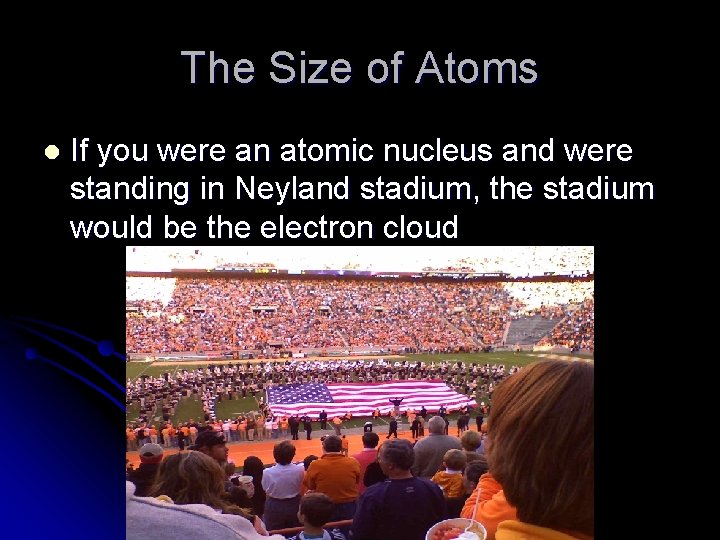
The Size of Atoms l If you were an atomic nucleus and were standing in Neyland stadium, the stadium would be the electron cloud
Counting Atoms Atomic number (Z): The number of protons in the nucleus of each atom in that element l Always a whole number l Lithium = 3 l Silver = 47 l Neptunium = 93 l
Isotopes Atoms of the same element that have different masses l Protium: 1 proton, 0 neutrons l Deuterium: 1 proton, 1 neutron l Tritium: 1 proton, 2 neutrons l
Mass Number and Nuclear Symbols l l The total number of protons and neutrons in the nucleus of an isotope is the mass number (A) Hyphen notation: mass number is written with a hyphen after the element name: hydrogen – 3, hydrogen – 2, hydrogen – 1 Nuclear symbol: shows the composition of nucleus. Superscript is the mass number (A), Subscript is the atomic number (Z) Nuclide: general term for any isotope of any element
Average Atomic Mass The weighted average of the atomic masses of the naturally occurring isotopes of an element l Calculating average atomic mass l l 65. 17 % = copper – 63: atomic mass = 62. 93 amu l 30. 83 % = copper – 65: atomic mass = 64. 93 amu l (0. 6517 X 62. 93 amu) + (0. 3083 X 64. 93 amu) = 63. 55 amu
Gas Volumes and the Ideal Gas Law l l l Avogadro’s law: equal volumes of gases at the same temperature and pressure contain equal numbers of molecules. Dalton has guessed that the formula for water was HO. Avogadro found that for every one volume of oxygen collected two volumes of hydrogen were collected. Therefore water is H 2 O.
Molar Volume of a Gas Standard molar volume of a gas: the volume occupied by one mole of a gas at STP. l 1 mole of any gas at STP = 22. 4 Liters l
The Ideal Gas Law l l l l The ideal gas law is the mathematical relationship among pressure, volume, temperature and the number of moles of a gas. PV = n. RT P = pressure in atmospheres V = volume in liters n = number of moles of gas R = 0. 0821 L·atm/mol·K T = temperature in Kelvin
Ideal Gas Law Practice Problems l l l What is the pressure, in atmospheres, exerted by a 0. 500 mol sample of nitrogen gas in a 10. 0 L container at 298 K? What pressure in atmospheres is exerted by 0. 325 mol of hydrogen gas in a 4. 08 L container at 35°C? A gas sample occupies 8. 77 L at 20°C. What is the pressure, in atmospheres, given that there are 1. 45 mol of gas in the sample?
Ideal Gas Law and Partial Pressure Practice Problems l A sample of gas fills 4. 87 Liters at STP. How many moles of gas are present?
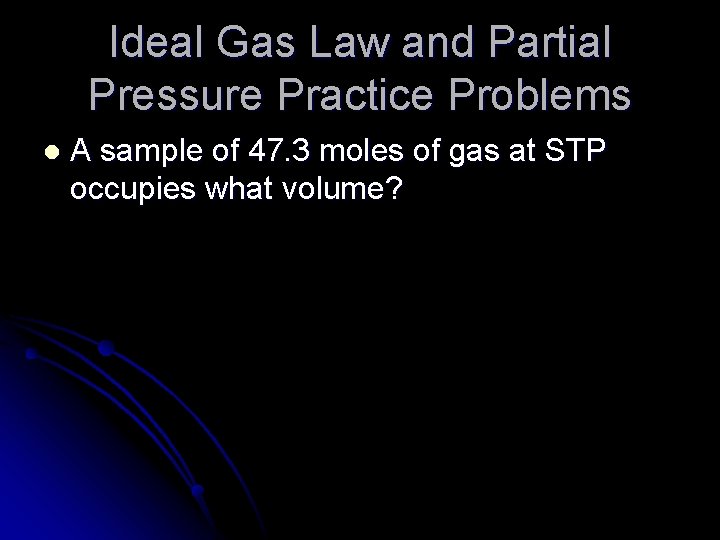
Ideal Gas Law and Partial Pressure Practice Problems l A sample of 47. 3 moles of gas at STP occupies what volume?
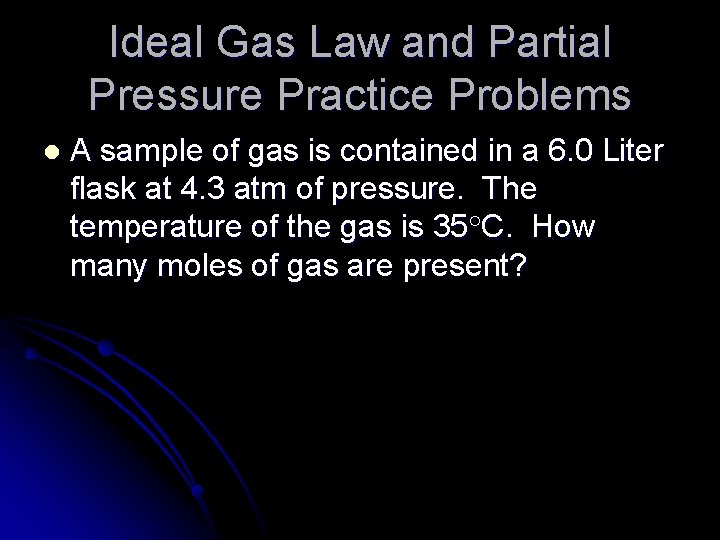
Ideal Gas Law and Partial Pressure Practice Problems l A sample of gas is contained in a 6. 0 Liter flask at 4. 3 atm of pressure. The temperature of the gas is 35°C. How many moles of gas are present?
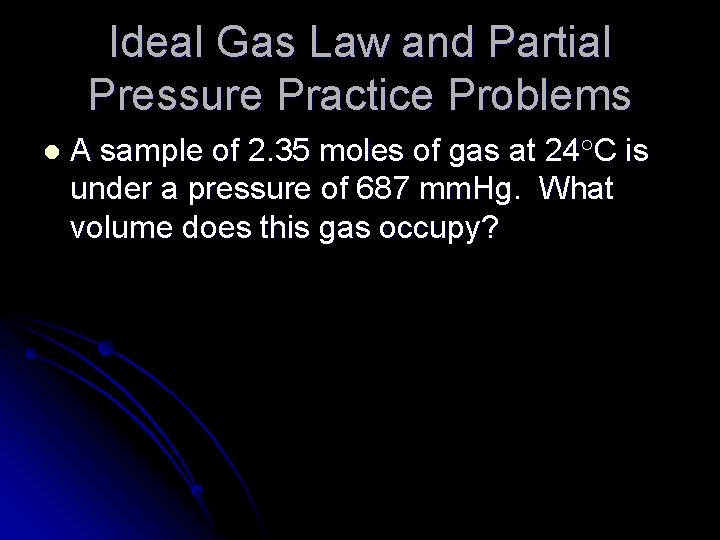
Ideal Gas Law and Partial Pressure Practice Problems l A sample of 2. 35 moles of gas at 24°C is under a pressure of 687 mm. Hg. What volume does this gas occupy?
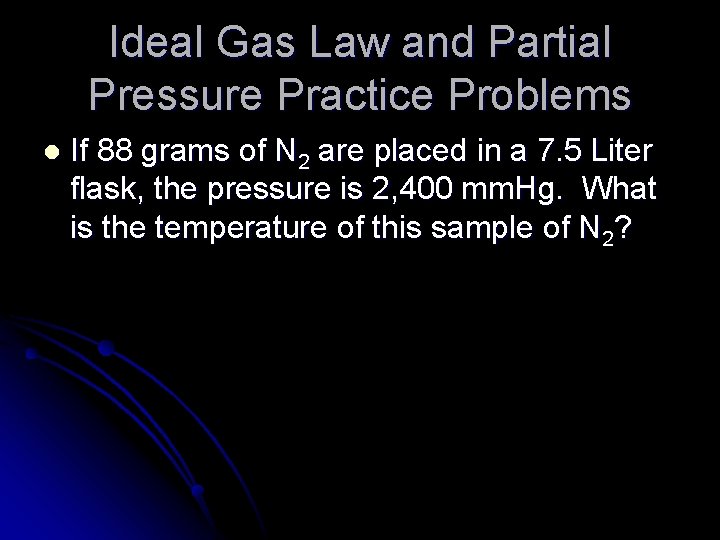
Ideal Gas Law and Partial Pressure Practice Problems l If 88 grams of N 2 are placed in a 7. 5 Liter flask, the pressure is 2, 400 mm. Hg. What is the temperature of this sample of N 2?
Ideal Gas Law and Partial Pressure Practice Problems l A sample of 11. 0 grams of carbon dioxide is placed in a 750 m. L flask and cooled to 28°C. What pressure would this CO 2 exert?
Ideal Gas Law and Partial Pressure Practice Problems l A sample of 230 grams of Xe occupies 53 Liters at room temperature (25°C). What pressure does the Xe exert?
Ideal Gas Law and Partial Pressure Practice Problems l A mixture of gases contains helium, hydrogen, and nitrogen. The partial pressure of He is 1. 7 atm, the partial pressure of H 2 is 0. 4 atm, and the partial pressure of N 2 is 0. 8 atm. What is the total pressure exerted by this mixture of gases?
Ideal Gas Law and Partial Pressure Practice Problems l A mixture of gases contains argon, xenon, and helium. The partial pressure of Ar is 0. 7 atm, the partial pressure of Xe is 0. 17 atm, and the partial pressure of He is 1. 4 atm. If the temperature of the mixture is 40°C and there are 2. 45 moles of gas altogether, what volume will the mixture occupy?
Ideal Gas Law and Partial Pressure Practice Problems l There are 40 grams of He and 20 grams of H 2 in a flask at room temperature. The total pressure of the gases is 12. 0 atm. What volume do they occupy?
- Slides: 53